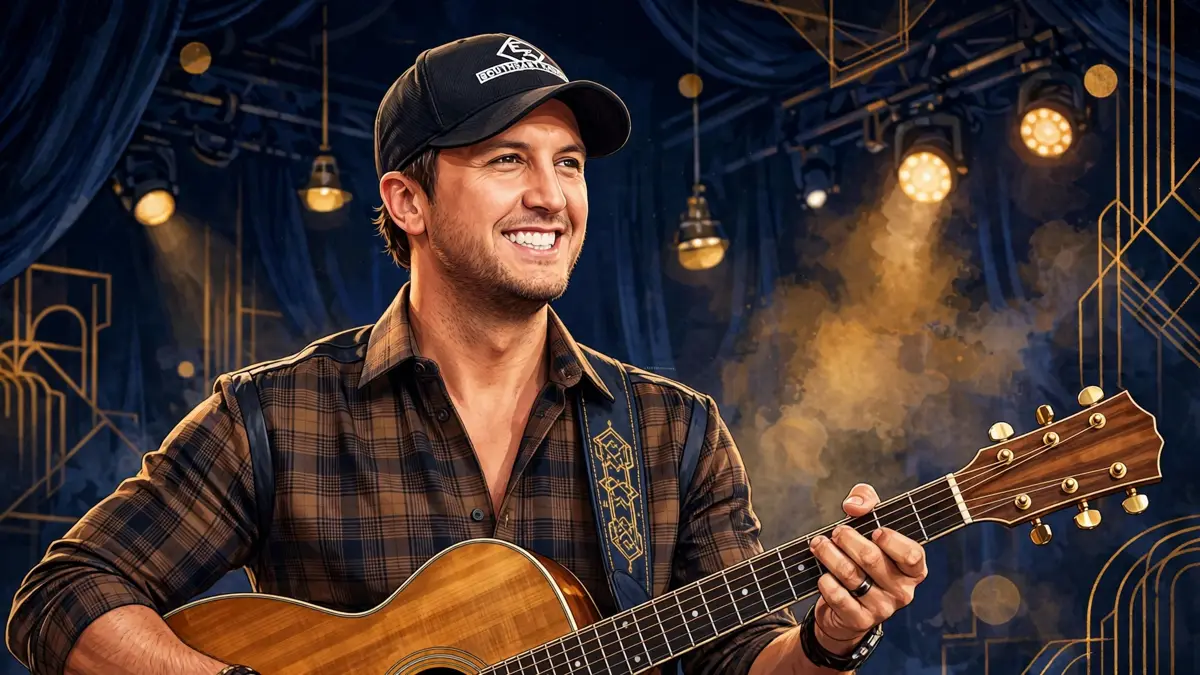
Luke Bryan turned 50 in July 2026, and he did it as one of the most bankable names in country music: an estimated net worth of $120–160 million, anchored at $160 million by Celebrity Net Worth and quoted by Parade in 2026, built on 30 number-one hits, more than 75 million records sold, and an American Idol judging chair he has held since 2018. This is the full Luke Bryan biography — the Leesburg, Georgia peanut farm where he grew up, the family losses that shaped him, the Nashville songwriting years that paid about $10,000 a year, and the touring, television and business empire that followed.
Born Thomas Luther Bryan on July 17, 1976, Bryan spent his first two decades in the small farming town of Leesburg, Georgia, working on his father’s peanut farm before a degree in business administration from Georgia Southern University and a move to Nashville in 2001. He did not arrive as a star. He arrived as a songwriter, writing hits for Travis Tritt and Billy Currington while waiting for his own turn — a turn that came with his 2007 debut album I’ll Stay Me and never really stopped. By 2026 he had collected five Entertainer of the Year awards across the Academy of Country Music and the Country Music Association, headlined stadiums, opened a Nashville honky-tonk, launched a record label and a beer brand, and raised five children — two sons of his own and three nieces and a nephew he took in after family tragedy.
Last updated: November 23, 2026 · By Celebamerica Editorial Staff
Quick Facts
| Full Name | Thomas Luther Bryan |
|---|---|
| Date of Birth | July 17, 1976 (age 50 as of November 2026) |
| Birthplace | Leesburg, Georgia, United States |
| Estimated Net Worth (2026) | $120–160 million, anchored at $160 million (Celebrity Net Worth, quoted by Parade, 2026) |
| Profession | Country singer-songwriter, television personality, American Idol judge |
| Record Sales | More than 75 million records sold worldwide |
| Number-One Hits | 30 |
| Major Awards | Five Entertainer of the Year awards (ACM and CMA combined) |
| Primary Income Sources | Touring, American Idol salary, record sales and streaming, songwriting royalties, endorsements |
| Key Ventures | Luke’s 32 Bridge Food + Drink (Nashville), 32 Bridge Entertainment (record label), Buck Commander, Two Lane beer, annual Farm Tour |
| Spouse | Caroline Boyer (married December 8, 2006) |
| Children | Sons Thomas “Bo” Bryan and Tatum “Tate” Bryan; raising nieces Jordan and Kris and nephew Til after his sister’s death |
| Height | Reported between 6 feet and 6 feet 3 inches |
| Education | Georgia Southern University, bachelor’s degree in business administration (1999) |
In This Article
- Early Life: A Peanut Farm in Leesburg, Georgia
- Family Tragedy That Shaped Him
- Education and the Move to Nashville
- The Songwriting Years: Travis Tritt and Billy Currington
- Breakthrough: I’ll Stay Me and the First Hits
- Country Stardom: Tailgates, Tanlines and Crash My Party
- Every Album and the 30 Number-One Hits
- American Idol: The Judge’s Chair Since 2018
- The Money: Touring, Idol Salary and Business Ventures
- Net Worth Breakdown and Growth Timeline
- Real Estate and Assets: Red Bird Farm and the Florida Flip
- The Farm Tour and the Brett Boyer Foundation
- Personal Life: Caroline, the Boys and Five Kids
- Controversies and Public Scrutiny
- How Luke Bryan Compares to His Country Peers
- Frequently Asked Questions
- Final Thoughts
- Sources and Reporting
Early Life: A Peanut Farm in Leesburg, Georgia
Thomas Luther Bryan was born on July 17, 1976, in Leesburg, Georgia, a small farming town in the southwestern corner of the state. His father, Tommy Bryan, ran a peanut farm and a peanut mill; his mother, LeClaire Bryan, kept the household running while the family worked land that had shaped their lives for generations. Luke was the youngest of three children, with an older brother, Chris, and an older sister, Kelly.
Life on the farm was physical and unglamorous. Bryan has described long days working the peanut fields, hauling, sorting and learning the rhythms of a crop that pays only when the weather and the market agree. That upbringing shows up all over his music — not just in the farm imagery of songs like “Huntin’, Fishin’ and Lovin’ Every Day,” but in the plainspoken way he talks about work, family and home. He grew up singing in church and at local gatherings, and by his teens he was writing songs and playing guitar with the easy confidence of a kid who had performed for neighbours since he could hold the instrument.
Leesburg itself mattered. It is the kind of town where everybody knows the family name, where a Friday night means high school football and a church social, and where leaving for Nashville feels like leaving the world. Bryan has returned to that world again and again — most visibly through his Farm Tour, which brings stadium-scale country shows back to working farms, including fields not far from where he grew up.
Family Tragedy That Shaped Him
Bryan’s biography cannot be told honestly without the losses. In 1996, when he was 19 and preparing to move to Nashville to chase music full time, his older brother Chris was killed in a car accident at the age of 26. Bryan stayed in Georgia instead. He has said many times that the death kept him home, close to his parents, for years longer than he had planned — and that the delay shaped everything that followed. He finished his degree, worked, grieved with his family, and only moved to Nashville in 2001, at 25, when his father finally pushed him to go.
The losses did not stop there. His sister Kelly died suddenly in 2007, at 39, from undisclosed causes. Her husband, Ben Lee Cheshire, died in 2014. Bryan and his wife Caroline then took in Kelly’s three children — daughters Jordan and Kris and son Til — and raised them alongside their own two boys. The household that resulted is one of the most quietly remarkable facts in country music: a superstar raising five children, three of them his late sister’s, without turning the arrangement into a publicity story.
Tragedy struck the wider family once more in 2017, when Bryan’s niece Sadie Brett Boyer, the infant daughter of Caroline’s sister, died from congenital heart disease. The family answered by founding the Brett Boyer Foundation, which supports families of children with heart conditions and funds research — a cause Bryan still works for through benefit concerts and his annual Farm Tour. The songs “Drink a Beer” and “Do I” carry the weight of these years; Bryan has never hidden that his most emotional material is drawn from real loss.
Education and the Move to Nashville
Bryan attended Lee County High School in Leesburg, then enrolled at Georgia Southern University in Statesboro, Georgia, where he studied business administration. He graduated in 1999 with a bachelor’s degree — a detail that matters more than it first seems, because Bryan later ran his touring and business operations with the instincts of someone who actually studied the subject. He also met his future wife, Caroline Boyer, at Georgia Southern; the two began dating in college and stayed together through the long Nashville grind that followed.
After graduation, Bryan worked in Georgia while his music plans waited. When he finally moved to Nashville in 2001, he was 25 — older than most new arrivals, with a degree, a fiancée back home, and a clear sense of what he was giving up if it did not work. Nashville in 2001 was a songwriter’s town first and a star-making town second, and Bryan started at the bottom of the first ladder: writing songs for other people, playing writers’ rounds, and living on what he later told the Pickler & Ben show in 2018 was “about $10,000 a year” in those early days.
The Songwriting Years: Travis Tritt and Billy Currington
Bryan’s first real break in Nashville came as a writer, not a singer. He signed a publishing deal and began placing songs with established artists. Travis Tritt recorded his material, and Billy Currington took Bryan’s “Good Directions” to number one on the country chart in 2007 — a songwriter’s number one, the kind that pays rent and gets a young writer’s phone to ring.
The songwriting years taught Bryan two things that defined his career. First, he learned how a hit is built: the hook, the conversational lyric, the chorus that a crowd can sing back after one hearing. Second, he learned the business side — publishing, royalties, the difference between a song that charts and a song that earns for a decade. The business degree and the publishing deal worked together, and when Capitol Nashville signed him as a recording artist in 2007, he arrived with a writer’s catalogue and a performer’s instincts already in place.
Breakthrough: I’ll Stay Me and the First Hits
Bryan’s debut album, I’ll Stay Me, arrived in 2007 on Capitol Nashville. Its lead single, “All My Friends Say,” cracked the country top five, and “Country Man” followed it into the top ten. The album did not make him a superstar overnight — debut albums rarely do — but it put a new voice on country radio with a sound that mixed traditional storytelling with a younger, party-ready energy.
The second album, Doin’ My Thing (2009), pushed him further. “Do I” reached number two, “Rain Is a Good Thing” became his first number-one single as a recording artist, and “Someone Else Calling You Baby” followed it to the top. By the end of 2010, Bryan had gone from a songwriter with a publishing deal to a radio act with a growing touring base and a reputation for live shows that felt more like parties than concerts.
That live reputation became a business of its own. In 2009 Bryan launched his spring break shows in Panama City Beach, Florida — high-energy beach concerts that ran annually through 2015 and built a young fan base that followed him to arenas. He also released a run of spring break EPs, turning a seasonal gimmick into a reliable revenue stream and a brand: Luke Bryan, the guy who turns a beach into a stadium.
Country Stardom: Tailgates, Tanlines and Crash My Party
The third album changed everything. Tailgates & Tanlines (2011) delivered “Country Girl (Shake It for Me),” “I Don’t Want This Night to End” and “Drunk on You” — three number-one singles in a row, and a sound that defined country radio in the early 2010s. The album went multi-platinum, and Bryan’s touring business scaled with it: bigger rooms, bigger guarantees, and a stage show built around movement, crowd work and the hip-shaking dance moves that became his signature.
Crash My Party (2013) was bigger still. It debuted at number one on the Billboard 200 — his first chart-topping album — and produced the title track, “That’s My Kind of Night,” “Play It Again” and the deeply personal “Drink a Beer,” a song about losing a brother that Bryan has called one of the most meaningful of his career. The album won the Academy of Country Music’s Album of the Year award and confirmed Bryan as the commercial centre of modern country.
The awards followed the sales. Bryan won the Academy of Country Music’s Entertainer of the Year award in 2013, 2014 and 2015, and the Country Music Association’s Entertainer of the Year in 2014 and 2015 — five in total across the two bodies, a haul matched by very few artists of his generation. He was, by the middle of the decade, the artist other country acts measured themselves against.
Every Album and the 30 Number-One Hits
Bryan’s catalogue now runs to ten studio albums, and the hit count — 30 number-one singles across Billboard’s country charts — is the number that anchors his legacy. The albums, in order, are I’ll Stay Me (2007), Doin’ My Thing (2009), Tailgates & Tanlines (2011), Crash My Party (2013), Kill the Lights (2015), What Makes You Country (2017), Born Here Live Here Die Here (2020) and Mind of a Country Boy (2024), alongside spring break compilations and the 2013 collection Spring Break… Here to Party.
Kill the Lights (2015) was a career peak in pure chart terms: six singles, six number ones — “Kick the Dust Up,” “Strip It Down,” “Home Alone Tonight” (a duet with Little Big Town’s Karen Fairchild), “Huntin’, Fishin’ and Lovin’ Every Day,” “Move” and “Fast.” No other country album of the streaming era produced that kind of clean sweep, and it locked in Bryan’s touring guarantees for years.
What Makes You Country (2017) gave him “Light It Up,” “Most People Are Good” — a song that became a kind of mission statement for his public image — and “Sunrise, Sunburn, Sunset.” Born Here Live Here Die Here (2020) arrived in the pandemic year and still produced four number ones, including “Knockin’ Boots,” “What She Wants Tonight,” “One Margarita” and “Down to One.” His most recent album, Mind of a Country Boy (2024), led with “Country On” and “But I Got a Beer in My Hand,” and Bryan spent 2026 touring behind it, with the 17th annual Farm Tour and a Word on the Street Tour on the calendar, per Parade’s July 2026 birthday piece.

The catalogue is not only about singles. Bryan has sold more than 75 million records worldwide, a figure Parade repeated in its July 17, 2026 birthday piece, and his songs have become wedding, tailgate and road-trip standards across the American South and far beyond it. The longevity is the point: Bryan has scored number-one hits in four different decades of chart history if you count his songwriting work, and as a recording artist he has stayed on country radio for nearly twenty years without a fallow stretch.
American Idol: The Judge’s Chair Since 2018
In 2018, Bryan joined the rebooted American Idol on ABC as a judge alongside Katy Perry and Lionel Richie, taking the seat for the show’s sixteenth season. It was a different kind of job from touring: weekly television, a national audience far beyond country radio, and a role that asked him to be a mentor as much as a critic. He turned out to be good at it — warm, funny, direct with contestants, and willing to sing along when a performance called for it.
The chair paid well. Parade reports that Bryan earns $12 million per season on American Idol, a figure repeated by multiple outlets in 2026 and notably higher than the $8 million per season that fellow country star Keith Urban earned during his own judging run on the show. Urban, who judged Idol from 2013 to 2016, is a useful measuring stick for the job: same show, same chair, different era — and Bryan’s reported pay reflects how much the rebooted series valued a sitting country superstar. For the full picture of what that Idol money means in the context of his whole fortune, see the detailed breakdown of Luke Bryan’s net worth on our sister site Guide Net Worth.
The panel changed in 2025, when Katy Perry left the show and Carrie Underwood — herself an Idol winner from season four — took her seat. Bryan stayed, alongside Underwood and Richie, into the 2026 season. The continuity matters: eight straight years in the same chair has made Bryan a television fixture, and the show keeps his name in front of viewers who may never buy a concert ticket. It also keeps his calendar full — Idol films in the spring, his tours run in the summer and fall, and the Farm Tour anchors the autumn.
The Money: Touring, Idol Salary and Business Ventures
Bryan’s fortune rests on four pillars, and touring is the biggest of them. Celebrity Net Worth prices his live shows at roughly $1 million per show, and Bryan has played well over a hundred dates in his biggest touring years, headlining stadiums, amphitheatres and festivals across the United States. Touring is where a country star’s money actually lives — the guarantees, the merchandise, the sponsorships tied to the stage — and Bryan’s live business has been running at the top of the genre for more than a decade.
The second pillar is television. At a reported $12 million per season, his American Idol contract is worth roughly the same as a full summer tour, and it arrives without the buses, the crew and the road. The third pillar is recorded music: more than 75 million records sold, streaming royalties on a catalogue of 30 number-one hits, and songwriting royalties that stretch back to his Nashville publishing days. The fourth is business — and it is the pillar that separates Bryan from peers who only sing.
That business portfolio starts on Lower Broadway in Nashville. In 2018 Bryan opened Luke’s 32 Bridge Food + Drink, a multi-level honky-tonk and entertainment venue named for the 32 bridges that cross the Tennessee River near his family’s Georgia home, and for the road — Highway 32 — that runs through his hometown. The venue is a full operation: live music, food, drink, merchandise, and a rooftop bar that has become a fixture of Nashville’s tourist strip. Alongside it, Bryan runs 32 Bridge Entertainment, his own record label, giving him a stake in the next generation of country acts.
He is also a co-owner of Buck Commander, the hunting lifestyle brand he built with fellow country stars and athletes, and he launched his own beer, Two Lane American Golden Lager, extending his brand from the stage to the cooler. Endorsements have added to the pile over the years, from his long-running work with the hunting and outdoor industry to mainstream brand deals. None of these ventures is a side project in the casual sense — Bryan runs them like the business graduate he is, and they produce income that does not depend on his voice holding out.
Net Worth Breakdown and Growth Timeline
So what is Luke Bryan worth in 2026? The honest answer is a range: $120–160 million, anchored at $160 million. That anchor comes from Celebrity Net Worth, the most-quoted public estimate, which Parade’s 2026 reporting cites directly. Guide Net Worth’s own adjudication of the same sources lands on the same $120–160 million range, and multiple 2026 profiles — including one updated in April 2026 — repeat the $160 million figure. One outlier profile, updated in November 2026, puts the figure at $170 million; we treat that as the top of the range of published guesses rather than a settled number, because no outlet has ever audited Bryan’s private finances.
How we estimated: Bryan has never disclosed his finances publicly, so every published figure is an estimate built from public data — reported salaries, touring guarantees, record sales, real-estate transactions and business filings. We anchor on Celebrity Net Worth’s $160 million because it is the most widely cited and the most recently updated of the major estimates, and we show the range ($120–170 million across outlets) so readers can see where sources disagree. The real number is private; the range is honest.
Forbes has tracked Bryan’s annual earnings at the peak of his powers. The magazine put his earnings at $42.5 million in 2015, the year he won his third straight ACM Entertainer of the Year award. Celebrity Net Worth’s year-by-year figures tell the same story in a longer arc: $50 million earned between June 2017 and June 2018, $43 million between June 2018 and June 2019, and $45 million between June 2019 and June 2020 — three consecutive years of $40 million-plus income, driven by touring, the Idol contract and the 32 Bridge opening.
| Year | Milestone |
|---|---|
| 2007 | Debut album I’ll Stay Me; first chart success as a recording artist. Songwriting income from “Good Directions” (Billy Currington number one). |
| 2009 | “Rain Is a Good Thing” becomes his first number-one single; Farm Tour launches. |
| 2011 | Tailgates & Tanlines goes multi-platinum; three straight number ones. |
| 2013 | Crash My Party debuts at number one on the Billboard 200; first ACM Entertainer of the Year award. |
| 2015 | Forbes puts annual earnings at $42.5 million; Kill the Lights produces six number-one singles. |
| 2017–2018 | Peak earning year: $50 million (June 2017–June 2018), per Celebrity Net Worth. |
| 2018 | Joins American Idol as a judge (reported $12 million per season); opens Luke’s 32 Bridge in Nashville. |
| 2020 | Born Here Live Here Die Here produces four number ones despite the pandemic touring shutdown. |
| 2024 | Florida beach house bought for $2.5 million in 2013 sells for $12.95 million — a $10.45 million gain; Mind of a Country Boy released. |
| 2026 | Turns 50; net worth estimated at $120–160 million; 17th Farm Tour and Word on the Street Tour on the calendar. |
The shape of that timeline is the shape of a career that compounded. Early money came from songwriting and radio; middle money came from touring at scale; recent money comes from television, real estate and businesses that earn while he sleeps. Few country artists have managed all three transitions — most peak on one income stream and fade on the others. Bryan’s range of $120–160 million reflects a career that kept adding streams instead of replacing them.
Real Estate and Assets: Red Bird Farm and the Florida Flip
Bryan’s best-documented asset is also his best investment. In 2013 he paid $2.5 million for an oceanfront mansion in Santa Rosa Beach, Florida — five bedrooms, 4,600 square feet, on the Gulf Coast. He listed it in December 2022 for $18 million and accepted $12.95 million in August 2024, a gain of $10.45 million on the purchase price before costs. The sale was widely reported at the time, and it is the single cleanest public data point in his whole financial picture: a real transaction, a real price, a real profit.
His home base is quieter. Bryan and his family live on Red Bird Farm, their property in Williamson County, Tennessee, near Nashville — a working farm in the same spirit as the one he grew up on, with land, animals and room for five children to grow up outside. He has kept the details of the property private, and we do not publish an estimated value for it, because no reliable public figure exists. The pattern is consistent with everything else about Bryan’s money: the flashy asset (the Florida house) is public record; the family home is not for sale and not for show.
Beyond property, his assets include the 32 Bridge venue and label, the Buck Commander stake, the Two Lane beer brand, his song catalogue and his touring operation. He is also known for his vehicles — trucks and farm equipment rather than exotic sports cars, in keeping with a man whose public image is built on work boots rather than red carpets.
The Farm Tour and the Brett Boyer Foundation
Bryan’s Farm Tour is the most distinctive project in country music — and the one that ties his biography back to his childhood. Launched in 2009, the tour brings full-scale concerts to working farms in rural communities, raising money for college scholarships for students from farming families and for the Brett Boyer Foundation. The 2025 edition expanded to California for the first time, drawing more than 57,000 fans across three shows in Atwater, Clovis and Shafter, and the 2026 schedule again included California dates alongside a separate fall run.

The Brett Boyer Foundation, named for his late niece Sadie Brett Boyer, supports families of children born with congenital heart defects and funds research into the condition. Bryan has folded the foundation into the Farm Tour’s fundraising and into benefit concerts, and the cause gives the tour a purpose beyond ticket sales. It is also the clearest expression of how Bryan has handled the tragedies in his family: not by talking about them on every talk show, but by building something that outlasts the headlines.
The Farm Tour also works as business. It keeps Bryan connected to the rural audience that made him, it generates enormous local goodwill in markets his arena tours skip, and it reinforces the brand — the farm boy who never really left the farm — that underpins his endorsements and his venue. Few artists have a touring concept that is simultaneously a charity, a homecoming and a marketing machine. Bryan has run one for seventeen years.
Personal Life: Caroline, the Boys and Five Kids
Bryan married Caroline Boyer on December 8, 2006, in Leesburg, Georgia. They had met at Georgia Southern University, dated through college and the early Nashville years, and married just as his recording career was taking off. Caroline — known to fans as “Lina” — has become a public figure in her own right, with a large social media following and a reputation for the same dry humour her husband brings to the stage.
Their sons are Thomas “Bo” Bryan, born in 2008, and Tatum “Tate” Bryan, born in 2010. After Bryan’s sister Kelly died in 2007 and her husband Ben Lee Cheshire died in 2014, the couple took in Kelly’s children — Jordan, Kris and Til — and raised them as their own. The five children have grown up largely out of the spotlight, on the family farm outside Nashville, with Bryan and Caroline keeping their schooling and daily lives private. Bryan’s height, for the record, is reported anywhere from 6 feet to 6 feet 3 inches — the sources disagree, and no official figure has ever been published, so the honest answer is the range itself.
Off stage, Bryan hunts, fishes and farms — the pursuits that fill his songs are the ones he actually does. He is a co-owner of Buck Commander, the hunting brand, and his social media is full of farm life: tractors, dogs, fishing trips with the boys. The image is not an act. It is the same life he was living in Leesburg before Nashville ever called, just with a bigger farm and a much bigger audience.
Controversies and Public Scrutiny
Bryan’s public record is unusually clean for a star of his size, but it is not spotless. In 2023, during a concert on his Country On Tour, a fan threw an object that struck Bryan in the face mid-performance; he paused the show, the moment went viral, and it became part of the wider conversation that year about fans throwing objects at performers. Bryan handled it with the shrug of a road veteran and carried on with the show.
He has also faced the usual criticism that follows a commercial country star: that his party songs are formulaic, that “bro-country” — the label critics attached to his early-2010s hits — prizes hooks over substance. Bryan has answered that criticism the only way that works in country music: by recording songs like “Drink a Beer” and “Most People Are Good” that nobody calls lightweight, and by letting the award count speak for itself. He has avoided political controversy, kept his interviews focused on music and family, and built a reputation as one of the more approachable stars in the genre — the kind who stays after the show to sign and take pictures.
How Luke Bryan Compares to His Country Peers
Bryan’s career sits in a particular generation of country music — the class that took over after the 2000s superstars and before the streaming-era newcomers. Keith Urban, who held the American Idol judging chair before Bryan, is the closest parallel: another country star who turned television into a second career, though Urban’s reported $8 million per season on Idol sits well below Bryan’s reported $12 million. Chris Stapleton took the opposite route — a songwriter who became a star on critical acclaim rather than radio ubiquity — and the contrast is instructive: Stapleton wins the awards-season arguments, Bryan wins the touring and sales ones.
The newer generation tells the same story from the other side. Morgan Wallen now moves the kind of streaming and touring numbers Bryan posted in his peak years, and Zach Bryan — no relation — has built a stadium career on the opposite aesthetic: stripped-back, writer-first, anti-Nashville polish. Lainey Wilson, who has shared bills with Bryan on tour, represents the current wave of country stars who grew up watching his arena shows. Jelly Roll crossed over from hip-hop to country stardom on a path Bryan never had to walk, but the destination is the same: a working-class audience, a story of hard years, and a live show that feels like a revival. And above them all stands Dolly Parton, the standard against which every country career is still measured — a reminder that the genre rewards the artists who build businesses, not just hit records.
What sets Bryan apart inside that group is durability without reinvention. He did not chase a new sound when trends shifted, did not disappear for years between albums, and did not burn out on the road. He kept releasing, kept touring, kept the television chair, and kept the businesses growing — and the $120–160 million estimate is the sum of that steadiness rather than any single windfall.
Frequently Asked Questions
How old is Luke Bryan in 2026?
Luke Bryan is 50 years old as of November 2026. He was born Thomas Luther Bryan on July 17, 1976, in Leesburg, Georgia, and celebrated his 50th birthday on July 17, 2026.
What is Luke Bryan’s net worth in 2026?
Luke Bryan’s estimated net worth in 2026 is $120–160 million, anchored at $160 million by Celebrity Net Worth and quoted by Parade in 2026. The range reflects disagreement between sources — one profile puts the figure at $170 million — and the fact that Bryan has never publicly disclosed his finances.
Who is Luke Bryan’s wife?
Luke Bryan’s wife is Caroline Boyer, whom he met at Georgia Southern University. They married on December 8, 2006, in Leesburg, Georgia, and have been together for more than two decades.
How many children does Luke Bryan have?
Luke Bryan is raising five children: his two sons, Thomas “Bo” Bryan (born 2008) and Tatum “Tate” Bryan (born 2010), and his late sister Kelly’s three children — Jordan, Kris and Til — whom he and Caroline took in after Kelly died in 2007 and her husband Ben Lee Cheshire died in 2014.
How tall is Luke Bryan?
Luke Bryan’s height is reported between 6 feet and 6 feet 3 inches, with sources disagreeing. Most profiles list him at 6 feet 3 inches, while others say 6 feet. There is no officially confirmed figure.
How much does Luke Bryan make on American Idol?
Parade reports that Luke Bryan earns $12 million per season as a judge on American Idol, a chair he has held since 2018. That is $4 million more per season than the $8 million Keith Urban earned during his judging run on the show.
How many number-one hits does Luke Bryan have?
Luke Bryan has 30 number-one hits on Billboard’s country charts, including “Country Girl (Shake It for Me),” “Drunk on You,” “Play It Again,” “Huntin’, Fishin’ and Lovin’ Every Day,” “Most People Are Good” and “One Margarita.” He has also sold more than 75 million records worldwide.
Where is Luke Bryan from?
Luke Bryan is from Leesburg, Georgia, where he grew up on his father Tommy Bryan’s peanut farm. He moved to Nashville in 2001 to pursue music, and he and his family now live on Red Bird Farm in Williamson County, Tennessee, near Nashville.
Final Thoughts
Luke Bryan’s biography is, at its core, a story about staying put while everything around you changes. He grew up on a peanut farm, lost a brother before his career began, lost a sister in the middle of it, took in her children, and kept going — kept writing, kept touring, kept showing up on television every spring. The $120–160 million fortune is real, and it is earned: 30 number-one hits, 75 million records, a $12 million-a-season television chair, a Nashville venue, a beer brand, and a Florida house flipped for a $10 million profit.
But the number is not the story. The story is that the farm boy from Leesburg never had to become someone else to succeed. He brought the farm with him — the Farm Tour, Red Bird Farm, the songs about hunting and fishing and drinking a beer for the people you’ve lost — and country music met him there. At 50, with a new album behind him and the tours still selling, there is no sign of the slowing down that other stars his age start to talk about. The peanut farm is still the foundation. Everything else is just what he built on top of it. For more celebrity life stories, browse our biography archive.
Sources and Reporting
This biography was researched from public sources in November 2026. Named sources include Celebrity Net Worth (net worth anchor of $160 million; annual earnings figures for 2017–2020; Florida property sale), Parade (2026 birthday piece: 75 million records sold, 17th Farm Tour, Word on the Street Tour; $12 million per season American Idol salary), Forbes ($42.5 million annual earnings in 2015) and Guide Net Worth (independent adjudication of the $120–160 million range). Career and discography details were checked against the artist’s official releases and chart history; family details were checked against multiple profiles and interviews.
How we estimated: Luke Bryan has never disclosed his finances publicly. Our $120–160 million range is an independent estimate anchored on Celebrity Net Worth’s $160 million figure, cross-checked against Parade’s 2026 reporting and Forbes’ annual earnings data, with the full range of published estimates ($120–170 million) shown so readers can see where sources disagree. Estimates may differ from private reality. Figures are dated November 2026 and will change as new earnings and transactions are reported.