Last updated: 17 November 2026 | By Celebamerica Editorial Staff
Keith Urban is 59 years old, a four-time Grammy winner with 18 number one singles on the US country chart, and — as of November 2026 — a newly single man starting a fresh chapter. Born Keith Lionel Urban on 26 October 1967 in Whangarei, New Zealand, and raised in Queensland, Australia, he spent three decades turning a guitar prodigy’s talent into one of the most durable careers in country music. His estimated net worth sits at about $75 million, according to Celebrity Net Worth, a figure Parade repeated in its September 2026 profile.
This biography follows the whole arc: the Queensland kid who won talent shows before he was a teenager, the Nashville outsider who had to rebuild his voice and his life, the hit machine behind “Somebody Like You” and “Blue Ain’t Your Color”, the television judge who became a household name, and the 2026 comeback — a yacht-rock covers album, Flow State, released five months after his divorce from Nicole Kidman was finalised. It is a story of talent, yes, but also of second chances: Urban has been open about addiction and recovery, and the second half of his career only happened because he asked for help when he needed it.
| Full Name | Keith Lionel Urban |
|---|---|
| Date of Birth | 26 October 1967 (59 years old in November 2026) |
| Birthplace | Whangarei, New Zealand; raised in Caboolture, Queensland, Australia |
| Height | 5 ft 10 in (178 cm) |
| Estimated Net Worth | About $75 million (Celebrity Net Worth, 2026), inside a $75–114 million published range |
| Primary Income Sources | Record sales and streaming, world tours, television judging and coaching, songwriting and publishing |
| Key Works | Golden Road (2002), Be Here (2004), Ripcord (2016), High (2024), Flow State (2026); “Somebody Like You”, “You’ll Think of Me”, “Blue Ain’t Your Color” |
| Awards | 4 Grammy Awards (19 nominations), 15 Academy of Country Music Awards, 13 Country Music Association Awards, 6 ARIA Music Awards |
| Family | Married Nicole Kidman 25 June 2006; divorce finalised 6 January 2026; two daughters, Sunday Rose and Faith Margaret |
| Current Base | Nashville, Tennessee |
Contents
- Early Life in New Zealand and Australia
- First Steps: Talent Shows, Pub Gigs and a Record Deal
- The Move to Nashville and the American Breakthrough
- Golden Road, Be Here and the Run of Number Ones
- Grammys, the Opry and the Television Years
- The Money: How Keith Urban Built His Fortune
- The 2022 Catalogue Deal and What It Means
- Flow State and Life in 2026
- Personal Life: Nicole Kidman, Family and Recovery
- Homes, Cars and Assets
- Net Worth Over Time: From Pub Singer to Millionaire
- How Keith Urban Compares With His Country Peers
- Frequently Asked Questions
- Final Thoughts: The Guitar Player Who Outlasted the Hype
- Sources and Reporting
Early Life in New Zealand and Australia
Keith Lionel Urban was born on 26 October 1967 in Whangarei, a small city on New Zealand’s North Island. His parents, Bob and Marienne Urban, moved the family across the Tasman Sea to Australia when Keith was two years old, settling in Caboolture, a town north of Brisbane in Queensland. His father ran a convenience store, and the household was working class rather than musical in any professional sense — but music was always in the air. Bob Urban loved country music, and the records he played at home gave his son his first education.
Urban picked up the guitar at six. By most accounts he was not a casual learner: he practised with an intensity that set him apart from other kids, and his parents found him a teacher who could keep up. He has often said his early heroes were the guitar players rather than the singers — the men whose fingers did the talking. That instinct never left him. Decades later, when country radio knew him for ballads and love songs, fellow musicians still talked about him first as a player, a guitarist’s guitarist who happened to sing.
Caboolture in the 1970s and early 1980s was not a place with a music industry. It was a town where a talented kid had to make his own chances, and Urban did. He played wherever anyone would listen — school events, local halls, and then the talent-show circuit that was a real pathway for young Australian performers of that era. The family supported the obsession, driving him to gigs and competitions, and the boy who had arrived from New Zealand as a toddler grew into a teenager with a reputation in Queensland country circles as someone to watch.
There is an often-overlooked detail in this part of the story: Urban’s Australian years gave him a sound that was never quite American country and never quite rock. He grew up on Australian country, British rock and American pop at the same time, and the blend — a country singer who played guitar like a rock player — became his calling card in Nashville years later. It also gave him a stubborn independence. He learned to play in pubs where the crowd would let you know fast if you were boring, and that lesson shaped every record he made after.
First Steps: Talent Shows, Pub Gigs and a Record Deal
Urban’s first taste of national attention came in 1983, when he appeared on New Faces, an Australian television talent show, at the age of 15. He did not win, but the appearance put him in front of the country, and the local gigs kept coming. Through the second half of the 1980s he worked the Australian country scene — television appearances, club dates, session work — building the kind of live chops that cannot be faked. He was, by his late teens, already a working musician rather than a hopeful one.
The first record deal followed. EMI signed him in Australia, and his debut album, Keith Urban, arrived in 1990, when he was 22. It charted four singles in Australia and gave him his first real taste of the business side of music: promotion, radio, the gap between a good record and a hit. The album did well enough to matter, but not well enough to make him a star, and Urban knew the Australian market had a ceiling for what he wanted to do. Country music’s centre of gravity was Nashville, and by 1992 he had made the decision that would define his career: he moved to the United States.
Those early Australian years also left him with something less visible but just as important — a network. Australian country artists who had made the same crossing, session players, songwriters who remembered the kid from Caboolture. Nashville is a town built on relationships, and Urban arrived with a guitar reputation that opened doors a singer alone might not have found. He started as a session player, the hired gun other people’s records needed, and he learned the town from the inside.
The Move to Nashville and the American Breakthrough
Nashville in 1992 was not an easy town for an outsider with an Australian accent and a rock guitarist’s attack. Urban spent his first years there doing the unglamorous work: session dates, writing rooms, small gigs. In 1997 he formed a band, The Ranch, with drummer Peter Clarke and bassist Jerry Flowers, and recorded one album through Capitol Nashville. The Ranch’s record did not break through, but it put Urban inside the Capitol system, and it taught him what Nashville wanted from him — songs first, guitar second, and a sound the radio could place.
The late 1990s tested him in ways the public did not see at the time. He has spoken since about his struggles with cocaine, and he entered rehab in 1998. Around the same period he dealt with a vocal cord problem that needed treatment before he could record properly again. It was, by any measure, a low point: a talented player in his early thirties, years into his Nashville gamble, with no hit record to show for it. What happened next is the reason his story is still told — he got help, he got his voice back, and he went back to work.
The payoff came in 1999, when Capitol Nashville released his first American solo album, also called Keith Urban. The record produced his first number one on the Billboard country chart, “But for the Grace of God”, and announced a new kind of country star: a singer who played his own searing guitar solos, wrote his own songs, and looked like he had walked in from a rock stage. The album went platinum in the United States. After nearly a decade of grinding, Urban was finally a recording artist with a hit, and Nashville started to pay attention.
The detail that matters: Urban’s breakthrough was not overnight. He arrived in Nashville in 1992 and did not score his first American number one until 2000 — eight years of session work, a failed band, rehab and vocal treatment first. The patience in that stretch explains why his later success lasted: he had already learned how to survive the bad years.
Golden Road, Be Here and the Run of Number Ones
If the 1999 debut opened the door, Golden Road (2002) kicked it off its hinges. The album’s lead single, “Somebody Like You”, spent weeks at number one and was later named by Billboard as the biggest country hit of the 2000s decade — a remarkable verdict on a song that, at the time, was simply a bright, urgent love song with a guitar hook you could not shake. Two more singles from the record, “Who Wouldn’t Wanna Be Me” and “You’ll Think of Me”, also topped the country chart, and the album went triple platinum. “You’ll Think of Me” earned Urban his first Grammy Award, for Best Male Country Vocal Performance, in 2005.
Be Here, released in 2004, was even bigger. It became his highest-selling album, certified four times platinum in the United States, and it produced a run of chart-toppers — “Days Go By”, “You’re My Better Half” and “Making Memories of Us” among them — that made Urban a headliner rather than a support act. By the mid-2000s he was selling out arenas, and his live show, built around long guitar passages and a band that could stretch a song without losing the crowd, became one of the best-regarded in country music.
The albums kept coming, and the hits kept coming with them. Love, Pain & the Whole Crazy Thing (2006) gave him “Stupid Boy”, which won him a second Grammy. Defying Gravity (2009) went to number one on the Billboard 200 — his first chart-topping album on the all-genre chart — and produced two more number ones, “Sweet Thing” and “Only You Can Love Me This Way”. “Sweet Thing” brought a third Grammy, and “‘Til Summer Comes Around” a fourth, completing a run of four wins in the Best Male Country Vocal Performance category between 2005 and 2010. Across his career he has charted 37 singles on the US Hot Country Songs chart, with 18 of them reaching number one.
The 2010s showed a different kind of range. Get Closer (2010) kept the radio streak going; Fuse (2013) debuted at number one on the Billboard 200 and produced four more Country Airplay number ones, including the duet “We Were Us” with Miranda Lambert and “Raise ‘Em Up” with Eric Church. Ripcord (2016) leaned further into pop and electronic textures with hits like “Blue Ain’t Your Color” and “The Fighter”, a duet with Carrie Underwood that became one of the biggest songs of his career. Graffiti U (2018) and The Speed of Now Part 1 (2020) both topped the country albums chart, and High (2024), his twelfth studio album, showed a veteran still chasing new sounds rather than resting on old ones.

Grammys, the Opry and the Television Years
Urban’s trophy count tells its own story. He has won four Grammy Awards from 19 nominations, all four in the Best Male Country Vocal Performance category, and he has collected 15 Academy of Country Music Awards and 13 Country Music Association Awards, including the CMA’s Entertainer of the Year honour. He has also won six ARIA Music Awards back home in Australia. In 2012 he was inducted into the Grand Ole Opry, one of country music’s highest honours, and he was later inducted into the Nashville Songwriters Hall of Fame — recognition that his writing mattered as much as his playing.
Television made him famous beyond country music. He coached the first two seasons of The Voice Australia in 2012 and 2013, bringing a warmth and a musician’s ear to the coaching chair that Australian audiences took to at once. He returned to the show in 2024, a decade after his first stint, and the return showed the same logic that has guided his career: a coaching chair keeps a veteran artist in front of a national audience between albums and tours.
In the United States, he judged four seasons of American Idol, seasons 12 to 15, from 2013 to 2016. The Idol chair paid well — reports put his fee at around $5 million a season — but its real value was exposure. Millions of viewers who had never bought a country record met Urban as the kind, funny, guitar-obsessed judge who knew exactly what a young singer was doing wrong and could show them how to fix it. The show also gave him one of his most memorable musical moments: his duet with Kris Allen on the season 8 finale, years before he took the judge’s chair, had already shown how naturally he connected with younger artists.
His collaborations say as much about his standing as his awards do. He has recorded with Tim McGraw — their “Highway Don’t Care” with Taylor Swift earned a Grammy nomination — and with Eric Church, Miranda Lambert and Carrie Underwood, artists who do not lend their names lightly. Other musicians seek him out for the guitar work as much as the voice, and his session-player past means he can still walk into a studio and play on someone else’s record without needing the spotlight.
The Money: How Keith Urban Built His Fortune
Keith Urban’s net worth in 2026 is estimated at about $75 million by Celebrity Net Worth, a figure Parade repeated in its profile updated on 17 September 2026. That is the anchor number for this article — the one most current trackers agree on. It is worth saying plainly what it is and is not: an estimate built from reported income, not an audited balance sheet. No tax return of Urban’s is public, and the terms of his touring splits, his television contracts and his 2022 catalogue deal were never disclosed, so every figure here is a careful estimate rather than a confirmed account.
The range around that anchor is wide. The New Zealand Herald, reporting on the divorce in October 2025, put Urban at $114 million. Some trackers land between $75 million and $100 million. A $160 million figure has circulated in tabloid coverage, but it has no named source behind it and sits far outside the rest of the published range, so this article treats it as an outlier rather than a competing estimate. For the full year-by-year breakdown of that fortune — the album money, the touring money, the television fees and the catalogue deal — our sister site has the numbers laid out in Keith Urban’s net worth in 2026, which anchors on the same $75 million figure inside the $75–114 million range.
Where does the money actually come from? Touring is the engine. Urban has headlined arenas on four continents for two decades, and a veteran act with his catalogue can command strong guarantees night after night. His 2024–2025 touring included a long Las Vegas residency run, and his 2026 dates — a headline slot at the C2C Festival in London in March, two nights at the Fontainebleau in Las Vegas in October, and a SiriusXM and Pandora holiday show in New York in December — show a touring business that is still booking prime rooms at 59.
Recorded music is the second pillar, and it works in two ways. There is the ongoing income from a catalogue that, as of December 2022, had sold 20.7 million equivalent album units in the United States alone, according to Parade — and then there is the one-off value of that catalogue, which Urban partly cashed in through his 2022 deal with Litmus Music (more on that below). Streaming pays less per play than the old CD business did, but a catalogue with 18 number one singles earns steadily, year after year, and Urban’s songs still turn up on country radio, in films and in television syncs.
Television is the third pillar. Four seasons of American Idol at a reported fee of around $5 million a season, plus two stints coaching The Voice Australia, added up to a substantial sum — and, just as importantly, kept his name in front of audiences between album cycles, which is what keeps ticket sales healthy. Endorsements and partnerships have been smaller for Urban than for some of his peers; he has never been a celebrity endorser in the usual sense. His brand is the guitar, and the guitar is the business.
The 2022 Catalogue Deal and What It Means
In 2022, Urban sold a stake in his master recordings catalogue to Litmus Music, a music-rights company that launched in August 2022 with $500 million in backing, according to Parade. The terms were never disclosed, and that silence is normal for these deals: catalogue sales are private transactions, and the price is almost never confirmed. What is public is the logic. For an artist in his mid-fifties with a deep catalogue, selling a stake converts future royalty income into cash now — money that can fund new projects, tours and a life after the heaviest touring years.
Catalogue deals have become one of the biggest money stories in music over the past five years, with artists from Bob Dylan to Bruce Springsteen selling their rights for nine-figure sums. Urban’s deal was smaller than those, and the coverage at the time treated it as a sensible, mid-sized transaction rather than a headline-grabbing one. But it matters for understanding his net worth: the $75 million estimate is a snapshot after that deal, not before it. Some of the value of his life’s work now sits in cash and investments rather than in royalty streams, which is one reason estimates from different outlets disagree as much as they do.
It also matters for what comes next. An artist who has sold a stake in his masters has less reason to chase streaming numbers and more freedom to make records like Flow State — a covers album that would never have topped a label’s priority list in the old model. The deal, in that sense, bought him creative room. Whether it was good value depends on numbers nobody outside the deal will ever see, but the timing — selling into a hot market for music rights — looks shrewd from the outside.
Flow State and Life in 2026
Urban’s thirteenth studio album, Flow State, arrived on 12 June 2026, and it surprised almost everyone. Rather than another set of country originals, it is mostly yacht-rock covers — smooth, breezy 1970s and 1980s songs like “Summer Breeze”, “Baby Come Back” and “Just the Two of Us” — reworked with Urban’s guitar and voice, plus one original track, “We Go Back”, featuring Michael McDonald. The album also features collaborations with John Mayer and Little Big Town, and it was produced by Urban with Dann Huff and recorded at Urban’s own studio in Nashville, The Sound.
The timing gave the record a weight its songs alone would not have carried. It was his first album since his divorce from Nicole Kidman was finalised in January 2026, and the first time he had spoken at length about his life in interviews since the split. In June 2026 he told the Associated Press that the album came at a particularly poignant and life-changing time for him, and in his first interview since the divorce, speaking with fellow guitarist Dann Huff, he talked about wanting to make a record that felt like an exhale. The songs he chose — old, warm, familiar — fit that mood. A man starting over reached for music that felt like home.
The rest of 2026 kept him busy. He headlined the C2C Festival in London in March, played two nights at the Fontainebleau in Las Vegas on 16 and 17 October, and turned 59 on 26 October — his first birthday since the divorce was finalised. In November, SiriusXM announced he would play a special holiday show at the Hammerstein Ballroom in New York on 8 December. He also continued to tour in Australia, with dates at Melbourne’s Rod Laver Arena in September, a reminder that the country where he grew up still claims him as its own.
What is striking about this period is how little of it has been played for the cameras. Urban has kept a lower public profile since the split, focusing on new music and performing rather than on interviews about his private life. The work, as ever, is the statement.

Personal Life: Nicole Kidman, Family and Recovery
Urban met Australian actress Nicole Kidman in January 2005 at G’Day LA, an event in Los Angeles celebrating Australian culture. They began dating later that year and married on 25 June 2006 in a private ceremony at the Cardinal Cerretti Memorial Chapel in Sydney. It was Urban’s first marriage and Kidman’s second, after her marriage to Tom Cruise. For nearly two decades they were one of Hollywood’s most durable couples — two Australians who had made it in America, raising their family between Nashville and Sydney.
They have two daughters: Sunday Rose, born in 2008, and Faith Margaret, born in 2010. Urban has always been protective of his children’s privacy, and both daughters have grown up largely out of the spotlight. Sunday Rose, now 18, has begun to appear at fashion events, but the family has kept the details of the girls’ lives private, and this article respects that boundary.
The marriage ended in the open, and quickly. News of their separation broke in September 2025, and Kidman filed for divorce on 30 September 2025, citing irreconcilable differences. Their divorce was finalised on 6 January 2026, less than four months after the filing — a fast timetable that reflected how much of the settlement had already been negotiated before the filing, according to court coverage at the time. Reported terms included no alimony and prepaid child support, with a custody split reported as 306 days to Kidman and 59 to Urban. Reports of the filings also mentioned a sobriety-related clause; no payment under it has ever been confirmed. Kidman has since spoken about a difficult year and about learning to embrace an uncertain future, while Urban has said little in public beyond his music.
Recovery is the other thread of Urban’s personal story, and he has been unusually open about it. He entered rehab in 1998, before his American breakthrough, and again in October 2006, just months after his wedding, when he checked into the Betty Ford Center for treatment for alcohol. He has credited Kidman with standing by him through that period, and he has spoken since about how close he came to losing everything — his marriage, his career, his health — before he got help. It is a part of his biography that fans mention often, because it makes the rest of the story believable: the comeback was real, and it was earned.
Since the divorce, neither Urban nor Kidman has publicly confirmed a new relationship. Kidman was linked in tabloid coverage to businessman Michael Reinstein in 2026, but neither she nor Reinstein has confirmed any relationship. Urban, for his part, has poured his energy into music. In October 2026, days after his 59th birthday, he spoke rarely and warmly about family life in comments to Hello! magazine, but he has kept the details of his private life where they have always been — private.
Homes, Cars and Assets
Urban’s most visible assets are his homes. He and Kidman built their family life around Nashville, where they have owned property for years, and Sydney, where their wedding took place and where they kept a home near the harbour. Reports over the years have also placed them in homes in Los Angeles and New York at various times. The exact current holdings are private, and property records for the couple have been reported in fragments rather than as a single picture — so this article does not put a price on the portfolio. What is clear is that real estate has been a steady store of value for Urban alongside his music income, and that Nashville remains his base.
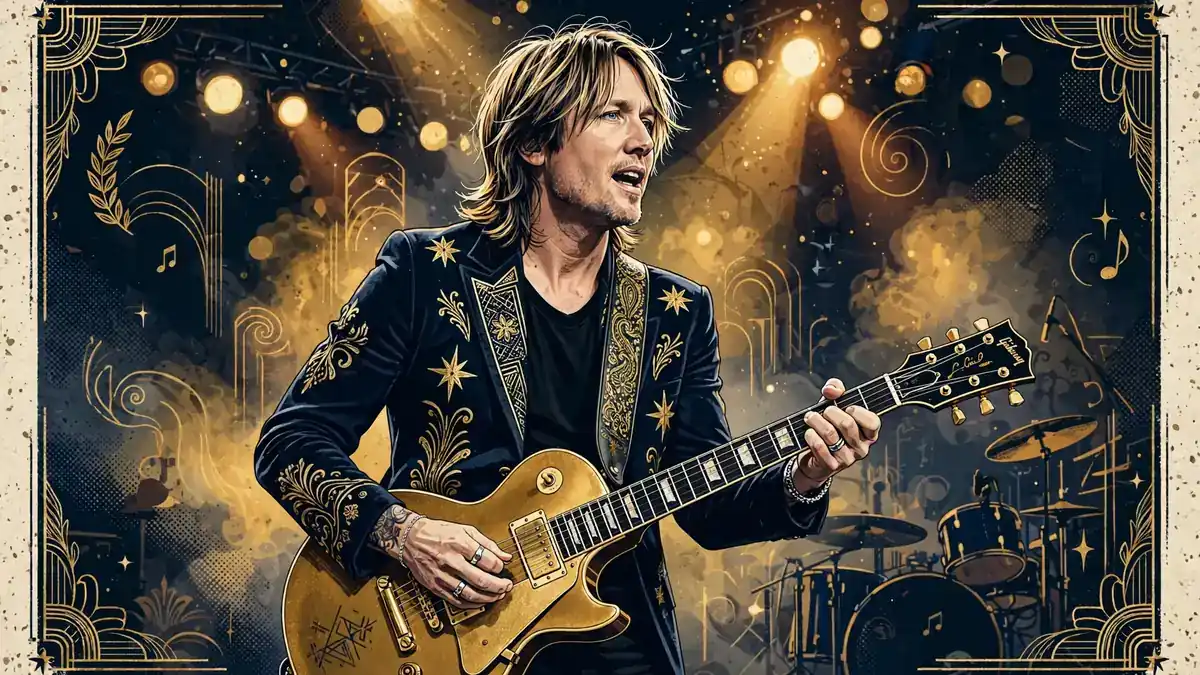
His other significant asset is the one that sits in his hands on stage: his guitars. Urban is a serious collector, and his collection includes vintage Gibson Les Pauls — the gold-top Les Paul he plays on stage has become almost a trademark — as well as Fender Stratocasters and a range of acoustic instruments. A vintage Les Paul in good condition can be worth tens of thousands of dollars, and a working collection built over thirty years is a real asset in its own right, quite apart from what it earns him on stage. He also owns his Nashville recording studio, The Sound, where Flow State was recorded — a working asset that doubles as his creative home.
Cars have never been a big part of Urban’s public image in the way they are for some celebrities, and he has not built a brand around them. He is known to favour practical, well-made vehicles over showpieces, and the money, by all accounts, has gone into music, property and family rather than into a garage full of trophies. That restraint fits the broader picture: Urban’s wealth was built slowly, album by album and tour by tour, rather than in a single windfall, and it shows in how he spends it.
Net Worth Over Time: From Pub Singer to Millionaire
Urban’s fortune was not made in a year. It was made in layers, and the timeline below shows how each stage of his career added to it. The early years paid little; the middle years paid a great deal; and the recent years have been about converting a lifetime of work into lasting value.
| Period | Career Stage | What Changed Financially |
|---|---|---|
| 1983–1991 | Australian talent shows, pub gigs, first EMI album | Working musician’s income; a living, not a fortune |
| 1992–1998 | Nashville session work, The Ranch, rehab | Session fees and small gigs; the lean years of the move |
| 1999–2001 | US solo debut, first number one | First platinum record; touring income begins in earnest |
| 2002–2006 | Golden Road, Be Here, first Grammys | Multi-platinum sales, arena headlining, first major wealth |
| 2007–2012 | Chart run continues, Opry induction | Catalogue grows; endorsement and publishing income build |
| 2013–2016 | American Idol judge, Fuse, Ripcord | Television fees at a reported ~$5 million a season; peak earning years |
| 2017–2021 | Graffiti U, The Speed of Now, Vegas dates | Steady touring and streaming income; catalogue value rises |
| 2022 | Catalogue stake sold to Litmus Music | Future royalties converted into cash; terms undisclosed |
| 2024–2026 | High, Flow State, divorce finalised | Estimated $75 million (Celebrity Net Worth), inside a $75–114 million range |
Two things stand out in that timeline. The first is how long the slow years lasted: Urban was 32 before his first American album and 35 before his first Grammy. The second is how steady the money has been since. Unlike stars whose fortunes spike and crash, Urban’s has grown in the same shape as his career — a long climb, a high plateau, and then a careful conversion of fame into lasting value.
How we estimated: the $75 million anchor comes from Celebrity Net Worth (2026) and was repeated by Parade in September 2026. The top of the range, $114 million, comes from the New Zealand Herald’s October 2025 reporting. A $160 million tabloid figure is treated as an outlier because it has no named source. No audited accounts exist, so treat every number here as an estimate, not a fact from a balance sheet.
How Keith Urban Compares With His Country Peers
Country music has never had a single ladder, and Urban’s place on it depends on what you measure. By chart success, he sits with the modern greats: 18 number one singles on the US country chart puts him in the company of artists who dominated radio for a decade. By awards, his four Grammys and 13 CMA Awards place him among the most honoured male country artists of his generation, though not at the very top — Dolly Parton, with 11 Grammys and a career spanning six decades, remains in a class of her own, and her business empire, from Dollywood to her publishing catalogue, is larger than Urban’s by any measure.
The most useful comparison is with the guitar-first artists who came up alongside him. Tim McGraw, his collaborator on “Highway Don’t Care”, built a fortune on a similar model — hit records, huge tours and television — but with a bigger acting career on top. Chris Stapleton, a generation younger, took the opposite route to the same place: years as a songwriter for other people, then a breakthrough as a performer with Traveller, and a reputation as a singer and guitarist that now rivals Urban’s own. The two men are often mentioned together because both made their name with the guitar in their hands rather than with a marketing plan.
Then there is the new generation. Luke Combs has spent the past few years doing what Urban did in the 2000s — turning one hit after another into arena tours and a catalogue that grows more valuable every year. The difference is speed: Combs reached the top in a fraction of the time, helped by streaming, which barely existed when Urban was climbing. What Urban has that the younger stars do not yet is time — thirty years of it, and a catalogue that has already survived three changes in how music is sold.
That durability is the real comparison. Plenty of country stars have had a bigger year than Urban ever had. Very few have had thirty good years. His biography is less a story of a peak than of a plateau held for two decades, and that is rarer than a single hit.
For more artist stories, browse the biography archive on CelebAmerica.
Frequently Asked Questions
How old is Keith Urban in 2026?
Keith Urban is 59 years old in November 2026. He was born on 26 October 1967 in Whangarei, New Zealand, and celebrated his 59th birthday on 26 October 2026 — his first birthday since his divorce from Nicole Kidman was finalised in January 2026.
What is Keith Urban’s net worth in 2026?
Keith Urban’s net worth is estimated at about $75 million in 2026, according to Celebrity Net Worth — a figure Parade repeated in its September 2026 profile. Published estimates range from $75 million to $114 million (the New Zealand Herald’s figure), so $75 million is the anchor inside a $75–114 million range. A $160 million tabloid claim has no named source and is treated as an outlier.
Are Keith Urban and Nicole Kidman still married?
No. Nicole Kidman filed for divorce on 30 September 2025, citing irreconcilable differences, and their divorce was finalised on 6 January 2026, ending a marriage of nearly 20 years. They married on 25 June 2006 in Sydney and have two daughters, Sunday Rose and Faith Margaret. Reported settlement terms included no alimony and prepaid child support.
How many Grammy Awards has Keith Urban won?
Keith Urban has won four Grammy Awards from 19 nominations, according to the Recording Academy. All four wins were in the Best Male Country Vocal Performance category, between 2005 and 2010, for “You’ll Think of Me”, “Stupid Boy”, “Sweet Thing” and “‘Til Summer Comes Around”. He has also won 15 Academy of Country Music Awards and 13 Country Music Association Awards.
What is Keith Urban’s new album Flow State?
Flow State is Keith Urban’s thirteenth studio album, released on 12 June 2026. It is mostly a yacht-rock covers album — including “Summer Breeze”, “Baby Come Back” and “Just the Two of Us” — with one original track, “We Go Back”, featuring Michael McDonald. It also features John Mayer and Little Big Town, and was produced by Urban with Dann Huff at his Nashville studio, The Sound.
Where was Keith Urban born and where did he grow up?
Keith Urban was born in Whangarei, New Zealand, on 26 October 1967. His family moved to Australia when he was two years old, and he grew up in Caboolture, Queensland, where he started playing guitar at six and appeared on the Australian talent show New Faces at 15. He moved to Nashville, Tennessee, in 1992 and is now based there.
Was Keith Urban a judge on American Idol?
Yes. Keith Urban judged four seasons of American Idol, seasons 12 to 15, from 2013 to 2016. Reports put his fee at around $5 million a season. He also coached the first two seasons of The Voice Australia in 2012 and 2013, and returned to the show in 2024.
How many number one songs does Keith Urban have?
Keith Urban has scored 18 number one singles on the US Hot Country Songs chart, from 37 singles charted. His biggest hits include “Somebody Like You” — named by Billboard as the biggest country hit of the 2000s decade — “You’ll Think of Me”, “Days Go By”, “Blue Ain’t Your Color” and “The Fighter” with Carrie Underwood.
Final Thoughts: The Guitar Player Who Outlasted the Hype
Keith Urban’s biography does not read like most celebrity stories, because the turning points are not the ones you would expect. The talent show at 15 did not make him. The move to Nashville did not make him, not for eight years. What made him was quieter: getting help in 1998, getting his voice back in 1999, and then doing the work — album after album, tour after tour — until the industry could no longer ignore him. The four Grammys, the 18 number ones, the Opry induction and the estimated $75 million fortune all came after the hard part was already done.
At 59, with a divorce behind him and a covers album that nobody saw coming, Urban is doing what he has always done: picking up the guitar and playing his way into the next chapter. Flow State is not a victory lap. It is a man who has survived the worst years of his life choosing music that sounds like a deep breath. If the next decade looks anything like the last three, the guitar will still be doing the talking — and the crowds will still be listening.
Sources and Reporting
This biography was researched from live reporting in November 2026. Money figures are estimates from named sources, not audited accounts. Key sources: Celebrity Net Worth ($75 million estimate, 2026); Parade (September 2026 profile, 20.7 million US equivalent album units, Litmus Music backing); Grammy.com (four wins, 19 nominations, award history); Britannica (career history, updated October 2026); Hello! magazine (divorce finalised January 2026, Flow State interviews, October 2026); Wikipedia (discography, chart history, awards totals). Divorce dates and settlement terms are drawn from court coverage as reported in October 2025 and January 2026. The New Zealand Herald’s $114 million figure is cited as the top of the published range; a $160 million tabloid claim is noted as an unsourced outlier. Where sources disagree, this article publishes a range and names the source behind each figure. Estimates may differ from private reality, and figures will change as new reporting appears.