Last updated: November 23, 2026 · By Celebamerica Editorial Staff
CKay’s net worth in 2026 is estimated at $2 million to $5 million, according to Net Worth Spot — but that tidy figure hides a much messier truth. Other trackers put the Nigerian Afrobeats star anywhere from $300,000 (AfroKonnect) to $8 million (NetWorthBreakdown), with Creebhills at $3 million and NetWorth202 at $500,000. CKay has never published his finances, no label has disclosed what he earned from “Love Nwantiti,” and every number in circulation is an outside estimate built on streaming counts, chart positions and guesswork about label splits. This article lays out the full spread, names every source, and explains why the middle of the range is the honest place to stand.
What is not in dispute is the size of the song that made him. “Love Nwantiti” — first released in 2019 on the EP CKay the First — became the first African song ever to pass one billion streams on Spotify, topped the first Billboard U.S. Afrobeats Songs chart, and reached the Billboard Hot 100 in the United States. CKay, born Chukwuka Chukwuma Ekweani on 16 July 1995 in Kaduna, Nigeria, went from producing beats for other artists in Lagos to fronting a sound he calls Emo-Afrobeats, signing to Warner Music South Africa and Atlantic Records, releasing two albums, and then — in 2025 — walking away from Warner to run his own label, Boyfriend Music, under a new partnership with AWAL. The money story below follows that arc: a slow producer’s grind, one once-in-a-career song, and a deliberate move toward independence.
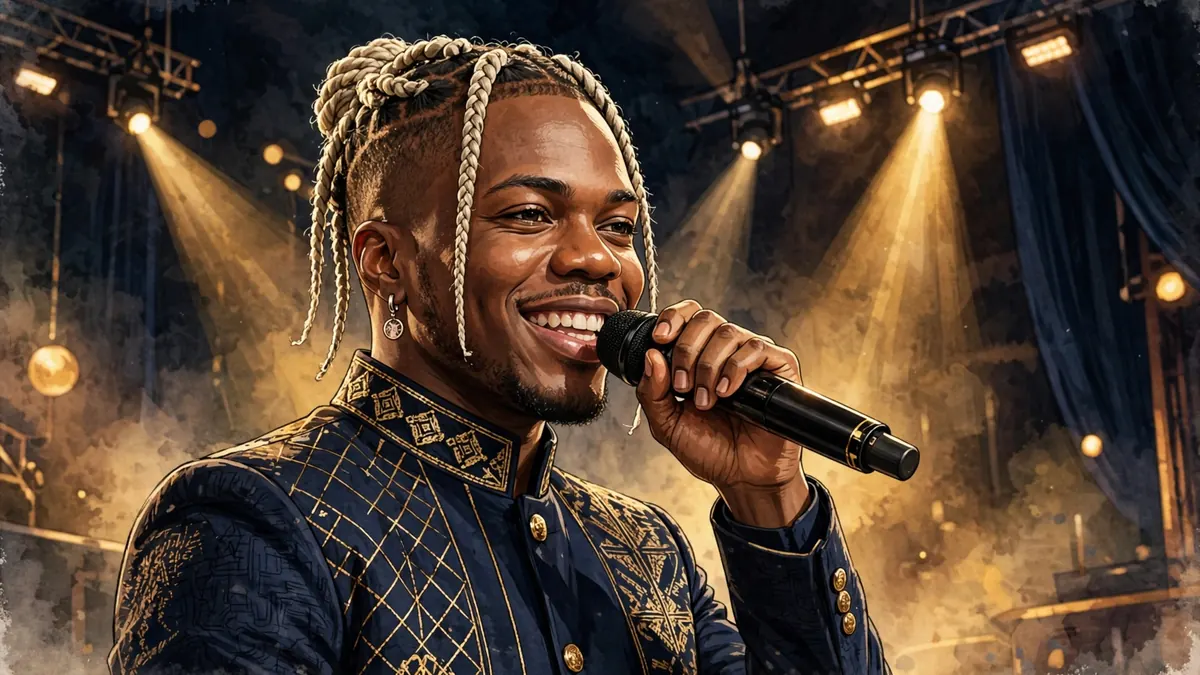
CKay: Quick Facts
| Full Name | Chukwuka Chukwuma Ekweani |
|---|---|
| Date of Birth | 16 July 1995 (31 years old in 2026) |
| Birthplace | Kaduna, Nigeria (Igbo heritage, Anambra State) |
| Estimated Net Worth (2026) | $2 million – $5 million (Net Worth Spot anchor); full published spread $300,000 – $8 million |
| Primary Income Sources | Streaming royalties, live performances and touring, songwriting and production fees, publishing, label ownership (Boyfriend Music) |
| Breakout Work | “Love Nwantiti” (2019; remix with Joeboy and Kuami Eugene, 2020) — first African song past 1 billion Spotify streams |
| Labels | Chocolate City (formerly, via Loopy Music); Warner Music South Africa / Warner Music Africa and Atlantic Records (2021–2025); Boyfriend Music with AWAL (2025–present) |
| Albums | Sad Romance (2022), EMOTIONS (2024), Banger Boy (2026) |
| Known As | Pioneer of Emo-Afrobeats |
Table of Contents
- How Much Is CKay Worth in 2026?
- Early Life and Background
- Career Rise: From Kaduna Beats to a Global Hit
- Love Nwantiti: The Song That Changed Everything
- Where the Money Comes From
- Albums, Tours and Live Earnings
- Houses, Cars and Lifestyle: What Is Actually on Record
- Net Worth Growth: Year by Year
- How CKay Compares to His Afrobeats Peers
- Personal Life
- CKay Net Worth: Frequently Asked Questions
- Final Thoughts: The Bottom Line
- Sources and Reporting
How Much Is CKay Worth in 2026?
The short answer is that nobody outside CKay’s own circle knows for certain — and the published guesses disagree by more than twentyfold. Here is the full spread, with each figure tied to the outlet that printed it:
| Source | CKay Net Worth Estimate (2026) |
|---|---|
| AfroKonnect | $300,000 |
| NetWorth202 | $500,000 |
| Net Worth Spot | $2 million – $5 million |
| Creebhills | $3 million |
| NetWorthBreakdown | $8 million |
We anchor on Net Worth Spot’s $2 million to $5 million as the working estimate, and we publish the whole $300,000 to $8 million spread alongside it. The reasons are straightforward. The low end looks too thin for an artist whose signature song passed a billion Spotify streams, who spent years signed to a major label, and who now owns his own imprint — a catalogue like that earns real money even after the label takes its cut. The high end, NetWorthBreakdown’s $8 million, is built from a neat model that assigns $4 million to streaming and music rights, $2 million to live performance, $1 million to production and publishing, and smaller slices to his label, endorsements and features. Those splits look tidy on paper, but no source behind them is a filing, a contract or a label statement; they are allocations the site itself generated. Treating a modelled split as a bank balance would be a mistake.
The middle of the range is where the evidence points. A billion-stream song, a debut album that charted in France and Nigeria, two further albums, international touring and a label of his own add up to a multi-million-dollar career — just not to eight million on the public record, and not to three hundred thousand either. Readers should treat every figure here, including our anchor, as an estimate built from public reporting rather than an audited statement of CKay’s wealth. For the fuller story of his life and career, see our CKay biography, and for his physical stats, our CKay height profile.
Why the range is the story: net worth trackers for African artists routinely disagree this widely because the underlying data is private. Streaming payouts depend on the artist’s label deal, territory mix and royalty split — none of which CKay or Warner has disclosed. Any site that prints one confident number for CKay is hiding that uncertainty. We would rather show you the disagreement.
Early Life and Background
Chukwuka Chukwuma Ekweani was born on 16 July 1995 in Kaduna, a city in north-western Nigeria. He is of Igbo descent, with family roots in Ukwulu in the Dunukofia Local Government Area of Anambra State, in Nigeria’s south-east. Music was in the house from the start: his father conducted the choir at their local church, and CKay learned to play the piano from him. He attended Zamani College in Kaduna for his secondary schooling, and by his teenage years he was already making beats and writing songs.
That early start matters to the money story, because CKay entered the industry as a producer, not as a singer. Before he ever released a record under his own name, he was a teenager in a band with two friends, learning arrangement, instrumentation and studio craft. Production gave him two things a pure vocalist rarely gets early on: a working knowledge of how records are actually made, and a second income stream — fees for producing other artists — that kept him going while his own artist career was still finding its shape.
In 2014 he moved to Lagos, Nigeria’s music capital, after being discovered. The move was the turning point of his early career. In Lagos he signed with Loopy Music, a label that later merged with Chocolate City, one of Nigeria’s biggest record labels. When the merger happened, CKay moved with it onto the Chocolate City roster — first working behind the scenes as a producer for established acts, then stepping forward as an artist in his own right.
His early production credits show the range of that apprenticeship. They include M.I Abaga’s “Your Father,” Koker’s “Give Them,” Yung6ix’s “Everything Gucci,” Dotman’s “Tonight” and Bisola’s “Controlla.” None of those records made him famous, but they put him inside the rooms where Nigerian pop was being made, and they taught him the commercial side of the business — what a hit costs to build, who gets paid, and how publishing works. That education shows up later in the way he handled his own career, from the Warner deal to the eventual decision to run his own label.
Career Rise: From Kaduna Beats to a Global Hit
CKay’s artist career began quietly. His debut EP, Who the F*ck Is CKay?, arrived on 11 September 2017 through Chocolate City. It introduced him as a singer-songwriter, but it did not break through; the Nigerian scene in 2017 was crowded, and CKay was still better known in studios than on stages. The record that changed that was his second EP, CKay the First, released on 30 August 2019 through Chocolate City. Its second track was a soft, guitar-led love song called “Love Nwantiti.” At first it was a modest regional hit. Nothing about its release suggested what would happen next.
What happened next was TikTok. In early 2021, a remix of “Love Nwantiti” — “Love Nwantiti (Ah Ah Ah),” released on 14 February 2020 and featuring fellow Nigerian singer Joeboy and Ghanaian highlife artist Kuami Eugene — caught fire on the platform. The song’s gentle, swaying hook travelled fast, spawning dance trends and covers across continents. By the middle of 2021 it was charting across Europe, Africa, Australia and New Zealand, reaching number 23 in the UK and earning CKay his first entry on the US Billboard Hot 100. It also became the second Nigerian song ever to chart on the Hot 100.
The industry noticed in real time. On 11 February 2021, CKay released his third EP, Boyfriend, through Warner Music South Africa. On 4 May 2021 he clarified his label position publicly, tweeting that he was no longer signed to Chocolate City and was signed to Warner Music South Africa. In July 2021 he received a Silver Creator Award from YouTube for passing 100,000 subscribers. That same year he became the first African artist to reach 20 million monthly listeners on Spotify, and in 2022 he became the second African artist to pass 1.2 billion total streams on the platform. The producer from Kaduna had, within about eighteen months, become one of the most-streamed African artists on earth.
The sound he was selling had a name of his own making: Emo-Afrobeats. Where much of Afrobeats leans on high-energy dance rhythms, CKay’s records are slower, more melodic and emotionally direct, blending Afrobeats with R&B and pop. The label stuck because it described something real — songs about longing and heartbreak set to rhythms you could still move to — and it gave him a lane of his own in a crowded genre. That distinct identity is part of his commercial value: it made his music recognisable in seconds, which is exactly what streaming algorithms and short-form video reward.

Love Nwantiti: The Song That Changed Everything
It is hard to overstate what “Love Nwantiti” did for CKay’s career — and his earning power. The song debuted at number one on the Billboard U.S. Afrobeats Songs chart when that chart launched on 29 March 2022. Then, on 9 May 2022, it became the first African song in history to pass one billion streams on Spotify. The remix charted in more than 30 countries. For a songwriter-producer who owns a share of the publishing, a record like that is not a one-off payday; it is a long-tail asset that keeps paying as long as people keep pressing play, and people have kept pressing play for years.
The song’s afterlife is the key to understanding CKay’s income. A billion streams on one platform, plus hundreds of millions more across Apple Music, YouTube, TikTok sounds and other services, plus radio play in dozens of countries, plus sync placements and cover versions, means the record generates royalties across many channels at once. The exact split between CKay, his label, his publishers and his collaborators is private — which is precisely why honest estimates of his wealth disagree so much. What can be said with confidence is that the song made him the kind of artist who could command real fees for shows, features and brand work, and gave him the leverage to renegotiate his position in the industry.
The awards followed the streams. “Love Nwantiti” won Best African Song at the 2021 Muzikol Music Awards and Most Performed Song at the 2022 BMI London Awards. CKay was nominated for Best African Act at the 2021 MOBO Awards, Best International Song at the 2022 Brit Awards, Favourite Afrobeats Artist at the 2022 American Music Awards, and Best New Artist at the 2022 Soul Train Awards, with multiple nominations at The Headies in 2022 and 2023. Nominations do not pay directly, but they raise booking fees and keep an artist visible between releases — and CKay used that visibility to build a catalogue rather than rest on one song.
It is worth pausing on the word “catalogue,” because it is where the real money sits for an artist like CKay. A single viral hit fades; a catalogue of hits, album tracks and production credits keeps earning. CKay’s catalogue now spans three EPs as a lead artist before 2021, three studio albums, and a run of singles and features — plus the production work from his early years. That depth is why the $300,000 figure from AfroKonnect reads as too low: it prices CKay as if “Love Nwantiti” were his only asset, when his publishing and recording catalogue is considerably broader than one song.
Where the Money Comes From
CKay’s income comes from five main channels. None of them is publicly audited, so the figures below are the shape of the business, not a balance sheet — but the shape itself is well documented.
Streaming royalties. This is the biggest channel, and the hardest to pin down. Widely cited industry estimates put Spotify’s per-stream payout at roughly $0.003 to $0.005, but that headline rate is misleading on its own: the money is split between the label, the distributor, the songwriter’s publisher and the artist, and the artist’s share depends on the deal. Under a major-label deal like CKay’s Warner arrangement, the label typically takes the larger share of recording royalties, while the songwriter keeps a separate publishing share. “Love Nwantiti” passing a billion Spotify streams therefore generated millions of dollars in total royalty value — but CKay’s personal share of that total is a fraction of it, and the fraction is private. That gap between total streams and personal income is the single biggest reason the trackers disagree.
Live performances and touring. After “Love Nwantiti” broke, CKay became a touring artist, playing festivals and headline shows across Africa, Europe and North America. Live fees for an Afrobeats star with a global hit run far higher than for a local act, and touring is typically the most direct income an artist controls — the fee arrives without the label taking a recording-royalty cut, though managers, agents and touring costs take their share. No public record states CKay’s per-show fee, so we do not print one.
Songwriting and production fees. CKay never stopped being a producer. His early credits for M.I Abaga, Koker, Yung6ix, Dotman and Bisola were fee work, and his later career added feature verses and production for other artists — including a feature on Janelle Monáe’s 2023 album The Age of Pleasure and collaborations with Ronisia. Production and feature fees, plus the publishing share that comes with writing credits, form a steady second income line that does not depend on his own releases.
Publishing. As a songwriter on his own hits, CKay earns publishing royalties every time his songs are streamed, played on radio, performed live or used in film, television and advertising. Publishing is the quiet earner in a career like this: it pays on other artists’ versions too, and it pays for decades. The BMI London Award for “Love Nwantiti” as Most Performed Song is a direct signal of how much performance royalty that one composition generates.
Label ownership. Since 2025, CKay has been co-founder and chief executive of Boyfriend Music, his own imprint, through which he released the CKay the Second EP in June 2025 and the Banger Boy album in August 2026. Owning the label changes the economics completely: instead of taking an artist’s share of a major label’s revenue, he controls the masters and the release schedule. That is a long-term wealth play rather than a quick payday — the value sits in the catalogue he is now building for himself.
What about brand endorsements? No major public endorsement deal for CKay is on the record in the sources we checked. Some trackers assign him a few hundred thousand dollars in brand income, but without a named brand or a reported deal, we do not count endorsements as a verified income line. If a deal is announced, the picture changes; as of November 2026, his money is music money.
| Income Stream | What We Know | Strength of Evidence |
|---|---|---|
| Streaming royalties | “Love Nwantiti” past 1 billion Spotify streams; 20M monthly listeners in 2021; 1.2B total streams by 2022 | Strong — chart and platform records |
| Live performance / touring | International shows and festivals since 2021 | Moderate — no published fee schedule |
| Songwriting / production | Credits for M.I Abaga, Koker, Yung6ix, Dotman, Bisola; Janelle Monáe feature (2023) | Strong — credited discography |
| Publishing | BMI Most Performed Song award (2022) for “Love Nwantiti” | Moderate — award record, split private |
| Label ownership (Boyfriend Music) | Co-founder and CEO; releases from 2025 under AWAL partnership | Strong — label and deal reporting |
| Brand endorsements | No named deal on public record | Weak — not counted as verified income |
Albums, Tours and Live Earnings
CKay’s album run is the second act of his career, and it shows an artist building staying power rather than cashing in one hit. His debut studio album, Sad Romance, arrived on 23 September 2022 through Warner Music South Africa. It featured “Emiliana,” “Watawi” and “You,” with guest appearances from Ayra Starr, Davido and Focalistic, and it charted at number 88 in France and number 29 in Nigeria, topping the Nigerian alternative chart. For a debut album from an artist still known mainly for one song, that was a solid commercial result — and it gave him a full live set to tour with, which is where albums earn their keep.
The follow-up, EMOTIONS, came in October 2024 as a 12-track album featuring Olamide, The Cavemen, Ty Dolla $ign and Nora Fatehi. It was a more layered, introspective record, drawing on African instruments such as the oja flute, and it closed out his Warner contract. Then came the independent chapter: the CKay the Second EP on 13 June 2025 under Boyfriend Music Limited, followed by the African Girls EP in May 2026 and a third studio album, Banger Boy, on 7 August 2026. The pace of releases since going independent — an EP and an album within about fourteen months — is itself a business signal: as his own label boss, CKay can release when he wants, keep a larger share of each stream, and build the catalogue that will pay him for years.
Touring is the other half of the live-earnings story. CKay has played across Africa, Europe and North America since “Love Nwantiti” went global, and his festival bookings put him on bills with the biggest names in Afrobeats. The economics of touring for an artist at his level are straightforward: a headline or festival fee, minus the costs of band, travel, production and management, leaves a margin that in a good year can rival streaming income. We do not have a published figure for his annual touring income, and we will not guess one — but the fact that he has sustained international touring for four straight years tells its own story about demand.

Houses, Cars and Lifestyle: What Is Actually on Record
Here is where an honest article has to say what it does not know. There is no verified public record of CKay owning a particular house, a car collection, or any property portfolio. No reputable outlet has reported a home purchase, and no credible source has listed vehicles he owns. Some biography sites carry claims about cars and houses, but they cite no source, no date and no evidence — and we do not repeat unsourced claims as facts.
What is on record is a lifestyle that is deliberately low-key for a global pop star. CKay keeps his private life out of the press, posts about music rather than luxury, and has never built his public image around cars, watches or houses the way some of his peers have. That restraint is worth noting because it cuts against the usual celebrity-net-worth template: for CKay, the wealth story is in the catalogue and the label, not in a garage. If he owns property or vehicles, he has chosen not to make them part of his public story, and we will not invent them to fill a section.
The one asset that is documented is the business itself. Boyfriend Music, the label he co-founded and runs as chief executive, is a real company with real releases, a distribution partnership with AWAL, and a growing roster of CKay’s own work. A label’s value is hard to price from outside — it depends on the catalogue, the deals and the future releases — but it is the asset most likely to grow CKay’s wealth over the next decade, because every stream of his post-2025 work flows through a company he controls.
Net Worth Growth: Year by Year
Because no audited figures exist, the timeline below tracks the career milestones that moved CKay’s earning power, with the estimate range attached to each era rather than a false precision figure for each year.
| Year | Career Milestone | Effect on Wealth |
|---|---|---|
| 2014–2016 | Moves to Lagos; signs to Loopy Music; produces for M.I Abaga, Koker, Yung6ix, Dotman, Bisola | Modest producer fees; building reputation, not wealth |
| 2017 | Debut EP Who the F*ck Is CKay? (Chocolate City) | First artist income; still a developing act |
| 2019 | CKay the First EP; “Love Nwantiti” released | Regional hit; first meaningful royalties |
| 2020 | “Love Nwantiti (Ah Ah Ah)” remix with Joeboy and Kuami Eugene | Song begins its global climb; streaming income rises |
| 2021 | TikTok virality; Boyfriend EP; Warner Music South Africa deal; 20M Spotify monthly listeners; first Hot 100 entry | The breakout year — earning power jumps several times over |
| 2022 | “Love Nwantiti” passes 1 billion Spotify streams; Sad Romance album; BMI and Muzikol awards; Brit and AMA nominations | Peak streaming and touring income; catalogue value set |
| 2023–2024 | Janelle Monáe feature; collaborations; EMOTIONS album (October 2024) | Steady catalogue and live income; Warner contract ends |
| 2025 | Exits Warner Music Africa (April); AWAL partnership (May); CKay the Second EP on Boyfriend Music (June) | Shift from label artist to label owner; short-term income dip possible, long-term upside higher |
| 2026 | African Girls EP (May); Banger Boy album (August) | Independent catalogue grows; estimate range $300K–$8M, anchored $2M–$5M |
The pattern is a familiar one for a one-song breakout who then builds a career: a long flat period, a sudden jump, and then a slow build as the catalogue deepens. The 2025 move to independence is the most interesting part of the curve. In the short term, leaving a major label can mean less marketing muscle and smaller advances. In the long term, owning the masters means keeping a far larger share of every stream — which is why CKay’s net worth in 2030 will depend less on “Love Nwantiti” and more on how the Boyfriend Music catalogue performs.
How CKay Compares to His Afrobeats Peers
CKay’s story reads differently from the other giants of Afrobeats, and the comparison helps explain why his net worth sits where it does. Wizkid and Burna Boy built their fortunes over a decade of albums, arena tours and global brand deals; their wealth is diversified across many income lines. CKay’s fortune, by contrast, is concentrated: one enormous song, a strong but younger catalogue, and a new label. That concentration is both his strength and his risk — the billion-stream record guarantees a floor under his income, but his ceiling depends on what he builds next.
The closer comparisons are the artists of his own generation. Omah Lay, who broke through around the same time, has followed a similar path of streaming success and international touring. Ayra Starr, who guested on Sad Romance, has built her own catalogue at a fast pace under the Mavin label system. All three are in the same bracket — successful global Afrobeats acts whose wealth is real but not yet at the level of the genre’s decade-long superstars — and all three are still in the building phase of their careers. For more on the genre’s big earners, see our profiles of Wizkid and Burna Boy, and for the full range of Afrobeats wealth on this site, browse the Net Worth category.
One thing sets CKay apart even among his peers: he owns the song that made him a global name in a way few artists can claim. “Love Nwantiti” was written and recorded before the fame, on an EP released by a label he has since left, and it keeps earning because it is a love song — the kind of record that does not age out of playlists the way a trend-chasing single does. That durability is the most valuable thing in his portfolio, and it is why the low-end estimates miss the mark.
Personal Life
CKay keeps his private life private, and the public record reflects that. He was born in Kaduna and raised partly there, with family roots in Anambra State; he has spoken about his father’s role as a church choir conductor and the piano lessons that started his musical education. Beyond that, he rarely discusses family in interviews, and there are no verified public reports about his parents or siblings beyond those early-life details.
On relationships, the reporting is thin and consistent: Nigerian outlet NigerianWaves reports that CKay is publicly single with no acknowledged relationship, and no reputable source has named a partner. We do not speculate about his dating life, and we do not repeat gossip-site claims that carry no sourcing.
There is also no public record of a major controversy or legal dispute involving CKay. No lawsuit, arrest or public feud of substance appears in the reporting we checked. For an artist who has spent a decade in the Nigerian music industry, that clean record is itself notable — and it means there is no controversy section to write, which is a good thing for his brand and his booking fees.
CKay Net Worth: Frequently Asked Questions
What is CKay’s net worth in 2026?
CKay’s net worth in 2026 is estimated at $2 million to $5 million, according to Net Worth Spot. Other published estimates range much wider, from $300,000 (AfroKonnect) to $8 million (NetWorthBreakdown), with Creebhills at $3 million and NetWorth202 at $500,000. CKay has never disclosed his finances, so every figure is an outside estimate — the $2 million to $5 million range is the honest middle of the published spread.
How did CKay make his money?
CKay made his money from music: streaming royalties led by “Love Nwantiti,” the first African song to pass one billion Spotify streams; live performances and international touring; songwriting and production fees from his early career producing for artists like M.I Abaga and Bisola; publishing royalties on his own songs; and, since 2025, his own label, Boyfriend Music, which he co-founded and runs as chief executive.
How many streams does Love Nwantiti have?
“Love Nwantiti” passed one billion streams on Spotify on 9 May 2022, becoming the first African song ever to reach that mark. The remix featuring Joeboy and Kuami Eugene charted in more than 30 countries, reached number 23 in the UK, and earned CKay his first entry on the US Billboard Hot 100.
What record label is CKay signed to?
CKay is no longer signed to a major label. He started with Loopy Music and Chocolate City, then signed to Warner Music South Africa (later Warner Music Africa) and Atlantic Records in 2021. He exited Warner in April 2025 when his deal ended, signed a partnership with AWAL in May 2025, and now releases music through his own label, Boyfriend Music.
How old is CKay?
CKay is 31 years old in 2026. He was born Chukwuka Chukwuma Ekweani on 16 July 1995 in Kaduna, Nigeria, and he turned 31 on 16 July 2026.
What is CKay’s real name?
CKay’s real name is Chukwuka Chukwuma Ekweani. He was born in Kaduna, Nigeria, and is of Igbo descent, with family roots in Ukwulu, Dunukofia Local Government Area, Anambra State.
What albums has CKay released?
CKay has released three studio albums: Sad Romance (2022), EMOTIONS (2024) and Banger Boy (2026). His EPs are Who the F*ck Is CKay? (2017), CKay the First (2019), Boyfriend (2021), CKay the Second (2025) and African Girls (2026).
Is CKay still with Warner Music?
No. CKay officially exited Warner Music Africa on 18 April 2025, following the end of his record deal. On 31 May 2025 he signed a new partnership deal with AWAL to support releases through his own imprint, Boyfriend Music, starting with the CKay the Second EP in June 2025.
Final Thoughts: The Bottom Line
CKay’s net worth in 2026 sits somewhere between $300,000 and $8 million depending on which tracker you ask — and the honest answer is the middle of that spread, $2 million to $5 million, anchored on Net Worth Spot. The disagreement is not a failure of research; it is the reality of pricing a private fortune built on a song whose royalties are split between an artist, a label and a publisher under terms nobody has published.
What the numbers cannot hide is the career underneath them. A producer from Kaduna who learned piano from his choir-conductor father, moved to Lagos at nineteen, wrote a love song in 2019, watched it become the first African record to pass a billion Spotify streams, and then used that leverage to walk away from a major label and build his own company — that is a career with real, durable value, whatever the trackers say. The next chapter is the one to watch: if the Boyfriend Music catalogue grows the way the Warner catalogue did, the $2 million to $5 million range will look conservative in a few years. If it does not, the billion-stream record still guarantees CKay an income most artists never reach.
Sources and Reporting
How we estimated this: No public filing, contract or label statement discloses CKay’s personal wealth, so this figure is a range built from named reporting. We collected every published 2026 estimate we could verify — AfroKonnect ($300,000), NetWorth202 ($500,000), Net Worth Spot ($2 million–$5 million), Creebhills ($3 million) and NetWorthBreakdown ($8 million) — and anchored on Net Worth Spot’s range as the working estimate because it sits in the middle of the spread and reflects the scale of a billion-stream catalogue without treating a modelled breakdown as fact. Career facts (dates, labels, chart positions, awards, discography) come from Wikipedia’s CKay biography and discography pages, cross-checked against the estimate sources and Qobuz’s CKay discography overview. Streaming milestones (one billion Spotify streams, 20 million monthly listeners) are drawn from the same reporting. Where sources conflicted, we published the range and said so. Net worth figures for public personalities are estimates built from public reporting — not audited financial statements.
- Wikipedia — CKay (biography, career timeline, labels, awards)
- Net Worth Spot — CKay Net Worth & Earnings (2026) ($2 million–$5 million)
- AfroKonnect — CKay Net Worth in 2026, Biography and Music Career ($300,000)
- NetWorth202 — CKay Net Worth ($500,000)
- Creebhills — CKay Biography, Age, Songs, Record Label, EP, Albums, Charts, Girlfriend, Wikipedia, Net Worth, and Career ($3 million)
- NetWorthBreakdown — CKay Net Worth 2026 ($8 million)
- Qobuz — CKay Discography
By Celebamerica Editorial Staff. This article is original reporting for celebamerica.com and was researched and written for this site; it is not copied from any sister-site article.