Bill Gates net worth in 2026 is about $121 billion, according to Forbes’ real-time tracker in November 2026, when he ranked 17th in the world. That is the anchored figure for this page. The honest range is wider than a single number: Forbes’ annual World’s Billionaires list, priced on March 1, 2026, put him at $108 billion and 19th, while Bloomberg’s index showed about $123 billion on November 11, 2026. The gap is not a mistake. It comes from different valuation dates and different ways of counting what Gates has already given away, and this article lays out both trackers, date by date, so you can see exactly where each figure comes from.
Gates, born October 28, 1955, in Seattle, co-founded Microsoft and held the title of the world’s richest person for 18 of the 24 years between 1995 and 2017, according to Forbes. He has not held that top spot for years now, and the reason is deliberate: he has moved tens of billions of dollars out of his personal fortune and into the Gates Foundation, and in May 2025 he announced he would give away about 99 percent of what remains before the foundation closes at the end of 2045. What is left in his name is still one of the largest personal fortunes on earth, but it is a shrinking one by design. The money that remains sits mostly in Cascade Investment, the private family office that has held his post-Microsoft wealth since the 1990s, with a small remaining Microsoft stake, large public-company holdings, farmland across the United States, and a famous lakefront home in Medina, Washington.
Last updated: November 16, 2026. By Celebamerica Editorial Staff.
Quick Facts: Bill Gates Financial Snapshot
| Full Name | William Henry Gates III |
|---|---|
| Date of Birth | October 28, 1955 |
| Birthplace | Seattle, Washington, United States |
| Estimated Net Worth (2026) | About $121 billion (Forbes real-time, November 2026); $108 billion on Forbes’ March 1, 2026 annual list; about $123 billion on Bloomberg’s index, November 11, 2026 |
| Global Rank (2026) | 17th (Forbes real-time, November 2026); 19th (Forbes annual list, March 2026) |
| Primary Income Sources | Microsoft share sales over decades; investment returns from Cascade Investment; dividends from public-company stakes |
| Key Ventures | Microsoft (co-founder); Cascade Investment (family office); Gates Foundation (chair); TerraPower; Breakthrough Energy; Gates Ventures |
| Marital Status | Divorced from Melinda French Gates in 2021 after 27 years of marriage |
| Children | Three: Jennifer, Rory and Phoebe Gates |
Table of Contents
- Quick Facts: Bill Gates Financial Snapshot
- How Much Is Bill Gates Worth in 2026?
- Why Forbes and Bloomberg Disagree
- Early Life and the Road to Microsoft
- The Microsoft Rise: How the Fortune Was Built
- Where the Money Sits Now: Cascade Investment
- Net Worth Timeline: From First Millions to Centibillionaire
- Assets: Homes, Farmland and What He Owns
- Giving It Away: The Foundation and the 2045 Plan
- Personal Life, Family and the Divorce
- Controversies and Questions That Followed Him
- Peer Comparison: Gates Against the Other Tech Billionaires
- Frequently Asked Questions
- Bottom Line
- Sources and Reporting
How Much Is Bill Gates Worth in 2026?
The short answer is about $121 billion, on Forbes’ real-time count in November 2026. The longer answer matters more, because Gates is the one billionaire whose published fortune moves a lot depending on who is counting and when they counted. Forbes’ annual list, the one that uses stock prices from March 1, 2026, recorded $108 billion and 19th place. By late August 2026 the same magazine’s real-time ranking showed about $109.7 billion, still 19th. By October 15, 2026, a tracker of Forbes’ real-time figures recorded $117 billion. By November 2026, Forbes’ profile, as reflected in reporting that month, showed $121.2 billion and 17th place, and a separate live tracker put him at $122.1 billion and 16th in the world on November 16, 2026. Bloomberg told a similar story at a slightly higher level: about $116 billion on October 10, 2026, and about $123 billion, 17th globally, on November 11, 2026.
Read together, those prints describe a fortune that spent most of 2026 in a band from roughly $103 billion to $123 billion, rising through the autumn as markets rose. The low end of that band came early in the year, when Forbes’ February 2026 real-time print was about $107.7 billion and Bloomberg’s was about $103 billion. Celebrity Net Worth, a third tracker, put him at about $105 billion in March 2026. None of these is a bank balance. Each is an estimate built from public share prices, disclosed holdings, and educated guesses about private assets, and each one is dated. A figure without a date attached to it is not useful for Gates, and any page that quotes a single number without saying when it was measured is cutting a corner.
What has not changed through 2026 is the shape of the fortune. Gates draws no salary from Microsoft, where he holds no operating role, and no salary from the foundation. His wealth is a pile of assets that rises and falls with the market: a residual Microsoft stake now estimated at under 1 percent of the company, a large book of public-company shares held through Cascade Investment, private stakes in companies such as Four Seasons Hotels and Resorts, farmland, and real estate. When Microsoft, Republic Services, Deere and the rest of that book rise, his estimated fortune rises with them. When they fall, it falls. There is no pay cheque behind the number, and there has not been one for years.
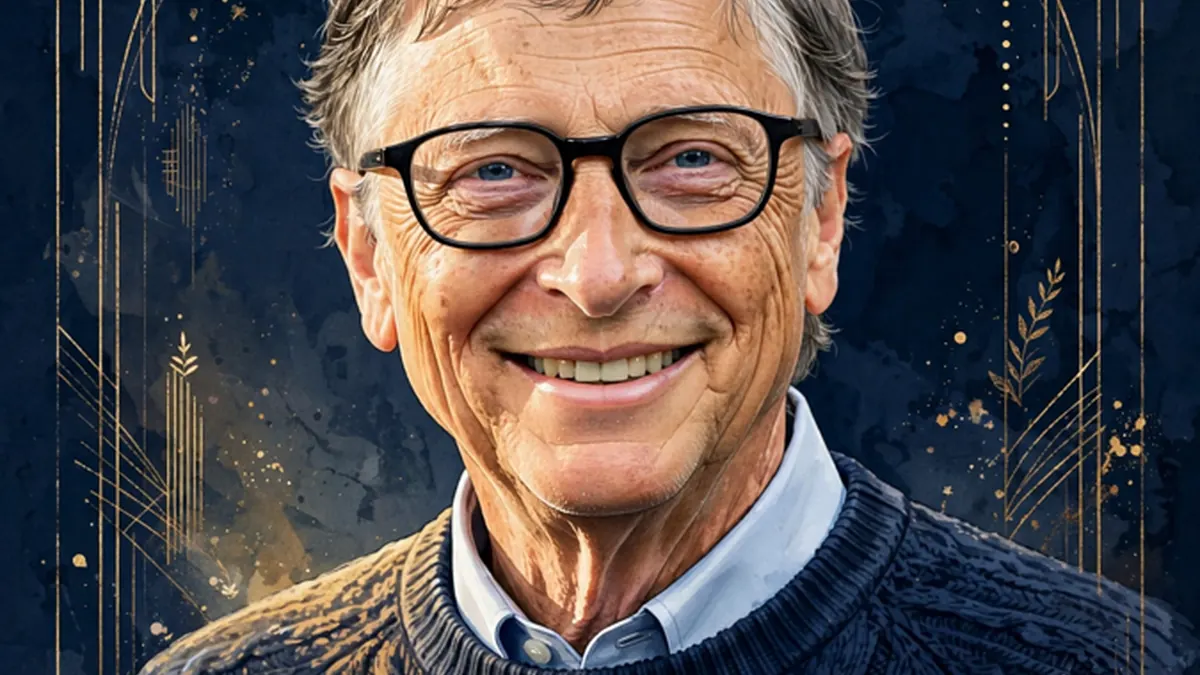
The number to remember: $108 billion (Forbes annual list, March 1, 2026) is the fixed, dated snapshot. About $121 billion (Forbes real-time, November 2026) is the live mark. The range between them is market movement plus the slow, planned transfer of wealth out of his personal fortune and into philanthropy — not a reporting error.
Why Forbes and Bloomberg Disagree
Forbes and Bloomberg have disagreed about Bill Gates more sharply than about almost any other billionaire, and the reason is specific to him: he has given away so much, through so many channels, over so many years, that the two trackers have had to make different judgement calls about what still counts as his.
The sharpest example came in July 2025. Bloomberg’s index carried Gates at about $175 billion, then cut the figure to about $124 billion within days after recalculating past donations — a drop of roughly $52 billion, about 30 percent, in a single week, which moved him from 5th to 12th on that index. Forbes never had him above about $108 billion in the same period. The difference was not a market crash. Bloomberg had been counting assets that Gates had already committed or transferred in ways Forbes had already excluded, and when Bloomberg updated its model to reflect those charitable transfers, its number fell to meet Forbes’ range. Reporting at the time, including in the New York Post, described the change as a recalculation of past donations rather than a loss of wealth.
Bloomberg made a further methodology change in January 2026, removing an additional $12.5 billion that Gates had agreed to transfer to Melinda French Gates for her independent charitable work. Forbes’ approach has been steadier: it counts currently held personal and Cascade assets, excludes assets already gifted to the foundation, and treats the foundation’s endowment as charitable capital under board governance, not as Gates’ spending money. That is why the two trackers can show materially different numbers on the same day even when both are working in good faith. They are measuring slightly different piles.
There is a second, simpler source of disagreement: timing. Forbes’ annual list is a snapshot priced on March 1. Bloomberg’s index updates on business days after the New York market closes. A real-time Forbes figure from November and a Bloomberg figure from October are not the same measurement, and comparing them as if they were is a common mistake in net worth coverage. This page gives the date with every figure for exactly that reason.
For readers, the practical rule is this: use the Forbes annual figure when you want a fixed point to compare year to year, and use the real-time figures when you want to know where he stands today. Both are estimates. Neither is an audited statement of his total personal assets, because most of the money sits inside Cascade Investment, a private holding company that files almost nothing in public.
Early Life and the Road to Microsoft
William Henry Gates III was born on October 28, 1955, in Seattle, Washington, to William H. Gates Sr., a lawyer, and Mary Maxwell Gates, who served on corporate and university boards. He grew up in a comfortable, civic-minded household in Seattle, attended the private Lakeside School, and showed an early, intense interest in computers at a time when very few schools had any. At Lakeside he met Paul Allen, two years his senior, and the two bonded over the school’s teletype terminal and the puzzle of making machines do useful things. That friendship became the founding partnership of Microsoft.
Gates went to Harvard University in 1973, where he lived down the hall from Steve Ballmer, who would later run Microsoft. He left Harvard in his junior year, in 1975, after he and Allen read about the Altair 8800 microcomputer and saw a chance to write software for it. They moved to Albuquerque, New Mexico, and founded Microsoft — originally Micro-Soft — with the idea that software, not hardware, would be the valuable layer of the personal computer business. It was a bet that looked eccentric in 1975 and obvious within a decade.
The early years were lean and frantic. Gates wrote code, negotiated deals, and built a small team around a single conviction: that a computer on every desk and in every home was coming, and that the company that supplied the software for those machines would sit at the centre of the industry. For the full story of his upbringing, schooling and the founding years, our Bill Gates biography covers his life in detail, while this page follows the money that came out of it.
The Microsoft Rise: How the Fortune Was Built
Microsoft’s first big break came with MS-DOS, the operating system it supplied for IBM’s personal computer in the early 1980s. The deal structure mattered as much as the product: Microsoft kept the right to license DOS to other makers, so as the PC market spread, Microsoft collected a fee on machine after machine. Windows, launched in 1985 and dominant by the early 1990s, turned that position into a near-monopoly on desktop computing. Office — Word, Excel and PowerPoint — added a second stream of revenue from the same customers. By the mid-1990s, Microsoft was the most valuable software company in the world, and Gates, who held a large share of it, was the richest person in the world.
Forbes first listed Gates as a billionaire in 1987, in its first America’s Richest issue. He ranked first on the Forbes 400 list of wealthiest Americans from 1993 to 2007, again in 2009, and from 2014 to 2017. Forbes ranked him as the world’s wealthiest person in its World’s Billionaires list for 18 out of 24 years between 1995 and 2017, including 13 years in a row from 1995 to 2007. In 1999 his net worth briefly passed $100 billion, making him the first centibillionaire — the first person ever to hold a fortune above that mark, even briefly.
The Microsoft IPO in 1986 is the hinge of the whole story. Gates was 30 years old, and the listing turned his large shareholding into a public, tradable fortune. From there the pattern was simple and hard to repeat: Microsoft’s share price rose for most of the next 14 years, and Gates’ stake rose with it. He sold shares steadily over the decades, diversifying the proceeds through Cascade Investment, and he gave large blocks of shares to the trust that funds the Gates Foundation — including billions of dollars’ worth in 2022 alone. That is why his remaining personal Microsoft stake is now estimated at under 1 percent of the company, even though Microsoft is still the source of the fortune. He did not lose the stake. He sold it and gave it away, on purpose, over 30 years.

Gates stepped down as chief executive in 2000, handing the role to Steve Ballmer, and stayed on as chairman and chief software architect. He left his full-time role at Microsoft in 2008 to focus on the foundation, and stepped down from the Microsoft board in 2020. By then the fortune had already changed shape: Microsoft was the origin story, and Cascade Investment was the present tense. A fuller account of the Microsoft years, including the antitrust case of the late 1990s and the handover to Ballmer, is in our Bill Gates biography on GuideNetWorth, which tells the same life from the biography angle.
One detail that often gets lost: Gates has never taken a conventional salary in the way a chief executive does today. His wealth was built from equity — owning a large share of a company that became enormous — not from pay. That is why there is no salary figure to quote for him in 2026, and why the fortune moves with the stock market rather than with any pay decision.
Where the Money Sits Now: Cascade Investment
Cascade Investment, L.L.C., is the private holding company that manages most of Gates’ non-Microsoft wealth. It is based in Kirkland, Washington, controlled by Gates, and managed since 1994 by Michael Larson. It does not publish a full portfolio, and its total assets were last put at about $70 billion in 2021 reporting — a dated figure that should not be quoted as current. What is known comes from public filings: the stakes Cascade is required to disclose when they cross reporting thresholds.
The largest of those is Republic Services, the waste management company. Cascade was reported as beneficial owner of about 109.8 million Republic Services shares, about 35.5 percent of the company, as of the March 2026 record date. It bought more during 2026: a September 2026 filing reported 117,058,444 shares, about 37.9 percent, worth roughly $26 billion at about $224 a share. Forbes’ last detailed public split of Gates’ capital, from September 8, 2023, when it marked him at about $111 billion, put Republic Services at about $16.1 billion — a figure that has grown since as Cascade added shares and the price rose. Republic Services is now, by a wide margin, the single largest disclosed holding in the personal fortune.
The rest of the disclosed book is broad and deliberately dull: the kind of companies that sell things people and businesses buy in every economy. Cascade controls 71.25 percent of Four Seasons Hotels and Resorts, the private luxury hotel group. It held about 7.06 million AutoNation shares, about 21.1 percent of the car dealer group, as of May 2026. It held about 27.9 million American depositary shares of FEMSA, the Mexican beverage and retail group, about 14 percent, as of March 31, 2026. Forbes’ 2023 breakdown also listed Deere at about $7.9 billion, Ecolab at about $5.7 billion, and smaller lines in Givaudan, Berkshire Hathaway, Canadian National Railway, Sika, Heineken, Signature Aviation and farmland. Deere, the farm equipment maker, fits the same pattern as the farmland: an investment in the food chain rather than a bet on a single trend.
That 2023 Forbes breakdown is worth quoting in full, because it is the last time the magazine published a detailed split: Microsoft at about $33.8 billion, cash and other investments at about $26.9 billion, Republic Services at about $16.1 billion, Deere at about $7.9 billion, Four Seasons at about $6.6 billion, Ecolab at about $5.7 billion, plus the smaller lines listed above. The mix has shifted since — Microsoft is a smaller share now, Republic Services a larger one — but the character has not: a diversified book of real businesses, run by a family office, with no single holding that could sink the fortune on its own.
Cascade is not the same thing as the Gates Foundation Trust, and confusing the two is the most common error in coverage of Gates’ money. The Trust is the charitable endowment that funds the foundation. Its second-quarter 2026 Form 13F filing, reported in August 2026, disclosed $34.4 billion across 24 United States-listed stocks, with Berkshire Hathaway as its largest position, followed by Caterpillar, Canadian National Railway, Waste Management and Deere. That $34.4 billion is foundation money, not Gates’ personal money, and Forbes does not count it in his personal net worth. Cascade’s Republic Services stake, by contrast, is personal, and it sits outside the Trust’s 13F portfolio. Keep the two piles apart and the numbers start to make sense.
Alongside Cascade, Gates runs Gates Ventures, his private office for newer bets, and he is a founder and backer of Breakthrough Energy, which funds clean-energy technology, and TerraPower, the nuclear energy company. Those are long-horizon, private holdings with no quoted market value, so trackers value them conservatively or not at all. They matter to the story of what Gates does with his money, but they are a small part of the published net worth figure.
Net Worth Timeline: From First Millions to Centibillionaire
Gates’ fortune is one of the best-documented wealth arcs in modern history, because Forbes has printed a number for him almost every year since 1986. The table below uses dated Forbes prints, not interpolated guesses. Where a year has no trustworthy personal total, it is left out rather than filled with a made-up rung.
| Year | Estimated Net Worth (Forbes) | Note |
|---|---|---|
| 1986 | $315 million | First Forbes 400 listing, the year Microsoft went public |
| 1987 | About $1.25 billion | First billionaire listing; among the youngest billionaires then recorded |
| 1995 | About $12.9 billion | Regains the top spot on the Forbes 400; start of 13 straight years at number one in America |
| 1999 | Briefly above $100 billion | First centibillionaire in history, at the peak of the dot-com boom |
| 2008 | About $58 billion | Steps back from full-time Microsoft work to focus on the foundation |
| 2013 | About $72 billion | Regains the global number one spot on the Bloomberg index |
| 2017 | About $86 billion | Last year of his long run at the top of the Forbes 400 |
| 2021 | About $134 billion (Forbes 400) | Ranked fourth in America; divorce year; large share gifts to the foundation trust |
| 2023 | About $111 billion | Forbes’ September 2023 detailed asset breakdown; ranked sixth in America |
| 2024 | About $107 billion | Forbes 400, October 2024 |
| 2026 (March 1) | $108 billion | Forbes World’s Billionaires annual list; 19th globally |
| 2026 (November) | About $121 billion | Forbes real-time tracker; 17th globally |
Two patterns stand out. First, the fortune peaked in 2021, at about $134 billion on the Forbes 400, and has been lower since — not because the investments failed, but because Gates gave large amounts away and transferred $12.5 billion to Melinda French Gates. Second, 2025 was the first year in 33 years that Gates fell out of Forbes’ top 10 richest people. That is a rank event driven by giving, not by losses. The people above him in 2026 — Elon Musk, Larry Ellison, Jeff Bezos, Mark Zuckerberg and others — kept more of their founder equity or saw it grow faster. Gates sold and donated his.
The comparison with Steve Ballmer makes the point neatly. Ballmer, Gates’ Harvard friend and Microsoft successor, held on to far more Microsoft stock. Forbes’ 2026 annual list put Ballmer 15th at about $126 billion, ahead of Gates at 19th and $108 billion on the same snapshot. The gap between them is, in effect, the price of Gates’ giving: the shares he donated and sold are the shares Ballmer kept.
Assets: Homes, Farmland and What He Owns
The most famous asset is Xanadu 2.0, the lakefront home in Medina, Washington, on Lake Washington outside Seattle. Gates bought the land in 1988 for $2 million and spent about $63 million building the house, a 66,000-square-foot residence with seven bedrooms and 24 bathrooms, completed in the late 1990s. Property records cited by Fortune in 2026 put its last appraisal, in 2025, at $132 million. Around it, Gates has spent three decades buying neighbouring homes and lots as a privacy buffer, including a four-bedroom house he bought for $1 million in 1995 and listed for $4.8 million in early 2026, and another nearby property sold in 2024 after being listed at nearly $4.9 million. The compound is a home, a headquarters for a private life, and a large share of his visible real estate wealth in one place.
Beyond Medina, the residential portfolio is wide. Reporting in 2026 listed a $43 million oceanfront mansion in Del Mar, California, an $18 million equestrian ranch in Rancho Santa Fe, a $12.5 million golf retreat in Indian Wells, and horse-country properties totalling $38 million in Wellington, Florida, bought largely around his daughter Jennifer’s equestrian career. Altogether, the residential real estate is worth nearly $300 million, not counting farmland or commercial projects tied to his clean-energy ventures. That sounds large until it is set against a $121 billion fortune: the houses are well under 1 percent of the total. Gates is not a property billionaire. He is an equity billionaire who happens to own very nice houses.

The farmland is the more interesting holding, and the one that draws the most questions. Entities linked to Gates control roughly 269,000 to 275,000 acres across at least 17 states, according to land-industry tallies and public filings cited in 2026, making him one of America’s largest private farmland owners. Cascade Investment holds the land through a wide network of companies, and the farms — corn and soy in the Midwest, potato operations in the Pacific Northwest — are managed by professionals. Gates has said he owns less than 1/4000 of the farmland in the United States, a point he made in a 2023 Reddit session, and that he invested in the farms to make them more productive and create jobs. Forbes’ 2023 breakdown valued the landholdings at about $1.2 billion — a real sum, and a small slice of a $111 billion fortune at the time. The farmland is an investment and a statement about food and agriculture, not the engine of the wealth.
Cars, planes and the other trappings of billionaire life are thinly documented for Gates, and this page does not invent a garage list. What is documented is a taste for privacy over display: a man who flies commercial more often than his peers are reported to, who wears the same style of sweater for decades, and whose most visible spending is the foundation, not a collection. The honest summary is that the assets that matter are the shares, the land and the Medina compound — in that order.
Giving It Away: The Foundation and the 2045 Plan
The Gates Foundation — founded in 2000 as the Bill and Melinda Gates Foundation, now the Gates Foundation — is the largest private foundation in the world, and it is the other half of the net worth story. Gates and Melinda French Gates have donated more than $60 billion to it by the end of 2024, according to the foundation’s own reporting, and Warren Buffett has given about $43 billion to it between 2006 and 2024. The foundation has distributed more than $100 billion since its inception, funding vaccines, global health programmes, poverty reduction and education in the United States.
In May 2025, on the foundation’s 25th anniversary, Gates announced the plan that now defines his fortune: he would donate about 99 percent of his remaining wealth to the foundation and close the foundation at the end of 2045, spending about $200 billion over the next 20 years — double what it spent in its first 25 years. The Gates Foundation’s January 14, 2026 release confirmed the operational version of that announcement: the board endorsed a record $9 billion annual payout for 2026, up from $8.74 billion in 2025, with operating costs capped at about 14 percent of the budget, about $1.25 billion, and a plan to cut up to 500 of about 2,375 staff positions by 2030 as the organisation moves toward closure. The foundation’s stated priorities for the money are ending preventable deaths, wiping out deadly infectious diseases such as polio and malaria, and cutting maternal and child deaths.
Gates has framed the decision as a response to urgent problems that cannot wait for a foundation to exist forever. In his own essay on GatesNotes, he wrote that he planned to donate virtually all of his wealth to the foundation and then sunset it. The Giving Pledge, the commitment he made with Buffett in 2010 to give away most of his fortune, is the same promise in an earlier form. The 2045 date gives it a deadline, and the $9 billion annual payout gives it a pace.
For the net worth figure, the spend-down matters in a direct way: every dollar moved into the foundation leaves the personal total. That is why the fortune has drifted down from its 2021 peak even as markets rose, and why it will keep drifting down if the plan holds. A reader in 2035 who finds a much smaller number for Gates should not assume he lost money. The plan, published and dated, is to have very little left by 2045.
Do not confuse the two piles: the foundation’s endowment, about $86 billion at the time of the January 2026 announcement, is charitable capital. It is not Gates’ personal spending money, and Forbes does not count it in his net worth. The $9 billion the foundation will spend in 2026 comes from that endowment, not from a new donation out of his pocket that year.
Personal Life, Family and the Divorce
Gates married Melinda French in 1994. She had joined Microsoft in 1987, and the two built the foundation together after their marriage. They have three children: Jennifer, born in 1996, Rory, born in 1999, and Phoebe, born in 2002. Jennifer is an equestrian and a doctor; Rory has kept a low public profile; Phoebe has begun working in fashion and media. Gates has said publicly that his children will inherit a small fraction of his fortune — enough to be comfortable, he has said in interviews over the years, but not enough to be set for life without working — with the bulk going to philanthropy. No figure for any inheritance has been published, and this page does not guess one.
The marriage ended in 2021. Gates and Melinda French Gates announced their divorce in May of that year after 27 years together, and it was finalised in August 2021. The settlement was private, but its scale is visible in the trackers: Forbes increased its estimate of the settlement tied to the divorce to roughly $25 billion, and Bloomberg’s January 2026 methodology update removed a further $12.5 billion that Gates agreed to transfer to Melinda French Gates for her independent charitable work. Melinda French Gates stepped down from the foundation in 2024 and now runs her own philanthropy, Pivotal Ventures. Her own fortune was put at about $34.5 billion by live trackers in November 2026.
Since the divorce, Gates has been reported to be in a relationship with Paula Hurd, the widow of former Oracle chief executive Mark Hurd. He has kept that part of his life largely private, and this page records only what has been reported in reputable outlets, without speculation about his private affairs.
Gates’ daily life, as he describes it in his writing and interviews, is built around reading, the foundation’s work, and his newer interests in climate technology and global health. He publishes a widely read annual letter and regular posts on GatesNotes, recommends books, and has written about energy and pandemic preparedness. He is 71 years old in 2026, and the public image — glasses, sweater, a book in hand — has barely changed in 30 years, even as the fortune behind it has been remade twice over.
Controversies and Questions That Followed Him
No honest profile of Gates can skip the controversies, and none of them changes the net worth figure — but they belong in the record because readers ask about them.
The antitrust case is the oldest and the most consequential for Microsoft. In 1998 the United States Department of Justice, joined by 20 states, sued Microsoft, arguing that it had used its dominance in operating systems to crush competition in web browsers. A federal judge ruled against the company in 2000, and the case ended in a settlement in 2001 that imposed restrictions on Microsoft’s business practices. Gates was chief executive through the case, and the episode shaped the company’s reputation for a decade. It did not dent the fortune — Microsoft’s share price recovered and went on to new highs — but it remains the sharpest public challenge Gates faced as a businessman.
The divorce in 2021 brought a second round of scrutiny. Reporting at the time, including in the Wall Street Journal and the New York Times, described questions about Gates’ conduct at Microsoft and at the foundation, and about his past association with Jeffrey Epstein. Gates has said he met Epstein socially on a small number of occasions, that he regretted those meetings, and that the two had no business relationship. In 2026 the foundation commissioned an external review of its engagement with Epstein, with an update expected in the summer of that year, according to reporting on the announcement. This page records what was reported; it does not repeat unproven claims as fact.
A third issue concerns Cascade Investment itself. In 2021, reporting in the New York Times described allegations of a toxic work environment under Michael Larson, Cascade’s manager, including claims of bullying and inappropriate remarks. Larson remains in charge of Cascade. The allegations were about workplace conduct, not about the value of the investments, and no finding against Larson has been reported. They are included here because Cascade is the vehicle that holds the fortune, and its management is part of the story.
Finally, the farmland drew a wave of online claims that Gates was buying farmland to control the food supply. Gates has answered that directly, saying he owns less than 1/4000 of American farmland and that the purchases are investments managed for return. The land is real, the acreage is large, and the share of national farmland is tiny. All three facts can be true at once.
Peer Comparison: Gates Against the Other Tech Billionaires
Context helps a net worth number land. On Forbes’ March 2026 annual list, Gates at $108 billion and 19th sat well behind the founders who kept larger stakes in faster-growing companies — and ahead of almost everyone else on earth. The nearest comparison is Steve Ballmer, his old colleague, who held on to far more Microsoft stock and stood 15th at about $126 billion on the same list. The gap between them is, in effect, the price of Gates’ giving: the shares he donated and sold are the shares Ballmer kept.
The wider peer group tells the same story from the other side. Jeff Bezos’ net worth and Mark Zuckerberg’s net worth both reflect founders who still hold large stakes in Amazon and Meta, companies that grew faster than Microsoft in the years after Gates stepped back. Warren Buffett’s net worth is the closest parallel to Gates’ own path: Buffett, who has given about $43 billion to the Gates Foundation since 2006, has also watched his ranking fall as he has given his Berkshire Hathaway fortune away, and in 2026 he sat near Gates on the lists for the same reason — a fortune deliberately reduced by philanthropy. For the full figures on each of them, follow the links; the point here is the pattern. Among the very richest people in the world, Gates is now unusual not for how much he has, but for how much he has chosen to let go of, and how openly he has put a date on giving the rest away.
One more comparison matters: Gates against his younger self. In 1999, briefly, he was worth more than $100 billion when $100 billion was a sum no one had ever held. In 2026 he is worth about $121 billion in nominal dollars — more money, 27 years later, after giving away tens of billions. The fortune grew, the giving grew faster, and the rank fell. That is the whole story in one line.
Readers who want to place Gates in the wider billionaire picture can browse the net worth category on CelebAmerica for the same treatment of his peers.
Frequently Asked Questions
What is Bill Gates’ net worth in 2026?
About $121 billion, according to Forbes’ real-time tracker in November 2026, when he ranked 17th in the world. Forbes’ annual World’s Billionaires list, priced on March 1, 2026, recorded $108 billion and 19th place, and Bloomberg’s index showed about $123 billion on November 11, 2026. The honest range for 2026 is roughly $103 billion to $123 billion, depending on the tracker and the date.
Why do Forbes and Bloomberg show different numbers for Bill Gates?
They count different piles on different dates. Forbes counts currently held personal and Cascade assets and excludes what has already been gifted to the foundation. Bloomberg recalculated its model in July 2025, cutting Gates from about $175 billion to about $124 billion in days, and again in January 2026, removing $12.5 billion agreed for Melinda French Gates. Forbes’ annual list is also a fixed March 1 snapshot, while Bloomberg updates daily, so the two are rarely measured on the same day.
How much Microsoft stock does Bill Gates still own?
Under 1 percent of the company, according to Forbes. He sold shares steadily over decades and gave large blocks, worth billions of dollars, to the trust that funds the Gates Foundation, including in 2022. Microsoft is still the source of his fortune, but it is no longer the largest part of what he holds today.
How did Bill Gates make his money?
He made it from equity, not salary. He co-founded Microsoft in 1975, and the company’s rise — MS-DOS, Windows and Office — made his large shareholding enormously valuable, especially after the 1986 IPO. He then diversified the proceeds through Cascade Investment into public companies, private businesses, farmland and real estate, and gave tens of billions to the Gates Foundation.
How much money has Bill Gates given away?
He and Melinda French Gates have donated more than $60 billion to the Gates Foundation by the end of 2024, and the foundation has distributed more than $100 billion since 2000. In May 2025 Gates announced he would give away about 99 percent of his remaining wealth, spending about $200 billion through the foundation before it closes at the end of 2045.
What is Cascade Investment?
Cascade Investment is Gates’ private family office, based in Kirkland, Washington, controlled by Gates and managed by Michael Larson since 1994. It holds most of his non-Microsoft wealth, including a roughly 38 percent stake in Republic Services, a controlling 71.25 percent stake in Four Seasons Hotels and Resorts, and stakes in AutoNation, Deere, Ecolab and FEMSA, plus farmland and real estate. It is separate from the Gates Foundation Trust, which is charitable money.
How much farmland and real estate does Bill Gates own?
Entities linked to Gates control roughly 269,000 to 275,000 acres of farmland across at least 17 states, making him one of the largest private farmland owners in the United States, though he says it is less than 1/4000 of all American farmland. His homes include Xanadu 2.0 in Medina, Washington, appraised at $132 million in 2025, plus properties in California and Florida, with residential real estate worth nearly $300 million in total.
Is Bill Gates still the richest person in the world?
No. He was the world’s richest person for 18 of the 24 years between 1995 and 2017, according to Forbes, but he has not held the top spot since. In 2026 he ranked 17th on Forbes’ real-time list in November, and 2025 was the first year in 33 years that he fell out of the top 10. The fall is driven mainly by giving: he has donated tens of billions of dollars and plans to give away about 99 percent of what remains by 2045.
Bottom Line
Bill Gates is worth about $121 billion in November 2026 on Forbes’ real-time count — $108 billion on the fixed March 2026 annual list — and the range between those two numbers is the story. He built the fortune from Microsoft equity, moved it into Cascade Investment, and has spent the last two decades giving it away on a published schedule that ends with the Gates Foundation closing in 2045. He is no longer the richest person in the world, and he does not plan to be again. The fortune that remains is still one of the largest on earth, but its direction is set: down, deliberately, and on a timetable he announced himself.
Sources and Reporting
Every figure on this page is tied to a named source, with the date of the measurement where it is known. The anchored figure is Forbes’ real-time tracker, November 2026, at about $121 billion, cross-checked against Forbes’ March 1, 2026 annual list at $108 billion and Bloomberg’s Billionaires Index at about $123 billion on November 11, 2026. The July 2025 Bloomberg recalculation, from about $175 billion to about $124 billion, is reported from coverage of that change. The Gates Foundation’s $9 billion 2026 payout, the $200 billion spend-down and the end-of-2045 closure come from the foundation’s own release of January 14, 2026, and Gates’ May 2025 announcement. Cascade Investment holdings — Republic Services, Four Seasons, AutoNation, FEMSA, Deere and Ecolab — come from Forbes’ September 2023 asset breakdown and from public filings reported in 2026, including Cascade’s September 2026 Republic Services filing. The farmland acreage and the Xanadu 2.0 appraisal come from land-industry tallies and property records reported by Fortune in 2026.
Sources consulted: Forbes, Bloomberg, Gates Foundation, GatesNotes, Microsoft, Celebrity Net Worth, Wikipedia (for dated Forbes list history and Cascade Investment holdings, cross-checked against Forbes and filing-based reporting). No figure on this page was invented. Where sources disagree, the range is published and the anchor is named.
How we estimated: this is an estimate built from named trackers and dated public filings, not a private accounting. Forbes and Bloomberg use different methods and different dates, so their figures differ; the foundation’s endowment is excluded from the personal total, and private holdings such as Four Seasons, TerraPower and Breakthrough Energy have no quoted market price, so any tracker must estimate them. The true figure, known only to Gates and his advisers, may differ from every published estimate.