By Celebamerica Editorial Staff | Last updated: November 8, 2026
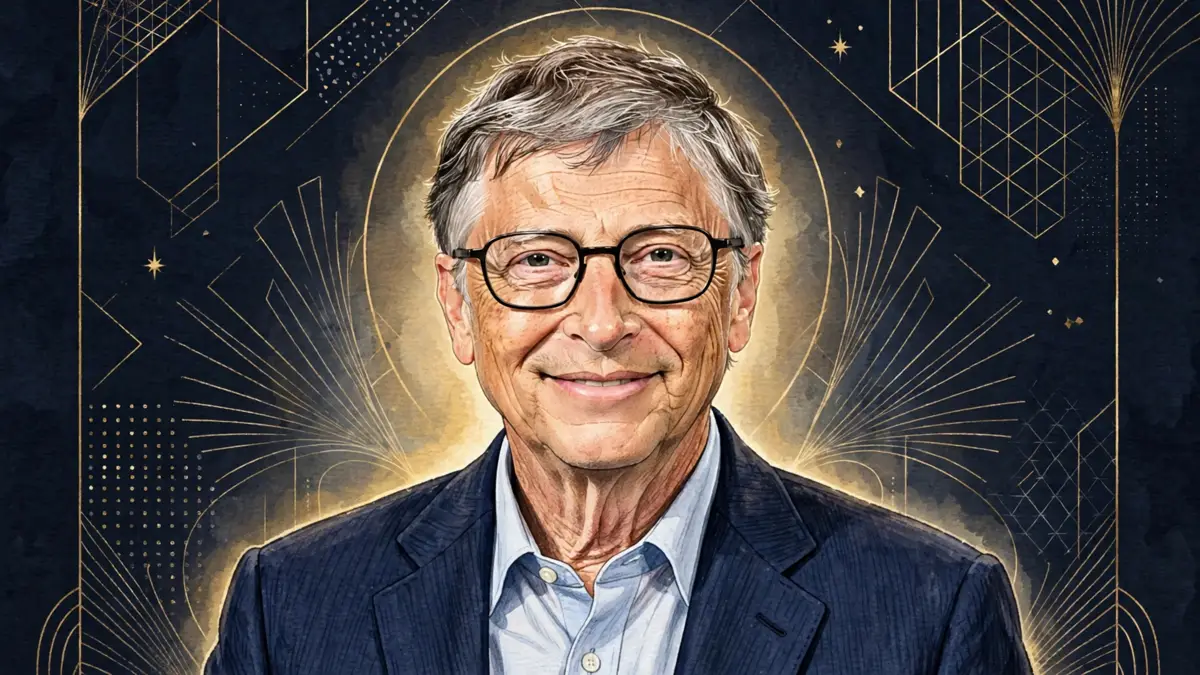
Bill Gates is 71 years old, and he is worth about $106.5 billion. That is the figure Forbes published in July 2026, when it ranked him the 19th-wealthiest person in the world. It is also a number he is trying hard to make smaller. In May 2025, Gates announced he would give away 99 percent of his remaining fortune through the Gates Foundation, which is now scheduled to spend more than $200 billion and close its doors on December 31, 2045.
This biography covers the full arc: a restless kid in Seattle who wrote his first program at 13, the Harvard dropout who built Microsoft with Paul Allen, the richest man on earth for 13 straight years, and the philanthropist who now says he does not want to die rich. Every money figure below is tied to a named source, and where the trackers disagree, we say so plainly.
| Full Name | William Henry Gates III |
|---|---|
| Date of Birth | October 28, 1955 (age 71 as of November 2026) |
| Birthplace | Seattle, Washington, United States |
| Estimated Net Worth | About $106.5 billion (Forbes, July 2026); Forbes’ March 2026 annual list put him at $108 billion, and real-time trackers ranged roughly $103–$120 billion through 2026 |
| Primary Income Sources | Microsoft shares and dividends; Cascade Investment portfolio; TerraPower and Breakthrough Energy ventures; book royalties |
| Key Ventures and Works | Microsoft (co-founder, 1975); Gates Foundation (chair); Cascade Investment; TerraPower; Breakthrough Energy; author of Source Code: My Beginnings (2025) |
Table of Contents
- Early Life in Seattle: A Restless Kid With a Computer Habit
- Lakeside, Harvard, and the Decision to Leave
- Founding Microsoft: BASIC, Albuquerque, and the Big Bet
- Windows, the PC Boom, and the Richest Man in the World
- How His Fortune Grew — and Shrank on Purpose
- Where the Money Sits Now: Cascade, Microsoft Stock, and Real Estate
- The Gates Foundation: Giving It Away
- The 2045 Plan: Giving Away 99 Percent
- Personal Life: Family, Divorce, and Life After Melinda
- Beyond Microsoft and the Foundation: TerraPower, Breakthrough Energy, and Books
- 2025–2026: Source Code, the AI Essay, and a New Chapter
- The Epstein Association: What the Record Shows
- Bill Gates Biography: Frequently Asked Questions
- Final Thoughts: The Man Who Plans to Die (Almost) Broke
- Sources and Reporting
Early Life in Seattle: A Restless Kid With a Computer Habit
William Henry Gates III was born on October 28, 1955, in Seattle, Washington. He was the middle child and only son of William H. Gates Sr., a prominent Seattle attorney, and Mary Maxwell Gates, a schoolteacher who went on to serve on civic and corporate boards, including the University of Washington Board of Regents. His older sister Kristi and younger sister Libby grew up with him in a comfortable, book-filled household in the city’s Laurelhurst neighborhood, where dinner-table talk ran toward law, business, and community work.
By his own account, and in the telling of his 2025 memoir Source Code: My Beginnings, young Bill was a handful: bright, argumentative, restless, and prone to long stretches of rocking in his chair while he thought. His parents worried about him enough to send him to a therapist, and they tried to channel the energy into books, family trips, and the Boy Scouts. What finally caught his attention was not a sport or a hobby but a machine. In 1968, when Gates was 13, his private school, Lakeside, installed a teletype terminal connected to a General Electric mainframe. He wrote his first program on it, a game of tic-tac-toe, and he was hooked.
The computer habit quickly became an obsession. Gates and his classmates spent hours on the terminal, and when the school’s computer budget ran out, they found workarounds. Along with Paul Allen, a Lakeside student two years his senior, Gates learned to exploit bugs in the system run by the Computer Center Corporation, the company that sold Lakeside its computer time. The company caught them, banned them, and then did something that shaped both boys’ lives: it hired them to find the bugs instead. Gates was a teenager being paid to break and fix software, and the lesson stuck — a computer was not a toy but a tool you could bend to your will if you understood it well enough.
Two early episodes from those years still echo through his story. The first was Traf-O-Data, a small company Gates, Allen, and their friend Paul Gilbert started to count traffic data for local governments using a machine that read punched paper tape. It made modest money and taught them how a business worked. The second was a loss: Kent Evans, Gates’s best friend at Lakeside and his partner in early programming projects, died in a mountaineering accident in 1972 while still in high school. Gates writes in Source Code that Evans’s death left a mark on him that never fully faded, and that it sharpened his sense that time was not to be wasted.
Lakeside, Harvard, and the Decision to Leave
Gates graduated from Lakeside in 1973 and enrolled at Harvard University that fall, where he lived in Wigglesworth Hall and registered as a pre-law student, partly to please his father. He was a strong student — he scored 1590 out of 1600 on the SAT, a figure he has mentioned in interviews — but Harvard never held his attention the way the computer room had. He spent his nights in the university’s computer center, played poker until dawn, and took mathematics and computer science courses that interested him while skipping the ones that did not.
It was at Harvard that he met Steve Ballmer, a fellow student who lived down the hall and who would later run Microsoft as its chief executive. The two became close friends, and Ballmer’s energy and bluntness matched Gates’s own intensity. But the friendship that mattered most to the next step was the older one, with Paul Allen, who had left Washington State University and was working in Boston for Honeywell. The two kept talking about the idea that had been forming since Lakeside: computers were about to get small and cheap, and somebody was going to have to write the software for them.
The moment came in December 1974, when Allen showed Gates the January 1975 issue of Popular Electronics with the Altair 8800 microcomputer on its cover. Gates called Ed Roberts, the head of MITS, the company that made the Altair, and told him they had a version of the BASIC programming language ready for his machine. They did not. Over the next eight weeks, Gates and Allen — with help from Harvard student Monte Davidoff — wrote one anyway, working around the clock in Harvard’s computer lab and testing the code on a simulator because they did not own an Altair. When Allen flew to Albuquerque to show it to Roberts, it worked on the first try. Gates left Harvard in the spring of 1975, during his sophomore year, and never went back for a degree. Harvard awarded him an honorary degree in 2007, when he gave the commencement address.
Founding Microsoft: BASIC, Albuquerque, and the Big Bet
Microsoft was founded on April 4, 1975, in Albuquerque, New Mexico, where MITS was based. Gates was 19 and Allen was 22. The company name, first written “Micro-Soft,” was a contraction of “microcomputer software,” and the hyphen fell away within a year. Their first product was Altair BASIC, and their first customers were hobbyists who built their own machines from kits. It was a tiny business, and for the first few years it stayed that way: a handful of programmers, long hours, and Gates’s famously combative management style, in which he grilled employees on their code and their assumptions until he was satisfied.
The deal that changed everything arrived in 1980, when IBM asked Microsoft to supply an operating system for its new personal computer. Gates did not have one ready, so he bought the rights to an existing system, 86-DOS, from Seattle Computer Products for $50,000, adapted it with his team, and licensed it to IBM as MS-DOS. The masterstroke was in the terms: unlike most software suppliers of the era, Microsoft kept the right to license MS-DOS to other computer makers. When IBM’s machine took off and clone makers flooded the market, every one of them needed Microsoft’s operating system. The company moved its headquarters to Bellevue, Washington, in 1979, then to nearby Redmond, where its campus still sits today.
Those early years also set the pattern of Gates’s working life. He was the company’s chief programmer and its chief salesman at the same time, writing code at night and negotiating licenses by day. He expected the same from everyone around him. The stories from that period — the all-night coding sessions, the blunt memos, the shouting matches over a single line of code — are now part of tech folklore, and Gates himself has said the intensity was part of the point. Microsoft was not trying to be a nice place to work. It was trying to put a computer on every desk, and in his telling, that was worth the friction.

Windows, the PC Boom, and the Richest Man in the World
MS-DOS made Microsoft rich. Windows made it untouchable. The first version of Windows arrived in 1985, and though it was rough, it pointed in the direction Gates had believed in since Lakeside: computing would be graphical, visual, and usable by people who had never written a line of code. Windows 3.0, released in 1990, sold millions of copies and turned the PC into a mass-market product. Windows 95, launched on August 24, 1995, with a marketing campaign that included midnight store openings and a Rolling Stones soundtrack, sold seven million copies in its first five weeks.
By then Gates was no longer just a software executive. He was the face of the PC revolution, and the richest man in it. Microsoft went public on March 13, 1986, at $21 a share, and Gates’s stake was valued at roughly $234 million on the day. A year later, in 1987, Forbes listed him as a billionaire with an estimated $1.25 billion, the youngest self-made billionaire in the world at 31. In 1995, Forbes ranked him the world’s wealthiest person for the first time, a title he held for 13 consecutive years through 2007 and for 18 of the 24 years from 1995 to 2017. In 1999, his net worth briefly passed $100 billion, making him the first centibillionaire in history, according to Forbes.
Success brought scrutiny. In 1998, the United States Department of Justice sued Microsoft, accusing it of using its Windows monopoly to crush the Netscape browser. The trial ran for years and produced some of the most damaging testimony of Gates’s career, including video depositions in which he sparred with government lawyers over the meaning of ordinary words. In 2000, a federal judge ordered the company broken in two. The order was overturned on appeal, and the case ended in a settlement in 2001, but the episode left a lasting dent in Gates’s public image and in Microsoft’s freedom to move. Gates stepped down as chief executive in January 2000, handing the job to Steve Ballmer, and stayed on as chief software architect and chairman.
He gave up the chairman’s role in February 2014, when Satya Nadella became chief executive, and stayed on the board as a technology adviser. On March 13, 2020 — 34 years to the day after the IPO — he left the Microsoft board entirely, saying he wanted to devote himself to philanthropy. By then his remaining Microsoft stake was under 1 percent of the company, according to Forbes, after decades of steady share sales that had funded his investment company and his foundation.
How His Fortune Grew — and Shrank on Purpose
Gates’s wealth story is unusual because it runs in two directions. For the first 25 years it climbed almost without pause, riding Microsoft’s rise from a startup to the most valuable company in the world. For the last 25 years it has been deliberately spent down, through gifts to the foundation and a public promise to give nearly all of it away. The dated Forbes figures below tell that story better than any single number can.
| Year | What Forbes Recorded |
|---|---|
| 1986 | $315 million — Gates debuts on the Forbes 400 the year Microsoft goes public |
| 1987 | $1.25 billion — the world’s youngest self-made billionaire, at 31 |
| 1995–2007 | World’s richest person for 13 consecutive years (Forbes) |
| 1999 | Net worth briefly passes $100 billion — the first centibillionaire |
| 2021 | $134 billion on the Forbes 400, still ranked fourth in America |
| March 2026 | $108 billion on Forbes’ annual World’s Billionaires list, ranked 19th |
| July 2026 | $106.5 billion (Forbes), ranked 19th in the world |
Two things are worth noting about the 2026 figures. First, Forbes and Bloomberg have disagreed about Gates more than about almost any other billionaire, because so much of his wealth sits inside Cascade Investment, his private holding company, which discloses almost nothing. In July 2025, Bloomberg’s index cut its estimate of his fortune from about $175 billion to about $124 billion in a matter of days after changing how it counted his past charitable gifts, while Forbes never had him above roughly $108 billion in the same period. Second, the range of published 2026 estimates is wide: Forbes’ February 2026 real-time figure was $107.7 billion, its March annual list said $108 billion, and some real-time trackers moved higher in the autumn as Microsoft shares rose. The honest summary is a range of roughly $103–$120 billion through 2026, anchored on Forbes’ July 2026 figure of $106.5 billion. That is the number this biography uses, and it is the number to quote with its date attached.
The comparison that tells the story: on Forbes’ March 2026 annual list, Gates’s old Microsoft colleague Steve Ballmer ranked 15th at an estimated $126 billion, ahead of Gates at 19th with $108 billion. Ballmer kept far more of his Microsoft stock. Gates gave his away — and that is the point of the second half of this biography.
Where the Money Sits Now: Cascade, Microsoft Stock, and Real Estate
Almost none of Gates’s fortune is a salary or a bank balance. It is a portfolio, run through a private investment firm called Cascade Investment, which he founded in 1995 to manage the proceeds of his Microsoft share sales. Cascade holds stakes in a spread of businesses — among the best known are the Four Seasons hotel group, the Canadian National Railway, the waste company Republic Services, and the water and hygiene firm Ecolab — along with farmland, bonds, and other assets that are rarely disclosed in detail. Because Cascade files almost nothing publicly, outside estimates of its size are educated guesses, and that is the main reason Forbes and Bloomberg land so far apart on Gates.
His Microsoft holding is the one piece that can be counted in public. According to Barron’s, Gates personally held about 103 million Microsoft shares in May 2026, worth around $43 billion at the time. By mid-October 2026, with Microsoft’s share price near $543, that same holding would have been worth roughly $55.9 billion, assuming he had not sold any shares in between. Gates has been selling Microsoft stock steadily for decades, and the foundation’s trust sold its remaining 7.7 million Microsoft shares in the first quarter of 2026, according to TheStreet. The direction of travel is one way: out of Microsoft, into Cascade, and from Cascade into the foundation.
His most famous asset is a house. Xanadu 2.0, his estate in Medina, Washington, on the shore of Lake Washington, covers about 66,000 square feet, took seven years to build, and cost about $63 million. It has an underground garage for his car collection, a 60-foot swimming pool with its own underwater music system, and a library with a domed reading room. Gates also owns farmland across the United States — he is one of the country’s largest private farmland owners — and homes in California and Florida, including a horse farm in Wellington, Florida, bought for his daughter Jennifer, a competitive equestrian. None of these properties is the source of his wealth, but they are where a visible part of it sits.
The Gates Foundation: Giving It Away
Gates’s second career began while the first was still running. In 1994, he and Melinda set up the William H. Gates Foundation, and in 2000 they folded it together with the Gates Learning Foundation to create the Bill & Melinda Gates Foundation, now renamed the Gates Foundation. Its focus was global health: vaccines, malaria, polio, HIV, and the basic fact that a child born in a poor country died far more often from preventable causes than a child born in a rich one. The foundation has since given away more than $100 billion, according to reporting on its 25th anniversary in May 2025, and it backs the vaccine alliance Gavi and the Global Fund to Fight AIDS, Tuberculosis and Malaria, among many other programs.
The foundation’s scale was transformed in 2006, when Warren Buffett, Gates’s close friend and bridge partner, pledged Berkshire Hathaway stock then worth about $31 billion — the largest charitable gift of its kind — and began giving it in annual installments. Buffett’s gifts have added tens of billions to the foundation’s resources over the years, and Gates has said plainly that the foundation’s reach would be far smaller without them. That partnership frayed in 2026: in July of that year, Buffett redirected his annual stock gift to four family foundations, excluding the Gates Foundation for the first time since the arrangement began, a move the Associated Press linked to the renewed scrutiny of Gates’s past association with Jeffrey Epstein. The foundation’s own money, meanwhile, kept flowing. Its governing board approved a budget of $8.74 billion for 2025, the largest in its history, and a payout of about $9 billion for 2026.
The foundation’s work is not without critics. Some public-health researchers argue that a single private foundation has too much say over global health priorities, and that its focus on vaccines and technology can crowd out spending on health systems and workers. Gates’s answer, given over many years in interviews and on his blog, is that results are the test: child mortality has fallen sharply since 2000, polio is close to eradication, and the foundation’s money goes where governments and markets do not. Readers can weigh that argument for themselves; the record of what was spent, and on what, is published in the foundation’s own annual reports.
The 2045 Plan: Giving Away 99 Percent
On May 8, 2025, the foundation’s 25th anniversary, Gates published an essay on his blog, Gates Notes, titled “The Last Chapter of My Career.” In it he announced that he would give away 99 percent of his remaining fortune — then valued at about $107 billion — and that the foundation would spend more than $200 billion over the next 20 years before closing permanently on December 31, 2045. The foundation had originally been chartered to wind down decades after the deaths of its founders. Gates moved the date up, writing that he did not want to “die rich,” a line he borrowed from Andrew Carnegie’s 1889 essay “The Gospel of Wealth.”
The plan changes the shape of his biography. The foundation’s board endorsed an annual payout of about $9 billion in January 2026, and the foundation has said it expects to spend about $200 billion before it closes, with the final figure depending on markets and inflation. Gates has also said his own net worth will fall by 99 percent over the same period, which means the Forbes ranking that defined him for two decades will slide year by year until there is not much left to rank. His three children, he has said, will inherit less than 1 percent of the fortune — a decision he repeated in a 2025 interview with the entrepreneur Raj Shamani, noting that even a fraction of 1 percent of a fortune this size is still an enormous inheritance.
None of this is a promise he can be forced to keep, and the numbers will move with the markets. But the structure is now in place: a fixed closing date, a board-approved spending plan, and a chair who has said his job is to spend the money, not to keep it. For a man who spent the first half of his life accumulating the largest fortune of his generation, the second half is a long, public exercise in giving it away.
Personal Life: Family, Divorce, and Life After Melinda
Gates married Melinda French on January 1, 1994, in a ceremony on the Hawaiian island of Lanai. She had joined Microsoft in 1987 as a product manager, and the two had dated for several years before marrying. They had three children: Jennifer, born in 1996; Rory, born in 1999; and Phoebe, born in 2002. For more than two decades they were a partnership in every sense — parents, co-founders of the foundation, and the public face of a new kind of billionaire philanthropy.
That partnership ended in public on May 3, 2021, when the couple announced they were divorcing after 27 years of marriage, saying they no longer believed they could grow together as a couple. The divorce was finalized on August 2, 2021. As part of the settlement, Gates agreed to a $12.5 billion commitment to Melinda French Gates’s own philanthropic vehicle, Pivotal Philanthropies Foundation, and tax filings reported by the New York Times showed he transferred $7.88 billion to it in 2024 alone. Melinda announced in May 2024 that she would step down from the Gates Foundation, effective June 7, 2024, leaving Gates as its sole chair, and the foundation was renamed the Gates Foundation in its 25th anniversary year.
Gates has kept his private life mostly out of view since the divorce, though he has spoken in interviews about the pain of the split and about staying close to his children, all three of whom are now adults. Jennifer, an accomplished equestrian, is married with children of her own. Rory keeps a low profile. Phoebe, the youngest, has spoken publicly about growing up as a Gates and about her own work in fashion and media. For readers curious about the smaller details of the story, our sister site GuideNetWorth has a full breakdown of how tall Bill Gates is, a question that comes up more often than you might expect for a man best known for sitting at a computer.
Beyond Microsoft and the Foundation: TerraPower, Breakthrough Energy, and Books
Gates’s post-Microsoft business life runs through a handful of vehicles that reflect what he cares about now: energy, climate, and health. TerraPower, the nuclear energy company he founded in 2006, is building a Natrium reactor in Kemmerer, Wyoming, a project that began construction in June 2024 and is meant to show that advanced nuclear power can be built at a reasonable cost. Breakthrough Energy, founded in 2015, backs clean-energy startups and technologies that struggle to attract ordinary venture capital because they take too long to pay off. Gates Ventures, his private office, manages his personal investments and the staff who run his public work.
He is also an author, and a more prolific one than most people realize. The Road Ahead (1995) laid out his vision of the internet age; Business @ the Speed of Thought (1999) was a management book; How to Avoid a Climate Disaster (2021) argued that innovation, not sacrifice alone, would solve climate change; and How to Prevent the Next Pandemic (2022) drew lessons from COVID-19. His memoir, Source Code: My Beginnings, published February 4, 2025, by Knopf, covers his childhood in Seattle through the early days of Microsoft, and he has said he plans two more volumes — one on his software career, not expected before 2027 at the earliest, and one on his philanthropy. He donates the proceeds of the memoir to the United Way.
His reading habit is famous in its own right. Gates reads about 50 books a year and posts reviews on Gates Notes, and his annual lists of recommended reads are followed by millions of readers. It is a small detail, but it fits the pattern of the whole biography: the kid who read his way through his parents’ bookcases never stopped.
2025–2026: Source Code, the AI Essay, and a New Chapter
The last two years have been among the most public of Gates’s life, and not always in ways he chose. The memoir landed in February 2025 to strong reviews, with the Associated Press calling it the first installment of a trilogy retracing his journey “from an often misunderstood kid to a polarizing technology titan to an influential philanthropist.” The 2045 giving announcement followed three months later. Then, on August 26, 2026, he published a roughly 6,000-word essay on Gates Notes, “The Turbulent AI Era Is Here. The Choices We Make Now Are Critical,” the first in a planned series.
The essay marked a shift in his public stance on artificial intelligence. Where he had once described himself as an AI optimist with reservations, he now argued that AI would be “the greatest equalizer ever invented, or the worst source of injustice,” and that no government had a credible plan for the transition. He named three risks: permanent job displacement, as AI substitutes for thinking rather than muscle, hitting entry- and mid-level work in law, medicine, software, and customer service within a decade; the misuse of AI for cyberattacks, fraud, deepfakes, and biological threats; and harm to children and relationships, as agreeable AI companions deprive young people of the friction — disagreement, rejection, negotiation — that builds social skill. His proposals were threefold: new national and international institutions modeled on nuclear inspection, aviation regulation, and the ozone agreements; “Human Reserved” domains deliberately set aside for people, the way land is set aside from development; and a rebalancing of taxation so the code no longer nudges an employer toward replacing a person with a machine.
The essay drew wide coverage and a formal response from the Boston Global Forum, among others, and it set the tone for his current public role: no longer a CEO, no longer the world’s richest man, but a wealthy elder statesman using his platform to argue about the future. He is 71, he chairs a foundation with a closing date, and he is writing books about a life that is still, by his own account, unfinished.
The Epstein Association: What the Record Shows
No honest biography of Bill Gates in 2026 can skip his association with Jeffrey Epstein, and the record is now documented in unusual detail. Gates met Epstein repeatedly from 2011 through 2014, after Epstein had pleaded guilty to Florida sex offenses and registered as a sex offender. Gates has said the contact was about philanthropy: Epstein claimed he could persuade extremely wealthy clients to give billions to global health, and the two discussed a donor-advised fund that would pool those gifts. The fund was never created, and Gates has said he ended contact with Epstein in December 2014.
On June 10, 2026, Gates gave a closed-door transcribed interview to the House Committee on Oversight and Government Reform, appearing voluntarily. In prepared opening remarks, he called meeting Epstein “a grave error in judgment,” said he “never witnessed nor had any indication that Epstein was engaged in ongoing criminal conduct,” and said he had never gone to Epstein’s island, ranch, or Florida home and had “never victimized anyone.” The committee’s chairman, James Comer, said no one was accusing Gates of wrongdoing, and Gates has not been accused of wrongdoing in connection with Epstein.
Separately, the Gates Foundation commissioned the law firm WilmerHale in March 2026 to review its own past engagement with Epstein. The review, published July 21, 2026, after more than 50 interviews, found no evidence that the foundation paid Epstein, and no evidence of participation in, or knowledge of, Epstein’s sex-trafficking operations. It confirmed roughly 30 meetings between Epstein and ten foundation leaders or staff from 2011 to 2014, and said staff had raised concerns about the reputational risk of the association. The review did not cover Gates’s personal communications or his private interactions outside the foundation. The foundation’s board approved new vetting and governance measures in response. Reporting on the testimony also noted that Gates acknowledged past extramarital affairs, which he has said contributed to the end of his marriage. That is what the public record shows, and this biography reports it without adding to it.
Bill Gates Biography: Frequently Asked Questions
How old is Bill Gates?
Bill Gates is 71 years old. He was born William Henry Gates III on October 28, 1955, in Seattle, Washington, and turned 71 on October 28, 2026.
What is Bill Gates’ net worth in 2026?
Forbes estimated Bill Gates’ net worth at $106.5 billion in July 2026, ranking him the 19th-wealthiest person in the world. Forbes’ March 2026 annual list put him at $108 billion. Published estimates ranged roughly $103–$120 billion through 2026, because so much of his wealth sits inside Cascade Investment, his private holding company, which discloses almost nothing — Forbes and Bloomberg have disagreed sharply about the total.
How did Bill Gates make his money?
Gates made his fortune by co-founding Microsoft with Paul Allen in 1975. The company sold the BASIC programming language, then MS-DOS to IBM in 1980, then Windows, which became the operating system for most of the world’s personal computers. Microsoft’s 1986 IPO valued his stake at roughly $234 million, and by 1987 he was a billionaire. Since then, the money has grown through Cascade Investment, his private investment firm, which holds stakes in companies such as Four Seasons, Canadian National Railway, and Republic Services.
Is Bill Gates still involved with Microsoft?
No. Gates stepped down as chief executive in January 2000, gave up the chairman’s role in February 2014, and left the Microsoft board entirely on March 13, 2020, to focus on philanthropy. He still owns Microsoft shares — about 103 million shares, worth around $43 billion in May 2026 according to Barron’s — but that is under 1 percent of the company, and he holds no executive or board role.
Why is Bill Gates giving away 99 percent of his fortune?
In May 2025, Gates announced that he would give away 99 percent of his remaining fortune through the Gates Foundation, which is scheduled to spend more than $200 billion and close on December 31, 2045. He wrote that he did not want to “die rich,” borrowing the phrase from Andrew Carnegie’s 1889 essay “The Gospel of Wealth,” and said the money would do more good spent now on global health and poverty than held in an institution that lasts forever.
What does the Gates Foundation do?
The Gates Foundation, founded in 2000 and renamed in its 25th anniversary year, funds global health and development: vaccines, malaria and polio eradication, HIV and tuberculosis programs, agricultural development, and education in the United States. It has given away more than $100 billion since it began, and its 2025 budget was $8.74 billion, the largest in its history. Warren Buffett’s gifts, pledged in 2006, added tens of billions to its resources.
Is Bill Gates still married?
No. Bill and Melinda French Gates divorced in 2021 after 27 years of marriage; the divorce was finalized on August 2, 2021. They have three children: Jennifer (born 1996), Rory (born 1999), and Phoebe (born 2002). Melinda left the foundation in June 2024, and Gates is now its sole chair. He has said his children will inherit less than 1 percent of his fortune.
What is Bill Gates doing now in 2026?
Gates chairs the Gates Foundation, runs the nuclear energy company TerraPower and the climate investment group Breakthrough Energy, and writes. His memoir Source Code: My Beginnings came out in February 2025, with two more volumes planned. In August 2026 he published a 6,000-word essay on Gates Notes, “The Turbulent AI Era Is Here. The Choices We Make Now Are Critical,” warning about AI-driven job loss, misuse, and harm to children, and calling for new institutions and “Human Reserved” domains set aside for people.
Final Thoughts: The Man Who Plans to Die (Almost) Broke
Bill Gates has lived two large lives in one lifetime. The first made him the richest person on earth: a teenager who saw the personal computer coming before almost anyone, a founder who turned a $50,000 operating system into an empire, and a chief executive who held the top spot on the Forbes list for 13 straight years. The second is giving it all away, on a timetable he set himself, with a closing date written into the foundation’s charter.
What ties the two halves together is the same trait his teachers noticed at Lakeside: a refusal to accept the world as it is. As a boy it was a computer terminal; as a young man it was an industry; as an older man it is child mortality, malaria, and the shape of the AI age. Whether the 2045 plan succeeds is a question for the next two decades. What is already clear is that the fortune Forbes counted at $106.5 billion in July 2026 is not a pile Gates intends to keep. It is a pile he intends to spend — and the biography of Bill Gates, for the first time, has an ending he wrote himself.
Sources and Reporting
How we estimated: Net worth figures in this article are estimates, not audited facts. We anchor on Forbes, whose July 2026 figure of $106.5 billion is the most recent dated estimate we could verify, and we report the range of published 2026 estimates (roughly $103–$120 billion) because Forbes and Bloomberg disagree sharply about Gates’s private holdings. Figures change daily with Microsoft’s share price and with the timing of his charitable gifts, so treat any single number as a snapshot with a date attached, not a fixed fact.
Named sources consulted for this biography include Forbes, Bloomberg, Gates Foundation, Gates Notes, Wikipedia, Associated Press, Reuters, Penguin Random House, Barron’s, and TheStreet. Where a figure or claim could not be tied to a named source, it was left out. Corrections can be sent to the CelebAmerica editorial team through the site’s contact page.