Luka Modric’s net worth is estimated at $75 million as of November 2026. That is the figure published by Celebrity Net Worth in its November 6, 2026 snapshot of the Croatian midfielder, and it lines up with the rest of the serious reporting on his money: independent estimates published in 2026 put him in a band from $70 million to $95 million, with SurpriseSports landing on $75 million to $90 million. The $75 million anchor is the number most outlets agree on, and it is the figure this article uses throughout.
Modric, 41, is still playing at the top level. After thirteen seasons at Real Madrid, where he became the most decorated player in the club’s history, he joined AC Milan on a free transfer in July 2025 and signed on for another season in July 2026, keeping him at San Siro through June 2027. His fortune was built the old-fashioned way for a footballer: two decades of elite wages, a Ballon d’Or, and a careful, low-key approach to the money that came with it. Player net worth figures are never audited, and Modric has never published his finances, so every number here is an estimate drawn from named sources — and where those sources disagree, this article says so and shows the range.
By Celebamerica Editorial Staff | Last updated: November 20, 2026
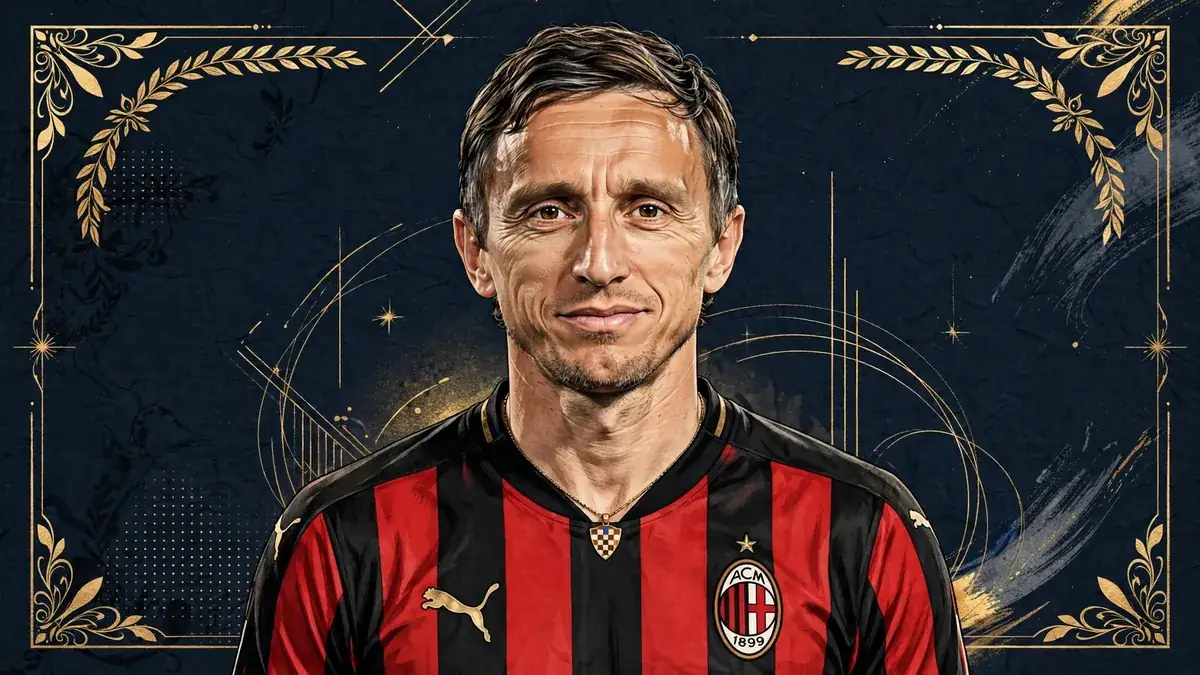
| Full Name | Luka Modrić |
|---|---|
| Date of Birth | September 9, 1985 |
| Birthplace | Zadar, Croatia |
| Age | 41 (as of November 2026) |
| Height | 1.72 m (5 ft 8 in) |
| Position | Central midfielder |
| Current Club | AC Milan (joined July 2025; contract through June 2027) |
| Estimated Net Worth | $75 million (Celebrity Net Worth, November 2026 snapshot; reported range $70M–$95M) |
| Career Gross Salary | Approximately $221.3 million (Capology) |
| Primary Income Sources | Club salaries, endorsements (Nike), image rights, investments |
| Major Honours | Ballon d’Or 2018, 6× UEFA Champions League, 2018 World Cup Golden Ball |
| Wife | Vanja Bosnić (married May 2010) |
| Children | Ivano, Ema and Sofia |
Table of Contents
- Early Life: From War-Torn Zadar to Dinamo Zagreb
- The Tottenham Years: Proving Himself in England
- Real Madrid: Thirteen Seasons and 28 Trophies
- The Ballon d’Or Year: 2018
- The AC Milan Move and the 2026–27 Season
- How Much Luka Modric Earns: Salary Breakdown
- Endorsements and Business Ventures
- How the Fortune Was Built: Net Worth Growth
- Houses, Cars and Lifestyle
- Personal Life: Wife Vanja and the Family
- Controversies and Legal Matters
- Frequently Asked Questions
- Final Thoughts: The Bottom Line
- Sources and Reporting
Early Life: From War-Torn Zadar to Dinamo Zagreb
Luka Modric was born on September 9, 1985, in Zadar, a port city on Croatia’s Adriatic coast, to Stipe Modric and Radojka Modric. He grew up in the small village of Zaton Obrovacki, near Obrovac, where his father worked as an aeromechanic in the Croatian Army and his mother worked in textiles. The family lived a modest rural life, and the young Luka played football with a ball his grandfather had given him, kicking it around the stone streets and the hillside behind the family home.
His childhood was broken open by the Croatian War of Independence. In December 1991, when Luka was six, his grandfather — also named Luka Modric — was killed by Serb rebels near the family home. The family fled Zaton Obrovacki and spent years living as refugees in Zadar, housed in the Hotel Kolovare, where Luka played football in the hotel car park with other displaced children. It is the defining chapter of his life story, and one he has spoken about rarely and plainly: football was the thing that stayed constant while everything else was taken away.
Coaches at NK Zadar noticed the boy first. He was small, slight, and technically far ahead of players his age, with a first touch and a range of passing that looked fully formed before he was a teenager. Dinamo Zagreb, Croatia’s biggest club, signed him to their youth academy in 2000, when he was fifteen. He was loaned out to gain senior experience — first to Zrinjski Mostar in Bosnia in 2003–04, where he was named the Bosnian Premier League Player of the Year at eighteen, then to Inter Zapresic in 2004–05, where he helped the small club to a second-place league finish and was named Croatian Football Hope of the Year.
He broke into Dinamo’s first team in 2005 and spent three seasons as the side’s creative hub, winning three straight Croatian league titles in 2006, 2007 and 2008 and being named Croatian Footballer of the Year in 2007. By the summer of 2008 he had outgrown the Croatian league entirely. The fee that took him to England was reported at around £16.5 million, a record sale for Dinamo Zagreb at the time and a sum that already hinted at the scale of the career — and the earnings — that would follow.
The Tottenham Years: Proving Himself in England
Modric signed for Tottenham Hotspur in July 2008, and the first months in London were not easy. The Premier League was faster and more physical than anything he had known, the language was new, and the club started the 2008–09 season so badly that manager Juande Ramos was sacked in October. Some English pundits wrote the slight Croatian off as too lightweight for the league. Harry Redknapp, who replaced Ramos, disagreed — and the decision that changed Modric’s career was Redknapp’s: he moved him from the wing into central midfield, where his passing range and his ability to receive the ball under pressure could run the game.
From that point, Modric became the player Tottenham built around. He made 160 appearances for the club and scored 17 goals, but the numbers understate his role. In the 2010–11 season he drove Spurs to the Champions League quarter-finals, outplaying the midfields of Inter Milan and AC Milan along the way, and his performances against the best teams in Europe put him on the radar of every major club on the continent. Chelsea tried to buy him in the summer of 2011; Tottenham refused, and Modric stayed one more season.
By 2012 the move was unavoidable. Real Madrid, the club he had dreamed of as a boy, came in with a fee reported at £30 million, and his wife Vanja — who had worked as his agent — helped close the deal. Four seasons in England had turned a talented teenager from Zadar into a proven Champions League midfielder, and the wages in Madrid would be a step up from anything Tottenham had paid him. The money story of Luka Modric starts in earnest here, in August 2012.
Real Madrid: Thirteen Seasons and 28 Trophies
Modric signed for Real Madrid on August 27, 2012, and made his debut two days later in the Spanish Super Cup against Barcelona. The first season was uneven — Madrid finished second in La Liga and lost the Champions League semi-final to Borussia Dortmund — but from 2013–14 onward, he became one of the first names on the team sheet, forming a midfield trio with Toni Kroos and Casemiro that would dominate European football for the better part of a decade. La Decima, Madrid’s tenth European Cup, arrived in 2014 with a 4–1 extra-time win over Atletico Madrid in Lisbon, and Modric’s corner set up Sergio Ramos’s stoppage-time equaliser.
The trophy count that followed is the stuff of record books. Modric won the Champions League six times — in 2014, 2016, 2017, 2018, 2022 and 2024 — along with four La Liga titles, two Copas del Rey, five Spanish Super Cups, five UEFA Super Cups, five Club World Cups and the 2024 FIFA Intercontinental Cup. Twenty-eight trophies in all, more than any player in Real Madrid’s history. He made 597 appearances for the club and scored 43 goals, and his final season, 2024–25, ended with a farewell at the Bernabeu in May 2025, when supporters and teammates saluted a player who had arrived as a £30 million signing and left as a club legend.
The Madrid years are also where the bulk of his fortune was earned. Capology, the football salary database, puts his gross fixed career salary at roughly $221.3 million, and the overwhelming share of that figure comes from his thirteen seasons in Spain, where his pay rose with each contract renewal and each new trophy. His final season at the Bernabeu carried an estimated gross base wage of €10.42 million, according to Capology — a figure that reflects a veteran on a reduced, year-by-year deal rather than the peak earnings of his prime, when Spanish reporting put his annual pay, including bonuses, at €10 million to €12 million.

He shared the Bernabeu dressing room with the biggest names of his generation, and the comparisons followed him everywhere. Jude Bellingham, the English midfielder who arrived at Madrid in 2023, is the player most often cast as the heir to Modric’s role in the side — younger, more physical, and learning the same craft of controlling games from the middle of the pitch. Vinicius Junior, the Brazilian winger who broke through alongside Modric in his later Madrid seasons, was one of the teammates who benefited most from Modric’s passing, and the two shared the 2022 and 2024 Champions League triumphs. Madrid’s midfield changed around Modric over thirteen years; he was the constant.
What made him last, by every account from coaches and teammates, was professionalism. He trained the same way at 39 as he had at 25, kept his weight at around 66 kilograms on a 1.72-metre frame, and adapted his game as his legs slowed — dropping deeper, passing earlier, letting his reading of the game do the running. That discipline is also the simplest explanation for his finances: a thirteen-year run at the top of the world’s richest club, with no public extravagance to eat into it.
The Ballon d’Or Year: 2018
If one year explains both Modric’s fame and his fortune, it is 2018. That summer he captained Croatia to the World Cup final in Russia, the best result in the country’s history, and was named the tournament’s best player, winning the Golden Ball. Croatia lost the final 4–2 to France, but Modric’s performances — three goals, including a stunning strike against Argentina in the group stage, and a midfield display that carried a nation of four million people to within one game of the title — made him the story of the tournament.
He returned to Madrid and won a third straight Champions League, then collected the individual honours in sequence: UEFA Men’s Player of the Year in August, FIFA’s Best Men’s Player award in September, and the Ballon d’Or in December, presented in Paris. He was the first player other than Lionel Messi or Cristiano Ronaldo to win the Ballon d’Or in a decade, ending a run of ten straight awards shared between the two. The commercial value of that year was immediate — his profile, his endorsement appeal and his negotiating position all rose sharply — and it is the year most often cited when people ask how a midfielder, rather than a goalscorer, built a fortune in the region of $75 million.
The Ballon d’Or also reset the way Modric is talked about in money terms. Before 2018 he was respected; after it, he was a global brand in his own right, the face of Croatian football and one of the most recognisable athletes in the world. For a sense of the scale at the very top of the game, Cristiano Ronaldo’s net worth story shows what the sport’s biggest earner built from the same era — Modric’s fortune is far smaller, but it was earned in the same dressing room, against the same opponents, over the same thirteen seasons.

He did not stop after 2018. Modric added two more Champions League titles, in 2022 and 2024, and led Croatia to third place at the 2022 World Cup in Qatar, winning the bronze medal match against Morocco. He has now played at five World Cups — 2006, 2014, 2018, 2022 and 2026 — and is Croatia’s most-capped player and captain, a role he has held since 2016. His 199th senior appearance for Croatia came against England in November 2026, and the Croatian Football Federation confirmed in September 2026 that he remained available for selection. Few players in the history of the game have stayed at the top for this long.
The AC Milan Move and the 2026–27 Season
When his Real Madrid contract ended in the summer of 2025, Modric had options. The Saudi Pro League was reported to be interested, as it has been for every ageing star of his generation, and there was talk of a return to Dinamo Zagreb or a move to Major League Soccer. He chose AC Milan instead, signing on a free transfer in July 2025, taking the number 14 shirt and describing the move as a football decision: Milan offered Serie A, the Champions League, and a club with a history that matched his own ambitions.
The initial deal ran through June 2026 with an option for a further season. On July 23, 2026, AC Milan announced that he had signed for another year, keeping him at the club until June 30, 2027. He was 40 when the extension was confirmed, and the fact that a club of Milan’s standing wanted him for a second season says as much about his conditioning as it does about his reputation. At 41, he is one of the oldest outfield players in Europe’s top five leagues, and still a regular starter.
The Milan contract is also the clearest window into what he earns now. Capology estimates his gross base wages at €6.48 million for the 2026–27 season, excluding bonuses — roughly $7.5 million at current exchange rates. Italian reporting puts his annual take-home pay at around €3.5 million, the gap between the two figures being Italy’s tax treatment of foreign players and the usual deductions. Either way, it is a long way below his Madrid peak, and it is consistent with a player in the final chapter of his career who chose the football over the biggest cheque on the table. The Saudi offers, had he taken one, would very likely have paid multiples of the Milan wage — and his net worth would look different today if he had.
The Milan decision, in money terms: Modric turned down far richer offers to join AC Milan in 2025. The choice cost him short-term earnings and probably added to his legacy — and it is the clearest evidence that the $75 million figure is a footballer’s fortune built on wages and longevity, not on a single windfall deal.
How Much Luka Modric Earns: Salary Breakdown
Modric has never disclosed his salary, and neither AC Milan nor Real Madrid publishes individual player pay. What follows is built from Capology’s salary database, the most widely cited public source for football wages, cross-checked against Italian press reporting on his Milan deal and the figures published by SureBets in July 2026. Capology’s numbers are estimates, and they cover fixed base pay — bonuses, image-rights payments and commercial income sit on top of them.
| Period | Club | Reported pay |
|---|---|---|
| 2005–2008 | Dinamo Zagreb | Modest early-career wages; not publicly disclosed |
| 2008–2012 | Tottenham Hotspur | Premier League wages, rising with each season; exact figures not publicly disclosed |
| 2012–2025 | Real Madrid | Peak annual pay of €10M–€12M including bonuses (Spanish press reporting); final season 2024–25 gross base €10.42M (Capology) |
| 2025–2026 | AC Milan | First Milan season on a free-transfer deal; terms not publicly disclosed |
| 2026–27 | AC Milan | €6.48M gross base wages, excluding bonuses (Capology); ~€3.5M annual take-home (Italian reporting) |
| Career total | All clubs | ~$221.3M gross fixed career salary (Capology) |
Two things stand out in that table. The first is the gap between gross career salary and net worth: $221.3 million in gross pay over a career, against a net worth of $75 million. That gap is normal for a footballer. Gross salary is taxed at high rates in Spain and Italy, agents take their share, and two decades of living — homes, family, travel, staff — absorb a large part of what remains. The $75 million figure is what is left after all of that, plus the value of his investments and property, minus any debts. Nobody outside Modric’s own circle knows the exact split, which is why honest reporting gives a range rather than a single precise number.
The second is how his pay has fallen with age, and how little that seems to have mattered to him. His Milan wage is roughly 40 percent below his final Madrid season, and far below the €10 million to €12 million he earned at his peak. Worked out from Capology’s €6.48 million annual figure, his 2026–27 gross pay comes to roughly €124,600 a week, or about €540,000 a month, before tax — and roughly €67,300 a week after tax on the Italian reporting of a €3.5 million take-home. Those are working figures derived from the reported annual numbers, not separate sources, and they are the best public guide to what the 41-year-old earns today.
On top of salary sit the extras that never appear in a wage database: Champions League win bonuses, appearance fees for Croatia, and the image-rights income that comes with being one of the most photographed footballers in the world. His long career at the highest level has generated more than $100 million in playing income alone, according to Celebrity Net Worth’s reporting, with the rest of his fortune coming from commercial work and investments.
Endorsements and Business Ventures
Modric has never chased the commercial spotlight the way some of his peers have. He has no fashion label, no boot line of his own, and no string of paid social media posts. What he does have is a long-term relationship with Nike, for whom he has been a global ambassador for years, wearing the brand’s boots throughout his Madrid and Milan careers and appearing in its campaigns. Athlon Sports, reporting on his finances in June 2026, named Nike as his headline endorsement and noted his investments alongside it. The exact value of the Nike deal is not public, and this article does not guess at it — but for a player of Modric’s standing, a multi-year boot deal with a major brand is typically worth seven figures over its life.
His most visible business move came in April 2025, when he became a co-owner of Swansea City, the Welsh club playing in England’s Championship. The announcement, made by the club that month, put Modric alongside the club’s American ownership group as a minority investor. It was a small stake rather than a takeover, and the price was not disclosed, but it marked his first public step into club ownership — and a signal about where his money may go after he stops playing. Swansea’s owners spoke at the time about Modric’s football knowledge being as valuable as his investment, and the deal fits a pattern seen across the game: players buying into clubs in the lower leagues while they are still active, then taking a bigger role when they retire.
Beyond Swansea and Nike, his business life is deliberately quiet. He has no widely reported restaurant chain, property empire or venture-capital portfolio, and his name does not appear in the kind of startup announcements that follow other footballers around. That may simply mean his affairs are private — he is famously guarded about his off-field life — or it may mean his wealth really is what it looks like: salary, carefully kept, plus a small number of chosen investments. Either reading points the same way: the $75 million estimate rests mostly on twenty years of wages, not on business deals.
How the Fortune Was Built: Net Worth Growth
There is no public record of Modric’s net worth year by year, and any article that prints one is inventing it. What can be shown honestly is the sequence of money events that built the fortune, and the range that the best sources agree on today.
| Stage | What happened | Money effect |
|---|---|---|
| 2008 | Move to Tottenham, reported £16.5M fee | First Premier League wages; first serious money |
| 2012 | Move to Real Madrid, reported £30M fee | Wages rise sharply; thirteen years at the top begin |
| 2014–2018 | Four Champions League titles in five seasons | Bonuses, renewals and a rising commercial profile |
| 2018 | Ballon d’Or, FIFA Best, World Cup Golden Ball | Peak earning power; endorsement value jumps |
| 2022–2024 | Two more Champions League titles; World Cup bronze | Late-career renewals on reduced terms; wealth consolidates |
| 2025 | Free transfer to AC Milan; Swansea City co-owner | Lower wages, first club investment |
| 2026 | Milan extension through June 2027 | Net worth estimated at $75M (Celebrity Net Worth) |
The honest way to read the $75 million figure is against the $221.3 million of gross career salary that Capology records. Roughly a third of a footballer’s gross pay surviving as net worth after tax, agents, living costs and two decades of family life is a plausible outcome — and it is the outcome that three separate 2026 sources converge on. SureBets, which built its estimate from Capology’s salary records and Milan’s own contract announcements and checked it on July 28, 2026, put the range at $70 million to $95 million. SurpriseSports, updated in October 2026, put it at $75 million to $90 million. Celebrity Net Worth, in its November 6, 2026 snapshot, settled on $75 million flat. Take the overlap of all three and you land on $75 million — which is why this article anchors on it.
How does that compare with his peers? Modric’s fortune is far below the billionaire tier of the game’s great goalscorers, and that is exactly what you would expect: midfielders earn less than strikers, and Modric never had a mega-deal in Saudi Arabia or a personal brand empire. Among midfielders, though, he sits near the top. Kevin De Bruyne’s net worth offers the closest comparison — another elite playmaker of the same generation whose fortune was built the same way, on Premier League wages and longevity rather than on goals and billboards. The difference between the two is mostly a matter of which league paid them and for how long.
Why the range matters: SureBets says $70M–$95M, SurpriseSports says $75M–$90M, Celebrity Net Worth says $75M. Nobody has seen Modric’s bank statements, his tax returns or his investment portfolio. A single precise figure would be false precision — the honest answer is $75 million, with a realistic band of $70 million to $95 million around it.
Houses, Cars and Lifestyle
For a man worth an estimated $75 million, Modric lives with striking restraint. He is reported to own a home in Madrid, where he spent thirteen years, and to have property in his native Zadar, where his family has roots — but the details of his homes, their value and their locations are not publicly documented, and this article does not repeat the speculative property valuations that circulate on low-quality net worth sites. What is known is that he has never been a headline buyer of mansions or islands, and no credible outlet has reported a property portfolio of the kind some of his peers own.
The same applies to cars. Modric drove Audi models during Real Madrid’s long sponsorship with the brand, as all Madrid players did, and he has been photographed with a range of high-end vehicles over the years. But there is no reliable public record of a personal car collection with values attached, and this article will not invent one. His public lifestyle, as far as it can be seen, is that of a family man who spends his free time with his wife and children, returns to Croatia whenever the calendar allows, and keeps his private life out of the press.
That restraint is worth noting because it is part of the money story. A fortune of $75 million built on $221.3 million of gross salary means a large share of what he earned was kept rather than spent — and the absence of a yacht, a private jet or a fleet of supercars in the public record is consistent with a player whose spending has stayed well behind his income for twenty years. The flashiest thing about Luka Modric, by every account, is his passing.
Personal Life: Wife Vanja and the Family
Modric is married to Vanja Bosnic, whom he met in 2007 when she worked at the Mamic Sports Agency, the firm that managed his career during his Dinamo Zagreb years. She later acted as his agent, and was closely involved in the negotiations that took him from Tottenham to Real Madrid in 2012 — a deal reported at £30 million. The couple married in a private civil ceremony in Zagreb in May 2010, followed by a church wedding the following year, and they have three children: a son, Ivano, born on June 6, 2010, just three weeks after the wedding; a daughter, Ema, born on April 25, 2013; and a younger daughter, Sofia, born on October 2, 2017.
Vanja, born on July 18, 1982, has largely stepped back from her agency career to raise the children, and the family has kept a notably low profile through two decades of fame. They were photographed together on the Bernabeu pitch after Modric’s final home game for Real Madrid in May 2025, greeting supporters with their children beside them — one of the rare public family moments in a career that has been carefully shielded from the tabloid press.
His parents, Stipe and Radojka, still live in Croatia, and Modric has spoken about the importance of his family in keeping him grounded through the Madrid years. His younger sisters, Jasmina and Diora, have also stayed out of the public eye. The family story matters here because it is the context for the money: Modric’s wealth was built by a man who married young, stayed married, and spent his career with the same small circle around him.
Controversies and Legal Matters
Modric’s record off the pitch is largely clean, but two legal matters from 2018 are part of the public record and belong in any complete account of his career.
The first was a Spanish tax case. In September 2018, Modric appeared before a court in Madrid and pleaded guilty to two counts of tax fraud relating to image-rights income from 2013 and 2014. He received an eight-month suspended prison sentence and a fine, and the case was settled. Suspended sentences of under two years for first-time tax offences are standard practice in Spain, and Modric served no time in prison. The case was reported by Reuters and other major outlets at the time, and it remains the only criminal conviction on his record.
The second was a false-testimony investigation in Croatia, connected to the trial of former Dinamo Zagreb executive Zdravko Mamic. Prosecutors alleged that Modric had given false evidence about the terms of his transfer arrangements; the investigation was dropped by a Zagreb court in October 2018, and no charges proceeded. Modric has always maintained that he told the truth, and the matter ended there.
Neither episode has left a lasting mark on his career. He won the Ballon d’Or three months after the Spanish case was settled, and he has captained Croatia and played at the highest level ever since. They are included here because a complete profile should not hide them — but they are a footnote in a twenty-year career, not the story of it.
Frequently Asked Questions
What is Luka Modric’s net worth in 2026?
Luka Modric’s net worth is estimated at $75 million as of November 2026, according to Celebrity Net Worth’s snapshot of November 6, 2026. Other 2026 estimates give a range: SureBets puts him at $70 million to $95 million (July 2026), and SurpriseSports at $75 million to $90 million (October 2026). Player net worth figures are unaudited estimates, not published accounts, so the honest answer is $75 million with a realistic band of $70 million to $95 million around it.
How much does Luka Modric earn at AC Milan?
Capology estimates Modric’s gross base wages at AC Milan at €6.48 million for the 2026–27 season, excluding bonuses — roughly $7.5 million. Italian press reporting puts his annual take-home pay at around €3.5 million, with the gap explained by tax and deductions. His contract runs through June 30, 2027, after Milan confirmed a one-year extension in July 2026.
How much did Luka Modric earn at Real Madrid?
Capology puts Modric’s gross fixed career salary at approximately $221.3 million, with the overwhelming share earned during his thirteen seasons at Real Madrid from 2012 to 2025. His final season at the Bernabeu carried an estimated gross base wage of €10.42 million, and Spanish press reporting put his peak annual pay, including bonuses, at €10 million to €12 million. He left Madrid in May 2025 as the most decorated player in the club’s history, with 28 trophies.
What is Luka Modric’s salary per week?
Worked out from Capology’s €6.48 million annual figure for 2026–27, Modric earns roughly €124,600 a week gross at AC Milan, or about €540,000 a month before tax. On the Italian reporting of a €3.5 million annual take-home, that works out to roughly €67,300 a week after tax. These are calculations from the reported annual figures, not separate sources, and bonuses sit on top of them.
Did Luka Modric win the Ballon d’Or?
Yes. Modric won the Ballon d’Or in December 2018, after captaining Croatia to the World Cup final and winning the tournament’s Golden Ball as its best player. He was the first player other than Lionel Messi or Cristiano Ronaldo to win the award in a decade. He also won FIFA’s Best Men’s Player award and the UEFA Men’s Player of the Year award in the same year.
Is Luka Modric still playing for Croatia?
Yes. Modric is still Croatia’s captain and its most-capped player, a role he has held since 2016. He played at his fifth World Cup in 2026, and his 199th senior appearance for Croatia came against England in November 2026. The Croatian Football Federation confirmed in September 2026 that he remained available for selection.
Who is Luka Modric’s wife?
Luka Modric’s wife is Vanja Bosnic, whom he met in 2007 when she worked at the Mamic Sports Agency. She acted as his agent during his 2012 transfer from Tottenham to Real Madrid. They married in Zagreb in May 2010 and have three children: son Ivano (born 2010) and daughters Ema (born 2013) and Sofia (born 2017).
What businesses does Luka Modric own?
Modric became a co-owner of Swansea City, the Welsh club in England’s Championship, in April 2025, joining the club’s ownership group as a minority investor. He is also a long-term global ambassador for Nike. Beyond those two, his business affairs are private, and he has no widely reported property empire, fashion label or startup portfolio — his fortune rests mainly on twenty years of football wages.
Final Thoughts: The Bottom Line
Luka Modric’s net worth of $75 million is the fortune of a footballer who did it the long way: twenty-one seasons at the top, thirteen of them at Real Madrid, a Ballon d’Or, six Champions League titles, and a wage bill that Capology totals at roughly $221.3 million gross. He never took the Saudi money, never built a brand empire, and never spent loudly — and the result is a fortune that three separate 2026 sources place in the same narrow band, from $70 million to $95 million, anchored at $75 million.
At 41, with his AC Milan contract running to June 2027 and a small ownership stake in Swansea City already in place, the next chapter is taking shape. The playing wages will taper off; the question is whether the investor and the elder statesman of Croatian football becomes the second act. Whatever comes next, the money story is already written: the boy from Zaton Obrovacki who fled a war as a six-year-old refugee became one of the richest midfielders the game has ever seen — and did it without ever changing who he is. For more profiles like this one, see our net worth collection.
Sources and Reporting
How we estimated: Luka Modric has never published his finances, and no player net worth figure is ever audited. This article anchors on Celebrity Net Worth’s $75 million estimate (snapshot November 6, 2026) and checks it against SureBets’ editorial range of $70 million to $95 million (July 28, 2026) and SurpriseSports’ range of $75 million to $90 million (updated October 6, 2026). Salary figures come from Capology’s database (career gross salary of approximately $221.3 million; €10.42 million gross base for the final Madrid season; €6.48 million gross base for AC Milan 2026–27), with Italian press reporting on his take-home pay of around €3.5 million a year. Where sources disagree, this article publishes the range and names the source for each figure. Transfer fees, honours, caps and family details are drawn from the reporting of the outlets below and from club announcements.
- Celebrity Net Worth — net worth estimate ($75 million, snapshot November 6, 2026) and career income reporting
- Capology — career gross salary (~$221.3 million) and season-by-season base wages
- SureBets — editorial net worth range ($70M–$95M, July 2026) and AC Milan contract dates
- SurpriseSports — net worth range ($75M–$90M, updated October 2026)
- AC Milan — official announcement of Modric’s contract extension through June 2027 (July 23, 2026)
- Heavy — family reporting and Croatia appearance record (June 2026)
- Athlon Sports — salary, Nike ambassadorship and Swansea City stake (June 2026)
Estimates on this page are based on publicly available information and named sources. Actual private finances may differ. Figures are updated as new reporting appears; the most recent check for this article was November 20, 2026.