Jeff Bezos is worth an estimated $370 billion as of October 2026, according to Forbes, making the Amazon founder the second-richest person on the planet. Only Elon Musk sits above him. That figure is a moving estimate, not a bank balance: it rose by about $102 billion in a single month — September 2026 — and it can swing by billions in a day as Amazon shares move.
The honest answer to “how much is Jeff Bezos worth in 2026” depends on the date on the print you are reading. Forbes put him at $224 billion on its annual list in March 2026, at $278 billion on August 1, at $380.8 billion on October 10, and at $368.5 billion on November 3. Bloomberg’s index landed near $372 billion in October 2026. This profile settles on a range of $368 billion to $381 billion for October–November 2026, anchored on Forbes’ real-time estimate, and explains exactly what sits inside that number: roughly 950 million Amazon shares, a rocket company that was suddenly revalued at $130 billion, a stake in an AI startup, a newspaper, and more than $49 billion of Amazon stock sold since the 1997 IPO. Last updated: November 11, 2026. By Celebamerica Editorial Staff.
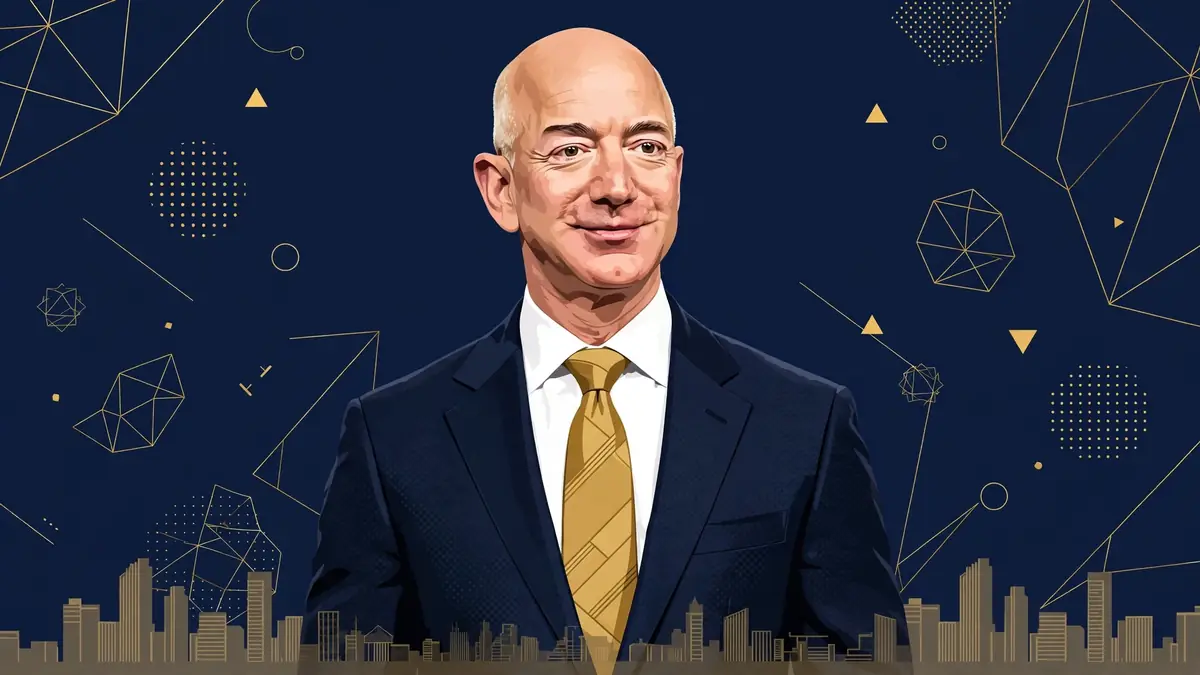
Jeff Bezos at a Glance
| Full Name | Jeffrey Preston Bezos (born Jeffrey Preston Jorgensen) |
|---|---|
| Date of Birth | January 12, 1964 (age 62 in November 2026) |
| Birthplace | Albuquerque, New Mexico, USA |
| Estimated Net Worth | About $370 billion (Forbes, early October 2026); range $368B–$381B across dated Forbes and Bloomberg prints, Oct–Nov 2026 |
| Primary Income Sources | Amazon shares (about 8.8% of the company), Blue Origin, Prometheus AI stake, Amazon stock sales, investments |
| Key Ventures | Amazon (founder, executive chairman), Blue Origin (founder), The Washington Post (owner), Bezos Earth Fund |
| Amazon Salary | $81,400 a year — unchanged since 1998 |
| Spouse | Lauren Sánchez (married June 2025); previously MacKenzie Scott (1993–2019) |
| Residence | Miami, Florida (Indian Creek Island) |
In This Article
- Jeff Bezos at a Glance
- Early Life and Education
- From a Garage to Amazon
- What Amazon Looks Like in 2026
- Where the Money Comes From Now
- Blue Origin and the Private Fortune
- The Salary That Barely Moved
- Homes, Yacht and the Good Life
- Net Worth Over Time
- How Bezos Compares With Other Billionaires
- Personal Life: Family, Wedding and Giving
- Criticism and Controversies
- Frequently Asked Questions
- The Bottom Line
- Sources and Reporting
Early Life and Education
Jeff Bezos was born Jeffrey Preston Jorgensen on January 12, 1964, in Albuquerque, New Mexico, to Jacklyn Gise, then a 17-year-old high school student, and Ted Jorgensen. His parents’ marriage lasted about a year. When Jeff was four, his mother married Miguel Bezos, a Cuban immigrant who had arrived in the United States alone as a teenager through Operation Pedro Pan. Miguel adopted Jeff, and the boy took his surname.
The family moved to Houston, Texas, where Miguel worked as an engineer for Exxon. Jeff spent summers on his maternal grandfather’s ranch in Cotulla, Texas — Lawrence Preston Gise, a former regional director of the Atomic Energy Commission — fixing windmills, castrating cattle and learning to work with his hands. He later said those summers taught him self-reliance and a tolerance for doing hard things alone, traits that showed up again in the way he built Amazon.
At school in Miami, where the family later moved, Bezos was a strong science student. He was valedictorian of his high school class and a National Merit Scholar. In 1982 he entered Princeton University, first intending to study physics, then switching to electrical engineering and computer science. He graduated in 1986. For the full story of his childhood, schooling and early career, see the Jeff Bezos biography on our sister site GuideNetWorth.
After Princeton, Bezos worked at Fitel, a telecom startup, then at Bankers Trust, and then at the quantitative hedge fund D.E. Shaw, where he rose to senior vice president by age 30. It was at D.E. Shaw that he met MacKenzie Tuttle, a research associate who became his wife in 1993. It was also at D.E. Shaw that he first saw the numbers that changed his life: in 1994, web usage was growing at roughly 2,300 percent a year. He drew up a list of products that could sell well online and settled on books — millions of titles, a category where a store with no shelves could beat every physical shop on selection.
From a Garage to Amazon
In July 1994, Bezos quit D.E. Shaw, drove across the country to Seattle with his wife, and started Amazon out of a rented garage in Bellevue, Washington. The first office was a converted garage with desks made from wooden doors. Amazon sold its first book in July 1995. Within two months it was selling in all 50 American states and more than 45 countries.
The company went public in May 1997 at $18 a share. Bezos owned about 16 percent of it at the time. What followed was a two-decade run of expansion that few businesses have ever matched: music and video, then electronics, then almost everything, then the Marketplace for third-party sellers, then Amazon Web Services in 2006 — a cloud business that now produces the bulk of Amazon’s profit — then the Kindle in 2007, Prime, Alexa, groceries, advertising, and logistics. Annual revenue passed $600 billion, and Amazon became one of the most valuable companies on earth.
Bezos ran Amazon as chief executive for 27 years. His management style became famous in its own right: the insistence on writing six-page narrative memos instead of slide decks, the “two-pizza teams,” the empty chair in meetings meant to represent the customer, and the willingness to lose money for years on a new business if the long-term math worked. The 2019 divorce from MacKenzie Scott cut his Amazon stake by about a quarter — she received roughly 4 percent of the company, worth about $36 billion at the time — and still left him the world’s richest person. In July 2021 he stepped down as chief executive, handing the job to Andy Jassy, the head of AWS, and moved to the role of executive chairman, where he still shapes the company’s biggest decisions.
The scale of the stock sales behind the fortune is easy to miss. Forbes calculates that Bezos has sold more than $49 billion worth of Amazon shares since the 1997 IPO. Those sales funded Blue Origin for two decades — he was putting roughly $1 billion a year of his own money into the rocket company — paid for The Washington Post, and built the cash pile that lets him buy three houses on one Miami island without blinking.
What Amazon Looks Like in 2026
Understanding Bezos’ wealth means understanding what Amazon became after the bookstore years. The company he founded now earns money in four very different ways, and the mix is what keeps the share price — and his fortune — so high.
Amazon Web Services is the profit engine. The cloud division, launched in 2006, reported revenue of $108 billion in 2024, and it produces the bulk of Amazon’s operating profit even though the retail business is larger by sales. When companies move their computing to AWS, a slice of that spending flows to Amazon’s bottom line, and the market values that recurring, high-margin revenue more richly than retail sales. AWS is also where Amazon’s AI bets live, including its large investment in the AI company Anthropic.
Retail and the Marketplace remain the volume business. Third-party sellers now account for more than 60 percent of the units Amazon sells, and Amazon takes a cut of each sale through fees, fulfilment and advertising. Prime, the membership programme that passed 200 million members in 2021, ties it together: members shop more, watch Prime Video, and stay inside Amazon’s world.
Advertising is the quiet giant. Amazon’s advertising business brought in about $56 billion in 2024, making it one of the largest digital advertising businesses in the world — a revenue line that barely existed a decade ago. Brands pay to appear at the top of product searches, and because shoppers on Amazon are ready to buy, those ads convert at rates other platforms envy.
Devices, groceries and logistics round out the picture: Echo speakers and Alexa, Whole Foods and Amazon Fresh, and a delivery network that moves hundreds of millions of packages with its own planes, vans and drivers. Bezos no longer runs the day-to-day operation — Andy Jassy does — but the structure is the one he designed: each business feeds the others, and the customer is the centre of every decision. That flywheel is why his 8.8 percent stake is still worth more than $200 billion thirty years after the IPO.
Where the Money Comes From Now
Bezos’ fortune is not a salary, a bank balance or a single asset. It is a stack of holdings that move at different speeds. Amazon shares are still the biggest piece, but for the first time in his career, private companies now drive the headlines. Here is the breakdown as the indexes reported it in October 2026.
| Holding | Estimated Value (Oct–Nov 2026) |
|---|---|
| Amazon shares (~950 million, 8.8%) | About $215–225 billion, depending on the share price on the day |
| Blue Origin (~93% stake) | About $123–130 billion (Forbes ~$130B; Bloomberg ~$123.5B at a $140B company valuation) |
| Prometheus AI stake (~20%) | About $8.2 billion (Forbes estimate, June 2026 valuation) |
| Cash from stock sales, The Washington Post, real estate, other investments | Tens of billions combined; Bezos has sold $49B+ of Amazon stock since the IPO |
| Total | About $368–381 billion (Forbes $380.8B on Oct 10, 2026; Forbes $368.5B on Nov 3, 2026; Bloomberg ~$372B in Oct 2026) |
Amazon stock. Amazon’s 2026 proxy statement, filed in April 2026, lists Bezos as the beneficial owner of 950,434,581 Amazon shares — 8.8 percent of the company — as of late February 2026. Forbes rounds that to about 8 percent in its own profiles. At Amazon’s 2026 share prices, that stake alone is worth roughly $215 billion to $225 billion, or about three-fifths of his fortune. Every $10 move in Amazon’s share price moves his net worth by roughly $9.5 billion. That is why the Forbes real-time tracker can show him up or down several billion dollars before lunch.
Stock sales. The quiet engine of his cash wealth is selling. Bezos has sold Amazon shares in planned blocks for years — often around $1 billion at a time in earlier years, and larger blocks more recently — and Forbes puts the lifetime total above $49 billion. He has said the proceeds largely fund Blue Origin, which he bankrolled himself for two decades before it took outside money in 2026.
Other investments. Bezos Expeditions, his family office, has backed companies including Airbnb, Uber, Twitter (now X), and the space and AI startups discussed below. He also owns The Washington Post, bought in 2013 for a reported $250 million, and his real estate portfolio is reported to be worth about $700 million in total. None of these is large next to the Amazon stake, but together they add tens of billions to the estimate.
Blue Origin and the Private Fortune
The story of 2026 is that Bezos’ fortune stopped being only an Amazon story. Blue Origin, the space company he founded in 2000 and funded out of his own pocket for more than twenty years, opened its first outside funding round in September 2026 — and the market priced it like a serious rival to SpaceX.
Bloomberg reported that the round was sized at roughly $10 billion at a valuation of about $140 billion, with Coatue Management expected to lead with a $4 billion commitment. Forbes, using a pre-money valuation of about $130 billion, valued Bezos’ roughly 93 percent stake at about $130 billion; Bloomberg’s version put the stake at about $123.5 billion after a small discount for the company’s private status. Bezos himself is contributing about $2 billion to the round. The revaluation alone added an estimated $85 billion to $87 billion to his paper fortune in October 2026 — the main reason Forbes recorded a $102 billion single-month gain for him in September 2026, the largest monthly jump the magazine has recorded for Bezos.
Blue Origin’s business is real but young next to SpaceX: the New Shepard suborbital vehicle has flown paying tourists, including Bezos himself in July 2021, and the heavy-lift New Glenn rocket is aimed at the orbital launch market. The outside money matters because it lets Blue Origin compete for large contracts without Bezos writing the cheques alone. The space race is also personal: his rival in suborbital tourism is Richard Branson, whose Virgin Galactic flew its own founder to space days before Bezos’ flight in 2021.
Prometheus. The second private driver is Prometheus, an industrial AI startup Bezos co-leads with Vik Bajaj, the former chief scientific officer of Verily. Prometheus closed a $12 billion Series B funding round at a $41 billion valuation in June 2026, according to Axios. Forbes estimated Bezos holds about a 20 percent stake, worth roughly $8.2 billion at that valuation. Together, Blue Origin and Prometheus now account for more than a third of his estimated net worth — a concentration that did not exist a year ago.
Why the number jumped so fast: Forbes’ $102 billion September 2026 gain for Bezos came almost entirely from private-company valuations, not from Amazon’s share price. Blue Origin’s first outside round repriced a company he had funded alone for 24 years, and Prometheus’ June raise did the same on a smaller scale. When private assets get priced by outside investors for the first time, the wealth indexes move in big steps — and they can move back just as fast if the next round prices lower.
The Salary That Barely Moved
For a man worth about $370 billion, Jeff Bezos’ paycheque is a running joke in business reporting — and the joke is documented in Amazon’s own filings. Amazon’s 2026 proxy statement confirms he still earns $81,400 a year, the same base salary he has received since 1998, when he raised it from $79,197. The filing states plainly: “Mr. Bezos requested not to receive additional compensation and has never received annual cash compensation in excess of his current amount.”
He explained the thinking at a New York Times DealBook summit in 2024: he already owned a large share of the company and did not feel good about taking more. He has never received stock-based compensation from Amazon — not because he was overlooked, but because he never needed it. Amazon does pay about $1.6 million a year for his security and business travel, which the company describes as reasonable and necessary, bringing his total 2025 compensation to nearly $1.7 million. Against a fortune of about $370 billion, that total package is a rounding error.
The contrast is the point of the story, and it is also a tax story. Law professor Ray Madoff has noted that salaries are taxed at up to 37 percent plus payroll taxes, while stock that grows unsold is not taxed at all until it is sold. Bezos gets wealthy from owning Amazon, not from being paid by it — a structure shared by many founders, but rarely at this scale.
Homes, Yacht and the Good Life
Bezos’ property portfolio is reported to be worth about $700 million in total, and its centre of gravity has moved south. His main home is now Miami, Florida, on Indian Creek Island — a small private island in Miami-Dade County with only around 40 residential properties, sometimes called the “billionaire bunker.” He bought three properties there between 2023 and 2024 for a combined purchase price of approximately $237 million, and moved his residence from Seattle to Florida, which also made him the richest person in Florida on Forbes’ 2026 lists.
He has also owned major homes in Beverly Hills, Washington, D.C., Maui and Texas, as well as his long-time home in Medina, Washington, across Lake Washington from Amazon’s Seattle headquarters. The Texas property is tied to Blue Origin: a large ranch in West Texas that hosts the company’s launch site.
The Koru. The most famous item in the collection is the Koru, a 127-metre sailing yacht built by the Dutch yard Oceanco and delivered in 2023. SuperYachtFan estimates its value at approximately $500 million, with annual running costs of around $25 million to $30 million. It travels with a 75-metre support vessel, the Abeona, which carries the helicopter, cars and toys that do not fit on the sailing yacht itself. The Koru — the name is a Māori word for an unfurling fern frond, symbolising new beginnings — became a fixture of the 2025 Venice wedding, where it was moored in view of the celebrations.
His private aviation is quieter: a Gulfstream G700, registered N11AF, is among the aircraft associated with him. None of this spending dents the fortune in any meaningful way. At $25 million to $30 million a year, running the Koru costs less than one-tenth of one percent of his estimated net worth — roughly what Amazon’s share price moves in a few minutes of trading.

Net Worth Over Time
Bezos’ fortune has never moved in a straight line. It has doubled, halved and doubled again with Amazon’s share price, a divorce, and now a private-company revaluation. The dated Forbes prints below show how fast the picture changes.
| Year / Date | Estimated Net Worth | What Drove It |
|---|---|---|
| 1997 | About $1.6 billion | Amazon IPO; Bezos takes the company public at 33 |
| March 2018 | $112 billion | Named the world’s richest person by Forbes |
| July 2018 | $150 billion | First centibillionaire on the Forbes Real Time list |
| 2019 | About $114–131 billion | Divorce settlement: MacKenzie Scott receives ~4% of Amazon (~$36B) |
| 2021 | About $177–211 billion | Pandemic e-commerce boom; steps down as CEO in July |
| March 1, 2026 | $224 billion (4th) | Forbes World’s Billionaires list, annual snapshot |
| August 1, 2026 | $278 billion (3rd) | Amazon shares up 14% in July alone (+$29B) |
| August 28, 2026 | About $273.2 billion (3rd) | Forbes real-time profile |
| September 2026 | About $378 billion (Forbes 400) | Blue Origin and Prometheus revaluations; +$102B in one month |
| October 10, 2026 | $380.8 billion (2nd) | Forbes real-time estimate; passes Larry Page |
| November 3, 2026 | $368.5 billion (2nd) | Forbes real-time estimate |
Two lessons sit in that table. First, the March annual list and the autumn real-time figure can be $150 billion apart in the same year — anyone quoting a single number for Bezos without a date is quoting a stale figure. Second, the September 2026 jump shows that his wealth now has a second engine: private companies whose valuations are set by funding rounds, not by the stock market. That makes the number jumpier, not steadier.
How Bezos Compares With Other Billionaires
Bezos has spent most of the last decade in the top three of the world’s rich lists, and he held the number one spot from 2017 to 2021, according to Forbes and the Bloomberg Billionaires Index. The gap to the top is now wide: Forbes’ 400 list in September 2026 put Elon Musk at $908 billion, after Musk’s fortune briefly passed $1 trillion in June on the back of SpaceX’s valuation. Bezos, at $378 billion on that list, is closer to the rest of the pack than to Musk. You can explore more profiles in our Net Worth section, where the same reporting standard is applied to every fortune.
Among fellow founders, the comparisons are instructive. Mark Cuban’s net worth — built on Broadcast.com and the Dallas Mavericks — is measured in single-digit billions, a reminder that even a spectacular exit is a different league from owning 8.8 percent of Amazon for three decades. The Bill Gates biography tells the other half of Bezos’ story: Gates was the man Bezos dethroned as the world’s richest person in 2017, and the two have traded the title’s shadow ever since, with Gates’ fortune now shaped more by philanthropy and diversified investments than by Microsoft shares. Sara Blakely’s biography shows the same founder playbook at a smaller scale: a self-made billionaire who built Spanx from $5,000 of savings and kept control of her company, just as Bezos kept control of Amazon.
What sets Bezos apart from almost every other billionaire is not the size of the number but its composition. Most fortunes his size rest on one company. His now rests on one public company and two private ones — and the private ones are the reason his 2026 gain was the biggest of his career in a year when Amazon’s own share price did not do anything extraordinary.
Personal Life: Family, Wedding and Giving
Bezos married MacKenzie Tuttle in 1993, a year after they met at D.E. Shaw. They have four children — three sons and an adopted daughter — and built Amazon together in its first years; MacKenzie was one of the company’s earliest employees and drove its first business plan. The marriage ended in 2019 in what was then the most expensive divorce settlement in history, with MacKenzie receiving about 4 percent of Amazon. She has since given away billions of it through her own philanthropy, and the two have stayed out of public conflict.
Bezos’ relationship with Lauren Sánchez, a former television anchor and helicopter pilot, became public in 2019. They got engaged in May 2023 and married in Venice in June 2025, in a three-day celebration that drew global press coverage and local protests about the spectacle. Sánchez is now Lauren Sánchez Bezos. Bezos is 5 feet 7 inches (170 cm) tall — a detail that surprises readers who picture him larger.
His giving has grown with the fortune. The Bezos Earth Fund, launched in 2020 with a $10 billion commitment, funds climate and nature work. The Day 1 Fund, started in 2018 with $2 billion, supports homeless families and builds Montessori-inspired preschools. In a 2022 CNN interview he said he planned to give away most of his wealth during his lifetime — a pledge he has repeated since, though the Earth Fund remains the largest single vehicle for it. He has also made nine-figure gifts, including $100 million to the Obama Foundation in 2021.
Bezos trains hard and it shows: the famously lean founder of the 1990s is now a visibly muscular 62-year-old, a transformation that became a minor media obsession of its own after photos of him in 2017. He has said he gets eight hours of sleep, starts the day without meetings, and makes a small number of high-quality decisions rather than a large number of fast ones.
Criticism and Controversies
No honest profile of Bezos can skip the criticism, and much of it is documented in court filings and public reporting.
Working conditions. Amazon’s warehouses have faced years of reporting and regulatory scrutiny over injury rates, the pace of work, and the treatment of delivery drivers. Workers and unions have organised in the United States and Europe, and the company has repeatedly said it invests in safety while disputing some of the figures cited by critics. The criticism is a standing part of the Amazon story, not a one-off news cycle.
Tax. A 2021 ProPublica investigation based on IRS records reported that Bezos paid no federal income tax in 2007 and 2011, and a true tax rate far below the headline rate in other years, because his wealth grew through unsold shares. He has not disputed the figures, and the reporting sharpened the public debate about how founders’ wealth is taxed. The $81,400 salary sits at the centre of that debate.
The Washington Post. Bezos bought the Post in 2013 for a reported $250 million and initially won praise for investing in its newsroom. In 2024, his decision to end the paper’s presidential endorsements drew public criticism from staff and readers, and the paper has since gone through layoffs and a change of direction that its own journalists have covered critically. Bezos has said the paper must win back trust by being fair and widely read, and that he will not direct its coverage.
Antitrust and the space race. In September 2023 the Federal Trade Commission sued Amazon, alleging the company used monopoly power to raise prices and stifle rivals — a case that is still working through the courts. Blue Origin, meanwhile, lost its 2021 protest over NASA’s lunar lander contract to SpaceX, a defeat Bezos took personally enough to sue over, and lost. Neither episode has dented the fortune, but both shape how the public judges it.
Frequently Asked Questions
What is Jeff Bezos’ net worth in 2026?
About $370 billion, according to Forbes’ real-time estimate in early October 2026, making him the second-richest person in the world. The honest range across dated prints is $368 billion to $381 billion for October–November 2026: Forbes put him at $380.8 billion on October 10 and $368.5 billion on November 3, while Bloomberg’s index put him near $372 billion in October. Forbes’ annual list, using March 1 prices, had him lower at $224 billion.
How did Jeff Bezos make his money?
He founded Amazon in 1994 and still owns about 8.8 percent of it — roughly 950 million shares — which is the biggest piece of his fortune. He has also sold more than $49 billion of Amazon stock since the 1997 IPO. In 2026, two private companies became major drivers: Blue Origin, the rocket company he founded in 2000, and Prometheus, an AI startup, together now account for more than a third of his estimated wealth.
How much Amazon stock does Jeff Bezos own?
Amazon’s 2026 proxy statement lists him as the beneficial owner of 950,434,581 shares — 8.8 percent of the company — as of late February 2026. Forbes rounds that to about 8 percent. He owned about 16 percent at the IPO in 1997; the 2019 divorce, which transferred about a quarter of his stake to MacKenzie Scott, and years of stock sales brought the figure down to today’s level.
What is Jeff Bezos’ salary at Amazon?
$81,400 a year — unchanged since 1998, when he raised it from $79,197. Amazon’s 2026 proxy statement confirms the figure and notes that Bezos asked not to receive additional compensation and has never received stock-based pay from Amazon. The company spends about $1.6 million a year on his security and business travel, bringing his total 2025 compensation to nearly $1.7 million.
How much is Blue Origin worth?
Forbes valued Blue Origin at about $130 billion in its first outside funding round in September–October 2026, while Bloomberg put the valuation at about $140 billion. Bezos owns roughly 93 percent of the company, so his stake is worth about $123 billion to $130 billion by those estimates. The round, sized at roughly $10 billion, added an estimated $85 billion to $87 billion to his fortune in a single month.
How tall is Jeff Bezos?
Jeff Bezos is 5 feet 7 inches (170 cm) tall, below the average height for an American man. He has never published an official measured height of his own; the figure is the widely reported one used across biographical profiles.
Who is Jeff Bezos married to?
Bezos married Lauren Sánchez in Venice in June 2025, after getting engaged in May 2023. He was previously married to MacKenzie Scott from 1993 until their divorce was finalised in 2019. He has four children from his first marriage.
How much did Jeff Bezos pay for The Washington Post?
He bought The Washington Post in 2013 for a reported $250 million, in a personal purchase separate from Amazon. He has owned the paper ever since, investing in its newsroom in the early years; in 2024 he ended its presidential endorsements, a decision that drew wide criticism from staff and readers.
The Bottom Line
Jeff Bezos is worth about $370 billion as of October 2026 — Forbes said $380.8 billion on October 10 and $368.5 billion on November 3, and Bloomberg landed near $372 billion in between. The number is best read as a range, $368 billion to $381 billion, and it is best understood as three fortunes in one: an Amazon stake of about 950 million shares, a rocket company repriced at $130 billion after its first outside money, and a stake in an AI startup that did not exist in his portfolio a few years ago. He still draws a salary of $81,400, still owns roughly 93 percent of Blue Origin, and still has more than $49 billion of Amazon stock sales behind him. The garage in Bellevue is long gone; the discipline that built it — small teams, long bets, and a refusal to be rushed — is the same one that turned a bookstore into the second-largest personal fortune on earth.
Sources and Reporting
This profile was compiled on November 11, 2026, from live reporting and public filings. Net worth figures are outside estimates, not disclosed totals, and they move with Amazon’s share price and with private-company valuations.
How we estimated: the headline figure is anchored on Forbes’ real-time billionaire tracker (October 10, 2026: $380.8 billion; November 3, 2026: $368.5 billion), cross-checked against the Bloomberg Billionaires Index (about $372 billion, October 2026) and the Forbes 400 (September 2026: $378 billion). Where the indexes disagree, this profile publishes the range and dates each print rather than picking one number. Holdings come from Amazon’s 2026 proxy statement (950,434,581 shares, 8.8 percent) and from Forbes, Bloomberg, Axios and CNBC reporting on the Blue Origin and Prometheus funding rounds. Private-company stakes are estimates based on reported valuations; the true value of a private stake is only known when shares change hands.
- Forbes — Real-Time Billionaires tracker and Forbes 400 (2026)
- Bloomberg — Bloomberg Billionaires Index (2026)
- U.S. Securities and Exchange Commission — Amazon 2026 proxy statement (DEF 14A)
- TheStreet — Bezos’ $102 billion September 2026 gain (October 8, 2026)
- Axios — Prometheus Series B funding round (June 2026)
- CNBC — Blue Origin funding round reporting (2026)
- Fortune — Bezos’ $81,400 salary and Amazon proxy reporting (2026)
- ProPublica — “The Secret IRS Files” tax reporting (2021)
- Wikipedia — Jeff Bezos biography and career timeline
- SuperYachtFan — Koru yacht profile and valuation estimate
By Celebamerica Editorial Staff. Figures are estimates based on public reporting and filings; the private reality may differ. If a source updates a figure after publication, the range above will be revised with the new date.