Last updated: 22 November 2026 | By Celebamerica Editorial Staff
Amitabh Bachchan was born on 11 October 1942 in Allahabad, and more than five decades after his first film he is still working — hosting the seventeenth season of Kaun Banega Crorepati in 2026, still taking on film roles, and still the most recognisable face in Hindi cinema. His life runs in three acts: a long, humiliating struggle, a reign as the “Angry Young Man” that remade the Hindi film hero, and a fall into near-bankruptcy followed by one of the most complete comebacks Indian cinema has ever seen.
The money tells the same story of rise, fall and return. The Hurun India Rich List 2026 puts his net worth at ₹4,000 crore (about $417 million at roughly ₹96 to the dollar), up from ₹1,630 crore a year earlier — a jump of about 145 percent. Other estimates are lower: Alux puts him at about $285 million (roughly ₹2,660 crore) in November 2026, built from his wife Jaya Bachchan’s sworn 2024 election affidavit, which declared the couple’s joint assets at about ₹1,578 crore. A fair range across the published sources is ₹2,660 crore to ₹4,000 crore, with Hurun’s figure as the anchor. This biography covers the whole arc — the Allahabad childhood, the eleven flops, Zanjeer and Sholay, the Coolie accident, politics, the ABCL collapse, and the television rescue that made him richer at 84 than he ever was at 34.
Table of Contents
- Amitabh Bachchan at a Glance
- Early Life and Family
- Education and the Calcutta Years
- The Long Struggle: Eleven Flops
- Zanjeer and the Birth of the Angry Young Man
- The Golden Run: Sholay, Deewaar and the Seventies
- The Coolie Accident That Stopped a Nation
- Politics, ABCL and the Fall
- The Comeback: Mohabbatein and Kaun Banega Crorepati
- The Money: Films, KBC Fees and Endorsements
- Real Estate and Investments
- Net Worth in 2026: What the Sources Say
- Personal Life and Family
- Awards and Honours
- Controversies and Legal Issues
- Frequently Asked Questions
- Final Thoughts
- Sources and Reporting
Amitabh Bachchan at a Glance
| Full Name | Amitabh Harivansh Bachchan (born Amitabh Srivastava) |
|---|---|
| Date of Birth | 11 October 1942 — 84 years old as of November 2026 |
| Birthplace | Allahabad, United Provinces, British India (now Prayagraj, Uttar Pradesh) |
| Estimated Net Worth (2026) | ₹4,000 crore (about $417 million) per the Hurun India Rich List 2026; published estimates range from ₹2,660 crore to ₹4,000 crore |
| Primary Income Sources | Films, Kaun Banega Crorepati hosting, brand endorsements, real estate |
| Career Span | 1969–present; more than 200 films |
| Spouse | Jaya Bhaduri (married 3 June 1973) |
| Children | Shweta Bachchan Nanda and Abhishek Bachchan |
| Key Honours | Padma Shri (1984), Padma Bhushan (2001), Padma Vibhushan (2015), Dadasaheb Phalke Award (2018), Legion of Honour (2007) |
| Nicknames | Big B, Shahenshah, the Angry Young Man |
Early Life and Family
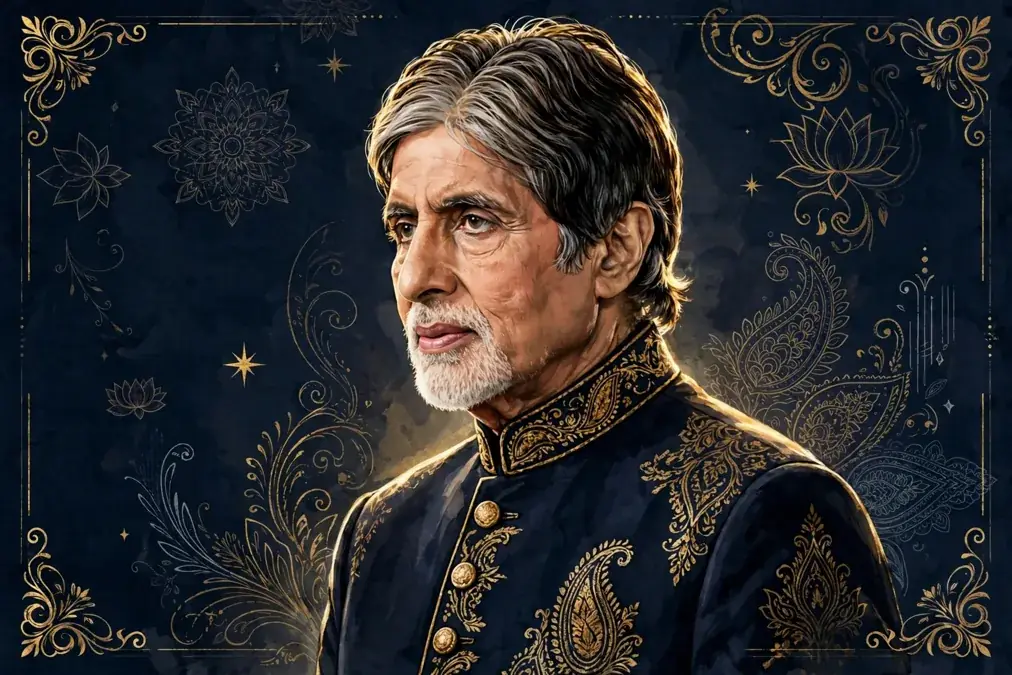
Amitabh Bachchan was born Amitabh Srivastava on 11 October 1942 in Allahabad, in what was then the United Provinces of British India. The city is now Prayagraj in Uttar Pradesh. His father was Harivansh Rai Bachchan, one of the most celebrated Hindi poets of the twentieth century, the author of Madhushala. His mother, Teji Bachchan, was a social activist from Faisalabad in Punjab. He has a younger brother, Ajitabh.
The household was literary before it was anything else. Harivansh Rai Bachchan’s study, his circle of writers and his public readings were part of the children’s daily life, and the boy who would become the most famous voice in Indian cinema grew up listening to poetry read aloud by a master of the form. That voice — the deep baritone that would later narrate films, sell products and hold a television audience for a quarter of a century — was shaped long before any camera found it. The family surname itself came from his father: Harivansh Rai had adopted “Bachchan” as his pen name, and it became the family name.
Allahabad in the 1940s and 1950s was a city of universities, courts and literary societies, and the Bachchan home sat at the centre of that world. Friends of the family included figures from Hindi literature and the independence movement, and the young Amitabh absorbed a sense of public life as something serious — a thread that would later pull him, briefly and unhappily, into politics. For now, though, he was a schoolboy in a house full of books, tall for his age, shy in company, and drawn to the stage.
Education and the Calcutta Years
Bachchan was educated at Sherwood College in Nainital, a boarding school in the hills of Uttarakhand, and then at Kirori Mal College, University of Delhi, where he took a Bachelor of Science degree. At college he acted in theatre, and the stage gave him the first taste of performance — but it did not yet look like a career. After graduating he did what respectable, educated young men of his generation were expected to do: he took a job.
He moved to Calcutta (now Kolkata) and worked as a business executive, first with a shipping firm and then in other corporate roles. The work was steady and unremarkable, and he has described those years as a time of waiting rather than living. He performed in theatre in the evenings, and the contrast between the office by day and the stage by night sharpened the question of what he actually wanted to do. In the late 1960s he decided to try Bombay.
He arrived in the film capital with no connections inside the industry — his father’s name opened doors in literary circles, not in studios — and with a look that casting directors found awkward: too tall, too thin, and a voice that one early radio test reportedly rejected as unsuitable. The rejection is now part of the legend, and it is worth remembering because it frames everything that followed. The man who would become the defining voice of Hindi cinema was once told his voice would not work.
The Long Struggle: Eleven Flops
Bachchan’s film career began in 1969, not as an actor but as a voice: he narrated Mrinal Sen’s Bhuvan Shome. His acting debut came the same year in Saat Hindustani, in which he played one of seven leads. The film won him a National Film Award for Best Newcomer, but it did not make him a star. What followed was a run of failure that would have ended most careers. By Britannica’s count, he performed in a string of eleven box-office flops in his early years, and he considered abandoning acting altogether.
The early 1970s were a hard apprenticeship. Anand (1971) gave him his first real notice and his first Filmfare Award, for Best Supporting Actor, as the quietly dying friend of Rajesh Khanna’s exuberant hero — but a supporting award does not carry a career. Films came and went. He was cast, dropped, recast. The industry’s leading men of the time were romantic heroes in the Rajesh Khanna mould, and Bachchan — tall, gaunt, intense — did not fit the mould. Producers did not know what to do with him, and audiences had not yet been shown what he could do.
What kept him going, by his own later accounts, was stubbornness and the absence of a better plan. He had left a safe job in Calcutta; going back would have meant admitting the gamble had failed. He took whatever roles came, including the small and the thankless, and waited for a script that matched the anger and restlessness he carried. That script arrived in 1973, from a writer-director team that had been turned down by every established star.
Zanjeer and the Birth of the Angry Young Man
Zanjeer (1973) was the turning point. The film’s hero, Inspector Vijay Khanna, was a man with no patience left — a policeman who had watched the system fail and decided to settle matters himself. The role had been offered to several leading actors, all of whom passed. Bachchan took it, and the film’s success remade him overnight. Britannica names Zanjeer as his breakthrough, followed by the action films Deewaar (1975) and Sholay (1975).
The “Angry Young Man” was not a marketing label invented after the fact; it was a response to the India of the 1970s. Unemployment was high, institutions felt unresponsive, and the Emergency was around the corner. Audiences who felt powerless in their own lives watched a tall man in a white shirt settle scores on screen and recognised something of themselves in him. Bachchan did not smile much in these films, did not sing and dance his way out of trouble, and did not wait for the system to save him. The persona was a clean break from the romantic hero, and it belonged to him alone.
Between 1973 and the early 1980s he became the biggest star Hindi cinema had ever produced. The films came in a flood: Namak Haraam, Abhimaan, Mili, Chupke Chupke, Amar Akbar Anthony, Don, Trishul, Muqaddar Ka Sikandar, Kaala Patthar, Sharaabi, Mard. He worked with every major director of the era and carried films on his name alone — a rare thing in an industry built on ensembles and star pairings. By the end of the decade, his name above the title was a guarantee of an opening, and his fee reflected it.
The Golden Run: Sholay, Deewaar and the Seventies
Sholay (1975) is the film that still defines him. As Jai, the laconic half of a pair of small-time crooks hired to catch a bandit, Bachchan played the quieter role against Dharmendra’s louder Veeru — and walked away with the film’s most quoted lines and its most enduring image. The film ran for years in single-screen theatres, and its dialogue entered everyday speech in a way no film had before. Deewaar, released the same year and written by Salim-Javed, gave him the Angry Young Man in his purest form: Vijay Verma, the dockworker who chooses crime over poverty and pays for it. The two films together made 1975 his year, and the years that followed only extended the run.
What is easy to forget, looking back at the legend, is how much range sat inside the stardom. The same actor who played the avenging Vijay in Deewaar played the gentle, comic husband in Hrishikesh Mukherjee’s Chupke Chupke (1975) and the devoted friend in Anand. He sang, he danced when the script asked, and he took character roles that other stars of his size would have refused. The filmography that resulted — more than 200 films across five decades, per Wikipedia — is not a list of hits with a few curiosities; it is a working actor’s record, with the experiments kept in alongside the blockbusters.
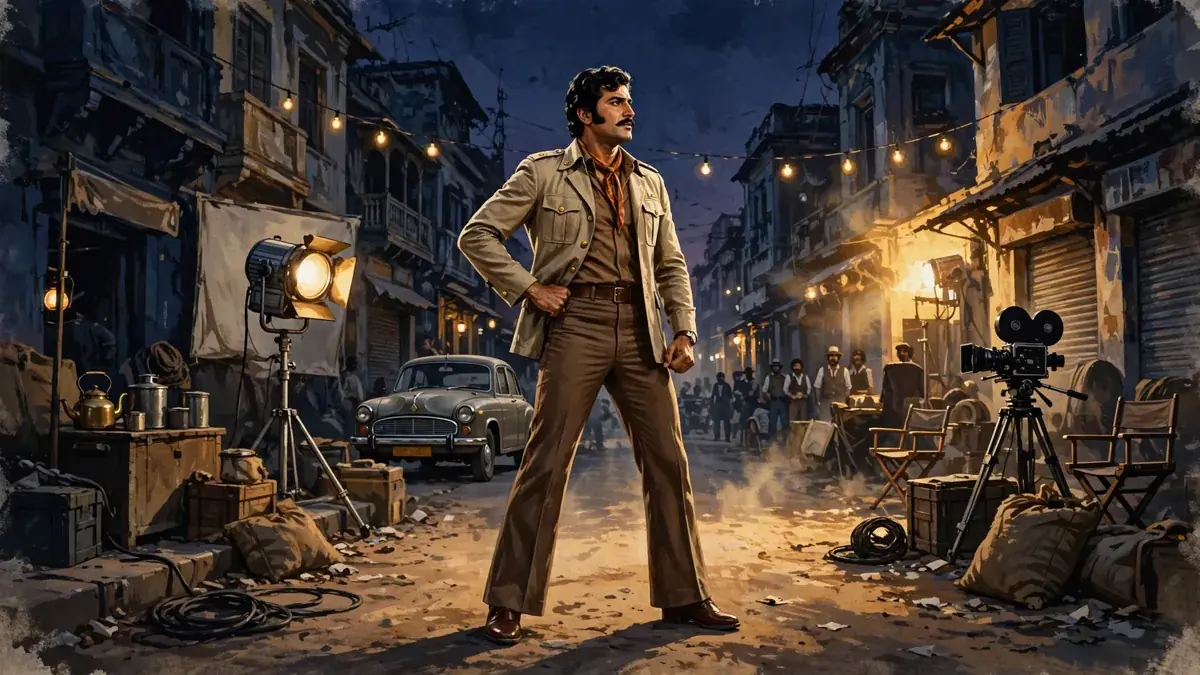
By the early 1980s he was, by most measures, the biggest film star in the world by audience size. Hindi cinema’s reach across India, the diaspora and the Middle East meant his face was known to hundreds of millions of people. He was also, by then, carrying the weight of that fame in his body. The schedule was relentless — multiple films shooting at once, long hours, little rest — and in 1982, on the set of Coolie, the pace caught up with him in the most literal way possible.
The Coolie Accident That Stopped a Nation
On 26 July 1982, while filming a fight sequence for Coolie in Bangalore, Bachchan mistimed a jump onto a table and struck his abdomen on its corner, rupturing his intestine. He was rushed to hospital in critical condition, and for days his life hung in the balance. India stopped. Prayer meetings were held outside hospitals, temples filled, and newspapers ran daily bulletins on his condition. The country had never before watched a film star’s medical chart as a national event, and it has rarely done so since.
He survived, but the accident left him with chronic pain and a long recovery, and it marked a line in his life. Britannica notes that the 1980s brought both the accident and bankruptcy, and that he emerged from the professional slump with his stardom not just intact but magnified. The public’s relationship with him changed after 1982: he was no longer only the invincible hero of the screen. He was a man the country had prayed for and who had come back. That bond — personal, almost familial — is part of why his later television career worked so well. Viewers did not just watch him; they felt they knew him.
Coolie itself was completed and released in 1983, with the accident scene left in the film and a freeze-frame noting that it was the shot on which he was injured. It was a huge commercial success, but the man who returned to work was not the same man who had left the set. The pace slowed, the roles changed, and the second half of his career — the character actor, the elder statesman, the television host — began to take shape.
Politics, ABCL and the Fall
In 1984, at the height of his fame, Bachchan entered politics. He contested the Lok Sabha election from Allahabad on a Congress ticket, defeating the veteran politician Hemwati Nandan Bahuguna, and served as a Member of Parliament from 31 December 1984 until his resignation on 29 July 1987. The stint was short and, by his own later admission, unhappy. He resigned after his name was dragged into the Bofors scandal — allegations he denied and from which he was later cleared — and he has stayed out of electoral politics ever since.
The greater wound came from business. In the mid-1990s he founded the Amitabh Bachchan Corporation Limited (ABCL), a company meant to produce films, manage events and build an entertainment empire. The venture ran into heavy debt, and by the late 1990s the company had collapsed. Alux reports that he was close to bankruptcy in that period, and the fall was public and humiliating: the biggest star in the country, creditors at the door, a production company in ruins. He has spoken since about those years as a time when he took any work that was offered, including stage shows abroad, simply to pay off what was owed.
It is worth pausing on this part of the story, because it is the part the wealth lists leave out. The man whose net worth is now reported at ₹4,000 crore was, within living memory, effectively broke. The comeback that followed was not a lucky break. It was a deliberate, disciplined rebuild — and it started with two decisions in 2000 that changed Indian entertainment.
The Comeback: Mohabbatein and Kaun Banega Crorepati
The first decision was a film. In Mohabbatein (2000), Bachchan played the stern principal of a music school, an authority figure rather than a hero — and the performance worked. Wikipedia marks his resurgence from 2000 with Mohabbatein, and the film opened the second act of his career: the elder statesman, the patriarch, the man whose presence anchored a film rather than carried it on his shoulders. The roles that followed — Kabhi Khushi Kabhie Gham (2001), Baghban (2003), Black (2005), Paa (2009), Piku (2015), Pink (2016) — showed an actor doing the best work of his life in his sixties and seventies, winning National Film Awards for Black, Paa and Piku to add to the one he had won for Agneepath (1990).
The second decision was television. In 2000 he agreed to host Kaun Banega Crorepati, the Indian version of Who Wants to Be a Millionaire. Friends and advisers warned him that a film star of his standing would cheapen himself on a game show. He took the job anyway, and the show became a national ritual. Britannica records that he hosted from 2000 to 2006 and returned in 2010, and he has hosted it ever since — including the seventeenth season in 2026. The show rescued his finances, and it did something more: it put him in Indian living rooms every week as himself — warm, witty, unhurried — and made the Bachchan of the 2000s more beloved than the Angry Young Man had ever been.
Television also gave him a second act as a host and personality. He hosted a season of Bigg Boss in 2009 and starred in the television miniseries Yudh in 2014. In 2013 he made a small but noticed appearance in Hollywood, playing Meyer Wolfsheim in Baz Luhrmann’s The Great Gatsby. The comeback, in other words, was not a single event but a slow, steady rebuilding across films, television and endorsements — the same discipline, applied for a quarter of a century, that turned a bankrupt former star into one of the richest actors in India.
The Money: Films, KBC Fees and Endorsements
Bachchan’s income in 2026 comes from four streams that have been built up over decades: films, television, endorsements and property. The film fees are the smallest part of the picture now, but they are still substantial. One 2026 report puts his fee at between ₹6 crore and ₹12 crore per film depending on the size of the role, with roughly ₹10 crore to ₹12 crore mentioned for the second part of Kalki 2898 AD. Zoom TV reports a range of ₹6 crore to ₹10 crore per project. At 84, he works less than he used to, but he still works — and every role carries the premium of a name that has sold tickets for fifty years.
Television is the anchor. Industry reports put his Kaun Banega Crorepati fee at approximately ₹4 crore to ₹5 crore per episode, with Equentis reporting that he charges over ₹5 crore per episode for the seventeenth season in 2026. A season runs to dozens of episodes, which makes KBC alone worth well over ₹100 crore a year in some seasons — before endorsements. The show is also the reason his endorsement value has never faded: he is in front of a mass Indian audience every week, in a format that presents him as wise, warm and trustworthy.
Endorsements are the third stream, and the hardest to pin down. Bachchan has been one of India’s leading brand endorsers for decades — Wikipedia notes the fact directly — and at various points he has fronted everything from pens and watches to banks, insurance, health products and government campaigns, including the long-running polio immunisation campaign. No reliable public total exists for his endorsement income, and any figure quoted for it should be treated as an estimate. What is certain is the pattern: advertisers pay for the trust he built on television, and that trust has only grown as he has aged.
One 2026 financial blog estimates his annual income at around ₹350 crore across films, KBC and brand deals. That number should be treated with caution — it is an estimate, not a disclosed amount, and it depends on how many films he shoots and how many episodes a KBC season runs. But the direction is right: the money now comes steadily, from several sources at once, and none of it depends on a single film succeeding. That is the difference between the Bachchan of the 1970s, who lived from opening to opening, and the Bachchan of the 2020s, who is paid for being Amitabh Bachchan.
Real Estate and Investments
Property is the quiet backbone of the fortune. The family home is Jalsa, the bungalow in Juhu, Mumbai, valued by Zoom TV at approximately ₹120 crore. The second family home, Pratiksha, also in Juhu, is valued at about ₹50 crore — and in November 2023 Bachchan gifted Pratiksha to his daughter Shweta, a transfer widely reported at the time. The family also owns other Mumbai property, including office space in an Oshiwara tower bought in 2024 for ₹59.58 crore and leased out in August 2026 for ₹33 lakh a month, according to Alux.
Beyond Mumbai, his property interests have widened in recent years. Equentis reports that in early 2026 he bought a 2.67-acre plot in Ayodhya for ₹35 crore, and Zoom TV reports his land interests in Ayodhya at more than ₹100 crore across several parcels. The Ayodhya purchases followed the opening of the Ram temple and the surge in land prices around the city — an investment in a place with personal as well as commercial meaning for him.
Then there are the investments that the wealth lists argue about. Alux notes that higher published figures for Bachchan rest on the investments run through his family office, valued at assumed market prices that are not disclosed anywhere that can be checked. He holds early stakes in several companies, and Equentis notes that impending public listings of companies in which he holds early stakes could push his wealth higher still. None of this is itemised in public filings, which is exactly why the published net worth estimates disagree by more than a thousand crore. The property is visible. The portfolio is not.
Net Worth in 2026: What the Sources Say
The honest answer is that nobody outside the family knows the exact number, and the sources disagree by a wide margin. Here is what they say, with the dates attached:
| Source | Estimate | Basis |
|---|---|---|
| Hurun India Rich List 2026 | ₹4,000 crore (about $417 million at roughly ₹96 to the dollar) | Annual rich list; up from ₹1,630 crore in 2025, a rise of about 145 percent |
| Alux (November 2026) | $285 million (about ₹2,660 crore), range $230 million to $350 million | Built from Jaya Bachchan’s sworn 2024 election affidavit (couple’s joint assets about ₹1,578 crore) plus later income, property growth and investments |
| Equentis (April 2026) | ₹3,600 crore (about $435 million) | Asset-based estimate; annual income put near ₹350 crore |
| TheHindMedia (2026) | ₹2,000 crore to ₹3,600 crore | Survey of published estimates; notes none is an official figure |
We anchor on the Hurun India Rich List 2026 figure of ₹4,000 crore, because it is the most recent dated rich-list valuation from a named compiler with a published methodology, and it is corroborated in direction by multiple outlets — Latestly, Curly Tales and Zoom TV all report the same ₹4,000 crore figure for 2026, with Latestly putting the dollar value near $480 million. The lower estimates are not wrong so much as narrower: Alux openly credits the whole joint affidavit figure to him and then adds only what it can document, which understates holdings it cannot see. A fair range across the sources is ₹2,660 crore to ₹4,000 crore (about $285 million to $480 million), and the true figure is known only to him and his advisers. Readers who want the full breakdown of the money — the fees, the property and the family office holdings — can read our companion piece on Amitabh Bachchan’s net worth on GuideNetWorth, which covers the same fortune from the wealth angle while this article covers the life behind it.
Peer comparison (Hurun India Rich List 2026): Shah Rukh Khan leads Bollywood’s richest actors at ₹10,000 crore, followed by Amitabh Bachchan at ₹4,000 crore, Salman Khan at ₹3,000 crore and Hrithik Roshan at ₹2,500 crore. Bachchan is the only one of the four whose career began in the 1960s — and the only one who has been rich, nearly broke, and rich again. For the full story of the man at the top of that list, see our Shah Rukh Khan biography; for his fellow seventies-to-nineties superstar, our Salman Khan biography; and for the richest of the later generation’s leading men, our Aamir Khan net worth profile.
The jump from ₹1,630 crore in 2025 to ₹4,000 crore in 2026 deserves a note of caution. A 145 percent rise in a single year is a revaluation, not a year’s earnings: it reflects Hurun’s changing view of his property and his family office stakes, including the Ayodhya land and the early-stage company holdings. It is a reminder that rich-list numbers are snapshots of someone else’s model, not bank statements. The direction is supported — property values rose, KBC kept paying, the portfolio grew — but the exact size of the step is Hurun’s judgement, and other compilers judge it smaller.
Personal Life and Family
Bachchan married the actress Jaya Bhaduri on 3 June 1973, in a private ceremony held to avoid the crowds that his new fame would have drawn. They have two children: Shweta, born in 1974, and Abhishek, born in 1976. Abhishek followed his father into films, and the family now spans three generations in the industry: Harivansh Rai the poet, Amitabh the actor, Abhishek the actor, and Abhishek’s wife Aishwarya Rai Bachchan, one of the most famous actresses of her generation. The Bachchan family is, in the literal sense, Indian cinema’s first family.
He is known for a disciplined life: he does not drink and does not smoke, keeps early hours, and writes a daily blog that he has maintained for years — a habit that makes him one of the few stars of his generation who speaks to his audience directly, in his own words, every day. The family lives in Mumbai, chiefly at Jalsa, with Pratiksha now in Shweta’s name after the November 2023 gift. The gift was widely read as succession planning in plain sight: the family home, passed to the daughter, while the father keeps working.
The next generation of Hindi cinema now leads the box office, and the contrast is part of the story. Stars such as Ranbir Kapoor — whose own biography we cover in full — grew up watching Bachchan’s films, and the industry’s centre of gravity has moved to actors half his age. Bachchan’s answer has been to keep working alongside them rather than against them, taking the roles only he can play: the patriarch, the judge, the voice of authority. It is a model of ageing in public that few stars manage, and it is one reason the audience has stayed with him.
Awards and Honours
The awards list is long enough to fill a page on its own, so here are the ones that matter. He has won four National Film Awards for Best Actor — for Agneepath (1990), Black (2005), Paa (2009) and Piku (2015) — a record in the category, with seven National Film Awards in total. He has won sixteen Filmfare Awards and is the most nominated performer in Filmfare history, with 34 nominations in the Best Actor category and 42 nominations overall, according to Wikipedia. The span of the wins matters as much as the count: his first Filmfare came in 1972 for Anand and his National Film Awards stretch from 1990 to 2015, a 25-year span at the top of the profession.
The Government of India has honoured him at every level: the Padma Shri in 1984, the Padma Bhushan in 2001 and the Padma Vibhushan in 2015, the country’s second-highest civilian honour. France made him a Chevalier of the Legion of Honour in 2007. Indian cinema’s highest honour, the Dadasaheb Phalke Award, came in 2018. He was also named in a BBC online poll as the “Star of the Millennium” in 1999 — a vote, not an award, but a measure of the same thing: the size of the audience that considers him the greatest star Hindi cinema has produced.
Controversies and Legal Issues
No life this long in public runs without controversy, and Bachchan’s includes two episodes that are still raised whenever his name appears. The first is the Bofors affair. In 1987 his name surfaced in allegations around the Bofors arms deal, and he resigned his Lok Sabha seat that July. He denied any wrongdoing from the start, and he was later cleared — the allegations were never sustained against him, and he has pointed to the clearance ever since as proof that he was wrongly dragged into the affair. The episode ended his political career, and he has never returned to electoral politics.
The second is the Panama Papers leak of 2016, in which his name appeared in connection with offshore entities. He denied any wrongdoing, said his taxes were in order, and no charges were brought against him. The episode is worth recording because it is part of the public record, and worth keeping in proportion: a name in a leaked database is not a finding, and in his case no finding followed.
There have been smaller storms — a song lyric here, a comment there, the occasional legal notice over a film or an advertisement — but none of them has stuck. The reason is partly the record itself: five decades in public life with no conviction and no sustained finding against him. It is also partly the temperament. He rarely answers critics in public, and when he does it is usually in the measured language of his blog rather than in a press conference. The controversies, in the end, are footnotes to a career that has outlasted all of them.
Frequently Asked Questions
How old is Amitabh Bachchan in 2026?
Amitabh Bachchan was born on 11 October 1942, which makes him 84 years old as of November 2026. He celebrated his 84th birthday on 11 October 2026, still working — hosting the seventeenth season of Kaun Banega Crorepati and continuing to take film roles.
What is Amitabh Bachchan’s net worth in 2026?
The Hurun India Rich List 2026 puts his net worth at ₹4,000 crore (about $417 million), up from ₹1,630 crore in 2025. Other estimates are lower — Alux estimates about $285 million (roughly ₹2,660 crore) — so a fair range across the published sources is ₹2,660 crore to ₹4,000 crore. The wealth comes from films, KBC hosting, endorsements and a large property portfolio.
How did Amitabh Bachchan become famous?
After eleven early flops and years of struggle, his breakthrough came with Zanjeer in 1973, in which he played the police inspector Vijay Khanna. The film created the “Angry Young Man” persona, and Deewaar and Sholay — both released in 1975 — made him the biggest star in Hindi cinema.
What happened to Amitabh Bachchan on the set of Coolie?
On 26 July 1982, while filming a fight scene for Coolie in Bangalore, he mistimed a jump onto a table and struck his abdomen on its corner, rupturing his intestine. He was critically ill for days, and the whole country followed his recovery in daily news bulletins. He survived, though the injury left him with chronic pain, and the film was completed and released in 1983.
How much does Amitabh Bachchan earn per episode of Kaun Banega Crorepati?
Industry reports put his KBC fee at approximately ₹4 crore to ₹5 crore per episode, with Equentis reporting over ₹5 crore per episode for the seventeenth season in 2026. He has hosted the show since 2000, returning in 2010 after a break, and it remains his most important single source of income.
Who is Amitabh Bachchan married to?
He married actress Jaya Bhaduri on 3 June 1973. They have two children: Shweta Bachchan Nanda and Abhishek Bachchan, who followed his father into films. The family lives in Mumbai, chiefly at their home Jalsa in Juhu.
What awards has Amitabh Bachchan won?
He has won four National Film Awards for Best Actor — for Agneepath (1990), Black (2005), Paa (2009) and Piku (2015) — and sixteen Filmfare Awards. His civilian honours include the Padma Shri (1984), Padma Bhushan (2001) and Padma Vibhushan (2015), the Legion of Honour (2007), and Indian cinema’s highest honour, the Dadasaheb Phalke Award (2018).
Where does Amitabh Bachchan live?
He lives at Jalsa, the family bungalow in Juhu, Mumbai, valued at approximately ₹120 crore. The family’s second Juhu home, Pratiksha, valued at about ₹50 crore, was gifted to his daughter Shweta in November 2023. He also owns office space in Oshiwara, Mumbai, and land in Ayodhya.
Final Thoughts
Amitabh Bachchan’s biography is not really a story about stardom. It is a story about refusing to stop. He was told his voice would not work, and he made it the most famous voice in India. He failed eleven times in a row, and he kept going until the twelfth film changed everything. He was nearly killed on a film set, went into politics and out of it, built a company and watched it collapse, and was close to bankruptcy at an age when most men retire — and then he rebuilt himself on television, one episode at a time, until he was richer and more loved at 84 than he had been at 34.
That is why the numbers, for all the argument about them, are almost beside the point. Whether the true figure is ₹2,660 crore or ₹4,000 crore, the fortune is the product of a career that refused to end — and the career is the product of a man who treated every setback as a scene to get through rather than a story to end on. He turned 84 in October 2026 — see our Amitabh Bachchan age profile for the full timeline — and he is still working. In an industry that discards its stars, that is the most remarkable figure in this whole biography. You can browse more life stories in our Biography section.
Sources and Reporting
Named sources for this article: Wikipedia (birth, family, filmography, awards, honours, political career); Britannica (career arc, the eleven early flops, Zanjeer as breakthrough, the Coolie accident, KBC hosting dates); Jagran Josh (family details, marriage date, Pratiksha gift); Alux (net worth estimate of $285 million, range $230–350 million, the 2024 affidavit basis, Oshiwara office purchase and lease); Equentis (₹3,600 crore estimate, KBC fee over ₹5 crore per episode in season 17, Ayodhya plot); Zoom TV (₹4,000 crore figure, Jalsa and Pratiksha valuations, film fees); Curly Tales (Hurun India Rich List 2026 peer ranking); Latestly (Hurun 2026 ₹4,000 crore figure); TheHindMedia (published-estimate range ₹2,000–₹3,600 crore, film fees).
How we estimated: net worth figures for a private individual are estimates, not audited accounts. We anchor on the most recent dated rich-list valuation — the Hurun India Rich List 2026 at ₹4,000 crore — and report the full published range (₹2,660 crore to ₹4,000 crore) where sources disagree, naming each source and its basis. Property values come from dated reporting; endorsement and portfolio figures are not publicly itemised and are described as estimates where quoted. Figures will differ from the private reality, and they change as new reporting appears.