Daniel Ricciardo is the Australian former Formula One driver who turned a grin, a late-braking overtake and a shoe full of champagne into one of the most recognisable careers in modern motorsport. Born on July 1, 1989, in Perth, Western Australia, he raced in Formula One from 2011 to 2024, won eight Grands Prix, stood on the podium 32 times and finished third in the drivers’ championship twice. In September 2025 he confirmed his retirement from competitive racing and stepped into a new role as global ambassador for Ford Racing.
As of November 2026, estimates of Daniel Ricciardo’s net worth stretch from $50 million to $125 million. Celebrity Net Worth puts the figure at $125 million, iFANN at $115 million, while BounceMojo ($55 million), SurpriseSports ($50 million) and PowerNetWorth ($50 million) land far lower. The honest answer sits in that range: his career team contracts alone passed $100 million, topped up by a reported $18 million McLaren exit settlement, endorsements and his own Enchanté clothing brand and DR3 wine label. This biography follows the full arc — the Perth karting kid, the Red Bull peak, the Renault gamble, the Monza redemption and the life he is building after the grid.
By Celebamerica Editorial Staff | Last updated: November 21, 2026
| Full Name | Daniel Joseph Ricciardo |
|---|---|
| Date of Birth | July 1, 1989 (age 37 in 2026) |
| Birthplace | Perth, Western Australia, Australia |
| Nickname | The Honey Badger |
| Formula One Career | 2011–2024 — HRT, Toro Rosso, Red Bull Racing, Renault, McLaren, AlphaTauri, RB |
| Career Record | 257 Grand Prix starts, 8 wins, 3 pole positions, 17 fastest laps, 32 podiums |
| Best Championship Finish | 3rd (2014 and 2016) |
| Estimated Net Worth | $50 million – $125 million (Celebrity Net Worth: $125M; most other outlets: $50M–$55M) |
| Peak Salary | About $27 million in 2020 with Renault (Forbes) |
| Key Ventures | Enchanté clothing brand, DR3 wine, Ford Racing global ambassador (from September 2025) |
| Partner | Heidi Berger |
| Honours | Member of the Order of Australia (2022 Australia Day Honours) |
Contents
- Early Life in Perth: A Karting Kid With Italian Roots
- Karting and the Junior Ladder
- Formula One Debut: HRT and Toro Rosso
- The Red Bull Peak: Three Wins and a Third Place in 2014
- The Renault Gamble: The Biggest Payday of His Career
- McLaren and the Monza Redemption
- The Comeback, the Hand Injury and the Singapore Farewell
- The Money: Salaries, Endorsements and Business Ventures
- Homes, Cars and Assets
- Net Worth Breakdown: Why the Estimates Disagree
- Personal Life: Heidi Berger, Family and Life Off Track
- The Shoey, the Honey Badger and Drive to Survive
- Life After Formula One: Ford Racing Ambassador
- Frequently Asked Questions
- Final Thoughts
- Sources and Reporting
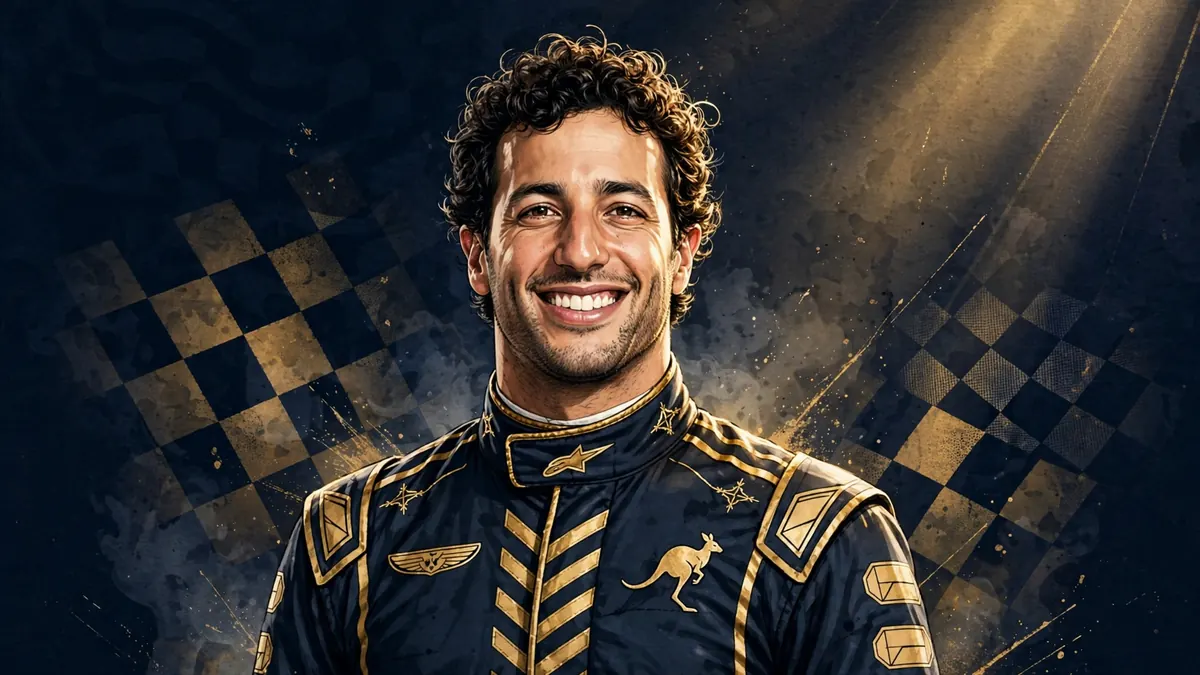
Early Life in Perth: A Karting Kid With Italian Roots
Daniel Joseph Ricciardo was born on July 1, 1989, in Perth, the isolated capital of Western Australia. His parents, Giuseppe “Joe” and Grace Ricciardo, are Italian-Australian, and the family kept close ties to its Italian heritage — a background Ricciardo has spoken about with pride throughout his career, from the Italian pronunciation of his surname to the flag he carried on his helmet. He grew up Catholic and attended Newman College, a Catholic school in the Perth suburb of Churchlands.
Perth sits about as far from Formula One’s European heartland as a racing-mad kid can be, yet the city has a habit of producing drivers with steel in them. Ricciardo’s father raced karts himself, and the young Daniel was around engines and pit lanes before he could properly reach the pedals. He started karting at nine years old, joining the Tiger Kart Club and racing on the small tracks around Western Australia. The early years were not glamorous: family-funded weekends, long drives to regional circuits and a teenager learning racecraft against kids who had been doing it just as long.
What set Ricciardo apart even then was not raw aggression but feel. Coaches and rivals from his junior days describe a driver who could sense grip where others could not, and who braked later than seemed sensible and still made the corner. That late-braking style — diving down the inside from a distance that looked impossible — would become his signature in Formula One, the move fans came to call the “divebomb”. It started on kart tracks in Perth, where the stakes were trophies and the audience was mostly parents.
The Ricciardo household backed the dream fully. Karting in Australia is expensive, and the family’s support carried him through the years when most young drivers run out of money long before they run out of talent. By his mid-teens he was winning at state level and catching the eye of people who scout for the next step. The plan was never to stay in Australia. Formula One lives in Europe, and every serious Australian driver of his generation knew the move across the world was not optional. Ricciardo made it while still a teenager, carrying little more than a helmet bag and the confidence of a kid who had never really doubted where he was headed.
He shares that Perth-to-Europe path with the next wave of Australian talent. His fellow Australian Oscar Piastri’s biography follows a similar arc from junior karting to the Formula One grid, a reminder that Australia keeps producing drivers who have to travel further than anyone else just to get a chance.
Karting and the Junior Ladder
Ricciardo’s climb through the junior formulae was steady rather than explosive, and that steadiness mattered. In 2005 he entered the Western Australian Formula Ford championship, driving a 15-year-old Van Diemen, and finished eighth. The following year he won a scholarship into the Formula BMW Asian championship with Eurasia Motorsport and finished third — a result that put his name on the lists that matter in junior single-seaters.
Formula Renault came next. He moved to Europe full-time in 2007, racing in the European and Italian Formula Renault 2.0 championships, and in 2008 he won the Formula Renault 2.0 West European Cup and finished second in the Eurocup. That same year he made his Formula Three debut at the Nürburgring. The results were piling up in the right order: each season a step higher, each step handled without drama.
His breakout junior season was 2009. Driving for Carlin in the British Formula Three Championship, Ricciardo won the title by 87 points, becoming the first Australian to do so since David Brabham in 1989. It was a statement season — dominant rather than lucky — and it earned him a place in the Red Bull Junior Team, the driver programme that has shaped more modern Formula One careers than any other. Red Bull’s backing changed everything: suddenly the money, the testing miles and the pathway to a Formula One seat were real.
In 2010 he raced in the Formula Renault 3.5 Series for Tech 1, finishing second to Mikhail Aleshin by just two points after a spectacular crash at Silverstone dented his title run. He started 2011 in the same series with ISR Racing, but his championship bid was cut short mid-season. Formula One was calling, and when the call comes, nobody finishes the junior season.
Looking back, the junior record tells you most of what you need to know about the driver he became. Ricciardo was never the teenager who won everything in sight — he was the one who kept arriving, kept learning and kept winning the titles that actually opened doors. British F3 in 2009 was the door. Red Bull walked him through it.
Formula One Debut: HRT and Toro Rosso
Ricciardo first drove a Formula One car in December 2009, testing for Red Bull, and spent the next two seasons as the team’s test and reserve driver alongside Brendon Hartley. The seat itself came from an unlikely place: HRT, the Spanish backmarker team running at the back of the grid on a shoestring budget. Midway through 2011, HRT replaced Narain Karthikeyan, and Ricciardo made his Grand Prix debut at the British Grand Prix on July 10, 2011 — nine days after his 22nd birthday.
The HRT was a slow car, and nobody expected results from it. Ricciardo finished the season pointless, as did everyone else in that car, but the point of the exercise was never points. It was 11 Grands Prix of real racing, real pit stops, real blue flags, real pressure — an education no simulator can give. He outpaced his teammate and did enough to earn the step that mattered: a race seat at Toro Rosso, Red Bull’s junior team, for 2012.
Toro Rosso in 2012 and 2013 was a midfield apprenticeship. Ricciardo finished 18th in the 2012 championship and 14th in the 2013, scoring points in fits and starts while his teammate Jean-Éric Vergne pushed him hard. The car was rarely capable of more than the lower reaches of the points, and both seasons ended well outside the top ten in the standings. But inside Red Bull, the judgement was not about the points table. It was about speed, feedback, racecraft and temperament — and on every one of those measures Ricciardo was building a case.
His Toro Rosso years also gave him his first taste of the wider Formula One world: the media pen, the sponsor days, the expectation that a Red Bull junior performs or disappears. He performed. When Mark Webber announced his retirement from Formula One at the end of 2013, Red Bull had a vacancy at the senior team, and the paddock’s worst-kept secret was who would fill it. Ricciardo’s teammate at Toro Rosso in those years included Carlos Sainz, another driver whose path crossed his more than once across the next decade.
The promotion was announced in September 2013. A kid from Perth who had started karting at nine was about to partner a four-time world champion at the most successful team of the era. Nobody outside Red Bull knew quite how good he was yet. They were about to find out.
The Red Bull Peak: Three Wins and a Third Place in 2014
The 2014 season is the one that made Daniel Ricciardo a star. He arrived at Red Bull Racing alongside Sebastian Vettel, who had just won his fourth consecutive world championship. The expectation in the paddock was polite: the new boy would learn, Vettel would lead, and the team would sort itself out. Instead, Ricciardo outscored Vettel, outqualified him across the season and finished third in the drivers’ championship while Vettel finished fifth.
The first sign came in Melbourne, the season opener and Ricciardo’s home race. He qualified second and finished second on the road, only to be disqualified hours later over a fuel-flow irregularity. It was a gutting way to start, and a lesser driver might have let it set the tone for the year. Ricciardo did the opposite. He won his first Grand Prix in Canada that June, holding off Nico Rosberg’s Mercedes in the closing laps, then won again in Hungary with a pass on Fernando Alonso that people still show in highlight reels, and again in Belgium. He ended the year as the only non-Mercedes driver to win a race in 2014 — three wins in a season when Mercedes won everything else.
That year also gave him the move that defined him. The late dive down the inside, braking impossibly late and somehow making the apex, became his calling card. It was not reckless; it was precise, and it worked because his car control at the limit was superb. Rivals learned to leave room. Fans learned to watch for it. The “Honey Badger” nickname — borrowed from the fearless animal, and a nod to the contrast between his easy grin off track and his aggression on it — stuck for good.
He stayed at Red Bull through 2018, and the results kept coming. He finished third in the championship again in 2016, won the Malaysian Grand Prix that year, and added victories in Azerbaijan in 2017 and in China and Monaco in 2018. The Monaco win mattered most. He had lost the 2016 Monaco race through a pit-stop error while leading, so winning there two years later — nursing a car with a failing power unit for most of the race — felt like a debt settled. By the end of 2018 he had seven wins and had established himself as one of the fastest drivers on the grid.
But the ground was shifting. Max Verstappen had arrived at Red Bull in 2016 and was being built into the team’s future, and Ricciardo could see the direction of travel. He was the senior driver in results and experience, yet the team’s long-term bet was clearly on his younger teammate. When his contract came up at the end of 2018, Ricciardo made the decision that would shape the rest of his career: he left. The story of his years beside Verstappen is part of a bigger picture — Max Verstappen’s biography picks up the other side of that partnership — while his 2014 teammate, the four-time champion he outscored in his first Red Bull season, is covered in Sebastian Vettel’s net worth story.
The Renault Gamble: The Biggest Payday of His Career
Ricciardo signed for Renault for 2019, and the move stunned the paddock. Renault was a works team with a proud history but a midfield car, and nobody quite understood why a race winner at Red Bull would trade down the grid. The answer was a mix of money and belief: a works team offering him the undisputed lead-driver role, a factory behind him, and a contract that made him one of the highest-paid drivers in the sport.
The money was the story before a wheel turned. Early media accounts suggested Renault might pay him as much as $35 million a year, a figure that was never publicly confirmed. Later salary compilations put his earnings at $17 million for 2019 and $32 million for 2020, and Forbes estimated he took home $27 million from racing plus $2 million from endorsements during its 2020 reporting period. Whatever the precise number, it was the richest deal of his career by a wide margin, and it made his two Renault seasons the financial core of his fortune.
On track, the gamble did not pay off the way he hoped. Renault finished fifth in the constructors’ standings in 2019, and Ricciardo ended the year ninth in the drivers’ championship without a podium. The 2020 season was better — two podiums, including a third place at the Eifel Grand Prix, and a fifth-place championship finish — but the wins he had left Red Bull to chase never came. The team was improving, yet the gap to the front was stubborn, and Ricciardo was spending the peak years of his career fighting for sevenths and fifths.
He has never publicly regretted the move, and there is a case that it was the right call on its own terms: a lead-driver role at a manufacturer team, a huge contract and two seasons of being the centre of a team’s plans. But it cost him something harder to measure — the years when he was at his absolute fastest, spent in a car that could not show it. The Renault era is the hinge of his career: the moment he chose money and status over the fastest car available, and the moment his trajectory bent away from the championship fight for good.
His Renault teammates in those years were Nico Hülkenberg in 2019 and Esteban Ocon in 2020. Ocon’s own story is part of the same paddock web — Esteban Ocon’s net worth profile covers the Frenchman’s career — while the driver Ricciardo passed for his famous 2014 Hungarian win, Fernando Alonso, had himself raced for Renault in two separate spells.
McLaren and the Monza Redemption
Ricciardo joined McLaren for 2021, partnering the young British driver Lando Norris, and the move came with fresh hope. McLaren was on the rise after years in the wilderness, and the team offered a race-winning car — or at least, a car that looked capable of it on its best days. His published salary estimates for the spell were $10 million for 2021 and $15 million for 2022, a step down from Renault but still firmly among the grid’s best-paid drivers.
The first half of 2021 was hard. Norris was quicker more often than anyone at McLaren expected, and Ricciardo struggled with a car whose braking characteristics fought his natural style. The driver famous for late braking could not get the McLaren to do what he wanted it to do on the brakes, and the gap to his teammate became the season’s running story. The paddock began to wonder whether the Renault years had taken something out of him.
Then came Monza. At the 2021 Italian Grand Prix, Ricciardo led from the start, held off Verstappen in the early laps, and drove a faultless race to win — McLaren’s first victory in nine years. It was his eighth and final Grand Prix win, and it arrived exactly when he needed it most. The image of him standing on the podium, shoe in hand, beaming, is one of the defining pictures of his career. For one afternoon, the old Ricciardo was back in full, and the questions went quiet.
But one afternoon was not enough. The 2022 season was worse: the car suited him even less, the gap to Norris widened, and McLaren decided to end the contract a year early. The split came with a reported settlement of around $18 million, according to RacingNews365 — a payment that softened the blow considerably and pushed his reported career earnings from team contracts past $120 million, per Celebrity Net Worth’s tally. Ricciardo left McLaren at the end of 2022 without a seat for 2023, and for the first time since he was a teenager, his future in Formula One was genuinely uncertain.
The McLaren years remain the most debated part of his career. Was it the car, or had the driver faded? The honest answer is probably both: a car that never suited his style, and a driver who could not adapt quickly enough to a machine built around someone else’s strengths. His teammate through it all, Lando Norris, went on to become McLaren’s long-term future — the future Ricciardo had once been at Red Bull.
The Comeback, the Hand Injury and the Singapore Farewell
Ricciardo returned to the Red Bull fold in 2023 as the team’s reserve driver, a role that kept him in the paddock and in the simulator while he waited for a door to open. It opened sooner than expected. Mid-season, Red Bull dropped Nyck de Vries from its junior team AlphaTauri and handed Ricciardo the seat from the Hungarian Grand Prix onward. He was back on the grid, twelve years after his debut, in the team where he had started his Formula One career.
The comeback was almost derailed within weeks. At the Dutch Grand Prix in August 2023, he broke his left hand in a crash during practice and was sidelined for several months, missing five races while Liam Lawson stood in. He returned for the United States Grand Prix and showed flashes of the old speed — most notably in Mexico, where he qualified fourth and finished seventh, dragging everything the car had to give out of it. It was a performance that reminded people what he could still do on a good day.
He stayed with the team — renamed RB for 2024 — for the full 2024 season, earning an estimated $7 million under his final Formula One arrangement. But the results never came back consistently. The car was a midfield machine, the qualifying gap to teammate Yuki Tsunoda hurt him, and the team was openly weighing Lawson as his replacement. The end came after the Singapore Grand Prix in September 2024, when RB released him mid-season and Lawson took the seat. Ricciardo’s last race was Singapore: 257 starts, eight wins, 32 podiums, and a farewell that arrived without a ceremony.
There was no retirement announcement at the time, just a quiet departure and a paddock full of tributes. The formal confirmation came almost a year later, in September 2025, when Ricciardo announced he had retired from competitive racing. He was 36, he had spent 14 seasons in Formula One, and he had nothing left to prove to anyone except the people still arguing about the McLaren years.
The Money: Salaries, Endorsements and Business Ventures
Ricciardo’s fortune was built in a short, high-paid window. His early seasons at HRT and Toro Rosso paid modestly, as all junior-team seats do. The money arrived with Red Bull, where his annual salary reached an estimated $6 million to $6.5 million in his later seasons there, per Celebrity Net Worth’s salary reporting. Then came Renault, the deal that changed his financial picture entirely: $17 million in 2019 and $32 million in 2020 on the salary compilations Celebrity Net Worth cites, with Forbes independently estimating $27 million from racing plus $2 million from endorsements in 2020.
McLaren paid him an estimated $10 million in 2021 and $15 million in 2022, with performance incentives on top, and the early termination of that deal produced the reported $18 million settlement. His final season with RB in 2024 paid an estimated $7 million. Add it up across 14 seasons, and Celebrity Net Worth’s tally puts his earnings from Formula One team contracts past $100 million, and past $120 million once the McLaren settlement is included. That is the spine of his wealth — no driver earns that kind of money without a long run at the front of the grid, and Ricciardo had one.
| Season | Team | Reported Salary | Source |
|---|---|---|---|
| 2011 | HRT | Modest rookie salary | Career reporting |
| 2012–2013 | Toro Rosso | Junior-team salary | Career reporting |
| 2014–2018 | Red Bull Racing | Rising to $6M–$6.5M a year | Celebrity Net Worth |
| 2019 | Renault | $17M | Celebrity Net Worth salary compilations |
| 2020 | Renault | $32M ($27M racing + $2M endorsements per Forbes) | Celebrity Net Worth; Forbes |
| 2021 | McLaren | $10M | Published salary estimates |
| 2022 | McLaren | $15M | Published salary estimates |
| 2023 | Red Bull reserve / AlphaTauri | Not publicly disclosed | — |
| 2024 | RB | $7M | Published salary estimates |
| 2022 exit | McLaren settlement | About $18M | RacingNews365 |
Endorsements added a second stream. Ricciardo was one of the most marketable drivers of his generation, and his deals reflected it: long associations with Red Bull and TAG Heuer, partnerships with Castore and Beats by Dre, and the kind of lifestyle-brand work that followed him because sponsors liked being near him. Forbes credited him with about $2 million a year from endorsements in 2020, and some outlets put his endorsement income higher across his peak years. His smile did real commercial work — the grin was not just a personality trait, it was an asset.
Then there are the businesses. Enchanté, his clothing brand, launched as a fashion label built around his personal style and has grown into a genuine venture, with collections and pop-up events tied to race weekends — including a planned Enchanté and Ford pop-up around the 2026 United States Grand Prix weekend. DR3, his wine label (named for his racing initials and number), has expanded from a passion project into a commercial brand, with a rosé launch in 2025. He has also partnered with the betting and entertainment brand Dabble. None of these ventures has published accounts, so their value is impossible to pin down — but they are real businesses with real revenue, not vanity projects, and they matter to his post-racing income in a way a driver’s salary never will again.
For the fullest money picture, the companion piece on our sister site breaks down the numbers in detail: Daniel Ricciardo’s net worth on GuideNetWorth covers the same estimates from the net-worth angle.

Homes, Cars and Assets
Ricciardo’s best-known property purchase is the Beverly Hills home he bought in November 2018 for $8.75 million, a modern house in the Los Angeles hills that became his base during the American-heavy stretches of the Formula One calendar. The timing tells its own story: he bought it in the weeks after announcing the Renault move, at the moment his earning power peaked. Los Angeles suited him — the weather, the media work, the distance from the European paddock bubble — and the house gave him a permanent foothold in the city where so much of his post-racing life now happens.
He has also kept ties to Australia, and to Perth in particular, where his family still lives. Reports over the years have placed him in property in both countries, though the details of his Australian holdings are private and not a matter of public record. What is clear is that real estate has been a meaningful store of his wealth rather than a spending spree: one headline purchase, well timed, in a market that has held its value.
On cars, Ricciardo has been more restrained than the stereotype of a Formula One driver would suggest. He has spoken about loving his cars — he has owned a Porsche and has been seen in classic machinery — but he never built the sprawling collection that some of his peers assembled. The most valuable car in his life was always the one he drove at work, and it was never his to keep. His tastes run more to motorcycles and to the open road than to garage trophies, which fits a driver whose public image was always about enjoyment rather than display.
His investments beyond property and his brands are private. There are no public filings, no disclosed stakes, no venture portfolio to tabulate — and any article that invents one is guessing. The honest accounting is that his wealth sits in career earnings, the McLaren settlement, property, endorsements and two growing brands. That is a solid, eight-figure foundation, and it does not need embellishment to be impressive.
Net Worth Breakdown: Why the Estimates Disagree
Here is where the reporting gets messy, and it is worth being straight about it. The published estimates for Daniel Ricciardo’s net worth in 2026 disagree by more than $70 million, which is a lot of disagreement for one driver’s bank balance. Understanding why they differ matters more than picking a number and pretending it is certain.
| Source | Estimate (2026) | Basis |
|---|---|---|
| Celebrity Net Worth | $125 million | Career earnings over $120M incl. McLaren settlement |
| iFANN | $115 million | Editorial estimate; 14-year F1 career + endorsements |
| BounceMojo | $55 million | Updated July 2026; salaries, endorsements, DR3 |
| SurpriseSports | $50 million | Public reporting; contracts, endorsements, ventures |
| PowerNetWorth | $50 million | F1 contracts, endorsements, business ventures |
| NetWorthBreakdown | $50 million | Race salaries and endorsement deals |
The gap comes down to method. Celebrity Net Worth’s $125 million figure is built on the career-earnings tally: more than $100 million from team contracts, plus the reported $18 million McLaren settlement, plus endorsements and business income, with relatively little deducted for tax, management and spending. The $50 million cluster — SurpriseSports, PowerNetWorth, NetWorthBreakdown and BounceMojo at $55 million — applies a heavier discount for the costs of a Formula One life: taxes across multiple countries, management fees, and fourteen years of living at the level the job demands.
There is also a wilder outlier to be aware of. A 2026 rich-list roundup cited by Evening Ledger put Ricciardo at $194 million, citing Yahoo Finance UK — a figure far above every other source and one that should be treated with real caution, since it appears to rest on a different and unexplained method. We do not anchor on it.
Our judgement, after weighing the sources: the defensible range is $50 million to $125 million, and the truth most likely sits in the upper half of it. His documented career earnings alone clear $120 million before tax, and while tax and spending take a large bite, they do not erase a fortune of that size — particularly when the McLaren settlement arrived as a lump sum late in his career and his brands continue to earn. Celebrity Net Worth anchors the top of the range; the $50 million cluster anchors the bottom. Readers should treat any single precise number as an estimate, not a fact, because Ricciardo has never published his finances and never will.
The anchor: Celebrity Net Worth’s $125 million is the highest credible estimate and the one most consistent with his documented career earnings. The most commonly repeated figure, $50 million, is the conservative end of the range. We publish the range, not a single number, because the sources genuinely disagree.
| Year | Milestone | Estimated Net Worth |
|---|---|---|
| 2011 | F1 debut with HRT | Under $1M |
| 2014 | First Red Bull wins; 3rd in championship | About $8M |
| 2018 | Monaco win; leaves Red Bull | About $30M |
| 2020 | Peak Renault salary year | About $40M |
| 2022 | McLaren exit; $18M settlement | About $50M |
| 2024 | Final F1 season with RB | $50M–$55M |
| 2026 | Retired; Ford Racing ambassador | $50M–$125M (range) |
The year-by-year figures before 2024 are our modelled estimates built from the published salary data and the BounceMojo timeline, which puts his net worth at $30 million in 2018, $40 million in 2020 and $50 million in 2022. They are approximations, and they are labelled as such.
Personal Life: Heidi Berger, Family and Life Off Track
Ricciardo has always guarded his private life more carefully than his public image suggests. The grin and the shoey are for the cameras; the life behind them is kept deliberately small. His partner is Heidi Berger, an actress and model, and the daughter of former Formula One driver Gerhard Berger — which makes their relationship a neat piece of paddock symmetry, the son of an Italian-Australian karting family with the daughter of an Austrian Grand Prix winner. As of 2026 they are in a relationship and keep it largely out of the spotlight, appearing together occasionally but rarely discussing it in public.
His family remains central. His parents, Joe and Grace, supported the karting years financially and emotionally, and Ricciardo has spoken often about what that backing meant — the weekends, the sacrifices, the belief that a kid from Perth could make it in a European sport. He has a sister, Michelle, and the family unit has stayed close even as his career took him to Monaco, Los Angeles and every circuit on the calendar. The Italian heritage runs through the family story: the surname, the food, the Catholic upbringing at Newman College, and a connection to Italy that he has never downplayed.
Off track, Ricciardo’s interests are well documented and genuinely his: surfing and the ocean, motorcycles, American football, music, and a love of the United States that eventually made Los Angeles a second home. He is 179 cm tall (about 5 feet 10 inches) and raced at around 65–69 kg, the lean build of a modern Formula One driver. If you want the age detail specifically, our sister site covers Daniel Ricciardo’s age in full.
In 2022 he was appointed a Member of the Order of Australia in the Australia Day Honours, a formal recognition of his services to motorsport. It is the kind of honour that says something about how Australia sees him: not just a fast driver, but a public figure who carried the country’s flag in a sport where Australians are rare and success is rarer.
The Shoey, the Honey Badger and Drive to Survive
No biography of Daniel Ricciardo is complete without the shoey. The tradition — drinking champagne from a racing shoe on the podium — started as a joke at the 2016 German Grand Prix and became a ritual fans demanded at every podium after. It was gross, joyful and unmistakably his, and it did more for his fame than any overtake. The shoey turned a podium ceremony into a moment people talked about on Monday morning, and other drivers — and even celebrities like Patrick Stewart — were eventually roped into doing it with him.
The “Honey Badger” nickname deserves its own note because it captures the central tension of his career. Off track he is famously relaxed, funny and easy company; on track he was one of the most aggressive overtakers of his generation. The honey badger, an animal known for fearlessness wildly out of proportion to its size, was the perfect shorthand. Ricciardo embraced it fully, putting the animal on his helmet and building a personal brand around the contrast.
Then came Netflix. Drive to Survive, the documentary series that brought Formula One to a vast new audience from 2019 onward, made Ricciardo one of its breakout stars. His humour, his honesty about the sport’s pressures and his willingness to be himself on camera made him the show’s most popular driver for many viewers — and, by extension, one of the most famous racing drivers in the world among people who had never watched a Grand Prix. The series changed his commercial value: suddenly the endorsements and the media work were not just paddock business, they were mainstream celebrity business.
That fame has a double edge, and it is worth naming. Drive to Survive made Ricciardo bigger than his results in his later years, which meant the decline was more public and more discussed than it would have been for a less famous driver. The McLaren struggles played out in front of millions of new fans who had arrived through the show. He handled it with the same grace he handled everything else — no public bitterness, no blame — but the gap between the Netflix star and the driver fighting for twelfth place was real, and it shaped how his final seasons were judged.
Life After Formula One: Ford Racing Ambassador
On September 4, 2025, Ford announced Ricciardo as its global ambassador for Ford Racing, a role focused on the Raptor brand and lifestyle. It was a natural fit: Ford returns to Formula One as Red Bull’s engine partner from 2026, and Ricciardo — a Red Bull man to his core — became the public face of that reunion. The job keeps him close to racing without the demands of a race seat, and it gives him a platform built on his personality rather than his lap times.
His 2026 calendar reads like a launch plan rather than a race schedule. Enchanté and Ford pop-up events are planned around race weekends, including the United States Grand Prix, and he has been co-hosting ESPN coverage and appearing at Ford events built around the Raptor family. There has been paddock chatter about a reserve role or a return to a race seat, but nothing has come of it, and the shape of his post-racing life suggests he is not chasing one. The ambassador work, the brands and the media appearances add up to a second career that looks deliberate rather than accidental.
What he does next will be watched closely, because Ricciardo is one of the few retired drivers with a genuine mainstream audience. Broadcasting, brand building, a bigger role at Ford — all of them are open to him. The drivers who stay relevant after retirement are the ones who built something beyond lap times, and Ricciardo spent a decade doing exactly that, almost without trying. The grin was always the product; the racing was how people found it.
For readers who want to keep exploring Formula One careers on this site, our biography section covers the drivers and personalities who shaped the sport’s modern era.
Frequently Asked Questions
How old is Daniel Ricciardo in 2026?
Daniel Ricciardo was born on July 1, 1989, in Perth, Western Australia, which makes him 37 years old in 2026. He was 22 when he made his Formula One debut at the 2011 British Grand Prix, 25 when he won his first race in Canada in 2014, and 36 when he confirmed his retirement from competitive racing in September 2025.
How many Formula One races did Daniel Ricciardo win?
Ricciardo won eight Formula One Grands Prix across 257 starts between 2011 and 2024, with 32 podium finishes, three pole positions and 17 fastest laps. His wins came for Red Bull (seven, including Canada, Hungary and Belgium in 2014, Malaysia in 2016, Azerbaijan in 2017, and China and Monaco in 2018) and McLaren (one, the 2021 Italian Grand Prix at Monza). His best championship finishes were third place in 2014 and 2016.
What is Daniel Ricciardo’s net worth in 2026?
Estimates range from $50 million to $125 million. Celebrity Net Worth puts his net worth at $125 million, iFANN at $115 million, while BounceMojo ($55 million), SurpriseSports ($50 million) and PowerNetWorth ($50 million) land lower. The range reflects different methods: his documented career earnings from team contracts pass $120 million including the reported $18 million McLaren settlement, but tax, management costs and spending reduce the final figure. He has never published his finances, so every number is an estimate.
Why did Daniel Ricciardo leave Formula One?
RB released him after the 2024 Singapore Grand Prix, his final race, and replaced him with Liam Lawson. His form in his last full season had been inconsistent, and the team chose to back its younger driver. Ricciardo confirmed his retirement from competitive racing in September 2025, almost a year later, and became global ambassador for Ford Racing. He has said the decision to step away was his own once the seat was gone, and he has not pursued a return to the grid.
Which teams did Daniel Ricciardo race for in Formula One?
Ricciardo raced for seven teams across 14 seasons: HRT (2011), Toro Rosso (2012–2013), Red Bull Racing (2014–2018), Renault (2019–2020), McLaren (2021–2022), AlphaTauri (2023) and RB (2024). He also served as Red Bull’s test and reserve driver in 2009–2011 and again in 2023 before his mid-season return with AlphaTauri. His eight wins were split between Red Bull (seven) and McLaren (one).
Who is Daniel Ricciardo’s partner?
Daniel Ricciardo’s partner is Heidi Berger, an actress and model. She is the daughter of former Formula One driver Gerhard Berger, who won ten Grands Prix in a career spanning 1984 to 1997. The couple keep their relationship largely private and rarely discuss it in public, though they have appeared together at events. Ricciardo has no children as of 2026.
What is the shoey?
The shoey is Daniel Ricciardo’s famous podium celebration, in which he drinks champagne from his racing shoe. It began as a joke at the 2016 German Grand Prix and became a ritual fans demanded at his podium finishes afterward. Other drivers and celebrities, including Sir Patrick Stewart, have joined in over the years. It became one of the most recognisable traditions in modern Formula One and a big part of Ricciardo’s popular appeal.
What is Daniel Ricciardo doing now?
Since September 2025, Ricciardo has been the global ambassador for Ford Racing, a role focused on the Raptor brand and lifestyle as Ford returns to Formula One as Red Bull’s engine partner from 2026. He also runs his Enchanté clothing brand and DR3 wine label, co-hosts ESPN coverage at selected races, and appears at Ford and Enchanté events around Grand Prix weekends. He has no race seat for 2026 and has not pursued a return to competitive racing.
Final Thoughts
Daniel Ricciardo’s biography is not a story about a championship that never came — it is a story about a driver who squeezed everything out of the talent he had and became, for a time, one of the most loved figures in world sport. Eight wins, 32 podiums and two third-place championship finishes is a career most drivers would trade their own for. The Renault gamble and the McLaren years cost him the chance to add to it, but they did not diminish what he achieved at Red Bull, where for three seasons he was genuinely among the three fastest drivers on the planet.
The money tells the same story as the racing. A fortune estimated between $50 million and $125 million, built on more than $120 million of career earnings, a headline settlement and two brands that keep growing after the chequered flag. The range is wide because the sources disagree, and we have said so plainly rather than hiding behind a single confident number. That honesty is the point: Ricciardo’s wealth, like his career, is best understood as a range with a clear anchor, not a fiction dressed up as precision.
What lasts is not the salary table. It is the late braking, the shoey, the grin and the afternoon at Monza when a driver everyone had written off won a Grand Prix and reminded the sport why it loved him in the first place. The Ford Racing role gives him a second act with a real platform. Whatever he does with it, the first act is already secure: the Honey Badger from Perth, who travelled further than almost anyone to reach Formula One — and then made the whole sport come to him.
Sources and Reporting
How we estimated: Every money figure in this article is tied to a named source. Celebrity Net Worth ($125 million; salary compilations and career-earnings tally) anchors the top of the net-worth range; BounceMojo ($55 million, updated July 2026), SurpriseSports ($50 million) and PowerNetWorth ($50 million) anchor the bottom. iFANN ($115 million) sits in between. Forbes’ 2020 reporting ($27 million racing plus $2 million endorsements) and RacingNews365 (the reported $18 million McLaren settlement) supply the salary detail. Career statistics (257 starts, 8 wins, 3 poles, 17 fastest laps, 32 podiums) come from Wikipedia’s career record, cross-checked against Britannica and Honda’s official driver profile. Biographical facts come from Wikipedia, Britannica (last updated November 12, 2026) and Honda. Where sources conflict — above all on net worth — we publish the range and say which source anchors each end. Ricciardo has never disclosed his finances, so all net-worth figures are estimates and may differ from his private reality.
Sources consulted: Wikipedia · Britannica · Celebrity Net Worth · Forbes · BounceMojo · SurpriseSports · PowerNetWorth · iFANN · Honda · Formula 1