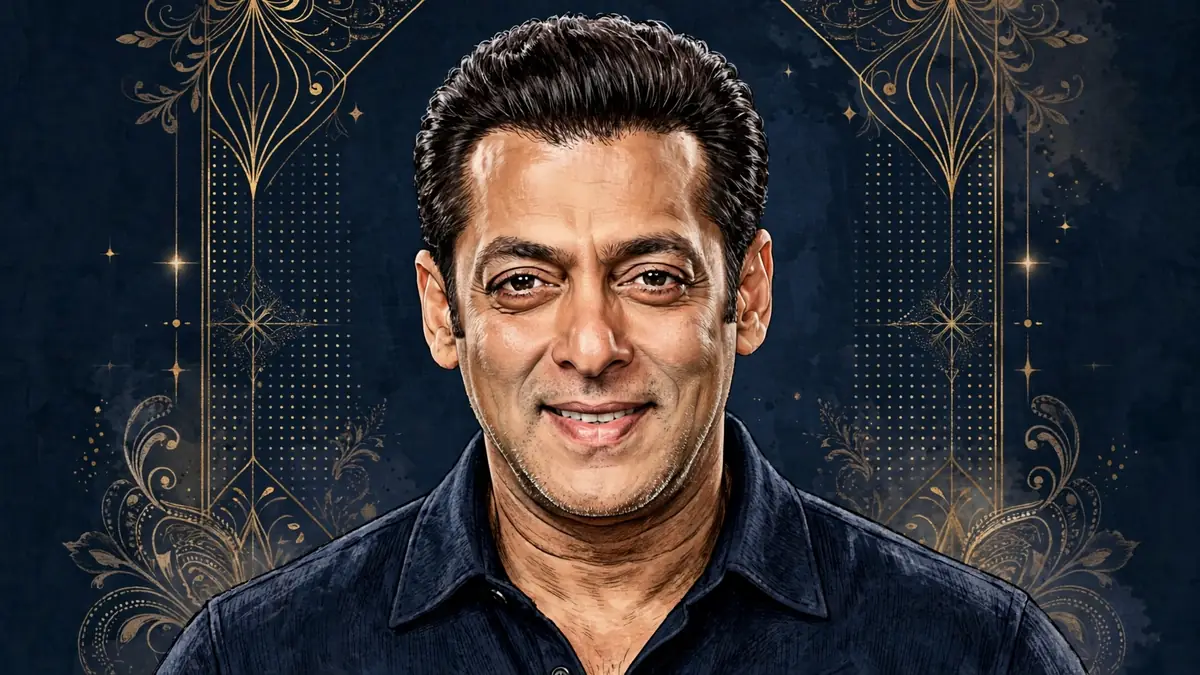
Salman Khan is 60 years old in 2026, and after 37 years in front of the camera he is still the most bankable name in Hindi cinema. Born Abdul Rashid Salim Salman Khan on December 27, 1965, in Indore, Madhya Pradesh, he turns 61 on December 27, 2026. His estimated net worth in 2026 sits at around $350 million (roughly ₹2,900–3,225 crore), inside a published range of $300 million to $375 million. This Salman Khan biography traces the full arc: the screenwriter’s son who arrived in Mumbai with no acting plan, the overnight star of Maine Pyar Kiya, the long middle stretch when the hits dried up, the second act built on Wanted and Dabangg, and the television host, producer and charity founder he became along the way.
Few Indian stars have held the top for as long. Khan has headlined films in five different decades, hosted Bigg Boss since 2010, and turned his name into a production house, a clothing label and a charity. He has also spent much of his adult life in courtrooms, answering for two cases that have followed him since the late 1990s and early 2000s. This profile gives the documented record on both, the money with its honest range, and the career year by year, so a reader can finish here without needing to search the same questions again. Last updated November 11, 2026. By Celebamerica Editorial Staff.
Contents
- Quick Facts
- Early Life and Family Background
- The Khan Family
- Debut and Breakthrough
- The 1990s: Romance, Family Films and Stardom
- The 2000s: Slump, Reinvention and Wanted
- The 2010s: The Blockbuster Decade
- Recent Years: Tiger 3, Sikandar and What Comes Next
- Bigg Boss: Sixteen Seasons as Host
- The Money: Net Worth in 2026
- Income Streams: Films, Television, Endorsements and Business
- Assets: Homes, Cars and Investments
- Net Worth Growth Over the Years
- Being Human Foundation and Charity Work
- Personal Life
- Court Cases and Controversies: The Documented Record
- How Salman Khan Compares With His Peers
- Frequently Asked Questions
- Final Thoughts
- Sources and Reporting
Quick Facts
| Full Name | Abdul Rashid Salim Salman Khan |
|---|---|
| Date of Birth | December 27, 1965 |
| Birthplace | Indore, Madhya Pradesh, India |
| Age in 2026 | 60 years old; turns 61 on December 27, 2026 |
| Height | Commonly reported as 5 feet 8 inches (about 174 cm) |
| Estimated Net Worth | Around $350 million (₹2,900–3,225 crore), inside a $300M–$375M published range |
| Primary Income Sources | Film fees and profit shares, Bigg Boss hosting, endorsements, Salman Khan Films |
| Key Ventures | Salman Khan Films, Being Human Foundation (founded 2007), Being Human clothing |
| Debut | Biwi Ho To Aisi (1988, supporting role) |
| Breakthrough | Maine Pyar Kiya (1989) |
| Television | Host of Bigg Boss since season 4 (2010) through season 19 (2025) |
| Marital Status | Unmarried |
| Latest Film | Sikandar (Eid, March 2025) |
| Next Film | Battle of Galwan, retitled Maatrubhumi in March 2026, planned for a 2026 release |
Early Life and Family Background
Salman Khan was born in Indore, the largest city in Madhya Pradesh, on December 27, 1965. He was the eldest child of Salim Khan and Salma Khan, and the household he grew up in was already steeped in cinema. His father, Salim Khan, was one half of the Salim-Javed writing partnership that wrote Sholay, Deewaar and Zanjeer, the films that shaped Hindi cinema in the 1970s. The boy who would become one of the industry’s biggest stars grew up watching scripts take shape at the dining table, and hearing the trade talk of writers, directors and actors as everyday conversation.
The family moved to Mumbai, where Salman spent most of his childhood in Bandra, the seaside suburb that has been his home ever since. He went to St. Stanislaus High School in Bandra and spent time at The Scindia School in Gwalior, before returning to Mumbai. He later joined St. Xavier’s College in Mumbai and left without finishing a degree. By his own account in interviews over the years, he was not a keen student. He liked sport, swimming and painting, and he spent long hours at the gym. The body that later became his screen trademark was built early, in those school and college years, long before a film camera ever pointed at him.
Nothing about his early life pointed straight at acting. His father was a writer, not a star, and the family name opened doors in the industry without handing him a career. Friends from that period remember a young man who was good-looking and restless, who modelled a little and drifted toward the film world rather than charging at it. He did some modelling work and appeared in a few small assignments while he worked out what he wanted to do. The break, when it came, arrived through the usual Mumbai route: someone who knew someone, a screen test, and a small part that nobody expected to change his life.
Indore still matters to the story. Khan was born there because his family roots run through the city, and he returns to the subject in interviews whenever he talks about where he comes from. He is a Mumbai man by upbringing, but the Indore birthplace is the first line of almost every biography of him, and it is the detail that trips up the many web pages that wrongly list Mumbai as his birthplace. The record is clear: Indore, December 27, 1965.
The Khan Family
The Khan household is one of the most close-knit families in Hindi cinema, and it has stayed that way in public for four decades. Salman’s father Salim Khan married Salma Khan first; his second wife is the former actress Helen, who joined the family when Salman was a teenager and is treated by all the children as a second mother. The siblings are brothers Arbaaz Khan and Sohail Khan, both actors and producers in their own right, and sisters Alvira Khan Agnihotri and Arpita Khan Sharma. Arpita is the youngest and was adopted into the family as a child.
That closeness shows up in the work. Arbaaz produced Dabangg (2010), the film that rebuilt Salman’s career, and Sohail has directed and produced films with his brother. Salim Khan has written for his son, and the family turns up together at premieres, on Bigg Boss sets and at Being Human events. When Salman launched his production house, the family was part of the setup. When his films open, the family is usually in the front row.
The family also shares the Bandra home that has become part of the Salman Khan story in its own right. For decades he has lived in a modest flat at Galaxy Apartments in Bandra, on the ground floor of a building that fans now treat as a landmark. While other stars of his stature moved into sea-facing bungalows and multi-storey mansions, Khan stayed in the flat he has lived in since before he was famous. His parents live in the same building, and his brothers have homes nearby. The arrangement says a lot about how the family works: success changed the scale of his life without changing its address.
His mother Salma Khan keeps a low profile, while Helen is a familiar presence at family gatherings. Salim Khan, now in his late eighties, remains the family’s anchor and its most quoted voice. In interviews, Salman credits his father with the discipline that kept him working through the lean years, and with the writing-room habit of judging a film by its story before anything else. That habit, learned at home, helps explain why his biggest hits — from Maine Pyar Kiya to Bajrangi Bhaijaan — are built on simple, emotional stories rather than on spectacle alone.
Debut and Breakthrough
Salman Khan’s first screen appearance came in 1988, in Biwi Ho To Aisi, where he played the younger brother in a family drama led by Rekha and Farooq Sheikh. The role was small and the film did little for him. He was 22 years old, and nothing in the performance suggested that a superstar had arrived. What it did give him was a credit, a set to learn on, and a face that casting directors started to remember.
The change came a year later, and it came fast. Maine Pyar Kiya, released in 1989, cast him opposite the newcomer Bhagyashree as Prem, a rich boy who falls for a girl from a poorer family. The film was a love story in the old Rajshri style — songs, family conflict, a hero who had to earn his love — and it ran to packed houses across India. Khan won the Filmfare Award for Best Male Debut, and Prem became the character he would return to, in one form or another, for the rest of his career. The film made him a star at 23, before he had learned much about acting at all.
The years right after Maine Pyar Kiya were busy but uneven. Baaghi (1990), Sanam Bewafa (1991) and Saajan (1991) kept him visible, and Saajan in particular was a big commercial hit, pairing him with Sanjay Dutt and Madhuri Dixit. But the early 1990s also brought a string of forgettable films, and the industry began to wonder whether the Maine Pyar Kiya boy had anything more to offer. He was handsome and he could dance, but the acting range that would later carry films like Tere Naam and Bajrangi Bhaijaan was still years away.
What saved him in that period was his willingness to work constantly. He took the roles that came, learned on the job, and built a fan base among young audiences who liked his screen presence even when the films around him were weak. The fan base mattered. When the right films finally arrived in the middle of the decade, the audience was already there, waiting.
The 1990s: Romance, Family Films and Stardom
The middle of the 1990s made Salman Khan a fixture of Hindi cinema. Hum Aapke Hain Koun..! (1994), Sooraj Barjatya’s family saga, became one of the highest-grossing Indian films of its time and gave Khan his biggest hit yet. He played Prem again, this time in a sprawling joint-family story built around weddings, songs and sacrifice, and the film’s success fixed his image as the clean-cut romantic hero of the family audience. The same year he appeared in Andaz Apna Apna with Aamir Khan, a comedy that flopped on release and later became a cult favourite. The two Khans on screen together — Aamir Khan, whose own net worth story we have profiled — is still one of the most rewatched pairings of the decade.
Karan Arjun (1995) put him opposite Shah Rukh Khan, his great contemporary and rival, in a reincarnation drama that was a box-office hit. The two men would go on to define the decade together, trading the top spot year after year. Shah Rukh Khan’s profile on CelebAmerica covers the other side of that rivalry in detail. The Khan trio — Salman, Shah Rukh and Aamir — dominated Hindi film through the 1990s and 2000s in a way no three actors had before, and their names on a poster together were a guarantee of an opening.

The decade closed with a run of hits that showed his range widening. Hum Saath-Saath Hain (1999) reunited him with Barjatya and a large family cast, and Hum Dil De Chuke Sanam (1999), directed by Sanjay Leela Bhansali, cast him as the passionate lover Sameer opposite Aishwarya Rai. The film earned him a Filmfare nomination for Best Actor and is still counted among his best performances. He also won praise for Biwi No. 1 and Hum Dil De Chuke Sanam in the same year, a reminder that his commercial peak and his acting peak were arriving together.
By the end of 1999 he had starred in more than 40 films, and he was 34 years old with a career that already spanned a decade. The numbers were strong, the fan base was loyal, and the industry treated him as one of its three biggest stars. What nobody could see yet was that the next few years would test him harder than the first decade had, on screen and off it.
The 2000s: Slump, Reinvention and Wanted
The early 2000s were the hardest stretch of Salman Khan’s career. The hits became rarer, the films grew weaker, and a run of releases — Chal Mere Bhai, Har Dil Jo Pyar Karega, Kahin Pyaar Na Ho Jaaye — did little at the box office. He was still a star, but the audience that had grown up with him was drifting toward younger heroes, and the romantic image that had carried him through the 1990s was starting to look dated. There were bright spots: Tere Naam (2003), in which he played a troubled young man with a shaved head and a broken heart, earned him some of the best reviews of his career and a Filmfare nomination. Mujhse Shaadi Karogi (2004) and No Entry (2005) were commercial hits, and Partner (2007) showed he could still carry a comedy. But the run was patchy, and by 2008, after the failure of Yuvvraaj, the talk in the trade was that his time at the top was ending.
What changed the story was Wanted (2009). Directed by Prabhu Deva, the film cast Khan as Radhe, a hitman with a swaggering walk and a one-line style, and it was built for the single-screen audience that had always loved him most. The action was loud, the dialogue was punchy, and Khan’s screen presence did the rest. Wanted was a hit, and it gave him a new template: the larger-than-life action hero who could open a film on his name alone. He was 43 years old, and he was starting again.
The reinvention was not only about action. Khan understood that his audience had changed. The family films of the 1990s had given way to a mass audience that wanted heroes who were invincible on screen and accessible off it. He leaned into that image — the shirtless fight scenes, the bracelet on his wrist, the “Bhai” persona that fans had given him — and he built his second act around it. The nickname Bhaijaan, elder brother, stuck because it matched how his fans already saw him: a star who belonged to them, not to the industry.
The 2000s also saw him step behind the camera as a producer. He set up SKBH Productions (Salman Khan Being Human Productions) in 2011, with a share of its film profits going to the Being Human Foundation, but the producing instinct was already visible in the years before that. He was thinking about the business of cinema, not only about his next role, and that thinking would shape the fortune he built in the decade that followed.
The 2010s: The Blockbuster Decade
If the 2000s tested Salman Khan, the 2010s rewarded him beyond anything the 1990s had promised. Dabangg (2010), produced by his brother Arbaaz, cast him as Chulbul Pandey, a corrupt but charming policeman in Uttar Pradesh. The film was a smash hit, won the National Film Award for Best Popular Film, and gave Khan his most quoted character. Chulbul Pandey’s moustache, his sunglasses and his way of talking became part of everyday language in India. Two sequels followed, and the franchise became one of the most durable in Hindi cinema.
The hits then came in a run that few Indian actors have matched. Ready (2011), Bodyguard (2011), Ek Tha Tiger (2012), Dabangg 2 (2012), Kick (2014), Bajrangi Bhaijaan (2015), Prem Ratan Dhan Payo (2015), Sultan (2016) and Tiger Zinda Hai (2017) each opened to huge numbers, and several of them crossed the ₹300 crore mark at the domestic box office. Bajrangi Bhaijaan, in which he played a simple man who helps a lost Pakistani girl return home, won the National Film Award for Best Popular Film Providing Wholesome Entertainment and is widely seen as his finest film of the decade. Sultan cast him as a wrestler past his prime, a role that asked him to look older, heavier and beaten down — and he pulled it off.
The Tiger series deserves a note of its own. Ek Tha Tiger (2012) paired him with Katrina Kaif as a spy caught between India and Pakistan, and the pairing clicked. Tiger Zinda Hai (2017) and Tiger 3 (2023) kept the franchise going, and the character became the spine of Yash Raj Films’ spy universe, crossing over into films led by Shah Rukh Khan and Hrithik Roshan. For an actor who had spent the 2000s fighting for relevance, the 2010s made him the centre of the biggest franchise in Hindi cinema.
He also used the decade to build his production house properly. Salman Khan Films, launched in 2011, produced Chillar Party, which won the National Film Award for Best Children’s Film, and went on to back films including Bajrangi Bhaijaan, Hero and Notebook. The company gave him a stake in films he did not star in, and a second income stream that did not depend on his own box-office draw. It also gave new directors and actors a platform, and Khan made a point of using it that way, launching newcomers in films his name could open.
By the end of the decade he was, by most measures, the highest-paid actor in India. Media reports put his per-film fee in the ₹100–150 crore range, with profit shares on top, and Forbes’ 2018 list of the world’s highest-paid celebrity entertainers ranked him the highest-placed Indian, with $37.7 million in estimated earnings for the year. That figure is often misread as his net worth. It is not. It is one year’s earnings, and it belongs in the income section of this profile, not in the wealth total.
Recent Years: Tiger 3, Sikandar and What Comes Next
The years since 2020 have been mixed for Salman Khan, and honest reporting should say so. Radhe (2021) went straight to streaming during the pandemic and drew poor reviews. Antim (2021) did modest business. Kisi Ka Bhai Kisi Ki Jaan (2023) underperformed, and Tiger 3 (2023), the third film in the spy series, earned well but fell short of the franchise’s earlier heights. The run of sure-fire openings that had defined the 2010s was over, and the trade began asking whether the mass-hero template still worked for audiences that had moved on to streaming and to different kinds of stories.
Sikandar, released on Eid in March 2025 and directed by A. R. Murugadoss, was meant to answer that question. It did not. The film, co-starring Rashmika Mandanna, opened big on the holiday and then faded fast, with reviewers and audiences alike finding it dated. Trade reports called it a box-office disappointment, and it became the film most often cited when people argue that Khan needs a new kind of role. At 60, he is at the age when most stars slow down. The question now is whether he reinvents himself a third time, as he did in 2009 and again in 2010.
His answer, so far, is a war film. In July 2025 he announced Battle of Galwan, directed by Apoorva Lakhia and based on the 2020 Galwan Valley clash between Indian and Chinese troops, drawing on the book India’s Most Fearless by Shiv Aroor and Rahul Singh. Reports said he would play Colonel B. Santosh Babu, the officer who led the 16 Bihar Regiment during the clash, in what would be his first role as an army officer on screen. Chitrangda Singh was cast opposite him, and filming began in Ladakh, with a 45-day schedule in Leh completed by September 2025.
Then the film changed. In March 2026 Khan announced that Battle of Galwan had been retitled Maatrubhumi, with a rewritten script that fictionalised the conflict and softened its treatment of the border clash, after objections reported in the press. The Hollywood Reporter India reported the title change on March 17, 2026, and noted that the new poster carried no release date. Trade reports since then have put the release in a July-to-October 2026 window, while a November 2026 report in Filmibeat pointed to December 4, 2026. The honest position, as of this writing, is that the film is planned for a 2026 release and no final date has been locked in. Readers checking this page later should look for the confirmed date rather than taking any single report as final. The retitle matters for the biography because it shows Khan, at 60, reaching for a serious, patriotic role rather than another action sequel — and because it shows how closely a film about a real border clash is watched, in India and beyond.
Alongside the film, he has kept his television work going, and his production house continues to develop projects. He remains one of the few Indian stars who can still open a film on his name, even when the film itself disappoints. That is the paradox of his recent years: the stardom has outlasted the hot streak, and the next film will tell us whether the two can be reunited.
Bigg Boss: Sixteen Seasons as Host
Salman Khan’s second career began in 2010, when he took over as host of Bigg Boss, the Hindi version of the Big Brother format, from season 4. Amitabh Bachchan, whose age profile we have covered, had hosted season 3 before him. Khan co-hosted season 5 with Sanjay Dutt and then hosted alone from season 6 onward, through season 19 in 2025. The show’s weekend episodes, in which he faces the contestants and reviews the week’s fights and friendships, became appointment viewing in their own right, and his presence is widely credited with keeping the format alive for a decade and a half.
The job matters to his biography for three reasons. First, it gave him a weekly presence in Indian homes that no film schedule could match, keeping him in front of audiences even in years when his films faltered. Second, it paid well: media reports put his per-season fee in the tens of crores, though no figure has ever been confirmed by the channel or by Khan, and this profile does not present any single number as fact. Third, it showed a different side of him. On Bigg Boss he is part host, part counsellor and part elder brother, scolding contestants one week and defending them the next. The “Bhai” persona that fans use for him was built as much on those weekend episodes as on any film.
Season 19, which ran in 2025, was the longest in the show’s history, running for about five months, and reports said Khan hosted the opening months before other hosts covered parts of the extended run, with Khan returning for the finale. The finale took place on December 7, 2025, with Gaurav Khanna named the winner. The exact hosting split was reported differently by different outlets, and this profile does not claim a detail the record does not settle. What is settled is that he remained the face of the show through its nineteenth season, sixteen years after he first took the job.
The show has also brought him security worries. In April 2024, two men on a motorcycle fired shots outside his Galaxy Apartments home in Bandra, an incident linked in press reports to threats from the Lawrence Bishnoi gang. Security around him and his home was tightened, and the show’s makers removed live audiences from episodes he attended. The threats have been reported widely since then, and they form part of the reason his public appearances are now heavily guarded.
The Money: Net Worth in 2026
Salman Khan’s estimated net worth in 2026 is around $350 million, roughly ₹2,900–3,225 crore, inside a published range of $300 million to $375 million. That anchor comes from GuideNetWorth’s 2026 age profile of Khan, which reviewed the year’s published estimates and placed the figure at $350 million, and it is the anchor this biography uses because it sits in the middle of the corroborated range rather than at either end of it. The range matters more than the single number. No audited figure exists for Khan’s wealth, and every number in circulation is a media estimate built from reported fees, property records and business interests. A reader who sees a single confident figure elsewhere should treat it with the same caution.
The published spread is wide, and it is worth showing in full. BeforeGood put the figure at $300 million in 2026. TechToFacts put it at $375 million. BioGraphiqs and NewslyMedia put it at around $360 million. Filmibeat listed $315 million. A January 2026 report in Siasat Daily placed the figure at ₹3,225 crore, which converts to roughly $390 million at the exchange rates used by Indian outlets, and sits at the top of the range. The $350 million anchor, equal to about ₹2,900 crore, is the figure most often repeated across the 2026 reporting, and it is the one this profile carries forward.
How to read the number: $350 million is an estimate, not a bank balance. It covers reported film earnings, television fees, endorsements, production profits, property and business stakes, minus the costs and taxes nobody outside Khan’s own accounts can see. Forbes’ much-quoted $37.7 million figure from 2018 is one year’s estimated pre-tax earnings, not wealth, and it should never be added to a net-worth total. Khan did not appear on the Hurun India Rich List in 2025, which some outlets noted, but that list’s method excludes several major film stars, so the absence is not evidence of a fall in wealth.
| Source | 2026 estimate |
|---|---|
| GuideNetWorth age profile (anchor) | Around $350 million (₹2,900–3,225 crore) |
| BeforeGood | $300 million |
| Filmibeat | $315 million |
| BioGraphiqs / NewslyMedia | Around $360 million |
| TechToFacts | $375 million |
| Siasat Daily (January 2026) | ₹3,225 crore |
| Forbes (2018, annual earnings only) | $37.7 million in one year — not a net-worth figure |
For readers who want the age detail behind the money, GuideNetWorth’s Salman Khan age profile for 2026 sets out the birth date, the age at each career milestone and the same net-worth range used here. It is the sister site’s different-angle profile of the same man, and it is the one cross-site link this article carries.
Income Streams: Films, Television, Endorsements and Business
Film fees are still the largest single source of Salman Khan’s income. Media reports put his per-film fee in the ₹100–150 crore range, with profit shares of 60–70 percent reported on some projects, and trade outlets have reported combined annual earnings of around ₹220–250 crore from films, television, endorsements and business together. Those numbers are reported figures, not confirmed contracts, and they vary from year to year with the number of releases. A year with two big releases and a full Bigg Boss season earns far more than a year with one film. The profit-share model matters here: on his biggest hits, Khan is reported to take a share of the film’s profits rather than a flat fee alone, which is why a ₹300 crore grosser can be worth far more to him than the headline fee suggests.
Television is the second pillar. Bigg Boss has run every year since 2010, and the hosting fee, reported in the tens of crores per season, arrives whether or not a film is in cinemas. That steady income is one reason his wealth held up through the lean film years of the early 2000s and again after the pandemic. Endorsements are the third pillar. Khan has fronted brands across food, drink, motorcycles, electronics and personal care for decades, and his face on a product still moves sales in the small towns and single-screen markets where his fan base is strongest. His endorsement roster has thinned in recent years as brands have shifted toward younger faces, but the deals he keeps are among the most expensive in the industry.
The business interests are the fourth pillar, and they are the hardest to value. Salman Khan Films produces films with and without him, and takes a producer’s share of their earnings. The Being Human clothing line, launched under his charity brand, sells apparel in India and overseas, with a share of sales going to the foundation. He has also been linked in press reports to investments in fitness, gyms and startups, though the details of those stakes are not publicly disclosed and this profile does not put a number on them. The honest summary is that his wealth rests on four legs — films, television, endorsements and business — and that no single leg carries the total on its own.
Assets: Homes, Cars and Investments
Salman Khan’s best-known asset is also his most unusual: the modest flat at Galaxy Apartments in Bandra where he has lived for decades. The flat is a one-bedroom home on the ground floor of a building that also houses his parents, and it is worth a fraction of what a star of his wealth could afford. He has spoken about staying there because his family is there, and because the home predates the fame. Press reports have also linked him to a farmhouse in Panvel, outside Mumbai, where he spends time with family and friends, and to property in Mumbai’s suburbs. The exact portfolio is not a matter of public record, and the ₹330 crore-plus real-estate figure that circulates in some net-worth breakdowns is a media estimate, not a disclosed valuation. This profile reports it as such.
His car collection is reported in the press as including luxury models from Rolls-Royce, Mercedes-Benz, Range Rover and Audi, alongside motorcycles he rides himself. The collection is real, but the full list changes with new purchases and sales, and no complete inventory has ever been published by Khan or his team. Readers should treat any list of exact models and prices as a press estimate. The same caution applies to his investments. He is reported to hold stakes in fitness and startup ventures, and his production house is itself an asset, but the values are not disclosed and this profile does not invent them.
What can be said with confidence is that his spending habits are famously low-key for a star of his standing. He flies commercial, he eats at home, and he has kept the same flat, the same gym routine and the same close circle for years. The wealth shows up in the scale of his productions and in the size of the charity he funds, not in a public display of luxury. That restraint is part of why the $350 million estimate surprises people who expect a billionaire’s lifestyle to go with it.
Net Worth Growth Over the Years
The shape of Salman Khan’s fortune follows the shape of his career. In the early 1990s, after Maine Pyar Kiya, he was a well-paid young star, but his wealth was modest by today’s standards. The family-film hits of the mid-1990s lifted his fees, and by the end of the decade he was among the best-paid actors in India. The early 2000s slowed that growth. The films were weaker, the fees flattened, and the court cases of those years brought legal costs and lost work. The fortune grew again after 2009, when Wanted and then Dabangg restored his box-office power, and the 2010s were the years of fastest growth, as the blockbuster run, the Bigg Boss fee and the production house all paid at once.
| Period | What was happening |
|---|---|
| 1989–1994 | Breakthrough and first stardom; fees rising after Maine Pyar Kiya and Hum Aapke Hain Koun..! |
| 1995–1999 | Peak 1990s stardom; Karan Arjun, Hum Dil De Chuke Sanam; among India’s best-paid actors |
| 2000–2008 | Uneven box office and legal costs; growth slows; Tere Naam a critical bright spot |
| 2009–2012 | Reinvention: Wanted, Dabangg, Ek Tha Tiger; fees and profit shares jump |
| 2013–2019 | Blockbuster decade; Bajrangi Bhaijaan, Sultan, Tiger Zinda Hai; Forbes 2018 earnings of $37.7 million |
| 2020–2024 | Pandemic disruption and mixed releases; television and production income steady the total |
| 2025–2026 | Sikandar underperforms; Maatrubhumi in production; estimate steady at around $350 million |
Media estimates of the year-by-year total vary too much to publish as a precise series, and this profile does not present one. Some outlets put his wealth at around ₹2,600 crore in 2023 and ₹2,900 crore in 2024 and 2025, a flat line that fits a period with fewer releases. Others put it higher. The pattern that holds across the reporting is a fortune built slowly in the 1990s, stalled in the 2000s, grown fast in the 2010s, and held roughly steady since, with the 2026 anchor of $350 million sitting in the middle of the published range.
Being Human Foundation and Charity Work
Salman Khan founded the Being Human Foundation in Mumbai in 2007, and it is the part of his life he talks about most readily. The charity works on education and healthcare for underprivileged people, funding medical treatment, supporting schools and paying for operations that families cannot afford. A share of the profits from his production house goes to the foundation, and the Being Human clothing line, which sells T-shirts and apparel carrying the brand, channels part of its sales to the same work.
The foundation’s profile is unusual in Indian cinema because Khan has kept it running for nearly two decades without turning it into a publicity vehicle. He visits hospitals, meets children the foundation supports, and turns up at its events, but the work itself is carried out quietly, and the foundation publishes little about its finances. That quiet approach has drawn praise and also questions: because the foundation does not publish detailed accounts, the scale of its spending is hard to verify from outside. What is on the record is the founding year, the focus on education and healthcare, and the link between the charity, the clothing line and the production house’s profits.
Being Human has also become a brand in its own right. The clothing line is sold in stores across India and in other countries, and its simple designs carry the foundation’s name rather than Khan’s face. For fans, buying the clothes is a way of supporting the charity, and for Khan it is a business that feeds the work he cares about. The model — a star’s name, a product line, a charity — has been copied by other actors since, but Khan’s was among the first in India to run at this scale.
Personal Life
Salman Khan has never married, and the question of why is the one he is asked most often in interviews. He has had long, well-documented relationships, most famously with Sangeeta Bijlani in the late 1980s and early 1990s, with Somy Ali in the 1990s, with Aishwarya Rai at the end of the 1990s, and with Katrina Kaif in the 2000s. Each of those relationships was public, covered in detail by the press at the time, and each ended without marriage. Khan has said in interviews that he came close to marrying more than once and that the timing never worked out. He has also said that he is happy with his life as it is, living with his parents, working, and spending his free time with family.
His daily life is famously routine. He wakes early, works out, shoots or attends meetings, and spends evenings with family or close friends. He paints, a hobby he has kept since his youth, and some of his paintings have been sold for charity. He rides motorcycles, keeps fit with a discipline that has lasted into his sixties, and he is known in the industry for helping younger actors, paying for medical treatment for colleagues, and turning up at the funerals and weddings of people he has worked with. The loyalty runs both ways: his staff and his co-stars tend to stay with him for years.
He is also known for his temper, and for the rows with other stars that have filled gossip columns for decades. The most famous of those was the long cold spell with Shah Rukh Khan, which began at a party in 2008 and ended with a public reconciliation in 2013. The two men have worked together since, appeared in each other’s films, and spoken warmly about one another in interviews. The feud and the reconciliation are part of the story because they show how personal the Hindi film industry is: the stars are not only colleagues, they are a small circle whose friendships and fallings-out play out in public.
Court Cases and Controversies: The Documented Record
Any honest biography of Salman Khan has to deal with the court cases, and it has to do so with care. Two cases have followed him for most of his adult life, and both have produced convictions, acquittals and appeals in turn. This section reports the documented outcomes only. It does not add findings beyond the record, and it does not repeat rumours that were never tested in court.
The first case dates to September 28, 2002, when a car ran over people sleeping on a pavement outside a bakery in Bandra, Mumbai, killing one person and injuring others. Khan was arrested and charged in connection with the incident. A trial court convicted him in 2015, but the Bombay High Court acquitted him of all charges in December 2015, finding that the prosecution had not proved its case. The Maharashtra government challenged the acquittal in the Supreme Court, and that challenge has remained part of the legal record. The facts of the night — one person dead, others hurt — are not in dispute. Who was driving, and whether the charges were proved, is what the courts addressed, and the High Court’s answer was acquittal.
The second case dates to 1998, when Khan was shooting Hum Saath-Saath Hain near Jodhpur in Rajasthan and was accused of poaching blackbuck, an endangered antelope protected under India’s Wildlife (Protection) Act. The case has run for more than 25 years through several courts. In 2016 the Rajasthan High Court acquitted him in the related chinkara and blackbuck poaching cases, finding the evidence did not match up. Then, in April 2018, a trial court in Jodhpur convicted him in the blackbuck case and sentenced him to five years in prison, describing him as a habitual offender. He spent two nights in Jodhpur Central Jail before a sessions court granted him bail on April 7, 2018. His co-stars in the case — Saif Ali Khan, Sonali Bendre, Tabu and Neelam — were acquitted. The 2018 conviction remains under appeal, and Khan is out on bail while the appeal is heard. That is the position as of this writing: convicted at trial in 2018, on bail, with the appeal pending.
Both cases have shaped how Khan is seen in India. To his fans, the acquittals and the long delays prove that the charges were never proved. To his critics, the convictions at trial show that the courts found against him, and the acquittals on appeal show the limits of the evidence rather than a clean record. This profile does not take a side. It reports the outcomes as the courts recorded them, because the record is what a biography can stand behind.
Outside the courtroom, the most serious recent episode was the April 2024 shooting outside his Bandra home, linked in press reports to threats from the Lawrence Bishnoi gang, which objects to the blackbuck case on religious grounds. Two men on a motorcycle fired shots at the building in the early hours of the morning. No one was hurt, and arrests followed. Security around Khan and his family was increased, and it has stayed high since. The episode is a reminder that the 1998 case is not only a legal matter; for some people, it is still a live grievance.
How Salman Khan Compares With His Peers
Salman Khan belongs to the generation of Hindi film stars who took over in the late 1980s and never gave the top spot back. The comparison that matters most is with the other two Khans. Shah Rukh Khan, born in 1965 like Salman, built a fortune reported at over $1 billion through films, production and a cricket team, and his wealth now runs well ahead of Salman’s. Aamir Khan, the third of the trio, is reported at around $220 million, behind Salman’s $350 million anchor, and his career has been built on fewer films, chosen more slowly, with a profit-share model of his own. The three men took different routes to the same summit: Shah Rukh through business and scale, Aamir through selectivity, Salman through volume, television and loyalty to the mass audience.
The younger generation tells a different story. Ranbir Kapoor, whose biography we have profiled on CelebAmerica, represents the star who grew up watching the Khans and now carries the big-budget films of the 2020s, including the forthcoming Love & War. Hrithik Roshan, Akshay Kumar and Ajay Devgn each built fortunes in the same era, with Akshay reported at around $315 million, close to Salman’s figure. What sets Salman apart from all of them is the length of his run at the top. He has been a leading man since 1989, a television host since 2010, and a producer since 2011, and he is still headlining films at 60, an age when most of his contemporaries have moved into character roles or stepped back.
That length is also the risk. The mass-hero template that made him in 2009 and 2010 is the template that let him down in Sikandar, and the audience that once turned out for his name alone now has streaming, social media and a dozen younger stars competing for its attention. Maatrubhumi is his answer to that risk: a serious role, a real story, a film that asks the audience to see him differently. Whether it works will say a lot about the next chapter of this biography.
Frequently Asked Questions
How old is Salman Khan in 2026?
Salman Khan is 60 years old in 2026. He was born on December 27, 1965, in Indore, Madhya Pradesh, and he turns 61 on December 27, 2026.
What is Salman Khan’s real name?
His full name is Abdul Rashid Salim Salman Khan. He was named after his father, screenwriter Salim Khan, and has used Salman Khan as his screen name since his debut.
What is Salman Khan’s net worth in 2026?
Salman Khan’s estimated net worth in 2026 is around $350 million (roughly ₹2,900–3,225 crore), inside a published range of $300 million to $375 million. The anchor comes from GuideNetWorth’s 2026 age profile, which reviewed the year’s published estimates. No audited figure exists.
Is Salman Khan married?
No, Salman Khan is unmarried as of 2026. He has had several long, well-documented relationships, including with Sangeeta Bijlani, Somy Ali, Aishwarya Rai and Katrina Kaif, but he has never married.
What was Salman Khan’s first film?
His first film was Biwi Ho To Aisi in 1988, in which he played a small supporting role at age 22. His breakthrough came a year later with Maine Pyar Kiya (1989), which won him the Filmfare Award for Best Male Debut.
How long has Salman Khan hosted Bigg Boss?
Salman Khan has hosted Bigg Boss since season 4 in 2010. He co-hosted season 5 with Sanjay Dutt and has hosted alone from season 6 onward, remaining the face of the show through season 19 in 2025.
What is the Being Human Foundation?
The Being Human Foundation is the charity Salman Khan founded in Mumbai in 2007. It works on education and healthcare for underprivileged people, and a share of his production house’s profits and of Being Human clothing sales goes to the foundation.
What is Salman Khan’s next film after Sikandar?
His next film is the war drama announced as Battle of Galwan, directed by Apoorva Lakhia, in which he is reported to play Colonel B. Santosh Babu. It was retitled Maatrubhumi in March 2026 and is planned for a 2026 release, though no final date has been locked in.
Final Thoughts
Salman Khan’s biography is the story of a star who has been written off twice and come back both times. The first comeback followed the uneven 2000s, when Wanted and Dabangg gave him a new image at 43. The second is still in progress, after Sikandar and the long wait for a film that can match the 2010s run. At 60, with an estimated fortune of around $350 million, a production house, a charity and a television job that has lasted sixteen seasons, he has already built a career that few Indian actors will match. The question now is not whether he was a superstar — that was settled in 1989 — but what the final act looks like. Maatrubhumi will give the first answer. Whatever it is, the record so far is clear: a boy from Indore who became Prem, then Chulbul Pandey, then Bhai, and stayed at the top longer than anyone expected. More long-form profiles like this one sit in CelebAmerica’s Biography section.
Sources and Reporting
How we estimated: the $350 million anchor comes from GuideNetWorth’s 2026 age profile of Salman Khan, which reviewed the year’s published estimates (TechnoSports, Siasat Daily, BeforeGood, TechToFacts, BioGraphiqs and NewslyMedia) and placed the figure inside a $300 million to $375 million range. Forbes’ $37.7 million figure from 2018 is annual earnings, not wealth. Film fees, the Bigg Boss hosting run and the Battle of Galwan / Maatrubhumi retitle are drawn from reporting by Bollywood Hungama, Filmfare and The Hollywood Reporter India, with career dates checked against the standard film record. Court outcomes are reported as the courts recorded them: the 2002 hit-and-run acquittal by the Bombay High Court in December 2015, and the 2018 blackbuck conviction by a Jodhpur trial court, with bail granted and an appeal pending. Estimates may differ from private reality, and figures will be updated when new reporting emerges.
Named sources: Forbes, Bollywood Hungama, Filmfare, The Hollywood Reporter India, GuideNetWorth.