By Celebamerica Editorial Staff | Last updated: November 12, 2026
Shah Rukh Khan was born on November 2, 1965, in New Delhi, and turned 61 on November 2, 2026. He is still the biggest working star in Hindi cinema: a television actor from Delhi who became the romantic hero of a generation, then a producer, a cricket-team owner, and — according to the Hurun India Rich List 2026 — India’s richest actor, with an estimated net worth of ₹10,000 crore (about $1.1 billion). That figure is down from Hurun’s 2025 estimate of ₹12,490 crore, a drop of ₹2,490 crore on paper, yet he still sits at the top of the actors’ list by a wide margin.
This biography follows the whole arc: the Delhi childhood and the early loss of both parents, the theatre and television years, the 1992 film debut, the romance era that made him King Khan, the experiments and the slump, the four-year break, the record-breaking 2023 comeback, the first National Film Award in 2025, and the family business empire he now runs with his wife Gauri Khan. It also deals honestly with the money — what Hurun actually counts, why its number moved, and what other sources say — because the wealth story is part of the life story now.
| Full Name | Shah Rukh Khan |
|---|---|
| Date of Birth | November 2, 1965 |
| Age (as of November 12, 2026) | 61 years old |
| Birthplace | New Delhi, India |
| Known As | SRK, King Khan, Baadshah of Bollywood, King of Bollywood |
| Height | About 5 ft 8 in (173 cm) — reports vary; see how tall Shah Rukh Khan is |
| Spouse | Gauri Khan (married October 25, 1991) |
| Children | Aryan Khan, Suhana Khan, AbRam Khan |
| Estimated Net Worth (2026) | ₹10,000 crore — Hurun India Rich List 2026 (India’s richest actor) |
| Primary Income Sources | Film fees and profit shares, Red Chillies Entertainment, Knight Riders cricket teams, endorsements, real estate |
| Key Ventures | Red Chillies Entertainment (co-founder, 2002), Kolkata Knight Riders (co-owner, 2008) |
| Major Honours | Padma Shri (2005), 8 Filmfare Best Actor awards, National Film Award for Best Actor (2025, for Jawan), France’s Legion of Honour (2014) |
| Next Film | King — directed by Siddharth Anand, releasing December 24, 2026 |
Table of Contents
- Early Life in Delhi: Loss, School and the Stage
- Delhi Theatre, Fauji and the Television Years
- Mumbai and the Film Debut: Deewana, Baazigar and Darr
- Dilwale Dulhania Le Jayenge and the Romance Era
- The Middle Years: Risks, Reinvention and Swades
- The Slump and the Four-Year Break
- The 2023 Comeback: Pathaan, Jawan and Dunki
- The National Film Award and the Met Gala Debut
- King: The 2026 Film With Daughter Suhana
- The Money: Hurun, Red Chillies, Cricket and Fees
- Net Worth Timeline: How the Estimate Moved
- Mannat, Real Estate and the Life the Money Buys
- Family: Gauri Khan and the Three Children
- Controversies and the Hard Years
- How He Compares: India’s Richest Actors
- Frequently Asked Questions
- Bottom Line
- Sources and Reporting
Early Life in Delhi: Loss, School and the Stage
Shah Rukh Khan was born on November 2, 1965, in New Delhi, to Meer Taj Mohammad Khan and Lateef Fatima Khan. His father’s family traced its roots to Peshawar, and the household he grew up in was middle-class, bookish and close. His father ran a small restaurant and a transport business in Delhi, and the young Shah Rukh grew up in Rajendra Nagar, a neighbourhood that later became part of his own legend — the boy from a modest Delhi home who ended up owning the city’s imagination.
Loss came early and shaped him. His father died in 1981, when Shah Rukh was 15. His mother died in 1991, the same year he married and moved to Mumbai. He has spoken in interviews over the years about how losing both parents young left him with a sense of urgency — a feeling that he had to build something, and build it fast, because there was nobody left to fall back on. Friends from his Delhi years describe a boy who was restless, funny, fiercely competitive and already performing: at school, on stage, anywhere there was an audience.
He went to St. Columba’s School in Delhi, where he was active in sports and theatre and won the school’s Sword of Honour for all-round achievement. From there he went to Hansraj College at the University of Delhi, where he studied economics and graduated in 1988. He then began a master’s degree in mass communication at Jamia Millia Islamia — and dropped out to act. That decision, made by a 22-year-old with no film family and no safety net, is the hinge of this whole story. Everything after it follows from a young man from Delhi deciding that the stage was worth the risk.
Delhi also gave him the two people who anchor his private life. He met Gauri Chhibber, a Punjabi Hindu girl from Delhi, when he was 18 and she was 14, at a party in the city. Their courtship lasted six years, survived family objections on both sides, and ended in marriage on October 25, 1991. His sister, Shahnaz Lalarukh, known as Lala Rukh, stayed in Delhi; her long struggle with her health after their father’s death is something he has spoken about only rarely, and with evident care.
Delhi Theatre, Fauji and the Television Years
Before Bollywood, there was the Delhi stage. Shah Rukh trained under Barry John at the Theatre Action Group in Delhi, one of the most respected theatre teachers in India, and the discipline he learned there — voice, body, timing, the habit of rehearsing until a scene felt lived-in — stayed with him through every phase of his film career. Theatre in Delhi in the late 1980s was not a path to money. It was a path to craft, and he took it seriously enough that directors noticed.
Television noticed first. In 1989 he played Lieutenant Abhimanyu Rai in Fauji, a Doordarshan serial about army cadets, and the role made him a recognisable face across India at a time when Doordarshan was the only channel most households had. The same year he appeared in Circus, a serial about circus performers, and in the television film Idiot. The work was steady, the pay was modest, and the audience was national. By 1991, with his mother gone and his marriage to Gauri fresh, he made the move every television actor in India dreamed of: he packed up and went to Mumbai to try films.
The Mumbai he arrived in had no room for him on paper. He was 25, he had no godfather in the industry, he was not conventionally tall or classically handsome by the standards of the time, and his Hindi carried a Delhi accent. What he had was television fame, stage training, and an energy that casting directors kept remarking on. Producer Vivek Vaswani and director Hema Malini were among the early believers who helped him get meetings. Within months of arriving, he had signed his first films — not one, but several, in quick succession, because producers who met him tended to want him immediately.
Mumbai and the Film Debut: Deewana, Baazigar and Darr
Shah Rukh Khan’s film debut came in 1992 with Deewana, opposite Rishi Kapoor and Divya Bharti. The film was a hit, and his performance won him the Filmfare Award for Best Male Debut. But the debut is not what made him. What made him was the choice he made next: instead of settling into safe romantic leads, he played villains. In Baazigar (1993) he played a charming murderer out for revenge, and in Darr (1993) an obsessive stalker. Both films were huge hits, and both broke the rules of what a new leading man was supposed to do.
Those early anti-hero roles matter because they explain the range that followed. An actor who starts by playing a killer and a stalker, and gets the audience to root for him anyway, has a different kind of screen power than a conventional hero. Directors saw it at once. Yash Chopra, who directed Darr, became a lifelong collaborator. Abbas-Mustan, who directed Baazigar, gave him the thriller template he would return to. And the audience learned something about him early: he could be dangerous, funny, tender and wounded in the same scene, and the camera loved all of it.
The early 1990s also filled out his filmography at a pace that looks punishing now. Chamatkar, Raju Ban Gaya Gentleman, Kabhi Haan Kabhi Naa — the last of these, a small film about a young man who keeps losing the girl, is still cited by critics as one of his most natural early performances. He worked constantly, sometimes on several films at once, and he has said since that those years taught him the work ethic that carried the rest of his career: show up, know your lines, and treat every set like it matters.
Dilwale Dulhania Le Jayenge and the Romance Era
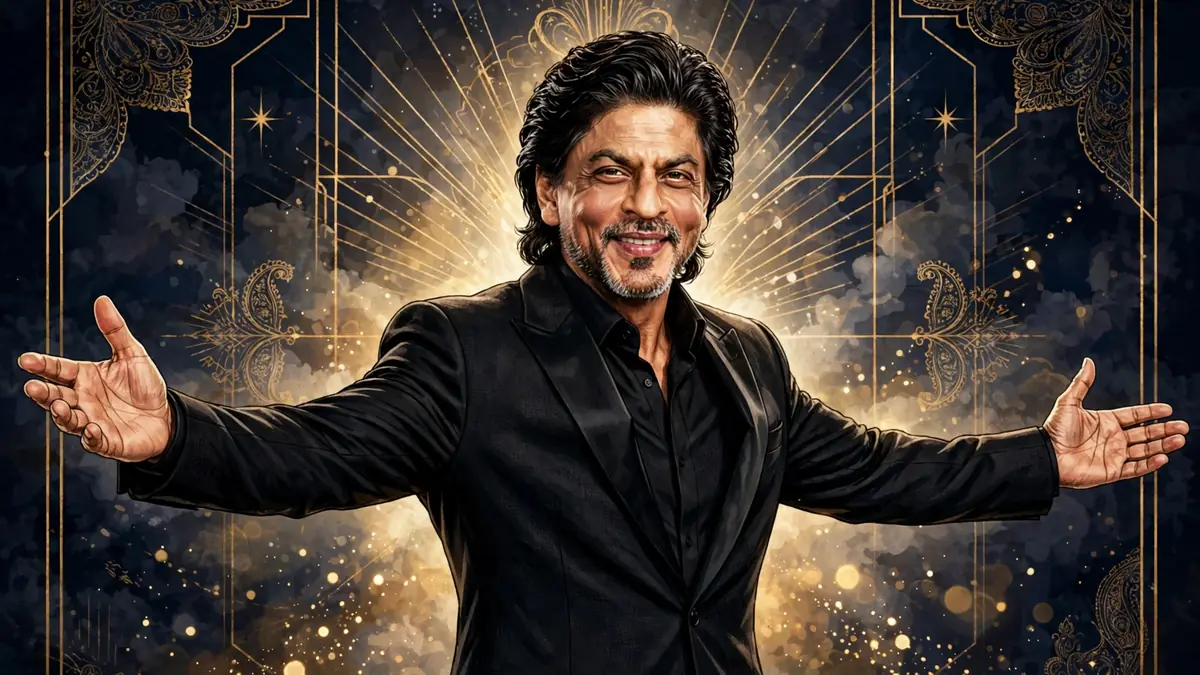
Everything changed on October 20, 1995, when Dilwale Dulhania Le Jayenge — DDLJ — opened in cinemas. Directed by Aditya Chopra and co-starring Kajol, it told the story of Raj and Simran, two young Indians raised in London who fall in love on a trip across Europe and then have to win over her strict father back in Punjab. Shah Rukh’s Raj was playful, respectful and stubborn in equal measure, and the arms-outstretched pose from the film’s climax became the defining image of his career — the one in the portrait at the top of this page.
DDLJ ran at Mumbai’s Maratha Mandir theatre for decades, one of the longest theatrical runs in cinema history, and it remade Shah Rukh’s identity. He was no longer the dangerous newcomer. He was the romantic hero of Hindi cinema, the man a generation of audiences trusted to carry a love story. The films that followed built the same persona in different shapes: Dil To Pagal Hai (1997), Kuch Kuch Hota Hai (1998), Mohabbatein (2000), Kabhi Khushi Kabhie Gham (2001), Devdas (2002), Kal Ho Naa Ho (2003), Veer-Zaara (2004). The pairing with Kajol became one of Indian cinema’s most loved screen partnerships, and the pairing with director Karan Johar became a run of hits that defined the 1990s and 2000s.
It is worth saying plainly what this era did to his earning power. A romantic hero who can open a film across India and in the diaspora — in the UK, the US, the Gulf — is worth far more than a domestic star. DDLJ and its successors made him a global name, and that global reach is the base on which the later business empire sits: the overseas audience that followed him from the romance era is the same audience that buys tickets to Pathaan and watches his productions on streaming today.
The romance era also gave him his nickname. “King Khan” and “Baadshah of Bollywood” started as press shorthand and became how audiences actually talked about him. He collected Filmfare Best Actor awards through this period — eight in total across his career, per Encyclopaedia Britannica — and the Padma Shri, one of India’s highest civilian honours, followed in 2005. France added the Legion of Honour in 2014. By the mid-2000s he was not just a star; he was the reference point other stars were measured against. Salman Khan’s biography covers a parallel rise from the same era — the two Khans, along with Aamir Khan, formed the trio that ruled Hindi cinema for three decades.
The Middle Years: Risks, Reinvention and Swades
What separates Shah Rukh Khan from a star who simply repeats a winning formula is how often he walked away from it. In 2004 he played a NASA scientist who returns to his Indian village in Ashutosh Gowariker’s Swades — a quiet, thoughtful film that was a commercial disappointment and is now regarded as one of his finest performances. In 2007 he played a disgraced hockey coach rebuilding the women’s national team in Chak De! India, a film that turned a sports story into a national talking point and won him another Filmfare Best Actor award.
In 2010 he played a man with Asperger’s syndrome crossing America after 9/11 in Karan Johar’s My Name Is Khan, a film that did strong business overseas and showed he could carry a serious, issue-led drama to a global audience. The same period saw the big commercial bets: Om Shanti Om (2007), Chennai Express (2013) and Happy New Year (2014) were all major box-office successes, and Ra.One (2011) was an expensive science-fiction gamble that leaned heavily on his own visual-effects company. Not every gamble paid off, but the pattern was clear: he used the security of the romance era to take risks, and he used his own production company to fund the ones the studios would not.
That production company is central to the biography, not a side note. In 1999 he had co-founded Dreamz Unlimited with Juhi Chawla and director Aziz Mirza. In 2002 he and Gauri restructured it as Red Chillies Entertainment, which grew into a production house and a visual-effects studio, Red Chillies VFX, that worked on his own films and on outside blockbusters. The VFX arm, by some reports, accounts for a large share of the studio’s revenue — NDTV reporting cited in 2025 coverage put it at nearly 70 percent. Owning the means of production changed his position in the industry: he was no longer just an actor waiting for offers, he was a producer who could green-light his own films.
The Slump and the Four-Year Break
From 2017, the run of hits stopped. Jab Harry Met Sejal (2017) underperformed, and Zero (2018), in which he played a vertically challenged man from Meerut, was a costly box-office failure. The film had been one of the most expensive Hindi productions of its time, heavy on visual effects from his own studio, and its failure stung twice: as an actor and as a producer. He has since said that Zero‘s failure made him question what audiences wanted from him, and whether the star persona he had built over 25 years still worked.
His answer was to stop. Between the release of Zero in December 2018 and the release of Pathaan in January 2023, he did not appear as a leading man in a single film — a break of more than four years, the longest of his career. He stayed visible in other ways: he hosted television, produced films and series through Red Chillies, made cameo appearances, and spent time with his family. But the absence was noticed, and the industry began to ask whether the King Khan era was over. Younger stars were filling the space, and the trade press wrote him off more than once.
The break matters to the biography because it is the only honest way to read the comeback. He did not stumble into 2023. He spent four years choosing scripts, watching the market change, and waiting for material that fit a 57-year-old star rather than pretending he was still the 30-year-old Raj from DDLJ. That patience is rare in a business that punishes absence, and it is the reason the next section reads the way it does.
The 2023 Comeback: Pathaan, Jawan and Dunki
On January 25, 2023, Pathaan opened, and the break ended in the loudest possible way. Directed by Siddharth Anand and co-starring Deepika Padukone and John Abraham, the action thriller was a YRF Spy Universe entry and became one of the highest-grossing Hindi films of all time, crossing ₹1,000 crore worldwide by widely reported trade estimates. Shah Rukh played a retired intelligence operative pulled back into service, and the film leaned into his age rather than hiding it: the character was weathered, funny and dangerous, and audiences loved him for it.
Seven months later came Jawan, directed by Atlee, in which he played a double role — father and son, soldier and vigilante — and the film crossed ₹1,000 crore worldwide as well, again by trade estimates, becoming one of the top-grossing Indian films ever. Then, in December 2023, Rajkumar Hirani’s Dunki, a gentler film about illegal immigration, completed a year in which he had three releases and two of them were among the biggest hits in Indian cinema history. No actor his age had ever had a year like it. The four-year break, which had looked like decline, turned out to be a reset.
The comeback also reset his market value. Reports citing IMDb put his fee at roughly ₹150 crore to ₹300 crore per film, with backend profit shares on top — figures that should be treated as trade estimates, not confirmed contracts, but which point in the same direction as the box office: in 2023 he became, again, the most bankable star in Hindi cinema. The comeback is also why the Hurun numbers moved the way they did, which is covered in the money section below: success at that scale lifts the value of the production company and the brand at the same time.
The National Film Award and the Met Gala Debut
In 2025, after more than three decades in films, Shah Rukh Khan won his first National Film Award. At the 71st National Film Awards, honouring Indian cinema of 2023, he won Best Actor for Jawan, sharing the honour with Vikrant Massey, who won for 12th Fail. The winners were announced on August 1, 2025, and the award was presented by President Droupadi Murmu on September 23, 2025, at Vigyan Bhawan in New Delhi. The gap is worth pausing on: eight Filmfare Best Actor awards, a Padma Shri, a Legion of Honour — and the National Award, the one Indian acting honour that had eluded him, arrived only in 2025, for a mass action film rather than one of his quieter performances.
The same year brought a different kind of debut. In May 2025 he walked the Met Gala red carpet in New York for the first time, dressed by designer Sabyasachi Mukherjee. The appearance was covered around the world and marked how far his fame had travelled beyond cinema: he was there not as a film star promoting a movie but as a global cultural figure. The year also brought his children’s projects to the front of the news, which the family section below covers in full.
For a biography, 2025 is the year the story stopped being only about the past. The National Award closed a 32-year gap in his honours list, the Met Gala put him on a new kind of world stage, and the film he was preparing — King — was already being talked about as the next chapter rather than a footnote.
King: The 2026 Film With Daughter Suhana
Shah Rukh Khan’s next film is King, directed by Siddharth Anand, the director of Pathaan, and scheduled for release in cinemas on December 24, 2026. The film is an action thriller produced by Red Chillies Entertainment and Marflix Pictures, and filming began in May 2025, with shoots reported in Mumbai, Poland and South Africa. It is his first big-screen outing since Dunki in 2023, and the Christmas Eve release date puts it in the most prized slot in the Hindi film calendar.
What makes King different from any film he has made before is the casting. His daughter Suhana Khan co-stars, in her first theatrical feature film, after her acting debut in Zoya Akhtar’s Netflix musical The Archies (2023). Father and daughter sharing the screen as leads is the kind of event Indian cinema has not seen from this family before, and the build-up has treated it that way: the first song from the film, “Tu Mil Jaaye”, featuring Shah Rukh and Deepika Padukone, was released on his 61st birthday, November 2, 2026. Deepika, who co-starred in both Pathaan and Chennai Express, is part of the ensemble along with Abhishek Bachchan, Rani Mukerji and Anil Kapoor, with reports of a cameo by Ranveer Singh.
There is a risk in King that is easy to miss. Suhana’s debut in The Archies drew mixed reviews, and the nepotism debate in Hindi cinema is fiercer now than it was when her father arrived with nothing in 1991. Putting his daughter beside him in his own production, in a film directed by the man behind his comeback, is a statement of confidence — in her, and in the audience’s willingness to judge the film on its own terms. Filmmaker Farah Khan said publicly at a Dubai event that Shah Rukh has been personally training Suhana for her action role. Whatever the box office says in December, the film will be read as a handover moment: the star who built the empire putting his daughter inside it, on screen, in front of everyone.
The Money: Hurun, Red Chillies, Cricket and Fees
The headline number first, with its source attached: the Hurun India Rich List 2026 puts Shah Rukh Khan’s estimated net worth at ₹10,000 crore, and names him India’s richest actor. That is the figure to use. It is also a figure that needs explaining, because it is ₹2,490 crore lower than Hurun’s own 2025 estimate, and the gap between the two years is the most instructive part of the money story.
Hurun’s 2025 list had put Shah Rukh Khan and his family at ₹12,490 crore — about $1.4 billion — and that made him the first Indian actor to enter the billionaire bracket on a Hurun list. The 2026 list, published in September 2026, put him at ₹10,000 crore. Filmfare’s report on the 2026 list and the Indian Express’s coverage both give the same two numbers, and both note the same context: a separate Hurun estimate earlier in 2026, the Hurun Global Rich List, had put him at ₹10,800 crore — already much closer to the new figure than the 2025 one. The honest reading is that the 2025 figure was the outlier, not the 2026 one, and that the value of his businesses was re-rated between the two editions rather than him losing cash. Hurun does not publish a line-by-line breakdown, so nobody outside the list’s researchers can say which asset moved. What can be said is that the 2026 figure still leaves him far ahead of the next actors on the list, and that his wealth comes from businesses whose valuations move with the market. A fuller treatment of the money figures, including the dollar conversion and the year-by-year movement, is set out in our sister site’s Shah Rukh Khan net worth profile, and the same story is covered from the NetWorthCraft angle in Shah Rukh Khan’s net worth breakdown on NetWorthCraft.
How we read the Hurun numbers: Hurun’s estimates are valuations of companies, property and holdings, not bank balances. A ₹2,490 crore fall in the estimate does not mean ₹2,490 crore left his accounts. Red Chillies Entertainment is a private company, so its value is estimated from revenues, comparable deals and the performance of its films — and a re-rating of one or two holdings can move the headline by thousands of crores. Treat ₹10,000 crore as Hurun’s 2026 estimate, and the 2025 figure of ₹12,490 crore as the earlier estimate from the same list, not as money gained or lost.
Red Chillies Entertainment is the engine. Founded with Gauri Khan in 2002, the company produces films, runs the Red Chillies VFX studio, and has moved into streaming content and commercials. Reports in 2025 and 2026 put the combined value of the production and VFX arms at over ₹2,000–₹3,000 crore, with the VFX division alone accounting for a large share of revenue — NDTV reporting cited in recent coverage put it at nearly 70 percent of studio revenue, since the unit works on outside blockbusters as well as his own films. The company’s hits under its banner include Om Shanti Om, Chennai Express, Happy New Year and Dear Zindagi, alongside the 2023 run. When Pathaan and Jawan each crossed ₹1,000 crore, the value of the company that made them rose with them.
Cricket is the second engine. In 2008 he bought the Kolkata Knight Riders IPL franchise with Juhi Chawla and Jay Mehta, and the team has won the IPL three times — in 2012, 2014 and 2024. The Knight Riders Group has since expanded into the Trinbago Knight Riders in the Caribbean Premier League, the Abu Dhabi Knight Riders in the ILT20 and the Los Angeles Knight Riders in Major League Cricket in the United States, with a Knight Riders cricket ground announced in Pomona, California, in July 2026. Reports in 2025 and 2026 said he had raised his stake in KKR from around 55 percent to nearly 90 percent. The franchise was bought for a reported $75 million in 2008; its value today is estimated in the hundreds of millions of dollars, and it is one of the few IPL teams with a genuine global footprint.
Acting fees are the third stream, and the hardest to pin down. Reports citing IMDb put his fee at roughly ₹150 crore to ₹300 crore per film, with backend profit shares on top for films made under his own banner. Those numbers are trade estimates and should be read as such — no contract has been published — but the direction is confirmed by the box office. Endorsements are the fourth stream: over three decades he has fronted brands from Hyundai and Pepsi to Tag Heuer and, since 2015, the online grocer BigBasket, along with a string of luxury and consumer names. He has also held stakes outside film and cricket, including a reported stake in the Indian arm of the KidZania theme-park chain.
Net Worth Timeline: How the Estimate Moved
| Year | Estimate and what drove it |
|---|---|
| 1992–1995 | Working actor’s pay. Television and early film fees; the Deewana debut and the Baazigar/Darr hits establish him, but the fortune is still ahead of him. |
| 1995–2002 | The romance era builds the brand. DDLJ and the Kajol/Karan Johar run make him the top-paid romantic lead in Hindi cinema and a global name in the diaspora. |
| 2002–2008 | Producer and owner. Red Chillies Entertainment is founded in 2002; the Kolkata Knight Riders franchise is bought in 2008. Wealth shifts from fees to equity. |
| 2008–2018 | Empire years. KKR wins IPL titles in 2012 and 2014; Red Chillies VFX grows into one of Asia’s leading effects houses; Mannat and the property portfolio appreciate. |
| 2018–2023 | The break. No leading-man release after Zero; income continues from production, cricket and endorsements, but the film-fee stream pauses. |
| 2023 | The comeback year. Pathaan and Jawan each cross ₹1,000 crore worldwide; Dunki follows. Fees, profit shares and the Red Chillies valuation all rise. |
| 2025 | Hurun India Rich List 2025: ₹12,490 crore for Shah Rukh Khan and his family (about $1.4 billion) — the first Indian actor in the billionaire bracket on the list. |
| 2026 | Hurun India Rich List 2026: ₹10,000 crore (a ₹2,490 crore re-rating, not a cash loss); Hurun Global Rich List earlier in 2026: ₹10,800 crore. Still India’s richest actor. |
Two things stand out from that timeline. First, the fortune was built in stages, and the biggest stage was not acting — it was ownership. Fees made him rich; Red Chillies and KKR made him a billionaire on paper. Second, the 2025–2026 movement is a reminder that rich-list figures are estimates of private-company value, and private-company value is the least stable number in a biography. The next edition of the list could move him up again if King performs. The biography’s job is to report the estimate, name the source, and say plainly that it is an estimate.
Mannat, Real Estate and the Life the Money Buys
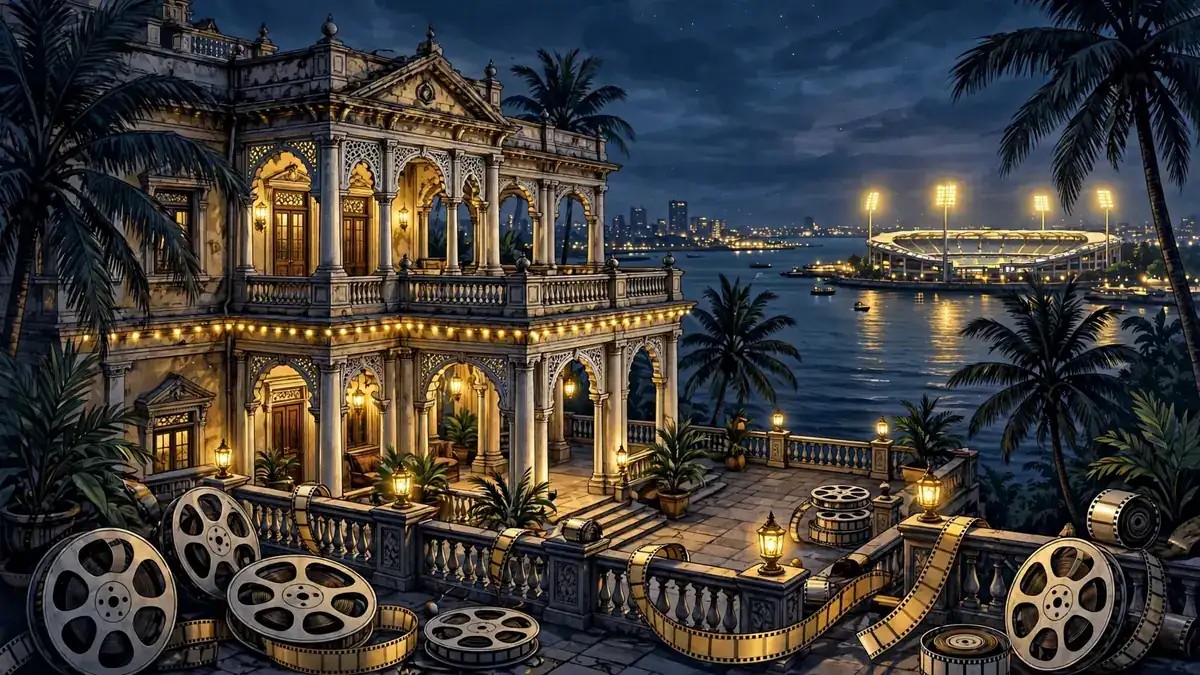
Mannat is the most famous celebrity home in India, and the story of how he got it is part of the legend. The sea-facing bungalow on Bandstand in Bandra, Mumbai, was built in 1914 as Villa Vienna. He bought it in 2001, reportedly for around ₹18 crore, at a point when, by his own account, he had spent so much on the house that there was little left for furniture. Today reports value it at roughly ₹200–₹300 crore. It is a heritage structure, exempt from demolition, and the family has expanded it with a six-storey annex holding a library, a gym, a swimming pool and a private theatre. In July 2026, India’s Supreme Court dismissed a challenge concerning approvals connected with proposed additions to the property — a small legal footnote that shows how closely even the house is watched.
The wider property portfolio is reported to be worth around ₹3,000 crore, according to a Moneycontrol report cited in 2026 coverage. Beyond Mannat it is said to include a home in Delhi, a flat in London’s Park Lane area, a villa on Dubai’s Palm Jumeirah, a holiday home in Alibaug and a Beverly Hills house reported to be rented out. None of these valuations is audited, and the portfolio figure should be read as a press estimate built from reported deals, not a verified total. What the portfolio does show, reliably, is a preference for property as a store of wealth — the same instinct that led him to buy a cricket team and a production company rather than simply collecting fees.
His cars draw the same kind of reporting, and the same caution applies: the collection is widely reported to include a Bugatti Veyron, a Rolls-Royce Phantom and a fleet of luxury SUVs, but the exact contents change with each new purchase and each new article. What is not in doubt is the public side of the wealth — the annual birthday gathering outside Mannat, where thousands of fans wait for him to appear on the balcony, is one of the most photographed rituals in Indian public life, and it happens every November 2.
Family: Gauri Khan and the Three Children
Gauri Khan is not a footnote in this biography; she is a partner in the business and in the story. Married to Shah Rukh since October 25, 1991, after a six-year courtship that began in Delhi when he was 18 and she was 14, she is a producer at Red Chillies Entertainment and an interior designer whose firm, Gauri Khan Designs, designed Mannat itself. The marriage has lasted 35 years in an industry where few last five, and the two of them run the production company together: he is the face and the creative engine, she is the producer who keeps the machine running. Their partnership is the reason Red Chillies exists in the form it does.
Their three children are now stepping into public life in three different ways, and 2025–2026 has been the year all three moved at once. Aryan Khan, born in 1997, chose to work behind the camera: his directorial debut, the Netflix series The Ba***ds of Bollywood, streamed from September 18, 2025, and was reported to have won him a Best Director honour at the Bollywood Hungama India Entertainment Awards in December 2025. He had already shown an entrepreneurial streak, launching the luxury collective brand D’YAVOL with partners in 2022 under SLAB Ventures. Suhana Khan, born in 2000, trained at New York University’s Tisch School of the Arts, made her short-film debut in The Grey Part of Blue (2019), then her acting debut as Veronica Lodge in Zoya Akhtar’s The Archies (2023), and now co-stars with her father in King. AbRam Khan, born in 2013, is still a child and is kept largely out of the professional spotlight, though he is a familiar face at KKR matches and family events.
The family story has a hard chapter that belongs in any honest biography. In October 2021, Aryan Khan was detained by the Narcotics Control Bureau in connection with a cruise-ship drug case, spent weeks in custody, and was granted bail before receiving a clean chit from the NCB in 2022, with no drugs found in his possession. The case dominated Indian news for months, and Shah Rukh said almost nothing in public through it. The episode is covered in more detail in the controversies section below, because it is the closest his family has come to a public crisis — and because the way he handled it, by silence and by letting the process run, is characteristic of how he handles trouble generally.
Controversies and the Hard Years
A 34-year career at the top of Hindi cinema does not happen without friction, and this biography would be incomplete if it skipped the episodes that tested him. Three are worth recording, factually and briefly, because each one changed something about how he works.
The first is the Aryan Khan case of 2021–2022, described in the family section above: detention by the Narcotics Control Bureau in October 2021 in connection with a cruise-ship case, weeks in custody, bail, and a clean chit from the NCB in 2022, with no drugs found in his possession. The case also produced a long tail: in January 2026, the Delhi High Court dismissed a defamation suit filed by former NCB officer Sameer Wankhede against Aryan Khan and the makers of The Ba***ds of Bollywood, on jurisdictional grounds, without ruling on the merits. The series itself satirises the episode. For Shah Rukh, the two years after the case were also the years of the professional break — and his public silence through both is one of the most remarked-on features of the period.
The second is the Wankhede Stadium incident of 2012. After an IPL match, an altercation involving Shah Rukh and stadium staff led the Mumbai Cricket Association to ban him from the Wankhede Stadium for five years. The ban was later lifted, and he has attended KKR matches at the ground since. The episode is a reminder that the cricket-owner role and the film-star role collide in public in ways neither job prepares you for.
The third is the long-running, widely reported fallout with Salman Khan after a public argument at Katrina Kaif’s birthday party in 2008, which kept the two biggest stars in Hindi cinema from working together or appearing together for years before a public reconciliation. It is reported as a personal rift rather than a professional one, and the two have appeared together at events and in each other’s films since. None of these episodes ended his career; all of them are part of why the 2023 comeback landed the way it did — the audience had watched him go quiet, and then watched him come back.
How He Compares: India’s Richest Actors
The Hurun India Rich List 2026 gives a clean peer comparison, and it shows how far ahead Shah Rukh Khan sits. The list puts him at ₹10,000 crore. The next actor on it, Amitabh Bachchan, is estimated at ₹4,000 crore. Salman Khan appears on the 2026 list for the first time, at ₹3,000 crore, and Hrithik Roshan at ₹2,500 crore. Juhi Chawla and Karan Johar, who appeared on the 2025 list at ₹7,790 crore and ₹1,880 crore respectively, do not feature in the 2026 ranking. The gap between first and second — ₹6,000 crore — is larger than the entire estimated wealth of most of the actors below him.
The comparison with the other Khans is instructive. Aamir Khan’s net worth profile traces a different model: fewer films, carefully chosen, with enormous per-film returns. Salman Khan’s wealth is built on a similar mix of films, television hosting and brand work, plus his own production interests. What sets Shah Rukh apart is not the size of any single film fee but the breadth of the equity: a production company with a VFX arm, a global cricket group, and a property portfolio, all held alongside a film career that is still active at 61. Ranbir Kapoor’s biography shows the next generation working in the same industry with a different balance — film-led, with business interests still growing — and the contrast underlines how unusual Shah Rukh’s position is. For readers who want the full set, our celebrity biography archive covers the same ground for the rest of the era’s stars.
There is one more comparison worth making, and it is the one his own fans make most often: Shah Rukh Khan against his younger self. The actor who played Raj in 1995 could not have bought a cricket team or built a VFX studio. The producer who owns those things could not have made Pathaan without the audience the romantic hero built. The biography only makes sense when the two halves are read together — the star made the businesses possible, and the businesses made the star independent.
Frequently Asked Questions
How old is Shah Rukh Khan in 2026?
Shah Rukh Khan was born on November 2, 1965, in New Delhi, and turned 61 on November 2, 2026.
What is Shah Rukh Khan’s net worth in 2026?
The Hurun India Rich List 2026 estimates Shah Rukh Khan’s net worth at ₹10,000 crore (about $1.1 billion), making him India’s richest actor. Hurun’s 2025 list had put him and his family at ₹12,490 crore, so the 2026 figure is a ₹2,490 crore re-rating of his business holdings, not a cash loss. Hurun does not publish a breakdown, and the figure is an estimate, not an audited total.
What is Shah Rukh Khan’s next movie?
His next film is King, directed by Siddharth Anand and scheduled for release in cinemas on December 24, 2026. It co-stars his daughter Suhana Khan in her first theatrical feature, along with Deepika Padukone, Abhishek Bachchan, Rani Mukerji and Anil Kapoor. Filming began in May 2025 in Mumbai, Poland and South Africa.
Who is Shah Rukh Khan’s wife?
Shah Rukh Khan is married to Gauri Khan (born Gauri Chhibber), a film producer and interior designer. They married on October 25, 1991, after a six-year courtship that began in Delhi, and together they run Red Chillies Entertainment. They have three children: Aryan, Suhana and AbRam Khan.
Has Shah Rukh Khan won a National Film Award?
Yes. In 2025 he won the National Film Award for Best Actor for Jawan at the 71st National Film Awards, sharing the honour with Vikrant Massey, who won for 12th Fail. It was his first National Award after more than three decades in films. He has also won eight Filmfare Best Actor awards and received the Padma Shri in 2005.
How tall is Shah Rukh Khan?
Shah Rukh Khan is generally listed at about 5 ft 8 in (173 cm), though reports vary between 5 ft 6 in and 5 ft 8 in, so the exact figure is hard to pin down.
What happened during Shah Rukh Khan’s break from films?
After Zero failed at the box office in December 2018, Shah Rukh Khan took a break of more than four years from leading-man roles, returning with Pathaan in January 2023. During the break he produced films and series through Red Chillies Entertainment, hosted television, made cameo appearances and spent time with his family. The comeback year that followed — Pathaan, Jawan and Dunki in 2023 — was one of the biggest years of his career.
What businesses does Shah Rukh Khan own?
His main businesses are Red Chillies Entertainment, the production and visual-effects company he co-founded with Gauri Khan in 2002, and the Knight Riders cricket group, built around the Kolkata Knight Riders IPL franchise he co-owns since 2008, with teams in the Caribbean, the UAE and the United States. He also holds property in Mumbai, Delhi, London, Dubai and the US, and has endorsement deals with brands including Hyundai, Tag Heuer and BigBasket.
Bottom Line
Shah Rukh Khan’s biography is the story of a Delhi boy who lost both parents young, learned his craft on the Delhi stage, arrived in Mumbai in 1991 with a suitcase and no film family, and built the longest reign in modern Hindi cinema — first as the romantic hero of Dilwale Dulhania Le Jayenge, then as a producer and cricket owner, then, after a four-year break that looked like the end, as the action star of the biggest comeback year Indian cinema has seen. At 61, with a National Film Award finally on the shelf, a Met Gala debut behind him, and King arriving on Christmas Eve 2026 with his daughter beside him, he is still the centre of the industry he entered 34 years ago.
The money is real but it is not the point on its own. The Hurun India Rich List 2026 estimate of ₹10,000 crore makes him India’s richest actor, and the fall from the 2025 estimate of ₹12,490 crore is a re-rating of private-company value, not a loss of cash. What the number actually measures is the distance he travelled from fees to ownership — from being paid to act, to owning the company that makes the films, the team that plays the cricket, and the house the fans gather outside every November 2. That is the biography in one line: he did not just become the king of Bollywood. He bought the kingdom.
Sources and Reporting
This biography was researched from live reporting and reference sources in November 2026. The net-worth figures come from the Hurun India Rich List 2026 as reported by Filmfare, the Indian Express and Bollywood Hungama, with the 2025 comparison figure of ₹12,490 crore from the Hurun India Rich List 2025. Career, awards and biography details were checked against Encyclopaedia Britannica, Zee News and Filmfare. Details of King, the National Film Award and the 2025–2026 family projects were checked against Bollywood Hungama, Filmibeat and Latestly. Business and property reporting was checked against Mint and Moneycontrol coverage cited in 2026 reporting.
How we estimated: the net-worth figure in this article is Hurun’s published estimate, not a figure supplied by Shah Rukh Khan or his companies, and no private financial records were available. Where sources disagreed — the 2025 and 2026 Hurun figures, the two Hurun estimates inside 2026, and the range of reported values for Mannat and for his per-film fee — this article reports the range and names the source for each figure rather than picking one. Estimates of private wealth can move sharply between rich-list editions as company valuations change, and they should be read as informed estimates, not as audited totals.