Stone Cold Steve Austin — born Steven James Anderson on December 18, 1964 — is the wrestler who turned a beer-swilling, boss-stunning rebel into the biggest box-office draw professional wrestling has ever seen. As of November 2026, his net worth is estimated at $30 million, anchored on Celebrity Net Worth’s long-standing figure, with a range of $30 million to $45 million once newer trackers are counted. He won the WWF Championship six times, won the Royal Rumble a record three times, headlined four WrestleManias, and walked away in 2003 — then came back for one last match at WrestleMania 38 in 2022, nineteen years after his supposed final bout.
This is the full story: the Texas childhood, the football scholarship that went nowhere, the firing from WCW that lit the fuse, the “Austin 3:16” speech that changed wrestling overnight, the neck injury that cut his prime short, the movies, the podcasts, the beer brand, the ranch in Nevada, and the money he made along the way. Every figure below is tied to a named source, and where sources disagree, we say so.
Last updated: November 25, 2026 | By: Celebamerica Editorial Staff
Stone Cold Steve Austin: Quick Facts
| Full Name | Steven James Anderson (later Steven James Williams; legally Steve Austin since 2007) |
|---|---|
| Ring Name | “Stone Cold” Steve Austin — also “The Texas Rattlesnake” and “The Bionic Redneck” |
| Date of Birth | December 18, 1964 (age 61 for most of 2026; turns 62 in December) |
| Birthplace | Victoria, Texas, USA (a handful of profiles list Austin, Texas; Victoria is the most widely cited record) |
| Height | 6 feet 2 inches (188 cm) |
| Estimated Net Worth | $30 million (range $30 million–$45 million; see the money section) |
| Peak / Primary Income Sources | WWE wrestling pay and merchandise royalties, WWE Legends contract, acting, television hosting, podcasting, Broken Skull beer |
| Key Ventures / Works | Broken Skull IPA and Broken Skull American Lager (El Segundo Brewing), The Steve Austin Show podcast, Broken Skull Sessions, Broken Skull Ranch, films The Condemned and The Expendables |
| Wife | Kristin Feres (married 2009; fourth marriage) |
| Children | Three |
| Hall of Fame | WWE Hall of Fame 2009 (individual); 2025 Immortal Moment with Bret Hart for WrestleMania 13 |
Table of Contents
- Stone Cold Steve Austin: Quick Facts
- Early Life in Texas
- Football Dreams and the Road to Wrestling
- WCW Years: Stunning Steve Austin
- ECW and the Birth of Stone Cold
- The Ringmaster and Austin 3:16
- The Attitude Era and the Feud with Vince McMahon
- The Rock, WrestleMania and the Peak Years
- Injury: The Neck That Changed Everything
- Retirement in 2003
- The Money: How Stone Cold Built His Fortune
- Acting, Hosting and Television
- Podcasts and the Broken Skull Brand
- Life at Broken Skull Ranch
- Personal Life and Family
- Controversies and Legal Issues
- The WrestleMania 38 Comeback
- Legacy and Hall of Fame
- Stone Cold vs His Peers: Net Worth Comparison
- Frequently Asked Questions
- Final Thoughts
- Sources and Reporting
Early Life in Texas
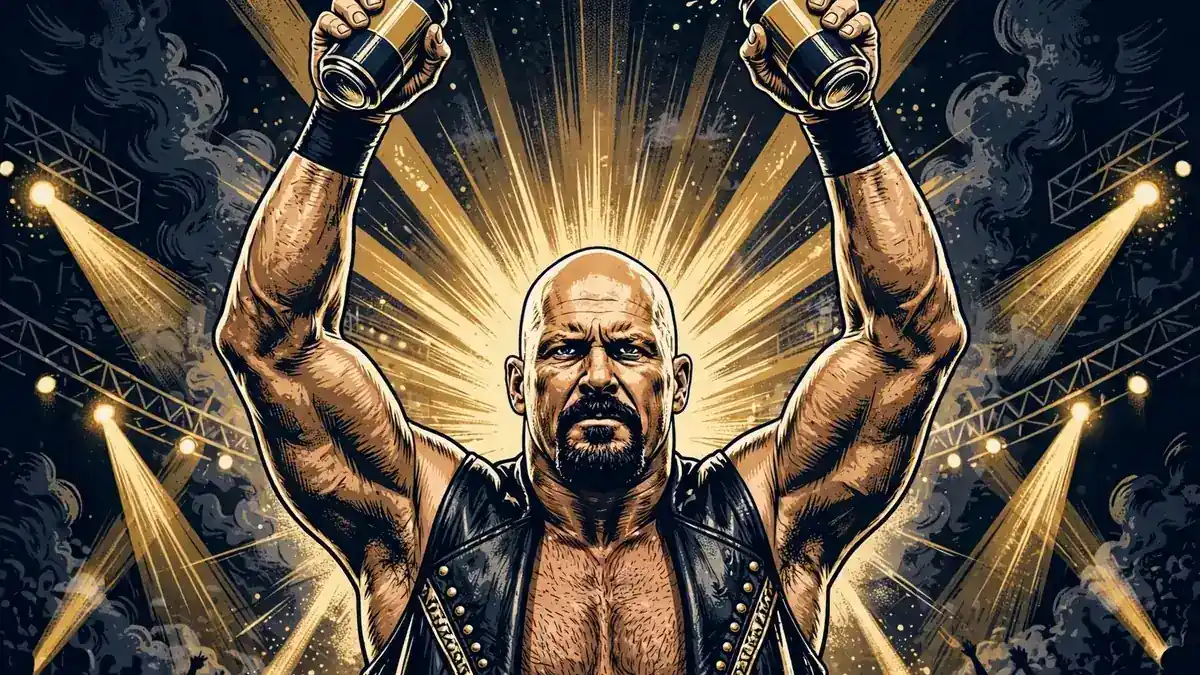
Steve Austin was born Steven James Anderson on December 18, 1964. His birthplace is listed as Victoria, Texas in the most widely cited records, including Wikipedia, though a small number of profiles give Austin, Texas instead. The confusion is understandable — he grew up a Texan through and through, and the city of Austin later lent him his famous ring surname. The family eventually settled in Edna, Texas, a small town where Austin spent his formative years.
His early life was not easy. His biological father left the family when Austin was about a year old, and his mother later remarried. Austin took his stepfather’s surname and became Steven James Williams for much of his youth. He grew up in a blended household with brothers and a sister — the kind of crowded, working-class Texas home that later shaped the chip on his shoulder, both as a man and as a character.
As a boy, Austin fell in love with professional wrestling. He has said in interviews, including to the Houston Chronicle, that he knew from the age of seven or eight that he wanted to be a wrestler, calling it the biggest thing in his life. He watched the regional Texas wrestling shows the way other kids watched cartoons, studying the heroes and the villains and filing away the way a crowd reacted to each one. That early obsession would turn out to be the most practical education he ever got.
School in Edna gave him two things: a reputation as a tough, athletic kid, and a path out. He played football, and he played it well enough to matter. The discipline of the sport — the weight room, the hitting, the team structure — suited him. It also gave him the physical base that would later let him survive one of the most punishing schedules in entertainment.
Football Dreams and the Road to Wrestling
After high school, Austin attended Wharton County Junior College, where he played football, before earning a scholarship to the University of North Texas. He played linebacker there, and for a while the plan looked like football. But the plan did not hold. Austin has been open about the fact that his heart was never fully in the classroom or in a football career that was going nowhere fast. What he wanted, still, was the wrestling ring.
In 1989, at 24 years old, Austin drove to the Dallas Sportatorium and tried out for World Class Championship Wrestling. The trainer who took him on was “Gentleman” Chris Adams, a British wrestler who had made Texas his home and who ran a respected wrestling school. Adams was a hard teacher — precise, demanding, and old-school about the fundamentals. Austin learned to bump, to chain-wrestle, to sell, and to work a crowd. Adams would later become his brother-in-law of sorts through the tangled personal relationships of the Texas wrestling scene, and their story would spill into storylines on television.
Austin made his professional debut on September 30, 1989. He was not Stone Cold yet. He was not even Steve Austin yet — he wrestled under his real name at first, a big, athletic rookie with a good look and a better work ethic. The pay was small, the travel was rough, and the crowds were local. But he was in. The boy from Edna who had watched wrestling on television was now taking bumps in the same buildings he had dreamed about.
The early years were a grind of small promotions and long drives across Texas. Austin worked the regional circuit, sharpening his craft in front of a few hundred people a night. He learned something in those rooms that the big companies could not teach: how to read a crowd in real time, how to slow a match down, how to make a simple punch mean something. That education would pay off many times over when the crowds got bigger.
WCW Years: Stunning Steve Austin
In 1991, Austin arrived in World Championship Wrestling, the national promotion based in Atlanta. WCW gave him his first real television exposure and his first memorable persona: “Stunning” Steve Austin, a blond, arrogant pretty-boy heel with a great physique and a cocky sneer. The gimmick was the opposite of everything he would later become, and that was the point — it taught him how to be hated, which is the first half of learning how to be loved.
The WCW years were productive. Austin won the WCW World Television Championship and then the WCW United States Heavyweight Championship twice. His most famous run of the period came as one half of the Hollywood Blonds, a tag team with Brian Pillman. The Blonds were slick, funny, and genuinely good in the ring, and they captured the unified NWA and WCW World Tag Team Championship. For a young wrestler, it was a strong run — regular television, titles, and a growing reputation as one of the best workers in the company.
Behind the scenes, though, the picture was less rosy. Austin was a mid-card act in a company that did not see him as a future star. In 1995, while he was recovering from an injury, WCW fired him. The decision has gone down as one of the great miscalculations in wrestling history. WCW’s management at the time reportedly considered him injury-prone and not worth a top spot. Austin, sitting at home with a bad knee and no job, has described the firing as the moment that changed everything: the insult lit a fire under him, and the bitterness became fuel.
The firing also freed him. In WCW he had been a company man playing a company role. Out of it, he was forced to figure out who he actually was as a performer. The answer would come quickly, and it would not look anything like “Stunning” Steve Austin.
ECW and the Birth of Stone Cold
After WCW let him go, Austin spent a short but important stretch in Extreme Championship Wrestling, the Philadelphia-based promotion run by Paul Heyman. ECW was small, loud, and allergic to the polished style of the big companies. Heyman gave Austin a microphone and told him to talk — really talk, in his own voice, about what had happened to him.
Those ECW promos are now part of wrestling lore. Austin, still nursing his injury and his grudge, cut angry, funny, brutally honest interviews about being fired by WCW, about the politics of the business, and about the stars he thought were overrated. He mocked the big companies and the people running them. The crowds in the ECW Arena ate it up. For the first time, Austin was not playing a character written for him — he was playing a sharper, louder version of himself.
It was in this period that the “Stone Cold” name took shape. The story, as told by his then-wife Jeanie Clarke, is that she was making tea one day and suggested he drink it before it went “stone cold” — and the phrase stuck. Austin liked the sound of it. The name fit the new attitude: cold, unbothered, dangerous. He paired it with a new look — shaved head, black goatee, black trunks and boots, a plain black vest — and a new finishing move, the Stone Cold Stunner, a jawbreaker-style move that looked devastating and could be hit on anyone, any time.
ECW was never going to be his home for long. The money was small and the promotion was a stepping stone. But the stone had been cut. When the WWF came calling in late 1995, Austin arrived with a character, a look, a finisher, and a voice that was entirely his own.
The Ringmaster and Austin 3:16
Austin’s WWF debut in December 1995 was, on paper, a step backwards. He was introduced as “The Ringmaster,” a silent technical wrestler managed by Ted DiBiase, the Million Dollar Man. The gimmick was a throwback: a master technician who won matches with a Million Dollar Dream sleeper hold. DiBiase did the talking. Austin did the wrestling. It was a solid mid-card act, and it went nowhere.
The problem was obvious to anyone watching: the company had hired a man who could talk like a bar-room brawler and dressed him up as a quiet technician. The Ringmaster was gone within months. DiBiase left the company, Austin dropped the gimmick, shaved his head, grew the goatee, and became Stone Cold Steve Austin full-time. The name, the look, and the attitude he had built in ECW were finally in front of a national audience.
The turning point came on June 23, 1996, at the King of the Ring pay-per-view in Milwaukee. Austin won the tournament, beating Marc Mero in the final, and then cut a post-match promo on his opponent Jake “The Snake” Roberts, a born-again Christian who had quoted scripture in his own interview. Austin looked into the camera and said, “You sit there and you thump your Bible, and you say your prayers, and it didn’t get you anywhere! Talk about your psalms, talk about John 3:16… Austin 3:16 says I just whipped your ass!”
The line detonated. “Austin 3:16” became a catchphrase, then a T-shirt, then one of the best-selling pieces of merchandise in wrestling history. The shirt — black, with a white skull and the words “Austin 3:16” — sold in numbers the company had never seen from a single wrestler’s merchandise. Austin had gone from a mid-card technician to the most talked-about man in the business in the space of one promo. The WWF, which had been losing the ratings war to WCW, suddenly had a star who felt real in a way no one else on the roster did.
What made it work was not the profanity or the beer. It was the recognition. Austin’s character was the working man who had been pushed around by the boss one time too many and had decided to push back. Fans who had never watched wrestling understood him instantly. Fans who had watched it for years had never seen anyone quite like him.
The Attitude Era and the Feud with Vince McMahon
The late 1990s belonged to Austin. His feud with Bret Hart in 1997 — built around a submission match at WrestleMania 13 in which Austin, locked in the Sharpshooter, refused to submit and passed out in a pool of his own blood — is still ranked among the greatest matches ever wrestled. The match also produced a rare double turn: the crowd, which had come in cheering the hero Hart, left cheering Austin. That match was later inducted into the WWE Hall of Fame as the first-ever “Immortal Moment” in 2025, with Austin and Hart inducted together for it.
But the feud that defined the Attitude Era was Austin against Vince McMahon, the company’s owner, playing himself on television as the scheming, cowardly boss. The storyline was simple and endlessly repeatable: McMahon tried to control Austin, Austin refused, and Austin got revenge — with a Stunner, a beer truck, a cement truck, a Zamboni, or a bedpan. The segments drew enormous television ratings, and the Monday night ratings war swung the WWF’s way. Wrestling, for a brief window, was the hottest thing on American television, and Austin was the reason.
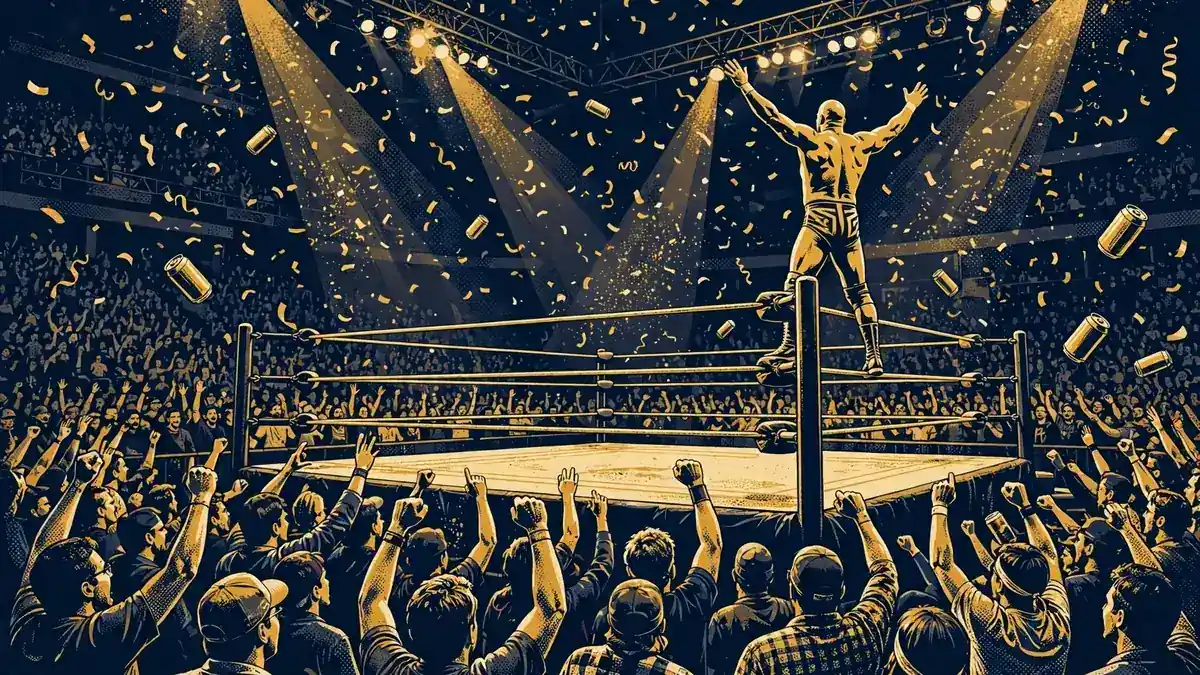
The McMahon feud worked because it was not really about wrestling. It was about every person who had ever wanted to tell their boss exactly what they thought of him. Austin said the things the audience wished they could say, and he did it with a smirk. The beer drinking was part of the act — the famous image of Austin standing on the turnbuckle, spraying two cans of beer over the crowd — but the character’s core was defiance. He answered to no one, and the crowd loved him for it.
Behind the scenes, the era made Austin rich and famous, and it also made the WWF a fortune. The company, which had been on the edge of collapse in the mid-1990s, became a publicly traded entertainment giant. Austin’s merchandise, his pay-per-view main events, and his television ratings were the engine of that turnaround. His peers from that era went on to their own long careers — Triple H, who rose through the same Attitude Era ranks and later took charge of WWE’s creative direction — but none of them ever matched Austin’s connection with the crowd at its peak.
The Rock, WrestleMania and the Peak Years
If McMahon was Austin’s great villain, The Rock was his great rival. The two men headlined WrestleMania three times — WrestleMania 15 in 1999, WrestleMania 17 in 2001, and WrestleMania 19 in 2003 — and each match told a different chapter of the story. Austin won the first two, taking the WWF Championship from The Rock both times. The Rock won the third, in what turned out to be Austin’s final full-time match.
Their rivalry worked because the two men were opposites who were equals. The Rock was polished, funny, and endlessly quotable; Austin was raw, blunt, and dangerous. Put them in a ring together and the crowd split down the middle, then roared for both. The matches drew some of the largest pay-per-view audiences in wrestling history, and the WrestleMania 17 main event in Houston — where Austin turned heel by aligning with McMahon — remains one of the most debated nights in the sport’s history.
Between 1998 and 2001, Austin was the biggest star in wrestling, full stop. He won the Royal Rumble three times — 1997, 1998, and 2001 — a record no one has matched. He won the WWF Championship six times. He won the Intercontinental Championship twice, the Tag Team Championship four times, and the Million Dollar Championship once, making him the fifth WWF Triple Crown Champion. He won the 1996 King of the Ring. He headlined WrestleMania four times: 14, 15, 17, and 38.
The money matched the fame. TWSN, in its 2026 profile of Austin, reported that at the height of his career he pulled in as much as $16 million in a single year, driven by performance bonuses and huge merchandise sales. The figure is a single-source report, not an official disclosure, but it fits the shape of his peak: the top merchandise seller in the company, the top pay-per-view draw, and the face of a boom period that lifted the whole industry.
There was a cost, though. Austin wrestled a brutal, physical style — brawling through crowds, taking bumps on concrete floors, working a schedule of several hundred matches a year. His body was paying for the run even while the run was still going. The bill would come due sooner than anyone expected.
Injury: The Neck That Changed Everything
The injury that shortened Austin’s career happened on August 3, 1997, at SummerSlam in New Jersey. In a match for the Intercontinental Championship, Owen Hart delivered a botched piledriver — a move in which Austin was dropped on his head. Austin has described the moment plainly: he felt his arms go numb, and for a time he could not move them. He finished the match, somehow, winning the title with a roll-up while barely able to move. Then he went to the hospital.
The damage was a serious neck injury, and it never fully healed. Austin kept wrestling — he had to, he was the company’s top star — but the injury changed how he worked. He cut out the high-risk moves, shortened his matches, and leaned harder on brawling, punching, and the Stunner. The crowds never noticed the difference; the matches stayed hot. But the pain was constant, and the knee injuries that followed piled on top of it.
By 2002, the wear and tear was impossible to ignore. Austin’s body was breaking down, and his patience with the company’s creative direction was wearing thin too. In June 2002, he walked out of the company rather than work a television match against Brock Lesnar that he felt had no buildup and no story behind it. The walkout was a public embarrassment for both sides, and it cost Austin money and goodwill. He later admitted he handled it badly. The episode also showed, though, how much leverage a star of his size had — and how much the company still needed him. The two sides patched things up, and Austin returned, but his in-ring time was nearly over. Brock Lesnar, the young powerhouse at the center of that 2002 dispute, went on to build his own fortune in WWE and the UFC.
Retirement in 2003
Stone Cold Steve Austin’s final full-time match took place on March 30, 2003, at WrestleMania 19 in Seattle. The opponent was The Rock, for the third time on wrestling’s biggest stage. The Rock won. Austin lost, shook his hand, and walked away. He was 38 years old. He had wrestled his first match in 1989, and his body had been through fourteen years of punishment.
The retirement was not announced with a farewell tour or a tearful speech. Austin simply stopped wrestling full-time. He took a brief on-screen role as the General Manager of Raw in 2003, appearing in a suit and tie — a strange sight for a man famous for a black vest and beer cans — and then stepped back from regular television. He made sporadic appearances after that: guest referee spots, Hall of Fame inductions, anniversary shows. He inducted Bret Hart into the Hall of Fame in 2006 and Jim Ross in 2007. He stayed close to the company, and the company stayed close to him, but the in-ring career was over.
What the retirement did not end was the earning. Austin signed on as a WWE ambassador and Legends-contract talent, a deal that pays him for merchandise royalties, video-game likeness rights, and appearances. It is the kind of deal that keeps paying long after the last match, and it is one of the reasons his net worth has held up for more than two decades after retirement. Sportskeeda, in its 2025 profile, put it plainly: his money now comes from the WWE Legends deal, which includes royalties from branding and merchandise, along with acting, television, and podcasting.
The Money: How Stone Cold Built His Fortune
Stone Cold Steve Austin’s net worth is estimated at $30 million as of 2026, anchored on Celebrity Net Worth’s long-standing figure for him, which the majority of 2026 profiles repeat. A few newer trackers go higher — BounceMojo, in its June 2026 ranking of the richest wrestlers, put him at $45 million — and a small number of older or thinner profiles quote figures anywhere from $30 million to $75 million. We anchor on $30 million and show the $30 million–$45 million range, because Celebrity Net Worth is the most-cited tracker of his fortune, the $30 million figure appears in Sportskeeda, TWSN, and several other 2026 profiles, and the higher numbers come from single sources with no supporting detail. For a full breakdown of the figure, see our sister site’s look at Stone Cold Steve Austin’s net worth, which tracks the same estimate from the money angle.
Where did the money come from? The short answer is that Austin made most of it during a four-year window, roughly 1997 to 2001, when he was the biggest star in wrestling. The longer answer is that he turned that window into a twenty-year income stream. Here is how the pieces fit together.
| Income stream | What it is and what it is worth (as reported) |
|---|---|
| WWE wrestling pay (peak years) | Base pay plus pay-per-view bonuses as the company’s top draw, 1997–2001. TWSN reported peak-year earnings of as much as $16 million in a single year, driven by bonuses and merchandise. |
| Merchandise royalties | The Austin 3:16 shirt was among the best-selling wrestling shirts ever. Royalties from shirts, figures, and video games continue under his WWE Legends contract. |
| WWE Legends contract | An ongoing deal covering merchandise and branding royalties, appearances, and likeness rights. Sportskeeda reported in 2025 that this deal is now the backbone of his income. Surprise Sports reported an annual figure of around $3 million from the Legends contract and other ventures. |
| Acting | Film roles including The Condemned (2007), The Expendables (2010), and Grown Ups 2 (2013), plus television guest work. |
| Television hosting | Redneck Island, Steve Austin’s Broken Skull Challenge (2014–2017), Straight Up Steve Austin (2019–2021), and a stint hosting WWE’s Tough Enough. |
| Podcasting | The Steve Austin Show (2013–present) and the Broken Skull Sessions video podcast (2019–2022) on the WWE Network and Peacock. |
| Broken Skull beer | Broken Skull IPA (launched 2014) and Broken Skull American Lager, brewed with El Segundo Brewing Company. |
| Real estate | Two homes in Marina Del Rey, California, bought in 2009 and 2017 (the second for $1.49 million through a private deal) and sold together for $3.395 million in April 2021, per Celebrity Net Worth via Sportskeeda. Broken Skull Ranch 2.0 in Nevada is his current home base. |
How the range works: $30 million is the anchor — it is the figure Celebrity Net Worth has carried for years, and it is the number Sports Illustrated, Sportskeeda, TWSN, and Surprise Sports all repeat in their 2025 and 2026 profiles. The $45 million top end comes from BounceMojo’s June 2026 ranking. No official financial disclosure exists for Austin, so every figure here is a third-party estimate. The honest range is $30 million to $45 million, with $30 million as the figure we trust most.
Two things stand out about Austin’s money story. First, he made his fortune in a short, intense burst — the wrestling boom of the late 1990s — and then protected it by staying relevant for decades without taking the physical punishment that made him. Second, he never chased the kind of business empire some of his peers built. There is no tequila brand, no movie studio, no football league in his portfolio. There is a beer, a ranch, a podcast, and a Legends contract. It is a smaller, steadier kind of wealth, and it has lasted.
The real-estate moves tell the same story. The Marina Del Rey homes were bought quietly, held for years, and sold together in April 2021 for $3.395 million. The original Broken Skull Ranch near Tilden, Texas was sold in 2019, and Austin moved to Broken Skull Ranch 2.0 near Gardnerville, Nevada, which he bought in 2018. These are the moves of a man who likes land, privacy, and a long hold — not flipping, not speculation, not headlines.
Acting, Hosting and Television
When the wrestling ended, Austin moved into acting the way a lot of wrestlers do — but with a better hit rate than most. His first notable film role was in The Longest Yard (2005), Adam Sandler’s prison-football remake, where he played Guard Dunham. His first leading role came in The Condemned (2007), a WWE Studios action film in which he played a death-row inmate forced to fight on a remote island for a live internet audience. The film was not a hit with critics, but it made money, and it proved Austin could carry a movie.
The biggest film on his resume is The Expendables (2010), Sylvester Stallone’s ensemble action film, in which Austin played the villain Dan Paine opposite Stallone, Jason Statham, and Jet Li. He followed it with a run of straight-to-video action films — The Stranger (2010), Hunt to Kill (2010), Recoil (2011), Maximum Conviction (2012) — the kind of steady working-actor run that pays well without ever making headlines. He reunited with Adam Sandler for Grown Ups 2 (2013), playing a small role in a film that made far more money than any of his action movies.
Television gave him a steadier home. He hosted Redneck Island on CMT, a reality competition that ran from 2012, and then Steve Austin’s Broken Skull Challenge, a physical-competition show that ran on CMT from 2014 to 2017 and sent contestants to a course built to represent his ranch. He hosted a season of WWE’s Tough Enough, the reality show that tried to turn fans into wrestlers. And from 2019 to 2021 he hosted Straight Up Steve Austin on the USA Network, a talk-and-adventure show in which he took celebrity guests — including fellow wrestlers and actors — out to do the things he likes doing: driving, shooting, fishing, and talking. The show ran for two seasons and gave him a television presence that had nothing to do with wrestling.
None of this made him a movie star, and that was never really the aim. Acting and hosting gave him income, visibility, and a reason to keep working without taking bumps. For a man whose body had already paid the price of a wrestling career, that was the whole point.
Podcasts and the Broken Skull Brand
Austin’s most durable post-wrestling project is his podcast. He launched The Steve Austin Show in April 2013, a weekly show in which he talks wrestling, hunting, beer, and life, often with guests from the wrestling world and beyond. The show has run for more than a decade now, with a family-friendly main feed and a racier spin-off, The Steve Austin Show – Unleashed! The podcast keeps him connected to the wrestling audience without requiring him to be in a ring, and it has become a genuine business: advertising, live shows, and a loyal audience that has followed him from radio to streaming.
In November 2019, he added a video podcast, Broken Skull Sessions, on the WWE Network (later Peacock). The format was simple: Austin sitting down with a wrestler for a long, unhurried conversation. The premiere episode featured The Undertaker, whose own net worth story runs on a similar Legends-contract model, and the show ran until 2022. The conversations were relaxed and revealing in a way wrestling interviews rarely are, and they reminded audiences that Austin is a good listener as well as a good talker.
The Broken Skull name is also a beer brand. In 2014, Austin teamed up with El Segundo Brewing Company in California to launch Broken Skull IPA, a West Coast-style IPA named after his ranch. A Broken Skull American Lager followed. The beer is sold in cans and on tap, and Austin has promoted it the way he promotes everything: personally, constantly, and with obvious enthusiasm. Sportskeeda’s 2025 endorsement roundup lists El Segundo Brewing alongside Kawasaki USA, ESPN+, and WWE among the brands tied to Austin, and the beer remains the most personal of them — a product with his ranch’s name on it, brewed by people he works with directly.
There is also the merchandise that never stopped selling. The Austin 3:16 shirt is still one of the most recognizable shirts in wrestling, and WWE still sells it. Every new generation of wrestling fans discovers the Attitude Era through clips and documentaries, and every one of them seems to end up wanting the shirt. It is the closest thing wrestling has to a permanent income stream.
Life at Broken Skull Ranch
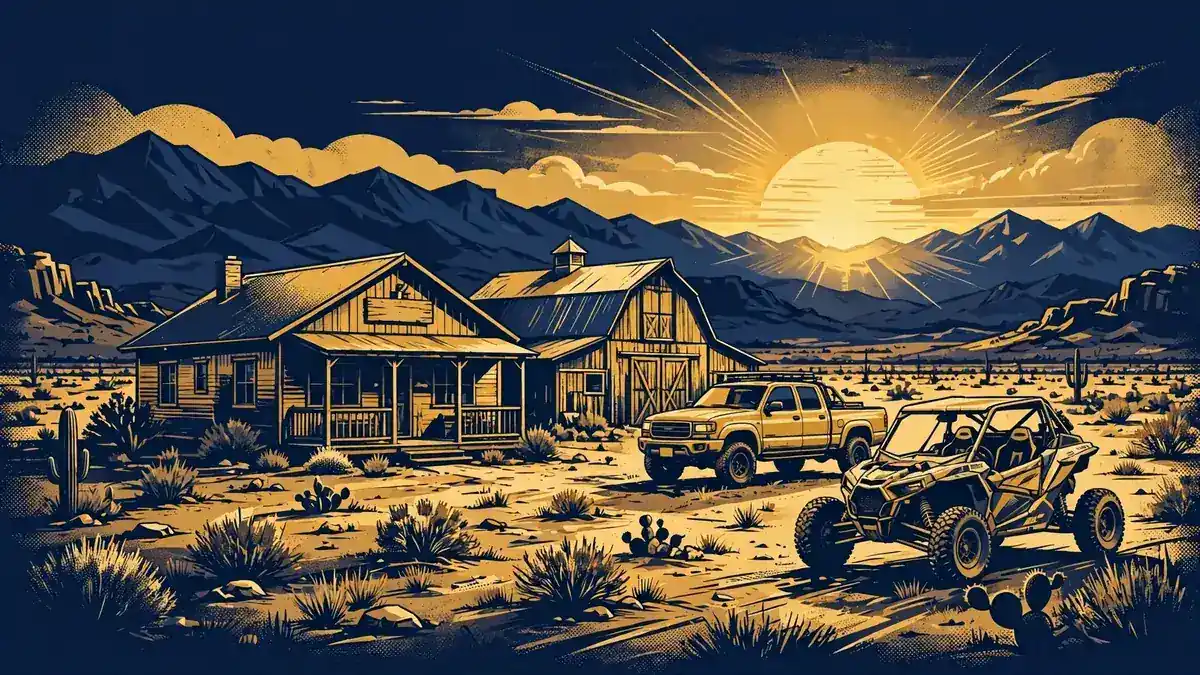
Broken Skull Ranch is more than a brand name — it is where Austin lives. The original ranch was near Tilden, Texas, a stretch of South Texas land where he could hunt, shoot, and be left alone. He sold it in 2019. The current ranch, Broken Skull Ranch 2.0, sits near Gardnerville, Nevada, south of Reno, at the foot of the Sierra Nevada mountains. He bought it in 2018, and he and his wife Kristin split their time between the ranch and a home in California.
The ranch is a working property, not a showpiece. Austin hunts, fishes, and works the land. He has talked on his podcast about the rhythms of ranch life — early mornings, long drives, fixing things himself — and about how much he prefers it to the road life of a wrestler. The ranch is also where he records much of his podcast, and it is the backdrop for the Broken Skull brand: the beer, the show, the whole second act.
Since 2023, Austin has also competed in desert racing with a UTV, a sidecar of his ranch life that fits the same pattern — fast, dusty, outdoors, and entirely on his own terms. It is a long way from the Dallas Sportatorium, and it is exactly where he seems to want to be.
Personal Life and Family
Austin has been married four times. His first marriage was to his high-school girlfriend Kathryn Burrhus, in November 1990; the marriage was annulled in August 1992. He then married English wrestling manager Jeanie Clarke — known to fans as Lady Blossom — on December 18, 1992, his 28th birthday. They had two daughters, Stephanie (born 1992) and Cassidy (born 1996), and Austin also adopted Clarke’s daughter Jade from her previous relationship with Chris Adams, the trainer who had taught him to wrestle. The marriage to Clarke ended in divorce in May 1999.
His third marriage was to fellow WWE star Debra Marshall, in September 2000. That marriage ended in divorce in February 2003, and the circumstances of its ending — a domestic dispute at their San Antonio home in June 2002 — are covered in the controversies section below.
In late 2009, Austin married his fourth wife, Kristin Feres, now Kristin Austin. The two had met years earlier, when Kristin worked as a ring announcer, and married in a private ceremony. They have been together ever since, and Kristin works alongside him on the Broken Skull Ranch. Sports Illustrated, profiling Kristin in 2024, described her as a private person who stays out of the spotlight apart from the occasional red-carpet appearance, and as a central part of Austin’s post-retirement life.
Austin has three children, and he has grandchildren through his adopted daughter Jade. He is a private man about his family — his daughters live their own lives, largely out of public view — and that privacy is one of the reasons so little is written about them. What is public is the shape of it: a man who married young, made mistakes in public, and settled, in his forties, into a stable marriage and a quiet ranch life.
Physically, Austin is listed at 6 feet 2 inches tall, a figure our own height profile verified against WWE, Wikipedia, and the wrestling databases. In his prime he wrestled at around 250 pounds of muscle, built in the weight room and kept through a career of nightly punishment. The bald head and goatee — the look that defined him — were a choice he made in 1996 and never went back on.
Controversies and Legal Issues
No honest biography of Austin skips the hard parts, and the hardest is the end of his third marriage. On June 15, 2002, Debra Marshall called the police to the couple’s home in San Antonio after a domestic dispute. Austin was arrested and later pleaded no contest to a misdemeanor charge of assault; he was fined and given probation. He filed for divorce the following month, and the divorce was finalized on February 5, 2003. Austin has addressed the incident in interviews since, calling it a low point and saying he takes responsibility for his part in it. We report it here because it is a matter of public record and part of the story, not because it defines him.
The second controversy is professional rather than personal: the June 2002 walkout. Austin left WWE rather than lose a match to Brock Lesnar on free television with no buildup, a booking he felt would waste both men. The company was furious, the fans were split, and Austin lost money and standing. He has said since that he handled it the wrong way and should have raised his objections differently. The two sides reconciled within months, and the episode is now remembered as a footnote to a career that was nearly over anyway.
There were smaller storms along the way — the usual tabloid noise around a famous, hard-drinking character — but Austin’s public image has been remarkably steady for a man who played a rebel for a living. He has been open about drinking responsibly and has pushed back, more than once, against the idea that the beer-swilling character and the man are the same person. The character drank on television. The man drinks a beer at the ranch. He has always been clear about the difference.
The WrestleMania 38 Comeback
For nineteen years, the story was that Austin would never wrestle again. The neck, the knees, the age — everyone, including Austin, said the door was closed. Then, in the spring of 2022, Kevin Owens started insulting Texas on television, night after night, and the company booked a segment: Owens would host his talk show, The KO Show, at WrestleMania 38 in Dallas, with Austin as his guest.
What happened on April 2, 2022, at AT&T Stadium in Dallas, is now part of wrestling history. Owens challenged Austin to a No Holds Barred match on the spot. Austin accepted. The talk segment became a match, the match became the main event of WrestleMania 38 Night 1, and the two men brawled through the crowd and around the ringside area for nearly fourteen minutes before Austin hit the Stunner and pinned Owens. The crowd — in Dallas, where Austin had wrestled his very first match back in 1989 — roared for every second of it.
Austin later said the symmetry mattered to him: his first match was in Dallas, and his last one should be there too. The match was not a technical classic. It did not need to be. It was a 57-year-old man proving he could still do the thing that made him famous, in front of the people who had loved him for it, and then walking away on his own terms. It was also a reminder of how rare his drawing power still was: the segment and the match dominated wrestling conversation for weeks.
He has appeared since — notably at WrestleMania 41 in Las Vegas in April 2025, where he came out to announce the night’s attendance and managed to crash his ATV into the ringside barricade, a moment that went viral for all the wrong reasons and that Austin laughed off afterward. But he has not wrestled again, and no one seriously expects him to. The WrestleMania 38 match stands as the real ending: the last Stunner, the last beer toast, the last walk up the ramp.
Legacy and Hall of Fame
Austin was inducted into the WWE Hall of Fame in 2009, six years after his retirement, in a ceremony that felt like a coronation. The induction put him in the company of the men he had worked with and against — the generation that built the modern wrestling business. In 2025, he was inducted a second time, alongside Bret Hart, in the new “Immortal Moment” category, for their WrestleMania 13 match. He was also inducted into the Professional Wrestling Hall of Fame in 2016, in its Modern Era wing.
His legacy is not really about the titles, though the titles are many. It is about what he did to the business. Before Austin, the top stars in wrestling were heroes — clean-cut, polite, aspirational. Austin was none of those things, and he was more popular than any of them. He proved that a wrestling audience would embrace an anti-hero, and every anti-hero who has headlined since owes him something. The Attitude Era was built around him, and the era’s success — the ratings, the pay-per-view records, the mainstream attention — pulled the whole industry out of a slump.
His influence shows up in the careers of the men who followed him. John Cena, who carried WWE through the decade after Austin left, has spoken about Austin’s shadow over the job. Shawn Michaels, the man Austin beat for his first WWF Championship at WrestleMania 14, was both his rival and his benchmark. And the generation of wrestlers who grew up watching Austin — the ones who now headline the company — still copy his promos, his timing, and his attitude. The Stunner is still one of the most imitated moves in wrestling, and “Austin 3:16” is still one of the most quoted lines in the sport’s history.
There is also the simple fact of his longevity as a public figure. Austin retired from full-time wrestling in 2003. More than two decades later, he still headlines documentaries, still trends when he appears at a WrestleMania, and still sells merchandise. Few wrestlers have ever managed that kind of staying power, and fewer still have done it while living quietly on a ranch in Nevada, far from the spotlight they could still command.
For more wrestler life stories in this style, see our biography archive, which covers the Attitude Era stars and the generations that followed them.
Stone Cold vs His Peers: Net Worth Comparison
Austin’s fortune looks modest next to the biggest names in wrestling — and that is exactly what makes it interesting. He made his money in a short, white-hot window and kept it, while his peers built theirs over longer careers or bigger business empires. Here is how the reported 2026 estimates stack up.
| Wrestler | Reported net worth (2026) | Main wealth drivers |
|---|---|---|
| Stone Cold Steve Austin | $30 million (range $30M–$45M) | WWE Legends royalties, podcasting, beer, acting |
| The Rock (Dwayne Johnson) | $800 million | Film, Seven Bucks Productions, Teremana tequila, TKO board seat — per BounceMojo’s June 2026 ranking |
| Triple H (Paul Levesque) | $250 million (combined with wife Stephanie McMahon) | WWE executive role, equity, wrestling career — per Celebrity Net Worth via Sportskeeda |
| John Cena | $80 million | Film, television, WWE contract — per Celebrity Net Worth via Sportskeeda |
| The Undertaker (Mark Calaway) | $17 million | WWE Legends deal, licensing, appearances — per Twin City Telegraph’s 2026 ranking |
The table tells a story about timing. The Rock and Cena left wrestling for Hollywood and built fortunes that dwarf what any wrestler can earn in the ring. Triple H stayed inside the company and rose to run it. The Undertaker, like Austin, stayed loyal to wrestling and lives off the Legends economy — and his number is smaller than Austin’s, because Austin’s peak was bigger. Austin sits in the middle: richer than the lifers, poorer than the crossover stars, and comfortable in a way that has nothing to prove.
Frequently Asked Questions
What is Stone Cold Steve Austin’s real name?
He was born Steven James Anderson on December 18, 1964. After his mother remarried, he took the surname Williams and was known as Steven James Williams for much of his youth. In 2007, he legally changed his name to Steve Austin, matching the name that had made him famous.
How old is Stone Cold Steve Austin in 2026?
He was born on December 18, 1964, so he is 61 for most of 2026 and turns 62 in December. He was 57 when he wrestled his comeback match at WrestleMania 38 in April 2022.
What is Stone Cold Steve Austin’s net worth in 2026?
His net worth is estimated at $30 million as of 2026, anchored on Celebrity Net Worth, with a range of $30 million to $45 million — BounceMojo’s June 2026 ranking of the richest wrestlers put him at $45 million. His income now comes mainly from his WWE Legends contract, merchandise royalties, podcasting, acting, and his Broken Skull beer brand.
How many times did Stone Cold win the Royal Rumble?
Three times — in 1997, 1998, and 2001. It is a record: no other wrestler has won the Royal Rumble three times. He also won the 1996 King of the Ring and the WWF Championship six times.
Why did Stone Cold Steve Austin retire?
A serious neck injury from a botched piledriver at SummerSlam 1997, plus years of knee injuries, cut his career short. He wrestled his last full-time match at WrestleMania 19 on March 30, 2003, losing to The Rock, and retired from full-time competition at 38.
Did Stone Cold really return at WrestleMania 38?
Yes. On April 2, 2022, at WrestleMania 38 in Dallas, Kevin Owens challenged him to a No Holds Barred match during a KO Show segment, and Austin accepted. He beat Owens with a Stone Cold Stunner in his first match in 19 years, in the same city where he had wrestled his first match in 1989.
Is Stone Cold Steve Austin married?
Yes. He has been married to Kristin Feres, now Kristin Austin, since 2009. It is his fourth marriage. He has three children, and he and Kristin live at Broken Skull Ranch 2.0 in Nevada.
What is Broken Skull Ranch?
Broken Skull Ranch is Austin’s home and the name behind his brand. The original ranch was near Tilden, Texas, and was sold in 2019. The current ranch, Broken Skull Ranch 2.0, is near Gardnerville, Nevada, bought in 2018. The Broken Skull name is also on his beer — Broken Skull IPA and Broken Skull American Lager, brewed with El Segundo Brewing Company — and on his Broken Skull Sessions podcast.
Final Thoughts
Stone Cold Steve Austin’s story is the story of a man who got fired, got angry, and turned the anger into the most popular character wrestling has ever seen. He was born Steven James Anderson in small-town Texas, failed at football, learned his trade in front of a few hundred people a night, and then — in the space of one promo on one summer night in 1996 — became the face of a boom that saved his industry. Six world titles, three Royal Rumbles, four WrestleMania main events, and a fortune estimated at $30 million, with a range up to $45 million, tell the scale of it. The neck injury that ended it all at 38, and the comeback at 57 that closed the book properly, tell the rest.
What lasts is not the money or the titles. It is the image: a bald man in a black vest, standing on a turnbuckle, spraying beer over a crowd that loved him for refusing to bow to anyone. Wrestling has had bigger stars since, and richer ones. It has never had another Stone Cold.
Sources and Reporting
How we estimated: Austin has never publicly disclosed his finances, so his net worth is an estimate built from third-party trackers and reporting. We anchor on Celebrity Net Worth’s $30 million figure — the most-cited tracker for Austin, repeated by Sports Illustrated, Sportskeeda, TWSN, and Surprise Sports in 2025–2026 profiles — and show a $30 million–$45 million range to reflect BounceMojo’s June 2026 ranking, which put him at $45 million. Peak-year pay and real-estate figures are attributed to the outlets that reported them in the text. Estimates may differ from private reality, and figures will move as new reporting appears.
Career facts, dates, and match records in this article were checked against Wikipedia’s Stone Cold Steve Austin profile, Sports Illustrated, Sportskeeda, TWSN, Yardbarker, Khel Now, Wrestling Inc., and our own CelebAmerica height profile for Austin. Sources consulted include:
- Wikipedia — Stone Cold Steve Austin
- Sports Illustrated — Stone Cold Steve Austin Net Worth
- Sports Illustrated — Who Is Stone Cold Steve Austin’s Wife, Kristin Austin?
- Sportskeeda — Steve Austin’s Net Worth in 2025
- TWSN — Stone Cold Steve Austin Net Worth in 2026
- Yardbarker — Steve Austin’s Net Worth in 2025
- BounceMojo — Richest Wrestlers 2026
- Surprise Sports — Stone Cold Steve Austin 2026
- Wrestling Inc. — Steve Austin Farewell Match at WrestleMania 38
- CelebAmerica — Stone Cold Steve Austin Height 2026
By Celebamerica Editorial Staff. Corrections: if you spot a factual error in this article, contact us and we will check it against the sources above and correct it.