By Celebamerica Editorial Staff | Last updated: November 25, 2026
Dendi net worth is estimated at $1 million to $3 million as of November 2026. That is the honest range for Danil “Dendi” Ishutin, the Ukrainian Dota 2 legend who won the first-ever The International with Natus Vincere in 2011 and later founded his own esports organisation, B8 Esports. The range sits on hard, documented numbers: Esports Earnings records $828,082.53 in career tournament prize money from 131 events, and independent estimates from Slot Streamers ($1–2 million) and Walikali ($1–3 million) bracket the rest of his income from salaries, sponsorships and streaming.
Some websites claim far bigger numbers — one puts Dendi at $10–15 million — but those figures have no named sourcing behind them and do not square with his documented prize money. This article works through every claim, shows the maths, and explains why the $1–3 million range is the one that holds up.
| Full Name | Danil Ishutin (Ukrainian: Данило Ішутін) |
|---|---|
| Known As | Dendi |
| Date of Birth | December 30, 1989 (age 36) |
| Birthplace | Lviv, Ukraine |
| Estimated Net Worth | $1 million – $3 million (November 2026) |
| Documented Prize Money | $828,082.53 from 131 tournaments (Esports Earnings) |
| Primary Income Sources | Tournament prize money, team salaries, sponsorships, Twitch streaming, B8 Esports ownership |
| Key Ventures | Natus Vincere (2010–2019), B8 Esports founder and captain (2020–present) |
| Signature Achievement | Winner, The International 2011 — the first $1 million Dota 2 tournament |
| Signature Heroes | Pudge, Puck, Invoker, Shadow Fiend, Queen of Pain |
Table of Contents
- From Lviv Internet Cafes to the Pro Scene
- Joining Natus Vincere and the Road to The International
- The International 2011: The Night Dota Changed
- TI2, TI3 and the Pudge Years
- Where the Money Comes From
- The Net Worth Figure, Explained
- Leaving NaVi and Building B8 Esports
- Streaming, Sponsorships and the Second Career
- Homes, Cars and Investments
- Net Worth Growth Over the Years
- Personal Life
- How Dendi Compares With Dota’s Richest Players
- Controversies and Setbacks
- Frequently Asked Questions
- Bottom Line
- Sources and Reporting
From Lviv Internet Cafes to the Pro Scene
Danil Ishutin was born on December 30, 1989, in Lviv, a city in western Ukraine then still part of the Soviet Union. He grew up in a household where games were a shared pastime before they were a career. His older brother played, and when his brother married and moved out — taking the family computer with him — the young Dendi started spending his time in the internet cafes of Lviv, where the original Defense of the Ancients, the Warcraft III mod that became Dota, was the game everyone gathered around.
His childhood was not an easy one. His father died of cancer while Dendi was still young, a loss that pushed him further into gaming as a place to focus his energy. Away from the screen he played piano and practised acrobatics, two disciplines that friends and profile writers have since pointed to when explaining his unusual hand speed and stage calm. He later graduated from the Ukrainian Academy of Printing in 2011, the same year his professional career exploded — a degree he earned while already playing Dota at the highest level in the world.
Dendi turned professional at 17, in 2006, with a team called Wolker Gaming. The money in those days was close to nothing: small local prizes, travel paid out of pocket, and a scene held together by passion rather than pay cheques. He moved through the Ukrainian and CIS circuit with teams such as DTS Gaming and Ks.int, building a reputation as a mid-laner who would try things other players would not — aggressive dives, off-meta hero picks, and plays that looked reckless until they worked. By 2010, the whole Dota world knew his name, even though Dota 2 itself had not launched yet.
What set him apart, even then, was personality as much as skill. Dendi smiled on stage, joked with opponents, and played with a visible joy that was rare in a scene full of stone-faced grinders. That warmth would later make him the most marketable player in Dota 2 — and it is a large part of why his earning power lasted long after his peak results faded.
Joining Natus Vincere and the Road to The International
On Christmas Day 2010, Dendi joined Natus Vincere — Na’Vi — the Ukrainian organisation that would define his career. The timing was perfect. Valve, the company behind Dota, was preparing to launch Dota 2 as a standalone game, and it invited the sixteen best DotA teams in the world to Cologne, Germany, in August 2011 for a tournament unlike anything esports had seen: The International, with a $1.6 million prize pool and $1 million for the winners.
Na’Vi arrived as one of the favourites, and Dendi arrived as their mid-laner and creative engine. The roster — Dendi, Clement “Puppey” Ivanov, Alexander “XBOCT” Dashkevich, Ivan “ArtStyle” Antonov and Dmitriy “LighTofHeaveN” Kupriyanov — clicked fast. They played a fast, aggressive style built around Dendi’s mid-lane dominance: win the lane, rotate early, and choke the enemy team before it could settle. In a game where most teams played safe and slow, Na’Vi played like they were in a hurry, and crowds loved them for it.
The run to the final took them past the best teams on the planet, and it set up a grand final against China’s EHOME, a team Na’Vi had already beaten once in the tournament. Nobody in that arena in Cologne knew they were watching the birth of modern esports — but the $1 million first prize, the largest in competitive gaming history at the time, made sure the whole gaming world was paying attention.
The International 2011: The Night Dota Changed
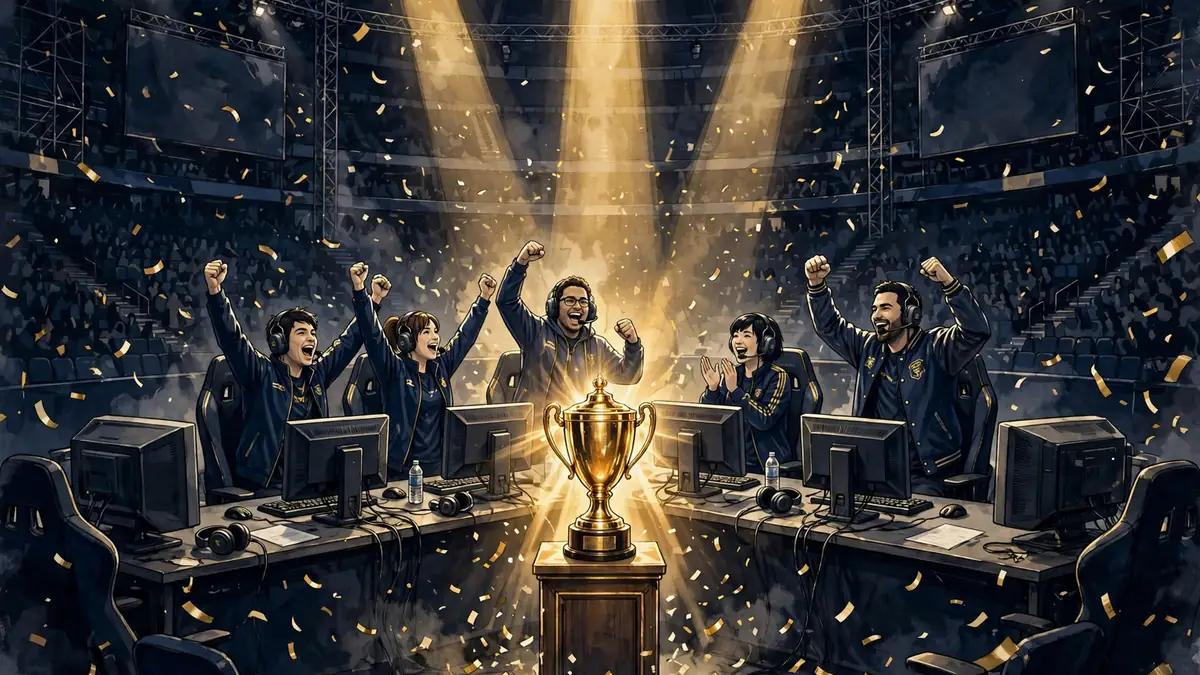
Na’Vi beat EHOME 3–1 in the grand final of The International 2011, and Dendi’s performance in the deciding game became the stuff of Dota legend. Playing Puck, he landed a Dream Coil on four EHOME heroes as they pushed into the Roshan pit — a team fight that ended in a clean wipe and effectively sealed the championship. Fans still call it the million-dollar Dream Coil, because that single play swung a match worth a million dollars to the winners.
The victory did more than make Dendi rich by the standards of a 21-year-old from Lviv. It made him the face of a game that would grow into one of the biggest esports on earth. Valve filmed him for its 2014 documentary Free to Play, alongside American player Clinton “Fear” Loomis and Singaporean player Benedict “hyhy” Lim — three players chosen to tell the story of Dota to the world. Valve later honoured him inside the game itself, releasing a Pudge cosmetic with a small doll of Dendi attached to the hero’s back.
The money, though, needs honest framing. The $1 million was a team prize, split five ways between the players, with the organisation taking its share and taxes on top. Dendi’s personal cut from TI1 was roughly $200,000 before those deductions — life-changing money, but not the kind of sum that makes a person a multi-millionaire on its own. That distinction matters, because it is the gap between the headline “won a million dollars” and the reality of a player’s bank account, and it runs through this whole net worth story.
TI2, TI3 and the Pudge Years
Na’Vi stayed at the top of Dota 2 for two more years, and Dendi stayed at the centre of it. At The International 2012 in Seattle, they reached the grand final again, losing to China’s Invictus Gaming. The run produced one of the most famous team fights in the game’s history — “The Play” — in which Dendi, on Rubick, stole the enemy Enigma’s Black Hole ultimate and turned it back on Invictus Gaming to wipe their team. It is still shown in highlight reels more than a decade later.
At The International 2013, Na’Vi reached a third straight grand final, this time against Sweden’s Alliance. The five-game series is widely regarded as the greatest grand final Dota 2 has ever produced, and it came down to a single play in the final minutes: Alliance’s Gustav “s4” Magnusson landed a Dream Coil of his own that caught Dendi’s teleport by a fraction of a second, costing Na’Vi their Ancient and the title. The moment is known as the Million Dollar Dream Coil — the same name fans gave Dendi’s TI1 play, now turned against him. It is a neat piece of symmetry, and a reminder of how thin the line between winning and losing was at that level.
Those three years also made Dendi’s Pudge famous. Pudge is a slow, hook-throwing hero that most professionals considered a joke pick in the mid lane. Dendi played him mid, landed hooks that looked impossible, and turned the hero into a symbol of his style — the “Pudge God” nickname stuck, and the mid-Pudge trend he started spread through pubs and pro games alike. His other signature heroes — Invoker, Shadow Fiend, Queen of Pain, Templar Assassin — all shared the same trait: high-skill, high-risk picks that rewarded the player willing to take the fight to the enemy.
After 2013, Na’Vi’s dominance faded. The roster changed again and again, results slipped, and Dendi’s form came under the kind of public criticism that only a famous player attracts. He stayed loyal to the organisation through the lean years — eight years in total, and 1,560 games in Na’Vi colours, according to Dota 2 records — while many of his peers jumped to richer teams. That loyalty cost him prize money in the short term. It also built the reputation that still pays him today.
Where the Money Comes From
Dendi’s income has never come from one place. It has come in layers, stacked across a career that has now lasted twenty years — and the layers changed as he aged. Prize money led in the early years. Salaries and sponsorships carried the middle. Streaming and team ownership carry the later years. Here is how each layer works, with the numbers we can actually verify.
Prize money: the documented floor
Esports Earnings, the most widely used tracker of competitive gaming payouts, lists Dendi’s career tournament winnings at $828,082.53 from 131 tournaments. That figure is the hardest number in this whole article: it is built from published tournament results, it is checkable event by event, and it is the floor under everything else. Ukrainian outlet dev.ua, reporting on the richest Ukrainian players in 2025, put the same figure in plain words — “during his career, Dendi won over $828,000” — and noted that it was enough for him to fund his own organisation after leaving Na’Vi.
Two things are worth noting about that total. First, it is gross prize money paid to the player across his whole career, not a salary and not a net worth. Second, it is modest next to the modern Dota 2 elite, because Dendi’s peak came before prize pools exploded — TI1’s $1 million total looks small next to the $40 million pool at The International 2021. A different tracker, Dotabuff, has been cited by some outlets for a higher lifetime prize figure near $2.3 million, but Esports Earnings’ event-by-event record is the more transparent source, and the $828,000 figure is the one we anchor on. Readers should know the gap exists; it does not change the conclusion, because even the higher figure would still leave Dendi well short of the $10 million-plus claims floating around online.
Salaries: the steady pay cheque
For nine years, Na’Vi paid Dendi a salary. The organisation has never published its player contracts, and Dendi has never discussed his pay in public, so no exact figure can be stated honestly. What is known is the shape of the market: top Dota 2 players in the early 2010s earned monthly salaries in the low thousands of dollars, rising to five-figure monthly sums for stars on big organisations by the late 2010s. Over nine years at Na’Vi, that adds up to a meaningful sum — likely in the high six figures in total — but it is an estimate built from market norms, not a reported fact, and this article will not dress it up as one.
Sponsorships and brand deals
Dendi’s real commercial value was never his prize money; it was his face. He was one of the first Dota 2 players to become a genuine brand ambassador, most notably as a Red Bull athlete, and he has worked with gaming brands including G2A and AliExpress over the years. Exact deal values are private, and one low-quality viral article’s claim of “$500,000 to $1 million a year” from sponsorships carries no sourcing and should not be repeated as fact. What can be said safely is that a player with Dendi’s fame — the subject of a Valve documentary, a hero cosmetic in the game itself, and a decade as the most recognisable face in Dota — commanded sponsorship income well above the average pro for many years.
Streaming: the second career
Streaming is where Dendi’s income moved as his playing results faded. Slot Streamers, a streamer-tracking site, lists him with about 1.1 million Twitch followers and an average of roughly 1,000 viewers per stream, playing Dota 2 alongside World of Warcraft, Warcraft III and Deadlock. A channel of that size earns from subscriptions, donations, bits and ad revenue — typically a few thousand dollars a month for a mid-sized streamer with a loyal audience, varying sharply with how often he goes live. It will not make anyone a millionaire on its own, but across several years it is a real and steady income stream, and it is one Dendi controls himself.
He is far from the only star to make that move. The streaming world is full of former pros who rebuilt their income around an audience rather than a tournament bracket — xQc built a whole second career on it, and Ninja turned Twitch fame into mainstream celebrity. Dendi’s version is smaller and quieter, but the model is the same: the audience that first watched him win TI1 now watches him play, and that attention has a price.
B8 Esports: owner, not just player
Since January 2020, Dendi has been the founder, captain and mid-laner of B8 Esports, the organisation he built after leaving Na’Vi. B8 fields Dota 2 rosters and has expanded into Counter-Strike and Valorant teams. Owning a team changes the economics: instead of taking a salary from an organisation, Dendi shares in the organisation’s winnings, sponsorships and brand value — but he also carries its costs, from player salaries to travel and boot camps. No public filings show B8 turning a profit, and small esports organisations usually run at a loss in their early years, funded by their founders. B8 should be counted as an asset and a long-term bet, not as a pile of cash. Its value is real but unquantified, which is exactly why the net worth figure in this article is a range rather than a single number.
The honest summary: about $828,000 in documented prize money, plus nine years of Na’Vi salary, plus sponsorships led by Red Bull, plus several years of Twitch income, plus ownership of B8 Esports. That is a career that comfortably clears a million dollars — and one that has no documented path to ten million. The range below follows from that.
Readers who follow our net worth coverage will recognise the pattern: esports fortunes are built slowly, in public, one tournament at a time — and the honest ones can be checked.
The Net Worth Figure, Explained
We estimate Dendi’s net worth at $1 million to $3 million as of November 2026. The bottom of the range is set by documented prize money plus a conservative read of his salary and sponsorship years. The top allows for his best-paid years, his streaming income and the value of B8 Esports. Nothing in the public record supports going higher, and going lower would ignore a decade of earnings that are plainly documented.
Here is what the published estimates say, side by side, and why they differ so much:
| Source | Figure | Assessment |
|---|---|---|
| Esports Earnings | $828,082.53 prize money | Documented, event-by-event. The hard floor. |
| Slot Streamers | $1–2 million | Streamer profile estimate. Consistent with the documented floor plus salary and streaming. |
| Walikali | $1–3 million | Esports profile estimate. Matches this article’s range. |
| World Sports Today | About $1 million | Built from the $828,000 prize figure plus streaming and sponsorships. Conservative but defensible. |
| Celebrity Birthdays | $5 million (Dec 2023) | Unsourced, and the site attributes the figure to “our analysis, Wikipedia, Forbes & Business Insider” without any actual Forbes or Business Insider reporting. Treat with caution. |
| BahrainTrust | $10–15 million (2024) | No named sourcing, inflated sponsorship claims, and a prize-money figure that does not match Esports Earnings. Not credible as an anchor. |
The pattern is familiar to anyone who reads celebrity net worth pages: the wilder the number, the thinner the sourcing. The $5 million and $10–15 million figures come from sites that copy each other without ever showing their working, while the $1–3 million range comes from sources that show theirs. There is also a simple reality check. Dendi’s entire documented prize career is $828,000. To be worth $10 million, he would need to have earned more than ten times his prize money from salaries, sponsorships and streaming — in a career spent mostly on one team in a scene where even stars were not paid footballer money. Nothing in his public record supports that. A $50 million claim found on one content-farm page is not even worth tabling here; it contradicts every documented figure by an order of magnitude.
One more honest caveat: net worth is not cash in the bank. It is an estimate of everything a person owns minus what they owe, and Dendi’s private finances — his home, his savings, his stake in B8, his tax position in Ukraine — are not public. The $1–3 million range is our best read of the public record. The private reality could sit anywhere inside it, and that is exactly what a range is for.
Leaving NaVi and Building B8 Esports
After eight years as Na’Vi’s mid-laner, Dendi was removed from the active roster in September 2018. It was the end of an era that everyone in Dota could see coming: results had slipped, the roster had churned, and the organisation needed a rebuild. Dendi vowed to keep playing. He took short stints with Tigers in Southeast Asia and with The Pango, and in August 2019 he formally left Na’Vi — closing a chapter that had lasted 1,560 games.
At The International 2019, attending as an analyst rather than a player, he announced his plan: he would build his own organisation. In January 2020, he revealed it in a short film that showed an elderly Dendi looking back on his glory days — and then announced the name: B8, pronounced “bait”, a nod to his love of fishing, a hobby Valve had explored in the Free to Play documentary years earlier. ONE Esports reported the launch with the full first roster: Dendi as mid-laner and captain, joined by former Na’Vi teammate Nikola “LeBron” Popović, Andrey “Ghostik” Kadyk, Rinat “KingR” Abdullin and Alexandr “pio65” Zalivako.
B8 has competed in tier-two and tier-three Dota 2 events ever since, with the roster changing often and results that have rarely matched Dendi’s Na’Vi years. That is not the point of B8, or at least not the whole point. The organisation is Dendi’s second act: a team built around his vision, a brand that carries his name, and a business that keeps him inside the game he helped build. It has also expanded beyond Dota 2, with teams under the B8 tag in Counter-Strike and Valorant, according to dev.ua. For a player whose playing peak ended years ago, owning the team is the move that keeps the career going — and it is the part of his story that most resembles the founders and owners in traditional sports.
Streaming, Sponsorships and the Second Career
Dendi’s streaming career is easy to underrate and hard to replace. With about 1.1 million Twitch followers, he is a mid-sized streamer by the standards of the platform’s giants — Jynxzi’s net worth story shows what the very top of Twitch can pay — but his audience is unusually loyal, built over fifteen years rather than bought in a viral moment. He streams Dota 2 most often, with World of Warcraft, Warcraft III and Deadlock in the mix, and his chat is full of viewers who have followed him since the Na’Vi days.
That loyalty is also why sponsors stayed with him after his results dipped. Red Bull’s backing of Dendi lasted well beyond his peak, because brands pay for attention and affection, not just trophies — and few players in any esport are as widely liked as Dendi. The same dynamic explains why his post-playing career has worked at all: the audience came for the highlights and stayed for the person. Other creators have ridden the same wave in different games — Asmongold turned a World of Warcraft audience into a media career — and Dendi’s quieter version of the same playbook has kept him earning into his late thirties.
There is also the documentary and media work. Free to Play gave him a global audience beyond Dota, and he has appeared as an analyst at The International and in Dota 2’s in-game cosmetic world. None of these pay like a tournament win, but together they form the kind of diversified income that keeps a retired star comfortable: a bit of streaming, a bit of sponsorship, a bit of media, and a team that carries his name.
Homes, Cars and Investments
Here is where honesty requires a short section rather than a long one: there is no public record of Dendi’s property, cars or investments. He has never shown off a house or a car collection on social media, no property registry story has ever attached his name to a purchase, and no interview has him discussing investments. That is normal for a Ukrainian esports player who has spent his career outside the celebrity-magazine spotlight, and it is better to say so than to invent a garage full of sports cars.
What can be said: he has lived and worked in Ukraine for most of his career, with long stretches in Kyiv around Na’Vi’s base, and he has spent extended periods abroad for tournaments and boot camps. His one documented investment is B8 Esports itself — the organisation he founded with his own money and still runs. If he owns property, it is private, and this article will not guess at it. Readers who want a flashy assets list will be disappointed; readers who want the truth will find this section refreshingly short.
Net Worth Growth Over the Years
| Year | Milestone | Estimated Position |
|---|---|---|
| 2006 | Turns pro at 17 with Wolker Gaming | Close to zero; small local prizes |
| 2010 | Joins Natus Vincere | Modest; first real salary |
| 2011 | Wins The International 2011; $1M team prize | First six-figure year; roughly $200K personal share before deductions |
| 2012–2013 | TI2 and TI3 runner-up finishes; Free to Play filmed | Growing; salary plus sponsorships rising |
| 2014 | Free to Play released; Pudge cosmetic in Dota 2 | Peak earning years as a player |
| 2015–2018 | Na’Vi results fade; Dendi stays loyal | Flat to slow growth; sponsorships and streaming begin to matter more |
| 2019 | Leaves Na’Vi; plays for Tigers and The Pango | Transition year |
| 2020 | Founds B8 Esports | Owner rather than employee; capital goes into the team |
| 2021–2024 | Streaming and B8; still competing in tier-two events | Steady; streaming income plus B8 brand value |
| 2026 | Still active with B8 at 36 | $1–3 million estimated net worth |
The shape of that table is the shape of most long esports careers: a sharp rise in the early twenties, a long plateau, and then a reinvention. Dendi’s reinvention — owner, streamer, ambassador — is what separates him from players who earned the same prize money and vanished. The money did not keep growing at the TI1 pace, but it did not stop either.
Personal Life
Dendi keeps his private life private, and there is little verified to report. He is not publicly known to be married, and no relationship has ever been confirmed in interviews or on his social channels; one celebrity-profile site lists him as possibly single and not dating as of December 2023, but that is a weak source and should be read as “nothing is known” rather than as a fact. He has spoken in the past about his father’s death from cancer and about the piano and acrobatics of his childhood, and he is open about his love of fishing — the hobby that gave B8 its name.
Since Russia’s full-scale invasion of Ukraine in 2022, Dendi has been part of a Ukrainian esports community that has had to play, stream and run teams through a war. He has taken part in charity streams and fundraising for Ukraine, and B8 has continued to operate as a Ukrainian organisation. He has not turned his personal experience of the war into public content, and this article will not press further than the public record goes.
How Dendi Compares With Dota’s Richest Players
| Player | Documented Prize Money | What Sets Them Apart |
|---|---|---|
| Johan “N0tail” Sundstein | Over $7 million | Two-time TI winner (2018, 2019) with OG; the highest-earning Dota 2 player ever |
| Anathan “ana” Pham | Over $6 million | OG’s carry in both TI wins; retired young at the top |
| Jesse “JerAx” Vainikka | Over $6 million | OG support; two TI titles |
| Danil “Dendi” Ishutin | $828,082.53 | TI1 winner; fame and longevity far exceed his prize total |
| SumaiL Hassan | Over $3.7 million | TI5 winner with Evil Geniuses at 16; the young prodigy of his era |
The comparison makes the central point of this article in one glance: Dendi is not one of Dota’s richest players by prize money, and he never was. He is one of its most famous, and fame has paid him in ways the prize table cannot show — sponsorships, streaming, a documentary, a team of his own. N0tail earned roughly nine times Dendi’s prize money, but ask a casual Dota fan to name one player from the game’s history and the answer is usually Dendi. That gap between earnings and fame is exactly why the net worth conversation around him is so muddled online, and why the careful range matters more than the loud number.
The same gap shows up across gaming. MoistCr1TiKaL built his fortune as a creator first and a competitor second, and Dendi’s later career follows the same logic: the game gives you the audience, and the audience gives you the income.
Controversies and Setbacks
Dendi’s career has been remarkably free of scandal, but it has not been free of controversy on the server. The most famous is the “Fountain Hook” at The International 2013: Dendi’s Pudge, paired with Puppey’s Chen, used Chen’s Recall to drag hooked enemies back to Na’Vi’s fountain, where the fountain’s defences finished them. TongFu, the team on the receiving end, were winning the series before the hooks started. The tactic was legal under the rules as written, but it sparked a fierce debate about sportsmanship, and Valve later changed the mechanics so it could never happen again. Dendi has always treated it as fair play within the rules — a clever use of the game’s systems, not an exploit — and history has largely agreed with him.
The other real setback was the end of his Na’Vi career. Being benched in September 2018 after eight years, and then leaving the organisation in 2019, was a public and painful moment for a player who had become synonymous with the team. Critics said his form had fallen off; supporters said the team around him had fallen apart first. Both things were partly true, and Dendi handled the split with the same good humour he had always shown, refusing to blame the organisation in public.
There are no legal cases, no bans, no financial scandals and no public disputes attached to Dendi’s name. For a player who has been famous for fifteen years, that clean record is itself notable — and it is part of why sponsors have stayed comfortable associating with him for so long.
Frequently Asked Questions
What is Dendi’s net worth in 2026?
Dendi’s net worth is estimated at $1 million to $3 million as of November 2026. The range is anchored on his documented career prize money of $828,082.53 (Esports Earnings) plus nine years of Natus Vincere salary, sponsorships led by Red Bull, Twitch streaming income and his ownership of B8 Esports. Higher figures of $5 million or $10–15 million circulate online, but they come from unsourced pages and do not match his documented earnings.
How much prize money has Dendi won in his career?
Esports Earnings records $828,082.53 in career tournament prize money from 131 tournaments. His biggest single payday was The International 2011, where his team Natus Vincere won the $1 million first prize — split five ways between the players, so Dendi’s personal share was roughly $200,000 before the organisation’s cut and taxes. Some outlets cite a higher lifetime figure near $2.3 million from Dotabuff, but the event-by-event Esports Earnings record is the more transparent source.
What is Dendi’s real name and how old is he?
Dendi’s real name is Danil Ishutin (Ukrainian: Данило Ішутін). He was born on December 30, 1989, in Lviv, Ukraine, which makes him 36 years old as of November 2026 — he turns 37 on December 30, 2026. He began playing professionally at 17 in 2006 and joined Natus Vincere on Christmas Day 2010.
Did Dendi win The International?
Yes. Dendi won the first-ever The International in August 2011 in Cologne, Germany, with Natus Vincere, beating China’s EHOME 3–1 in the grand final. The tournament carried a $1 million first prize, the largest in esports history at the time. He also reached the grand final in 2012 (losing to Invictus Gaming) and 2013 (losing to Alliance), making him one of only a few players to appear in three straight TI finals.
What is the million-dollar Dream Coil?
The name belongs to two famous plays. In the TI1 grand final in 2011, Dendi’s Puck landed a Dream Coil on four EHOME heroes at Roshan, a team fight that sealed Na’Vi’s $1 million win. Two years later, at TI3, Alliance’s s4 landed a Dream Coil that caught Dendi’s teleport by a fraction of a second and cost Na’Vi the title — a play fans call the Million Dollar Dream Coil. Both moments turned on the same spell in the biggest match of the year.
Why did Dendi leave Natus Vincere?
Dendi was removed from Na’Vi’s active roster in September 2018 after eight years and 1,560 games with the organisation, as results slipped and the roster was rebuilt. He played briefly for Tigers and The Pango, then formally left Na’Vi in August 2019. He has never publicly blamed the organisation, and the split is generally seen as a sporting decision after a long decline in results rather than a personal falling-out.
What is B8 Esports?
B8 Esports is the organisation Dendi founded in January 2020 after leaving Natus Vincere. The name is pronounced “bait” and refers to his love of fishing. Dendi is its founder, captain and mid-laner, and the organisation fields Dota 2 rosters in tier-two and tier-three events, with teams under the B8 tag also competing in Counter-Strike and Valorant. It is both his team and his main business asset.
Is Dendi still playing Dota 2 in 2026?
Yes. Dendi remains active with B8 Esports as its captain and mid-laner, competing in tier-two and tier-three Dota 2 events — Esports Earnings lists his most recent recorded tournament results in 2024 — while also streaming regularly on Twitch, where he has about 1.1 million followers. He has shifted from chasing titles to running a team, streaming and acting as an ambassador for the game he helped make famous.
Bottom Line
Dendi is the rare esports star whose fame outran his prize money — and whose career outlasted both. He won the first International, became the face of Dota 2, survived the fall of the team he defined, and rebuilt himself as an owner, a streamer and an ambassador. The money tells the same story: about $828,000 in documented prizes, nine years of salary, sponsorships that lasted because people liked him, and a team that carries his name.
That adds up to a net worth of $1 million to $3 million in 2026 — a fortune built slowly and in public, and one of the most honestly documented in esports. The websites claiming $10 million or $15 million are selling a headline, not a number. The real Dendi story is better than that: a kid from the internet cafes of Lviv who won a million dollars with one spell, and then spent fifteen years making sure the game never forgot his name.
Sources and Reporting
Prize money: Esports Earnings (Dendi player page, $828,082.53 from 131 tournaments). Career history and Na’Vi timeline: Dota 2 Wiki and ONE Esports (B8 launch and roster, January 2020). Earnings context and B8 expansion: dev.ua (richest Ukrainian players, 2025). Streamer profile and estimate: Slot Streamers ($1–2 million; 1.1 million Twitch followers). Estimate range: Walikali ($1–3 million) and World Sports Today (about $1 million). Outlier claims flagged: Celebrity Birthdays ($5 million) and BahrainTrust ($10–15 million).
How we estimated: we started from the hardest number available — Esports Earnings’ event-by-event prize record of $828,082.53 — and added the income layers that the public record supports: nine years of Na’Vi salary, sponsorships, Twitch streaming and B8 Esports ownership. Where published estimates agreed ($1–3 million across three independent profiles), we adopted that range. Where they did not (the $5 million and $10–15 million claims), we checked them against the documented prize money and set them aside as unsourced outliers. Dendi’s private finances are not public, so this is an estimate, not an audit — but every figure in it can be traced to a named source.