Stone Cold Steve Austin is 6 feet 2 inches (188 cm) tall. That is the billed height WWE has used for him across his whole career, and it is the figure Wikipedia, The Famous People, Healthy Celeb and the wrestling database The SmackDown Hotel all list for him as of November 2026. If you have seen 6 feet 4 inches quoted somewhere, you have found the one outlier on the internet — a fan-edited wiki page — and this article explains why that number does not hold up, what his real height most likely is, and how he stacks up against the other giants of his era.
Austin, born Steven James Anderson on December 18, 1964, in Austin, Texas, is 61 years old as of November 2026. He is the biggest drawing card WWE has ever had in a single era: a six-time WWF Champion, a three-time Royal Rumble winner, the man whose “Austin 3:16” line turned a mid-card gimmick into the Attitude Era, and the wrestler whose beer-smashing, boss-stunning rebellion carried WWE past WCW in the Monday Night Wars. His height mattered to that story. At 6 feet 2 inches and a billed 252 pounds, he was big enough to look like a genuine threat to anyone on the roster, yet small enough next to men like The Undertaker and Kane that the crowd could buy him as the working-class underdog who beat the system with a middle finger and a Stunner. This is the full story of that height — the billed number, the real number, the comparisons, and the career and fortune built on top of it.
Last updated: November 18, 2026 | By: Celebamerica Editorial Staff | Height verified against: Wikipedia, WWE, The SmackDown Hotel, The Famous People, Healthy Celeb
Stone Cold Steve Austin: Quick Facts
| Full Name | Steven James Anderson (later Steven James Williams) |
|---|---|
| Ring Name | “Stone Cold” Steve Austin |
| Height | 6 ft 2 in (188 cm / 1.88 m) — billed height per WWE and Wikipedia |
| Weight | 252 lb (114 kg) — billed weight |
| Date of Birth | December 18, 1964 (age 61 as of November 2026) |
| Birthplace | Austin, Texas, United States (raised in Victoria, Texas) |
| Estimated Net Worth | $30 million (range $30 million–$45 million; see the money section) |
| Peak Income Sources | WWE contracts and merchandise, acting roles, podcasting, Broken Skull beer brand |
| Key Works | WWF/WWE 1995–2003 and 2022; Austin 3:16; The Steve Austin Show; Broken Skull Sessions; Broken Skull Challenge; Broken Skull IPA |
| Championships | 6-time WWF Champion; 3-time Royal Rumble winner (1997, 1998, 2001); King of the Ring 1996; WWE Hall of Fame 2009 and 2025 |
Table of Contents
- Stone Cold Steve Austin: Quick Facts
- How Tall Is Stone Cold Steve Austin?
- Billed Height vs Real Height: Settling the Debate
- Stone Cold Steve Austin Height Compared to Other WWE Legends
- Early Life: From Victoria, Texas to the Football Field
- WCW and ECW: The Long Road Before Stone Cold
- The Attitude Era: Austin 3:16 and the Rise of the Texas Rattlesnake
- Championships, Records and the Numbers Behind the Fame
- The Neck Injury and the 2003 Retirement
- WrestleMania 38: One More Match at 57
- The Money: How Stone Cold Built His Fortune
- Broken Skull: Beer, Podcasts and Television
- Real Estate and Assets: Broken Skull Ranch
- Personal Life and Family
- Controversies and Legal Issues
- Frequently Asked Questions
- Bottom Line
- Sources and Reporting
How Tall Is Stone Cold Steve Austin?
Stone Cold Steve Austin stands 6 feet 2 inches tall, which converts to 188 centimetres, 1.88 metres, or 74 inches. That is the answer every major reference source gives, and it has not changed in decades. Wikipedia lists his billed height as 6 ft 2 in (188 cm) in the infobox of his biography, citing WWE’s own records. The Famous People lists his height as 6’2″ (188 cm). Healthy Celeb, which has tracked his measurements since its profile was first published in January 2020 and last updated in July 2020, lists 6 ft 2 in or 188 cm. The SmackDown Hotel, the wrestling database that updated his profile in October 2026, lists his height as 6 ft 2 in (188 cm). Sports Digest, in a 2026 biography, gives the same figure: 6 feet 2 inches (1.88 m). The Official Wrestling Museum lists him at 6’2″. When that many independent sources agree on the same number across that many years, the figure is settled.
His billed weight sits alongside the height in those same listings: 252 pounds, or 114 kilograms. Together, 6 feet 2 inches and 252 pounds put him in the heavyweight class with room to spare, and that was the point. WWE’s billed measurements are part of the presentation — they tell the audience what kind of performer they are watching before he ever throws a punch. Austin was billed as a heavyweight brawler from Victoria, Texas, and the numbers backed the act: tall enough and thick enough to trade blows with the biggest men in the company, and quick enough to make it look real.
For readers who think in metric, the conversions are simple. Six feet 2 inches is 188 cm. In metres, that is 1.88 m. In inches alone, 74 inches. His weight of 252 pounds converts to 114 kilograms, or just over 18 stone. Those are the numbers to use whenever a quiz, a debate or a comment thread asks for them.
Billed Height vs Real Height: Settling the Debate
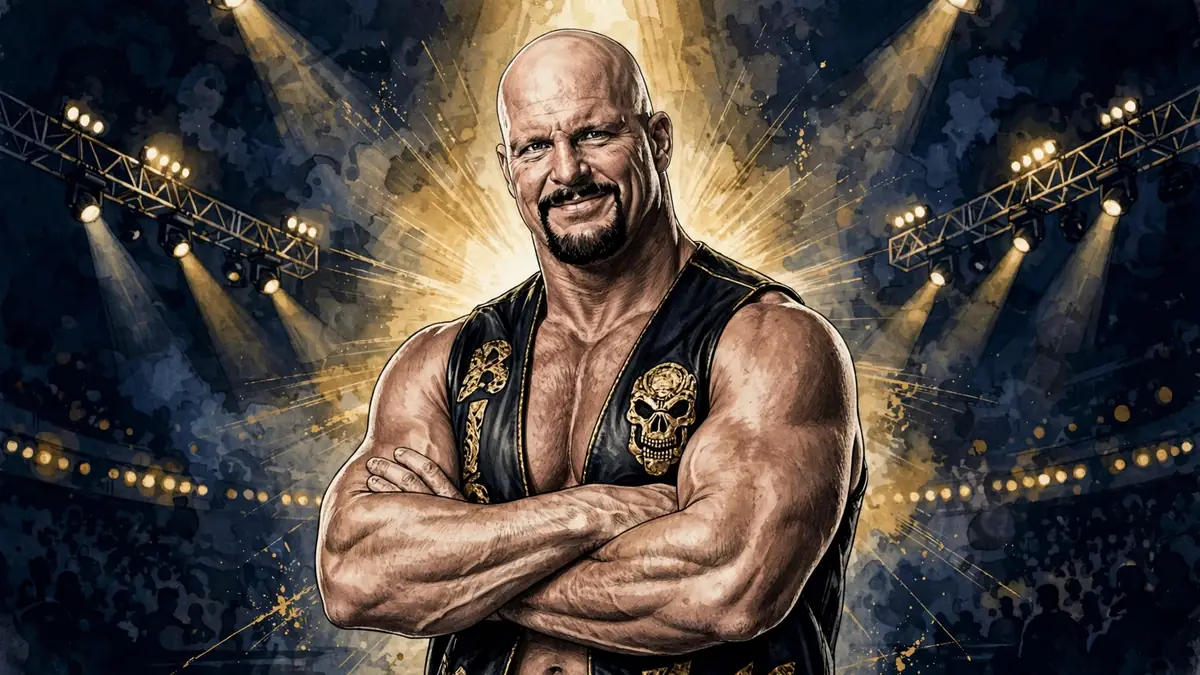
The only real argument about Steve Austin’s height is between 6 feet 2 inches and 6 feet 4 inches, and it is not much of an argument once you look at where each number comes from. The 6 feet 2 inches figure comes from WWE itself, from Wikipedia, and from every established biography and wrestling database listed above. The 6 feet 4 inches figure comes from one place: the fan-edited Official WWE Wiki on Fandom, which lists his height as 6 ft 4 in (1.93 m) on a page anyone can edit. No established biography, no wrestling database and no WWE listing repeats that number. It is an outlier, and it should be treated as one.
Why does the wrong number survive? Wrestling heights are a mess by design. Promotions have always added an inch or two to a wrestler’s billed height, and they measure men in boots on a wrestling mat, not barefoot against a wall. Fans then copy the biggest number they see, and fan wikis copy each other. The 6 feet 4 inches figure likely started as a simple error — someone typed the wrong number, or mixed Austin up with a taller contemporary — and then sat uncorrected on a page that few people check against a primary source. It is the kind of error that looks true because it is printed confidently, and this article exists in part to correct it.
There is a second, fairer question underneath the first: is 6 feet 2 inches his real height, or just the billed one? Here the honest answer is that wrestling’s billed heights are promotional, and Austin’s real height is very likely a touch under the billed figure — that is true of almost every wrestler of his era, because billed heights are taken in boots and rounded up. But there is no credible measurement, photograph comparison or interview that puts him meaningfully below 6 feet 2 inches either. He stands eye to eye with Cody Rhodes, who is also listed at 6 feet 2 inches, and he is visibly shorter than Triple H, listed at 6 feet 4 inches, and visibly shorter still than The Undertaker, listed at 6 feet 10 inches. The photo record matches the paperwork: Austin is a genuine 6-footer, right around the 6 feet 1 inch to 6 feet 2 inches mark in real life, billed at an even 6 feet 2 inches. For any practical purpose — a quiz answer, a comparison, a trivia night — 6 feet 2 inches is the correct number to give.
It is worth saying plainly what this article does not do. It does not claim a secret real height measured by a doctor, because no such measurement is public. It does not repeat the 6 feet 4 inches figure as a live possibility, because the sources behind it do not stand up. And it does not treat the billed height as a lie: in wrestling, the billed height is the official height, the one the company prints, the announcers say and the record books keep. Austin’s official height is 6 feet 2 inches, and that is the number this article anchors on.
Stone Cold Steve Austin Height Compared to Other WWE Legends
Height only means something next to other people, and in wrestling it meant a great deal. Austin spent his peak years in rings with men who towered over him, and part of his act was that he did not care. The table below uses billed heights — the official WWE figures — so the comparisons are apples to apples.
| Wrestler | Billed Height | Difference vs Austin |
|---|---|---|
| The Undertaker | 6 ft 10 in (208 cm) | 8 inches taller |
| The Rock | 6 ft 5 in (196 cm) | 3 inches taller |
| Randy Orton | 6 ft 5 in (196 cm) | 3 inches taller |
| Triple H | 6 ft 4 in (193 cm) | 2 inches taller |
| Brock Lesnar | 6 ft 3 in (191 cm) | 1 inch taller |
| Stone Cold Steve Austin | 6 ft 2 in (188 cm) | — |
| Cody Rhodes | 6 ft 2 in (188 cm) | Same height |
| John Cena | 6 ft 1 in (185 cm) | 1 inch shorter |
| Kevin Owens | 6 ft 0 in (183 cm) | 2 inches shorter |
The gap that mattered most was the one with The Undertaker. At 6 feet 10 inches billed, The Undertaker stood eight inches taller than Austin, and their matches sold on that mismatch: the dead man who could not be kept down, against the rattlesnake who would not stay down. Our full profile of the Deadman covers his own height in detail — see The Undertaker’s height — and the contrast explains why Austin’s wins over him felt like upsets even when the crowd expected them.
Against The Rock, the gap was three inches. The Rock, billed at 6 feet 5 inches, had the size, the look and the mic skills, and their three WrestleMania matches — WrestleMania XV in 1999, WrestleMania X-Seven in 2001 and WrestleMania XIX in 2003 — are still the standard by which WWE main events are judged. Austin won the first two and lost the third, which was his last match for 19 years. The three-inch gap never decided anything; the crowd did.
Brock Lesnar, billed at 6 feet 3 inches, is one inch taller than Austin and a full weight class heavier, which is why their near-miss in 2002 still gets talked about. Austin walked out of WWE that year rather than lose to Lesnar on free television with no build, a decision he later called a mistake, and the two never had the big pay-per-view match fans wanted. Our profile of Lesnar’s height puts his 6-foot-3 frame in the same kind of context — see Brock Lesnar’s height.
Cody Rhodes is the exact match: 6 feet 2 inches, the same as Austin, and the comparison is more than a number. Rhodes is the modern version of the story Austin told — a second-generation wrestler who left WWE, rebuilt himself outside it and came back as the company’s top babyface. Our profile of Rhodes covers his height the same way — see Cody Rhodes’ height. John Cena, at 6 feet 1 inch, is one inch shorter than Austin, and he carried the company through the decade after Austin retired. Our profile of Cena’s age tracks the generation that followed Austin — see how old John Cena is today. Triple H, at 6 feet 4 inches billed, was Austin’s great rival of 1999–2001 and later the executive who rebuilt WWE’s development system; his story is told in our Triple H biography. And Randy Orton, billed at 6 feet 5 inches, is the bridge between the two eras — a third-generation star who debuted while Austin was still on top and is still headlining today; see our Randy Orton biography.
Kevin Owens, at 6 feet 0 inches, is the shortest man on this list, and he is the one who brought Austin back. Their WrestleMania 38 match in 2022 — Austin’s first in 19 years — worked because Owens could talk, brawl and take a beating, and because two inches of height meant nothing next to 19 years of waiting.
Early Life: From Victoria, Texas to the Football Field
Steven James Anderson was born on December 18, 1964, in Austin, Texas. He grew up in Victoria, Texas, a small city on the Gulf Coast plain, where his family settled while he was still a boy. He has talked often about a tough, working-class childhood — a house where money was tight, a stepfather he has described as strict, and a kid who found his way out through sports. Football was the first escape. He was a good enough athlete at Victoria High School to earn a scholarship to the University of North Texas in Denton, where he played as a defensive end and tight end for the Mean Green in the mid-1980s.
College football did not lead to the NFL, and that dead end is where the wrestling story starts. After graduating, Austin worked the kind of jobs his character would later make famous — warehouse work, loading docks, manual labour — while he figured out what came next. A friend who worked at a wrestling school pointed him toward Chris Adams, a British wrestler running a training school in Texas, and Austin paid his dues there in 1989. Adams taught him the basics, and more than that, he taught him the business: how to work a crowd, how to sell a beating, how to make a simple move look like it hurt.
He debuted in 1989 in World Class Championship Wrestling, the Texas promotion that was already fading, under his real name, and then moved to the United States Wrestling Association. The early years were lean. He worked small buildings for small pay, drove long miles between towns, and learned the craft the way wrestlers of his generation all learned it — by doing it, night after night, in front of crowds that would let him know immediately if he was boring them. He was not boring them. By 1991 he had the look, the build and the ring sense to get a call from WCW, and the next chapter began.
WCW and ECW: The Long Road Before Stone Cold
Austin joined World Championship Wrestling in 1991 as “Stunning” Steve Austin, a blond pretty-boy heel with a good body and a better dropkick. WCW used him well at first. He won the WCW World Television Championship twice and the WCW United States Heavyweight Championship twice, and in 1993 he formed the Hollywood Blonds with Brian Pillman — a tag team that was too good for its own good, cutting promos and stealing shows until WCW split them up to protect its established stars. He and Pillman won the WCW World Tag Team Championship together, and for a while Austin looked like a man on his way to the top of the company.
It did not happen. WCW’s management never saw him as a main-event player, and in 1995, while he was sidelined with a triceps injury, the company released him. Eric Bischoff, who ran WCW at the time, later became the villain of the story — the executive who fired the biggest star in wrestling history because he did not think Austin could sell tickets. Austin has told the story many times since, and the sting of it clearly never left him: a phone call, or a letter, telling him he was done, while he was hurt and unable to argue the point in the ring.
He landed in Extreme Championship Wrestling, the Philadelphia promotion run by Paul Heyman, and ECW gave him the one thing WCW never had: a microphone and no script. Heyman let Austin cut promos to camera about WCW, about Bischoff, about being fired, about everything that had gone wrong — and Austin found his voice. He was angry, funny and real in a way wrestling promos rarely were, and the audience in that bingo hall in Philadelphia responded to it. It was in ECW that the “Stone Cold” name arrived. The story Austin tells is that his then-wife Jeanie Clarke suggested it one evening while he was drinking iced tea — she told him to drink his tea before it got stone cold, and the name stuck. He took it to the WWF a few months later, and it became the most famous ring name in wrestling history.
The Attitude Era: Austin 3:16 and the Rise of the Texas Rattlesnake
Austin signed with the World Wrestling Federation in late 1995 and debuted as The Ringmaster, a technical wrestler managed by Ted DiBiase, the Million Dollar Man. The gimmick was a dead end — a talented worker dressed in plain trunks with no character — and Austin knew it. He started growing a goatee, shaving his head, and letting the bitterness from the WCW firing bleed into his promos. The company gave him the Stone Cold name, and in June 1996 everything changed at King of the Ring.
Austin won the tournament, beating Jake “The Snake” Roberts in the final, and then cut the most famous promo in wrestling history. Roberts had been preaching about John 3:16 in his promos, quoting the Bible verse. Austin, holding the trophy, looked into the camera and said: “You sit there and you thump your Bible, and you say your prayers, and it didn’t get you anywhere. Talk about your psalms, talk about John 3:16… Austin 3:16 says I just whipped your ass.” The line became a slogan, the slogan became a T-shirt, and the T-shirt became the best-selling piece of merchandise in wrestling history. Within a year, “Austin 3:16” shirts were everywhere — in arenas, in schools, in malls — and the man wearing them was the most popular wrestler in the world.
The character was a deliberate break from everything that had come before. The heroes of the 1980s were cartoon supermen; Austin was a blue-collar anti-hero who drank beer on the job, flipped off his boss, drove a truck into the arena and beat up anyone who stood in his way — including the boss himself. His feud with Vince McMahon, the company’s owner playing the evil chairman on television, became the engine of the Attitude Era. Every week, McMahon tried to humiliate him, fine him, fire him or have him beaten up; every week, Austin got even, usually with a Stunner and a beer bash. The audience, much of it young working people who hated their own bosses, saw themselves in him, and the ratings followed. Raw went from losing the Monday night ratings war to WCW’s Nitro to winning it outright, and Austin was the reason.
The height played its part in all of this. At 6 feet 2 inches, Austin was big enough to be believable against anyone, but he was not a giant, and the act depended on that. The Undertaker was eight inches taller; Kane was taller still; The Rock had three inches on him. Austin beat them all anyway, not by being bigger, but by being tougher, meaner and more stubborn. The crowd loved him because he was the size of a real man in a business of giants, and he beat the giants. That is the whole appeal of the Texas Rattlesnake in one image: a 6-foot-2 brawler standing up to a 6-foot-10 dead man and refusing to back down.
Championships, Records and the Numbers Behind the Fame
The championship record is the cleanest way to measure what Austin did. He won the WWF Championship six times, a total that puts him among the most decorated champions in company history. He won the Royal Rumble three times — in 1997, 1998 and 2001 — and he remains the only wrestler ever to win the Rumble three times. He won King of the Ring in 1996. He held the Intercontinental Championship twice and the Tag Team Championship four times. He main-evented WrestleMania three times as champion, and his matches with Bret Hart, Shawn Michaels and The Rock are fixtures on every list of the greatest matches ever wrestled.
The match with Bret Hart at WrestleMania 13 in March 1997 deserves its own paragraph, because it is the match that made him. It was a submission match, and it ended with Austin locked in Hart’s Sharpshooter, blood pouring down his face, screaming in pain and refusing to quit until he passed out. The referee stopped the match, Hart won, and the crowd — which had come in cheering Hart and booing Austin — turned completely. They cheered the man who would not quit, and they booed the winner for not finishing the job cleanly. It was a double turn, executed in one match, and it is still taught in wrestling schools as the best example of how to change a character’s alignment without saying a word. In 2025, WWE inducted Austin and Hart together into the Hall of Fame a second time, in the new Immortal Moment category, for that match — Austin’s second Hall of Fame induction, after his individual induction in 2009.
The WrestleMania record tells the rest. He beat Shawn Michaels for his first WWF Championship at WrestleMania XIV in 1998, with Mike Tyson at ringside as the special enforcer. He beat The Rock at WrestleMania XV in 1999 and again at WrestleMania X-Seven in 2001, in a match many call the greatest WrestleMania main event ever wrestled. He lost to The Rock at WrestleMania XIX in 2003, and that was the end. Three WrestleMania matches against the same man, across five years, each one bigger than the last, and the rivalry still defines both men’s careers.
The business numbers behind the fame were just as big. At his peak, Austin was the top merchandise seller in wrestling, and the Austin 3:16 shirt is still, decades later, one of the best-selling wrestling shirts of all time. One 2026 profile put his peak-year earnings as high as $16 million in a single year, driven by pay-per-view bonuses, merchandise royalties and his WWE contract — a figure that, if right, made him the highest-paid wrestler of his era by a wide margin. He was the face of the company at the exact moment the company became a public, billion-dollar business, and he was paid like it.
The Neck Injury and the 2003 Retirement
The career that made him also broke him. At SummerSlam in August 1997, Austin took a piledriver from Owen Hart that went wrong. Hart dropped him on his head, and Austin’s neck was broken on the spot. He lay in the ring, temporarily unable to move, and then — in one of the most famous moments of his career — he crawled over and pinned Hart anyway, because the show had to go on. He wrestled on with the injury for two more years, working through pain and numbness in his arms, before finally having spinal fusion surgery in 1999. The surgery fused vertebrae in his neck and saved his mobility, but it cost him a year of his career and changed the way he wrestled forever.
He came back in 2000 and had one more great run, including the 2001 heel turn at WrestleMania X-Seven and the Invasion storyline that followed, but the body was giving out. His knees were gone, his neck was held together with hardware, and the schedule — 200-plus dates a year, four or five nights a week on the road — was not survivable anymore. In 2002 he walked out of the company during a dispute over how he was being used, a decision he has since called the biggest regret of his career. He returned, worked a reduced schedule, and finally retired on March 30, 2003, after losing to The Rock at WrestleMania XIX in Seattle. He was 38 years old. He had been wrestling for 14 years, and his neck had been broken for six of them.
The retirement was not the end of the relationship. WWE kept him on as an on-screen authority figure for a while, then as an ambassador, and he has appeared at WrestleMania and on WWE television many times since — usually to drink beer, hit someone with a Stunner and leave to a standing ovation. The neck injury is part of the legend now: the man who broke his neck on live television, pinned his opponent anyway, and came back to become the biggest star in the business. It is also the reason his height is sometimes argued about — men with serious spinal injuries can lose a fraction of an inch over the years, and fans who saw him in 2022 next to men he towered over in 1998 sometimes wonder. There is no evidence he has lost any meaningful height. He is listed at 6 feet 2 inches today, the same as he was listed in 1998, and the photographs from his 2022 return back that up.
WrestleMania 38: One More Match at 57
For 19 years, the retirement held. Austin made appearances, cut promos, hosted shows and drank beer in the ring, but he did not wrestle. Then, in the spring of 2022, WWE put him in a talk-show segment with Kevin Owens at WrestleMania 38 in Dallas, Texas — Austin’s home state — and the segment turned into a match. Owens challenged him to a No Holds Barred match in the main event of night one, Austin accepted, and for 14 minutes the 57-year-old rattlesnake wrestled his first match since 2003. He won, with a Stunner, and celebrated with his trademark beer bash, drinking his own Broken Skull beer in the middle of the ring while the crowd in his home state roared.
He was not done for the weekend. On night two, he came back out and delivered Stunners to Austin Theory, Pat McAfee and Vince McMahon himself — a greatest-hits set that closed the show and gave the fans everything they had come for. He told the Brewbound Podcast afterwards that he felt “100 percent” coming out of the match, and that it had been an honour to headline WrestleMania again in Texas. He also said he would be there for WrestleMania 39 if WWE called, and he has appeared at WrestleMania 41 in Las Vegas in 2025 as well. The match against Owens stands, as of the 2026 WrestleMania season, as his most recent one.
The return worked because the height still worked. At 57, Austin looked the same size he had always been — 6 feet 2 inches, thick through the shoulders, moving well for a man with a fused neck — and the crowd bought him as a threat to Owens, who is listed at 6 feet 0 inches. Two inches is not much, but in a wrestling ring, next to a man you have watched for 25 years, it reads as size, and size reads as danger. The match is the best proof available that the listed height is honest: a 57-year-old man, in the ring with a younger opponent, looking exactly as big as his record says he is.
The Money: How Stone Cold Built His Fortune
Stone Cold Steve Austin’s net worth is estimated at $30 million as of 2026, anchored on Celebrity Net Worth’s long-standing figure for him, which the majority of 2026 profiles repeat. A few newer trackers go higher — BounceMojo, in its June 2026 ranking of the richest wrestlers, put him at $45 million — and a small number of older or thinner profiles quote figures anywhere from $30 million to $75 million. We anchor on $30 million and show the $30 million–$45 million range, because Celebrity Net Worth is the most-cited tracker of his fortune, the $30 million figure appears in Sportskeeda, TWSN and several other 2026 profiles, and the higher numbers come from single sources with no supporting detail. No filing, contract or rich-list entry pins the number down exactly, and any profile that gives you a single exact figure for a retired wrestler is guessing with more confidence than the evidence allows.
The money came from four places, and the wrestling was only the first. His WWE earnings were the foundation: a peak-era contract, pay-per-view bonuses from the biggest drawing period in company history, and merchandise royalties from the Austin 3:16 shirt and the rest of the Stone Cold line. One 2026 profile put his peak-year earnings as high as $16 million in a single year. Even at half that figure, his run from 1997 to 2001 made him a multi-millionaire several times over, and the WWE Legends contract he has held since retirement has kept the cheques coming — royalties on merchandise, video games and network programming that use his likeness, plus appearance fees for the WrestleMania cameos and the occasional television spot.
Acting was the second stream. After retiring, Austin moved into action films, and while he never became a movie star on the scale of The Rock, he worked steadily: The Condemned in 2007, his first leading role; Damage in 2009; The Expendables in 2010, alongside Sylvester Stallone, Jason Statham and a cast of action veterans; Hunt to Kill in 2010; and smaller roles in films like Grown Ups 2 in 2013. The pay was never public, but the roles kept him visible and paid through the years when his in-ring income had stopped, and they gave him a second career to build on.
Television and podcasting were the third stream, and in the long run they may be the most durable. He hosted Steve Austin’s Broken Skull Challenge on CMT from 2014 to 2017, a physical-competition show that ran for five seasons. He hosted Straight Up Steve Austin on the USA Network from 2019 to 2021, a talk-and-activity show that paired him with celebrities doing the things he likes to do — riding, shooting, driving. His podcast, The Steve Austin Show, has run since 2013 and remains one of the most popular wrestling podcasts in the world, and his WWE Network video podcast, Broken Skull Sessions, ran from 2019 to 2022 and produced some of the best long-form interviews in wrestling history, including the first full interview with The Undertaker about his career. Podcasting pays through advertising and sponsorship, and Austin’s audience — loyal, older, and famously willing to buy what he recommends — is exactly the audience advertisers want.
The fourth stream is the one with his name on the label: beer. Austin partnered with El Segundo Brewing in California to create Broken Skull IPA in 2014, and the line has since added Broken Skull American Lager, which launched on March 16, 2022 — Stone Cold Steve Austin Day, 3:16 — and was promoted all through his WrestleMania 38 return. The beer business is private, so its revenue is not public, but it is a real operating business with national distribution, and it turns his most famous habit — smashing two beers together and pouring them down his throat — into a product on a shelf. It is the most Austin business imaginable, and it is still growing.
| Income Stream | What It Covers | Notes |
|---|---|---|
| WWE career and Legends deal | Peak-era salary, pay-per-view bonuses, merchandise royalties, appearance fees | Peak-year earnings reported as high as $16 million (TWSN, 2026) |
| Acting | The Condemned, The Expendables, Damage, Hunt to Kill, Grown Ups 2 | Steady film work 2005–2013 |
| Television and podcasting | Broken Skull Challenge, Straight Up Steve Austin, The Steve Austin Show, Broken Skull Sessions | Podcast running since 2013 |
| Broken Skull beer | Broken Skull IPA (2014) and American Lager (2022) with El Segundo Brewing | Private business, revenue not public |
Broken Skull: Beer, Podcasts and Television
The Broken Skull brand is the thread that runs through everything Austin has done since he stopped wrestling full-time, and it is worth understanding on its own, because it is how a retired wrestler stays relevant without getting back in the ring. The name comes from his ranch — Broken Skull Ranch, the property in Texas where he lived after retirement — and from the skull logo on his old vest. It started as a nickname for his home, became the name of his television show, then the name of his podcast studio, and finally the name of his beer.
The beer came first as a joke and then as a business. Austin had been drinking beer on television for years — the beer bash, where he smashed two cans together and sprayed the crowd, was one of his signature celebrations — and fans had been asking for his own beer for almost as long. In 2014 he partnered with El Segundo Brewing, a craft brewery in California, to make Broken Skull IPA, a proper India Pale Ale with his name and his skull on the can. It sold. In 2022, on March 16 — 3/16, his day — the line added Broken Skull American Lager, a lighter beer aimed at a wider audience, and Austin promoted it through his WrestleMania 38 appearances, drinking it in the ring on the biggest stage in wrestling. The lager’s cans, red, white and blue on silver, were visible in every photograph from that weekend, and the promotion worked: the beer became the story of the weekend almost as much as the match did.
The podcasts are the other half of the brand. The Steve Austin Show, which he started in 2013, is a twice-weekly conversation show where he talks wrestling, hunting, football, beer and life with guests and with his audience, and it has run for more than a decade without losing its audience. Broken Skull Sessions, the video interview show he did for the WWE Network and Peacock from 2019 to 2022, gave him a different stage: long, unhurried interviews with the people he came up with, including The Undertaker, The Rock, Bret Hart and Vince McMahon. Those interviews are some of the best primary sources that exist for the history of the Attitude Era, precisely because Austin asks the questions as a peer, not as a journalist. He knows what to ask, and the people he interviews know he knows.
The television shows filled the gaps. Broken Skull Challenge, on CMT, took ordinary athletes and put them through the kind of physical tests Austin used to train with — rope climbs, tyre flips, obstacle courses on his ranch — and ran for five seasons. Straight Up Steve Austin, on the USA Network, was looser: Austin taking a celebrity guest — a fellow wrestler, an actor, a musician — out to do something he likes, whether that was riding ATVs in the desert or fishing on a lake, and talking while they did it. None of these shows made him a television star in the conventional sense. All of them kept him working, kept him in front of his audience, and kept the Broken Skull name growing.
Real Estate and Assets: Broken Skull Ranch
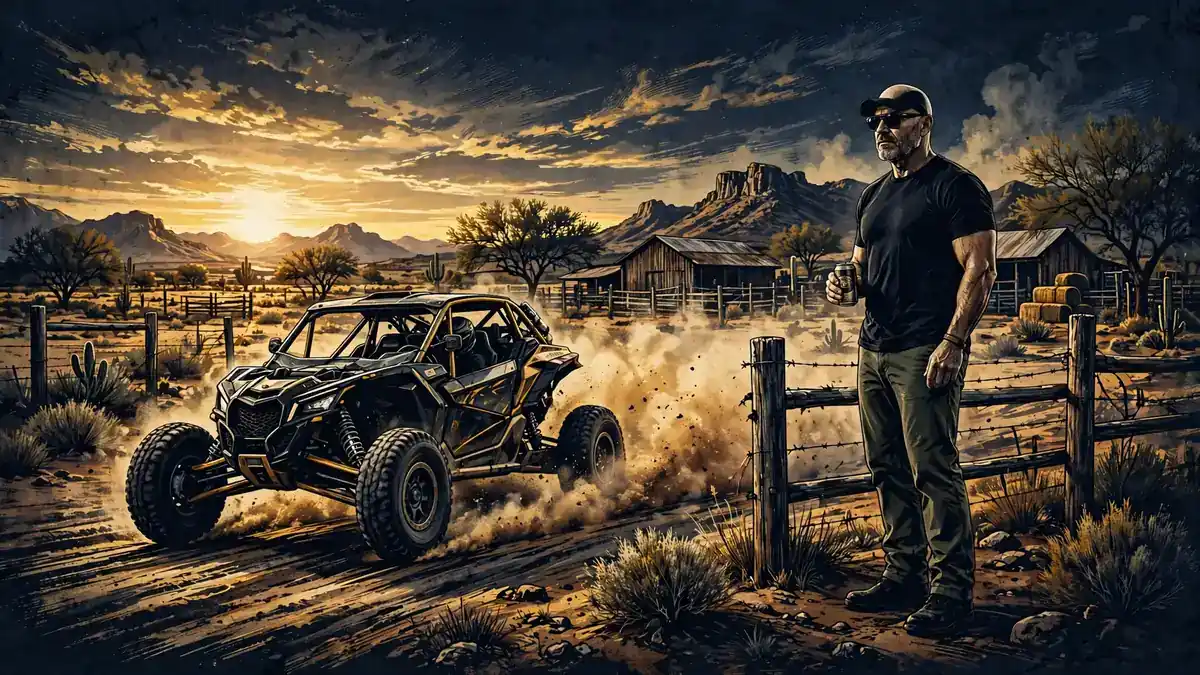
Austin’s most famous asset is the one that gave his brand its name. Broken Skull Ranch was his home in Texas for years — a working ranch near Tilden, in the south of the state, where he kept cattle, hunted, rode and filmed his television shows. He sold the Texas ranch and bought Broken Skull Ranch 2.0 in 2018, a property near Gardnerville, Nevada, south of Reno, where he lives now. The Nevada ranch is the base for his desert-racing hobby, which he took up in earnest in 2023, competing in UTV events across the American Southwest. It is also where he records his podcast and where much of his post-wrestling life happens — a long way from the arenas, and deliberately so.
His other property moves are public record, and they tell the same story of a man cashing out of the big-city life. He owned homes in Marina del Rey, Los Angeles, and sold those properties in 2021 for $3.395 million, according to Virtual Globetrotting’s property tracking. The sale fits the pattern: the Los Angeles houses went, the Nevada ranch stayed, and the money went into the life he actually lives — the ranch, the racing, the beer business and the podcast. He has never been a collector of cars or watches in the way some of his peers are, and there is no public record of an exotic car collection or a property portfolio. His wealth is in the brand, the royalties and the ranch, not in a garage.
That modesty is part of the appeal, and it is also good business. Austin’s public image has always been the working man who got rich without forgetting where he came from, and his spending matches it. He lives on a ranch in Nevada, drives a UTV through the desert, drinks his own beer and talks to his friends on a podcast. It is not a lifestyle built for Instagram. It is a lifestyle built for a 61-year-old man with a fused neck who has already done the biggest thing there is to do in his business, and who would rather be at home than anywhere else.
Personal Life and Family
Austin has been married four times. His first marriage was to Kathryn Burrhus, from 1990 to 1992. His second was to Jeanie Clarke, from 1992 to 1999 — Clarke is the woman credited with suggesting the “Stone Cold” name, and she worked in wrestling herself as Lady Blossom. His third marriage was to Debra Marshall, a former wrestling manager and valet, from 2000 to 2003; that marriage ended in the circumstances covered in the next section. Since 2009 he has been married to Kristin Feres, and that marriage has lasted longer than the first three combined. He has three daughters, and he has kept them almost entirely out of the public eye — a deliberate choice, and one this article respects by not naming them or detailing their lives.
The family story behind the fame is not a happy one, and Austin has been open about it in interviews and in his 2003 autobiography, The Stone Cold Truth, written with Jim Ross. He has spoken about a difficult childhood, a strict stepfather, and a relationship with his own father that was distant for years. He has also spoken about the cost of the wrestling schedule on his marriages: 200-plus nights a year on the road, home for a day or two at a time, and a career that asked everything of him and gave back money and fame but not much else. The stability of his current marriage, and his life on the ranch in Nevada, read as a conscious answer to all of that — a man who spent his thirties and forties on the road, and his fifties and sixties at home.
He is 61 now, and he looks it in the way healthy 61-year-olds do: still thick, still strong, hair gone and goatee grey, but moving well and working at the things he cares about. He turns 62 on December 18, 2026. He is signed to WWE as an ambassador, which means he appears when the company wants him and the moment is right, and he picks his spots carefully. The days of 200 nights a year are over, and he has said more than once that he has no interest in going back to them.
Controversies and Legal Issues
There is one serious legal matter in Austin’s history, and a complete profile has to cover it honestly. In June 2002, while he was married to Debra Marshall, Austin was arrested and charged in connection with a domestic violence incident at their home in San Antonio, Texas. He pleaded no contest to a misdemeanor assault charge, and received probation, a fine and community service. Marshall later spoke publicly about the incident and about the marriage, and Austin has addressed it in interviews since, without minimising it. The marriage ended in divorce in 2003, the same year he retired from wrestling.
It is the one stain on a career that is otherwise remarkably clean for a man of his fame and era, and it is worth stating plainly rather than hiding: a no-contest plea to misdemeanor assault is a matter of public record, and any profile that skips it is not telling the full story. It is also worth stating what happened next. Austin did not have further legal trouble. His subsequent marriage has lasted 17 years. He has not been the subject of further allegations, and his public life since 2003 has been defined by the podcast, the ranch, the beer and the occasional triumphant return to the ring. The incident is part of his story. It is not the whole of it.
The other controversy of his career was professional, not legal, and he has been equally open about it: the 2002 walkout, when he left WWE rather than lose a match to Brock Lesnar on free television without a build. He has called it the biggest mistake of his career, apologised for it publicly, and made it up to the company and the fans many times over — most notably by coming back for the WrestleMania 38 match twenty years later, against a man in Kevin Owens who understood exactly what that return meant. The walkout cost him money and goodwill in 2002. The apology and the return earned both back.
Frequently Asked Questions
How tall is Stone Cold Steve Austin?
Stone Cold Steve Austin is 6 feet 2 inches tall (188 cm / 1.88 m). That is the billed height WWE uses for him, and it is the figure listed by Wikipedia, The Famous People, Healthy Celeb and The SmackDown Hotel. His billed weight is 252 lb (114 kg).
Is Stone Cold Steve Austin really 6 feet 4 inches tall?
No. The 6 feet 4 inches figure appears only on the fan-edited Official WWE Wiki on Fandom, a page anyone can edit. WWE’s own listings, Wikipedia, The Famous People, Healthy Celeb, Sports Digest and The SmackDown Hotel all list him at 6 feet 2 inches. The 6-foot-4 figure is an outlier with no reliable source behind it.
How tall is Stone Cold Steve Austin in cm?
He is 188 cm tall, which is 1.88 metres or 74 inches. His billed weight converts to 114 kg.
How much does Stone Cold Steve Austin weigh?
His billed weight is 252 lb (114 kg). That is the weight WWE has listed for him throughout his career, alongside the 6-foot-2 height.
How tall is Stone Cold Steve Austin compared to The Undertaker?
The Undertaker is billed at 6 feet 10 inches (208 cm), which makes him 8 inches taller than Austin. That gap was part of their rivalry: the dead man who towered over the rattlesnake, and the rattlesnake who beat him anyway.
How old is Stone Cold Steve Austin?
He is 61 years old as of November 2026. He was born Steven James Anderson on December 18, 1964, in Austin, Texas, and he turns 62 on December 18, 2026.
What is Stone Cold Steve Austin’s net worth in 2026?
His net worth is estimated at $30 million as of 2026, anchored on Celebrity Net Worth, with a range of $30 million to $45 million — BounceMojo’s June 2026 ranking put him at $45 million. The fortune comes from his WWE career and Legends deal, acting roles, podcasting and television, and his Broken Skull beer brand with El Segundo Brewing.
Is Stone Cold Steve Austin still wrestling?
He retired from full-time wrestling in 2003 after WrestleMania XIX, but he returned for one more match at WrestleMania 38 in April 2022, beating Kevin Owens in a No Holds Barred match at 57 — his first match in 19 years. He is signed to WWE as an ambassador and still makes occasional appearances, including at WrestleMania 41 in 2025, but he does not wrestle full-time.
Bottom Line
Stone Cold Steve Austin is 6 feet 2 inches tall — 188 cm, 74 inches, 252 pounds — and that number is settled. WWE lists it, Wikipedia lists it, and every established biography and wrestling database agrees on it. The 6-foot-4 figure you may see quoted comes from a single fan-edited wiki page and has no reliable source behind it. The real story is not the number itself but what he did with it: a 6-foot-2 brawler from Victoria, Texas, who was never the biggest man in the room, became the biggest star in wrestling history by being the toughest, the loudest and the most stubborn man in it. He won six world championships, won the Royal Rumble three times, carried WWE past WCW, broke his neck and came back, retired at 38, and came back once more at 57 to win a match in front of his home state. His fortune, estimated at $30 million as of 2026, was built the same way his career was: in the ring first, then in films, on television, behind a podcast microphone and behind the label of his own beer. For more celebrity profiles in the same style, browse our Celebrity section. And if anyone tells you he is 6 feet 4 inches, you now know where that number comes from — and why it is wrong.
Sources and Reporting
Height, weight, birth date and career facts: Wikipedia (Stone Cold Steve Austin biography, billed height 6 ft 2 in / 188 cm, billed weight 252 lb / 114 kg; Hall of Fame inductions 2009 and 2025; WrestleMania 38 return); WWE (official billed measurements and career history); The SmackDown Hotel (profile updated October 2026, height 6 ft 2 in / 188 cm); The Famous People (height 6’2″ / 188 cm, birth date December 18, 1964); Healthy Celeb (height 6 ft 2 in, profile last updated July 2020). Net worth: Celebrity Net Worth ($30 million anchor, as reported across 2026 profiles); BounceMojo ($45 million, June 2026 richest-wrestlers ranking); Sportskeeda ($30 million); TWSN (April 2026, $30 million estimate and peak-year earnings reporting). WrestleMania 38 and Broken Skull beer: Post Wrestling (April 19, 2022 interview) and ScreenRant (April 4, 2022). Real estate: Virtual Globetrotting (Broken Skull Ranch 2.0, Gardnerville, Nevada, bought 2018; Marina del Rey properties sold 2021 for $3.395 million).
How we estimated: The headline figure in this article is a height, not a net worth, and it is anchored on WWE’s own billed measurement of 6 feet 2 inches (188 cm), confirmed by Wikipedia and four independent profile sources. The single conflicting figure of 6 feet 4 inches comes from a fan-edited wiki and is treated as an outlier, not a live range. The net worth figure is an estimate, not a fact: we anchor on Celebrity Net Worth’s $30 million and show the $30 million–$45 million range because BounceMojo’s June 2026 ranking gives $45 million and no filing or contract pins the number down. Net worth figures for public personalities are estimates built from public reporting, not audited financial statements. Where sources disagreed, we said so and named the source on each side.
By: Celebamerica Editorial Staff | Last updated: November 18, 2026