Khamzat Chimaev is a Chechen-born mixed martial artist who fights out of the United Arab Emirates, a former UFC middleweight champion, and one of the most talked-about fighters of his generation. Born on May 1, 1994, in Chechnya, Russia, he won the UFC middleweight title at 31 with one of the most one-sided championship performances ever recorded, then lost the belt in his first defence at 32. As of November 2026, his professional record stands at 15-1, and his net worth is estimated at around $4 million, inside an honest $3-6 million range.
His nickname tells you most of what you need to know before the first bell. “Borz” is the Chechen word for wolf, and Chimaev fights like one: he hunts opponents down, drags them to the mat, and stays on them until they break. In his first three UFC fights, all won inside 66 days in the summer of 2020, he absorbed almost no damage at all. The aura that followed him — unbeaten, unhittable, unstoppable — lasted six years, through wins over Gilbert Burns, Kamaru Usman and Robert Whittaker, until Sean Strickland ended it on a May night in Newark. This biography follows the full arc: a childhood in a war-scarred corner of Russia, a teenage move to Sweden, three Swedish freestyle wrestling titles, a rocket ride through the UFC, a championship win that looked like a coronation, a first loss that changed everything, and the money, family and controversy around it all. Last updated November 25, 2026.
| Full Name | Khamzat Khizarovich Chimaev |
|---|---|
| Date of Birth | May 1, 1994 (age 32; turns 33 on May 1, 2027) |
| Birthplace | Gvardeyskoye, Chechnya, Russia (some databases render the village as Beno-Yurt) |
| Nickname | “Borz” — Chechen for “wolf” |
| Nationality | Russian-born; Emirati citizen since January 2025; formerly Swedish resident |
| Height / Reach | 6 ft 2 in (188 cm) / 75 in (191 cm) |
| Division | Middleweight (185 lb); also fought at welterweight (170 lb) |
| Professional Record | 15-1 (6 knockouts, 6 submissions, 3 decisions); UFC record 9-1 |
| Title Reign | UFC middleweight champion, August 16, 2025 – May 9, 2026 |
| Estimated Net Worth | Around $4 million in 2026 (range $3-6 million; see the money section for the source-by-source breakdown) |
| Primary Income Sources | UFC fight purses and pay-per-view shares, post-fight bonuses, sponsorships and endorsements |
| Key Ventures | Smash Labs nutrition line; sponsorships with Dragon Energy, Nigma Galaxy, Smilodox and Venum; a wrestling gym built in his home village |
| Residence | Dubai, United Arab Emirates |
Contents
- Early Life in Chechnya
- The Move to Sweden at 18
- Wrestling Roots: Three Swedish Titles
- Finding MMA at Allstars
- UFC Debut: Three Fights in 66 Days
- The Rise: Burns, Usman and Whittaker
- Winning the Title at UFC 319
- Losing the Belt at UFC 328
- The Money: Purses, Sponsorships and Net Worth
- Net Worth Growth Over the Years
- Fighting Style: Why Borz Is So Hard to Beat
- Personal Life: Marriage, Family and Dubai
- Controversy: The Kadyrov Connection
- How Chimaev Compares to His Peers
- What Comes Next: The Road Back
- Frequently Asked Questions
- Final Thoughts
- Sources and Reporting
Early Life in Chechnya
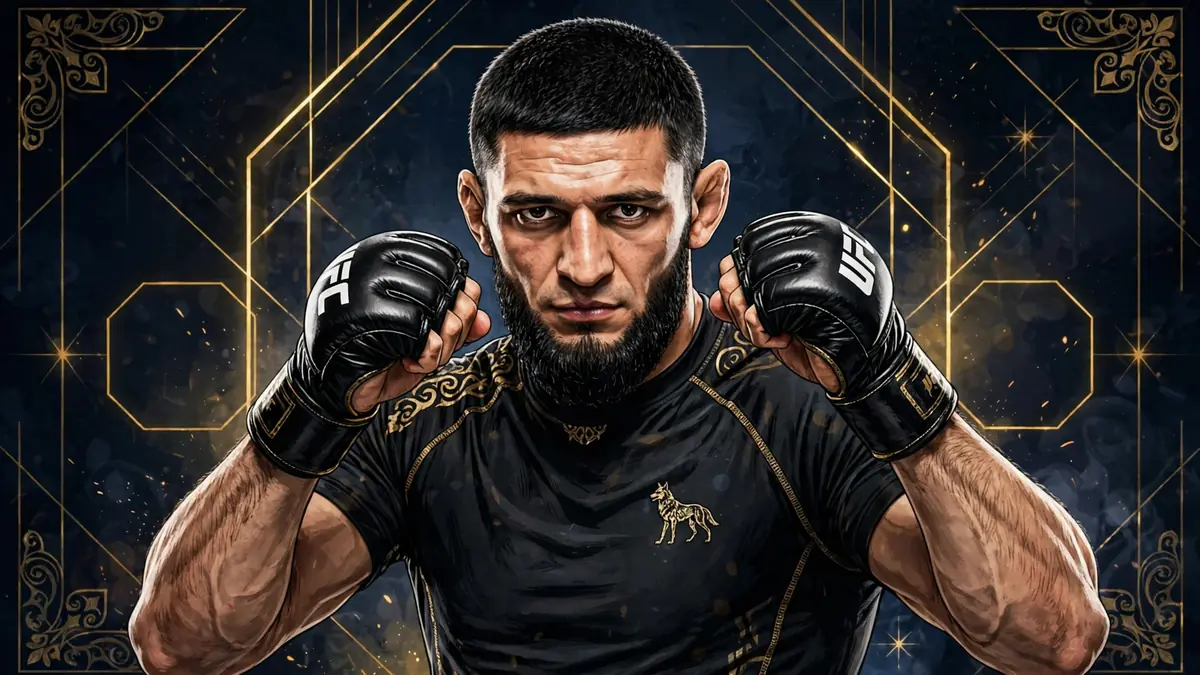
Khamzat Khizarovich Chimaev was born on May 1, 1994, in Gvardeyskoye, a village in the Chechen Republic of Russia. A handful of databases render his birthplace as Beno-Yurt, a neighbouring village name that has travelled with his biography through different record-keeping systems; the May 1, 1994 date itself is consistent across Tapology, MMA Full Contact, MMA Official and Wikipedia, and that is the date this article uses. He grew up in a conservative Muslim family during a period of intense conflict in the region, in a household where wrestling was not a hobby but a way of life. His father, Khizar Chimaev, raised his sons around the sport, and Khamzat started wrestling at the age of five.
Chechnya’s wrestling culture runs deep. In the Caucasus mountains, wrestling is closer to a language than a sport — boys learn it the way other children learn to ride a bicycle, and the mats are where respect is earned. Chimaev took to it early and stayed with it. He trained in sambo from his mid-teens and won a bronze medal at the Russian National Championships at junior level, a result that marked him as a serious prospect in a country that produces elite wrestlers by the hundred. But talent alone was not enough to change his circumstances. Chechnya in the years after the wars offered little in the way of opportunity, and the family looked west.
What shaped him most in those early years was not any single tournament but the combination of hardship and discipline. He has spoken about his mother’s sacrifices and the poverty of the family’s early years, and about the way wrestling gave a restless, competitive boy a structure to pour himself into. The boy who would later be described by UFC commentators as a force of nature was, in Gvardeyskoye, simply the kid who never stopped coming forward on the mat.
The Move to Sweden at 18
In 2013, at 18 years old, Chimaev moved to Sweden with his mother, following his older brother Artur, who had already made the journey. The family settled in Kalmar, a small town on Sweden’s south-east coast, and the move was driven by the search for stability, opportunity and medical treatment for Artur. Sweden gave the family safety. It did not give them comfort. Chimaev worked in a small poultry factory in Kalmar and later did security work in Stockholm, and the early years in Sweden were defined by long shifts and tight money.
The move also gave him something Chechnya could not: a wrestling system with regular competition and a path upward. He kept wrestling after arriving in Sweden, and the results came quickly. Within a few years he was one of the best freestyle wrestlers in the country, and the factory job was funding a dream rather than replacing one. The contrast between the two lives — poultry plant by day, wrestling mat by night — became a central part of his story, the kind of detail fans repeat because it explains the hunger that showed up later in the cage.
Sweden also gave him his first real community outside his family. He trained alongside wrestlers who would go on to compete internationally, learned to navigate a new language and culture, and slowly built the identity that would follow him into the UFC: a Chechen by birth, a Swede by upbringing, and eventually an Emirati by choice. Each of those identities matters to a different part of his fanbase, and each of them is real.
Wrestling Roots: Three Swedish Titles
Chimaev’s wrestling record in Sweden is the foundation everything else was built on. He won the Swedish freestyle national championship three times, taking the title at 86 kilograms in 2016 and 2017 among his championship runs, and he was rated among the best freestyle wrestlers in the country. The UFC’s own profile lists him as a Swedish national champion in freestyle wrestling and a brown belt in Brazilian jiu-jitsu, and notes that he went undefeated as an amateur in MMA with four finishes before turning professional.
Wrestling at that level teaches things that cannot be learned in a gym alone. It teaches how to chain attempts together when the first one fails, how to ride an opponent without wasting energy, and how to stay calm while another human being is trying to hurt you. Watch any Chimaev fight and you can see the freestyle base in every exchange: the level changes are instant, the grip fighting is relentless, and once he has a body lock or a single leg, the takedown feels like a matter of time rather than a question. That base is why his style translated so directly to MMA, and why opponents who had spent their whole careers stuffing takedowns found themselves on their backs anyway.
The wrestling pedigree also puts him in a lineage that fight fans know well. The Caucasus region has produced a generation of wrestler-grapplers who have reshaped the UFC, and the most famous of them remains Khabib Nurmagomedov, the Dagestani former lightweight champion whose own wrestling-first style dominated the sport a few years earlier. Chimaev and Khabib are not related, despite the shared roots, the shared religion and the shared manager, and the two have had a public falling out — but the comparison followed Chimaev from his debut, and it set a standard he spent his early UFC career chasing.
Finding MMA at Allstars
Chimaev began training in mixed martial arts at 23, late by modern standards, and the way he found the sport has become part of his legend. After winning a gift card at a hotel in Stockholm, he spent a weekend at Allstars Training Center, tried MMA, and felt immediately that this was something for him. When he went back to Kalmar, he quit his job and moved to Stockholm to train full time. Allstars was the right room at the right time: it was home to Alexander Gustafsson, the three-time UFC light heavyweight title challenger, and to a deep roster of Swedish and international fighters who gave a raw wrestler with heavy hands a real education in striking, submissions and cage craft.
He turned professional in 2018 and fought on the regional scene in Sweden and the Middle East, building a 6-0 record with finishes in every fight before the UFC called. His amateur career had already hinted at what was coming: four fights, four finishes, zero defeats. The professional run was the same story at a higher level. He fought for Brave Combat Federation, the Bahrain-based promotion where he picked up wins over Ikram Aliskerov — a future UFC middleweight himself — and others, and by the time the UFC signed him in 2020 he was already being talked about in MMA circles as a prospect worth watching.
What stood out even then was the completeness of the package. Most wrestlers arrive in MMA with a hole in their game — no striking, no submissions, no cardio to match the wrestling. Chimaev arrived with heavy hands, a developing submission game and a gas tank built by years on the wrestling mat. He was not a specialist learning a new sport. He was an athlete who had found the sport his body was built for.
UFC Debut: Three Fights in 66 Days
Chimaev made his UFC debut on July 15, 2020, on Fight Island in Abu Dhabi, beating John Phillips by second-round submission. Ten days later he beat Rhys McKee, again by stoppage. Then, on September 19, 2020, he knocked out Gerald Meerschaert in 17 seconds. Three fights, three finishes, 66 days — and, most remarkably, he had absorbed almost no damage in any of them. The UFC had seen fast starts before, but rarely one this violent and this clean at the same time.
The timing helped. The pandemic had emptied the UFC’s schedule and pushed events onto Fight Island, where a hungry newcomer willing to fight on short notice was worth his weight in gold. Dana White, the UFC president, took notice immediately, and Chimaev became the breakout star of the strangest year in the promotion’s history. Fans gave him a second nickname that stuck for a while — the hype was that loud — but “Borz” was the one that lasted, and it fit better: a wolf does not hype itself, it hunts.
The run stalled in 2021, and the reason was serious. Chimaev contracted COVID-19 and suffered badly with it, with lung problems that kept him out of the cage for more than a year and at one point led him to announce his retirement on social media. Fights against Leon Edwards were booked and cancelled repeatedly. He eventually recovered, returned in October 2021 to submit Li Jingliang in the first round, and the machine started moving again. The illness cost him a year of his prime and a fortune in missed paydays, but it also gave his story a second act: the comeback from a health scare that had genuinely threatened his career.
The Rise: Burns, Usman and Whittaker
The fights that turned Chimaev from a prospect into a contender came in a run of four bouts between 2022 and 2024, each one harder than the last. At UFC 273 in April 2022 he faced Gilbert Burns, a former title challenger and one of the most dangerous welterweights on the roster, and won a unanimous decision in a three-round war that earned Fight of the Night honours. It was the first time anyone had genuinely tested him, the first time he had been hit cleanly and repeatedly, and the first time he had to win a fight on heart as much as on wrestling. He passed the test, and the win aged well: Burns went on to beat Jorge Masvidal and Neil Magny afterwards, and the fight is still talked about as one of the best welterweight bouts of the decade.
After a win over Kevin Holland, Chimaev moved up to middleweight and faced Kamaru Usman at UFC 294 in October 2023, in Abu Dhabi. Usman was a former welterweight champion and one of the greatest 170-pound fighters ever, stepping up on short notice, and Chimaev beat him by majority decision over three rounds. The win proved he could handle a fellow elite wrestler at the higher weight, and it put him one fight from a title shot. The purse for that night, around $1.6 million by BetMGM estimates reported in the MMA press, was his biggest to that point and a sign of how far his earning power had travelled from the $86,000 debut cheque.
The final step before the title came at UFC 308 in October 2024, against Robert Whittaker, the former middleweight champion. Chimaev submitted Whittaker with a face crank at 3:34 of the first round — a finish so sudden and so violent that Whittaker later revealed it had broken his jaw and displaced his teeth. It was a statement finish against an elite opponent, and it made the title fight unavoidable. The Whittaker win also paid him around $1.06 million, again by BetMGM estimates, and it set up the biggest night of his life.
Through this run, the middleweight division around him was changing hands. Israel Adesanya, the long-reigning champion whose style and star power had defined the division for years, lost the belt to Alex Pereira, regained it, then lost it again to Sean Strickland in 2023, who lost it to Dricus du Plessis in early 2024. By the time Chimaev got his shot, du Plessis was the champion and the division was waiting for someone to take control of it. Chimaev’s wrestling-heavy style was the one matchup nobody in the division wanted, and the title fight was booked for UFC 319 in Chicago.
Winning the Title at UFC 319
On August 16, 2025, at the United Center in Chicago, Khamzat Chimaev fought Dricus du Plessis for the UFC middleweight championship at UFC 319, and the result was one of the most one-sided title fights in the sport’s history. All three judges scored it 50-44 for Chimaev, including a 10-8 third round. The numbers behind the win tell the story better than any adjective: Chimaev landed 529 strikes to du Plessis’s 45, secured 12 takedowns, and held 21 minutes and 40 seconds of control time in a 25-minute fight. Du Plessis, a champion known for his toughness and awkward, effective style, spent almost the entire fight on his back, trapped in the crucifix position while Chimaev worked him over.
The performance was dominant and, in the eyes of some critics, dull — five rounds of control without a finish will always divide fight fans. But nobody disputed the outcome, and nobody disputed what it meant. Chimaev had taken the belt from a champion who had beaten Adesanya, Strickland and Whittaker, and he had done it without ever looking in trouble. He was 31 years old, 15-0, and the champion of the deepest glamour division in the UFC outside lightweight. The coronation looked complete.
The win also changed his pay. Estimates of his UFC 319 purse differ — BetMGM figures carried by the MMA press put it at around $2.6 million, with GiveMeSport reporting a total of $2.68 million, while The Sportster’s breakdown put it closer to $1.8-2 million including pay-per-view shares. The honest reading is that the exact figure is undisclosed, the reported estimates cluster between $1.8 million and $2.68 million, and it was by some distance the biggest payday of his career. He also took home a $50,000 Performance of the Night bonus, one of seven such bonuses across his UFC run, worth $350,000 in total.
The 50-44 night: three judges, three identical 50-44 scorecards, 529 strikes landed to 45, 12 takedowns and 21:40 of control time. However the fight is remembered, the numbers from UFC 319 are among the most lopsided ever recorded in a UFC championship bout.
Losing the Belt at UFC 328
The reign lasted 266 days. On May 9, 2026, at the Prudential Center in Newark, New Jersey, Chimaev defended the middleweight title for the first time against Sean Strickland at UFC 328, and Strickland won by split decision. Two judges scored it 48-47 for Strickland; the third, Sue Sanidad, scored it 48-47 for Chimaev. Strickland became a two-time middleweight champion, and Chimaev suffered the first loss of his professional career, falling to 15-1.
The fight did not follow the UFC 319 script. Chimaev started as he always does, shooting for a takedown within 16 seconds and dragging Strickland down, and the first round looked like business as usual. But Strickland survived the opening storm, stuffed a takedown in the second round and ended up on top in a sequence rarely seen in Chimaev’s career, and as the fight wore on the momentum shifted. Strickland, who had lost his nose to damage during the fight and kept coming forward anyway, took over on the feet in the later rounds and held a 123-98 edge in significant strikes by the final bell. Chimaev landed nine takedowns in total but could not hold Strickland down the way he had held du Plessis, and Strickland edged the decisive final round. The two men embraced at the bell despite a bitter build-up that had included a kick thrown at a face-off and a cancelled ceremonial weigh-in staredown.
The build-up had been genuinely hostile. Chimaev and Strickland were former training partners who had become rivals, and the pre-fight week was filled with insults, threats and genuine animosity. After the result, Strickland used his Octagon interview with Joe Rogan to apologise for his behaviour during the build-up. For Chimaev, the loss ended more than an unbeaten record: it ended the aura. Fighters who had feared the wrestling now had a blueprint — survive the first round, keep the fight standing, make him work for every takedown — and every future opponent will study the Strickland tape before anything else. The rematch, if it happens, is one of the biggest fights the UFC can make in 2026 and 2027.
The Money: Purses, Sponsorships and Net Worth
Chimaev’s money story is the story of a fighter whose earning power arrived late and then jumped in steps. His UFC debut purse was about $86,000. His Fight of the Night war with Gilbert Burns at UFC 273 paid around $155,000 plus a bonus. The Kamaru Usman fight at UFC 294 paid close to $1.6 million. The Robert Whittaker win at UFC 308 paid about $1.06 million. And the title win at UFC 319 paid somewhere between $1.8 million and $2.68 million, depending on which estimate you trust, plus a $50,000 Performance of the Night bonus. Heading into UFC 328, he was projected to earn around $3 million for the Strickland defence. The direction of travel is obvious even where the exact figures are not: each step up the ladder roughly doubled the cheque before it.
But the purses are only part of the fortune, and by Chimaev’s own account they are no longer the biggest part. In interviews, he has said plainly that his sponsorship deals now pay more than his UFC fight purses. “I make more money out of the UFC because of who I became,” he told Beyond the Win, describing a stream of brands that want to work with him because of the name he has built. His partners have included his own nutrition line Smash Labs, Dragon Energy Drink, the esports organisation Nigma Galaxy, and apparel and lifestyle brands including Smilodox, Venum, Superz Budapest, YoFleet and Pain Pen. He has also put money into Blockasset, a blockchain-based sports investment platform, and a similar partnership with Royalitz.
Put the pieces together and the net worth picture is this: Khamzat Chimaev’s net worth is estimated at around $4 million in 2026, inside a $3-6 million range. Celebrity Net Worth lists $4 million. EssentiallySports’ 2026 reporting puts him at $3-4 million. Sportskeeda puts him at around $3 million. SurpriseSports puts him at $4-5 million, and some smaller outlets go as high as $5 million or $4-8 million. The $4 million anchor is the figure most often repeated by the most established outlets, and the $3-6 million range is the honest way to hold the disagreement between them. These are estimates built from public purse reports, bonuses and sponsorships, not bank statements — the UFC does not publish fighter pay, and Chimaev’s private finances are his own.
The spending side of the story is quieter but telling. Chimaev has said he spent $600,000-700,000 building a wrestling gym in his home village in Chechnya, a project that says more about his priorities than any car or watch ever could. He is also known for a love of high-end watches, and reports link him to property in Dubai, though no public registry confirms the details of his holdings and this article does not present them as fact. The gym is the one big purchase he has talked about on the record, and it fits the rest of his story: a wrestler from a small village who made his money on the mat and put some of it back into the mat.
| Fight | Event | Estimated Payout |
|---|---|---|
| John Phillips (debut) | UFC, July 2020 | About $86,000 |
| Gilbert Burns | UFC 273, April 2022 | About $155,000 + Fight of the Night bonus |
| Kamaru Usman | UFC 294, October 2023 | Close to $1.6 million |
| Robert Whittaker | UFC 308, October 2024 | About $1.06 million |
| Dricus du Plessis (title win) | UFC 319, August 2025 | $1.8-2.68 million (estimates differ) + $50,000 bonus |
| Sean Strickland (title loss) | UFC 328, May 2026 | Projected around $3 million |
| Post-fight bonuses (career) | 2020-2026 | 7 bonuses x $50,000 = $350,000 |
Purse figures are estimates reported by BetMGM and carried by EssentiallySports, GiveMeSport, NY Fights and Khel Now. The UFC does not disclose official fighter pay, so all purse numbers should be read as informed estimates, not confirmed salaries.
Net Worth Growth Over the Years
| Year | Estimated Net Worth | What Changed |
|---|---|---|
| 2020 | Under $500,000 | UFC debut; three wins in 66 days on entry-level pay |
| 2021 | Around $500,000-1 million | COVID layoff; return win over Li Jingliang |
| 2022 | Around $1-2 million | Burns war and Holland win; first big bonuses |
| 2023 | Around $2-3 million | Usman win at UFC 294; sponsorships growing |
| 2024 | Around $3-4 million | Whittaker finish; sponsorships now out-earning purses |
| 2025 | Around $4 million | Title win at UFC 319; biggest payday of his career |
| 2026 | Around $4 million (range $3-6 million) | Title loss at UFC 328; no fight since May; endorsements carrying the income |
The shape of that table is the shape of most UFC careers: slow early growth, then a sharp jump when the title picture arrives. Chimaev’s jump was sharper than most because his rise was faster than most — he went from debut to champion in five years, and from a five-figure debut cheque to a seven-figure title payday in the same span. The flat line in 2026 is the cost of the Strickland loss: without the belt, the next payday will be smaller than the last one was, and the fastest way back to the big money is a win over a top contender or a Strickland rematch. That is the financial reality behind the sporting one, and it is why the next fight matters as much for his bank balance as for his legacy.

Fighting Style: Why Borz Is So Hard to Beat
Chimaev’s style starts with the wrestling and ends with the pressure. He shoots early — 16 seconds into the Strickland fight, before Strickland had thrown a meaningful punch — and once he has a hold of an opponent he chains attempts together until one of them works. The single leg becomes a double, the double becomes a body lock, the body lock becomes a trip, and the trip becomes top control. On the ground he is heavy, patient and violent in short bursts: the crucifix position he used against du Plessis let him pin both arms and land free strikes for round after round, and the face crank that finished Whittaker showed a submission game that is easy to overlook because the wrestling gets all the attention.
His striking has improved every year, and by the title fight it was good enough to set up the wrestling rather than the other way around. He does not need to outstrike anyone; he needs to make them worry about the takedown, and the worry does the work. Opponents who over-commit to stopping the shot leave their chin open. Opponents who focus on the striking get taken down. That dilemma is the core of his game, and it is why 15 of his 16 professional opponents have lost to him.
The style has limits, and Strickland exposed them. Chimaev’s pace is built for three rounds of fury and five rounds of control, but when an opponent survives the early storm and keeps the fight standing, the later rounds get harder: his takedown attempts in rounds four and five against Strickland were slower, shorter and easier to stuff. His cardio has been questioned since the Burns fight, and the Strickland fight gave the doubters fresh evidence. The great wrestler-grapplers of the sport’s past faced the same question, and the answer was always the same: adapt the pacing, pick the shots, and win the rounds that matter. Georges St-Pierre, the Canadian great whose wrestling-first approach dominated the welterweight division for a decade, built his late career on exactly that kind of adjustment, and Chimaev’s camp will have studied the tape.
Personal Life: Marriage, Family and Dubai
Chimaev is one of the most private stars in the UFC, and the privacy is deliberate. He married in May 2022 in a traditional Chechen ceremony in Chechnya, an event attended by Chechen leader Ramzan Kadyrov. He has never named his wife, never shared photos of her, and rarely discusses his marriage in interviews. The boundary is consistent and has held for years: the public gets the fighter, and the family stays out of view.
The couple are reported to have one son, born around 2023. In October 2024, Chimaev spoke publicly about his son’s health, telling ESPN that the child was born with a kidney condition — “He has one kidney. Some problem, I don’t know what that calls in English” — and that the boy had already needed multiple surgeries. Doctors had assured him the condition is relatively common in children, but the situation weighed on him heavily. “For me, most important my family, not the fighting game,” he said. It was a rare window into a private life, and it reframed the discipline that fans see in the cage: the early mornings and the clean living are not just about winning fights.
In 2023, Chimaev moved his family from Sweden to the United Arab Emirates, and in January 2025 he became an Emirati citizen. He now lives in Dubai and fights under the Emirati flag. The move followed a period in which his relationship with Sweden had cooled — he has spoken about feeling unwelcome there late in his time in the country — and Dubai offered warm-weather training, world-class facilities and a more supportive environment for his career. He still trains at times with Allstars Training Center in Stockholm, and his closest friends in the sport include Darren Till and Jack Hermansson, the kind of training-room bonds that survive moves and title changes.
Outside the cage, he keeps a low profile for a fighter with 12.8 million Instagram followers. His social media is mostly training footage and promotional material, and he has a YouTube channel where he shares training clips and lighter moments with friends. The flashier side of his life — the watches, the cars, the Dubai lifestyle — shows up in glimpses rather than as a brand. The through-line is the same as it was in Kalmar: work first, everything else second.
Controversy: The Kadyrov Connection
No honest biography of Chimaev can skip his relationship with Ramzan Kadyrov, the authoritarian head of the Chechen Republic. The connection is public, long-standing and well documented. Kadyrov attended Chimaev’s wedding in May 2022 and has gifted him a Mercedes-Benz, which Chimaev later crashed. After the UFC 319 title win, Chimaev presented his championship belt to Kadyrov’s 17-year-old son, Adam Kadyrov. The ties have drawn criticism from Western media and from human rights observers, who note Kadyrov’s record and the role his patronage plays in Chechen public life.
Chimaev has never hidden the relationship and has never offered a detailed public defence of it either. For him, Kadyrov is the leader of his home region, and the relationship is part of being a prominent Chechen in public life. For his critics, it is a stain on an otherwise remarkable sporting story. The honest position for a reader is to hold both facts at once: the fighter’s achievements in the cage are real and documented, and so is the company he keeps outside it. This article reports the connection because it is part of the public record, not because it settles the question of what to make of it.
There is one more thing worth saying plainly. Chimaev is sometimes confused with Khabib Nurmagomedov in casual conversation — two fighters with Russian origins, Muslim faith, wrestling bases and undefeated records for much of their careers. They are not related, they have had a public falling out, and their careers are separate stories. The confusion is understandable, but it is still a confusion.
How Chimaev Compares to His Peers
The middleweight division Chimaev fought his way through is one of the most competitive in UFC history, and the comparison with his peers is what gives his record its weight. Dricus du Plessis, the champion he dethroned, had beaten Adesanya, Strickland and Whittaker on his way to the belt — Chimaev beat him more decisively than any of them had. Robert Whittaker, the former champion he finished in the first round, had held the belt and beaten almost everyone else in the division. Kamaru Usman, the former welterweight champion he outwrestled at UFC 294, is regarded as one of the greatest 170-pound fighters ever. None of those wins came cheap, and together they form a resume that most champions would be proud of.
| Fighter | Record (Nov 2026) | Title Status | Connection to Chimaev |
|---|---|---|---|
| Khamzat Chimaev | 15-1 | Former middleweight champion (Aug 2025-May 2026) | — |
| Sean Strickland | 31-7 | Middleweight champion (from May 2026) | Beat Chimaev by split decision at UFC 328; former training partner |
| Dricus du Plessis | — | Former middleweight champion | Lost the belt to Chimaev at UFC 319 (50-44 x3) |
| Robert Whittaker | — | Former middleweight champion | Submitted by Chimaev in round 1 at UFC 308 |
| Kamaru Usman | — | Former welterweight champion | Lost to Chimaev by majority decision at UFC 294 |
On money, the gap between Chimaev and the division’s biggest earners is still wide. Conor McGregor, the sport’s biggest pay-per-view draw, built a fortune an order of magnitude larger than any middleweight’s, and Chimaev’s estimated $4 million net worth is modest next to the sport’s crossover stars. But the comparison that matters for his career is narrower: against the middleweights he actually fought, his purses grew faster than theirs did at the same stage, and his sponsorship income — by his own account now larger than his fight pay — is unusual for a fighter who has only recently held a belt. If he wins the title back, the money follows. If he does not, the Strickland loss will be remembered as the night the wolf met a fence he could not climb.
What Comes Next: The Road Back
As of November 2026, Chimaev has not fought since the May loss, and no next fight has been announced. At 32, with a 15-1 record and a style built on wrestling and pressure rather than reflexes, the record says his prime is not over — grapplers who win with control tend to peak later than strikers who rely on speed. The question is which version of him returns: the one who took du Plessis apart for 25 minutes, or the one who faded against Strickland in the championship rounds.
The path back to the belt is straightforward on paper. A win over a top-five middleweight — a rematch with du Plessis, a fight with Whittaker again, or a contender like Nassourdine Imavov — puts him one win from another title shot. An immediate rematch with Strickland is also possible, given how close the UFC 328 scorecards were and how big the rivalry has become. Sherdog’s rankings after UFC 328 still had Chimaev at number two in the division, behind only Strickland, and noted that he could be in line for an immediate rematch. Either way, the next fight is the most important of his career: a win restores the aura, and a second straight loss changes the story entirely.
There is also the question of weight. Before the Strickland loss, there was talk of a move to light heavyweight (205 pounds), and Sherdog’s post-UFC 328 rankings noted that such a move might be ill-advised after he struggled to keep Strickland down. Staying at middleweight, where his size and strength are advantages rather than liabilities, looks like the smarter play. The belt is there, the rematch is there, and the division is not getting any easier. For a fighter who has built his whole career on coming forward, the next step is the same as the first one was in Gvardeyskoye: forward.
Frequently Asked Questions
Who is Khamzat Chimaev?
Khamzat Chimaev is a Chechen-born mixed martial artist who fights out of the United Arab Emirates. Born on May 1, 1994, he is a former UFC middleweight champion with a professional record of 15-1. Known by the nickname “Borz”, the Chechen word for wolf, he built his name on suffocating wrestling, relentless pressure and a run of early finishes that made him one of the most feared fighters in the sport.
How old is Khamzat Chimaev?
Khamzat Chimaev is 32 years old. He was born on May 1, 1994, in Chechnya, Russia, and turns 33 on May 1, 2027. He won the UFC middleweight title at 31 and lost it in his first defence at 32, so his age sits right in the middle of the debate about how much of his prime is still ahead of him.
What is Khamzat Chimaev’s record?
Khamzat Chimaev’s professional MMA record is 15-1 as of November 2026. His 15 wins break down into six knockouts, six submissions and three decisions, and nine of his wins came in the first round. His only loss is the split decision to Sean Strickland at UFC 328 on May 9, 2026, which cost him the UFC middleweight title. His UFC record stands at 9-1.
When did Khamzat Chimaev win the UFC title?
Khamzat Chimaev won the UFC middleweight title at UFC 319 on August 16, 2025, in Chicago, beating Dricus du Plessis by unanimous decision with all three judges scoring it 50-44. He landed 529 strikes to du Plessis’s 45, secured 12 takedowns and held more than 21 minutes of control time in one of the most one-sided title fights ever recorded.
How did Khamzat Chimaev lose to Sean Strickland?
Sean Strickland beat Khamzat Chimaev by split decision at UFC 328 on May 9, 2026, at the Prudential Center in Newark, New Jersey. Two judges scored it 48-47 for Strickland and one scored it 48-47 for Chimaev. Strickland survived a heavy first round, took over on the feet as the fight went on and held a 123-98 edge in significant strikes, handing Chimaev his first professional loss and taking the middleweight belt.
What is Khamzat Chimaev’s net worth in 2026?
Khamzat Chimaev’s net worth in 2026 is estimated at around $4 million, inside an honest $3-6 million range. Celebrity Net Worth lists $4 million, EssentiallySports puts him at $3-4 million and Sportskeeda at around $3 million, while other outlets go as high as $5 million. The money comes from UFC purses, pay-per-view shares and sponsorships that Chimaev himself has said now pay more than his fight purses.
Is Khamzat Chimaev married?
Yes, Khamzat Chimaev married in May 2022 in a traditional ceremony in Chechnya, attended by Chechen leader Ramzan Kadyrov. He has never named his wife or shared photos of her, keeping her identity fully private. The couple are reported to have one son, born around 2023, and Chimaev has spoken publicly about his son’s kidney condition and the surgeries it has required.
Where does Khamzat Chimaev live now?
Khamzat Chimaev lives in Dubai, United Arab Emirates. He moved his family from Sweden to the UAE in 2023 and became an Emirati citizen in January 2025, and now fights under the Emirati flag. He still trains at times with Allstars Training Center in Stockholm, the gym where his MMA career began, and with teams in the UAE.
Final Thoughts
Khamzat Chimaev’s biography is a story of two halves. The first half is the rise: a boy from a war-scarred village who learned to wrestle at five, moved to Sweden at 18, worked in a poultry factory, won three national wrestling titles, and then tore through the UFC so fast that the sport ran out of superlatives. The second half is the fall and the question that follows it: a title win so dominant it looked like a coronation, a first loss so close it could have gone either way, and a 32-year-old former champion with everything still to prove. The money — around $4 million, built on purses that grew from $86,000 to millions and sponsorships that now out-earn the fighting — is the reward for the first half. The second half is still being written, and the next fight will decide whether the Strickland loss was a footnote or a turning point.
For more fighter stories from the same era, explore our biography archive and the middleweight rivalries that shaped this division.
Sources and Reporting
This biography was researched in November 2026 from the UFC’s official fighter profile, ESPN and theScore fight coverage, Sherdog rankings, and reporting from EssentiallySports, Sportskeeda, Bloody Elbow, GiveMeSport, The Sportster, The Sport Review, NY Fights, Khel Now, Yardbarker, MMA Full Contact and Tapology, alongside our sister site GuideNetWorth’s profiles of Chimaev’s age and net worth. Fight results, scorecards and statistics come from the UFC, theScore and Field Level Media. Purse figures are estimates reported by BetMGM and carried by the MMA press; the UFC does not disclose official fighter pay.
How we estimated: the net worth figure is an estimate, not a bank balance. Celebrity Net Worth lists $4 million, EssentiallySports reports $3-4 million, Sportskeeda around $3 million and SurpriseSports $4-5 million. This article anchors on $4 million inside a $3-6 million range because that is where the most established outlets cluster, and it names the disagreement rather than hiding it. Where sources conflicted on a purse figure — notably the UFC 319 payday — the article publishes the range and says which outlets reported which end of it. Private taxes, expenses and investments are not public, so the true figure may differ. Birthplace is rendered as Gvardeyskoye by most sources, with Beno-Yurt appearing in some databases; both are noted.
Named sources: UFC, ESPN, theScore, Sherdog, EssentiallySports, Sportskeeda, Bloody Elbow, GiveMeSport, Tapology, MMA Full Contact, Wikipedia. Byline: Celebamerica Editorial Staff.