By Celebamerica Editorial Staff | Last updated: November 14, 2026
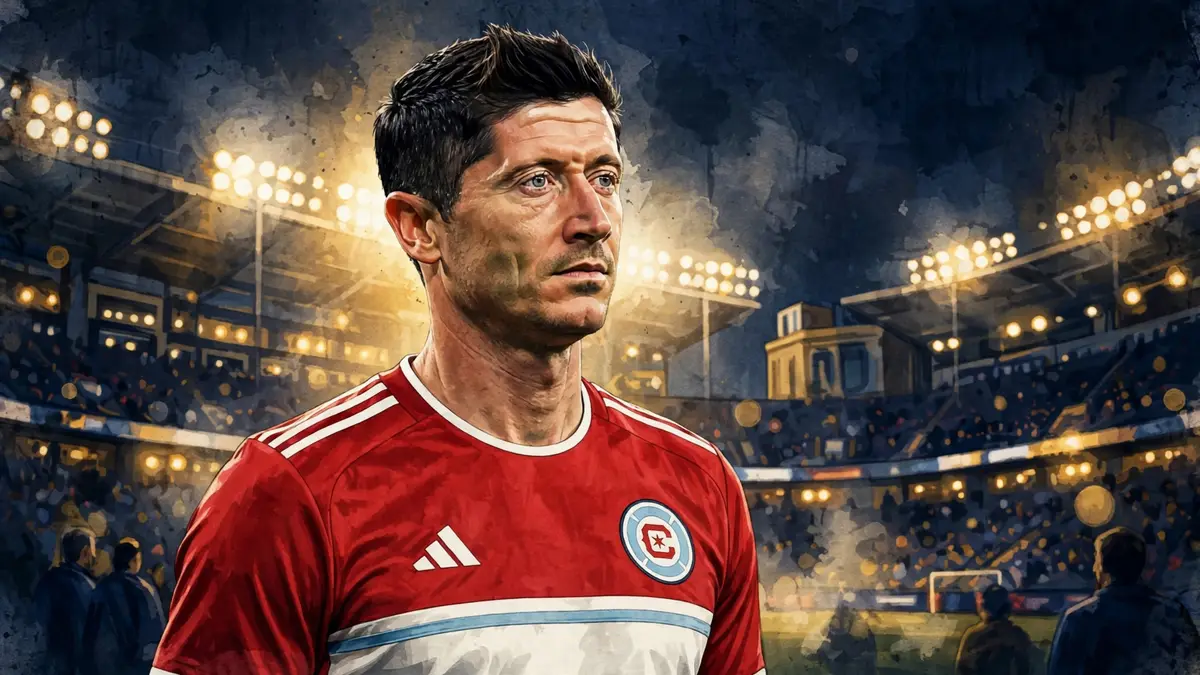
Robert Lewandowski is a Polish professional footballer who plays as a striker for Chicago Fire FC in Major League Soccer and captains the Poland national team. Born on August 21, 1988, in Warsaw, he has scored more than 700 goals for club and country, won 33 trophies, and built an estimated net worth of $85 million to $120 million, anchored at $105 million by Celebrity Net Worth (snapshot November 6, 2026).
His story runs from the lower divisions of Polish football to the very top of the European game — two Bundesliga titles with Borussia Dortmund, a treble and a Champions League crown with Bayern Munich, three La Liga titles with Barcelona — and, in June 2026, a surprise move across the Atlantic to Chicago at the age of 37. This is the full Robert Lewandowski biography: the goals, the records, the money, the family, and the late-career American chapter that nobody saw coming a decade ago.
| Full Name | Robert Lewandowski |
|---|---|
| Date of Birth | August 21, 1988 (age 38) |
| Birthplace | Warsaw, Poland |
| Height | 6 ft 1 in (1.85 m) |
| Position | Striker |
| Current Club | Chicago Fire FC (MLS) — signed June 29, 2026, contract through the 2027–28 season |
| National Team | Poland — captain since 2014; 167 caps, 89 goals (all-time record) |
| Career Goals | 700+ for club and country |
| Estimated Net Worth | $85 million – $120 million (Celebrity Net Worth: $105 million) |
| Primary Income Sources | Club salaries (Dortmund, Bayern, Barcelona, Chicago Fire), Nike and other endorsements, business ventures |
| Key Ventures | RL9 brand, RL9 Coffee, investments across food, fitness and media |
| Spouse | Anna Lewandowska (married June 22, 2013) |
| Children | Two daughters, Klara (born 2017) and Laura (born 2020) |
Table of Contents
- Early Life in Warsaw: A Sporting Family
- Znicz Pruszków and Lech Poznań: The Polish Breakthrough
- Borussia Dortmund: Becoming a Bundesliga Star
- Bayern Munich: The Record-Breaking Years
- FC Barcelona: A New Challenge in Spain
- Chicago Fire: The MLS Chapter Begins
- Poland National Team: Captain and Record Scorer
- The Money: Salary, Endorsements and Business
- Net Worth Growth: Year by Year
- Real Estate, Cars and Lifestyle
- Personal Life: Anna Lewandowska and Family
- Controversies and Setbacks
- Frequently Asked Questions
- Final Thoughts: The Bottom Line
- Sources and Reporting
Early Life in Warsaw: A Sporting Family
Robert Lewandowski was born in Warsaw on August 21, 1988, into a household where sport was not a hobby but a way of life. His father, Krzysztof Lewandowski, was a Polish judo champion who also played football for Hutnik Warsaw, and his mother, Iwona, played volleyball at a high level. His younger sister, Milena, followed their mother into volleyball. The family lived in Leszno, a village just outside Warsaw, where Robert’s first kicks came on local pitches rather than in any academy system.
Sport shaped the boy early, and loss shaped him too. Krzysztof died in 2005, when Robert was 16, and the teenager has spoken since about how that loss pushed him to take football seriously as a profession rather than a pastime. His mother kept the family steady, and Robert’s discipline — the diet, the sleep, the extra training sessions that would later become his trademark — traces back to those years. He was never the flashiest youth player in Poland. Coaches who watched him as a teenager remember a skinny striker with good movement and a clean strike, not a prodigy. What set him apart was work rate: he stayed after training, practised finishing from every angle, and treated his body like a professional long before anyone paid him like one.
His youth path ran through Partyzant Leszno and Varsovia Warsaw, a Warsaw youth club known for developing talent without the resources of the big academies. A spell with Legia Warsaw’s reserve side ended in disappointment — Legia let him go — and that rejection became the first of several setbacks he answered with goals. He dropped down the divisions to rebuild, joining Znicz Pruszków in the Polish third tier in 2006. It was the right call. Regular football, week after week, against grown men, taught him more than another year in a reserve team ever would.
By the time he left Poland, Lewandowski had already built the habits that would carry him through 18 years at the top: a striker’s obsession with positioning, a sprinter’s training routine, and a refusal to let a setback define him. The boy from Leszno was about to become the most famous Polish footballer of all time.
Znicz Pruszków and Lech Poznań: The Polish Breakthrough
At Znicz Pruszków, Lewandowski announced himself the only way a striker can: by scoring, relentlessly. In the 2006–07 season he finished as the third division’s top scorer with 15 goals, helping Znicz win promotion. The following season, in the second tier, he did it again — 21 goals, top scorer once more, and the whole of Polish football started asking who this lanky forward from a small club was. Two golden boots in two seasons, in two different divisions, is the kind of record that forces bigger clubs to pay attention.
Lech Poznań paid attention. In June 2008, Lewandowski signed for the Ekstraklasa side, and the step up tested everything he had learned. He scored on his league debut and finished his first top-flight season with 14 goals. In 2009–10 he went further: 18 league goals, the Ekstraklasa top scorer award, and a league title as Lech won the championship. He added the Polish Cup and the Polish Super Cup, and his performances in the Europa League — including goals against established European sides — put him on the scouting lists of Germany’s biggest clubs.
What scouts saw was a complete centre-forward in the making. Lewandowski could hold the ball up with his back to goal, run the channels, finish with either foot, and score headers despite not being the tallest striker around. He was also unusually disciplined for a 21-year-old, already known for his strict diet and his habit of studying opponents’ defenders before matches. Borussia Dortmund, under a young Jürgen Klopp, saw a player who fit their high-pressing, high-energy system perfectly. In June 2010, Dortmund signed him for a reported fee of around €4.5 million. It was a bargain that would reshape German football.
Borussia Dortmund: Becoming a Bundesliga Star
Lewandowski’s first season at Dortmund was a learning year. He played mostly as a substitute behind Lucas Barrios, scored 8 league goals, and still picked up a Bundesliga winners’ medal as Dortmund won the 2010–11 title. The real breakthrough came in 2011–12, when he became the first-choice striker and scored 22 league goals, adding a hat-trick in the DFB-Pokal final as Dortmund beat Bayern Munich 5–2 to complete a league and cup double. Klopp’s side played fast, fearless football, and Lewandowski — pressing from the front, linking play, finishing clinically — was its spearhead.
The 2012–13 season took him onto the biggest stage of all. Dortmund reached the Champions League final at Wembley, and along the way Lewandowski produced one of the great individual performances in the competition’s history: four goals against Real Madrid in the first leg of the semi-final, the first player ever to score four in a Champions League semi-final. Dortmund lost the final 2–1 to Bayern, but Lewandowski had arrived as a European star. He finished the season with 24 league goals and the reputation of a striker who scored in the biggest games.
His final Dortmund season, 2013–14, was played under a cloud — everyone knew he had agreed to join Bayern Munich on a free transfer the following summer — but he still won the Bundesliga top scorer award with 20 goals and gave Dortmund everything on the pitch. He left Westfalenstadion with two Bundesliga titles, one DFB-Pokal, one German Super Cup, and 103 goals in 187 appearances. The move to Bayern was controversial with Dortmund fans, but it was also the logical next step for a striker who had outgrown his club and wanted to test himself at the very top, year after year.
Bayern Munich: The Record-Breaking Years
If Dortmund made Lewandowski a star, Bayern Munich made him a legend. Over eight seasons in Munich, from 2014 to 2022, he scored 344 goals in 375 appearances — a rate of nearly a goal a game sustained across almost a decade — and won the Bundesliga in every single season he played there. Eight league titles, three DFB-Pokals, and, in 2020, the treble: Bundesliga, DFB-Pokal and Champions League, sealed with a 1–0 win over Paris Saint-Germain in the final in Lisbon.
The numbers from those years still look unreal. On September 22, 2015, he came off the bench at half-time against Wolfsburg with Bayern 1–0 down and scored five goals in nine minutes — the fastest five-goal haul in Bundesliga history, a record that earned him four entries in the Guinness Book of Records in a single night. In the 2019–20 season he scored 34 league goals and 15 in the Champions League as Bayern swept Europe. Then, in 2020–21, he scored 41 Bundesliga goals in a single season, breaking Gerd Müller’s 49-year-old record of 40, set in 1971–72. Müller himself had called the record untouchable; Lewandowski broke it on the final day of the season, with a 90th-minute goal against Augsburg.
He was named The Best FIFA Men’s Player in 2020 and again in 2021, and he won the European Golden Shoe in both 2021 and 2022 as the top scorer across Europe’s leagues. The one prize that eluded him was the Ballon d’Or: the 2020 award was cancelled because of the pandemic, in the year he was the clear favourite, and in 2021 he finished second to Lionel Messi, a result that still sparks debate among fans. Whatever the individual awards said, the Bayern years made Lewandowski one of the most feared strikers on the planet — and one of the best-paid. His final Bayern contract was widely reported to pay around €22 million a year in base salary, plus bonuses, and his 2020 earnings were estimated at roughly $30 million, with most of it coming from salary and the rest from endorsements and bonuses.

His Bayern exit, in the summer of 2022, was handled badly by everyone involved. Lewandowski wanted a new challenge while he was still at his peak; Bayern wanted to keep him. He spoke publicly about wanting to leave, the club’s hierarchy bristled, and the standoff dragged through the summer until Barcelona paid a reported €45 million fee, plus €5 million in add-ons, for a 33-year-old striker. Plenty of people called it a gamble. Lewandowski treated it as the next mountain to climb.
FC Barcelona: A New Challenge in Spain
Barcelona in 2022 was a club rebuilding after the departure of Messi and years of financial trouble. Lewandowski arrived as the statement signing — a proven, world-class number nine to lead a young team. He delivered immediately. In his first season he won La Liga and the Pichichi Trophy as the league’s top scorer with 23 goals, becoming the first Barcelona player to win the award since Messi. He scored a hat-trick against Viktoria Plzeň on his Champions League debut for the club and settled quickly into life in Catalonia, learning Spanish and embracing the club’s culture.
Over four seasons at Camp Nou, Lewandowski scored 120 goals in 193 appearances and won seven trophies: three La Liga titles, one Copa del Rey and three Spanish Super Cups. He also became one of only three players in history to score 100 goals for three different clubs, a measure of his longevity at the highest level. His game adapted with age: less sprinting in behind, more clever movement, more involvement in build-up play, and the same ruthless finishing inside the box. Younger team-mates leaned on his experience, and his professionalism — the diet, the recovery routines, the preparation — set the standard in the dressing room.
The Barcelona years were not without friction. As he moved deeper into his thirties, questions about his pace and his place in a team built around younger attackers grew louder. His contract was due to expire at the end of the 2025–26 season, and by the spring of 2026 it was clear the club would not offer him the extension he wanted. In May 2026 he confirmed he would leave when his contract ran out, closing the chapter with his head high: 120 goals, three league titles, and a reputation intact. What came next surprised almost everyone — including, by some accounts, Lewandowski himself.
Chicago Fire: The MLS Chapter Begins
On June 29, 2026, Chicago Fire FC announced the acquisition of Robert Lewandowski as a Designated Player, on a contract running through the 2027–28 MLS season. The 37-year-old arrived as a free agent after his Barcelona contract expired, becoming the eighth Poland-born player in the club’s history and the biggest name ever to wear the Fire shirt. Head coach and director of football Gregg Berhalter later revealed the club had been working on the deal since January 2025 — a year and a half of quiet pursuit before the Pole decided his European chapter was over.
The move followed a path first cut by David Beckham, whose arrival in MLS in 2007 proved that a global superstar could transform a club and a league. Chicago’s bet is the same one: that a striker with more than 700 career goals for club and country raises standards on the pitch, sells tickets, and lifts the profile of a club preparing to move into a new stadium, McDonald’s Park, scheduled to open in 2028. Chicago were third in the Eastern Conference at the 2026 World Cup break, building on a 2025 season in which they scored 68 goals, the second-highest total in MLS, and finally snapped a seven-year playoff drought.
Lewandowski’s first weeks in America were quiet by his standards. He made his debut on July 22, 2026, in a 3–2 away defeat against Inter Miami, and went goalless in his first two outings. Then, on August 1, in front of his new home crowd at Soldier Field, he scored both goals in a 2–1 win over Charlotte FC — the first a strike from outside the box in the 20th minute, the second in the 68th — and was named MLS Player of the Matchday. It was the announcement Chicago had been waiting for. By early November 2026 he had 9 goals in 19 MLS appearances, leading the line alongside Belgian forward Hugo Cuypers for a club chasing the upper reaches of the Eastern Conference.
The Chicago move also changed the maths of his career. His MLS salary has not been disclosed — Chicago Fire, like most MLS clubs, does not publish Designated Player pay in detail — but the deal’s value to him goes beyond wages. America offers a new commercial market, a softer physical schedule than La Liga, and a stage on which to close out a career that has already lasted 18 professional seasons. For a player who has always planned his career in chapters, Chicago is the final one, written on his own terms.

Poland National Team: Captain and Record Scorer
Lewandowski made his Poland debut in 2008 and has been the face of Polish football ever since. He has worn the captain’s armband since 2014, and his numbers for his country are unmatched: 167 caps and 89 goals as of June 2026, both national records, making him Poland’s all-time leading scorer by a wide margin. He has led Poland at two World Cups, in 2018 and 2022, and four European Championships, in 2012, 2016, 2020 and 2024 — the golden generation of Polish football, built around one striker.
The high point came at Euro 2016 in France, where Poland reached the quarter-finals for the first time, losing to eventual champions Portugal on penalties. Lewandowski scored the opening goal of the tournament’s knockout stage and, though his own scoring at that tournament was modest, his leadership carried a team that had never before gone so far. At the 2022 World Cup in Qatar, he scored his first-ever World Cup goal, against Saudi Arabia, and helped Poland reach the round of 16 for the first time since 1986.
The captaincy itself has not been a smooth ride. In June 2025, Lewandowski briefly stepped away from the national team after a dispute with then-coach Michał Probierz, who had removed him as captain. The row dominated Polish sports media for weeks before Lewandowski returned later in 2025 and was reinstated as captain. The episode showed a different side of him: a player willing to walk away from his country on principle, and a federation that quickly realised it needed him more than he needed it. With Poland, his legacy is already secure — no Polish player has scored more, played more, or carried the team further, and his 700-goal club-and-country total includes the 89 that matter most to the fans back home.
The Money: Salary, Endorsements and Business
Lewandowski’s fortune was built the old-fashioned way for a footballer: enormous salaries, sustained over a very long time, at the richest clubs in the world. Public salary database Capology puts his gross career salary at around $266 million before bonuses — and that figure excludes his undisclosed Chicago Fire pay. His final Barcelona season was estimated at roughly €20.8 million in gross base wages, around $24.2 million a year, with some reports suggesting the later years of that deal could rise toward €30 million with incentives. At Bayern, his final contract was widely reported at about €22 million a year in base salary plus €3 million in achievable bonuses. Even his Dortmund years paid well: around €4.6 million in his final season there, a fortune by Polish standards in 2014.
The full money picture is laid out in detail in our sister site’s breakdown of Robert Lewandowski’s net worth, which tracks the same figures from the salary databases. What the salary numbers miss is the endorsement income. Lewandowski’s commercial portfolio has always been smaller than those of Cristiano Ronaldo or Messi — he is a quieter, less social-media-driven star — but it is still substantial. Nike has been his boot sponsor for most of his career, and his deals have included Gillette, Huawei and, more recently, Chinese carmaker Chery Automobile. Estimates put his endorsement income at more than $10 million a year at its peak, and in 2020 his total earnings were estimated at about $30 million, with roughly $24 million from salary and the rest from endorsements and performance bonuses.
Off the pitch, he has built a business portfolio that Forbes Poland has profiled in depth, covering more than 30 joint projects. The best-known is his RL9 brand, which spans clothing, coffee (RL9 Coffee) and other consumer goods, and he has invested across food, fitness and media ventures in Poland. His wife Anna’s company, Foods by Ann, is a separate success in its own right, and the couple’s business interests overlap in the health and nutrition space. Some analysts put the combined Lewandowski family wealth above $250 million, though that figure mixes Robert’s fortune with Anna’s business and should be treated with care — it is not his personal net worth.
What makes his financial story different from many footballers is the discipline behind it. Lewandowski has never been a tabloid figure for reckless spending. His money went into property, into businesses he understood, and into the training and recovery infrastructure that extended his career into his late thirties — which, in turn, kept the salaries coming. The Chicago Fire deal is the last big payday of that career, and its terms are private, but the pattern of his life suggests the money will be managed the same way the rest of it was: carefully.
| Income Stream | Detail |
|---|---|
| Club Salaries (career) | ~$266 million gross, per Capology — before bonuses and Chicago Fire pay |
| Barcelona (final season) | ~€20.8 million gross base wages (~$24.2 million a year) |
| Bayern Munich (final years) | ~€22 million a year base salary, plus ~€3 million in bonuses |
| Peak Annual Earnings | ~$30 million in 2020 (salary + endorsements + bonuses) |
| Endorsements | Nike, Gillette, Huawei, Chery Automobile — $10 million+ a year at peak |
| Business Ventures | RL9 brand, RL9 Coffee, 30+ projects profiled by Forbes Poland |
| Chicago Fire (2026– ) | Designated Player deal through 2027–28; salary undisclosed |
Net Worth Growth: Year by Year
Published estimates of Lewandowski’s net worth disagree with each other — which is normal for a private individual whose assets, taxes and debts are not public. Celebrity Net Worth puts the figure at $105 million (snapshot November 6, 2026). A detailed July 2026 analysis by SureBets, built from Capology’s salary records and Forbes Poland’s reporting on his businesses, gives a range of $85 million to $120 million. Other outlets go higher — WhoEarns claims $200 million, and SurpriseSports puts it at $85 million — but the $200 million figure sits well above the salary evidence and looks like an outlier, so we anchor on the $85 million to $120 million range with Celebrity Net Worth’s $105 million at its centre.
The growth of that fortune tracks his career almost exactly. At Lech Poznań, he was a well-paid young player in a modest league. At Dortmund, his salary rose sharply with each new contract, but the real jump came at Bayern, where eight years of €15 million-plus salaries, Champions League bonuses and a growing endorsement portfolio turned a rich footballer into a wealthy man. Barcelona’s €20 million-plus annual wages kept the total climbing through his mid-thirties, and the business ventures — RL9 and the rest — added a second engine that will keep running after he stops playing.
| Period | Career Stage |
|---|---|
| 2006–2010 | Znicz Pruszków and Lech Poznań — modest Polish-league wages, first professional money |
| 2010–2014 | Borussia Dortmund — Bundesliga salaries rising to ~€4.6 million a year; first major trophies |
| 2014–2022 | Bayern Munich — €15–22 million a year; eight straight league titles; fortune built here |
| 2022–2026 | FC Barcelona — ~€20.8 million a year base; three La Liga titles; business portfolio grows |
| 2026– | Chicago Fire — Designated Player deal, undisclosed terms; MLS commercial upside |
One honest note: no published net worth figure for Lewandowski is audited. The range we give — $85 million to $120 million — is an estimate built from public salary data and documented business activity, and the true number could sit outside it in either direction. What is not in doubt is the scale: two decades at the top of world football, at the richest clubs, with disciplined spending, produces a fortune in the nine-figure range. Compared with peers, he sits well below Ronaldo and Messi, whose commercial empires dwarf his, but comfortably alongside the richest strikers of his generation — a group that includes Erling Haaland, the Norwegian who followed him as Dortmund’s number nine and now chases his scoring records, and Mohamed Salah, whose Liverpool career has run on a parallel track of goals and trophies.
Real Estate, Cars and Lifestyle
Lewandowski’s lifestyle is famously controlled. He and Anna own homes in Warsaw and Munich, and the family kept a base in Barcelona during his four years in Spain. The Munich property, bought during his Bayern years, is their long-term home, and the Warsaw base keeps them close to family and to their Polish business interests. Neither home has been the subject of the kind of lavish property reporting that follows some footballers, which fits a couple who keep their private life private and their spending out of the papers.
His car collection has drawn more attention, mostly because sponsors kept him in notable machines: he has been seen in a range of high-end cars over the years, including models from the premium German brands and, during his Barcelona years, vehicles tied to club sponsors. But cars are not the story of his spending. The story is the gym, the kitchen and the recovery room. Lewandowski’s diet — no fried food, no sugar, a strict regime built with Anna, a trained nutritionist — is the stuff of legend among team-mates, and he has invested heavily in his own physical preparation, from personal chefs to sleep optimisation. That investment paid for itself many times over: it is a large part of why he was still scoring at the highest level at 37, when most strikers have retired.
He gives back, too, though quietly. Lewandowski has supported children’s hospitals and charities in Poland throughout his career, and during the pandemic he and Anna donated €1 million to the fight against coronavirus. He has also backed youth football projects in Poland, and his foundation work tends to stay out of the headlines — donations announced once, then left alone. It is a pattern: the public Lewandowski is the goalscorer; the private one is a family man who treats wealth as a tool, not a display.
Personal Life: Anna Lewandowska and Family
Robert Lewandowski married Anna Stachurska on June 22, 2013, in Serock, Poland. Anna is a former karate champion — she won medals at world and European level — and has built her own career as a nutritionist, fitness trainer and entrepreneur, founding the Foods by Ann brand and a chain of healthy-eating ventures. She is, by any measure, a public figure in Poland in her own right, and the couple are one of the country’s most famous partnerships: the striker and the nutritionist, the goals and the diet that fuelled them.
They have two daughters: Klara, born in 2017, and Laura, born in 2020. Family life is deliberately kept out of the spotlight — the girls appear in public rarely, and Lewandowski’s social media, while popular, is mostly football and training rather than family life. Anna has spoken about the discipline of their household: early mornings, planned meals, training schedules that run like clockwork even on holiday. It is a partnership in the full sense, and those close to the couple say Anna’s expertise in nutrition and recovery has added years to Robert’s career.
Outside football, Lewandowski’s interests are narrow and consistent: family, fitness, business, and Poland. He speaks Polish, German, English and Spanish, and he has talked about staying involved in football after retirement — coaching is a possibility, though he has never committed to it publicly. For now, the focus is Chicago, and the family has settled into life in the United States for the final chapter of his playing days.
Controversies and Setbacks
For a player of his profile, Lewandowski’s career has been remarkably free of scandal. The controversies that exist are professional, not personal. The biggest was his departure from Borussia Dortmund to Bayern Munich in 2014. Joining a direct rival on a free transfer angered Dortmund supporters, and the move was debated in Germany for years — though it is worth noting that Bayern had a habit of signing Dortmund’s best players in that era, and Lewandowski was far from the only one. He has always said the move was about sporting ambition, and his record at Bayern makes the argument for him.
The second was the 2022 exit from Bayern. His public statements that he wanted to leave, and that his “story at Bayern was over”, strained relations with the club’s board, and the summer-long standoff played out in the press. Bayern eventually sold him to Barcelona for a reported €45 million, and both sides moved on — he left as the club’s second-highest scorer of all time, behind only Gerd Müller.
The third was the national-team row of 2025, when coach Michał Probierz stripped him of the captaincy and Lewandowski briefly stepped away from Poland duty. It was the most emotional episode of his career, and it ended with his return and reinstatement as captain later the same year. Beyond those three episodes, the record is clean: no legal trouble, no doping issues, no tabloid scandals. The setbacks he faced were sporting — the lost Champions League final in 2013, the cancelled Ballon d’Or in 2020, the quarter-final defeat at Euro 2016 — and he answered each of them the same way, with goals.
Frequently Asked Questions
How old is Robert Lewandowski in 2026?
Robert Lewandowski was born on August 21, 1988, which makes him 38 years old in November 2026. He was 37 when he signed for Chicago Fire FC in June 2026, and he turned 38 during his first MLS season.
What team does Robert Lewandowski play for now?
As of November 2026, Robert Lewandowski plays for Chicago Fire FC in Major League Soccer. He signed as a Designated Player on June 29, 2026, after leaving FC Barcelona as a free agent, on a contract running through the 2027–28 MLS season. He wears the number 9 shirt.
How many goals has Robert Lewandowski scored in his career?
More than 700 goals for club and country combined, according to Chicago Fire FC’s announcement of his signing. That total covers Znicz Pruszków, Lech Poznań, Borussia Dortmund, Bayern Munich, FC Barcelona, Chicago Fire and the Poland national team. He scored 344 goals in 375 games for Bayern and 120 in 193 for Barcelona.
What is Robert Lewandowski’s net worth in 2026?
His estimated net worth is $85 million to $120 million, anchored at $105 million by Celebrity Net Worth (snapshot November 6, 2026). The range reflects his gross career salary of around $266 million per Capology, plus endorsements and business ventures, minus taxes, fees and spending. No audited figure is public.
How much did Robert Lewandowski earn at Barcelona?
His final Barcelona season was estimated at about €20.8 million in gross base wages, roughly $24.2 million a year, per Capology, with some reports suggesting later contract years could rise toward €30 million with incentives. His total earnings in 2020, his peak year at Bayern, were estimated at around $30 million including endorsements and bonuses.
Who is Robert Lewandowski’s wife?
Robert Lewandowski’s wife is Anna Lewandowska, a former karate champion, nutritionist and entrepreneur who founded the Foods by Ann brand. They married on June 22, 2013, and have two daughters, Klara (born 2017) and Laura (born 2020).
How many goals has Lewandowski scored for Poland?
He has scored 89 goals in 167 appearances for Poland, both national records. He has captained the team since 2014 and is Poland’s all-time leading scorer by a wide margin, having played at two World Cups (2018, 2022) and four European Championships (2012, 2016, 2020, 2024).
Did Robert Lewandowski ever win the Ballon d’Or?
No. He was the clear favourite in 2020, the year he won the treble with Bayern, but the award was cancelled because of the pandemic. In 2021 he finished second to Lionel Messi. He was named The Best FIFA Men’s Player in both 2020 and 2021, and won the European Golden Shoe in 2021 and 2022.
Final Thoughts: The Bottom Line
Robert Lewandowski’s biography is the story of a player who was never the most talented teenager in the room and became one of the greatest strikers in football history anyway — through discipline, durability and an almost unreasonable consistency in front of goal. From the Polish third division to Dortmund, from Bayern’s record books to Barcelona’s league titles, and now to Chicago, every chapter of his career has been earned. The numbers speak for themselves: 700-plus goals, 33 trophies, 167 caps and 89 goals for Poland, and a fortune estimated at $85 million to $120 million, built on two decades of top-level salaries and a business portfolio that will outlast his playing days.
The Chicago Fire chapter is the last one, and it is being written on his terms: a new league, a new city, a new stadium on the horizon, and a striker who, at 38, is still scoring. Whatever happens in MLS, his place is already secure — alongside the great centre-forwards of the modern game, and alone at the top of Polish football history. For more player stories, explore our Biography section.
Sources and Reporting
How we estimated: Net worth figures are estimates, not audited accounts. We anchor on Celebrity Net Worth ($105 million, snapshot November 6, 2026) and the SureBets July 2026 range of $85 million to $120 million, which is built from Capology’s tracked career salary of around $266 million gross and Forbes Poland’s reporting on his business interests. Where sources disagree — notably the $200 million figure published by some outlets — we say so and favour the range supported by the salary evidence. Salaries are gross figures before tax, agent fees and spending. Chicago Fire has not disclosed his MLS salary, so it is excluded from the calculation.
Career facts, honours and statistics were checked against the official announcements and records of Chicago Fire FC, Major League Soccer, UEFA and Wikipedia’s career record, with net worth reporting from Celebrity Net Worth and Forbes. Figures are as reported by those sources as of November 14, 2026; private finances may differ from these public estimates.