By Celebamerica Editorial Staff | Last updated: November 14, 2026
RuPaul Andre Charles — the drag queen, television host, singer, producer and author the world knows simply as RuPaul — is worth an estimated 60 million to 65 million dollars in 2026. Celebrity Net Worth puts the figure at 60 million dollars in a profile updated June 26, 2026, and Parade agrees at 60 million in its September 14, 2026 update. A few outlets go higher, up to 65 million, so the honest range is 60 to 65 million, anchored at 60 million by the two most careful sources.
That fortune was not built on one hit. RuPaul, born November 17, 1960, in San Diego, California, spent three decades turning drag from a nightclub act into a global television franchise. He hosts, judges and executive-produces RuPaul’s Drag Race, a show that began as a nine-episode curiosity on Logo TV in 2009 and grew into one of the most awarded reality series in television history. Along the way he collected 14 Primetime Emmy Awards — more than any other Black artist in Emmy history — a Tony Award as a Broadway producer, a star on the Hollywood Walk of Fame, and a place on the Time 100 list. This biography walks through the whole story: the San Diego childhood, the Atlanta club years, the New York grind, the “Supermodel” breakthrough, the Drag Race empire, the money behind it, the Wyoming ranch, and the husband he has been with since 1994.
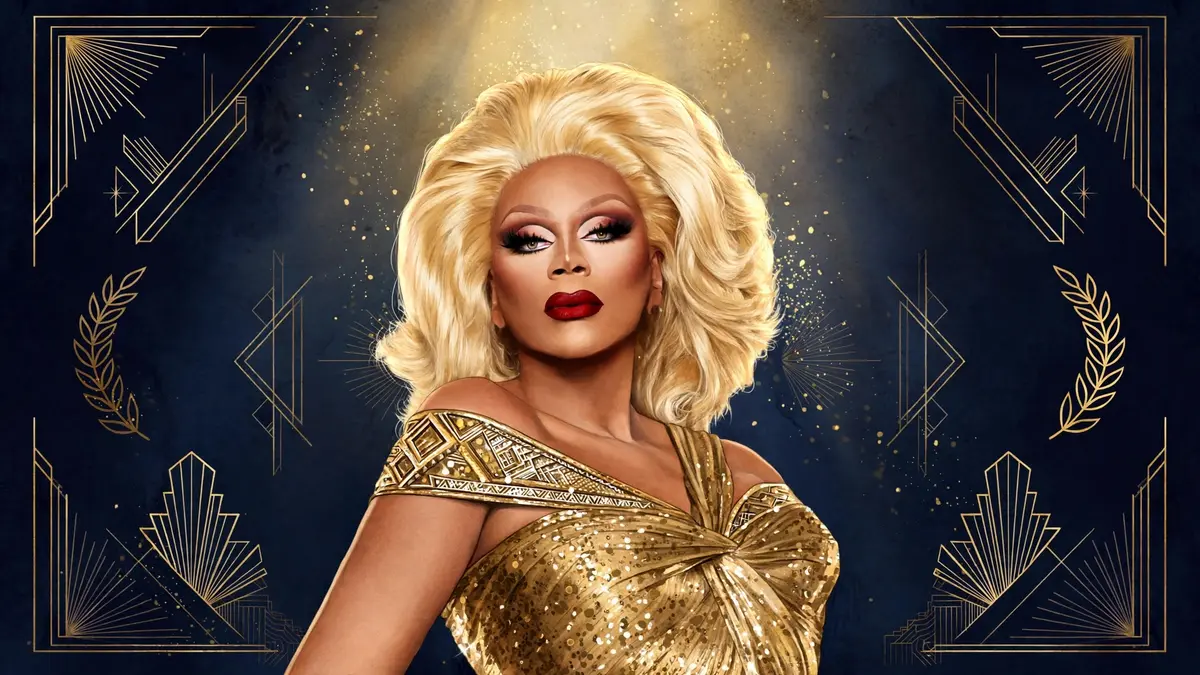
RuPaul Quick Facts
| Full Name | RuPaul Andre Charles |
|---|---|
| Date of Birth | November 17, 1960 |
| Birthplace | San Diego, California, United States |
| Age in 2026 | 65 (turns 66 on November 17, 2026) |
| Height | 6 feet 4 inches (193 cm) |
| Estimated Net Worth | 60 million to 65 million dollars — anchored at 60 million by Celebrity Net Worth (updated June 26, 2026) and Parade (September 14, 2026) |
| Primary Income Sources | RuPaul’s Drag Race hosting and executive-producer fees, franchise and international spin-offs, music streaming and catalogue, books, touring and live shows, endorsements |
| Key Works | RuPaul’s Drag Race (2009–present), “Supermodel (You Better Work)” (1993), The RuPaul Show (1996–1998), AJ and the Queen (2020), The House of Hidden Meanings (2024 memoir) |
| Awards | 14 Primetime Emmy Awards, Tony Award for Best Musical (A Strange Loop, 2022), two Billboard Music Awards, five GLAAD Media Awards, Guinness World Records title |
| Spouse | Georges LeBar (together since 1994, married January 2017) |
| Residences | Beverly Hills mansion (bought 2019 for 13.7 million dollars), 60,000-acre ranch in Wyoming |
Table of Contents
- Early Life in San Diego: A Childhood Split in Two
- Atlanta: The Club Kid Who Found Drag
- New York: The Grind Before the Fame
- Supermodel: The 1993 Breakthrough That Changed Everything
- RuPaul’s Drag Race: From Logo TV to a Global Empire
- The Money: How RuPaul Built a 60 Million Dollar Fortune
- Net Worth Timeline: From Paycheck to Paycheck to 60 Million
- Real Estate and Assets: The Beverly Hills Mansion and the Wyoming Ranch
- Personal Life: Georges LeBar and a 30-Year Partnership
- Books and the 2024 Memoir
- Awards and Records: 14 Emmys, a Tony and a Walk of Fame Star
- Controversies: The Ranch, the Fracking Interview and the Apology
- Frequently Asked Questions
- Bottom Line
- Sources and Reporting
Early Life in San Diego: A Childhood Split in Two
RuPaul Andre Charles was born on November 17, 1960, in San Diego, California, the third of four children of Ernestine “Toni” Charles and Irving Charles. His mother was from Louisiana; his father worked as a contractor. The name RuPaul came from his mother — “Ru” from roux, the base of gumbo, a nod to her Louisiana roots — and it stuck so completely that most of the world has never known him by anything else.
The household was tense. His parents’ marriage broke down when RuPaul was seven, and the split shaped everything that followed. He has described his childhood home as a place of constant friction, and his 2024 memoir, The House of Hidden Meanings, returns to those years in detail — a boy watching his parents’ marriage fall apart and learning, early, to perform his way out of discomfort. After the divorce he lived mostly with his mother and his three sisters, in a house where money was tight and the television was always on.
Television was his first education in show business. He watched the variety shows and the glamour of old Hollywood and absorbed them whole. He was a shy, watchful kid who loved to dress up, and by his early teens he was already experimenting with clothes and makeup in a city — and an era — where a Black boy doing drag was not something the neighbours applauded. What kept him going was a stubborn certainty, the one he repeats in interviews to this day: he knew he was meant to be famous. It was not arrogance so much as a survival plan. Fame, in his telling, was the exit route from a home that felt too small for him.
School never held him. He was bright but restless, and the classroom could not compete with the stage he was building in his head. At fifteen he left San Diego with his older sister Renetta and moved to Atlanta, Georgia, to study performing arts at the Northside School of Performing Arts. It was a bold move for a teenager, and it put him in exactly the right city at exactly the right time — Atlanta in the mid-1970s was cheap, strange, creative and full of misfits, and RuPaul fit right in.
Atlanta: The Club Kid Who Found Drag
Atlanta gave RuPaul his apprenticeship. He dropped out of performing-arts school and threw himself into the city’s underground scene — punk clubs, drag bars, art-school parties, and the kind of late-night rooms where a kid with a wig and a sense of humour could become somebody. He performed in bands, including the new-wave group Wee Wee Pole, and worked the club circuit as a go-go dancer and a drag performer, learning the craft the hard way: in front of live crowds, night after night, with no safety net.
The money in those years was close to nothing. He has talked openly about living hand to mouth, crashing on couches, and taking whatever work paid — including, at one point, work as a male stripper and sex work, which he has discussed frankly in interviews and in his memoir rather than hiding. That honesty matters to the story, because the later fortune was not inherited or lucky. It was assembled, dollar by dollar, from a performer who treated every gig as a rung.
Atlanta also gave him his first taste of the screen. He appeared in the B-52’s video for “Love Shack” in 1989, a small role that put him in front of a national audience for the first time, and he made a low-budget film, Star Booty, that became a cult curio. He was building a reputation in the underground, but the underground does not pay rent. By 1987 he had decided the ceiling in Atlanta was too low, and he moved to New York City — the place where drag, fashion, music and television collided, and where a performer with his range could finally be seen.
New York: The Grind Before the Fame
New York in the late 1980s was electric and brutal in equal measure. RuPaul landed in the middle of the club-kid scene — the Pyramid Club, the Palladium, Wigstock, the downtown world of Leigh Bowery-inspired excess — and became one of its best-known faces. He was tall, funny, fearless and impossible to miss, and he worked constantly: hosting club nights, performing in drag revues, appearing in independent films and music videos, and hustling for any paying gig that kept him in the city.
The work was relentless and the pay was thin. He has described years of living on very little, sleeping on floors and borrowing outfits, while building the persona that would eventually make him famous. What the New York years gave him was range. He was not only a drag queen — he was a singer, a comic, a host, an actor, a personality. That range is the whole business model of the later fortune: RuPaul never depended on a single paycheque, because he had learned to earn from five directions at once.
The turning point came at the start of the 1990s, when the downtown scene began to leak into the mainstream. Madonna’s “Vogue” had made ballroom culture fashionable; club kids were appearing in magazines; and the music industry was looking for a drag star who could cross over. RuPaul, with a voice, a look and a decade of stagecraft behind him, was the obvious candidate. He signed a recording deal, and in 1993 he released the single that changed his life.
Supermodel: The 1993 Breakthrough That Changed Everything
“Supermodel (You Better Work)” arrived in 1993 on RuPaul’s debut album, Supermodel of the World, and it did what no drag record had ever done: it became a genuine pop hit. The song climbed the Billboard Hot 100, its video played in heavy rotation on MTV, and its hook — “you better work” — entered the language. RuPaul was suddenly on television chat shows, in magazines, and on the cover of the culture itself. He was 32 years old, and he had been working towards that moment for half his life.
The breakthrough brought something the club years never had: corporate money. In 1994 he became the first drag queen to front a major cosmetics campaign, signing with MAC as the face of its Viva Glam lipstick, with proceeds going to the MAC AIDS Fund. The deal was historic twice over — it made RuPaul the first openly gay man and the first drag performer to front a mainstream beauty campaign — and it paid. It also put him in the public eye as something new: not a novelty act, but a brand.
The 1990s kept the cheques coming, if not always the hits. He hosted The RuPaul Show, a talk show on VH1 that ran from 1996 to 1998, interviewing guests from Cher to Diana Ross in full drag — the first time a drag queen had hosted a mainstream American talk show. He released more albums, appeared in films like Crooklyn (1994), To Wong Foo, Thanks for Everything! Julie Newmar (1995) and But I’m a Cheerleader (1999), and became a fixture of the celebrity circuit. But the pop-star moment faded, as pop moments do, and by the early 2000s the big paydays had thinned. RuPaul was famous, respected and solvent — but the fortune that would define him was still a decade away, and it would come from a place nobody in television expected: a low-budget reality competition about drag queens.
RuPaul’s Drag Race: From Logo TV to a Global Empire
RuPaul’s Drag Race premiered on February 2, 2009, on Logo TV, a small LGBTQ cable channel, as a nine-episode competition with a modest budget and no expectation of mainstream success. RuPaul hosted, judged and executive-produced it alongside the production company World of Wonder, founded by Fenton Bailey and Randy Barbato. The format was simple and ruthless: a group of drag queens competed in weekly challenges — sewing, acting, comedy, lip-syncing — and one was eliminated each episode until a winner was crowned “America’s Next Drag Superstar.”
Nobody in the television business predicted what happened next. The show’s first seasons built a devoted audience through word of mouth and, later, streaming. Its humour, its heart and its unapologetic celebration of queer artistry made it a cult hit, and the cult kept growing. In 2017, for its ninth season, the show moved to VH1, a much bigger stage, and the audience doubled. In 2023, for its fifteenth season, it moved again, to MTV. By then it was no longer a niche show: it was a franchise, with spin-offs in the United States (RuPaul’s Drag Race All Stars, RuPaul’s Secret Celebrity Drag Race), the United Kingdom, Canada, Australia, France, Spain, Brazil, Mexico, Germany, Italy, Sweden, the Netherlands, Belgium, Thailand and the Philippines, plus the long-running companion show Untucked.

The economics of the franchise are what built the fortune. RuPaul does not merely host the show — he executive-produces it, which means a producer’s fee on top of a host’s fee, plus a stake in a format that has been licensed to more than a dozen countries. His exact per-episode pay has never been publicly disclosed, and any outlet that prints a precise salary figure for him is guessing. What is public is the scale: seventeen seasons of the American flagship, multiple spin-offs, international versions, live touring shows, a merchandise line, and the DragCon conventions that World of Wonder runs in Los Angeles and London. Every one of those revenue lines flows, in part, through the man whose name is on the show.
The show also made RuPaul the most decorated host in reality television. He won the Emmy for Outstanding Host for a Reality or Competition Program eight years in a row, from 2016 to 2024 — a run that finally ended at the 77th Primetime Emmy Awards in September 2025, when Alan Cumming of The Traitors took the prize. Even so, RuPaul’s total of 14 Primetime Emmy Awards stands as the most ever won by a Black artist, and Guinness World Records lists him as the drag performer with the most Emmy wins. The streak mattered beyond the trophies: each win raised his fee, his leverage and the value of the format, and each season brought a new generation of queens — and a new generation of viewers — into the franchise.
Like the late-night hosts who built their own empires, RuPaul understood that a show is only half the business. Jimmy Kimmel’s biography shows a similar arc — a host who turned a nightly desk into a production company and a brand — and Stephen Colbert’s biography tells the same story from the other side of late night. RuPaul’s version was louder, sparklier and entirely his own: he did not inherit a format, he invented one, and he owns a piece of everything it became.
The Money: How RuPaul Built a 60 Million Dollar Fortune
Celebrity Net Worth puts RuPaul’s net worth at 60 million dollars, in a profile updated June 26, 2026. Parade, in a September 14, 2026 update, agrees at 60 million, citing Celebrity Net Worth. That agreement between the two most careful sources is why 60 million is the anchor figure for this biography.
Not every outlet agrees. Scintillating Stars, updated in September 2026, puts the figure at 65 million, citing “Forbes estimates” — but Forbes has never published a RuPaul net worth list, so that attribution should be read with care. TheStreet, in a January 2025 update, reported the common 60 million figure. The honest range, then, is 60 million to 65 million dollars, anchored at 60 million. Anyone who tells you an exact number beyond that is inventing precision that does not exist: RuPaul’s contracts are private, his production-company economics are not public, and the true figure lives somewhere inside that range.
The fortune breaks down into five income streams, and the order matters — Drag Race is the engine, and everything else is a wheel it turns.
1. Drag Race hosting and producing. This is the largest single stream. RuPaul is paid as host and as executive producer of the American flagship, and he holds a producer’s interest in the format that World of Wonder licenses around the world. The show has run for seventeen seasons plus All Stars and international editions, which means the fees have compounded for a decade and a half. His salary has never been published, and this biography does not invent one.
2. Music. RuPaul has released fifteen studio albums, and the catalogue earns steadily. His songs are the backbone of the show — every lip-sync, every runway walk, every finale — which means the music is marketed to a built-in audience of millions every single week. Parade reported in September 2026 that he had racked up more than 846 million streams on Spotify alone as of October 2025. Streaming does not pay like record sales did in 1993, but 846 million streams is a serious, recurring income line, and the catalogue also earns from sync licences, compilations and the show itself.
3. Books. Four books, including a number-one New York Times bestseller. Lettin’ It All Hang Out (1995) was the first drag memoir to reach a mainstream audience; Workin’ It! (2010) and GuRu (2018) followed; and The House of Hidden Meanings (HarperCollins, March 2024) topped the bestseller list. Book advances and royalties are a smaller stream than television, but a bestseller from a major publisher is real money, and the memoir doubled as marketing for everything else.
4. Live shows, touring and conventions. Drag Race’s live tours, the Werq the World tours, and the DragCon conventions in Los Angeles and London turn the television audience into ticket buyers. RuPaul headlines and hosts, and the touring business has been a steady earner since the show’s audience exploded in the late 2010s.
5. Endorsements and acting. The MAC Viva Glam deal in 1994 was the first, and the most symbolic, but the endorsement stream never stopped — beauty, fashion and lifestyle brands pay for access to an audience that trusts RuPaul’s taste. Acting roles, from AJ and the Queen on Netflix in 2020 to voice work on The Tiny Chef Show, add fees and keep the brand in front of audiences that do not watch Drag Race.
How the range works: net worth figures for public personalities are estimates built from public records — property purchases, reported fees, streaming data, book sales and business filings. Private debts, taxes, business expenses and the exact terms of production deals are not public, so the true figure can sit anywhere inside the published range. This biography anchors at 60 million dollars because Celebrity Net Worth and Parade, the two sources that show their working, agree on it.
The scale becomes clearer next to other television hosts. James Corden’s net worth was built on the same model — a late-night hosting fee plus producing and acting income — and the comparison shows how much of RuPaul’s fortune depends on ownership rather than salary alone: Corden was paid to host someone else’s show, while RuPaul executive-produces his own. That ownership is the difference between a comfortable career and a 60 million dollar one.
Net Worth Timeline: From Paycheck to Paycheck to 60 Million
| Period | What happened |
|---|---|
| 1960–1975 | Born in San Diego; parents divorce when he is seven; moves to Atlanta at fifteen to study performing arts. |
| 1975–1987 | Atlanta club years — bands, drag revues, go-go dancing, couch-surfing. Income close to zero; reputation growing in the underground. |
| 1987–1992 | New York club scene — the Pyramid Club, Wigstock, independent film and video work. Working constantly, still living hand to mouth. |
| 1993–1994 | “Supermodel (You Better Work)” becomes a pop hit; debut album Supermodel of the World; MAC Viva Glam deal in 1994 — the first major cosmetics campaign fronted by a drag queen. |
| 1996–1998 | Hosts The RuPaul Show on VH1, the first mainstream American talk show hosted by a drag queen. |
| 2009 | RuPaul’s Drag Race premieres on Logo TV. The franchise — and the fortune — begins. |
| 2016 | First Emmy win for Outstanding Host; the start of an eight-year winning streak. The show moves to VH1 in 2017 and the audience doubles. |
| 2018 | Star on the Hollywood Walk of Fame — the first drag queen to receive one. GuRu published. |
| 2019 | Buys the Beverly Hills mansion for 13.7 million dollars; inducted into the California Hall of Fame. |
| 2022 | Tony Award for Best Musical as a producer of A Strange Loop. |
| 2023–2024 | Drag Race moves to MTV; The House of Hidden Meanings published March 2024 and becomes a number-one New York Times bestseller; 14th Emmy win, January 2024. |
| 2025–2026 | Tenth Emmy nomination for hosting, July 2025; the eight-year hosting streak ends at the September 2025 ceremony. Net worth estimated at 60 to 65 million dollars (Celebrity Net Worth, June 2026; Parade, September 2026). |
Real Estate and Assets: The Beverly Hills Mansion and the Wyoming Ranch
RuPaul’s two best-known assets could hardly be more different, and together they explain a lot about how he handles money: one is a showpiece, the other is a working piece of land.
The showpiece is the Beverly Hills mansion he bought in October 2019 for 13.7 million dollars, according to Celebrity Net Worth and Parade. The house is 10,300 square feet, and RuPaul later gave Architectural Digest a tour of it — a rare look inside a home that mixes old-Hollywood glamour with the maximalist taste you would expect from the Queen of Drag. It is the kind of purchase that only makes sense once the Drag Race money was fully flowing: a statement home bought with franchise earnings, not a first paycheque.
The other asset is the 60,000-acre ranch in Wyoming, which he owns with his husband, Georges LeBar. The ranch is not a hobby property. It is working land, and RuPaul leases parts of it to oil companies for water and mineral rights — a fact he discussed in a March 2020 interview on NPR’s Fresh Air. The lease income is real, and so is the land itself: 60,000 acres in Wyoming is a substantial holding by any measure, and its value has only grown since the purchase. The ranch is also where the couple spend much of their time away from Los Angeles, and where LeBar, who comes from a ranching family, is most at home.
Beyond property, the assets are the catalogue and the format: fifteen studio albums that stream hundreds of millions of times, four books, and a producer’s stake in a television format licensed in more than a dozen countries. Those are not the kind of assets you can photograph for a magazine tour, but they are the ones that keep paying long after a single season ends. RuPaul has never been a conspicuous collector of cars or watches in the way some celebrities are, and this biography does not invent a garage for him — the public record shows a man who put his money into land, a home, and the business he owns.
Personal Life: Georges LeBar and a 30-Year Partnership
RuPaul has been with his husband, Georges LeBar, since 1994 — more than three decades, which makes theirs one of the longest partnerships in celebrity life. They met in New York in 1994, at the Limelight nightclub, and they married in January 2017, shortly after same-sex marriage became the law of the land across the United States. LeBar is a rancher from Wyoming, a painter, and a man who stays almost entirely out of the public eye — the opposite of his husband in every way that matters for a marriage.
The contrast is the point. RuPaul’s public life is wigs, cameras and catchphrases; his private life is, by his own account, deliberately quiet. The couple split their time between Los Angeles and the Wyoming ranch, and LeBar manages the ranching side of their life while RuPaul runs the empire. RuPaul has described their arrangement as an open marriage, and he has been frank about it in interviews, including a 2019 conversation with Vanity Fair — a candour that is characteristic of him and that his fans have long taken as part of the deal.
RuPaul’s age in 2026 is 65 — he was born November 17, 1960, and turns 66 on his birthday this year — and he has never hidden it. He talks about ageing in drag with the same directness he brings to everything else: the wigs get bigger, the heels stay high, and the work does not slow down. At 6 feet 4 inches tall, he has always been one of the tallest figures in the room, in or out of heels; the full breakdown of RuPaul’s height and how it compares with the Drag Race judges is covered in our companion piece. He has no children. His family, as he describes it, is the chosen family of the Drag Race world — the queens, the producers, the crew and the audience he has built over seventeen seasons.
For all the fame, RuPaul guards his private life carefully. He rarely posts about his home life, he does not bring his husband to premieres, and he has said more than once that the person the public sees — the glamorous host in the gold gown — is a character he puts on and takes off. The man underneath, he insists, is a shy kid from San Diego who got very, very lucky and worked very, very hard.
Books and the 2024 Memoir
RuPaul has published four books, and they trace the same arc as his career: from survival guide to self-help to full memoir.
Lettin’ It All Hang Out (1995) was the first — a mix of autobiography and advice, published at the height of the “Supermodel” fame, and the first drag memoir to reach a mainstream bookstore audience. Workin’ It! RuPaul’s Guide to Life, Liberty, and the Pursuit of Style (2010) followed, a self-help book built around his philosophy of self-belief. GuRu (2018) collected his aphorisms and life lessons in the voice his fans know from the show’s closing monologues.

The fourth book is the one that matters most for this biography. The House of Hidden Meanings, published by HarperCollins on March 5, 2024, is a full memoir, and it became a number-one New York Times bestseller. In it, RuPaul writes about his parents’ broken marriage, his San Diego childhood, the Atlanta years, the sex work and the struggle, and the long road to Drag Race — the parts of the story he had never told in full before. He has called the writing process cathartic, and the book’s success proved that the audience for his story extends well beyond the Drag Race fanbase. It is also, not incidentally, a significant income line: a number-one bestseller from a major publisher, with the audiobook and the publicity tour that came with it.
The books matter to the money story in a second way. Each one arrived at a moment when RuPaul was reinventing himself — the pop star in 1995, the television host in 2010, the guru in 2018, the memoirist in 2024 — and each one kept his name in bookstores between television seasons. That is how a brand survives for thirty years: never letting the audience forget you, and never giving them the same thing twice.
Awards and Records: 14 Emmys, a Tony and a Walk of Fame Star
The awards list is the shortest route to understanding RuPaul’s place in television history. He has won 14 Primetime Emmy Awards, including eight for Outstanding Host for a Reality or Competition Program — a run of consecutive wins from 2016 to 2024 that no other reality host has matched. Guinness World Records lists him as the drag performer with the most Emmy wins, and he holds the record for the most Emmy wins by a Black artist in the history of the awards. In July 2025 he received his tenth nomination in the hosting category, for the seventeenth season of Drag Race — making him the most-nominated reality host in Emmy history — even though the streak itself ended that September, when Alan Cumming won for The Traitors.
The Emmys are not the whole list. In 2022 he won a Tony Award for Best Musical as a producer of A Strange Loop, the Pulitzer-winning Broadway musical — a prize that puts him in rare company among television hosts. He has also won two Billboard Music Awards, five GLAAD Media Awards, a Critics’ Choice Television Award, four Canadian Screen Awards and five Producers Guild of America Awards. In 2018 he received a star on the Hollywood Walk of Fame, the first drag queen ever to be given one, presented by Jane Fonda. In 2019 he became the first drag queen inducted into the California Hall of Fame. In 2017, Time magazine named him one of the 100 most influential people in the world, and Fortune called him “easily the world’s most famous drag queen.”
The awards are not decoration. In television, awards are leverage: they raise a host’s fee, they raise a show’s licence value, and they raise the price of everything attached to the name. Fourteen Emmys is not just a record — it is a business asset, and it is one of the reasons the 60 million dollar figure is credible.
Controversies: The Ranch, the Fracking Interview and the Apology
No honest biography skips the rough patches, and RuPaul has had two that are worth recording plainly.
The first came in March 2020, when he appeared on NPR’s Fresh Air and discussed the Wyoming ranch. Asked about leasing the land to oil companies, he said the ranch leased mineral and water rights, and that he did not manage that side of the business. The interview drew a sharp backlash from fans and environmental campaigners, who saw a contradiction between the ranch’s oil leases and RuPaul’s public image — and the criticism stung because it came from the same audience that had made Drag Race a hit. RuPaul did not apologise for owning the land or for the leases, and the episode remains the most sustained criticism he has faced. It is worth noting for the money story, too: the leases are a real income line, and the ranch is a real asset, not a backdrop.
The second came earlier, in 2018, when RuPaul gave an interview to The Guardian in which he suggested that transgender women who had medically transitioned should not compete on Drag Race. The remarks drew immediate criticism from trans activists and from former contestants, and RuPaul apologised on social media, saying his comments had been hurtful and that he understood why. The show has since featured trans contestants prominently, including winners, and the episode is now usually told as a turning point — a reminder that even a figure as beloved as RuPaul can misjudge the room, and that the Drag Race audience expects the show’s values to match its stage.
Neither episode damaged the franchise. Drag Race kept growing, the Emmys kept coming, and the audience kept watching. But both belong in the record, because a biography that only lists the wins is a press release, not a life.
Frequently Asked Questions
How old is RuPaul in 2026?
RuPaul is 65 years old in 2026. He was born RuPaul Andre Charles on November 17, 1960, in San Diego, California, and he turns 66 on November 17, 2026. He is still hosting RuPaul’s Drag Race at 65, and still collecting Emmy nominations.
What is RuPaul’s net worth in 2026?
RuPaul’s net worth is estimated at 60 million to 65 million dollars in 2026. Celebrity Net Worth puts it at 60 million dollars in a profile updated June 26, 2026, and Parade agrees at 60 million in its September 14, 2026 update. Scintillating Stars reports 65 million, so the honest range is 60 to 65 million, anchored at 60 million.
What is RuPaul’s real name?
RuPaul’s real name is RuPaul Andre Charles. “Ru” comes from roux, the base of Louisiana gumbo — a nod to his mother’s Louisiana roots. He has used the name RuPaul since childhood, and it is his legal name in everyday use.
Who is RuPaul’s husband?
RuPaul’s husband is Georges LeBar, a rancher and painter from Wyoming. They have been together since 1994, when they met at the Limelight nightclub in New York, and they married in January 2017. The couple own a 60,000-acre ranch in Wyoming together.
How tall is RuPaul?
RuPaul is 6 feet 4 inches tall (193 cm) — and considerably taller in heels. His height is part of his stage presence, and it made him one of the tallest drag performers in the business long before Drag Race existed.
How many Emmys has RuPaul won?
RuPaul has won 14 Primetime Emmy Awards, including eight for Outstanding Host for a Reality or Competition Program, won consecutively from 2016 to 2024. Guinness World Records lists him as the drag performer with the most Emmy wins, and he is the most-awarded Black artist in Emmy history.
When did RuPaul’s Drag Race start?
RuPaul’s Drag Race premiered on February 2, 2009, on Logo TV, as a nine-episode competition. It moved to VH1 for its ninth season in 2017 and to MTV for its fifteenth season in 2023. The American flagship has run for seventeen seasons, with spin-offs in more than a dozen countries.
What is RuPaul’s memoir called?
RuPaul’s memoir is called The House of Hidden Meanings, published by HarperCollins on March 5, 2024. It became a number-one New York Times bestseller and covers his San Diego childhood, the Atlanta club years, his parents’ divorce and the long road to Drag Race. It is his fourth book.
Bottom Line
RuPaul Andre Charles built a 60 to 65 million dollar fortune the hard way: three decades of performing, a pop hit in 1993, a talk show, and then a reality competition that he invented, hosts and executive-produces — a show that turned drag into a global franchise and its host into the most decorated Black artist in Emmy history. The anchor figure is 60 million dollars, from Celebrity Net Worth (updated June 26, 2026) and Parade (September 14, 2026), with a range up to 65 million to reflect the higher estimate in circulation. The money sits in a Beverly Hills mansion, a 60,000-acre Wyoming ranch, a music catalogue with more than 846 million Spotify streams, four books, and a producer’s stake in a format licensed around the world. At 65, with fourteen Emmys and a Tony on the shelf and a number-one memoir behind him, he is still hosting — and still, in his own phrase, working.
Sources and Reporting
How we estimated: RuPaul’s net worth is anchored at 60 million dollars by Celebrity Net Worth (profile updated June 26, 2026) and Parade (September 14, 2026), with a published range of 60 to 65 million dollars to reflect the higher figure reported by Scintillating Stars (September 2026). His Drag Race salary has never been publicly disclosed, so this biography does not print one. Property figures come from Celebrity Net Worth and Parade reporting on the 2019 Beverly Hills purchase (13.7 million dollars). Figures are estimates built from public records and may differ from private reality.
Named sources used for this biography: Celebrity Net Worth — RuPaul net worth estimate (60 million dollars, updated June 26, 2026); Parade — RuPaul net worth and career profile (updated September 14, 2026), Spotify streams, Emmy count; Wikipedia — RuPaul biography, birthdate, career history, books and Tony Award; Guinness World Records — most Emmy Awards won by a drag performer (14, 2016–2024). For more profiles in this series, browse our celebrity biography archive.