Ricky Gervais is an English comedian, actor, writer, director and producer whose life reads like a slow-burn success story: a failed pop star at 21, a radio DJ at 35, and a household name at 40 after co-creating The Office. As of November 2026, his net worth is estimated at $170 million, according to Celebrity Net Worth, which updated its figure on 7 November 2026. Other trackers put him lower — TheRichest at $160 million and older roundups at $140 million — so the honest range is $140 million to $170 million, with the $170 million figure as the anchor.
Born Ricky Dene Gervais on 25 June 1961 in Reading, Berkshire, England, he turned 65 in June 2026 and shows no sign of slowing down. His fourth Netflix special, Mortality, arrived on 30 December 2025 and won a Golden Globe in 2026; his adult animation Alley Cats landed on Netflix on 7 August 2026; and his new stand-up tour, Legend, runs from autumn 2026 into the end of 2027, with Netflix already signed up to film it as his fifth special. This biography traces the whole arc — the council estate, the pop duo, the radio years, the sitcoms that remade television comedy, the arena tours, the money, the property, and the 44-year partnership with novelist Jane Fallon.
By Celebamerica Editorial Staff | Last updated: 23 November 2026
Quick Facts
| Full Name | Ricky Dene Gervais |
|---|---|
| Date of Birth | 25 June 1961 |
| Age | 65 (as of November 2026) |
| Birthplace | Battle Hospital, Reading, Berkshire, England |
| Nationality | English (British) |
| Height | 5 ft 8 in (173 cm) |
| Education | University College London — BA in Philosophy, 1983 |
| Occupation | Comedian, actor, writer, producer, director, podcaster |
| Estimated Net Worth | $170 million (Celebrity Net Worth, 7 November 2026); range $140 million–$170 million |
| Primary Income Sources | The Office syndication and format rights, Netflix stand-up specials, arena tours, television creation and acting, Golden Globes hosting |
| Key Works | The Office (2001–2003), Extras (2005–2007), Derek (2012–2014), After Life (2019–2022), Alley Cats (2026) |
| Partner | Jane Fallon (together since 1982; not married) |
| Awards | Seven BAFTA Television Awards, five Golden Globe Awards, two Primetime Emmy Awards (Wikipedia tally) |
Table of Contents
- Early Life and Education
- Seona Dancing and the Long Road to Comedy
- The Office: The Show That Changed Television
- Extras, Derek and After Life
- Stand-Up, Netflix and the Arena Years
- Five Nights Hosting the Golden Globes
- How the Money Adds Up
- Net Worth Over the Years
- Homes and Property
- Business Ventures Beyond Comedy
- Personal Life: Jane Fallon and 44 Years Together
- Controversies and Public Rows
- Awards and Recognition
- Ricky Gervais in 2026: Mortality, Legend and Alley Cats
- How He Compares With Other Comics
- Frequently Asked Questions
- Final Thoughts
- Sources and Reporting
Early Life and Education
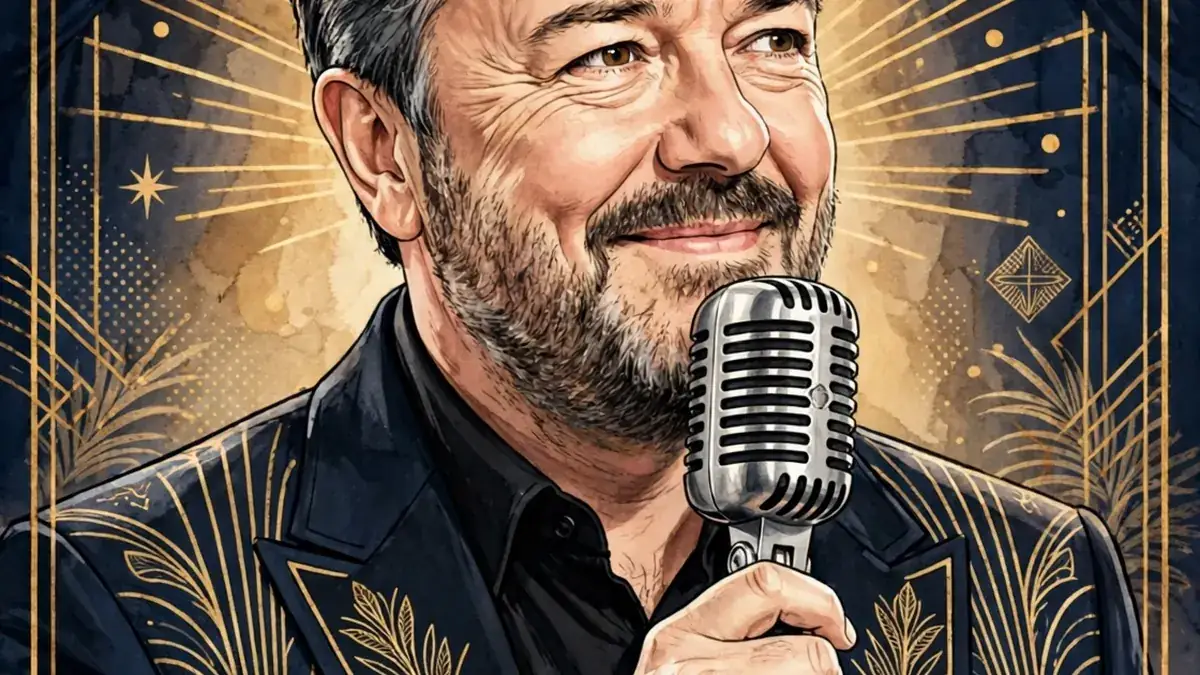
Ricky Dene Gervais was born on 25 June 1961 at Battle Hospital in Reading, Berkshire, the youngest of four children. His father, Lawrence Raymond Gervais, was French-Canadian, and his mother, Eva Sophia Gervais, was English. The family lived on a council estate in Whitley, a working-class area of Reading, and money was tight. Gervais has talked often about that upbringing — not as a hardship story told for sympathy, but as the source of the outlook that runs through his comedy: a suspicion of pomposity, a fondness for underdogs, and a habit of puncturing people who take themselves too seriously.
At school in Reading he was bright but not obviously headed for show business. He went on to University College London, where he studied philosophy and graduated in 1983. UCL mattered for two reasons that shaped the rest of his life. First, philosophy gave him the argumentative streak and the atheist convictions that later became a public part of his identity. Second, it was there in 1982 that he met Jane Fallon, then a history student, who would become his partner for more than four decades and a successful novelist and television producer in her own right. The couple have been together since that year, and the relationship is the one constant running through every chapter of this biography.
Nothing about Gervais’s twenties suggested a comedy career was coming. He left university without a plan, drifted through odd jobs, and spent years trying to make it in music. The detour lasted most of the decade — and it taught him the entertainment business from the inside, as a performer who could not get a break, before he ever tried to write his way in. For readers keeping track of the dates, our Ricky Gervais age profile sets out the same timeline year by year.
Seona Dancing and the Long Road to Comedy
While still at UCL, Gervais formed the new-wave pop duo Seona Dancing with his friend Bill Macrae in 1982. Gervais sang and wrote the songs; Macrae played keyboards. The duo released two singles, “More to Lose” and “Bitter Heart”, in 1983 and 1984. In Britain both sank without trace. In the Philippines, oddly, “More to Lose” became a hit, and Seona Dancing developed a small following there that Gervais still gets asked about. The band split in 1984, and the pop-star dream was over — but the experience left him with a performer’s instincts and a thick skin about rejection.
After the band folded, Gervais worked as an entertainment manager at the University of London Union, booking acts for student venues, and briefly managed the alternative rock band Suede in their early days. The jobs kept him close to live performance without putting him on stage. He was learning how rooms worked, what audiences responded to, and how the business side of a gig was put together — knowledge that would pay off years later when he started filling arenas himself.
The turning point came in 1996, when Gervais joined the London radio station XFM. He hired a young Stephen Merchant as his assistant, and the two began writing together. Karl Pilkington, the station’s head of production, became their producer and, before long, their on-air foil. The XFM shows were loose, funny and often chaotic, and they built a cult audience. The chemistry between the three men — Gervais the provocateur, Merchant the exasperated straight man, Pilkington the accidental philosopher — became the engine of The Ricky Gervais Show, first as a radio programme, then as a record-breaking podcast, and later as an animated HBO series that ran from 2010 to 2012.
Gervais did his first stand-up gig at the Café Royal in London in 1998, at the age of 37 — late by comedy standards, and a fact worth remembering when people call his rise overnight. The same year he joined Channel 4’s The 11 O’Clock Show, the late-night satire programme where he worked alongside Ali G creator Sacha Baron Cohen. The show ran until 2000 and gave Gervais his first regular television exposure. He was 39 when the BBC gave him and Merchant the chance to make a sitcom. Nothing in his career before that point had suggested what was about to happen.
The Office: The Show That Changed Television
The Office first aired on BBC Two in July 2001. Gervais and Merchant wrote and directed it, and Gervais starred as David Brent, the deluded regional manager of the Slough paper company Wernham Hogg. Shot as a mockumentary, with hand-held cameras, awkward silences and no laugh track, it looked like nothing else on British television. The first series drew modest audiences and mixed reviews. The second series, in 2002, and the two-part Christmas special in 2003 turned it into a phenomenon. In total the British original ran to just 14 episodes plus the specials — a short run by design, and one Gervais has repeated as a principle ever since: finish at the peak rather than stretch a show thin.
The show’s real fortune was made in America. NBC remade The Office with Steve Carell as Michael Scott, and the US version ran for nine seasons and 201 episodes from 2005 to 2013, becoming one of the most valuable comedy libraries in television. Gervais and Merchant stayed on as executive producers. Celebrity Net Worth reports that Gervais holds at least 10% of the show’s syndication profit participation and that his earnings from syndication sales have passed $100 million before taxes. The scale of the library was underlined in June 2019, when NBCUniversal paid $500 million for a five-year deal to move the American Office to its Peacock streaming service from January 2021. That deal covered streaming rights for a defined period, not ownership of the franchise — but it showed how much the format Gervais created was worth, two decades after a 14-episode BBC sitcom.
The format has been remade in more than a dozen countries, and in September 2025 Peacock premiered The Paper, a comedy set inside the American Office universe, with Gervais holding an executive producer credit. Few television creators ever see one idea pay them for a quarter of a century. For Gervais, The Office is not just his best-known work — it is the financial foundation of everything that followed, and the reason his name appears on wealth lists at all. A full breakdown of the syndication figures sits in our sister site’s money-focused piece, Ricky Gervais net worth on GuideNetWorth.
Extras, Derek and After Life
Gervais and Merchant followed The Office with Extras, which aired on BBC Two and HBO from 2005 to 2007. Gervais played Andy Millman, a jobbing background actor chasing a speaking part, and the show’s parade of guest stars — Kate Winslet, Daniel Radcliffe, Patrick Stewart, Robert De Niro — playing exaggerated versions of themselves became its signature. Extras won awards on both sides of the Atlantic and confirmed that Gervais could build a second hit without repeating the first.
His next solo creation, Life’s Too Short (2011–2013), a mockumentary about the actor Warwick Davis, was smaller and more divisive, but it kept Gervais working in the form he had invented. Then came Derek, which ran on Channel 4 from 2012 to 2014. Gervais played Derek Noakes, a kind-hearted care-home worker, in a gentle, sentimental comedy that split critics — some praised its warmth, others found its portrayal of a man with learning difficulties uncomfortable. Gervais defended the character as a decent man written with affection, and the show ran for two series and a special. Whatever the arguments, Derek showed a different side of its creator: the provocateur who wanted, at least once, to make something tender.
The most personal of his series came last. After Life, which streamed on Netflix from 2019 to 2022, starred Gervais as Tony Johnson, a local newspaper journalist whose life collapses after his wife Lisa dies of cancer. Across three series and 18 episodes, Tony moves from grief and anger toward something like acceptance, helped by the people around him — his father-in-law, his colleagues, his dog Brandy, and the sex worker and drug addict who become unlikely friends. The show was a hit for Netflix and a critical success, praised for writing that was funny and bleak in the same scene. It also drew on real feeling: Gervais has said the show was his way of writing about loss, and audiences responded to that honesty. After Life is the work most fans name when asked for their favourite Gervais series, and it is the one that best explains why his audience has stayed with him for 25 years.
Alongside the series, Gervais kept a film career going. He appeared in Night at the Museum (2006) as the museum director Dr McPhee, starred in the romantic comedy Ghost Town (2008), co-wrote and co-directed The Invention of Lying (2009), co-wrote Cemetery Junction (2010) with Merchant, played the villain in Muppets Most Wanted (2014), and directed and starred in the Netflix film Special Correspondents (2016) and the David Brent spin-off David Brent: Life on the Road (2016). None of the films matched the sitcoms for impact, but they added steady acting and directing fees and kept his name in cinemas between television projects.
Stand-Up, Netflix and the Arena Years
Stand-up is where Gervais became rich in a second way. His early tours — Animals (2003), Politics (2004), Fame (2007) and Science (2010) — sold well in Britain. The Netflix era took him to a different scale. Humanity (2018) was his first Netflix special, followed by SuperNature (2022) and Armageddon (2023). Celebrity Net Worth reports Netflix fees of $20 million per special, and the Armageddon tour grossed more than $30 million, including a Hollywood Bowl show that entered the Guinness Book of World Records as the highest-grossing single comedy stand-up show ever. Armageddon won the Golden Globe for Best Performance in Stand-Up Comedy on Television in 2024.
Mortality, his fourth Netflix special, was filmed at the London Palladium and released globally on 30 December 2025. The tour behind it ran to more than 80 arena shows around the world, taking in the Hollywood Bowl, New York’s Radio City Music Hall, a 14-night run at the Palladium and three nights at Wembley Arena, and breaking box-office records for English-language comedy in Spain, Italy, France, Portugal, Sweden, Denmark, Norway, Finland, Germany, Austria, Switzerland and the Czech Republic. Mortality won the same Golden Globe in 2026, making it two in a row for Gervais. He has described Mortality as his most honest and confessional show, built around getting older, death and the state of the world — and the critics largely agreed that the material was sharper when he talked about his own life than when he lectured the audience.
The arena model is the quiet engine of his wealth. A single tour can play to hundreds of thousands of people, and Gervais keeps a large share of the ticket money because he writes, performs and tours the show himself, with no cast to pay. As with The Office, ownership is the point: he owns the material, he owns the specials, and the streaming deals pay him again every time a new audience finds them. The stand-up boom also explains why his wealth kept growing well after his last sitcom ended — the tours, not the television, are what fill the arenas now.

That scale puts Gervais in a small group of comics who can fill stadiums. Kevin Hart’s biography tells a similar story of a stand-up who turned touring into a business empire, and Dave Chappelle’s biography covers another comic who walked away from television money and rebuilt his fortune on the road. Gervais never walked away — he kept the television, the specials and the tours running at the same time, which is why his earnings have been so steady for so long.
Five Nights Hosting the Golden Globes
Gervais hosted the Golden Globe Awards five times — in 2010, 2011, 2012, 2016 and 2020 — more than any other host of the modern era, and each stint became a news story of its own. The monologues were famous for roasting the stars in the room: jokes about Scientology, about Hollywood’s hypocrisy, about actors who took themselves too seriously. The 2011 show drew complaints and headlines in equal measure; the 2020 show, his last, opened with a long attack on “woke” Hollywood and ended with him telling the winners to keep their politics out of their speeches. The clips still circulate, and they made the ceremony itself into an event people watched for the host rather than the awards.
The hosting fees were never the point — reports have put them in the low six figures per night, small money next to a Netflix special. The value was exposure: the monologues kept Gervais in the American conversation between tours, and they fixed his image as the comic who says what others will not. That image has cut both ways. It won him a huge loyal audience, and it has also made him a lightning rod — every new special brings a fresh round of arguments about whether his jokes punch up or down. The Globes years are also where his public persona hardened into the one most people know now: the smiling provocateur with a microphone and a room full of famous people waiting to see who he picks next. Chris Rock’s age profile covers another comic whose awards-show moments became career-defining headlines.
How the Money Adds Up
The $170 million figure is an estimate, not a bank balance, and it is worth showing the working. Celebrity Net Worth, the source behind the anchor figure, breaks Gervais’s wealth into four streams. The largest is The Office: at least 10% of the syndication profit participation, worth more than $100 million before taxes over the life of the show, plus executive-producer fees from the American series and its spin-off The Paper. The second stream is stand-up: reported Netflix fees of $20 million per special across four specials, plus tour grosses — Armageddon alone grossed more than $30 million. The third is television creation and acting: creator and star fees for Extras, Derek, After Life and Alley Cats, plus film roles and directing work. The fourth is the long tail: books, podcasts, voice work, hosting fees and business interests such as his stake in Ellers Farm Distillery, the maker of Dutch Barn Vodka.
Forbes placed his earnings at $25 million for the year ending in June 2018, a snapshot from the middle of the Netflix boom. That is a single-year earnings figure, not a net-worth figure, and the two are often confused in roundups — earnings are what came in before tax and spending; net worth is what is left after both. Gervais’s spending is famously modest for a man of his wealth: no yachts, no private jets in the press, no fleet of supercars. The money has gone mostly into property, into his production company, and into charity. He routinely gives away large sums from his tours, with animal welfare as his main cause, and a share of the proceeds from the Mortality tour was donated to charity, continuing a practice he has followed on every tour.
The one-line version: roughly two-thirds of the fortune traces back to The Office — the format, the syndication and the American remake — and the rest comes from a decade of Netflix specials and arena tours. That is why the figure has kept rising long after the last episode of the British original aired in 2003.
| Income stream | What it is worth (reported) |
|---|---|
| The Office syndication and format | More than $100 million before taxes (Celebrity Net Worth); at least 10% profit participation |
| Netflix stand-up specials | Reported $20 million per special (Celebrity Net Worth); four specials so far |
| Arena tours | Armageddon tour grossed more than $30 million; Mortality tour played 80+ arenas |
| Television and film | Creator/star fees for Extras, Derek, After Life, Alley Cats; film roles and directing |
| Business and other | Stake in Ellers Farm Distillery (Dutch Barn Vodka); books, podcasts, hosting |
| Single-year earnings peak (reported) | $25 million for the year ending June 2018 (Forbes) |
Net Worth Over the Years
No source publishes a year-by-year balance sheet for Gervais, and any article that pretends to know his exact wealth in 2010 is guessing. The honest timeline uses only dated anchor points that a named source actually reported. Before The Office took off, Gervais was a working radio presenter and jobbing television writer — comfortable, not rich. The American remake changed that in the late 2000s, when syndication money began to flow. By 2013, trackers were putting him near $80 million. By 2019, estimates had climbed to around $110 million as the Netflix deals and the Peacock sale landed. The current figure — $170 million from Celebrity Net Worth, updated 7 November 2026 — reflects the full run of specials, the Armageddon and Mortality tours, and the continuing value of The Office library.
The disagreements between sources are small in the scheme of things. TheRichest lists $160 million. Older roundups still floating around the web say $140 million, a figure that dates from before the latest specials. The UK press, reporting in pounds, gives £125 million (OK.co.uk, June 2026), which converts to roughly the same dollar figure as the Celebrity Net Worth estimate. One outlier deserves a note rather than a place in the range: TheRichest’s August 2026 report on the marriage story put his fortune at £141 million, about $192 million at the time — well above every other tracker, and not repeated by any other source. We have left it out of the range and flagged it here so readers can see why some pages show a bigger number.
| Year | Reported figure |
|---|---|
| 2013 | Around $80 million (tracker estimates) |
| 2019 | Around $110 million (tracker estimates) |
| June 2026 | £125 million (OK.co.uk) |
| November 2026 | $170 million (Celebrity Net Worth, updated 7 November 2026); TheRichest $160 million |
The pattern is steady growth rather than a single windfall — a format that keeps paying, specials that keep selling, and tours that keep filling arenas. That is also why the figure is likely to move again: the Legend tour and its Netflix special, due at the end of 2027, will add another large payday.
Homes and Property
Gervais and Fallon own homes in London, the English countryside and New York. The best-documented is the nine-bedroom house in Hampstead, north London, bought in 2024 for £14.75 million, according to multiple reports. The couple also own two apartments in New York. In 2014 they bought a riverside retreat in Marlow, Buckinghamshire, for £2.75 million; after winning permission to replace the house with a new one, Gervais listed the property for £2.95 million in September 2026, with private river access and the redevelopment permission included. The listing price is an asking price, not a confirmed sale — a distinction worth keeping, since several roundups have reported it as though the sale had already happened.
Property is the one part of his wealth that is easy to verify, because purchases and listings leave a paper trail. It is also the part that explains the marriage story of 2026: under UK law, an unmarried partner has no automatic right to inherit, and inheritance tax is charged at 40% on the taxable part of an estate above the nil-rate band of £325,000. A spouse, by contrast, inherits tax-free. With a Hampstead house worth £14.75 million at stake, the tax question is not abstract — it is the reason Gervais told Saga magazine in August 2026 that he planned to marry Fallon after all, a story covered in detail below.
Business Ventures Beyond Comedy
Gervais’s best-known business interest outside comedy is Ellers Farm Distillery in North Yorkshire, where he is a co-owner. The distillery makes Dutch Barn Vodka, and Gervais has used his public profile to promote it, lending the brand the same blunt, funny voice as his stand-up. The stake is a genuine business investment rather than a paid endorsement: he is listed as a co-owner, and the brand has grown with his backing. No public figure exists for the value of his holding, and this profile does not invent one.
Beyond the distillery, his business life is mostly his own production operation. He writes, directs and stars in his shows, which means the production fees that would normally go to a separate company stay inside his own operation. He has also published books — including Flanimals, the children’s book series, and collections tied to his stand-up — and the podcast and radio archive continues to earn. The pattern is the same as in his creative work: keep control, keep ownership, and let the back catalogue do the work. Jim Carrey’s net worth story offers a useful contrast — a comic of the same generation whose fortune came mostly from film salaries rather than from owning a format.
Personal Life: Jane Fallon and 44 Years Together
Ricky Gervais has been with Jane Fallon since 1982, when the two met as students at University College London. Fallon went on to a career as a television producer and then as a bestselling novelist, with books including Getting Rid of Matthew, Got You Back and Foursome. The couple have never married and have no children — a deliberate choice both have spoken about publicly. Gervais has said they are “married for all intents and purposes” and that everything is shared; Fallon has said neither of them was ever interested in a wedding.
That position shifted, at least in public, in August 2026. Speaking to Saga magazine, Gervais said he now expected to marry Fallon, and that inheritance tax would be the reason. “It is [the reason]. And that will be the reason I marry,” he said. “We haven’t done it yet.” The story was picked up widely, with some outlets reporting it as though a wedding had already happened. It had not: as of the Saga interview, the couple were not married, and no wedding date had been announced. The tax logic is straightforward — a married partner inherits free of inheritance tax, while an unmarried partner can face a 40% charge on the value above the threshold — and Gervais was unusually open about the calculation. The Law Gazette reported that family lawyers used his comments to call for reform of the rules for long-term cohabiting couples, who are treated as strangers by the law on inheritance tax however long they have lived together.
The couple’s year was also marked by a health scare. On 12 March 2026, Fallon disclosed on Instagram that she had been diagnosed with early-stage breast cancer after a routine mammogram the week before Christmas 2025. In October 2026 she said she had fully recovered, while still dealing with exhaustion as a side effect of tamoxifen, the post-treatment medicine she was taking. Gervais has kept the details of her treatment private, and this profile does the same.
At home, the couple are famous for their cats — a running joke in Gervais’s stand-up and social media, and a genuine part of their life together. He is an outspoken atheist and an animal-rights campaigner, and he gives large sums to animal charities, often quietly and often from tour proceeds. Friends and colleagues describe a private life that is far quieter than the public persona: long walks, books, and a home life built around the same person he met at university 44 years ago.
Controversies and Public Rows
A comedian who makes a living by offending people will collect controversies, and Gervais has collected more than most. The Golden Globes monologues drew formal complaints and angry responses from stars in the room, particularly in 2011 and 2020. His 2022 special SuperNature brought a wave of criticism over jokes about trans people, with campaigners calling the material harmful and Gervais answering that a joke about a subject is not the same as an attack on the people it concerns. The argument has followed him to every special since, and he has refused to soften the material — which is, for his fans, the point, and for his critics, the problem.
Derek drew a different kind of criticism: disability campaigners and some critics argued that the character’s portrayal was patronising. Gervais answered that Derek was written as a good, kind man and that the show’s target was the cruelty of the people around him, not Derek himself. The debate never settled, and it is still cited whenever the show is discussed. On social media, Gervais has had long-running rows with other public figures, usually over animal rights, religion or free speech, and he has been criticised for the tone of some of those exchanges as often as he has been praised for the substance.
None of the rows has damaged his career in any lasting way. The specials keep topping the Netflix charts, the tours keep selling out, and the awards keep coming. That is worth stating plainly, because it is the honest answer to the question readers often ask after a controversy: did it hurt him? By every measure that matters to a working comedian — ticket sales, streaming numbers, awards — it did not. Whether that says something good or bad about the audience is a question this profile leaves to the reader.
Awards and Recognition
Gervais’s trophy count is one of the largest of any British comic of his generation. The Wikipedia tally credits him with seven BAFTA Television Awards, five Golden Globe Awards and two Primetime Emmy Awards — a count that includes his wins for The Office, Extras and his stand-up specials. Celebrity Net Worth, the source behind his net-worth figure, credits him with three Emmy Awards, three Golden Globe Awards and two BAFTA Awards — a different tally that counts the awards differently. This profile follows the Wikipedia tally for the headline count and notes the difference here, because the two sources do not agree and a reader checking either one should know why.
The headline wins tell the story: The Office won the Golden Globe for Best Television Series (Musical or Comedy) in 2004, with Gervais winning Best Actor in the same ceremony — the first time a British comedy had taken those prizes. Extras won an Emmy for Outstanding Comedy Series writing and a Golden Globe for the show itself. Armageddon won the Golden Globe for Best Performance in Stand-Up Comedy on Television in 2024, and Mortality repeated the win in 2026. In 2025 he was presented with a star on the Hollywood Walk of Fame, a formal mark of how far a comic from a Reading council estate had travelled. He has also been nominated for Grammy Awards for his comedy albums, and his podcast with Merchant and Pilkington set a Guinness World Record as the most downloaded podcast of its time.
Ricky Gervais in 2026: Mortality, Legend and Alley Cats
For a man who turned 65 in June 2026, Gervais has had one of his busiest years. Mortality, released on Netflix on 30 December 2025, won the Golden Globe for stand-up in January 2026 and kept the tour selling through the spring. In September 2026 Netflix announced Alley Cats, an adult animation featuring Gervais alongside Diane Morgan, Tom Basden and Kerry Godliman; the series was released on 7 August 2026 and gave him a new format to work in at an age when most comics are slowing down. Then, in the autumn, he launched Legend, his new stand-up tour, with UK dates running from September to December 2026 and a world tour through 2027. Netflix bought the rights to film Legend as his fifth special before the tour had even started — a sign of how much the streaming service values the relationship.
The year also brought the two personal stories covered above: Fallon’s breast cancer diagnosis and recovery, and the Saga magazine interview in which Gervais said he planned to marry her for inheritance-tax reasons. Neither story changed the work. The tour dates kept coming, the special kept streaming, and the next project was already announced before the current one had finished. That pace — a special, a series, a tour, all overlapping — is the pattern of the last decade, and there is no sign of it ending. Gervais has said he has no plans to retire, and the Legend schedule, running into the end of 2027, backs him up.
How He Compares With Other Comics
Wealth lists put Gervais among the richest stand-up comics in the world, but the comparisons are instructive because the money was made in different ways. The table below uses Celebrity Net Worth estimates, the same source as Gervais’s anchor figure, and treats every number as an estimate. LoveMoney’s November 2026 ranking of the richest stand-up comics, using Celebrity Net Worth figures, placed Gervais 13th at $170 million and called him Britain’s richest comedian.
| Comedian | Estimated net worth (Celebrity Net Worth) |
|---|---|
| Ricky Gervais | $170 million |
| Jim Carrey | $180 million |
| Kevin Hart | $450 million |
| Chris Rock | $60 million |
| Dave Chappelle | $60 million–$100 million |
The contrast with Kevin Hart is the sharpest: Hart’s fortune was built on film salaries, touring and a production and drinks business, while Gervais’s was built on owning one format and a decade of specials. Jim Carrey, at $180 million, sits just above Gervais despite a much bigger film career, because Carrey was paid salaries while Gervais kept the rights. Dave Chappelle’s range — $60 million to $100 million — shows what happens when a comic walks away from a television deal, as Chappelle did in 2005, and rebuilds on the road. Gervais never had to rebuild: he kept the show, kept the specials and kept touring, and the money compounded.
Readers who want more on the comics in this table will find more celebrity biographies in our biography archive, including the Chappelle and Hart profiles linked above.
Frequently Asked Questions
Who is Ricky Gervais?
Ricky Gervais is an English comedian, actor, writer, director and producer, born Ricky Dene Gervais on 25 June 1961 in Reading, Berkshire, England. He is best known as the co-creator and star of The Office (2001–2003), the creator of Extras, Derek and After Life, a five-time host of the Golden Globe Awards, and a Netflix stand-up star whose specials include Humanity, SuperNature, Armageddon and Mortality.
What is Ricky Gervais’s net worth in 2026?
Ricky Gervais’s net worth is estimated at $170 million, according to Celebrity Net Worth, which updated its figure on 7 November 2026. Other sources put him lower — TheRichest at $160 million and older roundups at $140 million — so the honest range is $140 million to $170 million, anchored on the $170 million figure. The fortune comes mainly from The Office syndication and format rights, Netflix stand-up specials and arena tours.
How old is Ricky Gervais?
Ricky Gervais is 65 years old as of November 2026. He was born on 25 June 1961 in Reading, Berkshire, England, and turned 65 on 25 June 2026.
Is Ricky Gervais married?
No. Ricky Gervais has never married. He has been with his partner, novelist and former television producer Jane Fallon, since 1982. In August 2026 he told Saga magazine that he now planned to marry her, saying inheritance tax would be the reason — but he added “We haven’t done it yet”, and no wedding has been confirmed.
What is Ricky Gervais’s latest show in 2026?
Ricky Gervais’s latest work in 2026 is the adult animation Alley Cats, released on Netflix on 7 August 2026, and his new stand-up tour Legend, which runs from autumn 2026 to the end of 2027 and will be filmed as his fifth Netflix special. His fourth Netflix special, Mortality, was released on 30 December 2025 and won a Golden Globe in 2026.
How many times has Ricky Gervais hosted the Golden Globes?
Ricky Gervais has hosted the Golden Globe Awards five times: in 2010, 2011, 2012, 2016 and 2020. His monologues, which roasted the stars in the room, became famous in their own right and made the ceremony an event people watched for the host as much as for the awards.
How did Ricky Gervais make his money?
Gervais made most of his money from The Office: he holds at least 10% of the show’s syndication profit participation, worth more than $100 million before taxes according to Celebrity Net Worth, plus fees from the American remake and its spin-off The Paper. The rest comes from Netflix stand-up specials (reported at $20 million per special), arena tours such as Armageddon, which grossed more than $30 million, television creation and acting, and business interests including his stake in Ellers Farm Distillery.
Does Ricky Gervais have children?
No. Ricky Gervais and Jane Fallon have no children, a deliberate choice both have spoken about publicly. The couple have been together since 1982 and share their home — and their cats — in London.
Final Thoughts
Ricky Gervais’s biography is a study in patience. He failed as a pop star, worked in radio into his late thirties, and did his first stand-up gig at 37. The fame, when it came, came late — and it came because he owned what he made. The Office was 14 episodes long and it still pays him. The specials are his, the tours are his, and the format has been remade around the world. At 65, with a $170 million fortune, a Golden Globe for Mortality, a new series in Alley Cats and a world tour in Legend, he is working harder than comics half his age. The council-estate kid from Reading did not get lucky once. He built something that keeps paying, and then he kept building.
Sources and Reporting
How we estimated: the net-worth figure in this profile is an estimate, not a verified bank balance. We anchor on Celebrity Net Worth ($170 million, updated 7 November 2026) and give the honest range of $140 million–$170 million from TheRichest ($160 million) and older trackers ($140 million). Earnings figures are reported earnings before tax and spending, not net worth. Property prices are asking prices or reported purchase prices, not confirmed sale prices where the reporting says otherwise. Figures from different sources are labelled with their source and date so readers can see where each number comes from. Estimates may differ from private reality.
Named sources used in this profile: Celebrity Net Worth, Forbes, TheRichest, OK! Magazine, LoveMoney, Netflix, BBC, The Futon Critic, Law Gazette, Wikipedia. Career and awards details were cross-checked against the sources above and against contemporary reporting of the Mortality special, the Legend tour announcement and the Alley Cats release.