By Celebamerica Editorial Staff | Last updated: 11 November 2026
Dave Chappelle is 53 years old in November 2026, and his life reads like a dare that paid off twice. Born David Khari Webber Chappelle on 24 August 1973 in Washington, D.C., he started telling jokes in clubs at 14, built the sharpest sketch show of its era, walked away from it at the height of its fame, and then came back on his own terms to become one of the richest and most decorated comedians alive.
The money follows the same arc. Celebrity Net Worth puts Dave Chappelle’s net worth at about $100 million in 2026, inside a published range that runs from roughly $60 million to $100 million. That figure is an estimate, not an audited balance sheet, and this biography shows the work behind it: the reported $60 million Netflix deal of 2016, the arena touring, the eight Netflix specials, and a growing property footprint in the Ohio village he calls home. What follows is the full story — the childhood between two cities, the slow 1990s climb, the show, the walkaway, the comeback, the awards, the family, and the arguments that still follow him onto every stage.
| Full Name | David Khari Webber Chappelle |
|---|---|
| Date of Birth | 24 August 1973, Washington, D.C., United States |
| Age in November 2026 | 53 (turns 54 on 24 August 2027) |
| Estimated Net Worth | About $100 million (Celebrity Net Worth, November 2026), inside a $60–100 million published range — an estimate, not an audited figure |
| Peak / Primary Income Sources | Netflix specials (reported $60 million first deal, 2016), arena stand-up touring, television, film, live residencies |
| Key Works | Chappelle’s Show (Comedy Central, 2003–2006); eight Netflix specials including The Age of Spin, Equanimity, Sticks & Stones, The Closer and The Dreamer; Half Baked (1998); Saturday Night Live hosting (2016, 2020) |
| Major Awards | Six Grammy Awards for Best Comedy Album; five Primetime Emmy Awards; Mark Twain Prize for American Humor (2019); NAACP President’s Award (2025) |
| Spouse / Family | Married Elaine Erfe in 2001; three children — Sulayman, Ibrahim and Sanaa |
| Home Base | Farm near Yellow Springs, Ohio |
Contents
- Early Life: Washington, Yellow Springs, and Two Remarkable Parents
- First Jokes: Clubs at 14 and the Duke Ellington School
- New York and the Long 1990s Climb
- Chappelle’s Show: The Sketch Show That Changed Television
- The Walkaway: Leaving a Reported Fifty Million on the Table
- The Netflix Comeback: Sixty Million and Eight Specials
- The Money, Broken Down: Where the Fortune Comes From
- The Trophy Shelf: Six Grammys, Five Emmys, the Mark Twain Prize
- Yellow Springs: The Farm, the Firehouse, and the Schoolhouse
- Personal Life: Elaine, Three Children, and a Quiet Farm
- Controversies: The Closer, Duke Ellington, and Madison Square Garden
- Dave Chappelle in 2026: Karmageddon and Two Nights at the Garden
- How Chappelle Compares With His Fellow Comics
- Frequently Asked Questions
- Final Thoughts: The Walkaway That Made Him
- Sources & Reporting: How We Estimated
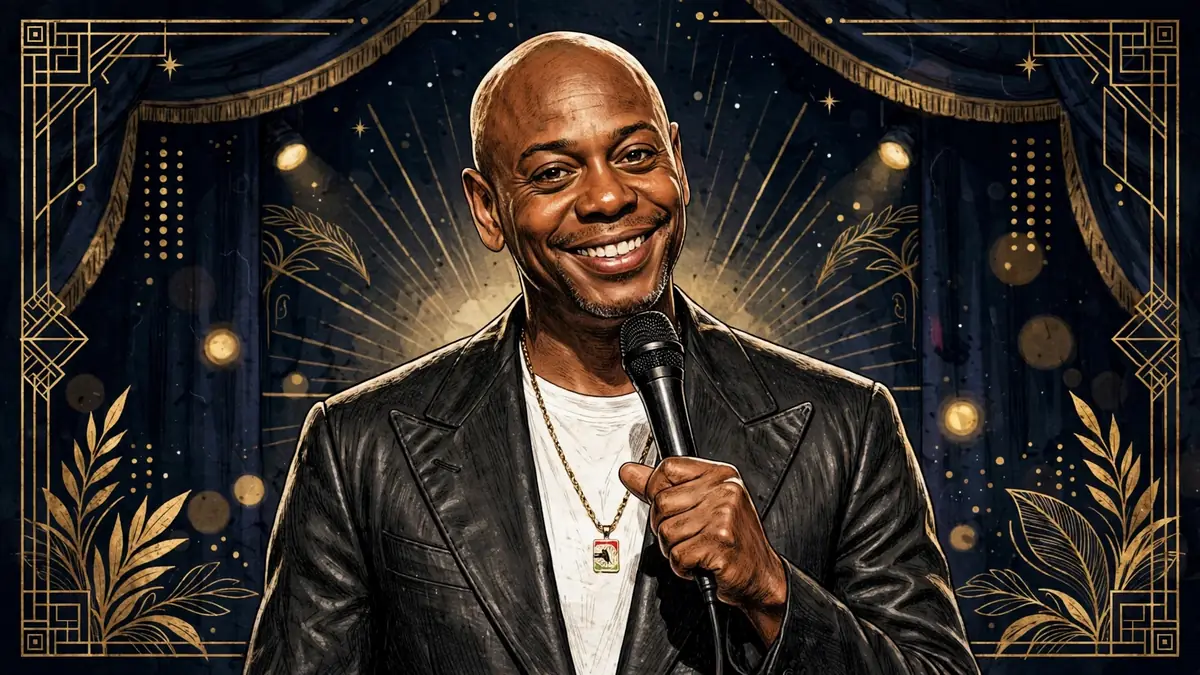
Early Life: Washington, Yellow Springs, and Two Remarkable Parents
David Khari Webber Chappelle was born on 24 August 1973 in Washington, D.C., into a household where books, politics and music were everyday currency. His father, William David Chappelle III, was a professor of vocal performance and dean of students at Antioch College in Yellow Springs, Ohio. His mother, Yvonne Seon, had worked for Congolese prime minister Patrice Lumumba before becoming a Unitarian Universalist minister and a professor and university administrator at institutions including Wright State University and Prince George’s Community College.
That parentage gave Chappelle two home towns and two very different Americas. He grew up in Washington and in Silver Spring, Maryland, with his mother, and spent summers in Yellow Springs with his father. His parents separated when he was young, and the split set the pattern of his childhood: school terms in the capital, summers in a small Ohio college town of a few thousand people, and a long drive between the two worlds in between. Both places stayed with him. Washington gave him the politics and the street timing. Yellow Springs gave him the quiet — and, decades later, the place he would choose to live.
The house in Washington was a political one. Family friends and visitors included activists, musicians and artists, and the boy who would become a comedian grew up listening to adults argue about the world at the kitchen table. His great-grandfather, William D. Chappelle, had been a bishop in the African Methodist Episcopal Church, and the family tree reaches back to Robert John Palmer, a Black legislator in South Carolina during Reconstruction. Chappelle has joked on stage that his family has been talking about race in America for a very long time. The joke lands because it is true.
Comedy found him early. He has said he was drawn to Richard Pryor and Eddie Murphy as a boy, studying their timing the way other children studied sport. By his early teens he was writing jokes and trying them out loud, and his mother — rather than telling him to wait until he was older — drove him to clubs and sat with him while he performed, because he was too young to get in alone. Washington in the late 1980s was a hard city, and Chappelle has said more than once that his mother saw the clubs as the safer option. “Of all the bad things I could have been doing,” he told an interviewer years later, “I think my mom was like, well, he just wants to tell jokes.”
First Jokes: Clubs at 14 and the Duke Ellington School
Chappelle started performing stand-up in Washington-area clubs at 14. His mother chaperoned him into rooms that would not have admitted a teenager on his own, and he learned the trade the old way: short sets, rough crowds, and the long walk back to the car when a joke died. He attended Eastern High School in Washington for a short time before transferring to the Duke Ellington School of the Arts, where he studied theatre arts and graduated in 1991. He also worked as an usher at Ford’s Theatre, watching professional actors from the wings while he waited for his own turn.
Ellington mattered in two ways. It gave him stagecraft — voice, movement, the discipline of rehearsal — and it gave him a room full of young artists who took the work seriously. It also gave him a debt he has repaid in public ever since: he has stayed close to the school for decades, returning for events and fundraisers, and in 2022 he declined to have its theatre named after him after a student protest over his material, asking instead that it be called the Theater for Artistic Freedom and Expression. That episode, covered in the controversies section below, says as much about the man as any award on his shelf.
His first television appearance came before he had even finished school. In September 1990 he appeared in a montage of people telling jokes on the first episode of ABC’s America’s Funniest People. It was a blink — a teenager in a crowd of strangers — but it was proof that the boy from the D.C. clubs could hold a camera’s attention. He graduated from Ellington in 1991 and moved to New York City to do comedy full time.
New York and the Long 1990s Climb
New York gave him his first hard lesson. Soon after arriving, he took the stage at Harlem’s Apollo Theater for Amateur Night and was booed off. The Apollo crowd is famously unsentimental, and a 17-year-old newcomer with a soft voice and long stories was an easy target. Chappelle has described the night ever since as the moment that gave him the courage to keep going — if the worst room in America could not finish him, no room could. He went back to the clubs, worked the parks, and built a name on the New York circuit set by set.
The break came in 1992, when he appeared on HBO’s Def Comedy Jam. The show, hosted by Martin Lawrence, was the shop window for a new generation of Black comics, and Chappelle’s set put him on the map. At 19 he was opening for Aretha Franklin. Film work followed in small steps: a part in Mel Brooks’s Robin Hood: Men in Tights in 1993, The Nutty Professor in 1996, Con Air and You’ve Got Mail in 1997 and 1998, and Blue Streak in 1999. None of these roles made him a star, but each one paid, each one taught him a film set, and each one kept his name in casting rooms.
The film that mattered most to his own story was one he wrote himself. Half Baked, released in 1998, was co-written by Chappelle and Neal Brennan, and starred Chappelle as a lovable slacker caught up in a drug deal gone wrong. It was a modest box-office performer that became a cult favourite on video, and it did two things that shaped everything after it: it proved Chappelle could carry a film built around his own voice, and it bonded him with Brennan, the writing partner with whom he would build Chappelle’s Show five years later.
By the end of the decade he was a known quantity in comedy without being a household name — the comic other comics quoted, the actor directors called for the funny best friend. His first hour-long special, Killin’ Them Softly, aired on HBO in 2000 and showed what the clubs already knew: a long, loose, story-driven set that could hold an audience for an hour without a single cheap laugh. A second special, For What It’s Worth, followed on Showtime in 2004, recorded while his television show was at its peak. The 1990s had been slow, and the slowness was the point. When the big chance came, he had ten years of stage time behind him.
Chappelle’s Show: The Sketch Show That Changed Television
Chappelle’s Show premiered on Comedy Central in January 2003, co-created by Chappelle and Neal Brennan, and it did not look like anything else on television. The format was simple — Chappelle on a street corner or a stage, introducing sketches filmed like short movies — and the sketches were fearless. Clayton Bigsby, a blind white supremacist who does not know he is Black. Rick James, retold by Charlie Murphy with Chappelle playing the funk star in platform boots. A Wayne Brady sketch that turned the wholesome host into a streetwise menace. A retelling of Prince beating Charlie Murphy’s crew at basketball in blouses. The show treated race, fame and American hypocrisy as material for jokes that were written to be quoted the next day at work, and they were.
The numbers followed the noise. The first season drew a young audience Comedy Central had never held, the DVD sets sold in huge numbers, and by the second season Chappelle was the most talked-about comedian in America. The show won a devoted following across racial lines, which was the point: Chappelle’s comedy was written from a Black point of view and aimed at everybody. Critics who had followed him since the clubs said the show was the first time television had let him be himself at full length. The money, by the standards of a cable sketch show, was real but not yet life-changing — the fortune would come later, from the deal he walked away from and the one he signed after it.
What made the show last was not only the jokes but the way it was made. Chappelle and Brennan wrote together, cast friends and club comics, and shot sketches with a film-maker’s patience. The show trusted its audience to keep up, and it trusted Chappelle’s instinct for when a joke had gone far enough — and when it had not gone far enough. That instinct is also what ended it.
The Walkaway: Leaving a Reported Fifty Million on the Table
In the spring of 2005, in the middle of production on the third season, Dave Chappelle left. He walked out of the show, turned down a reported $50 million contract extension, and flew to South Africa. The news broke while the season was unfinished, and for weeks nobody — not Comedy Central, not his management, not the press — could say where he was or when he was coming back. The third season eventually aired in 2006 in a patched-together form, hosted by Brennan and Charlie Murphy, built from sketches already in the can. It was good television. It was not the show.
Chappelle has explained the decision many times since, and the explanation has stayed consistent: the work had stopped feeling like his. He has talked about the pressure of the money, the speed of the production, the feeling that the laughter in the room had changed — that white audiences were laughing at the wrong parts, and that the show was being read as permission rather than satire. He has also talked about exhaustion, and about wanting to think before he signed away years of his life for a sum that would have made him rich and miserable in equal measure. The trip to South Africa was not a publicity move. It was a man getting off a train before it reached a station he did not want to visit.
The walkaway cost him in the short term. The show was over, the contract was gone, and the gossip industry filled the silence with rumours about drugs and breakdowns that Chappelle has denied ever since. It made him in the long term. The decision became the defining fact of his biography — the comic who said no to fifty million dollars — and it gave everything he did afterwards a weight no marketing budget could buy. When he came back, he came back on his own terms, and the audience that had missed him was willing to pay to see him do it his way. The walkaway is the hinge of this whole story. Without it there is no Netflix deal, no arena tour, and no hundred-million-dollar estimate. With it, there is a career that belongs to the man who made it.
The Netflix Comeback: Sixty Million and Eight Specials
The comeback took a decade, and it was built the slow way: small rooms, long sets, no cameras. Chappelle toured clubs and theatres through the late 2000s and early 2010s, testing new material in front of audiences who had to be there in person to hear it. He popped up on other people’s stages, hosted benefits, and kept his name alive by refusing to chase it. By 2015 the industry had caught up with him. The specials market was changing, streaming platforms were paying real money for stand-up, and Netflix wanted the biggest name in the form.
In November 2016 Netflix announced the deal that reset his finances: a reported $60 million agreement for three specials, working out at about $20 million per special. The first two arrived together in March 2017 — The Age of Spin, filmed at the Hollywood Palladium, and Deep in the Heart of Texas, filmed in Austin — followed by Equanimity and The Bird Revelation on New Year’s Eve 2017. The deal was later expanded, and the specials kept coming: Sticks & Stones in August 2019, the short film 8:46 in June 2020, The Closer in October 2021, What’s in a Name? in 2022, and The Dreamer in December 2023. The eighth Netflix special, The Unstoppable…, arrived as a surprise release on 19 December 2025, after the Jake Paul–Anthony Joshua fight, and debuted at number nine on Netflix’s English-language television chart with a reported 3.3 million views in its first week.
| Special | Released | Platform / Note |
|---|---|---|
| Killin’ Them Softly | 2000 | HBO — first hour special |
| For What It’s Worth | 2004 | Showtime — recorded at the Chappelle’s Show peak |
| The Age of Spin | March 2017 | Netflix — first special under the 2016 deal |
| Deep in the Heart of Texas | March 2017 | Netflix — released the same day |
| Equanimity | December 2017 | Netflix — won an Emmy for Outstanding Variety Special |
| The Bird Revelation | December 2017 | Netflix — filmed at the Comedy Store, Los Angeles |
| Sticks & Stones | August 2019 | Netflix — filmed in Nashville |
| 8:46 | June 2020 | YouTube / Netflix — response to the killing of George Floyd |
| The Closer | October 2021 | Netflix — his most argued-over special |
| What’s in a Name? | 2022 | Netflix — built around his Duke Ellington School speech |
| The Dreamer | December 2023 | Netflix — his seventh Netflix special |
| The Unstoppable… | December 2025 | Netflix — eighth Netflix special, surprise release |
The Netflix money did more than pay Chappelle. It changed the market for every comic after him. A $20 million fee per special became the number agents quoted and streamers argued about, and Chappelle’s deal is still the benchmark other stand-up contracts are measured against. In April 2026, Variety reported that Chappelle had re-teamed with Netflix for three more shows, a sign that the partnership — now a decade old — still has room to run. The fees for the later specials were never disclosed, which is one reason the net worth trackers disagree with each other by tens of millions. The first deal is on the record. Everything after it is reported, estimated, or kept private.
Alongside the specials came the return to Saturday Night Live. Chappelle hosted the show in November 2016, days after the presidential election, and delivered a monologue that was quoted for weeks; he hosted again in November 2020. Both appearances won him Primetime Emmys for Outstanding Guest Actor in a Comedy Series, and both reminded a television audience that the comic who had walked away from his own show had lost none of his nerve. A small film role in A Star Is Born in 2018 — as Noodles, a friend of Bradley Cooper’s character — showed the same thing on the big screen: a performer who could do more with five minutes than most actors do with a whole film.
The Money, Broken Down: Where the Fortune Comes From
So what is Dave Chappelle worth in 2026? The honest answer is a range, and any profile that gives you a single number without saying so is selling certainty it does not have. Celebrity Net Worth, the tracker most outlets quote, puts him at $100 million, a figure its snapshot dated 6 November 2026 still carried. Wealthy Gorilla, updated in November 2026, still lists $60 million. Net Worth Radar, modelling the figure in October 2026, lands at $95 million with a likely range of $73 million to $121 million. PowerNetWorth, from May 2026, publishes $120 million. GuideNetWorth’s own Dave Chappelle net worth post, last updated in July 2026, reported $60–70 million — a figure that reflected Celebrity Net Worth’s estimate at the time, before it moved up. For the full money picture, our sister site’s Dave Chappelle net worth profile on NetWorthCraft tracks the same figures from the wealth angle.
| Source | Estimate | Date |
|---|---|---|
| Celebrity Net Worth | $100 million | Snapshot 6 November 2026 |
| Net Worth Radar (modelled) | $95 million (range $73–121 million) | 28 October 2026 |
| Wealthy Gorilla | $60 million | Updated November 2026 |
| PowerNetWorth | $120 million | May 2026 |
| GuideNetWorth (sister site, now dated) | $60–70 million | July 2026 |
This biography anchors on $100 million per Celebrity Net Worth, inside the $60–100 million published range, and labels it for what it is: an estimate. No audited balance sheet exists, no tax return is public, and the fees for his later Netflix specials were never disclosed, so nobody outside his accountants can price his wealth to the dollar. The range itself tells the story. The low end reflects the figures trackers carried for years, when the only hard number was the 2016 deal. The high end reflects what has happened since: eight specials, a decade of arena touring, and a property portfolio that keeps growing.
Why the trackers disagree: the documented income is large but incomplete. Forbes put Chappelle’s annual earnings at $47 million in 2017 and $35 million in 2018, the two years the Netflix money landed. Pollstar reported $44.2 million in ticket gross from 30 shows on one tour leg — gross, not profit, before venues, promoters, production, travel, staff and tax took their share. Add the reported $60 million first Netflix deal, the undisclosed fees for the later specials, and the property spending in Yellow Springs, and you get a fortune that is plainly large and honestly hard to pin down. A tracker that counts only the public deals lands near $60 million. One that prices the whole career lands at $100 million. Both are guesses built on the same facts.
The income streams behind the estimate break down into four parts. First, the Netflix money: the reported $60 million first deal, plus fees for five more specials that were never disclosed, with reporting that puts his total Netflix earnings at roughly $80 million or more across the partnership. Second, live touring: arena dates, theatre runs and residencies, including the phone-free shows that have become his trademark — no recordings, no clips, Yondr pouches at the door, and tickets priced for rooms of thousands. Third, television and film: the Chappelle’s Show years, the SNL appearances, and film roles from the 1990s to A Star Is Born. Fourth, property and local business in Yellow Springs, covered in its own section below, where money he had already earned was turned into buildings that now earn money of their own. There is no public record of endorsement deals, and Chappelle has never been a pitchman. The fortune was built on stage, on screen, and on the page — not on selling other people’s products.
The growth of that fortune tells the same story as the career. In 2005, the year he walked away, his wealth was the wealth of a successful television comic: comfortable, not vast. By 2017, the year the Netflix money arrived, Forbes was ranking him among the highest-paid comedians in the world. By 2026 the estimate had settled at the top of the range, helped by the fact that he never stopped touring and never stopped releasing specials. The walkaway looks, in hindsight, like the best financial decision he ever made — not because fifty million dollars is small, but because the freedom it bought was worth more than the money it cost.
The Trophy Shelf: Six Grammys, Five Emmys, the Mark Twain Prize
The awards record is the cleanest way to measure the Netflix era, because it is counted by institutions rather than estimated by trackers. Chappelle has won six Grammy Awards for Best Comedy Album, one for each of his Netflix specials’ album releases: The Age of Spin, Equanimity & The Bird Revelation, Sticks & Stones, The Closer, What’s in a Name?, and The Dreamer. Six specials, six Grammys — a run no other living comic can match, and a sign that the recording industry heard what the audiences heard.
The Emmy count needs a careful word, because many profiles get it wrong. Plenty of sites say Chappelle has won six Emmy Awards. The awards list kept by Wikipedia records five Primetime Emmy wins from twelve nominations, and that is the figure this biography uses. The five break down as two for Outstanding Guest Actor in a Comedy Series, for hosting Saturday Night Live in 2016 and 2020, and wins for his variety specials, including Equanimity. The confusion is easy to understand — the nominations pile up across categories, and a sixth win is often claimed by outlets that count a nomination as a prize. The record, checked against the awards list, says five.
Above the competitive awards sits the honour that matters most in American comedy. On 27 October 2019 the Kennedy Center presented Chappelle with the Mark Twain Prize for American Humor, the prize the Center calls America’s highest comedy honour. The ceremony gathered comics from across his career — Jon Stewart, Sarah Silverman, Bradley Cooper, and the cast of Chappelle’s Show among them — and the citation praised a comic who had, in the Center’s words, changed the way America talks about itself. In February 2025 the NAACP added its President’s Award, given for service and achievement beyond entertainment. He also carries a Screen Actors Guild Award nomination, shared with the ensemble of A Star Is Born. The shelf is not decoration. It is the paper trail of a comeback that the industry voted on, year after year, with real ballots.
Yellow Springs: The Farm, the Firehouse, and the Schoolhouse
For all the arena money, Dave Chappelle lives on a farm. He and his family have long lived on a 65-acre farm near Yellow Springs, Ohio, the village of about 3,700 people where his father taught and where he spent his childhood summers. It is the most deliberate choice in his biography: a man who could live anywhere chose the place that raised him, and then set about buying pieces of it.
The buying is done through Iron Table Holdings, his real estate company, and it has made him one of the biggest property owners in the village. The holdings, as reported by the Yellow Springs News and Celebrity Net Worth from county records, include three attached buildings at 239, 241 and 243 Xenia Avenue, bought in November 2018 for $599,000; more than $1.6 million of village property bought in 2020 alone; the former Miami Township fire station, bought in 2021 for $424,000 and redeveloped as the YS Firehouse, a venue for comedy and music; and the historic Union Schoolhouse, bought in 2020 for $480,000 with an adjacent parcel at $70,000. In April 2022, Greene County records showed at least 19 acres of former Oberer land, in 15 parcels next to his home, transferring to Iron Table Holdings. County appraisals reported in May 2026 valued his residential and commercial holdings inside the village at $10.9 million.
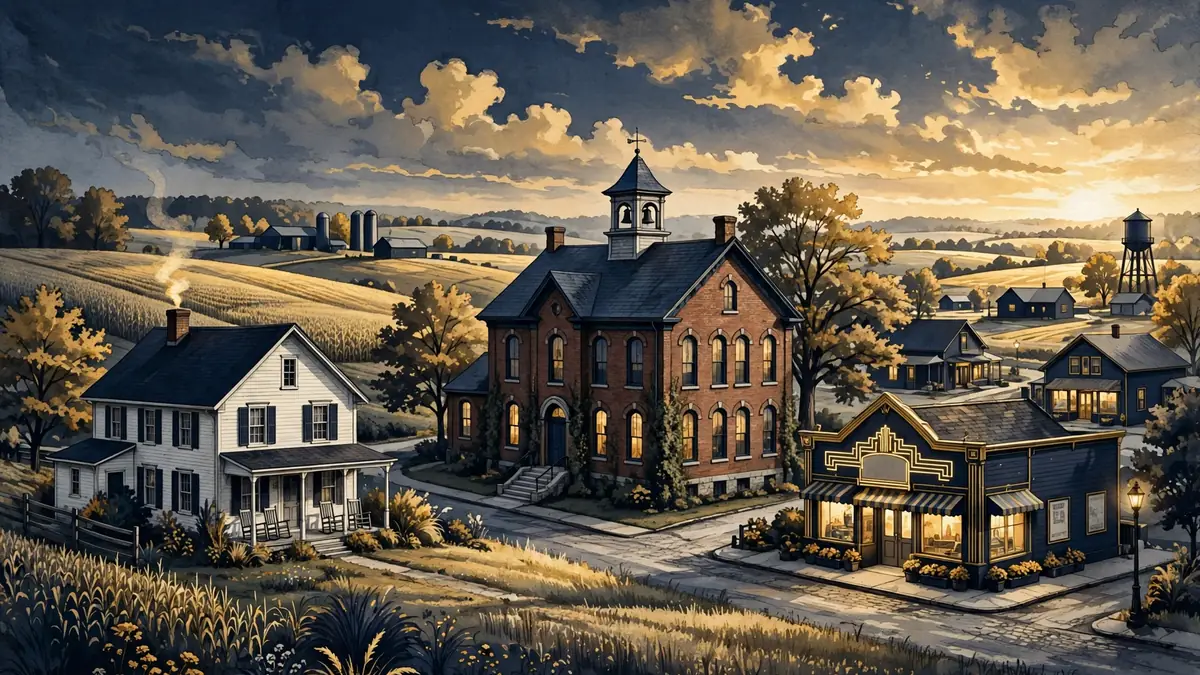
The schoolhouse is the project that shows what the money is for. The Union Schoolhouse was built in 1872 and served as one of the village’s earliest integrated schools before later housing municipal offices and small businesses. After sitting empty for years, it was bought by Iron Table Holdings in 2020 and rebuilt as a multi-use space, with public radio station WYSO 91.3 on the lower floors and Chappelle’s own offices on the top floor. WYSO began broadcasting from the building in March 2026, and on 9 April 2026 Chappelle stood on the front lawn for a ribbon-cutting ceremony with neighbours and local officials, as the Associated Press reported. WYSO said in July 2026 that his company had invested $15 million in the property; the station leases its space, and the arrangement keeps a 68-year-old local station rooted in the village instead of relocating. The village marked the day: the mayor proclaimed 9 April 2026 as WYSO Day.
The village businesses kept growing. In April 2026 he opened The Chappelle Shop at 221 Xenia Avenue, a merchandise store selling Chappelle-branded apparel, vinyl records and other items, in a downtown building he had bought in 2021. The pattern is consistent across every purchase: buy the building, fix it, put it to work for the village, and keep the money in the place that raised him. The claim that he “bought the whole town” is a viral exaggeration — he owns a group of downtown buildings and the land around his farm, not the village itself — but the scale is real enough. A farm, a firehouse, a schoolhouse, a shop, and a radio station add up to a second career as a small-town developer, built with comedy money and run on the same terms as the comedy: his own, and local.
Personal Life: Elaine, Three Children, and a Quiet Farm
Dave Chappelle married Elaine Mendoza Erfe in 2001, before Chappelle’s Show made him famous and before the walkaway made him a legend. They have three children together — sons Sulayman and Ibrahim, and daughter Sanaa — and the family has lived on the Yellow Springs farm for most of the children’s lives. Elaine, who is of Filipino descent, keeps a low public profile, and Chappelle has guarded the family’s privacy with the same stubbornness he brings to his contracts: the farm is not a content farm, the children are not public figures, and the house is not on any tour.
He has spoken publicly about his Muslim faith, and about raising his children between the faith, the farm, and the road. The family life is the quiet counterweight to the career in this biography. The man who fills arenas goes home to a village, a wife of 25 years, and three children who grew up watching their father leave for the stage and come back to the same kitchen table. It is worth saying plainly because it explains the choices: the walkaway, the farm, the schoolhouse, and the refusal to live in Los Angeles or New York all point the same way. He built the career to serve the life, not the other way round.
His siblings — brother William and sister Felicia — have stayed largely out of the spotlight, and his parents’ influence runs through the story from first page to last: a father who taught voice at Antioch, a mother who worked for Lumumba and preached from a pulpit, and a son who learned from both of them that words carry weight and that a stage is a responsibility. The farm is where those two inheritances meet.
Controversies: The Closer, Duke Ellington, and Madison Square Garden
No honest biography of Dave Chappelle skips the arguments, because the arguments are part of the work. The sharpest came with The Closer, released in October 2021. In the special Chappelle returned to material about the transgender community that had already drawn criticism in Sticks & Stones, and the response was swift: criticism from LGBTQ advocacy groups, an employee walkout at Netflix, and a public debate about whether a streamer should carry material its own staff found harmful. Netflix co-chief executive Ted Sarandos defended the special on free-expression grounds, and Chappelle, in the specials that followed, answered his critics on stage rather than apologising off it. The episode cost him goodwill in parts of the industry and cost Netflix a bruising news cycle; it did not cost him his audience, and the special went on to win a Grammy.
The second argument happened at home. In November 2021 Chappelle returned to the Duke Ellington School of the Arts for a question-and-answer session with students, and the room split: some students cheered him, others challenged him over the same material, and one called him a bigot to his face. His response — cool, combative, and unbending — made the news, and the school postponed a planned ceremony to name its theatre after him. In the summer of 2022 he settled the question himself, declining the honour and asking that the theatre instead be named the Theater for Artistic Freedom and Expression. It was a neat piece of stagecraft from a man who understands symbols: he gave up his name on a building and kept the principle it stood for.
The third came at the very end of the period this biography covers. On 6 and 7 November 2026, closing his Karmageddon tour at Madison Square Garden, Chappelle made remarks about the 2025 assassination of conservative commentator Charlie Kirk that drew a fresh wave of criticism. According to Consequence, reporting on 8 November 2026, he told the crowd he felt “better” since Kirk’s killing, a remark that circulated on social media in a low-quality clip and was amplified by commentators including Rob Henderson. The shows were phone-free, with Yondr pouches at the door, so the clip’s origin is unclear, and as of 9 November 2026 no apology or statement had come from Chappelle or his representatives, and no dates had been cancelled. This biography reports the episode as it was reported — with the sourcing attached and the uncertainty intact — because that is all the public record supports. The pattern across all three episodes is the same: Chappelle says what he thinks on stage, the room argues about it for weeks, and he goes back on stage and says what he thinks again.
Dave Chappelle in 2026: Karmageddon and Two Nights at the Garden
At 53, Dave Chappelle is not slowing down. His 2026 fall tour, Karmageddon, ran seven dates across the United States and Canada: Nashville on 20 October, Charlotte on 21 October, Toronto on 23 October, Louisville on 24 October, Austin on 26 October, Houston on 28 October, and then the close — two nights at Madison Square Garden, Friday 6 November and Saturday 7 November, at 7:30 PM, opening the 22nd New York Comedy Festival, presented with Live Nation. The shows were phone-free, as his shows have been for years: no recordings, no clips, no phones in the room. For the full age picture, see our Dave Chappelle age profile on CelebAmerica, and the Dave Chappelle age post on GuideNetWorth covers the same milestone from the sister site’s angle.
The year around the tour was busy in Yellow Springs too: the WYSO move into the Union Schoolhouse in the spring, the opening of The Chappelle Shop in April, and the April 2026 report of three more shows with Netflix. The Unstoppable…, released the previous December, was still drawing viewers into 2026. Put together, the year looks like the settled shape of his career now: a big tour, a big room, a new special in the pipeline, and a village at home that keeps getting a little more of his attention and his money. Fifty-three years old, a farm in Ohio, two nights at the Garden, and a fortune estimated at $100 million. The boy who got booed off the Apollo stage would recognise the man on it.
How Chappelle Compares With His Fellow Comics
Chappelle’s place among his generation of comics is easier to describe than to rank, because he built a different kind of career from the men he is usually compared with. Kevin Hart’s biography is a story of volume — films, tours, brands, and a work rate that never stops. Chris Rock’s age profile traces a parallel path: a Saturday Night Live alumnus who became a defining stand-up voice of the 1990s and stayed at the top for three decades. Trevor Noah’s age profile covers a comic who took over The Daily Show and turned a late-night chair into a global platform. Jerry Seinfeld’s age profile follows the one comic whose television money dwarfs them all, built on a sitcom and a syndication run that has paid for decades. Ricky Gervais’s age profile covers a fellow Netflix provocateur who, like Chappelle, built a career on refusing to soften. And Bill Burr’s net worth profile tracks another road comic who turned stand-up into arenas without ever chasing a sitcom.
What sets Chappelle apart from that group is not the size of the fortune — Seinfeld’s is larger, and Hart’s business empire is wider — but the shape of it. The others built their wealth by saying yes: to shows, to franchises, to brands. Chappelle built his by saying no at the moment that mattered most, and then spending the next twenty years proving that the no was the right call. The walkaway is the difference. It is why his biography reads like a story rather than a balance sheet, and why the comics in that list, for all their success, do not have a moment in their careers that audiences retell the way they retell his. For more comedian biographies, browse our Biography category on CelebAmerica.
Frequently Asked Questions
How old is Dave Chappelle in 2026?
Dave Chappelle is 53 years old in November 2026. He was born David Khari Webber Chappelle on 24 August 1973 in Washington, D.C., and he turns 54 on 24 August 2027.
What is Dave Chappelle’s net worth in 2026?
Celebrity Net Worth estimates Dave Chappelle’s net worth at about $100 million in 2026, inside a published range of roughly $60 million to $100 million. Wealthy Gorilla lists $60 million, Net Worth Radar models $95 million, and the figure is an estimate — no audited balance sheet exists and the fees for his later Netflix specials were never disclosed.
Why did Dave Chappelle walk away from Chappelle’s Show?
In the spring of 2005, during production on the third season, Chappelle left the show, turned down a reported $50 million contract extension, and flew to South Africa. He has said the work had stopped feeling like his, citing the pressure of the money, the speed of production, and the feeling that audiences were laughing at the wrong parts of the material. The third season aired in 2006 in a patched-together form hosted by Neal Brennan and Charlie Murphy.
How much did Netflix pay Dave Chappelle?
Netflix’s 2016 deal was reported at $60 million for three specials, about $20 million per special. The deal was later expanded, and Chappelle has since released eight Netflix specials in total. The fees for the later specials were never disclosed, and reporting puts his total Netflix earnings at roughly $80 million or more across the partnership.
How many Grammy and Emmy Awards has Dave Chappelle won?
Dave Chappelle has won six Grammy Awards for Best Comedy Album, one for each of his Netflix specials’ album releases, and five Primetime Emmy Awards, including two for hosting Saturday Night Live in 2016 and 2020. He also received the Mark Twain Prize for American Humor in 2019 and the NAACP President’s Award in 2025. Note that many profiles wrongly say six Emmys; the awards list records five wins.
Who is Dave Chappelle’s wife?
Dave Chappelle married Elaine Mendoza Erfe in 2001, before Chappelle’s Show made him famous. They have three children together — sons Sulayman and Ibrahim, and daughter Sanaa — and the family lives on a farm near Yellow Springs, Ohio.
Where does Dave Chappelle live now?
Dave Chappelle lives on a 65-acre farm near Yellow Springs, Ohio, where he spent childhood summers with his father. Through his company Iron Table Holdings he also owns downtown Yellow Springs property, including the YS Firehouse comedy venue, the restored Union Schoolhouse that now houses public radio station WYSO, and The Chappelle Shop, opened in April 2026.
What is Dave Chappelle doing in 2026?
In 2026 Dave Chappelle toured his Karmageddon show across the United States and Canada, closing with two nights at Madison Square Garden on 6–7 November 2026 to open the 22nd New York Comedy Festival. His eighth Netflix special, The Unstoppable…, was released in December 2025, and in April 2026 Variety reported three more shows with Netflix. In Yellow Springs, the WYSO radio station moved into his restored Union Schoolhouse in spring 2026 and he opened The Chappelle Shop.
Final Thoughts: The Walkaway That Made Him
Dave Chappelle’s biography does not follow the usual shape of a comedy career, because the usual shape is a climb and his is a climb, a refusal, and a second climb on different terms. The boy who started telling jokes in Washington clubs at 14 became the man who made the sharpest sketch show on television, and then became the man who walked away from it — and the walkaway is the reason the rest of the story exists. It bought him the freedom to sign a sixty-million-dollar deal on his own terms, to tour phone-free rooms on his own schedule, to fill a trophy shelf with six Grammys and five Emmys, and to put his money into a farm, a firehouse, a schoolhouse and a radio station in the village that raised him.
The fortune, estimated at about $100 million by Celebrity Net Worth inside a $60–100 million range, is the least interesting part of the story and the easiest to misread. It is an estimate, and it will move as the trackers catch up with the touring and the specials. What will not move is the fact underneath it: a comedian who said no to fifty million dollars at the peak of his fame, and spent the next twenty years showing that the no was worth more than the money. At 53, headlining two nights at Madison Square Garden and going home to a farm in Ohio, Dave Chappelle is still doing it his way — and the audience, the awards and the balance sheet have all followed him there.
Sources & Reporting: How We Estimated
This biography was researched from live reporting in November 2026. The net worth figure is anchored on Celebrity Net Worth ($100 million, snapshot 6 November 2026) inside a $60–100 million published range, cross-checked against Wealthy Gorilla ($60 million, November 2026), Net Worth Radar ($95 million modelled, 28 October 2026) and PowerNetWorth ($120 million, May 2026). Forbes annual earnings figures ($47 million in 2017, $35 million in 2018) are reported via Celebrity Net Worth. Touring grosses are from Pollstar reporting ($44.2 million from 30 shows, ticket gross before costs). Career and awards facts were checked against Wikipedia and its list of awards and nominations, which records five Primetime Emmy wins and six Grammy wins. Yellow Springs property facts come from the Associated Press (WYSO schoolhouse, 9 April 2026), the Yellow Springs News via county records, and Celebrity Net Worth’s real-estate reporting. The Madison Square Garden dates and the November 2026 remarks were checked against Consequence (8 November 2026) and New York Comedy Festival reporting. No audited balance sheet, tax return or private contract for the later Netflix specials is public, so all wealth figures here are estimates and are labelled as such.
How we estimated: we anchor on the named source with the most recent snapshot (Celebrity Net Worth, November 2026), publish the honest range where sources disagree, and never present a single tracker figure as an audited fact. Income is counted only where a named outlet has reported it; fees that were never disclosed are described as undisclosed rather than guessed. Figures may differ from private reality, and this page will be updated as new dated reporting appears.
Sources: Celebrity Net Worth · Forbes · Wikipedia · Associated Press · The Kennedy Center · The Recording Academy (Grammy Awards) · Netflix · Pollstar · Consequence · Variety · Wealthy Gorilla · Net Worth Radar