Kevin Hart biography 2026: Kevin Darnell Hart was born on July 6, 1979, in Philadelphia, Pennsylvania, and turned a rough North Philadelphia childhood into one of the biggest careers in modern comedy. As of November 2026, his estimated net worth sits in a range of $300 million to $450 million — Celebrity Net Worth lists $300 million in its May 2026 update, while Biography.com reported $400 million in April 2026 and other 2026 roundups still carry $450 million. No public filing confirms any single figure, so this biography treats the range honestly and shows where each number comes from.
Hart is a stand-up comedian, actor, producer and entrepreneur whose films have grossed more than $4.23 billion worldwide, according to the Associated Press reporting around his Mark Twain Prize honour in March 2024. He went from being booed off stage as “Lil Kev” at a Philadelphia amateur night to selling out arenas, headlining the Jumanji franchise, hosting the roast of Tom Brady, and building HartBeat, a media company once valued at $650 million. This is the full story: the childhood that shaped his jokes, the slow climb through comedy clubs, the film career, the business empire, the public setbacks, and where he stands in 2026.
By Celebamerica Editorial Staff | Last updated: November 10, 2026
Contents
- Quick Facts
- Early Life in North Philadelphia
- First Steps in Stand-Up: Lil Kev and the Laff House
- Breakthrough: Undeclared, Paper Soldiers and the Long Climb
- The Stand-Up Empire: Arena Tours and Specials
- Hollywood Leading Man: Jumanji, Ride Along and Netflix
- The Money: How the Fortune Was Built
- HartBeat, Laugh Out Loud and the 2026 Reset
- Gran Coramino, Hart House and Other Ventures
- Homes, Cars and Investments
- Personal Life: Family, Fitness and Fatherhood
- Setbacks: The Oscars, the Crash and the Cheating Scandal
- Awards and Recognition
- Kevin Hart in 2026 and What Comes Next
- Frequently Asked Questions
- Final Thoughts
- Sources and How We Estimated
Quick Facts
| Full Name | Kevin Darnell Hart |
|---|---|
| Date of Birth | July 6, 1979 |
| Birthplace | Philadelphia, Pennsylvania, USA |
| Age in 2026 | 47 (turned 47 on July 6, 2026) |
| Height | Reported between 5 ft 2 in and 5 ft 5 in depending on the source; Hart himself has said 5 ft 5 in with shoes on |
| Estimated Net Worth (2026) | $300 million to $450 million — Celebrity Net Worth $300 million (May 2026); Biography.com $400 million (April 2026) |
| Primary Income Sources | Stand-up touring, film salaries, Netflix deals, HartBeat media company, endorsements |
| Key Ventures | HartBeat (media), Laugh Out Loud, Gran Coramino Tequila, Hart House (closed), fitness brand and books |
| Best-Known Works | Laugh at My Pain, Let Me Explain, What Now?, Think Like a Man, Ride Along, Central Intelligence, Jumanji: Welcome to the Jungle, The Secret Life of Pets, Fatherhood, Lift, 72 Hours |
| Spouse | Eniko Parrish (married August 13, 2016); previously Torrei Hart (2003–2011) |
| Children | Four — Heaven and Hendrix (with Torrei Hart); Kenzo Kash and Kaori Mai (with Eniko Hart) |
| Major Honour | Mark Twain Prize for American Humor, 2024; star on the Hollywood Walk of Fame, 2018 |
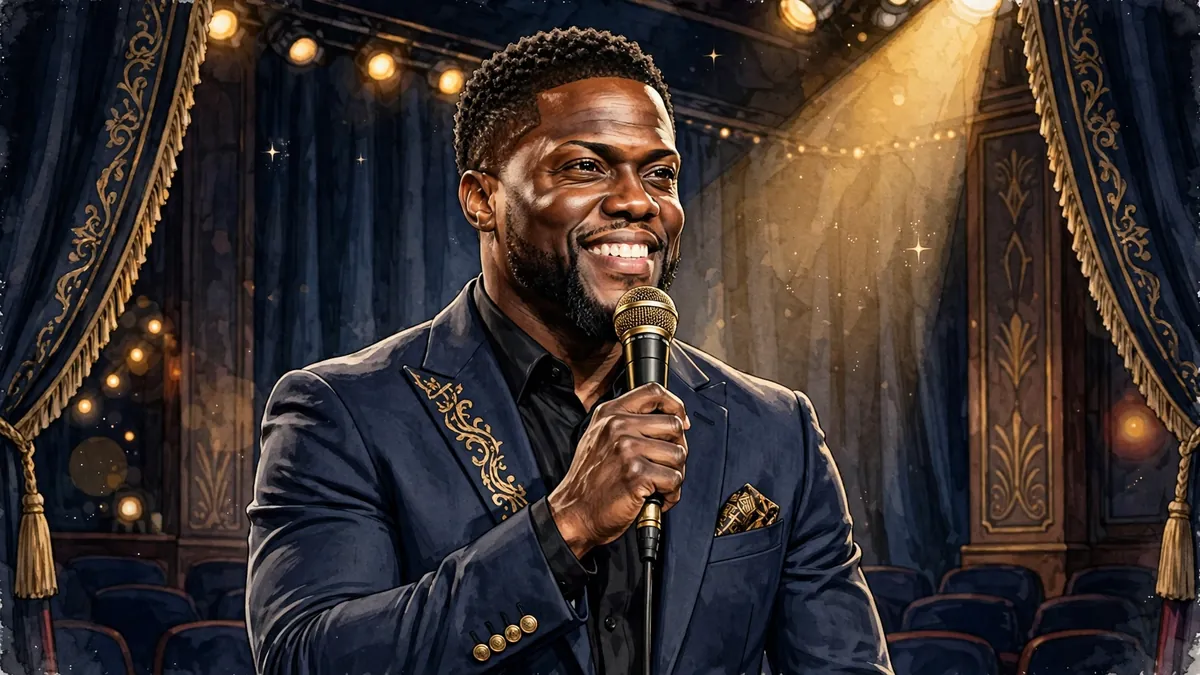
Early Life in North Philadelphia
Kevin Darnell Hart was born on July 6, 1979, in Philadelphia, Pennsylvania, the younger of two boys. He grew up in North Philadelphia, a neighbourhood he has described in his memoir I Can’t Make This Up (2017) as tough, loud and full of characters — the kind of place where a quick joke could defuse a tense moment and where being funny was a survival skill as much as a talent.
His mother, Nancy Hart, raised Kevin and his older brother Robert largely on her own. Nancy worked as a systems analyst for the Office of Student Registration and Financial Services at the University of Pennsylvania, and Hart has spoken often about her discipline, her faith and her refusal to let her sons drift. She died of cancer in 2007, just as his career was taking off, and he has said many times that she never got to see the full scale of what he became. That loss sits at the centre of his story: much of his drive, by his own account, comes from wanting to make the sacrifices she made worth something.
His father, Henry Witherspoon, struggled with cocaine addiction and spent much of Kevin’s childhood in and out of jail. Hart has never hidden that fact. In interviews and in his stand-up, he turned it into material — the absent father, the mother holding the household together, the kid who learned to make people laugh to cope with what was happening at home. The jokes were a way of managing a childhood that could easily have gone another way, and he has credited humour with keeping him out of trouble when friends around him were pulled into street life.
At George Washington High School in Northeast Philadelphia, Hart played on the swim team and started to notice that making classmates laugh gave him a standing he did not have anywhere else. After graduating, he enrolled briefly at the Community College of Philadelphia, then dropped out. He moved to New York City, then to Brockton, Massachusetts, where he worked as a shoe salesman — a job he later joked was his first real stage, because selling sneakers meant talking to strangers all day and learning how to read a room. The shoe job paid the bills while he figured out what he actually wanted to do, and the answer kept pointing back to the comedy clubs he had started visiting at night.
First Steps in Stand-Up: Lil Kev and the Laff House
Hart’s first stand-up performance took place at The Laff House in his native Philadelphia, at an amateur night, under the stage name “Lil Kev”. It did not go well. He was booed. The material was borrowed — he was doing impressions and bits that sounded like other comedians — and the crowd let him know it. Most people would have taken the hint. Hart took notes instead.
What followed was a long stretch of small rooms, long drives and thin pay. He worked comedy competitions across Philadelphia, New York and Boston, entered contests, lost plenty of them, and slowly learned the lesson that every working comic eventually learns: the audience does not care who you are trying to sound like, only whether what you are saying is true to you. His early act leaned on his height, his family, his failed relationships and the everyday humiliations of being a short man in a big man’s world. Once he started telling his own stories in his own voice, the rooms started to warm up.
Winning several stand-up competitions gave him his first real momentum. Club bookers who had ignored him started returning calls. He began getting regular spots in New York and Los Angeles, and the work taught him the discipline that still defines him: write every day, test material in small rooms, cut what does not land, and never blame the crowd. By the early 2000s he was a known name on the club circuit, even if the wider public had not caught up yet. The breakthrough, when it came, arrived through television rather than the stage.
Breakthrough: Undeclared, Paper Soldiers and the Long Climb
Judd Apatow cast Hart in a recurring role on the college comedy series Undeclared in 2001, giving him his first television foothold. His film debut followed in 2002 with Paper Soldiers, in which he played Shawn. Neither job made him famous overnight, but both put him in rooms with people who made decisions, and both taught him how a film set worked.
The next few years were a run of supporting parts and scene-stealing cameos: Scary Movie 3 (2003), Soul Plane (2004), Along Came Polly (2004), The 40-Year-Old Virgin (2005), Death at a Funeral and Little Fockers (2010). He was the funny friend, the fast-talking sidekick, the guy who could walk into a scene and lift it. It was steady work, but it was not stardom, and Hart has been open about the frustration of that period — being good enough to get hired and not yet big enough to carry a film.
The shift came from the stage, not the screen. His first stand-up album, I’m a Grown Little Man, arrived in 2009, followed by Seriously Funny in 2010. The specials built an audience that the film roles alone had not. People who had never seen him in a movie were quoting his routines, and the touring numbers started to climb. By the time Think Like a Man opened in 2012 and knocked The Hunger Games off the top of the box office — grossing more than $96 million — Hart was no longer the sidekick. He was a draw in his own right, and Hollywood started writing parts with him in mind rather than fitting him into other people’s films.
The Stand-Up Empire: Arena Tours and Specials
Stand-up is the engine of everything Hart built, and it is also the part of his career that is easiest to measure. Laugh at My Pain in 2011 was the turning point: the tour grossed more than $15 million, according to Wikipedia’s career summary, and the concert film went into theatres — something that almost never happened for a stand-up special at the time. It proved that a Black comedian could sell out arenas at a scale previously reserved for rock acts, and it set the template for everything that followed.
Let Me Explain followed in 2013, again released as a theatrical feature, and then came What Now?, the 2015–2016 world tour that ended with a filmed show in front of 53,000 people at Lincoln Financial Field in Philadelphia — his home city’s football stadium, filled for a comedy show. The image of a comedian from North Philadelphia filling an NFL stadium in his own town is the single best summary of how far the Laff House amateur night had travelled.

Touring stayed the most reliable money in his career. Forbes named him the highest-paid comedian in the world for the June 2015 to June 2016 period, estimating $87.5 million in pre-tax earnings across touring, film, endorsements and merchandise. For June 2018 to June 2019, Forbes estimated another $59 million, driven by a global stadium tour, sponsorships and a Netflix special. Those are earnings in a single year, before tax, management and agent fees — not net worth — but they explain why the fortune grew so fast: at his peak, Hart was earning in twelve months what most film stars earn in a decade.
Later specials kept the run going: Irresponsible (2019), Zero F**ks Given (2020), Reality Check (2023) and Acting My Age (2024). In May 2026, Netflix closed its Netflix Is a Joke festival with The Roast of Kevin Hart, a three-hour live event from the Kia Forum in Los Angeles hosted by Shane Gillis, with surprise appearances from Dwayne Johnson, Regina Hall and Katt Williams. Two years earlier Hart had hosted The Roast of Tom Brady on the same platform. The roast circuit, in other words, now runs through him — as host, as subject, and as the person whose presence signals that an event matters.
His height has always been part of the act, and he has never run from it. Listed heights for Hart vary between 5 ft 2 in and 5 ft 5 in depending on the source — Britannica lists 5 ft 4 in, while Hart himself told GQ, via Entertainment Weekly, that he is “5-foot-5, like with a shoe on”. For the full picture, including how the numbers differ and what he has said about them, see our Kevin Hart height profile. Fellow stand-up headliners who built the same kind of arena-touring business include Bill Burr, whose touring and special career followed a parallel path from clubs to arenas.
Hollywood Leading Man: Jumanji, Ride Along and Netflix
Ride Along (2014), opposite Ice Cube, turned Hart into a box-office leading man. He played Ben Barber, a fast-talking security guard desperate to impress his girlfriend’s detective brother, and the film’s success led to Ride Along 2 (2016). A third film is in production, with Tim Story — who directed the first two — attached to direct again. About Last Night (2014), Get Hard (2015) with Will Ferrell, and Central Intelligence (2016) with Dwayne Johnson followed in quick succession, and the Johnson pairing became one of the most bankable double acts in Hollywood.
The Jumanji films were the biggest step up. Jumanji: Welcome to the Jungle (2017) cast Hart as Franklin “Mouse” Finbar, and Jumanji: The Next Level (2019) brought the cast back. The franchise put him in front of the largest global audiences of his career, and it is a large part of why the Associated Press could report, in March 2024, that films featuring Hart have generated more than $4.23 billion in global box office. That number counts every film he appeared in, not just his own vehicles, but it is still the clearest single measure of his drawing power as a movie star.
Voice work added another lane: he voiced Snowball in The Secret Life of Pets films (2016–2019) and starred in Captain Underpants: The First Epic Movie (2017). On the dramatic side, Fatherhood (2021) on Netflix cast him as a widowed father raising a baby daughter alone, and the film’s success showed a different register — quieter, sadder, and further from the motor-mouth persona. True Story (2021), a Netflix limited series in which he played a comedian whose brother drags him into a crisis, pushed in the same direction, and Lift (2024), a Netflix heist film in which he played Cyrus Whittaker, kept him at the top of the streamer’s film slate.
Television has been a constant thread too. Real Husbands of Hollywood ran for five seasons as a spoof reality show built around Hart and his friends, and Die Hart turned his action-star ambitions into a joke about a comedian trying to become one. In 2024 he appeared in Peacock’s Fight Night: The Million Dollar Heist, and in 2026 his Netflix comedy 72 Hours — directed by Tim Story, released July 24, 2026 — became a streaming hit despite poor reviews, ranking seventh across all streaming platforms in its opening week according to Nielsen data reported by CBR. A new Jumanji film, Jumanji: Open World, is dated for Christmas Day 2026. Comedy film stars who made the same jump from stand-up stages to leading-man paydays include Jim Carrey, whose 1990s run set the template Hart’s generation followed.
The Money: How the Fortune Was Built
Here is where the numbers need care, because the published estimates for Kevin Hart disagree by a wide margin — and the disagreement itself is the story. Celebrity Net Worth, the most widely cited tracker, lists Hart at $300 million in its current page, updated May 12, 2026, with a snapshot dated November 5, 2026. The same page tallies roughly $639 million in pre-tax earnings from all sources between 2015 and 2025, including $60 million in 2025 alone. Biography.com reported a $400 million estimate in April 2026. CoinCodex, updated February 26, 2026, put the figure at $450 million, citing Celebrity Net Worth’s older estimate. Other 2026 roundups place him anywhere from $300 million to $500 million.
Our anchored range for this biography is therefore $300 million to $450 million, with Celebrity Net Worth’s current $300 million as the most recent single-source anchor and $400 million (Biography.com, April 2026) sitting inside the range. For the full money breakdown — the year-by-year earnings, the HartBeat valuation question and why the estimates moved down in 2026 — see our Kevin Hart net worth profile on our sister site NetWorthCraft.
Why do the estimates move so much? Almost all of the gap comes down to one question: what is HartBeat worth today? In April 2022, Abry Partners invested $100 million for a minority stake in HartBeat — reported as 15% — which implied a valuation of about $650 million for the whole company. Hart was the majority owner, and some outlets multiplied his reported 85% stake by that valuation and treated the result as personal wealth. That was never right: a private-company valuation is not cash, outside investors stand ahead of the founder, and the company has changed a great deal since 2022. Bloomberg reported in May 2026 that HartBeat had gone through layoffs, executive turnover and operating losses, and that proceeds from Hart’s January 2026 Authentic Brands deal helped buy out Abry. No public document gives a new HartBeat valuation, so any estimate that still prices Hart’s stake at the 2022 peak is out of date — which is why Celebrity Net Worth’s figure fell from the $400–450 million range to $300 million during 2026.
| Source | Figure | Date | What it actually measures |
|---|---|---|---|
| Celebrity Net Worth | $300 million | May 2026 (snapshot Nov 5, 2026) | Current headline net-worth estimate |
| Biography.com | $400 million | April 2026 | Published estimate, before the 2026 reset reporting |
| CoinCodex / Investormint | $450 million | Feb–Apr 2026 | Estimate built on the older HartBeat valuation |
| Forbes | $87.5 million | June 2015–June 2016 | Pre-tax earnings in one year, not net worth |
| Forbes | $59 million | June 2018–June 2019 | Pre-tax earnings in one year, not net worth |
| Celebrity Net Worth | $639 million cumulative | 2015–2025 | Pre-tax earnings over a decade, before tax, fees and spending |
| Abry Partners deal | $650 million | April 2022 | HartBeat company valuation at funding, not Hart’s bank balance |
The earnings themselves are better documented than the net worth. Forbes’ $87.5 million for 2015–16 and $59 million for 2018–19 are the two best single-year benchmarks, and Celebrity Net Worth’s $639 million cumulative tally for 2015–2025 gives the scale of the decade: touring at arena prices, film salaries, Netflix deals, endorsements with brands including Nike, Hyundai, Chase and Fabletics, and the media company. What nobody outside Hart’s own accountants knows is how much of that survived tax, agent and manager fees, divorce settlements, property purchases, business reinvestment and lifestyle spending. That is why honest estimates come as ranges, and why any site that prints a single precise number for Kevin Hart is guessing more than it admits.
The one number that matters most: $639 million in pre-tax earnings between 2015 and 2025 (Celebrity Net Worth). Whatever Hart is worth today, it was built on a decade of earning at a level very few comedians have ever reached — and on owning the company that produced his work, rather than renting himself out to studios by the film.
HartBeat, Laugh Out Loud and the 2026 Reset
Hart’s business instinct showed up early. He founded HartBeat Productions in 2009 to produce his own specials and films, so that the money from his work would flow through a company he controlled. In 2017 he launched Laugh Out Loud, a comedy platform built with Lionsgate, betting that a comedian could own his own distribution the way a studio executive owns a studio. In April 2022 the two were combined as Hartbeat, with Abry Partners investing $100 million at the reported $650 million valuation and Thai Randolph named chief executive of the merged company.
The vision was grand: HartBeat would become a platform other celebrities used, with Hart’s relationships and infrastructure behind it. The reality, as Bloomberg reported in a May 2026 investigation republished by the Los Angeles Times, was harder. Two chief executives left within about 15 months. Hart himself stepped in as CEO in January 2025 after the second departure. In late 2024, days before Thanksgiving, HartBeat cut roughly 20 of its 80 employees — about 25% of the workforce — and December 2025 brought another round that hit scripted television, marketing, social media and the podcast division. A planned Barbershop television adaptation stalled, Lil Kev season 2 was cancelled, and planned podcasts never launched.
Hart confirmed the cuts on The Breakfast Club in May 2026, saying HartBeat had cut nearly 25% of staff but pushing back firmly against reports that the company was closing. “Hartbeat is never going anywhere,” he said, framing the January 2026 deal with Authentic Brands Group as a strategic decision rather than an exit. Under that deal, Hart licensed his name, image and likeness to Authentic Brands Group — the company that manages the likenesses of Marilyn Monroe, Muhammad Ali, Shaquille O’Neal and David Beckham — with cash proceeds used partly to buy out Abry Partners. Bloomberg described the deal as a turning point that signalled the end of HartBeat as a standalone production company; Hart described it as a way to operate more efficiently. Both readings can be true at once: the company that was supposed to become a studio is now, in large part, a brand-licensing vehicle, while Hart himself remains one of the highest-paid entertainers in the world.
The legal fallout added to the strain. In January 2026, HartBeat sued two senior podcast executives, Eric Eddings and Lesley Gwam, who were fired on January 30, 2026, alleging they had put together a pitch deck for a competing podcast venture while still on the payroll; the company sought an injunction over breach of contract and trade-secret claims. The case is a reminder that the business side of Hart’s story is not a clean success narrative — it is a real company, with real staff, real losses and real disputes, and the 2026 reset is the honest context for any net-worth estimate published this year.
Gran Coramino, Hart House and Other Ventures
If HartBeat is the complicated part of Hart’s business story, Gran Coramino is the clean win. In 2022 Hart co-founded the premium tequila brand with Juan Domingo Beckmann, an eleventh-generation heir to the Jose Cuervo dynasty. The brand passed $200 million in cumulative retail sales by February 2026, according to Shanken News Daily reporting cited in 2026 net-worth coverage. Retail sales are not profit and not Hart’s personal income — the money is split across the company, distributors, retailers and his partner — but the scale is real, and it is the single best-performing consumer brand in his portfolio.

Hart House, his plant-based fast-food chain, tells the other side of the story. Launched with fanfare in Los Angeles in 2022, it expanded to several locations and then closed them all — every location had shut by the time 2026 coverage was published, and later profiles that still listed it as active were simply out of date. The closure is a useful check on celebrity business coverage: a launch gets headlines, a quiet closure often does not, and a biography written from old press releases will get the present wrong.
Other ventures fill out the picture. He has published books — I Can’t Make This Up (2017), a memoir, and the children’s book series built around it — and launched a fitness brand and app, acting as a very public advocate for early-morning workouts and disciplined training. He has invested in startups and taken endorsement deals across sportswear, cars, banking and nutrition. He also holds a stake in the tequila business through the Beckmann partnership, and his January 2026 Authentic Brands deal added licensing income and equity in a company whose whole business is turning famous names into durable brands. None of these ventures has a publicly disclosed value, which is another reason the net-worth range stays wide: the visible assets are real, the private ones are not priced.
Homes, Cars and Investments
Property is the most visible part of Hart’s wealth, and the reporting on it is patchy — purchase prices surface in property records, current values do not. What is documented: in 2012 he bought a house in Tarzana, California, reported at $1.99 million. In 2021 he bought a mansion in Calabasas reported at about $7 million, and separate reporting describes a larger Calabasas estate of more than 16 acres valued around $8 million. In 2019 he sold a two-storey home in the Mulholland Park area for a reported $2.75 million. These are purchase and sale prices from property reporting, not a full inventory — Hart owns more property than the public record neatly lists, and no outlet has published a verified list of everything he holds.
Cars are the other public passion. Hart is a well-known collector, and his garage has been covered in car magazines and on his own social channels for years. He has owned Ferraris, a Lamborghini, a Mercedes and a string of classic American muscle cars, including a 1970 Plymouth Barracuda that was badly damaged in the 2019 crash described below and later rebuilt. The collection is a hobby as much as an asset: classic cars can hold value, but they also cost a great deal to maintain, insure and restore, and treating a garage full of exotics as a simple line on a balance sheet would be misleading.
Investments beyond property and cars are mostly private. Hart has put money into startups and early-stage companies, and his HartBeat stake — whatever it is worth after the 2026 reset — remains his largest single business holding. The honest summary is that his wealth is concentrated in three places: cash earned from a decade of touring and film work, the HartBeat business, and property. The exact split is not public, and anyone who claims to know it is inventing detail.
Personal Life: Family, Fitness and Fatherhood
Hart married his first wife, Torrei Hart, in 2003. They had two children together — daughter Heaven, born in 2005, and son Hendrix, born in 2007 — and divorced in 2011, after filing in 2010. He married model Eniko Parrish on August 13, 2016, in Santa Barbara, California, with Hendrix serving as best man. Their son Kenzo Kash was born in November 2017, and their daughter Kaori Mai was born on September 29, 2020. Hart has four children in total, and fatherhood is the subject he returns to most often in interviews — the mistakes he made as a young father, the effort to be present now that his schedule allows it, and the way his own absent father shaped how he parents.
He turned 47 on July 6, 2026, and age has become a running theme in his recent work — Acting My Age, his 2024 special, is built around it, and the jokes about bad backs, early mornings and generational gaps landed because they are true. For the year-by-year picture, see our Kevin Hart age profile on our sister site GuideNetWorth.
Fitness is the other pillar of his daily life. Hart is famous for 5 a.m. workouts, long runs and a training routine he posts constantly, and he has built a small fitness brand around it. The discipline is not a pose: people who work with him describe a schedule that starts before dawn and runs through meetings, shoots and shows without gaps. It is also, by his own account, part of how he manages the pressure of a career that never really stops — the gym is where the noise goes quiet.
He splits his time between Los Angeles and work on the road, and his public life is unusually open for a star of his size: he posts constantly, tours constantly and talks about his family constantly. That openness has a cost, as the controversies below show, but it is also why his audience feels it knows him. The man on stage telling stories about his kids and his wife is not playing a character very far from the man at home.
Setbacks: The Oscars, the Crash and the Cheating Scandal
No honest biography of Kevin Hart skips the setbacks, because they are part of why the story is interesting — and because Hart himself has talked about them at length.
The biggest professional blow came in December 2018, when Hart was announced as host of the 2019 Academy Awards and then stepped down within days after old tweets containing homophobic jokes resurfaced. He initially refused to apologise, then apologised, then withdrew, saying he did not want to be a distraction from the ceremony. The episode cost him the biggest hosting job in entertainment and became a case study in how old social media posts can end a career moment overnight. Hart has since said the experience changed how he thinks about his words, and he returned to the Oscars conversation in 2024 when he hosted the Mark Twain Prize ceremony — a different stage, but the same industry watching.
In September 2019, Hart was a passenger in a serious car crash in Calabasas when his 1970 Plymouth Barracuda went off the road. He suffered back injuries that required surgery and months of rehabilitation, and he has spoken about the crash as a moment that forced him to slow down and reassess. The car was later rebuilt. The recovery was long and, by his own account, humbling for a man whose whole brand is relentless energy.
In 2017, while his wife Eniko was pregnant with Kenzo, Hart was caught in a cheating scandal after a video surfaced and an extortion attempt followed. He apologised publicly, and the episode became a long-running theme in his stand-up — he has joked about it, owned it and refused to pretend it did not happen. The marriage survived, and the couple’s second child, Kaori, was born in 2020. The scandal is worth recording plainly, without relish: it happened, he apologised, and it is part of the record.
There have been smaller storms too — the public falling-out with Katt Williams, who attacked Hart in a long 2024 interview, and the HartBeat lawsuits described above. Williams appeared as a surprise guest at The Roast of Kevin Hart in May 2026, which suggests the feud has cooled, or at least that both men understand the value of a good reconciliation on stage. Through all of it, Hart’s public response has been consistent: keep working, keep touring, and let the next project do the talking.
Awards and Recognition
The highest honour of Hart’s career arrived on March 24, 2024, when he received the Mark Twain Prize for American Humor at the Kennedy Center in Washington, becoming the 25th recipient of a prize whose past winners include Richard Pryor, George Carlin and Dave Chappelle. Chappelle, Chris Rock and Jerry Seinfeld were in the audience to pay tribute, and the ceremony aired on Netflix on May 11, 2024. Hart wiped away tears on stage — a rare unguarded moment for a performer whose default mode is a joke.
He received a star on the Hollywood Walk of Fame in 2018, was named to the TIME 100 list of most influential people in 2015, and has been nominated for two Grammy Awards (for his comedy albums) and four Primetime Emmy Awards. The Grammy and Emmy nominations matter because they show the range: he is recognised as a recording artist and a television performer, not just a film comedian. Dave Chappelle and Chris Rock, both present at the Mark Twain ceremony, are the two peers whose careers Hart’s is most often measured against — Chappelle as the conscience of stand-up, Rock as the bridge between stand-up and film stardom that Hart crossed a generation later.
Kevin Hart in 2026 and What Comes Next
As of November 2026, Hart is 47, still touring, still making Netflix films, and in the middle of a business reset that will define the next phase of his career. 72 Hours (July 2026) proved his streaming audience is still there even when critics are not kind. Jumanji: Open World arrives on Christmas Day 2026, and Ride Along 3 is in production. An untitled Netflix spy action-comedy directed by McG, announced in May 2026, is on the slate, with The Leading Man opposite John Cena also in development.
The open question is what HartBeat becomes. The company that was supposed to be a studio is now a smaller, licensing-led business, and Hart’s deal with Authentic Brands Group points to a future in which his name itself is the product — licensed, managed and monetised by specialists, while he focuses on performing. That is a reasonable model for a 47-year-old star with a huge audience and a proven work rate, but it is a different model from the empire-building of 2022, and the net-worth estimates will keep moving until the new shape of the business is clear.
What is not in doubt is the foundation. A comedian who was booed at his first amateur night built a career that filled football stadiums, carried film franchises past $4 billion at the box office, earned $639 million before tax in a single decade, and won the Mark Twain Prize. The businesses around that career will rise and fall — Hart House closed, HartBeat shrank, Gran Coramino passed $200 million in retail sales — but the stage work is the constant. As long as Hart keeps touring, the fortune has a floor under it that most celebrity wealth does not.
For more on the people and places in this story, see our Biography category, which covers the lives behind the fame across film, comedy, sport and music.
Frequently Asked Questions
What is Kevin Hart’s net worth in 2026?
Kevin Hart’s estimated net worth in 2026 sits in a range of $300 million to $450 million. Celebrity Net Worth lists $300 million in its May 2026 update, Biography.com reported $400 million in April 2026, and other 2026 roundups still carry $450 million. No public filing confirms any single figure, so the range — not one number — is the honest answer.
How old is Kevin Hart?
Kevin Hart was born on July 6, 1979, in Philadelphia, Pennsylvania, which makes him 47 years old as of November 2026. He turned 47 on July 6, 2026.
How tall is Kevin Hart?
Reported heights for Kevin Hart vary between 5 ft 2 in and 5 ft 5 in depending on the source. Britannica lists 5 ft 4 in, while Hart himself has said he is 5 ft 5 in with shoes on. His height has been a running joke in his stand-up for his whole career.
Who is Kevin Hart’s wife?
Kevin Hart is married to Eniko Parrish, whom he wed on August 13, 2016, in Santa Barbara, California. They have two children together, Kenzo Kash and Kaori Mai. Hart was previously married to Torrei Hart from 2003 to 2011, with whom he has two children, Heaven and Hendrix.
How many children does Kevin Hart have?
Kevin Hart has four children: daughter Heaven (born 2005) and son Hendrix (born 2007) from his first marriage to Torrei Hart, and son Kenzo Kash (born November 2017) and daughter Kaori Mai (born September 29, 2020) with his wife Eniko Hart.
What is HartBeat, Kevin Hart’s company?
HartBeat is Kevin Hart’s media company, formed in April 2022 by combining HartBeat Productions (founded 2009) and Laugh Out Loud (launched 2017). Abry Partners invested $100 million at a reported $650 million valuation. In 2024–2025 the company cut about 25% of its staff, Hart became CEO in January 2025, and a January 2026 deal with Authentic Brands Group licensed his name, image and likeness, with proceeds used partly to buy out Abry.
Why did Kevin Hart step down from hosting the Oscars?
Kevin Hart was announced as host of the 2019 Academy Awards in December 2018 and stepped down within days after old tweets containing homophobic jokes resurfaced. He apologised and withdrew, saying he did not want to be a distraction from the ceremony. He has since said the experience changed how he thinks about his words.
What are Kevin Hart’s biggest movies?
Kevin Hart’s biggest films include Think Like a Man (2012), Ride Along (2014), Central Intelligence (2016), Jumanji: Welcome to the Jungle (2017) and Jumanji: The Next Level (2019), The Secret Life of Pets (2016), Fatherhood (2021), Lift (2024) and 72 Hours (2026). Films featuring Hart have grossed more than $4.23 billion worldwide, according to Associated Press reporting from March 2024.
Final Thoughts
Kevin Hart’s biography is not a story about overnight fame. It is a story about a kid from North Philadelphia who got booed at his first gig, spent a decade learning his craft in small rooms, and then built — joke by joke, tour by tour, film by film — one of the biggest careers in comedy. The fortune, honestly stated, is $300 million to $450 million as of 2026, and the businesses around it are in flux: HartBeat is smaller than it was, Gran Coramino is bigger than anyone expected, and the next chapter will be written by licensing deals and Netflix films rather than by a media empire.
What stays constant is the work. At 47, Hart is still on stage, still filling rooms, still making films that people watch in huge numbers even when critics shrug. The Mark Twain Prize in 2024 was the establishment’s verdict; the arena crowds are the audience’s. Both agree on the same thing: the kid who started as Lil Kev at the Laff House became one of the defining comedians of his generation, and the story is not finished yet.
Sources and How We Estimated
Named sources for this biography: Celebrity Net Worth (net-worth estimate $300 million, May 2026 update; $639 million cumulative pre-tax earnings 2015–2025); Forbes ($87.5 million estimated pre-tax earnings, June 2015–June 2016; $59 million, June 2018–June 2019); Biography.com ($400 million estimate, April 2026); Associated Press (films grossing more than $4.23 billion; Mark Twain Prize, March 2024); Wikipedia (career timeline, tour grosses, filmography); Bloomberg via the Los Angeles Times (HartBeat layoffs, leadership changes and the January 2026 Authentic Brands Group deal, May 2026); Shanken News Daily (Gran Coramino passing $200 million in cumulative retail sales, February 2026); Entertainment Weekly (Hart on his height, via GQ).
How we estimated: no public filing discloses Kevin Hart’s personal balance sheet, so every net-worth figure is an estimate. We anchored on the most recent named-source figure — Celebrity Net Worth’s $300 million (May 2026) — and published the range $300 million to $450 million because Biography.com ($400 million, April 2026) and other 2026 roundups ($450 million) fall inside it and disagree with each other. Earnings figures are pre-tax and before agent, manager and legal fees unless stated otherwise. Company valuations (HartBeat, $650 million in April 2022) describe the whole private company at a funding round, not Hart’s personal wealth, and are not used as a net-worth figure. Retail sales (Gran Coramino, $200 million cumulative) are consumer sales, not profit. Where sources conflict — most notably on height (5 ft 2 in to 5 ft 5 in) and on net worth — we report the disagreement rather than picking one number and hiding the rest. Estimates may differ from private reality, and this page will be updated as new named-source reporting lands.