By Celebamerica Editorial Staff | Last updated: November 17, 2026
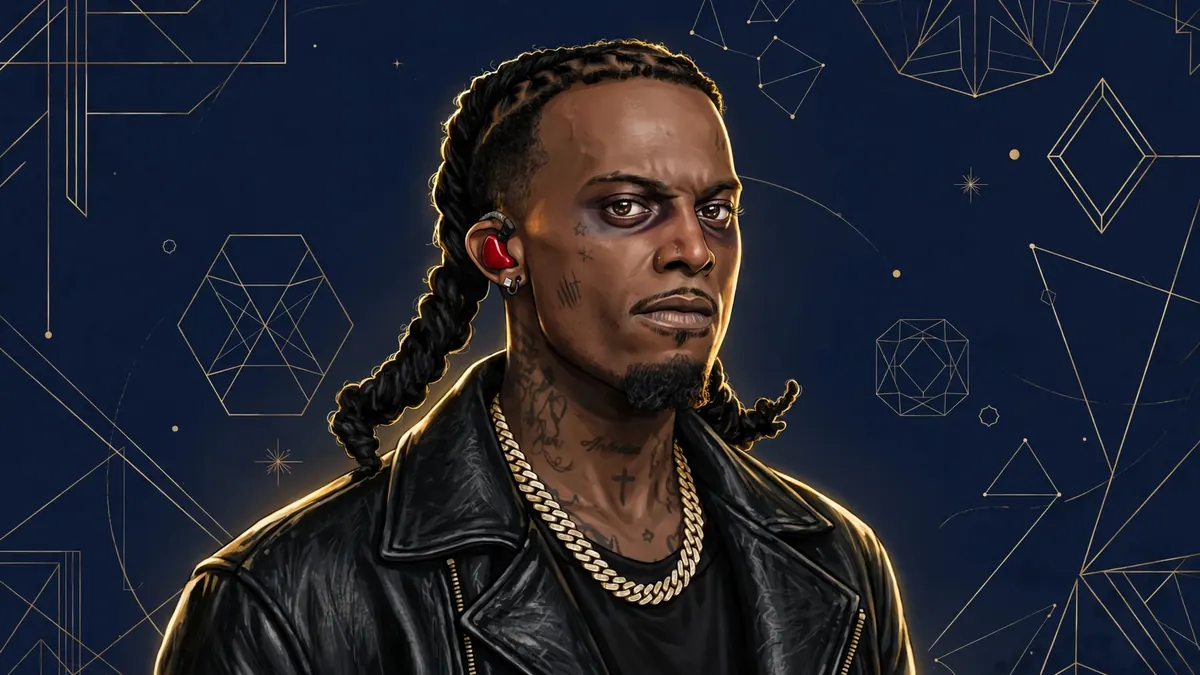
Playboi Carti’s net worth in 2026 is estimated at somewhere between $9 million and $25 million, with the most widely cited source — Celebrity Net Worth — contradicting itself on its own page, printing $12 million in its headline and fact box while its body text says $20 million. That spread is the honest answer. Carti, born Jordan Terrell Carter in Atlanta, has spent a decade turning a SoundCloud start into two Billboard 200 number-one albums, a sold-out arena tour, and his own record label, Opium — but he discloses almost nothing about his personal finances, so every published figure is an estimate built from public clues rather than an audited balance sheet.
This profile settles the headline figure the way the evidence demands: as a range, anchored on Celebrity Net Worth’s $12 million to $20 million, with the lower and higher ends named and dated. Below it, the full picture — the Atlanta beginnings, the “Magnolia” breakout, the five-year wait for MUSIC, the Antagonist Tour, the Opium label, the fashion work, and the legal trouble that has followed him — each tied to the sources that reported it.
Quick Facts: Playboi Carti
| Full Name | Jordan Terrell Carter |
|---|---|
| Date of Birth | September 13, 1995 (some sources print 1996 — see the note below the table) |
| Birthplace | Atlanta, Georgia, United States (raised in the suburb of Riverdale) |
| Estimated Net Worth (2026) | $9 million – $25 million; anchored on Celebrity Net Worth’s $12 million – $20 million |
| Primary Income Sources | Music streaming and sales, touring, merchandise, Opium record label, fashion and brand work |
| Key Works | Playboi Carti (2017 mixtape), Die Lit (2018), Whole Lotta Red (2020), MUSIC (2025) |
| Labels | Awful Records (early), AWGE / Interscope Records, Opium (his own label, founded 2019) |
| Height | About 6 ft 1 in (185 cm) |
| Children | Son Onyx Carter, born June 2020, with rapper Iggy Azalea |
A note on the birth year: most profiles, including the widely cited biographical record, give September 13, 1995. Wikipedia’s current entry hedges it as “September 13, 1995 or 1996,” and at least one 2026 biography prints 1996 outright. This article uses 1995, the date carried by the majority of sources, and treats him as 31 years old as of November 2026. The one-year gap changes nothing about the money, but it is worth stating plainly because so many net-worth pages copy a birth year without checking it.
Table of Contents
- Quick Facts: Playboi Carti
- The Net Worth Estimate: Why the Numbers Disagree
- Early Life: Riverdale, Atlanta, and the Sir Cartier Years
- Career Rise: SoundCloud, Magnolia, and Die Lit
- Whole Lotta Red and the Vampire Era
- MUSIC in 2025: The Comeback Album That Reset the Math
- Touring Money: The Antagonist Tour and Stadium Support Slots
- Where the Money Comes From: Income Streams in Detail
- Opium: The Label That Turned a Rapper Into an Executive
- Fashion, Modelling, and Brand Work
- Assets and Lifestyle: Cars, Jewellery, and Real Estate
- Net Worth Growth Timeline
- How Carti Compares: Peer Rappers in the Same Bracket
- Personal Life: Iggy Azalea, Onyx, and Privacy
- Legal Issues and Controversies
- Frequently Asked Questions
- Final Thoughts: The Bottom Line
- Sources and How We Estimated
The Net Worth Estimate: Why the Numbers Disagree
Ask ten sites what Playboi Carti is worth and you will get nearly ten answers. That is not sloppy reporting on any one site’s part — it is what happens when a star’s income is real, large, and almost entirely private. Carti has never published a balance sheet, given a money interview, or filed a public disclosure of his assets. What exists instead is a set of estimates built from chart positions, tour dates, label ownership, and the occasional court filing. Here is what each of the main sources actually prints, with dates, so the reader can judge the spread for themselves.
| Source | Figure printed | Date / note |
|---|---|---|
| Celebrity Net Worth | $12 million in the headline and fact box; $20 million in the body text | Page snapshot November 6, 2026; body text updated August 27, 2026 |
| CelebriHub | $25 million | February 2026; credits the MUSIC album and the Antagonist tour |
| ScoopMeadow | $9 million | January 2026 |
| Networth202 | $9 million | Updated November 2, 2026 |
| The Parallax Wire | $10 million | November 2026 |
| CheckCharm | $10 million – $15 million | 2026 |
| Daily Odyssey | $8 million – $10 million | November 2025 |
| The Most 10 | $20 million | June 2025 |
The single most telling entry in that table is the first one. Celebrity Net Worth is the source most other net-worth pages lean on, and its own Playboi Carti page currently carries two different figures at once: $12 million up top and $20 million in the narrative. The page’s body text was updated in August 2026, apparently without the headline figure being changed to match. One specialist audit of the page, published by Net Worth VIP in September 2026, called the contradiction out directly and declined to publish either number as fact, noting that the page supplies no asset list, debt schedule, or reconciliation to back either figure.
That audit is the right instinct, and it shapes how this profile reports the number. The defensible statement is a range: about $9 million to $25 million, anchored on Celebrity Net Worth’s $12 million to $20 million. The low end reflects the pre-MUSIC estimates that were still circulating in early 2026. The high end reflects CelebriHub’s February 2026 read, which prices in the MUSIC album cycle and the arena tour that followed it. The middle of the range — roughly $12 million to $20 million — is where the best-known estimator sits, even if it cannot agree with itself.
Why the range is wide: Carti’s biggest paydays are also his least transparent ones. Touring guarantees, label equity in Opium, merchandise margins, and streaming splits are all private contracts. A rapper with two number-one albums and a 30-date arena tour is plainly earning at a scale the $9 million figure understates — but nothing in the public record supports stamping $25 million on him as settled fact either. The range is the estimate; the single number would be a guess dressed up as one.
CelebriHub also prints an annual salary estimate of $3 million to $5 million a year for Carti, tied to music, touring, merchandise, and Opium. Treat that as their working assumption rather than a reported salary: no contract or filing backs it, and a touring year like 2025 would look very different from a quiet year like 2022 or 2023, when Carti released no album at all.
One more caution from the public record is worth carrying through the rest of this article. A 2021 federal complaint, Reilly v. UMG Recordings, quoted a merchant’s figures for a single Carti merchandise drop: about 6,000 units sold, just under $250,000 in gross sales, and roughly $56,000 in royalties said to be due to Carti — about 22 cents per sales dollar. Those are pleaded figures about one drop, not an audited career margin, and they show how thin the hard evidence is: the most concrete dollar amounts anyone can point to for Carti’s business cover a single merch release, not a career.
Early Life: Riverdale, Atlanta, and the Sir Cartier Years
Jordan Terrell Carter was born in Atlanta, Georgia, and grew up in Riverdale, a suburb south of the city that has produced a long line of trap and SoundCloud-era talent. Little is reliably documented about his parents or his schooling — Carti has guarded his family background from the start, and the profiles that claim detail usually cite each other rather than an interview or a record. What is solid is the timeline of the music itself: he began releasing tracks on SoundCloud in 2011 under the name Sir Cartier, at around fifteen or sixteen years old, part of the first wave of Atlanta teenagers who treated the platform as a label, a radio station, and a fan club all at once.
The Sir Cartier period matters to the money story because it explains how Carti learned to build an audience without spending one. There was no marketing budget, no radio push, and no label advance behind those early uploads. The audience arrived track by track, drawn to a delivery that sounded like nothing else on the platform: high-pitched, baby-voiced ad-libs, repeated phrases used as hooks, and beats that left wide open space for the voice to sit in. Producers in the Atlanta underground — most notably Pierre Bourne, who would become his defining collaborator — built soundscapes around that voice rather than asking it to fit a standard rap template.
By 2014, the local scene had noticed. Carti signed with Awful Records, the Atlanta underground label run by Father, a deal that put him inside a working collective of like-minded artists rather than a major-label machine. The Awful years gave him his first real shows, his first press, and a network that included UnoTheActivist, his cousin and a rapper in his own right. It also gave him a reputation for being hard to pin down: shows cancelled, verses arriving late, interviews almost never given. That elusiveness would later become part of the brand — scarcity as a marketing strategy — but in 2014 it was simply how a teenager from Riverdale operated.
The move that changed the scale of everything came in 2016, when Carti signed with AWGE, the label run by A$AP Rocky and the A$AP Mob, in a joint venture with Interscope Records. Forbes described the recording contract as a six-figure agreement — the only hard dollar figure attached to any Carti deal in the public record — and reported separately that he earned a six-figure payday from an Adidas advertising campaign during the same early breakout period. Both figures come to us second-hand, via Celebrity Net Worth’s reporting of the Forbes items, but they are the closest thing to documented deal money in Carti’s whole career. A six-figure label advance in 2016, for an artist with no album out, was a serious bet: it meant a major label believed the SoundCloud numbers would convert into real sales.
Carti also joined the A$AP Mob orbit as a member, which put him on stages and in rooms far beyond Atlanta. The association gave him fashion-world access — A$AP Rocky was already a front-row fixture — and it taught him the value of the visual side of rap stardom: the clothes, the hair, the refusal to look like anyone else on a lineup. That lesson would pay off repeatedly in the years that followed, in modelling work and brand partnerships that a rapper of his streaming numbers alone might not have commanded.
Career Rise: SoundCloud, Magnolia, and Die Lit
The breakout arrived in 2017, and it arrived as a single song. “Magnolia,” produced by Pierre Bourne, was released as part of Carti’s self-titled debut mixtape in April 2017 and became the kind of record that rearranges a career in weeks. Its hook — built around the repeated phrase “in New York I Milly Rock” — was simple enough to chant and strange enough to remember, and the song climbed into the top 30 of the Billboard Hot 100, a remarkable showing for a SoundCloud rapper’s first commercial single. The mixtape itself, released through AWGE and Interscope, established Carti as a commercial artist rather than an internet curiosity, and “Magnolia” went on to become his signature song, the one still shouted back at him on every tour.
What “Magnolia” proved was that Carti’s oddest qualities were his most commercial ones. The baby voice, the ad-libs, the refusal to rap in full sentences — all of it read as a limitation to traditionalists and as a sound to a generation raised on SoundCloud. Streaming rewarded it: the song’s replay value was enormous, and its short runtime made it a playlist staple. The mixtape’s other tracks, including “wokeuplikethis” featuring Lil Uzi Vert, showed that the formula worked with collaborators too, and the Uzi link connected Carti to the other great SoundCloud star of the moment.
The follow-up, Die Lit, arrived on May 11, 2018, and it did something harder than producing a hit single: it proved Carti could carry a full album. The record debuted at number three on the Billboard 200, carried features from Nicki Minaj, Travis Scott, and Lil Uzi Vert, and leaned even further into Pierre Bourne’s bright, synth-heavy production. Critics who had dismissed Carti as a one-song act had to reckon with a coherent album that held together across nineteen tracks, and fans rewarded it with the kind of long-tail streaming that keeps paying for years. Die Lit is still the album many listeners name as their favourite Carti project, and its songs remain fixtures of his live set.
Between the mixtape and Die Lit, Carti also began the pattern that would define his career: long silences followed by sudden, enormous releases. He does not feed the content machine. He disappears, lets anticipation build, and returns with a full project rather than a drip of singles. The strategy costs him steady streaming income in the quiet years and pays him back in event-level attention when he returns — a trade-off that makes year-to-year earnings unusually lumpy and helps explain why net-worth estimates swing so widely depending on when they were written.
The features kept coming through the late 2010s and early 2020s: verses for Travis Scott, Drake, Lil Uzi Vert, and others, each one a payday and a reminder that Carti’s voice was one of the most requested textures in rap. He also began to appear in fashion contexts that had nothing to do with music — front rows, campaigns, magazine shoots — building the second pillar of his income and his image at the same time.
Whole Lotta Red and the Vampire Era
If Die Lit proved Carti could make an album, Whole Lotta Red proved he could move a culture. Released on Christmas Day 2020, after two years of teasing, leaks, and fan frenzy, the album debuted at number one on the Billboard 200 — Carti’s first chart-topper — and it did so with a sound that was deliberately harder, darker, and more abrasive than anything he had released before. The bright synths of Pierre Bourne were largely replaced by the distorted, punk-inflected production of F1lthy and the Working on Dying collective, and Carti’s voice dropped into a lower, raspier register that fans quickly named the “vampire” voice.
The vampire era was more than a sound. It was a full visual world: black and red, gothic fonts, horror imagery, and a stage persona that owed as much to punk and metal as to rap. Carti leaned into it completely, and the audience followed — Whole Lotta Red sold on the strength of the event as much as the music, with fans who had waited two years buying, streaming, and arguing about it in the same week. The album’s divisive reception was itself a form of marketing: people who hated it still talked about it, and the talk kept it on the charts.
Commercially, the album reset Carti’s earning power. A number-one album, a devoted fanbase willing to buy merchandise at premium prices, and a live show built around mosh-pit energy made him a festival headliner rather than a support act. The King Vamp tour that followed carried the vampire aesthetic onto arena stages, and the merch — black hoodies, gothic lettering, limited drops that sold out in minutes — became a serious revenue line in its own right. It was during this period that the merchandise economics quoted in the 2021 court complaint were generated: limited drops, high demand, and a direct line from fan enthusiasm to cash.
The album also widened the gap between Carti and his peers. Where other SoundCloud-era rappers softened their sound to chase radio, Carti doubled down on the strangest version of himself and was rewarded with his biggest commercial result. That lesson — that his audience wants the extreme version, not the safe one — shaped everything that followed, including the five-year wait for the next album.
MUSIC in 2025: The Comeback Album That Reset the Math
For five years, the question in rap was when Playboi Carti would release another album. The answer arrived on March 14, 2025, when MUSIC — also styled as I Am Music — was released through AWGE and Interscope Records. The standard edition ran to 30 tracks and featured guest appearances from Travis Scott, the Weeknd, Kendrick Lamar, Jhené Aiko, Skepta, Future, Lil Uzi Vert, Ty Dolla Sign, and Young Thug, with hosting from DJ Swamp Izzo. It was, by any measure, an event release: the guest list alone read like a festival lineup, and the five-year gap had turned the album into the most anticipated rap release of the year.
The numbers matched the anticipation. MUSIC debuted at number one on the Billboard 200 with 298,000 album-equivalent units in its first week, making it Carti’s second number-one album, his fastest-selling, and the highest-selling rap debut of 2025 at that point. All 30 tracks debuted on the Hot 100 simultaneously, a chart feat that speaks to how completely the album dominated its release week. A deluxe edition, MUSIC – Sorry 4 Da Wait, followed on March 25, 2025, adding four more tracks, and the album was certified Platinum by the RIAA on March 13, 2026. SeatGeek’s album guide also notes the record became the most-streamed rap album in a single day in 2025, with 134 million streams — a figure that shows the scale of the listening even if streaming totals are not the same thing as royalty cheques.
For the net-worth question, MUSIC is the hinge. The estimates written before March 2025 — the $8 million to $10 million figures — describe a rapper who had not released an album in over four years. The estimates written after it — CelebriHub’s $25 million, the $20 million readings — price in a number-one album, a deluxe edition, a Platinum certification, and the arena tour that followed. Neither set is wrong about its own moment; they are simply measuring different Cartis. A reader comparing a January 2026 estimate with a February 2026 one is not looking at a disagreement about the same facts, but at two snapshots taken on either side of the biggest commercial event of his career.
It is also worth saying plainly what MUSIC‘s success does not prove. Album-equivalent units measure consumption, not Carti’s personal payout. A 298,000-unit week generates real money — streaming royalties, sales, and the touring demand that follows — but the split between artist, label, producers, featured guests, and managers is private, and the copyright records show Interscope or Universal Music Group as the claimant on most of his registered sound recordings, often with AWGE as an additional claimant. Carti personally holds trademark rights — a US Patent and Trademark Office registration issued in April 2024 lists Jordan Carter as the owner for entertainment and recorded-media services — but the masters picture is a label picture, not a personal one. The album made him richer; the public record does not say by how much.
Touring Money: The Antagonist Tour and Stadium Support Slots
For a rapper of Carti’s standing, touring is where album success turns into cash. Recorded music pays in fractions of a cent per stream, spread across many hands; a sold-out arena pays in guarantees, merchandise, and fees that land in weeks rather than trickling over years. Carti’s 2025 touring schedule was the most ambitious of his career, and it is the single biggest reason the post-MUSIC net-worth estimates jumped.

The headline run was the Antagonist Tour, announced in August 2025 and staged from October 3 to December 1, 2025, opening at the Delta Center in Salt Lake City and closing at State Farm Arena in Atlanta. Twenty-eight dates were announced initially, with the count rising to 31 after extra Texas dates were added. The venues tell the story of the scale: Crypto.com Arena in Los Angeles, MGM Grand Garden Arena in Las Vegas, the United Center in Chicago, TD Garden in Boston, Barclays Center in Brooklyn. Pollstar presented it as Carti’s first solo headlining tour since 2021, and the openers were drawn entirely from his own Opium roster — Ken Carson, Destroy Lonely, Homixide Gang, and Apollo Red — which meant the tour doubled as a showcase for the label he owns.
Alongside the headline run, Carti spent much of 2025 and 2026 supporting the Weeknd on the After Hours til Dawn Tour, a stadium run that put him in front of crowds far larger than his own arena shows. Support slots pay less per night than headlining, but they pay in exposure: tens of thousands of new listeners a night, in markets where his own tour might not yet sell out. The Weeknd’s audience and Carti’s overlap only partly, which is exactly what makes the slot valuable — it is an introduction to listeners who might never have sought him out.
What did the touring earn him? No promoter, venue, or agency has published a figure, and this profile will not invent one. What can be said with confidence is that a 30-date arena tour plus a stadium support run is a multi-million-dollar gross enterprise, and that Carti’s share — after promoter splits, production costs, crew, travel, and management — is the largest single income event of his career to date. It is also the income line most exposed to costs: arena staging for a show as visual as Carti’s is expensive, and the vampire-era production values do not come cheap. Gross and net are different numbers, and only the gross is visible from the outside.
The merchandise table is the other half of the touring story. Carti’s limited drops have a history of selling out fast, and arena crowds are the ideal market for them: fans who have already paid for a ticket, standing in a venue where the only place to buy the tour hoodie is the stand in front of them. The 2021 complaint’s figures — a single drop generating just under $250,000 in sales — date from before the arena era. A tour-stand version of that same drop, across 30 dates, is plainly a larger business, even if the per-unit royalty rate stayed the same.
Where the Money Comes From: Income Streams in Detail
Carti’s wealth, such as it is, comes from five streams that behave very differently. Understanding the range in his net-worth estimates means understanding how uneven those streams are — and how much of each one he actually keeps.
Streaming and recorded music. This is the foundation and the slowest payer. Four projects — the 2017 mixtape, Die Lit, Whole Lotta Red, and MUSIC — plus a long list of guest verses generate streaming royalties every day, with MUSIC‘s 2025 numbers dwarfing the earlier catalogue in any single week. But per-stream rates sit in the fractions of a cent, the label takes its share before the artist sees anything, and producers and featured artists take theirs too. The catalogue is valuable — it earns while Carti sleeps — but it is not the stream that makes him rich in any single year. Its real value is as a base: steady, growing, and permanent.
Touring and live performance. The biggest single-year earner, and the most volatile. A touring year like 2025, with an arena headline run and a stadium support slot, can produce more income in three months than the catalogue produces in three years. A quiet year produces almost nothing from this line. That volatility is the main reason estimates written in different years disagree so sharply: they are catching different points in the touring cycle.
Merchandise. Carti’s merch operation runs on scarcity — limited drops, gothic designs, prices that reflect demand rather than cost. The model works because his fans treat the clothing as part of the identity, not just a souvenir. The one hard data point, the 2021 complaint’s $56,000 in royalties on just under $250,000 of sales from a single drop, suggests a royalty rate of roughly 22 cents per sales dollar on that release. Applied across a career of drops, the line is meaningful, but it is also the line most often exaggerated in fan-written profiles, where gross sales are routinely quoted as if they were profit.
Opium and label income. Covered in full in the next section, but the short version is that Carti earns as an owner, not just as an artist: a share of his signees’ recordings, touring, and merchandise, plus the value of the label itself as an asset. This is the stream with the most upside and the least public evidence.
Fashion, modelling, and brand work. The six-figure Adidas payday from his early breakout, reported by Forbes, is the only documented brand cheque in his career. Since then, the work has been visible — front rows, campaigns, high-fashion associations with houses like Givenchy and Balenciaga noted in 2026 profiles — but the fees are not. Fashion pays Carti in two currencies: direct fees for modelling and campaigns, and the cultural status that lets him charge more for everything else. The second currency is probably worth more than the first, and it is entirely unquantifiable.
| Income stream | How it pays | What we actually know |
|---|---|---|
| Streaming and sales | Royalties per stream and sale, split with label and collaborators | Two No. 1 albums; MUSIC did 298,000 units in week one; MUSIC certified Platinum March 2026 |
| Touring | Guarantees and ticket shares, minus production and crew costs | Antagonist Tour, 28–31 arena dates, Oct–Dec 2025; Weeknd stadium support 2025–2026 |
| Merchandise | Direct sales and royalties on limited drops | One 2021 drop: ~$250,000 gross sales, ~$56,000 royalties due (pleaded figures) |
| Opium label | Owner’s share of signees’ music, touring, and merch | Founded 2019; Ken Carson, Destroy Lonely, Homixide Gang, ASAP Nast on the roster |
| Fashion and brands | Campaign and modelling fees | Six-figure Adidas payday reported by Forbes; later high-fashion associations, fees undisclosed |
Opium: The Label That Turned a Rapper Into an Executive
In 2019, Carti founded Opium — occasionally styled as 00pium — a record label and rap collective based in Atlanta. The move is the most consequential business decision of his career, and the one that most separates him from rappers who simply earn and spend. Opium is not a vanity imprint. It is a working label with a roster, a sound, and a touring operation, and its artists — Ken Carson, Destroy Lonely, the duo Homixide Gang, and fellow A$AP Mob member ASAP Nast — have become a genuine movement inside modern rap, carrying the rage and punk-inflected sound Carti pioneered into a second generation.

The label’s economics work in Carti’s favour in a way his own recording career does not. As an artist on AWGE and Interscope, he splits his recording income with a major label. As the owner of Opium, he sits on the other side of that split for his signees’ work — taking an owner’s share of their recordings, their touring, and their merchandise, while the artists themselves do the performing. Ken Carson’s rise has been the clearest proof of the model: Carti served as executive producer on Carson’s album X in July 2022, featured on Carson’s More Chaos album in April 2025 on the song “Off the Meter” alongside Destroy Lonely, and then took both Carson and Destroy Lonely on the road as his Antagonist Tour openers. Each of those moves raised the value of the label and, by extension, the value of Carti’s stake in it.
Opium is also a creative agency in the broader sense — the label’s visual identity, its producers (including F1lthy, KP Beatz, and Lil 88), and its whole dark, vampiric aesthetic are a single package, and Carti is its creative director as much as its owner. That matters for valuation: a label with a distinct sound and a loyal audience is worth more than a collection of contracts, because the audience follows the brand from artist to artist. The Antagonist Tour was the fullest expression of that idea — four Opium acts on one arena bill, presented as a movement rather than a support slot.
None of this can be priced precisely from the outside. Opium is private, its deals are private, and no revenue figure has ever been published. But any serious estimate of Carti’s wealth has to include it, and the estimates that ignore it — the ones that treat him as a solo artist with a streaming catalogue — will always come in low. The $25 million end of the range is, in effect, the estimate that takes Opium seriously; the $9 million end is the one that does not.
Fashion, Modelling, and Brand Work
Carti’s second career is fashion, and it has been there from the beginning. The A$AP Mob connection put him in front of designers early, and his instinct for clothes — the skinny silhouettes, the gothic accessories, the refusal to dress like a conventional rapper — made him a natural model and muse. The six-figure Adidas advertising payday reported by Forbes during his early breakout was the first documented evidence that brands would pay for that instinct, and it arrived before he had an album out.
Since then, the fashion work has grown with the music. He has walked runways, fronted campaigns, and sat front row at shows where his presence is itself a statement. Profiles published in 2026 note creative partnerships with high-fashion houses including Givenchy and Balenciaga during the MUSIC era, and his vampire-era styling — black leather, silver jewellery, dark makeup — became a look that fans copied and brands courted. None of these arrangements comes with a published fee, which is normal for fashion work at this level: the deals are private, the terms are bespoke, and the value is often in product, access, and association as much as in cash.
The honest way to value the fashion line is as a multiplier rather than a standalone fortune. Carti is not a fashion mogul with a brand of his own — he has no clothing line with published revenues, and this profile will not pretend otherwise. What fashion gives him is leverage: a higher profile, a more distinctive image, and a reason for brands to call him before they call a rapper with similar streaming numbers but no visual identity. That leverage shows up in his touring fees, his merchandise prices, and his negotiating position with labels — all of which are real money, even if the fashion fees themselves stay private.
Assets and Lifestyle: Cars, Jewellery, and Real Estate
This is the section where most net-worth profiles go wrong, and it is worth saying why before listing anything. Carti is photographed in expensive cars, wearing heavy jewellery, and dressed in designer clothes — and every one of those things is visible, countable, and almost meaningless as evidence of wealth. A leased Lamborghini is not an asset. A borrowed chain is not net worth. A rented mansion is not property. This profile lists only what is sourced, and marks the rest as what it is: a lifestyle, not a balance sheet.
Cars. Carti has been seen with high-end vehicles throughout his career, and fan pages maintain long lists of models associated with him. No purchase record, registration, or price has been reliably tied to a specific car he owns, and this profile will not repeat fan-compiled garage lists as fact. What is safe to say is that luxury cars are part of his public image and part of his spending — whether owned, leased, or borrowed for a video, they cost money to have around, and they are a cost line rather than an investment.
Jewellery and watches. The chains are real and they are heavy — Carti’s jewellery is a signature part of his look, and custom pieces from top jewellers run into five and six figures. Jewellery of this kind holds some resale value, but it is a poor store of wealth: custom pieces sell at a steep discount to their cost, and the value sits in the stones rather than the design. Treat the jewellery as spending on image, not as an asset class.
Real estate. No property purchase by Jordan Terrell Carter has been documented in the public record this profile could verify — no deed, no listing, no reported sale price. Some profiles claim an Atlanta home; none of them cites a source this profile could check. Carti has been reported as living and working in and around Atlanta after relocating from Los Angeles, but a reported location is not a property portfolio. Until a deed or a credible report surfaces, the honest statement is that his real estate holdings are undisclosed, and any profile that lists houses and prices is guessing.
Investments. One speculative claim deserves a direct answer because it circulates widely: a 2026 web piece suggested Carti held multi-million-dollar Bitcoin positions, citing a late-2021 reference. No wallet, transaction, or statement backs the claim, and the same piece’s headline numbers — a $25 million to $40 million total — rest on stacking that crypto guess on top of the highest music estimates. This profile does not include crypto in the range. If Carti holds digital assets, he has never said so in a verifiable way, and an unverified claim is not an asset.
The broader point is that Carti’s visible spending is high and his visible assets are thin — which is normal for a 30-year-old rapper whose money goes into touring production, label investment, fashion, and jewellery rather than property portfolios. The wealth, if the high-end estimates are right, sits in the catalogue, the label, and the touring business — none of which photographs well, and all of which are harder to count than a car.
Net Worth Growth Timeline
Because no single figure is settled, the timeline below is presented as the range of published estimates at each stage, with the event that moved the number. Read it as a story of step-changes, not a smooth curve: Carti’s wealth jumps when he releases, tours, or signs, and idles in the long silences between.
| Year | Published estimate range | What moved it |
|---|---|---|
| 2016 | Under $1 million | AWGE / Interscope signing; six-figure deal reported by Forbes; no album yet |
| 2017 | $1 million – $3 million | “Magnolia” breakout; self-titled mixtape; first major touring and features |
| 2018 | $3 million – $5 million | Die Lit debuts at No. 3 on the Billboard 200; Adidas campaign payday |
| 2019 | $4 million – $6 million | Opium founded; label equity enters the picture; catalogue streaming compounds |
| 2020 | $5 million – $9 million | Whole Lotta Red debuts at No. 1; vampire era merch and touring |
| 2021–2024 | $8 million – $12 million | No new album; catalogue and merch carry the income; estimates drift with the silence |
| 2025 | $12 million – $25 million | MUSIC debuts at No. 1 with 298,000 units; Antagonist Tour; Weeknd stadium support |
| 2026 | $9 million – $25 million | Post-tour estimates split: older $9 million pages still circulate beside the $20 million–$25 million readings |
Two things stand out in that table. First, the 2021–2024 plateau: four years without an album did not make Carti poorer on paper, because the catalogue kept earning and the merch kept selling, but it did freeze the estimates — there was simply nothing new to price. Second, the 2026 split: the range is widest now not because Carti’s finances got murkier, but because the internet holds estimates from every era at once, and a reader who lands on a 2025 page and a 2026 page side by side is looking at two different moments in the same career. The range in this profile is the attempt to hold both moments honestly.
How Carti Compares: Peer Rappers in the Same Bracket
Net worth only means something in context, and Carti’s context is the Atlanta trap generation that came up on SoundCloud and stayed on top through the streaming era. Set beside his peers, the $9 million to $25 million range puts him in the solid middle of that class — richer than the one-album stars, well short of the moguls who turned rap into business empires.
Take 21 Savage’s biography as the closest comparison: another Atlanta rapper who broke through in the mid-2010s, built a catalogue of hits, and turned consistency into wealth. Savage’s career has been steadier — more regular releases, fewer long silences — which is why his estimates tend to sit in a narrower band. Carti’s career is the opposite shape: longer gaps, bigger events. The two models earn similar money over a decade; they just earn it on different schedules.
Future’s biography shows the next rung up. Future, a generation older and vastly more prolific, pairs a huge catalogue with constant touring and a long list of hits as a featured artist. He is the proof of what volume does: release every year, tour every year, and the estimates climb into a bracket Carti has not reached. The gap is not talent — it is output. Carti has released four projects in nine years; Future has released several times that many.
The MUSIC guest list itself maps the peer group. Kendrick Lamar’s age profile covers a rapper of the same generation who has taken the opposite path to wealth: fewer releases than Future, but each one a cultural event with critical weight, plus a Pulitzer Prize and a stadium tour of his own. Kendrick’s feature on MUSIC was a co-sign that mattered commercially as well as artistically, and the two rappers’ careers show the two ways to be valuable in modern rap — volume or event, and Carti has chosen event.
Lil Baby’s age profile covers the younger Atlanta star who inherited the trap throne Carti helped build. Baby’s rise was faster and more conventional — hit singles, regular albums, brand deals — and his estimates reflect that steadiness. The comparison is useful because it shows what Carti’s career would look like without the silences: probably richer on paper, certainly less mythic in the culture. Carti’s fans would argue the myth is worth the money. The market, so far, has tended to agree, since every return has been bigger than the last.
For readers who want to compare more rapper fortunes, our Net Worth archive carries the full set of profiles in this series. The pattern across them is consistent: the rappers who own labels, tour arenas, and control their merchandise sit a full bracket above the ones who only stream. Carti checks all three boxes, which is why the top of his range — not the bottom — is the better guide to where his wealth is heading.
Personal Life: Iggy Azalea, Onyx, and Privacy
Carti’s personal life is the part of his story he talks about least and the press talks about most. The central relationship was with Australian rapper Iggy Azalea, whom he dated from September 2018 to October 2020. Their son, Onyx Carter, was born in June 2020, and the couple split about four months later. The break-up played out publicly and bitterly: Azalea said on social media that Carti refused to sign Onyx’s birth certificate, alleged that he cheated on her during the pregnancy, and said he missed their son’s birth. She later described the relationship as volatile, and in September 2025 she pushed back publicly against commentary that framed her as an obsessed ex, saying her experience involved a man who was violent and that it still affected her life years later because a child was involved.
Carti has said almost nothing about any of this in public. He does not give interviews about his family, does not post about his son, and has never responded in detail to Azalea’s claims. That silence is characteristic — it is the same silence that surrounds his money — and it means the public record on his personal life is almost entirely one-sided. This profile reports what Azalea has said, attributes it to her, and does not treat her account as a finding of fact about Carti. Readers should know both that the claims exist and that Carti has not publicly answered them in kind.
Beyond Azalea, Carti’s private life is genuinely private. He is not known to be married, and no current partner has been confirmed in credible reporting. His cousin UnoTheActivist is a rapper and a sometime collaborator, and his closest creative circle remains the Opium roster and the producers — F1lthy, Pierre Bourne, KP Beatz, Lil 88 — who built his sound. He lives, by the best available reporting, in and around Atlanta, the city that made him and the city his label is based in.
One small, human detail rounds out the picture: Carti is about 6 feet 1 inch tall, a fact that surprises people who expect a rapper with such a high, light voice to be slight. The height has been a minor internet debate of its own, with some sources pushing it to 6 feet 2 inches, but the 6-foot-1 consensus — backed by modelling profiles and booking information — is the safer figure, and it is the one this profile uses.
Legal Issues and Controversies
No honest profile of Playboi Carti can skip the legal record, and no honest profile can overstate it either. The facts are serious, the outcomes are mostly unresolved in public, and the distinction between an allegation and a finding matters throughout.
The earliest incident came in July 2017, when Carti was arrested after an argument with his then-girlfriend outside Los Angeles International Airport, in which he was accused of grabbing her by her backpack and pulling her out of the terminal. The case did not become a long-running legal saga, but it established a pattern that would recur: a private dispute, a public arrest, and a news cycle that moved on before any resolution was reported.
The most serious case followed in February 2023, when Carti was arrested in Georgia on charges of felony aggravated assault and hindering a person from making an emergency telephone call. The charges stemmed from an alleged incident on December 20, 2022, in which his then-girlfriend — 14 weeks pregnant at the time, and in a relationship with Carter for about two years — told police he grabbed her by the throat and pushed her during an argument about a paternity test, holding her neck until she could barely breathe. He was released on a $100,000 bond. His attorney, Brian Steel, said Carter was falsely accused and told reporters the case would be dismissed without prosecution, citing communications with the Fulton County District Attorney’s office. No final public resolution of the case has been widely reported, and this profile will not state one.
Azalea reacted to the 2023 arrest publicly, alleging that Carti rarely visited their son Onyx and describing what she called his serial abuse of women. Those are her words and her allegations, reported here as such. In October 2025, Celebrity Net Worth’s updated profile also noted a further case after an incident involving a limousine driver in Utah, with no final public resolution reported by mid-2026. The detail is thin and the outcome is unknown, which is itself the point: Carti’s legal history is a series of allegations and arrests with very little public closure, and any profile that presents a clean verdict in either direction is inventing one.
None of this appears to have damaged his commercial standing in a measurable way. MUSIC was released two years after the 2023 arrest and became his biggest album; the Antagonist Tour sold arenas the same year. Whether that reflects fan loyalty, the passage of time, or the simple fact that streaming audiences rarely punish artists the way other industries do is a question for the culture, not for a net-worth profile. What matters here is that the legal record is part of the story, that it carries potential costs — legal fees, settlements, and the risk of future liability — that no estimate can price, and that the range in this profile is wide enough to carry that uncertainty without pretending it does not exist.
Frequently Asked Questions
What is Playboi Carti’s net worth in 2026?
Playboi Carti’s net worth in 2026 is estimated at between $9 million and $25 million. The range is anchored on Celebrity Net Worth, which prints $12 million in its headline and fact box but $20 million in its body text (November 2026 snapshot). CelebriHub puts the figure at $25 million, crediting the MUSIC album and the Antagonist tour, while several other 2026 sources print $9 million or $10 million. No single figure is settled because Carti discloses nothing about his personal finances.
Why do different sources disagree about Playboi Carti’s net worth?
The disagreement comes from timing and from what each source counts. Estimates written before his March 2025 album MUSIC — mostly $8 million to $10 million — describe a rapper who had not released an album in over four years. Estimates written after it — $20 million to $25 million — price in a number-one album, a Platinum certification, and a 30-date arena tour. Even Celebrity Net Worth contradicts itself on one page, showing $12 million in the headline and $20 million in the text. Touring guarantees, label equity in Opium, and merchandise margins are all private, so every figure is an estimate built from public clues.
How old is Playboi Carti?
Playboi Carti was born on September 13, 1995, which makes him 31 years old as of November 2026. Some sources, including Wikipedia’s current entry, hedge the year as 1995 or 1996, and at least one 2026 biography prints 1996 outright. This profile uses 1995, the date carried by the majority of sources.
What is Playboi Carti’s real name?
Playboi Carti’s real name is Jordan Terrell Carter. He was born in Atlanta, Georgia, and grew up in the suburb of Riverdale. He first released music under the stage name Sir Cartier in 2011 before adopting the Playboi Carti name.
How did Playboi Carti make his money?
Carti’s money comes from five streams: music streaming and sales from four projects including two Billboard 200 number-one albums; touring, led by the 2025 Antagonist arena tour and his support slot on the Weeknd’s stadium tour; merchandise sold through limited drops; his Opium record label, founded in 2019, which earns an owner’s share from artists like Ken Carson and Destroy Lonely; and fashion and brand work, including a six-figure Adidas payday reported by Forbes during his early breakout.
What is Opium, Playboi Carti’s record label?
Opium — sometimes styled 00pium — is the record label and rap collective Carti founded in Atlanta in 2019. Its roster includes Ken Carson, Destroy Lonely, the duo Homixide Gang, and A$AP Mob member ASAP Nast. The label’s artists opened Carti’s Antagonist Tour in 2025, and Carti has executive-produced and featured on his signees’ records, including Ken Carson’s albums X (2022) and More Chaos (2025).
How much did Playboi Carti’s album MUSIC sell in its first week?
MUSIC, released on March 14, 2025, debuted at number one on the Billboard 200 with 298,000 album-equivalent units in its first week, making it Carti’s second number-one album and the highest-selling rap debut of 2025 at that point. All 30 tracks debuted on the Hot 100, and a deluxe edition, MUSIC – Sorry 4 Da Wait, followed on March 25, 2025. The album was certified Platinum by the RIAA on March 13, 2026.
Does Playboi Carti have children?
Yes. Playboi Carti has a son, Onyx Carter, born in June 2020 with rapper Iggy Azalea, whom he dated from 2018 to 2020. The couple split about four months after Onyx was born. Carti rarely speaks publicly about his son or his family life, and Azalea has said publicly that he rarely visits Onyx — a claim Carti has not publicly answered in detail.
Final Thoughts: The Bottom Line
Playboi Carti’s net worth in 2026 sits somewhere between $9 million and $25 million, and the honest thing is to leave it there. The $12 million to $20 million middle of that range is where the best-known estimator lands, even if it cannot agree with itself on a single page. The top of the range is the bet that MUSIC, the Antagonist Tour, and Opium have made him a different scale of earner than the pre-2025 estimates describe. The bottom is the bet that streaming pays less, touring costs more, and label equity is worth less than the optimists think. Both bets are defensible, and neither can be proven from the public record.
What is not in doubt is the career underneath the number. A teenager from Riverdale who started on SoundCloud as Sir Cartier now owns a label, headlines arenas, and releases albums that stop the rap world for a week. He did it by being stranger than everyone else and refusing to soften, by turning long silences into events, and by building a roster of artists who carry his sound forward. The money follows that career, unevenly and opaquely, the way it follows most artists who never open their books. If the next album arrives on anything like the schedule of the last one, the range will narrow upward — and this profile will need updating the week it does.
Sources and How We Estimated
How we estimated: Playboi Carti has never disclosed his personal finances, so no published figure is an audited fact. We collected every current estimate we could verify — Celebrity Net Worth ($12 million headline / $20 million body, November 6, 2026 snapshot), CelebriHub ($25 million, February 2026), ScoopMeadow ($9 million, January 2026), Networth202 ($9 million, updated November 2026), The Parallax Wire ($10 million, November 2026), CheckCharm ($10–$15 million), Daily Odyssey ($8–$10 million, November 2025), and The Most 10 ($20 million, June 2025) — and published the full spread as a range, anchored on Celebrity Net Worth, rather than picking the most flattering single number. Chart positions, tour dates, and album facts were checked against Billboard reporting via Wikipedia’s album pages, SeatGeek’s tour guide, and the Recording Academy’s coverage; deal figures come from Forbes as reported by Celebrity Net Worth; merchandise figures come from the pleaded claims in the 2021 federal complaint Reilly v. UMG Recordings and are labelled as pleaded, not proven. Where sources conflict — above all on the birth year, 1995 versus 1996 — we state the conflict and the choice we made. Estimates of private wealth can differ sharply from reality, and this profile will be revised as new reporting appears.
Sources consulted: Celebrity Net Worth — Playboi Carti · Wikipedia — Playboi Carti · Wikipedia — MUSIC (Playboi Carti album) · CelebriHub — Playboi Carti · ScoopMeadow — Playboi Carti Age · Networth202 — Playboi Carti Net Worth · Net Worth VIP — Playboi Carti Net Worth · The FADER — Playboi Carti charged with felony aggravated assault · PopCulture — Playboi Carti arrested on felony assault charges · SeatGeek — Playboi Carti tickets and tour guide