21 Savage is one of the most unlikely success stories in modern hip-hop: a London-born kid raised on Atlanta’s east side who turned a near-death experience into a rap career, survived a deportation fight that made national news, and built a fortune now estimated at $16 million to $30 million as of November 2026. Celebrity Net Worth puts the figure at $30 million, while Capital Xtra reports it at more than $16 million — and the honest answer sits inside that range, built on four chart-topping albums, a Grammy win, a diamond-selling guest verse, and a decade of steady touring.
His real name is Shéyaa Bin Abraham-Joseph. He was born on October 22, 1992, in Plaistow, in the London borough of Newham, and moved to Atlanta with his mother when he was seven years old. Almost nobody outside his circle knew he was British until February 2019, when U.S. Immigration and Customs Enforcement arrested him on Super Bowl Sunday and the story of his birthplace landed on front pages around the world. By then he was already a star. The arrest, the shooting that nearly killed him on his 21st birthday, and the green card he finally received in 2023 are not footnotes to his biography — they are the spine of it, and they explain why his music sounds the way it does: quiet, flat, unsparing, and allergic to exaggeration.
This biography covers the whole arc. It starts in East London, follows the family to Atlanta, walks through the mixtape years, the Metro Boomin partnership, the Post Malone and Drake collaborations that made him a household name, the Grammy win for “A Lot,” the immigration case, the money, the family life he keeps mostly private, and where he stands in 2026 after the American Dream album and tour.
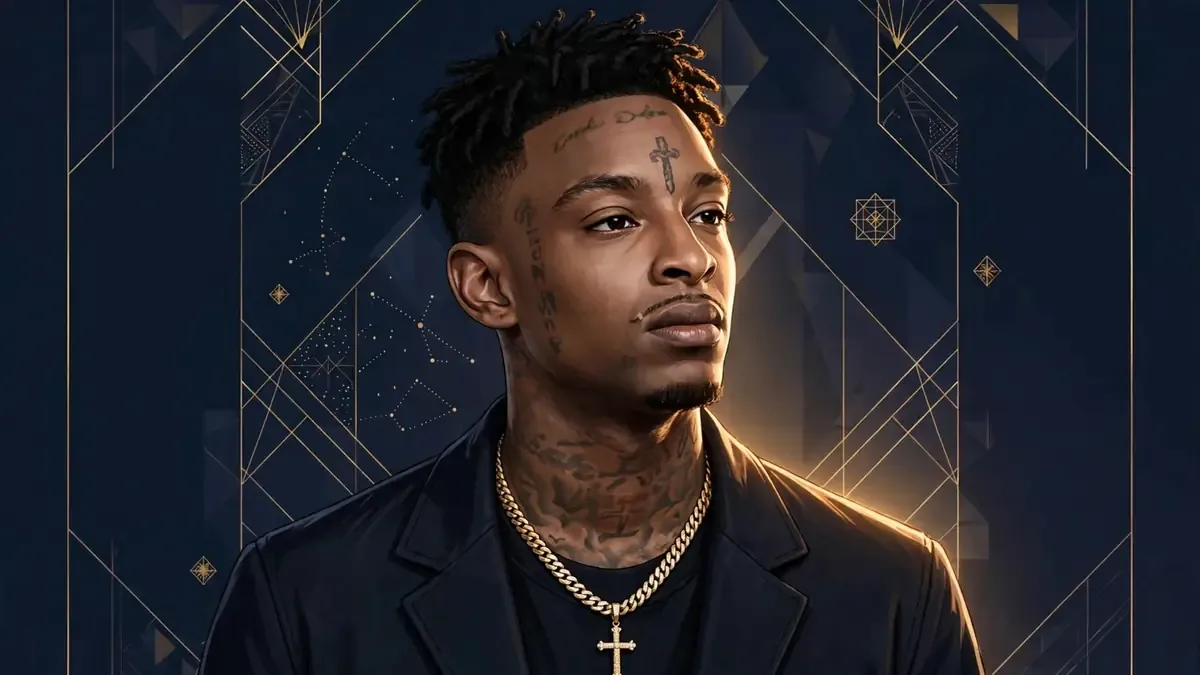
21 Savage Quick Facts
| Full Name | Shéyaa Bin Abraham-Joseph |
|---|---|
| Date of Birth | October 22, 1992 |
| Age in 2026 | 34 (turned 34 on October 22, 2026) |
| Birthplace | Plaistow, Newham, East London, England |
| Raised In | Atlanta, Georgia, United States (moved at age seven) |
| Nationality | British-born; U.S. lawful permanent resident since 2023 |
| Estimated Net Worth | $16 million to $30 million as of November 2026 (Celebrity Net Worth: $30 million; Capital Xtra: over $16 million) |
| Primary Income Sources | Music streaming and royalties, touring, features, songwriting, Slaughter Gang label |
| Record Labels | Slaughter Gang Entertainment / Epic Records |
| Breakthrough Work | Savage Mode EP with Metro Boomin (2016) |
| Major Albums | Issa Album (2017), I Am > I Was (2018), Savage Mode II (2020), American Dream (2024) |
| Biggest Collaborations | “Rockstar” with Post Malone, Her Loss with Drake, “A Lot” with J. Cole |
| Grammy Awards | 1 win — Best Rap Song for “A Lot” (2020); 11 career nominations as of the 2024 Grammys |
| Children | Three (as widely reported) |
| Mother | Heather Carmillia Joseph |
Table of Contents
- 21 Savage Quick Facts
- Early Life: Born in London, Raised in Atlanta
- The Night That Changed Everything
- Career Beginnings: Mixtapes and the Atlanta Underground
- Savage Mode and the Breakthrough
- Rockstar, Issa Album, and Going Mainstream
- I Am Greater Than I Was and the Grammy Win
- Her Loss, Savage Mode II, and the Drake Era
- American Dream and the 2024 Comeback
- The Money: How 21 Savage Built His Fortune
- Net Worth Growth Over the Years
- Homes, Cars, and Lifestyle
- Personal Life: Family, Relationships, and Fatherhood
- The ICE Arrest and the Fight to Stay
- Giving Back: Financial Literacy and Atlanta
- Controversies and Legal Troubles
- Frequently Asked Questions About 21 Savage
- Final Thoughts
- Sources and Reporting
Early Life: Born in London, Raised in Atlanta
Shéyaa Bin Abraham-Joseph was born on October 22, 1992, in Plaistow, Newham, in East London, to a Haitian father and a Dominican mother. His mother, Heather Carmillia Joseph, would later become one of the most recognizable voices in his story — she opens his 2024 album American Dream by telling the family’s story in her own words. When Shéyaa was about seven years old, Heather moved the family to Atlanta, Georgia. The move was supposed to be a fresh start. In practice it dropped a British kid into one of the toughest corners of Atlanta’s east side, where he would spend the rest of his childhood and youth.
Atlanta shaped him in ways London never could have. He grew up in the city’s Eastside neighborhoods, went to local schools, and was expelled from school in the seventh grade after a gun-related incident — a detail he has spoken about openly in interviews since. From there, his teenage years were defined by the streets. He has described a youth spent running with a crew, carrying weapons, and living day to day in a world where violence was normal background noise. He was not writing rhymes in a bedroom and dreaming of a record deal. He was surviving, and music was not yet on the horizon at all.
That matters because it explains the sound he eventually built his name on. When 21 Savage started rapping, he did not adopt a persona. He reported what he had seen, in a flat, almost bored voice, over dark, sparse beats. There was no shouting, no showmanship, no punchline-chasing. The delivery felt like a police statement read aloud — and that was the point. Fans heard something they had not heard before: a rapper who sounded like he meant every word because he had lived every word.
His mother stayed a steady presence through those years, and she has remained close to him as an adult. She attended the 62nd Grammy Awards with him in 2020, the night “A Lot” won Best Rap Song, and her voice opens American Dream, narrating the family’s emigration from Britain to America. The album is framed, in a real sense, as her story as much as his. That family thread runs through his whole biography: the kid who crossed an ocean at seven, the mother who held the family together, and the son who eventually bought his way out of the life that almost killed him.
One more fact from those early years is worth stating plainly, because it became the center of a national news story later: 21 Savage entered the United States in July 2005 and his visa expired in 2006. He lived in America for most of his life without legal status, and almost no one in the music industry knew it. He was, in every way that counted day to day, an Atlanta rapper. The paperwork said otherwise, and in February 2019 the paperwork caught up with him.
The Night That Changed Everything
On October 22, 2013 — his 21st birthday — 21 Savage was shot six times in an ambush in Atlanta. His close friend Quantivayus Johnson, known to friends as Johnny, was killed in the same attack. Savage survived, but only just. The shooting left him with lasting scars and a story he has told in fragments across interviews and songs ever since: a birthday party that ended in gunfire, a best friend lost, and a young man who walked away from death with a new sense of what his life was for.
The date became his name. “21” marks the birthday and the age at which his life split in two; “Savage” is the street name he carried from those years. He has said in interviews that the shooting is the reason he started taking music seriously. Before it, rap was a hobby at best. After it, it became the only way out he could see. Within months he was recording, and within two years he was one of the most talked-about new voices in Atlanta.
The shooting also shaped his public image in a way that no marketing plan could. When he raps about guns, death, and loss, listeners know he is not borrowing someone else’s stories. He was shot six times and buried his best friend on the day he turned 21. That fact hangs over everything he has recorded since, from the Savage Mode EP to American Dream, and it is a large part of why his audience trusts his voice. He does not perform danger. He describes it, in a monotone, as if he is still surprised to be alive to tell it.
It is also worth saying what the shooting did not do. It did not make him a preacher or a reformed-street-kid spokesman. His music stayed dark and unsentimental, and his public statements about that night have stayed brief and matter-of-fact. He treats it as the turning point it was, without turning it into a brand. That restraint is part of the appeal: the story is so extreme that it does not need selling.
Career Beginnings: Mixtapes and the Atlanta Underground
21 Savage started releasing music in 2014, months after the shooting, and his first full project, the mixtape The Slaughter Tape, arrived in May 2015. A second mixtape, Slaughter King, followed in December of the same year. Neither project charted, but they did something more useful: they put his voice in front of the Atlanta underground, and the underground passed it on. His early singles, including “Red Opps,” built a local following the old-fashioned way — through the streets, through SoundCloud, through DJs and word of mouth — before any label was involved.
The sound was already fully formed. His voice sat low and flat over beats that left a lot of empty space. Producers like Metro Boomin, who would become his most important collaborator, understood right away that the space was the point: the less going on in the track, the more weight every word carried. Where other Atlanta rappers of the moment piled on melody and energy, 21 Savage stripped everything back. The contrast made him stand out immediately.
By early 2016, the buzz had outgrown Atlanta. He released the Free Gucci EP and kept dropping singles that spread through streaming, and the industry started paying attention. He was not a viral novelty or a one-song rapper. He had a catalog forming, a distinct voice, and a story that made writers and fans lean in. The question was who would help him turn a local following into a national career — and the answer, as it turned out, was the producer who had believed in him from the start.
Savage Mode and the Breakthrough
In July 2016, 21 Savage and Metro Boomin released Savage Mode, a nine-track collaborative EP that changed his life. The project peaked at number 23 on the Billboard 200 — a modest chart position that understates its impact. Savage Mode was the record that made 21 Savage a name outside Atlanta. Its two singles, “X” featuring Future and “No Heart,” became staples, and the EP’s dark, minimal production set the template for a whole wave of trap music that followed.
What made Savage Mode work was the fit between rapper and producer. Metro Boomin’s beats were spacious and menacing, built on deep bass and eerie, stripped-back melodies, and 21 Savage’s deadpan delivery filled them without crowding them. The record sounded like nothing else on the radio in 2016, and that was exactly why it spread. It earned platinum certification, and its success gave Savage his first real leverage with the major labels.
The EP also introduced the wider public to the two sides of his persona that would define his career. On one hand, the cold, violent storyteller of “No Heart” and “X.” On the other, a rapper with a dry, deadpan sense of humor that showed up in interviews, on social media, and eventually in a series of much-loved viral moments — from his matter-of-fact interview answers to his deadpan appearance in the “Bank Account” era. The humor mattered. It kept him from being boxed in as a one-note street rapper, and it gave him a public personality that fans found oddly warm.
Savage Mode was followed quickly by more momentum. He signed with Epic Records in 2017, keeping his own Slaughter Gang imprint as his home base, and the industry’s biggest names started calling. The kid who had been recording for barely two years was suddenly working with the most in-demand artists in the world — and the next chapter of his biography would be written at the very top of the charts.

Rockstar, Issa Album, and Going Mainstream
September 2017 delivered the song that made 21 Savage a global star. “Rockstar,” Post Malone’s single featuring 21 Savage, went to number one on the Billboard Hot 100 and stayed there for eight weeks. It was one of the biggest songs of the year, earned nominations for Record of the Year and Best Rap/Sung Performance at the 61st Grammy Awards, and put 21 Savage’s voice — that flat, unmistakable drawl — in front of listeners who had never heard a trap record in their lives. His verse, short and blunt, was the song’s spine. People who could not name another 21 Savage song knew his voice from “Rockstar.”
His debut studio album, Issa Album, arrived in July 2017, a few months before “Rockstar” peaked, and it reached number two on the Billboard 200. Its lead single, “Bank Account,” became his first solo hit, peaking at number 12 on the Hot 100 and turning into a signature song — and later, the name of his financial-literacy program for young people. The album proved he could carry a full-length record on his own, and it established the commercial pattern of his career: no huge radio push, no pop makeover, just a loyal audience that showed up every time.
The money started to move in a serious way around this point. Celebrity Net Worth reports that he earned an estimated $6 million in the twelve months between June 2017 and June 2018, a figure that covers the Issa Album run, the “Rockstar” windfall, and his first big touring paydays. It was the first year in which his income looked like a star’s income, and it set the base for everything that followed. He was 25 years old, two years removed from the mixtape circuit, and already a millionaire many times over.
Just as important as the chart positions was what was happening around him. He was becoming a fixture of the culture: a go-to feature for other stars, a meme-friendly interview subject, and a rapper whose guest verses were treated as events. His feature run in 2017 and 2018 — on records by Post Malone, Cardi B, and others — kept him on the charts even between his own releases, and each one added to the publishing and royalty income that would compound into his net worth.
I Am Greater Than I Was and the Grammy Win
His second studio album, I Am > I Was, arrived in December 2018 and became his first release to debut at number one on the Billboard 200. The title was a statement of intent — he was, in his own telling, a different person from the one who had made Savage Mode — and the record backed it up with his most polished work to date. The guest list ran from J. Cole to Post Malone to Childish Gambino, and the production was richer and more varied than anything he had done before, without losing the darkness at the center of his sound.
The album’s centerpiece was “A Lot,” featuring J. Cole. The track was a slow, reflective cut about family, money, and survival, and it became the biggest critical success of his career. In January 2020, at the 62nd Grammy Awards, “A Lot” won Best Rap Song — 21 Savage’s first Grammy, and the award that turned him from a streaming star into a certified, industry-recognized artist. He attended the ceremony with his mother, Heather, who had watched the whole journey from East London to Atlanta to the Grammy stage.
The win mattered for reasons beyond the trophy. A Grammy raises a rapper’s feature fee, his touring guarantee, and his negotiating position with a label — all of which feed directly into net worth. It also gave him a different kind of credibility with audiences outside hip-hop. “A Lot” was the song that proved he could do more than menace. He could reflect, he could write about his family, and he could hold his own next to J. Cole, one of the most respected lyricists of his generation.
I Am > I Was also went platinum, and it confirmed the commercial pattern that has held for his entire career: every album debuts high, the catalog keeps streaming, and the audience never really leaves. He was no longer a breakout act. He was an established star with a Grammy on the shelf and a second number-one album — and he was about to enter the most commercially successful stretch of his life.
Her Loss, Savage Mode II, and the Drake Era
October 2020 brought Savage Mode II, the long-awaited sequel to his breakthrough EP, again made with Metro Boomin. The album debuted at number one on the Billboard 200, and it opened with narration from Morgan Freeman — a choice that told you everything about how far 21 Savage had come from the mixtape circuit. Freeman’s voice gave the record a sense of occasion, and the music matched it: darker, grander, and more confident than the first Savage Mode. It was his third chart-topping project, counting his solo work, and it kept him at the top of the genre through the pandemic years.
Then came the collaboration that defined his early 2020s. In November 2022, he and Drake released the joint album Her Loss, which debuted at number one on the Billboard 200 and became one of the biggest rap releases of the year. The pairing worked because the two rappers are opposites in the best way: Drake is melodic, verbose, and confessional; 21 Savage is flat, brief, and dry. Their contrast made the record funny, tense, and endlessly replayable, and it gave 21 Savage his biggest commercial moment since “Rockstar.”
The Her Loss era paid off in touring, too. In 2023, he joined Drake on the “It’s All A Blur” tour across North America, a run that promoters reported grossed more than $100 million. Arena tours are where rap money is really made — a single arena date can pay an established act several times what a month of streaming brings in — and the Drake tour put him in front of the biggest crowds of his career. He followed it with a return to London for the first time in nearly two decades in December 2023, playing shows in the city where he was born, now as a headliner.
By the end of 2023, the picture was clear. He had four number-one albums on the Billboard 200 across solo and joint projects, a Grammy, a catalog that streamed in the billions, and a touring profile that put him in arenas. The estimates of his wealth started to climb to match. And he was about to make the most personal album of his career — one that finally told the immigration story in his own words.
American Dream and the 2024 Comeback
On January 12, 2024, 21 Savage released his third solo studio album, American Dream — his first solo album in more than five years. It debuted at number one on the Billboard 200, moving 133,000 units in its first week on the back of 165 million streams, and it held the top spot for two weeks. All 14 tracks debuted on the Billboard Hot 100, with “Redrum” reaching number two and “Née-Nah,” featuring Travis Scott and Metro Boomin, reaching the top 10. The album also made him the 16th artist in history to log 100 entries on the Billboard Hot 100 — a milestone that says as much about his consistency as a collaborator as it does about his solo work.
The album’s title was a deliberate choice, and the record itself is built around the idea. It opens with his mother, Heather, describing the family’s emigration from Britain to America, and it closes the same way — with her voice, framing the whole record as a family story rather than a rap album. Guest appearances run from Doja Cat and Young Thug to Summer Walker, Burna Boy, Travis Scott, and Brent Faiyaz, and the production, much of it from Metro Boomin and London on da Track, is the most polished of his career. The album was released alongside a film of the same name, American Dream: The 21 Savage Story, directed by Donald Glover and collaborators — a sign of how far his story had travelled beyond music.
The comeback was not only musical. In February 2024, fresh off a debut appearance on Saturday Night Live, he announced the “American Dream Tour,” his first headlining North American tour behind the album, with dates including Pine Knob Music Theatre in May 2024. The tour, the album’s two weeks at number one, and six Grammy nominations at the 2024 ceremony — which brought his career nomination total to 11 — made 2024 the biggest year of his career by almost any measure.
Reports in 2026 list a fourth studio album, What Happened to the Streets?, released in December 2025, extending the run. The core of his catalog, though, remains the four chart-topping projects from I Am > I Was through American Dream, and the run of collaborations that kept him on the Hot 100 for a decade. Few rappers of his generation can match that record of consistency — and it is the foundation of his fortune.

The Money: How 21 Savage Built His Fortune
21 Savage’s net worth is estimated at $16 million to $30 million as of November 2026. Celebrity Net Worth, the most widely cited tracker of celebrity wealth, puts the figure at $30 million, while Capital Xtra reports it at more than $16 million, and several 2026 profiles settle around $20 million as a middle estimate. The range exists because no one outside his business team sees his real accounts — every public figure is modelled from royalties, touring, and known deals — but the direction is not in doubt. He has been earning at a high level for nearly a decade, and the catalog keeps paying.
Streaming and royalties are the base. Four number-one albums, a diamond-selling feature on “Rockstar,” a Grammy-winning single in “A Lot,” and a decade of guest verses add up to a catalog that generates income every day, whether or not he releases anything new. Publishing income matters here too: as a songwriter on his own hits and on songs for others, he earns from every play, every sync, and every cover. Some 2026 profiles estimate his streaming income alone at several million dollars a year, though those figures are modelled, not audited, and should be read as informed guesses.
Touring is the second pillar, and it is the one that moves the needle fastest. His reported $6 million in earnings between June 2017 and June 2018 came largely from live shows and the “Rockstar” windfall, and the scale only grew from there. Arena dates pay far more than club shows, and the 2023 “It’s All A Blur” tour with Drake — reported to have grossed more than $100 million — put him on arena stages across North America. His own “American Dream Tour” in 2024 added headlining income on top of that. For a rapper who tours selectively, each run is worth a large share of his annual income.
Features and collaborations are the third pillar. 21 Savage is one of the most in-demand guest voices in rap: a short, flat verse from him can anchor a single, and his feature fee rose sharply after “Rockstar” and the Grammy win. He has appeared on hits for Post Malone, Drake, Cardi B, and many others, and each feature brings an upfront fee plus a share of the song’s royalties. It is the kind of income that compounds quietly — a verse recorded in an afternoon can pay for years.
His label, Slaughter Gang Entertainment, is the fourth pillar. Run as an imprint under Epic Records, it gives him a share of the economics on his own releases and a platform for signing and developing other artists. Label ownership is the difference between being a well-paid employee of the music business and being a part-owner of it, and it is the asset that most separates established stars from one-hit acts. Brand work rounds out the picture: he has fronted a Mastercard financial-literacy campaign and other partnerships, choosing them carefully rather than taking every offer.
For a fuller look at the numbers behind the range — the album-by-album earnings, the touring income, and the sources that anchor the estimate — our sister site’s money profile covers 21 Savage’s net worth in detail, with the same $16 million to $30 million range and the Celebrity Net Worth figure as its anchor.
Net Worth Growth Over the Years
| Year | Estimated Net Worth | What Drove It |
|---|---|---|
| 2015 | Under $1 million | Mixtape years; local following, no major label deal |
| 2016 | $1 million to $2 million | Savage Mode EP breaks through; first real streaming income |
| 2017 | $2 million to $3 million | “Rockstar” goes number one; Issa Album peaks at number two |
| 2018 | $6 million to $8 million | I Am > I Was debuts at number one; reported $6 million earned in a single year |
| 2020 | $10 million to $12 million | Grammy win for “A Lot”; Savage Mode II debuts at number one |
| 2022 | $12 million to $16 million | Her Loss with Drake debuts at number one |
| 2024 | $20 million to $30 million | American Dream debuts at number one; arena touring; Grammy nominations |
| 2026 | $16 million to $30 million | Catalog, touring, label income; estimates vary by source |
Two things stand out in that timeline. First, the growth is steady rather than sudden: there is no single windfall, no viral lottery ticket, no business exit. The fortune was built album by album, tour by tour, feature by feature. Second, the range widens at the top end, which is normal for a working musician: the more income streams there are, the more room there is for trackers to disagree. Celebrity Net Worth’s $30 million sits at the top of the range, Capital Xtra’s figure of more than $16 million at the bottom, and the middle estimates of around $20 million are where most 2026 profiles land. None of these figures is audited. They are the best public estimates available, and this article reports them as estimates, not as verified fact.
Homes, Cars, and Lifestyle
21 Savage lives in Atlanta, the city he has called home since childhood, and his lifestyle reflects the habits of a rapper who came up with nothing and remembers it. He has spoken about wanting to buy a private jet — a dream he has mentioned in interviews and profiles — but his public spending is notably quieter than that of many of his peers. There are no widely reported mega-mansion purchases with public price tags, no fleet of supercars paraded on social media, and no splashy business empire announced with a press release. The wealth is real, but the display of it is restrained.
What is documented is the jewelry — the gold chains, including the cross pendant he wears in most public appearances, are part of his visual identity — and the cars he has been photographed with over the years. Beyond that, the public record is thin, and this article does not fill the gap with guesses. Real estate holdings in Atlanta have been reported in passing by net-worth profiles, but without public transaction records to cite, no specific property or price is stated here. Readers should treat any profile that lists exact home values for him as speculation unless it cites a deed or a named report.
That restraint is, in its own way, part of the story. He is a rapper whose whole brand is understatement — flat delivery, short verses, few interviews, no shouting. His lifestyle matches. The money goes into the catalog, the label, and the family, and the public sees relatively little of the rest.
Personal Life: Family, Relationships, and Fatherhood
21 Savage is a father of three, a fact that has been widely reported, though he keeps his children almost entirely out of the public eye. He rarely posts about them, rarely discusses them in interviews, and has never used them as content. The privacy is deliberate: his own childhood was public in ways he did not choose, and he has chosen the opposite for his kids.
His relationship with rapper Latto has been widely reported since 2020, with reports in 2025 and 2026 describing the relationship as publicly confirmed. He has not publicly confirmed a marriage, and reports that describe him as married remain unconfirmed — Capital Xtra, for example, notes that the question of a wife remains unclear. This article reports what is documented and leaves the rest alone: he is in a long-reported relationship, he is a father, and he does not discuss his private life in detail.
His mother, Heather Carmillia Joseph, remains the most visible family member in his public life. She opens American Dream with the family’s story, attended the Grammys with him, and has been credited by him as the person who held the family together through the move from London to Atlanta and everything that followed. His father, who is Haitian, and his Dominican mother gave him a mixed heritage that he has spoken about rarely — he is, by background, a Londoner of Caribbean and Latin descent who became an Atlanta rapper, and that layered identity is part of what makes his biography so unusual.
The ICE Arrest and the Fight to Stay
On February 3, 2019 — Super Bowl Sunday — 21 Savage was arrested by U.S. Immigration and Customs Enforcement in Atlanta. The agency said he was a British citizen who had entered the United States in July 2005 and overstayed a visa that expired in 2006. For most of the world, it was the first time anyone had heard that the Atlanta rapper was not American at all. The news dominated the music press for days, drew statements of support from other artists, and turned a little-known corner of immigration law into a national conversation.
He was held in detention for ten days and released on bond on February 13, 2019, while deportation proceedings were pending. The case was later postponed indefinitely, and he spent the next four years living and working in the United States while his lawyers worked through the system. The detention cost him a performance at the 61st Grammy Awards, where he had been due to perform “Rockstar” with Post Malone — a reminder that the case had real, immediate consequences for his career, not just his legal status.
The story ended, for practical purposes, in 2023, when he became a lawful permanent resident of the United States and was granted a green card. Reports at the time noted that he would be eligible to apply for citizenship in 2028. One of the first things he did with the green card was travel: he toured Canada with Drake, played shows in Europe, and returned to London for the first time in nearly two decades in December 2023, playing a homecoming show in the city where he was born.
The case changed how the public understood him, and it changed his music. American Dream is, in large part, an album about that journey — about crossing an ocean as a child, growing up American in every way except on paper, and finally being allowed to call the country home. The album’s title, which might otherwise sound like a cliché, is literal. The American dream, for him, was a green card.
Giving Back: Financial Literacy and Atlanta
21 Savage’s best-known work outside music is financial literacy. In 2018, around the release of “Bank Account,” he launched a financial-literacy program for young people under the same name, aimed at teaching kids in Atlanta — kids like the one he had been — how money actually works: saving, banking, credit, and planning. The program ran workshops and events for local youth, and it was later extended through a partnership with Mastercard on money skills and financial education. It is the rare celebrity charity project that connects directly to the artist’s own story: a kid who grew up with no money teaching other kids how not to repeat his mistakes.
Atlanta has recognized the work. The city has designated December 10 as “21 Savage Appreciation Day” in Fulton County, and he has received the “Carry The Torch” award for his efforts to widen access to financial literacy and personal development resources for local young people. These are local honors, not national headlines, but they matter to the biography: they show a rapper who stayed rooted in the city that raised him, and who puts time into the place rather than just taking money out of it.
He has also spoken publicly about the immigration experience since his case was resolved, and his story has been cited by advocates as an example of how the system treats long-term residents who arrived as children. He has not made activism his second career, but he has not hidden from the subject either. The green card did not end his connection to the issue — it gave him the standing to talk about it.
Controversies and Legal Troubles
Any honest biography of 21 Savage has to include the parts that are not flattering, and the record is not short. His teenage years involved gun charges and time in and out of trouble with the law, including the school expulsion in seventh grade that he has discussed openly. The shooting in 2013 was the most violent episode of that period, and it left him with a criminal record and a reputation that followed him into his music career.
The immigration case is the largest legal matter of his adult life, and it is covered in full above: the 2019 arrest, the ten days in detention, the postponed deportation case, and the green card in 2023. It was not a criminal case in the ordinary sense — it was an immigration enforcement action — but it dominated his public image for years and cost him work, travel, and peace of mind.
He has also faced the ordinary controversies of a famous rapper: public feuds and diss tracks, including a well-publicized back-and-forth with other artists in the late 2010s; criticism of lyrics that some listeners found violent or misogynistic; and the scrutiny that comes with any lyric that gets quoted out of context. None of these episodes derailed his career, and none of them produced the kind of sustained legal trouble that has ended other rappers’ runs. His record since 2019 is, by the standards of the genre, notably quiet: albums, tours, a Grammy, and a green card.
One thing worth noting is what has not happened. There have been no major fraud cases, no business collapses, no public bankruptcies, and no scandals involving his label or his money. For a rapper who has been famous for a decade, that is a meaningful part of the financial story: the fortune survived because the behavior around it stayed relatively steady.
Frequently Asked Questions About 21 Savage
What is 21 Savage’s real name?
His real name is Shéyaa Bin Abraham-Joseph. He was born in Plaistow, Newham, East London, on October 22, 1992, and moved to Atlanta with his mother when he was seven years old.
How old is 21 Savage in 2026?
21 Savage was born on October 22, 1992, which makes him 34 years old as of November 2026. He turned 34 on October 22, 2026.
Where was 21 Savage born?
He was born in Plaistow, in the London borough of Newham, England. He was raised in Atlanta, Georgia, after his mother moved the family to the United States when he was about seven. His British birthplace was not widely known until his arrest by immigration authorities in February 2019.
What is 21 Savage’s net worth in 2026?
His net worth is estimated at $16 million to $30 million as of November 2026. Celebrity Net Worth puts the figure at $30 million, while Capital Xtra reports it at more than $16 million. The fortune comes from streaming and royalties, touring, features, and his Slaughter Gang label.
How did 21 Savage get shot?
On October 22, 2013, his 21st birthday, he was shot six times in an ambush in Atlanta. His close friend Quantivayus Johnson was killed in the same attack. The shooting became a turning point: he has said it is the reason he started taking music seriously.
Why was 21 Savage arrested by ICE?
He was arrested by U.S. Immigration and Customs Enforcement on February 3, 2019. The agency said he was a British citizen who had entered the United States in July 2005 and overstayed a visa that expired in 2006. He was released on bond after ten days, and in 2023 he became a lawful permanent resident and received a green card.
Did 21 Savage win a Grammy?
Yes. He won Best Rap Song at the 62nd Grammy Awards in January 2020 for “A Lot,” featuring J. Cole, from his album I Am > I Was. He had 11 career Grammy nominations as of the 2024 ceremony, including six nominations that year.
Is 21 Savage married?
He has not publicly confirmed a marriage. His relationship with rapper Latto has been widely reported since 2020, and he is a father of three children, but he keeps his family life largely private and has not confirmed any marriage publicly.
Final Thoughts
21 Savage’s biography does not fit the usual rap-star template. There was no childhood dream of stardom, no talent-show discovery, no slow climb through the industry. There was a kid from East London who landed in Atlanta, a teenager who lived through street violence, a 21st birthday that ended in gunfire and a funeral, and a decision — made in the aftermath — to try music. Everything after that was execution: the Metro Boomin partnership, the breakout EP, the number-one feature, the debut album, the Grammy, the Drake album, and the comeback record that finally told the whole story in his own words.
The money follows the same pattern. A fortune estimated at $16 million to $30 million, built without a single windfall, from a catalog that keeps streaming, tours that keep selling, and a label that gives him a stake in his own work. It is the fortune of a working artist who never stopped releasing, never chased a trend, and never left the sound that made him. The range in the estimates is honest: no one outside his team knows the exact figure, and this article does not pretend otherwise.
What will last, though, is not the number. It is the voice — flat, dry, and unmistakable — and the story behind it. A British-born kid who became an Atlanta rapper, survived a shooting and a deportation fight, won a Grammy, and came home to London as a headliner. The American dream, in his case, was not a metaphor. It was a green card, a number-one album, and a mother narrating the story at the start of the record. That is the biography, and it is still being written.
Sources and Reporting
Figures and career facts in this article were checked against reporting from Celebrity Net Worth, Billboard, the Recording Academy (Grammy Awards), Capital Xtra, and contemporary coverage of the American Dream album and tour. Source homepages:
- Celebrity Net Worth — net worth estimate ($30 million) and 2017–2018 earnings
- Billboard — Billboard 200 and Hot 100 chart positions
- Grammy Awards (Recording Academy) — Best Rap Song win for “A Lot” and nomination totals
- Capital Xtra — birthplace, age, and net worth reporting (over $16 million)
How we estimated: The $16 million to $30 million range is anchored to Celebrity Net Worth’s current $30 million figure at the top and Capital Xtra’s report of more than $16 million at the bottom, with several 2026 profiles landing near $20 million in the middle. No public audit of 21 Savage’s finances exists, so all figures are modelled estimates based on royalties, touring, features, and label income. Private holdings, debts, and spending are not public, and the real figure may sit above or below the published range. Where sources disagreed, this article reports the range and names the sources rather than picking a single number.