Last updated: 6 November 2026 | By Celebamerica Editorial Staff
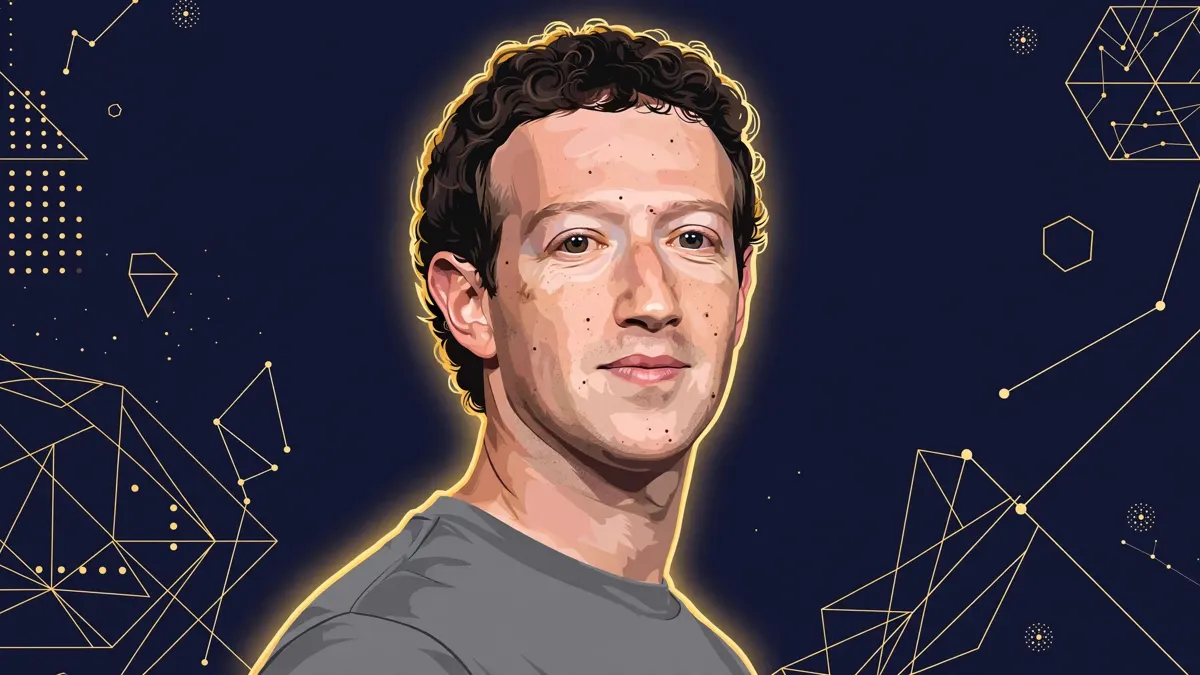
Mark Zuckerberg is 42 years old, the co-founder, chairman and chief executive of Meta Platforms, and one of the richest people alive. Forbes puts his fortune at about $212 billion on its real-time billionaires list as of 6 November 2026 — a figure that has swung between roughly $212 billion and $258 billion across 2026 alone, because almost all of his wealth sits in Meta stock and moves with the share price.
That swing is the first thing to understand about Zuckerberg. He does not draw a fortune’s worth of salary — his official Meta pay is $1 a year — and he has never sold the bulk of his stake. His money is his company: around 13 percent of Meta, the business behind Facebook, Instagram, WhatsApp, Messenger and Threads, plus the voting control that comes with it. The biography below follows the full arc, from a childhood bedroom in Dobbs Ferry, New York, where an 11-year-old built a messaging system for his father’s dental office, to the Harvard dorm room where Facebook was born in February 2004, to the Meta of late 2026, where Zuckerberg is betting the company’s future — and more than $135 billion a year in capital spending — on personal superintelligence.
| Full Name | Mark Elliot Zuckerberg |
|---|---|
| Date of Birth | 14 May 1984 (age 42 in November 2026) |
| Birthplace | White Plains, New York, United States |
| Estimated Net Worth | About $212 billion (Forbes real-time, 6 November 2026); 2026 range roughly $212–258 billion |
| Primary Income Source | Meta Platforms stock — about 13% ownership, about 60.8% of voting power |
| Role | Co-founder, chairman and CEO of Meta Platforms; co-founder and co-CEO of the Chan Zuckerberg Initiative |
| Education | Phillips Exeter Academy; Harvard University 2002–2004 (left in his sophomore year, no degree) |
| Spouse | Priscilla Chan (married 19 May 2012) |
| Children | Three daughters — Maxima, August and Aurelia |
| Key Ventures | Facebook (2004), Instagram (acquired 2012), WhatsApp (acquired 2014), Oculus / Reality Labs, Meta AI and Muse (2026) |
In This Article
- Early Life and Childhood in Dobbs Ferry
- Harvard Years and the Birth of Facebook
- From Dorm Room to a Public Company
- The Money: How the Fortune Was Built
- Net Worth Over the Years
- The Big Bets: Instagram, WhatsApp, and the Metaverse
- Meta in 2026: AI, Muse, and a New Share Class
- Homes, Land, and Lifestyle
- Family Life and the Chan Zuckerberg Initiative
- Controversies and Courtroom Battles
- How He Compares With His Peers
- Frequently Asked Questions
- Final Thoughts
- Sources and Reporting
Early Life and Childhood in Dobbs Ferry
Mark Elliot Zuckerberg was born on 14 May 1984 in White Plains, New York, to Edward Zuckerberg, a dentist, and Karen Kempner Zuckerberg, a psychiatrist. He grew up in Dobbs Ferry, a village on the Hudson River about 20 miles north of Manhattan, in a Reform Jewish household with three sisters — Randi, Donna and Arielle. The house was comfortable and bookish rather than showy, and the detail that keeps coming up in every serious profile is how early the programming started.
Zuckerberg learned to code as a child. At about age eleven he built ZuckNet, a small messaging program that linked the computers in his family’s home with the network in his father’s dental office, so the front desk could ping Edward between patients. His father also hired a private computer tutor, David Newman, who later told reporters that it was hard to stay ahead of the boy — the student kept arriving at lessons having already worked past the material. By high school, Zuckerberg had written Synapse Media Player with his friend Adam D’Angelo, a music program that learned a listener’s tastes and suggested songs. It was good enough that both AOL and Microsoft reportedly showed interest in it, and in the young programmer behind it.
He attended Phillips Exeter Academy, the boarding school in New Hampshire, where he studied classics as well as computing and captained the fencing team. The picture that emerges from his school years is not the hoodie-wearing dropout of the movie poster but a student who was strong across the board — languages, maths, fencing — and who happened to be better at code than almost anyone around him. In 2002 he entered Harvard University to study computer science and psychology, the two subjects that, put together, explain Facebook better than any business plan ever has: the machine side and the people side.
Harvard Years and the Birth of Facebook
Harvard is where the story turns from promise into history, and it turns fast. In the autumn of 2003, Zuckerberg built Facemash, a site that let students compare photographs of fellow undergraduates and vote on them. It drew a crowd overnight, crashed parts of the Harvard network, and got him hauled before the university’s disciplinary board on charges including breaching security and violating privacy. The charges were dropped, but the episode taught him two things that shaped everything after: that a campus would flock to a social product, and that a product built around people’s photos and identities would attract trouble as quickly as it attracted users.
He also met Priscilla Chan at a Harvard party in 2003, while waiting in line for the bathroom — a detail the couple has told more than once, and one that matters because Chan has been at the centre of his life and his philanthropy ever since. Then, on 4 February 2004, Zuckerberg launched thefacebook.com from his Kirkland House dorm room with roommates Eduardo Saverin, Dustin Moskovitz, Andrew McCollum and Chris Hughes. It was a simple directory at first: Harvard students could make a profile, upload a photo and list their friends. Within weeks it had spread to other Ivy League campuses; within months it had a million users and a name shortened to Facebook.

He left Harvard in his sophomore year, in the spring of 2004, and never went back for the degree. The decision looks inevitable in hindsight, but at the time it was a real gamble: Facebook had no revenue, no proven business model, and a legal fight already forming on the horizon. That summer the team moved into a rented house in Palo Alto, California, and the company began to look less like a student project and more like the start of something large. PayPal co-founder Peter Thiel invested $500,000 in 2004, the first outside money, and by the end of that year Facebook had a million users and its first office.
Why he never finished the degree: Zuckerberg has said he left because Facebook was growing too fast to run from a dorm room. Harvard agreed with the verdict in the end — in 2017 the university awarded him an honorary Doctor of Laws degree and invited him to give the commencement address, thirteen years after he walked out.
From Dorm Room to a Public Company
The eight years between Palo Alto and the stock market were a sprint. Facebook opened beyond universities in 2006, added the News Feed the same year — a feature users first hated and then could not live without — and passed 100 million users in 2008. That same year, at 23, Zuckerberg became the world’s youngest self-made billionaire, worth about $1.5 billion by Forbes’ count. The company kept raising money at rising valuations, bought its way into photo sharing and messaging, and by 2011 had more than 800 million users.
The initial public offering came on 18 May 2012. Facebook priced its shares at $38, raised about $16 billion and was valued at roughly $104 billion on debut — one of the largest technology listings ever. The first day of trading was messy, with technical glitches at the Nasdaq and the share price sliding below its offer price in the weeks that followed, and plenty of commentators wrote the company off. They were wrong. Within a year the stock had recovered, and the advertising engine built on the News Feed and the mobile app turned Facebook into one of the most profitable companies on earth.
What set Zuckerberg apart in those years was control. From the start he structured the company so that his shares carried outsized voting power, and he kept it. Even after the IPO and years of share sales, Meta’s 2026 proxy statement lists him holding 639,347 Class A shares and 341,823,978 Class B shares as of 1 April 2026 — about 13 percent of the company, but 60.8 percent of its voting power. In practical terms, nobody can outvote him at the company he founded. That control is the reason he could rebrand the whole business as Meta in October 2021, pour tens of billions into virtual reality, and in 2026 pivot the company toward artificial intelligence, all without asking shareholders for permission first.
The Money: How the Fortune Was Built
Zuckerberg’s wealth has one source, and it is not a salary. His official Meta base salary is $1 a year, a symbolic figure he has kept for years. Meta’s filings put his total reported compensation for 2025 at about $25.1 million, and almost all of that was security and travel-related costs rather than pay he could spend. The fortune is the stock. Roughly 13 percent of Meta, a company with an enterprise value of about $1.60 trillion as of October 2026, is what puts him in the region of $212 billion — and it is also why the number jumps around so much.
Here is the honest picture of that number, because the trackers disagree with each other by tens of billions of dollars. Forbes’ annual World’s Billionaires list put him at $222 billion in 2026. Its real-time tracker has recorded $258 billion in September 2026 (the figure Wikipedia cites from Forbes), $243.3 billion on 18 October 2026, and $212.4 billion on 6 November 2026, when Inc. reported him passing Michael Dell on the rankings. Built In, citing Forbes’ Billionaires Index, put him at about $222 billion in 2026. Every one of those figures can be right for its own date, because Meta’s share price moves and his stake moves with it. This article anchors on the freshest dated figure — about $212 billion, Forbes real-time, 6 November 2026 — and treats the honest 2026 range as roughly $212 billion to $258 billion.
The stock itself was built, not granted. In the early years he took a small salary and equity while the company grew. He has sold shares over the years — in large, disclosed blocks, often to fund the Chan Zuckerberg Initiative — and he has also given shares away. The fortune has survived all of it because Meta kept growing: advertising revenue across Facebook, Instagram, WhatsApp and Messenger reached $63.06 billion in a single quarter, the third quarter of 2026, and the company’s family of apps counted 3.64 billion daily active people in September 2026. When the advertising machine prints money at that scale, a 13 percent stake is worth a fortune even after years of selling.
Net Worth Over the Years
The timeline below uses dated Forbes figures only, so the reader can see the shape of the fortune rather than a single snapshot. The pattern is unmistakable: a long, steep climb with sharp corrections whenever Meta’s share price fell — in 2018 after the Cambridge Analytica scandal, in 2022 when the stock lost more than half its value, and again in the autumn of 2026, when the share price slid from its September highs.
| Year / Date | Forbes Estimate | What Was Happening |
|---|---|---|
| 2008 | $1.5 billion | Youngest self-made billionaire at 23; Facebook passes 100 million users |
| 2017 | $56 billion | Instagram and WhatsApp integrated; Facebook passes 2 billion users |
| 2024 | $177 billion | Meta stock surges on AI-driven advertising gains |
| 2025 (annual list) | $216 billion | Reality Labs losses continue; advertising stays strong |
| October 2025 | $251 billion | Third-richest person in the world at that snapshot |
| 2026 (annual list) | $222 billion | Forbes World’s Billionaires list, 2026 edition |
| September 2026 | $258 billion | Real-time peak for the year, after Meta shares surged |
| 18 October 2026 | $243.3 billion | Fifth-richest in the world on the real-time list |
| 6 November 2026 | $212.4 billion | Fifth-richest; passed Michael Dell ($199.6 billion) on the real-time list |
Two things stand out from that table. The first is the scale of the 2022 fall, when his fortune dropped by more than $70 billion in a single year as Meta’s stock collapsed — a reminder that paper wealth tied to one company can evaporate as fast as it appears. The second is the recovery: by 2024 he had more than made it back, and by the autumn of 2026 his fortune was moving by billions of dollars in a single day as investors reacted to Meta’s AI spending. On 6 November 2026 alone, a strong day for Meta shares added about $3.8 billion to his estimated worth, according to Inc.’s reporting on the Forbes real-time list.
The Big Bets: Instagram, WhatsApp, and the Metaverse
Three purchases define Zuckerberg as a dealmaker, and the first two are among the best acquisitions in business history. In April 2012, a month before the IPO, Facebook bought Instagram for $1 billion in cash and stock. Instagram had 13 employees and about 30 million users. Today it has more than 2 billion monthly users and generates tens of billions of dollars in advertising a year. In February 2014 he went bigger, paying about $19 billion for WhatsApp, the messaging app with 450 million users at the time. WhatsApp now counts more than 2 billion users and has become a pillar of Meta’s business outside the United States.
The third purchase was a bet on a future that has not arrived yet. In March 2014, Facebook paid about $2 billion for Oculus VR, a virtual-reality headset maker. That deal became Reality Labs, the division building the Quest headsets and the Ray-Ban Meta smart glasses. Reality Labs has lost money every year since — its 2026 losses are expected to reach $18–19 billion, according to Meta’s own guidance — and the metaverse vision Zuckerberg laid out when he renamed the company Meta in October 2021 is widely seen as a costly detour. Even the Motley Fool, in a profile updated days before this article, calls the metaverse project a massive financial failure as of 2026, and says the company has largely moved on from it, even though the Meta name stays.
That record — two of the sharpest acquisitions ever made, plus one very expensive swing that missed — is the fair summary of his dealmaking. It also explains the 2026 strategy: the money that once went to virtual worlds now goes to AI, and the hardware bet has shifted from headsets to glasses, which sell in real numbers and carry Meta’s AI assistant in a form people actually wear.
Meta in 2026: AI, Muse, and a New Share Class
Meta in late 2026 looks very different from the Facebook of 2012. On 21 October 2026 the company reported third-quarter revenue of $64.6 billion, up 26 percent on a year earlier and above its own forecast, with advertising bringing in $63.06 billion of the total. A $9.89 billion legal charge — the cost of an agreement with 52 state attorneys general over litigation about teen mental health and social media — cut reported operating income by more than a third and left net income at $9.86 billion. Capital spending in the quarter alone was $34.91 billion, and free cash flow turned negative at minus $2.1 billion, because the company is building data centres as fast as it can.
Zuckerberg’s pitch on the earnings call was that this spending buys the company’s future. Meta launched Muse, its personal AI agent, and Muse Wonder, its first frontier AI model, in the autumn of 2026. More than 10 million people in the United States and Canada set up Muse agents within about six weeks of launch, and about a quarter of them use it daily. On the call Zuckerberg called personal superintelligence the company’s “North Star” and said the investments were paying off, with AI already delivering extra advertising revenue through better recommendations and more efficient ad tools. The company raised its full-year 2026 capital spending forecast to $135–145 billion and guided fourth-quarter revenue at $73–76 billion.

The quarter also brought a structural change that matters to anyone tracking his control of the company. Meta’s board approved a new class of non-voting Class C common stock, effective 19 January 2027, with a one-time Class C dividend of one share for every share held. The new shares give Meta a currency for raising money, paying staff and funding deals without diluting Zuckerberg’s voting control. Alongside the earnings, Meta disclosed a Founder Alignment Agreement with Zuckerberg and a commitment, recorded in an SEC filing dated 21 October 2026, to remain a resident of California — or wherever Meta is headquartered — for eight years, a move tied to Proposition 40, the proposed California billionaire tax heading to the ballot in November 2026. Forbes put his potential exposure under that tax at about $12 billion, based on its October 2026 estimate of $239.3 billion.
Homes, Land, and Lifestyle
For a man worth more than $200 billion, Zuckerberg’s public lifestyle is famously plain — grey T-shirts, jeans, a $1 salary — and the plainness is itself a kind of branding. Behind it sits a property portfolio that is anything but plain. He bought his Palo Alto home in 2011, a few miles from Meta’s Menlo Park headquarters, and over the following years quietly bought the neighbouring houses around it, creating a private compound. In Hawaii, he has assembled more than 1,400 acres on the island of Kauai, including the Koolau Ranch, a property that has drawn local scrutiny and reporting by Wired about its scale and its walled, self-sufficient design. He also owns property around Lake Tahoe, in Nevada and California.
The car collection and the wardrobe get far less attention than they do for other billionaires, and that is deliberate. Zuckerberg has said he keeps his daily life simple so he can spend his attention on work. The money that is visible goes to the Chan Zuckerberg Initiative, to Meta’s AI build-out, and to the security operation around him — Meta’s filings show his total 2025 compensation of about $25.1 million was almost entirely security and travel costs. The one indulgence the public sees regularly is his training: he took up Brazilian jiu-jitsu and mixed martial arts in the early 2020s, won medals in local tournaments, and spent part of 2023 preparing for a proposed cage match with Elon Musk that never happened.
Family Life and the Chan Zuckerberg Initiative
Zuckerberg married Priscilla Chan on 19 May 2012, the day after Facebook’s IPO, in a small backyard ceremony at their Palo Alto home. Guests had been told they were coming to celebrate Chan’s graduation from medical school. The couple have three daughters: Maxima, born in December 2015; August, born in August 2017; and Aurelia, born in March 2023. Chan, a paediatrician by training, is his partner in the family’s philanthropy as well as in their private life, and the two have kept their children largely out of the public eye.
In December 2015, with the birth of their first daughter, the couple announced the Chan Zuckerberg Initiative and pledged to give away 99 percent of their Meta shares over their lifetimes, to be spent on education, science and curing disease. The initiative is structured as a limited liability company rather than a traditional foundation, which gives it more freedom in how it invests and lobbies, and it has committed billions to biomedical research, including a long-term project to map every cell in the human body. The pledge is the largest single philanthropic commitment ever made by a person of his age, and it is the reason Zuckerberg has sold large blocks of Meta shares over the years — the sales fund the giving, not a lifestyle.
At home, the family keeps a low profile in Palo Alto, and Zuckerberg has said his daughters are being raised without the trappings of the fortune around them. He stands 5 feet 7 inches (171 cm) tall — a figure every major profile agrees on — and readers who want the full picture of that detail, including the sources behind it, can find it in our sister site’s profile of Mark Zuckerberg’s height.
Controversies and Courtroom Battles
No honest biography of Zuckerberg skips the fights, because they shaped the company as much as the product did. The first came within months of launch: twins Cameron and Tyler Winklevoss and their partner Divya Narendra said Zuckerberg had been hired to build their Harvard dating site, HarvardConnection, and had stolen the idea for Facebook instead. The case was settled in 2008 for $65 million — $20 million in cash and the rest in Facebook stock — though the Winklevosses later tried, and failed, to reopen it. Co-founder Eduardo Saverin sued separately after his stake was diluted in the company’s early restructuring; that case was settled out of court, and Saverin kept a stake that made him a billionaire.
The biggest crisis came in 2018, when reporting revealed that the political consultancy Cambridge Analytica had harvested the personal data of tens of millions of Facebook users. Zuckerberg was called before the United States Congress in April 2018 and spent two days answering questions about privacy, data and election interference. The fallout dragged on for years: a $5 billion settlement with the Federal Trade Commission in 2019, the largest privacy fine of its kind, and a steady drumbeat of hearings and fines around the world. In October 2026, the cycle produced its latest chapter — the $9.89 billion charge in Meta’s third-quarter results, settling litigation with 52 state attorneys general over teen mental health and social media.
Other rows have come and gone: the 2010 film The Social Network, based on Ben Mezrich’s book The Accidental Billionaires, painted him as a driven, sometimes ruthless founder and won three Academy Awards; the 2021 whistleblower Frances Haugen released internal documents showing the company knew more about Instagram’s effects on teenagers than it said publicly; and regulators in the United States and Europe have repeatedly questioned whether Meta’s acquisitions of Instagram and WhatsApp should have been allowed. Zuckerberg’s answer, in public and in court, has stayed the same: the products were built, not stolen, and the company’s size reflects people choosing to use them.
How He Compares With His Peers
On the Forbes real-time list of 6 November 2026, Zuckerberg sat in fifth place with about $212 billion. Directly ahead of him was Google co-founder Sergey Brin at about $220.4 billion, and directly behind him was Dell Technologies founder Michael Dell at $199.6 billion — a gap of roughly $13 billion on the day. The top of the list is a small club of founders whose fortunes all come from a single company they still control or once built: Elon Musk at Tesla and SpaceX, Jeff Bezos at Amazon, Larry Ellison at Oracle, Larry Page at Google.
What sets Zuckerberg apart from that group is his age and his grip. At 42 he is the youngest of the top five by more than a decade, and he is the only one who still runs his company day to day as founder and chief executive, with voting control locked in. Bezos stepped back from Amazon in 2021, Page from Alphabet in 2019, and Musk splits his time across several companies. Zuckerberg’s fortune is also the most concentrated: it is almost entirely one stock, in one company, which is why his net worth moves further and faster than the others’ when the market turns. That concentration is both his strength and his risk — the reason a good quarter can add $3.8 billion in a day, and a bad one can take far more away.
Frequently Asked Questions
How old is Mark Zuckerberg in 2026?
Mark Zuckerberg is 42 years old in November 2026. He was born on 14 May 1984 in White Plains, New York, and he co-founded Facebook at 19 while studying at Harvard University.
What is Mark Zuckerberg’s net worth in 2026?
Forbes’ real-time billionaires list put Mark Zuckerberg’s net worth at about $212 billion as of 6 November 2026, ranking him fifth in the world. The honest range for 2026 is roughly $212 billion to $258 billion — Forbes’ real-time tracker recorded $258 billion in September 2026 and $243.3 billion on 18 October 2026 — because almost all of his wealth is Meta stock and it moves with the share price.
How did Mark Zuckerberg make his money?
He made it by founding Facebook in 2004 and keeping a large stake in the company that became Meta Platforms. He owns about 13 percent of Meta — 639,347 Class A shares and 341,823,978 Class B shares, according to Meta’s 2026 proxy statement — which also gives him about 60.8 percent of the company’s voting power. His official salary is $1 a year, so the fortune is the stock, not the pay.
Did Mark Zuckerberg graduate from Harvard?
No. He entered Harvard in 2002 to study computer science and psychology, launched Facebook from his dorm room in February 2004, and left in his sophomore year to run the company full time. Harvard awarded him an honorary Doctor of Laws degree in 2017, when he gave the university’s commencement address.
Who is Mark Zuckerberg’s wife?
Mark Zuckerberg is married to Priscilla Chan, a paediatrician he met at a Harvard party in 2003. They married on 19 May 2012, the day after Facebook’s IPO, and have three daughters — Maxima (born 2015), August (born 2017) and Aurelia (born 2023). Together they run the Chan Zuckerberg Initiative.
How tall is Mark Zuckerberg?
Mark Zuckerberg is 5 feet 7 inches (171 cm) tall. That is the figure used by the major profiles that list his height, including Far Out Magazine and the coverage of his 2023 training with mixed martial arts fighters.
What does Mark Zuckerberg own?
His main asset is his roughly 13 percent stake in Meta Platforms, the parent company of Facebook, Instagram, WhatsApp, Messenger and Threads. He also owns a home and compound in Palo Alto, California, more than 1,400 acres of land on Kauai, Hawaii, and property around Lake Tahoe, and he co-founded the Chan Zuckerberg Initiative, through which he and his wife have pledged to give away 99 percent of their Meta shares.
What is Mark Zuckerberg doing now in 2026?
He is still chairman and CEO of Meta, and in 2026 his focus is artificial intelligence. Meta launched the Muse personal AI agent and the Muse Wonder frontier model in the autumn of 2026, is spending $135–145 billion on capital investment for the year, and has created a new non-voting Class C share class, effective January 2027, to fund the AI build-out without diluting his control.
Final Thoughts
Mark Zuckerberg’s biography is, at its core, the story of a single decision that never stopped compounding. A 19-year-old in a Harvard dorm room built a directory for his classmates, and twenty-two years later that directory is a company with 3.64 billion daily users, $64.6 billion in quarterly revenue, and a founder worth about $212 billion who still holds the voting power to steer it wherever he chooses. The fortune has been cut in half and rebuilt more than once, the company has been fined, hauled before Congress and accused of breaking the internet’s trust, and still the same person sits in the same chair.
Whether the next chapter works is the open question of this biography. The metaverse bet cost tens of billions and is now described even by sympathetic analysts as a failure. The AI bet is bigger — $135 billion or more a year — and its payoff is not yet proven. What is proven is the pattern: Zuckerberg bets the whole company on the next platform shift, takes the criticism, and waits. He did it with the News Feed in 2006, with mobile in 2012, with Instagram and WhatsApp, and he is doing it again with Muse and personal superintelligence in 2026. For a man who became the youngest self-made billionaire at 23 and is still, at 42, the youngest person in the world’s top five richest, the biography is not finished — and the next five years will decide whether the AI bet joins Instagram in the win column or the metaverse in the other one.
Sources and Reporting
How we estimated: Every money figure in this article is tied to a named source and a date. The headline fortune — about $212 billion — is Forbes’ real-time estimate as of 6 November 2026, as reported by Inc. on that day; the 2026 range of roughly $212–258 billion comes from Forbes’ own real-time tracker as cited by Wikipedia (September 2026: $258 billion), FourWeekMBA (18 October 2026: $243.3 billion) and the Motley Fool (2026 annual list: $214.6 billion, later revised in real time). Share counts and voting power come from Meta’s 2026 proxy statement, filed with the SEC in April 2026. Meta’s third-quarter 2026 results — revenue of $64.6 billion, the $9.89 billion legal charge, the Class C share plan and the Muse user figures — come from Meta’s own earnings release of 21 October 2026 and the Motley Fool’s transcript of the earnings call. Biographical facts come from Wikipedia, Britannica and EBSCO’s research biography. Net worth figures for public personalities are estimates built from public reporting, not audited financial statements, and the real figure is known only to Zuckerberg himself.
- Forbes — Real-Time Billionaires list and World’s Billionaires list 2026
- Wikipedia — Mark Zuckerberg biography and dated Forbes citations
- Britannica — Mark Zuckerberg profile, updated 22 October 2026
- The Motley Fool — Mark Zuckerberg profile and Meta Q3 2026 earnings call transcript
- Inc. — Zuckerberg passes Michael Dell on the billionaire rankings, 6 November 2026
- EBSCO — Mark Zuckerberg biography, Research Starters
- Built In — Who Is Mark Zuckerberg? (2026)
- FourWeekMBA — Mark Zuckerberg Net Worth 2026 (Forbes figures with dates)
- U.S. Securities and Exchange Commission — Meta 2026 proxy statement and Q3 2026 filings