Last updated: 6 November 2026 | By Celebamerica Editorial Staff
Jon Jones is the most gifted fighter mixed martial arts has ever seen — and the most complicated. Born Jonathan Dwight Jones on July 19, 1987, in Rochester, New York, he became the youngest champion in UFC history at 23, held the light heavyweight title twice, then came back after three years away to win the heavyweight crown in just over two minutes. He retired in June 2025 with a professional record of 28 wins, 1 loss and 1 no-contest, and a fortune that published estimates place anywhere from $3 million to $15 million — a spread that says as much about his career as any highlight reel does.
That range is the honest answer. Celebrity Net Worth puts him at the low end, around $3 million, while BounceMojo and MiddleEasy, both updated in the autumn of 2026, land near $8 million as a middle estimate. Fistsight, writing in May 2026, gives the full $3 million to $15 million spread. Jones himself told SportScape Magazine in October 2026 that his best single year earned him $15 million and that he made his first million at 24. Whatever the true number, the money story is inseparable from the rest of it: the record purses, the lost sponsorships, the suspensions that cost him tens of millions, and the $30 million demand that ended his career. This is the full story — the wrestling kid from Endicott, the champion, the controversies, the comeback, and the retirement that still is not quite final.
Quick Facts
| Full Name | Jonathan Dwight Jones |
|---|---|
| Nickname | Bones |
| Date of Birth | July 19, 1987 (age 39 as of November 2026) |
| Birthplace | Rochester, New York, USA |
| Height / Reach | 6 ft 4 in (193 cm) / 84.5 in reach |
| Division | Light heavyweight (2008–2020), Heavyweight (2023–2025) |
| Professional Record | 28–1–0 (1 no-contest) |
| Estimated Net Worth | $3 million – $15 million as of 2026 (most-cited middle estimate: around $8 million, per BounceMojo and MiddleEasy) |
| Peak Income Sources | UFC fight purses and pay-per-view points, endorsements, UFC antitrust settlement |
| Key Career Marks | Youngest UFC champion ever (23); two-time UFC light heavyweight champion; UFC heavyweight champion 2023–2025; 11 light heavyweight title defenses |
| Family | Fiancée Jessie Moses; brothers Arthur and Chandler Jones (both NFL players); father Arthur Jones, a pastor; mother Camille Jones (died 2017) |
| Team | Jackson Wink MMA Academy, Albuquerque, New Mexico |
Table of Contents
- Quick Facts
- Early Life and Family Roots
- Wrestling Roots: From Union-Endicott to Junior College
- The First Fights: A 6-0 Start in Three Months
- UFC Debut and the Fastest Rise in the Sport
- Youngest Champion Ever: UFC 128
- The Light Heavyweight Reign and the Great Rivalries
- Setbacks, Suspensions and the Lost Years
- The Heavyweight Comeback: UFC 285 and UFC 309
- Retirement, Tom Aspinall and the White House Saga
- The Money: Earnings, Endorsements and the Net Worth Range
- Homes, Cars and Investments
- Personal Life: Family, Faith and Jessie Moses
- Legacy: Where Jon Jones Ranks Among the Greats
- Net Worth Timeline and Source-by-Source Breakdown
- Frequently Asked Questions
- Final Thoughts
- Sources and Reporting
Early Life and Family Roots
Jonathan Dwight Jones was born on July 19, 1987, in Rochester, New York, the third of four children. His father, Arthur Jones Sr., is a pastor at Mount Sinai Church of God in Christ in Binghamton, New York. His mother, Camille, fought diabetes for years before dying in 2017 at the age of 55. When Jon was 10, the family moved from Rochester to the Binghamton area, settling in Endicott — the small upstate town that would shape him.
The Jones household was built around two things: faith and sport. Arthur Sr. preached on Sundays and coached his sons the rest of the week. All three boys became professional athletes, which is almost unheard of for one family. Arthur Jr. became an NFL defensive lineman, winning a Super Bowl with the Baltimore Ravens. Chandler became one of the best pass rushers of his generation, a star for the New England Patriots, Arizona Cardinals and Las Vegas Raiders. The youngest sister, Carmen, died before turning 18 — a loss Jon has spoken about rarely, and one that still hangs over the family story.
Growing up between two older-brother-sized shadows gave Jon a particular edge. He was the middle child, the one who had to scrap for attention and for wins. Friends from Endicott remember a quiet, polite kid who turned into something else entirely once a whistle blew. That split — the soft-spoken church kid and the ruthless competitor — would follow him for the whole of his career, and it is the key to understanding both his greatness and his troubles.
Wrestling Roots: From Union-Endicott to Junior College
At Union-Endicott High School, Jones was a state champion wrestler. He also played football as a defensive lineman, and it was there that he picked up the nickname that would become a brand. His frame was long and lean next to the other linemen, all arms and legs, and his coach started calling him “Bones.” The name stuck so well that most fight fans today would struggle to tell you his real first name is Jonathan.
Wrestling gave him everything his MMA career would later rest on: the balance, the trips and throws, the comfort of fighting from the clinch, and the conditioning to push a pace nobody else in the division could hold. In 2004 he won the Northeast Junior Greco-Roman Regional Championship at 189 pounds and was named the tournament’s most outstanding wrestler.
After high school he went to Iowa Central Community College, where as a freshman he won an NJCAA national wrestling championship, helped the team to the overall title, and was named an All-American. He then transferred to Morrisville State College to study criminal justice, with an eye on becoming a police officer. He never finished the degree. The plan changed the moment he walked into his first MMA gym and realised the sport could pay — and pay fast. He dropped out and turned professional in April 2008.

The First Fights: A 6-0 Start in Three Months
Jones did not ease into professional fighting. He went 6–0 in his first three months as a pro, finishing all six opponents and winning the USKBA light heavyweight championship along the way. The regional circuit in the north-east could not hold him. His reach — 84.5 inches, freakish for a light heavyweight — and his wrestling made him a puzzle nobody at that level could solve, and his elbows, thrown from angles opponents had never seen, finished fights early.
Word travelled fast. Within four months of his debut, the UFC signed him. He was 21, the youngest fighter on the roster, with seven professional fights to his name and no amateur career to speak of. The promotion saw a long, athletic wrestler with knockout power and a highlight reel already forming. What it could not have known was that it had just signed the fighter who would define the next decade of the sport.
UFC Debut and the Fastest Rise in the Sport
Jones made his UFC debut on August 9, 2008, against André Gusmão at UFC 87, winning a clear unanimous decision. He followed it with wins over Stephan Bonnar, Jake O’Brien and Brandon Vera, each one more convincing than the last. The Vera fight, in March 2010, was the statement: Jones took the veteran down at will and finished him with elbows in the first round.
The only blemish on his record came in December 2009, against Matt Hamill. Jones was dominating the fight when he threw a series of downward 12-to-6 elbows — a strike banned under the unified rules — and was disqualified. It remains, to this day, the only loss on his record, and it is a loss almost nobody in the sport counts as a real defeat. Hamill himself has said as much. The disqualification taught the UFC something, too: the rules around elbows were debated for years afterwards, and Jones was the reason.
By early 2011, Jones had beaten Ryan Bader — the first man to take him past the second round in the UFC — and the promotion had run out of reasons to hold him back. An injury to Rashad Evans opened the door to a title shot against Maurício “Shogun” Rua, and Jones, at 23, took it with six weeks’ notice.
Youngest Champion Ever: UFC 128
On March 19, 2011, at UFC 128 in Newark, New Jersey, Jon Jones beat Maurício Rua by technical knockout in the third round to win the UFC light heavyweight championship. He was 23 years and 8 months old — the youngest champion in UFC history, a record that still stands. Rua was a legend of the sport, a former Pride champion, and Jones made him look old. He outstruck him, took him down, and finished him with a knee to the body and punches on the ground.
The fight announced a new era. Jones was not just young; he fought like nobody the division had seen. He used oblique kicks to the knee that opponents called dirty and fans called genius. He spun. He threw elbows from the clinch that split skin open. He fought long, using every inch of that 84.5-inch reach, and when opponents got inside, he took them down with Greco-Roman throws. Within a year of winning the belt, he had defended it against Quinton “Rampage” Jackson, Lyoto Machida, Rashad Evans and Vitor Belfort — four former champions in a row.
The record that still stands: no fighter has won a UFC title younger than Jones did at 23. Fighters such as José Aldo and Jon’s own rivals all won their first belts older. It is the one record from his career that nobody has come close to touching.
The Light Heavyweight Reign and the Great Rivalries
Jones’s first reign as light heavyweight champion ran from 2011 to 2015, and it was the most dominant stretch the division has ever seen. He defended the belt eight times in that run, against a murderers’ row of former champions, and then added three more defences in his second reign — 11 successful light heavyweight title defences in total, a divisional record.
The fights that defined him were the rivalries. The first was with Rashad Evans, his former training partner at Jackson Wink in Albuquerque. The two men had trained together, cornered each other, and promised never to fight. When the title picture forced the issue, the friendship broke in public, and their UFC 145 meeting in April 2012 — Jones won a clear decision — was one of the biggest grudge matches of its era.
The second was with Alexander Gustafsson. Their first meeting, at UFC 165 in September 2013, is in the UFC Hall of Fame’s Fight Wing, and for good reason: it was the closest anyone had ever come to beating Jones. Gustafsson took him down — the first man ever to do it — cut him, and pushed him to the final bell. Jones kept the belt by decision, and both men left the cage battered. Jones won the rematch at UFC 232 in December 2018 by third-round stoppage, reclaiming the title he had been stripped of.
The third, and the bitterest, was with Daniel Cormier. They fought at UFC 182 in January 2015, a pay-per-view that sold around 800,000 buys, and Jones won a unanimous decision after a fight week that included a brawl at a press conference and a hotel-lobby shoving match. The rematch at UFC 214 in July 2017 ended with Jones knocking Cormier out with a head kick — and then, days later, the result was overturned to a no-contest after Jones failed a drug test. Cormier got his belt back, and the rivalry was frozen in place, unresolved, which is how it remains.
Through it all, Jones kept winning. Glover Teixeira, Chael Sonnen, Vitor Belfort, Lyoto Machida — each was a different puzzle, and he solved them all. By the time he vacated the light heavyweight title in August 2020, he had spent the best part of a decade at the top of the sport’s deepest division, and the argument about the greatest fighter of all time had his name at the centre of it.
Setbacks, Suspensions and the Lost Years
No honest biography of Jon Jones can skip the other half of the story. His talent was never in doubt; his time away from the cage was. The troubles began in May 2012, when he was arrested for driving under the influence after crashing his Bentley Continental GT into a pole in Binghamton. He pleaded guilty, and the episode cost him sponsors and goodwill.
The serious damage came in April 2015. Jones was involved in a hit-and-run crash in Albuquerque in which a pregnant woman was injured; he fled the scene on foot and returned later to collect cash from the car. He was charged with felony hit-and-run, pleaded guilty, and was stripped of the light heavyweight title and suspended indefinitely by the UFC. Nike, which in 2012 had made him the first mixed martial artist it sponsored on an international scale, cut ties. The title he had held for four years was gone in a week.
He returned in April 2016 to beat Ovince Saint Preux for the interim title, but the comeback stalled again that July, when he was pulled from UFC 200 days before the event after a failed drug test. The United States Anti-Doping Agency handed him a one-year suspension. Then came UFC 214 in July 2017 — the Cormier knockout, the failed test for the steroid Turinabol, the result changed to a no-contest, and a 15-month suspension. Dana White has said publicly that Jones’s controversies cost him tens of millions of dollars in lost earnings, and the figure is easy to believe: the cancelled UFC 200 main event alone, White said at the time, cost Jones something like $20 million in 2016.
There was one more public low. In September 2021, Jones was arrested in Las Vegas on charges including misdemeanor battery domestic violence and injuring or tampering with a vehicle, hours after being inducted into the UFC Hall of Fame for the Gustafsson fight. The domestic violence charge was later dismissed after he completed anger management counselling; he entered a no-contest plea on a property-destruction count. Jones has spoken since about therapy, about his faith, and about the gap between the man he wants to be and the man who keeps making headlines. Readers can judge that record for themselves; the facts above are the public record.
The Heavyweight Comeback: UFC 285 and UFC 309
When Jones vacated the light heavyweight belt in August 2020, he said he was moving up to heavyweight. It took him more than two years to get there — bulking up, healing, and waiting out the division — and when he finally arrived, the wait looked worth it. At UFC 285 on March 4, 2023, he fought Ciryl Gane for the vacant heavyweight championship and submitted him with a guillotine choke in 2 minutes and 4 seconds of the first round. It was one of the most one-sided title wins in UFC history, and it made Jones a two-division champion.
His first defence was supposed to come against Stipe Miocic at UFC 295 in November 2023, but a torn pectoral muscle suffered in training forced him out. The fight was rescheduled for UFC 309 on November 16, 2024, at Madison Square Garden. Jones stopped Miocic with a spinning back kick to the body and follow-up punches in the third round, defending the heavyweight title in his final fight. The reported payday for that night was between $5.7 million and $6.3 million depending on the outlet — the biggest of his career, and a fitting close to a fighting life that had always been about the biggest stage.

Retirement, Tom Aspinall and the White House Saga
The fight the sport wanted after UFC 309 was Jones against Tom Aspinall, the interim heavyweight champion from England, in a unification bout. It never happened. For months, negotiations dragged on, with Jones asking for a purse in the region of $30 million — a figure veteran journalist Ariel Helwani reported in August 2025, and one Jones himself later hinted he had turned down. On June 21, 2025, Dana White announced at a post-fight press conference in Azerbaijan that Jones had retired, and the heavyweight title passed to Aspinall. Jones was 37, and the greatest heavyweight fight available was off the table.
Retirement did not hold. Weeks later, after President Donald Trump announced plans for a UFC card at the White House in June 2026, Jones re-entered the UFC’s drug-testing pool and began campaigning for a place on that card — the historic setting, he said, mattered more to him than the opponent or the money. But the UFC never put him on it. When the promotion announced the UFC Freedom 250 line-up during UFC 326, Jones was not on the card; an interim heavyweight title fight between Alex Pereira and Ciryl Gane took the top spot instead, and White said Jones had never been under consideration.
Jones answered with a long post on X in late October 2026, saying his team had been in real negotiations, that he had come down from his original number, and that the UFC had lowballed him. “If the UFC truly feels like I’m done, then I respectfully ask to be released from my contract today,” he wrote. White replied that Jones was done because of a bad hip. Days earlier, on October 10, 2026, Jones had told a fan on X: “More than likely, I won’t fight again, but as of right now I’m still getting drug tested. Leaving doors open, you never know what the future holds.” The UFC’s testing records show he was tested four times in 2026. As of November 2026, he has not fought since UFC 309, he holds no title, and his contract status is unresolved — retired, but with the door still open a crack.
The Money: Earnings, Endorsements and the Net Worth Range
Jon Jones’s money story is a study in contrast: enormous career earnings, and a net worth that most outlets put well below what his résumé suggests. The disclosed numbers tell the first half. MMA Salaries, the outlet that tracks commission disclosures, puts his disclosed UFC payouts at $14.3 million, and Wealthy Gorilla totals his career earnings at $15,321,219. Those figures are only the visible part — they exclude most pay-per-view points, locker-room bonuses and sponsorship money, which is where the real money in championship fights sits.
The big nights show the scale. His heavyweight debut against Ciryl Gane at UFC 285 in March 2023 carried a reported $3 million base purse, with total estimates running to $3.5 million and beyond once bonuses and pay-per-view were counted. The Miocic fight at UFC 309 in November 2024 was bigger still: commission-based reporting put his take at about $5.7 million, while Sportscasting’s figures, drawn from MMA Salaries, put it at $6.29 million. Earlier, his 2015 fight with Daniel Cormier at UFC 182 — around 800,000 pay-per-view buys — is estimated to have earned him roughly $3.6 million for the night. Add it up across 17 years and the gross fighting income runs comfortably past $20 million before tax, management fees and legal bills.
Then there is the money that never arrived. Jones is also in line for a settlement from the UFC’s antitrust class-action lawsuit, which Wealthy Gorilla reports at between $6 million and $7 million — a significant post-retirement windfall. And in October 2026 he told SportScape Magazine that his best single year earned him $15 million and that he made his first million at 24, which puts the scale of his peak earning power in his own words. For a fuller, figure-by-figure look at the money side of his career, see our sister site’s Jon Jones Net Worth 2026 coverage, which breaks down the same estimates from the net-worth angle.
So why is the net worth range so wide, and why is the top of it not higher? Three reasons. First, the suspensions. Jones lost the UFC 200 main event, two title reigns’ worth of momentum, and years of prime earning time. Second, the sponsors. The Nike deal that made him the sport’s first internationally sponsored athlete by the brand ended in 2015, and the big endorsement money never fully came back; by 2025 his sponsor slate was thin, built on supplement deals and social-media promotions, including a reported global ambassador role with betting brand 1win in 2026. Third, the costs: taxes, a management cut, and years of legal bills. Put together, the published estimates make sense as a range: $3 million at the low end (Celebrity Net Worth, echoed by Wealthy Gorilla and SurpriseSports), around $8 million as the most-cited middle figure (BounceMojo, September 2026; MiddleEasy, October 2026; EssentiallySports, November 2025), and up to $15 million at the optimistic end (Fistsight, May 2026). Our anchor for this article is that $3 million to $15 million range, with $8 million the fairest single number to quote.
Homes, Cars and Investments
Jones has lived in Albuquerque, New Mexico, for most of his adult life — the city where Jackson Wink is based, and where he built his career. He owns a home there, the base he returns to between training camps and the place his family is rooted. Beyond that, the public record on his property is thinner than for most stars of his stature, which fits a man whose money has mostly been made and spent inside the fight business rather than in property portfolios.
One purchase did make the news: in November 2025, EssentiallySports reported that Jones had signed for a new apartment in Chechnya, in Russia’s North Caucasus, adding an unexpected piece of real estate to his holdings. The move raised eyebrows, but it fits a pattern of Jones keeping ties with fight circles far from the UFC’s home turf.
His cars tell a similar story of flash followed by trouble. The Bentley Continental GT he crashed in Binghamton in 2012 is the most famous vehicle he has owned, for the worst reason. Over the years he has been linked with a rotation of luxury cars, as most champions are, but he has never built the kind of public car collection that fighters like Conor McGregor flaunt. The honest picture is a man who earned championship money and spent it like a man in his twenties and thirties who believed the next payday was always coming — and who, by his own admission in 2026, now measures his wealth very differently from the way he did at 24.
Personal Life: Family, Faith and Jessie Moses
For all the noise around him, Jones’s private life has been remarkably steady in one respect: his partner. He has been with Jessie Moses since high school in Endicott — nearly twenty years together — and the two are engaged. They have three daughters. Moses has been a constant through the title runs, the suspensions and the retirements, and Jones credits her, and his faith, with holding his life together when his career was falling apart.
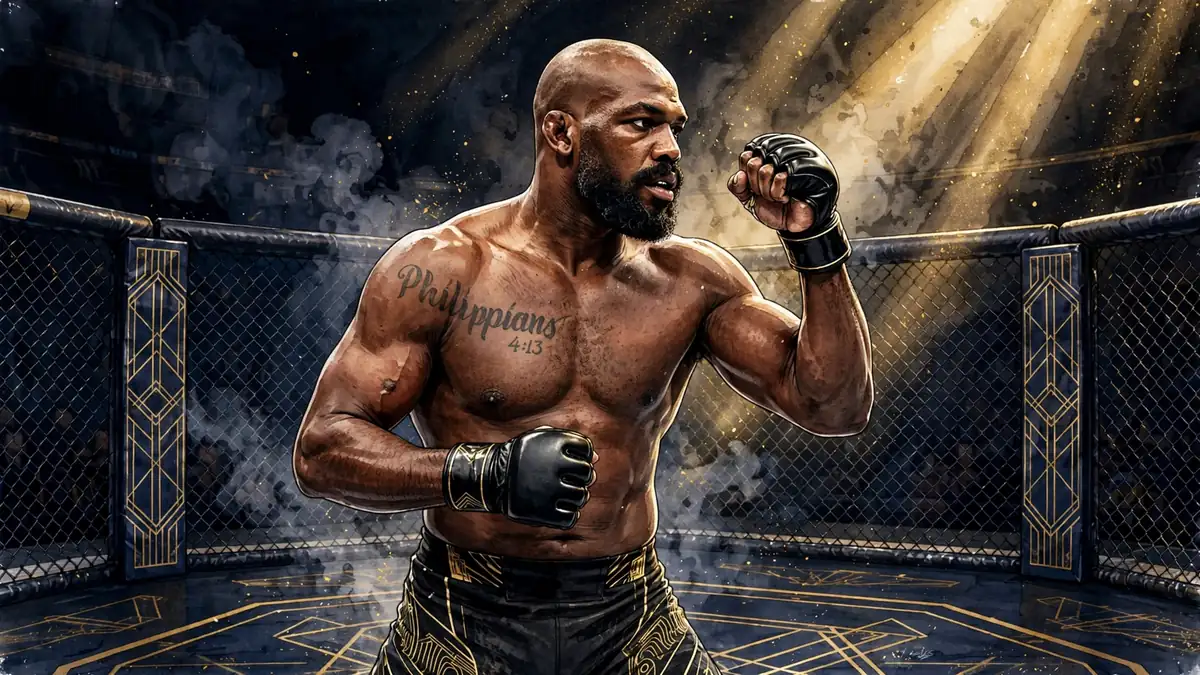
Faith is not a footnote in his story. His father is a pastor, and Jones’s chest bears a tattoo of the Bible verse Philippians 4:13 — “I can do all things through Christ who strengthens me.” He has talked openly about prayer before fights and about the pull between the life his upbringing pointed to and the life the fight world offered. His mother’s death in 2017, after her long fight with diabetes, hit him hard; he has said the loss changed the way he thought about his career and his family.
The brothers remain close. Arthur and Chandler both built long NFL careers, and the three of them — two football players and a fighter — are one of the great sibling stories in American sport. Chandler, the youngest, has spoken about watching Jon’s fights from NFL locker rooms; Jon has spoken about the pride of having brothers who understood, better than anyone, what it means to perform under pressure. In recent years Jones has also moved into coaching, working with Olympic gold medallist Gable Steveson as the young wrestler has explored MMA — a sign of where his post-fighting life may be headed.
Legacy: Where Jon Jones Ranks Among the Greats
The argument about the greatest mixed martial artist of all time has three or four names in it, and Jon Jones is in every version of it. The case for him is the record: the youngest champion ever, the most light heavyweight title defences, two divisions conquered, a 28–1 record in which the one loss is a disqualification most observers refuse to count, and wins over an entire generation of champions — Rua, Jackson, Machida, Evans, Belfort, Sonnen, Teixeira, Gustafsson, Cormier, Gane and Miocic.
The case against him is the one he built himself: the failed drug tests, the stripped titles, the fights that never happened. Georges St-Pierre never failed a test. Anderson Silva’s reign was cleaner. Demetrious Johnson never missed weight or a court date. Jones’s greatness was interrupted, repeatedly, by his own choices, and the sport is still arguing about how much that should count.
What is not arguable is the influence. Jones changed how light heavyweights fight — the oblique kicks, the elbows from the clinch, the use of reach as a weapon rather than a stat. He set the template for the modern tall, long, creative striker-grappler. And his heavyweight run, short as it was, proved that the skills scaled up: he beat the best heavyweight of the previous era and the most dangerous striker of the new one, and he did it without ever looking in danger. However the White House saga ends, the fighting record is closed, and it is one of the two or three best the sport has ever produced.
Net Worth Timeline and Source-by-Source Breakdown
Because the published estimates disagree so sharply, here is the honest picture: what each source says, and when it said it.
| Source | Estimate | When |
|---|---|---|
| Celebrity Net Worth (via Wealthy Gorilla) | $3 million | Updated November 5, 2026 |
| SurpriseSports | $3 million | Updated October 10, 2026 |
| BounceMojo | $8 million | Updated September 2026 |
| MiddleEasy (richest MMA fighters list) | $8 million | Checked October 2026 |
| EssentiallySports | $8 million | November 25, 2025 |
| Fistsight | $3 million – $15 million | May 2026 |
| Jones himself (SportScape Magazine) | Best single year: $15 million; first million at 24 | October 2026 |
And the career milestones behind those numbers:
| Year | Milestone | Money detail |
|---|---|---|
| 2008 | Turns professional; UFC debut in August | Regional purses; first UFC paydays |
| 2011 | Youngest UFC champion at 23 (UFC 128) | First million made at 24, per Jones |
| 2012 | First MMA athlete sponsored by Nike internationally | Landmark endorsement deal |
| 2015 | Beats Cormier at UFC 182; stripped of title after hit-and-run | UFC 182 earned an estimated $3.6 million; Nike deal ends |
| 2017 | UFC 214 win over Cormier overturned to no-contest | 15-month suspension; prime earning years lost |
| 2020 | Vacates light heavyweight title | Three years away from competition |
| 2023 | Wins heavyweight title at UFC 285 | Reported $3 million base purse; estimates to $3.5 million-plus |
| 2024 | Defends heavyweight title at UFC 309 | Reported $5.7 million – $6.3 million, career-best payday |
| 2025 | Retires in June; re-enters drug-testing pool | UFC antitrust settlement of $6 million – $7 million reported |
| 2026 | Left off White House card; asks for UFC release | Best single year $15 million, per Jones (October 2026) |
Frequently Asked Questions
How old is Jon Jones?
Jon Jones was born on July 19, 1987, in Rochester, New York, which makes him 39 years old as of November 2026. He was 23 when he became the youngest champion in UFC history at UFC 128 in March 2011.
Is Jon Jones retired?
Yes — officially. UFC president Dana White announced Jones’s retirement on June 21, 2025, and the heavyweight title passed to Tom Aspinall. But Jones re-entered the drug-testing pool weeks later, and in October 2026 he said he “more than likely” won’t fight again while staying tested and “leaving doors open,” so the door is not fully closed.
What is Jon Jones’s net worth?
Published estimates for 2026 range from $3 million to $15 million. Celebrity Net Worth puts him at $3 million, while BounceMojo and MiddleEasy — both updated in autumn 2026 — land near $8 million as a middle estimate. His disclosed UFC career earnings alone top $14.3 million, but suspensions, lost sponsorships, taxes and legal costs explain why his net worth sits below his gross earnings.
What is Jon Jones’s professional record?
Jon Jones’s record is 28 wins, 1 loss and 1 no-contest. His only loss is a 2009 disqualification against Matt Hamill for illegal downward elbows in a fight he was dominating. The no-contest is the 2017 rematch with Daniel Cormier, overturned after Jones failed a drug test.
Why is Jon Jones called “Bones”?
The nickname comes from high school football. Jones played defensive line at Union-Endicott High School, and because his frame was long and lean next to the other linemen, his coach started calling him “Bones.” It stuck, and it became one of the best-known nicknames in MMA.
Who are Jon Jones’s brothers?
His older brother Arthur Jones was an NFL defensive lineman who won a Super Bowl with the Baltimore Ravens, and his younger brother Chandler Jones became one of the NFL’s best pass rushers with the New England Patriots, Arizona Cardinals and Las Vegas Raiders. Their late sister Carmen died before turning 18.
Why did Jon Jones retire instead of fighting Tom Aspinall?
Money. Jones asked the UFC for a purse of around $30 million to face Aspinall in a heavyweight unification bout — a figure reported by Ariel Helwani and later hinted at by Jones himself. The two sides could not agree, and in June 2025 Dana White announced Jones had retired, with Aspinall promoted to undisputed champion.
Will Jon Jones fight again, or fight at the White House?
Almost certainly not at the White House. Jones campaigned for a place on the UFC’s White House card in June 2026, but he was left off the announced line-up, and Dana White said he was never under consideration. In late October 2026 Jones said the UFC lowballed him in negotiations and asked to be released from his contract. He remains in the drug-testing pool, so a return is technically possible, but as of November 2026 nothing is booked.
Final Thoughts
Jon Jones’s biography reads like two stories braided together. One is the story of the most talented fighter who ever lived: the wrestling kid from Endicott who became the youngest champion in UFC history, defended a title eleven times, and then walked into a heavier division and won that belt too, barely breaking a sweat. The other is the story of a man who kept getting in his own way — the arrests, the failed tests, the stripped titles, and the $30 million demand that cost him the last great fight of his career.
Both stories are true, and neither one makes sense without the other. The talent explains the money, the fame and the records. The troubles explain why the fortune is $3 million to $15 million instead of $50 million, and why a fighter who never truly lost in the cage still left the sport with unfinished business. At 39, retired but still being drug-tested, still arguing with the UFC on social media, Jon Jones remains what he has always been: the best fighter of his generation, and the hardest one to sum up.
Sources and Reporting
How we estimated: net worth figures in this article are estimates drawn from named public sources, not from private financial records. Where sources disagree, we publish the range and name the source behind each figure. Disclosed fight purses come from commission data and specialist trackers such as MMA Salaries; pay-per-view and bonus money is estimated by the outlets cited and is not officially disclosed by the UFC. Private taxes, fees and spending are not visible to us, so treat every figure as an estimate.
Sources consulted for this biography include Wikipedia, UFC, ESPN, Sherdog, MiddleEasy, BounceMojo, Celebrity Net Worth, Wealthy Gorilla, EssentiallySports, GiveMeSport, MMA News, bet365 News and SurpriseSports. Figures and dates were checked against live reporting dated between 2024 and November 2026.