By Celebamerica Editorial Staff | Last updated: November 6, 2026
Tom Cruise is one of the last true movie stars on the planet — a performer who has headlined hit films in five different decades, done his own stunts at 60-plus, and turned profit-sharing deals into one of the largest fortunes in Hollywood history. As of November 2026, Tom Cruise’s estimated net worth is $600 million, according to Celebrity Net Worth, an estimate repeated across Parade, TheRichest, and a wide run of 2026 entertainment-finance reporting. His films have grossed more than $11 billion worldwide, and his career earnings from acting and producing have passed $1 billion, per Celebrity Net Worth.
That headline number only tells part of the story. Cruise did not build his wealth the way most actors do. He took small upfront fees and large slices of the box office instead, produced the films he starred in, and kept the same two franchises — Top Gun and Mission: Impossible — earning for nearly forty years. This biography follows the whole arc: a restless childhood across fifteen schools, a breakout that made him the biggest star of the 1980s, a run of serious dramatic work that earned him three Oscar nominations, the backend deals that made him hundreds of millions, three marriages, a long and much-discussed association with Scientology, and a 2025–2026 chapter that brought an honorary Oscar, the close of the Mission: Impossible series, and a bold new film with Alejandro G. Iñárritu.
Table of Contents
- Tom Cruise Quick Facts
- Early Life: Fifteen Schools and a Restless Childhood
- First Roles and the Road to New York
- Risky Business and the Breakout Years
- Top Gun: Becoming the Biggest Star of the 1980s
- The Serious Actor: Rain Man, Born on the Fourth of July, and Jerry Maguire
- Mission: Impossible and the Producer Who Bet on Himself
- The Money: Salaries, Backend Deals, and a Billion in Career Earnings
- Net Worth Growth: Year by Year
- Business Ventures: Cruise/Wagner and the Warner Bros. Deal
- Real Estate and Assets
- Personal Life: Three Marriages and Three Children
- Scientology: The Longest-Running Story Around Him
- Height, Image, and the Stuntman Star
- 2025 and 2026: Honorary Oscar, Final Reckoning, and Digger
- How Tom Cruise Compares With His Peers
- Tom Cruise FAQs
- Final Thoughts: The Bottom Line on Tom Cruise
- Sources and Reporting
Tom Cruise Quick Facts
| Full Name | Thomas Cruise Mapother IV |
|---|---|
| Date of Birth | July 3, 1962 (age 64 as of November 2026) |
| Birthplace | Syracuse, New York, United States |
| Estimated Net Worth | $600 million (Celebrity Net Worth, 2026 estimate; see the range discussion below) |
| Career Box Office | More than $11 billion worldwide across his films; Warner Bros. put the figure at nearly $13 billion in January 2024 |
| Career Earnings | More than $1 billion from film salaries and backend participation, per Celebrity Net Worth |
| Peak Income Sources | Backend profit participation (first-dollar gross deals), producer fees, upfront acting salaries of $12–25 million per film |
| Key Ventures and Works | Cruise/Wagner Productions; Mission: Impossible franchise (8 films, 1996–2025); Top Gun (1986) and Top Gun: Maverick (2022); Rain Man, Jerry Maguire, Magnolia |
| Height | 5 feet 7 inches (170 cm), as listed by virtually every published source |
| Marriages | Mimi Rogers (1987–1990); Nicole Kidman (1990–2001); Katie Holmes (2006–2012) |
| Children | Isabella Jane Cruise (adopted 1992), Connor Antony Cruise (adopted 1995), Suri Cruise (born 2006) |
| Awards | Three competitive Oscar nominations for acting, one Best Picture nomination as a producer, and an honorary Oscar at the Governors Awards in November 2025 |
Early Life: Fifteen Schools and a Restless Childhood
Thomas Cruise Mapother IV was born on July 3, 1962, in Syracuse, New York, to Thomas Cruise Mapother III, an electrical engineer, and Mary Lee Pfeiffer, a special education teacher. He was the third of four children, with three sisters, and the family moved constantly for his father’s work — through New York, New Jersey, Kentucky, and Canada. By his own account and in profile after profile, Cruise attended around fifteen schools before the age of fourteen.
That kind of childhood leaves marks. Cruise has spoken openly about growing up with dyslexia, which made reading and schoolwork a daily struggle long before anyone gave the condition a name in his classroom. He has described himself as a poor student who learned to cope by listening hard and working harder than the other kids. The reading difficulty stayed with him into adulthood — he has said he taught himself to read fluently only later in life — and it shaped the work ethic that would define his career: relentless preparation, total focus on the task in front of him, and a refusal to be outworked.
His parents’ marriage was unhappy, and Cruise has described his father as abusive. His mother left the marriage when Cruise was a boy, taking the children with her, and the family lived for a time in near-poverty. Mary Lee worked hard to give her children a stable life, and Cruise has credited her again and again as the person who believed in him when nobody else did. The family settled for a stretch in Glen Ridge, New Jersey, where Cruise finished high school at Glen Ridge High School.
For a short period, Cruise considered the priesthood and spent time at a Franciscan seminary in Cincinnati, Ohio. The idea did not last — acting had already caught his attention — but the discipline of that year stuck with him. In high school he played football until a knee injury ended that path, and he found his way onto the stage in school plays. A teacher’s encouragement after one performance is often cited as the moment he decided acting was not a hobby but a calling.
What matters about this early life is not the hardship alone. Plenty of actors had hard childhoods. What set Cruise apart was what he did with it: he treated the instability as training. Moving schools every few months teaches a child to read a room fast, to make friends fast, and to perform — socially, at first, then literally. By the time he arrived in New York at eighteen, he had spent a lifetime practising the one skill an actor needs most: walking into a strange place and making people pay attention.
First Roles and the Road to New York
After high school, Cruise moved to New York City in 1980 with little money and no connections. He worked as a busboy while auditioning, the classic story, except that his version moved fast. His first onscreen role came in 1981 with a small part in Endless Love, for which he reportedly earned $50,000 — a modest sum that looks tiny against what came later, but real money for a teenager fresh out of New Jersey.
The same year he landed a bigger break in Taps (1981), playing a hot-headed military cadet opposite George C. Scott and Timothy Hutton. The performance stood out: critics noticed the intensity, the focus, the sense that this young actor was not just saying lines but living inside them. He followed it with The Outsiders (1983), Francis Ford Coppola’s ensemble of young talent, and All the Right Moves (1983), where he played a high-school football star trying to escape a dead-end town — a role that drew on his own life more than audiences knew at the time.
Those early years set a pattern that would hold for the next four decades. Cruise picked projects with strong directors, worked harder than anyone else on set, and treated every role as if his career depended on it — because, at that point, it did. He was not a child star and he was not an overnight success in the tabloid sense. He was a working actor climbing one rung at a time, and the climb was fast because the work was good.
Risky Business and the Breakout Years
Risky Business (1983) changed everything. Cruise played Joel Goodsen, a well-off suburban teenager who turns his parents’ house into a brothel while they are away — a comedy that doubled as a coming-of-age story and gave cinema one of its most copied images: Cruise sliding across a parquet floor in socks and a shirt, lip-syncing to Bob Seger. He was reportedly paid $75,000 for the role. The film grossed $63.5 million on a $6.2 million budget, and Cruise, at twenty-one, was suddenly a leading man.
The years that followed were a run of hits and near-hits that built his range. Legend (1985), Ridley Scott’s dark fantasy, was a commercial disappointment but showed Cruise willing to take risks. The Color of Money (1986), opposite Paul Newman, put him on screen with a legend and taught him how a movie star carries a film — Newman won the Oscar for that performance, and Cruise, who earned a reported $1 million for the role, learned at close range what screen presence looks like when it is fully formed.
By 1986, Cruise was no longer a promising young actor. He was a star with a growing list of hits, a reputation for total commitment, and a salary that was climbing with every picture. The next film would make him the biggest name in Hollywood.
Top Gun: Becoming the Biggest Star of the 1980s
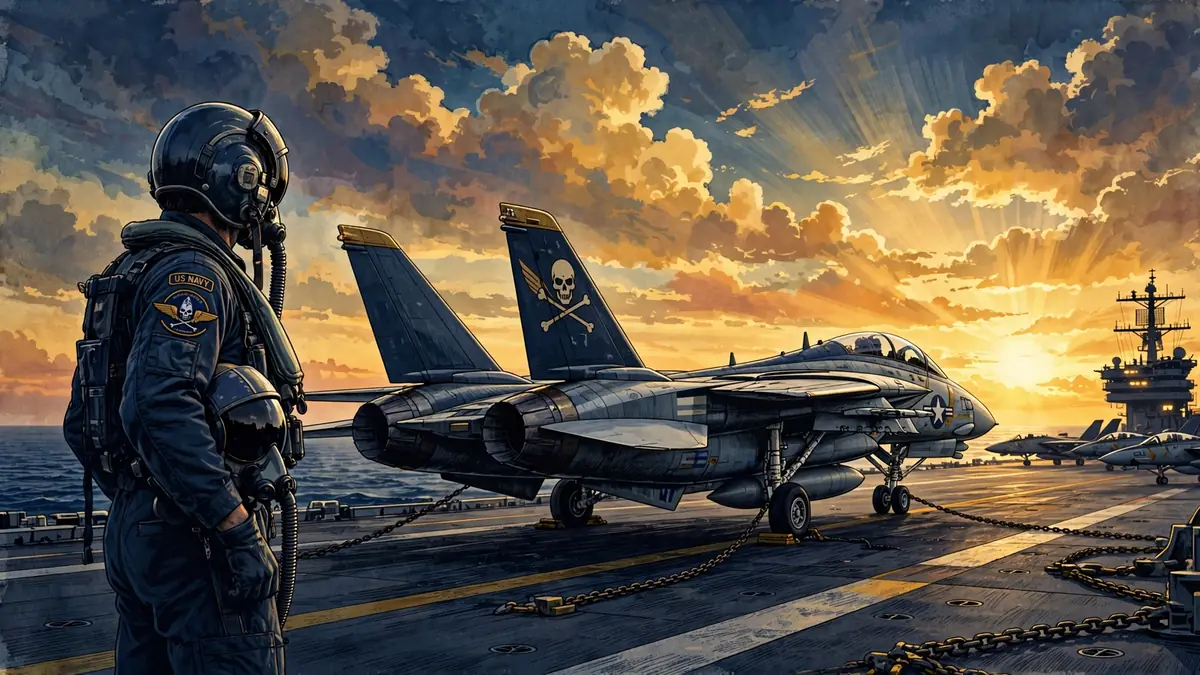
Top Gun (1986) made Tom Cruise a global star. He played Pete “Maverick” Mitchell, a cocky Navy fighter pilot sent to the Navy’s elite Fighter Weapons School, and the film became the highest-grossing movie of the year. Cruise commanded a reported $2 million for the role — a leap from the $75,000 of Risky Business three years earlier. The film made $357 million worldwide on a $15 million budget, and its soundtrack, its sunglasses, and its volleyball scene became part of the culture of the decade.
What Top Gun really sold was Cruise himself: the grin, the confidence, the physical ease. He did much of his own flying preparation, spending time with real Navy pilots and learning how a fighter jet actually feels. That habit — doing the real thing rather than faking it — would become his trademark. It also made the film feel different from other action movies of the era. The flying sequences were real, the sweat was real, and audiences could tell.
The late 1980s kept the momentum going. Cocktail (1988) was a hit even as critics shrugged. Rain Man (1988), opposite Dustin Hoffman, won the Academy Award for Best Picture and showed Cruise could hold his own against one of the great actors of his generation, playing the selfish younger brother who slowly learns to care for his autistic older brother. The film grossed more than $350 million worldwide and proved that Cruise was not just an action star — he was an actor directors trusted with serious material.
The Serious Actor: Rain Man, Born on the Fourth of July, and Jerry Maguire
If the 1980s made Cruise a star, the late 1980s and 1990s made him an actor critics had to take seriously. Born on the Fourth of July (1989), Oliver Stone’s Vietnam drama, cast him as Ron Kovic, a paralysed veteran turned anti-war activist. Cruise spent months in a wheelchair preparing, and the performance earned him his first Academy Award nomination for Best Actor and a Golden Globe win. It was the first time the industry saw the full depth of what he could do — and it set a pattern: whenever people wrote him off as a pretty face, he answered with a performance that made the argument impossible.
The 1990s brought a run of films that most actors would call a career on its own. A Few Good Men (1992), opposite Jack Nicholson, gave him one of the great courtroom scenes in film history. The Firm (1993) was a box-office hit. Interview with the Vampire (1994) cast him against type as the vampire Lestat, a gamble that paid off commercially. Jerry Maguire (1996) gave him his second Best Actor nomination and the line “Show me the money!” — a phrase that entered the language and, fittingly for this biography, became shorthand for the business of being Tom Cruise.
Magnolia (1999), Paul Thomas Anderson’s sprawling Los Angeles ensemble, brought his third acting Oscar nomination, this time for Best Supporting Actor, as Frank T.J. Mackey, a motivational speaker for men whose swagger hides deep wounds. The performance was raw, funny, and unsettling — and it remains the one many critics point to when they argue that Cruise’s best acting has often been in his least commercial films. Eyes Wide Shut (1999), Stanley Kubrick’s final film, co-starring Nicole Kidman, closed the decade with a strange, hypnotic drama that took more than a year to shoot and still divides audiences today.
Through all of it, Cruise’s method stayed the same: total immersion, endless takes, and a willingness to look foolish in rehearsal so the performance would look effortless on screen. Directors who worked with him in this period — Stone, Kubrick, Anderson, Cameron Crowe — have all described the same thing: an actor who arrives knowing his lines, his character, and everyone else’s lines too.
Mission: Impossible and the Producer Who Bet on Himself
In 1996, Cruise did something that changed the economics of his career forever. He did not just star in Mission: Impossible — he produced it, through Cruise/Wagner Productions, the company he had co-founded with his producing partner Paula Wagner. The film grossed $457.7 million worldwide on an $80 million budget, and Cruise’s combined salary and profit points reportedly earned him around $70 million from that one film.
The move was a bet on himself. Instead of taking a flat fee and walking away, Cruise took a share of the film’s profits — plus a producer’s share on top of the actor’s share. When the film worked, he was paid twice. When the franchise kept working, he kept getting paid. The eight Mission: Impossible films have grossed more than $4 billion worldwide combined, and Celebrity Net Worth estimates Cruise has earned more than $400 million from the franchise alone, counting acting salaries, backend profits, and producer shares.
The series also gave Cruise his defining image for a new century: Ethan Hunt, the IMF agent who runs, climbs, hangs off planes, and does the stunt himself. The stunts became a story of their own. He scaled the Burj Khalifa in Ghost Protocol (2011). He held his breath underwater for more than six minutes for a sequence in Rogue Nation (2015). He hung from the side of a military cargo plane as it took off in Rogue Nation — a shot that became one of the most talked-about images of his career. He rode a motorcycle off a cliff in Dead Reckoning (2023). At an age when most action stars have handed the dangerous work to doubles, Cruise made the danger the point.

The franchise closed with Mission: Impossible — The Final Reckoning, released in May 2025, the eighth film in the series and the end of Ethan Hunt’s run after nearly thirty years. Cruise was reportedly paid around $14 million upfront for the film, plus backend participation — the same structure he had used since the beginning, modest upfront money with the real payday tied to the film’s performance.
The Money: Salaries, Backend Deals, and a Billion in Career Earnings
Tom Cruise’s fortune is best understood not as a salary total but as a deal structure. Most actors take a fee. Cruise took a fee and a percentage. The percentage — often called “first-dollar gross” — meant he was paid from the first ticket sold, before the studio had recovered its costs. It is the most generous deal structure in Hollywood, and only a handful of stars have ever commanded it.
Parade reports that Cruise generally earns at least $20–25 million upfront per film. But the upfront number is the smaller part. The real money came from the backend. The clearest examples, as reported by Celebrity Net Worth, Variety, and Parade, tell the story:
| Film | Reported Cruise earnings |
|---|---|
| Risky Business (1983) | $75,000 upfront — the starting point |
| Top Gun (1986) | $2 million upfront; film grossed $357 million |
| Days of Thunder (1990) | $9 million upfront |
| Mission: Impossible (1996) | Around $70 million, salary plus profit points and producer share |
| Mission: Impossible 2 (2000) | Reported $100 million — he waived his upfront salary entirely and took profit participation instead; the film grossed $546 million |
| War of the Worlds (2005) | Reported $100 million, largely from backend participation |
| Mission: Impossible — Ghost Protocol (2011) | Reported $75 million |
| Top Gun: Maverick (2022) | $12–14 million upfront (Variety), with total earnings estimated at $100 million or more from a 10–20% first-dollar gross deal; the film grossed about $1.5 billion |
| Mission: Impossible — The Final Reckoning (2025) | Around $14 million upfront plus backend |
The Mission: Impossible 2 deal deserves a closer look, because it shows how Cruise thinks about money. He took no salary at all for the film and bet everything on a share of the profits. The film became the highest-grossing release of 2000, and his share came to a reported $100 million — making him the highest-paid actor in the world that year from a film where his listed salary was zero. It was a gamble that only works if you are certain the film will be a hit, and Cruise was certain because he was producing it and controlling it.
Top Gun: Maverick was the biggest single payday of his career. Variety reported an upfront fee of $12–14 million — modest by superstar standards — but Celebrity Net Worth reports his deal as 10% to 20% of first-dollar gross. The film grossed about $1.5 billion worldwide, his first film to pass $1 billion, and estimates of his total payout range from $100 million to $149 million, with some reporting suggesting it could have gone higher. It was, by most accounts, one of the largest single paychecks any actor has ever received for one film.
Forbes has placed Cruise on its highest-paid actors list more than once — he topped it in 1997, 2006, and 2012 — and its 2025 ranking placed him second with $46 million in annual earnings, behind Adam Sandler. That ranking measures a single year’s earnings, not wealth, and it is a useful reminder of the difference: Cruise’s net worth of $600 million is what he has kept after taxes, agent fees, and spending, while his career earnings of more than $1 billion are what he has been paid before those costs.
The honest range: Celebrity Net Worth anchors the estimate at $600 million, and that figure has barely moved since 2021 — normal for wealth estimates, which change only when big new data surfaces. Some trackers stretch the range higher, up to around $800 million or more, once later backend payouts are counted. A bottom-up model published by NetWorthRadar in October 2026 put the likely range at $520–680 million. We anchor on $600 million because it is the figure the named sources converge on, and we flag the range because Cruise publishes no audited accounts — nobody outside his circle knows the exact number.
Net Worth Growth: Year by Year
Cruise’s wealth did not grow in a straight line. It grew in jumps — one big film, one big deal, one franchise payday at a time. The timeline below uses reported salaries and published estimates; early figures are approximations based on the deals reported at the time.
| Period | What happened |
|---|---|
| 1981–1983 | First roles; $50,000 for Endless Love, $75,000 for Risky Business — a working actor’s income |
| 1986 | Top Gun: $2 million salary; first real wealth, and the start of the superstar fee scale |
| 1988–1992 | Rain Man, Born on the Fourth of July, A Few Good Men — fees rising into eight figures; first Oscar nominations |
| 1996 | Mission: Impossible and Jerry Maguire in the same year; around $70 million from the first film alone; Cruise/Wagner producing power established |
| 2000 | Mission: Impossible 2: reported $100 million from profit participation alone |
| 2005 | War of the Worlds: another reported $100 million payday |
| 2011–2018 | Ghost Protocol, Rogue Nation, Fallout — steady eight-figure paydays plus backend; franchise gross passes $3 billion |
| 2022 | Top Gun: Maverick grosses about $1.5 billion; Cruise’s total from the film estimated at $100 million-plus |
| 2025–2026 | The Final Reckoning closes the franchise; honorary Oscar; Digger opens October 2026 — estimate holds at $600 million |
One thing worth noting: the $600 million estimate has been stable for years, even as Cruise kept earning. That is because net worth is a stock, not a flow. He earns tens of millions in a good year and spends, invests, pays tax, and pays his team in the same year. The number moves only when something large changes — a property sale, a nine-figure backend cheque clearing, a new deal. The stability of the figure is not a sign that he stopped earning. It is a sign that published estimates are conservative and slow to update.
Business Ventures: Cruise/Wagner and the Warner Bros. Deal
Cruise/Wagner Productions, founded in 1993 with Paula Wagner, was the engine of Cruise’s wealth. The company produced the Mission: Impossible films, The Others, Vanilla Sky, The Last Samurai, and War of the Worlds, among others. As a producer, Cruise earned fees and profit shares on films he also starred in — the double dip that turned a good acting career into a great fortune. The company had a long deal with Paramount, and when that relationship ended in 2006 after a public falling-out, Cruise and Wagner moved on and kept producing.
The producing role also gave Cruise control. He chose directors, approved scripts, and shaped the marketing of his films. That control is part of why the Mission: Impossible franchise stayed consistent for nearly thirty years while other franchises faded: one person with a financial stake in every decision was making the calls.
In January 2024, Cruise signed a new deal with Warner Bros., announced in a press release that put his career box office at nearly $13 billion. The deal covers development and production of original films and franchise titles, with Cruise producing and starring. Digger, his 2026 film with Alejandro G. Iñárritu, was released by Warner Bros. under that arrangement. The partnership matters because it shows where Cruise’s career is heading at 64: fewer franchise obligations, more original films, and a studio relationship built around his name as a producer as much as a star.
Beyond film, Cruise has kept his business life simple. He is not known for a portfolio of startup investments, a fashion label, or a spirits brand — the side businesses other stars use to build wealth. His fortune comes from the films themselves, from the deals he struck on them, and from property. That focus is part of the story: he made his money doing one thing, at the highest level, for forty years.
Real Estate and Assets
Property has been Cruise’s most visible asset class, and his buying and selling over the years reads like a map of his life. Realtor and realestate.com.au have reported on a portfolio once valued at around $97.5 million, built up and then largely sold off as his base moved from Los Angeles to Florida.
The biggest sale was his Telluride, Colorado, ranch, which he sold in 2021 for $39.5 million. He had bought the mountain property in the 1990s during his marriage to Nicole Kidman and listed it originally at $59 million. In 2016 he sold the Beverly Hills compound he had shared with Katie Holmes for $38 million, having paid $30.5 million for it in 2007. The 1.2-acre spread included a seven-bedroom mansion, a tennis court, a swimming pool, and guesthouses. A year earlier, in 2015, he had sold his Hollywood Hills compound to actress Eva Longoria for $11.4 million, and in 2013 he sold his East Village loft in New York for $3 million in an off-market deal.
What he kept, and where he went, tells the next part of the story. In 2016–2017 Cruise bought a two-level penthouse in the SkyView tower in Clearwater, Florida, for a reported $9.5–9.6 million, plus three more condos in the same building for an additional $1.475 million, reportedly for staff or family. The penthouse, at more than 20,000 square feet, includes a gym, a home theatre, a roof deck with an infinity pool, and a car elevator. Clearwater is the spiritual headquarters of the Church of Scientology, and the move placed Cruise two blocks from its Flag Building. USA Today reported in September 2026 that he still owns the downtown Clearwater condo.
Cruise is also known for his collection of cars and motorcycles, and for the aircraft he has flown himself — he is a licensed pilot, a skill he picked up for Top Gun and kept for life. He has owned a P-51 Mustang, the vintage fighter plane he flew in Top Gun: Maverick, and a Gulfstream jet for travel. These are the toys of a man who has spent his life around machines that fly, and they double as tools: when your job involves flying a plane on camera, owning one is not a luxury, it is preparation.
Personal Life: Three Marriages and Three Children
Cruise has been married three times, and each marriage was one of the most covered celebrity relationships of its era. His first marriage was to actress Mimi Rogers, whom he married in May 1987. Rogers, six years his senior, is widely reported to have introduced Cruise to Scientology. The marriage lasted three years, ending in divorce in February 1990, and the two have kept a low profile about it ever since.
His second marriage, to Nicole Kidman, was the defining celebrity pairing of the 1990s. They met on the set of Days of Thunder in early 1990 and married on Christmas Eve that year in Telluride, Colorado. For a decade they were Hollywood’s golden couple, co-starring in Far and Away (1992) and Eyes Wide Shut (1999). During the marriage they adopted two children: Isabella Jane Cruise, born in December 1992, and Connor Antony Cruise, born in January 1995. The marriage ended in 2001, when Cruise filed for divorce citing irreconcilable differences. Kidman has since married country singer Keith Urban — a marriage that itself ended in divorce, finalised in January 2026 — and has two daughters with him.
Bella and Connor were raised largely with their father after the divorce, and both have kept low public profiles. Bella, now 33, lives in London with her husband Max Parker, whom she married in 2015, and works as an artist and graphic designer, selling work under the name Bella Kidman Cruise. Connor, now 31, tried acting as a teenager — appearing in Seven Pounds (2008) and Red Dawn (2012) — before stepping away from Hollywood. He lives in Florida, where he has been seen at public events in 2026, and both older children remain Scientologists, like their father.
Cruise’s third marriage was to Katie Holmes. They began dating in 2005, in a relationship the press dubbed “TomKat” after Cruise’s famous couch-jumping appearance on The Oprah Winfrey Show. Their daughter, Suri Cruise, was born on April 18, 2006, and the couple married in a lavish ceremony at the 15th-century Odescalchi Castle in Bracciano, Italy, on November 18, 2006. The marriage ended in 2012, when Holmes filed for divorce in June of that year. The divorce was settled in under two weeks, with Holmes receiving primary custody of Suri.
Suri, now 20, is Cruise’s only biological child. She graduated from LaGuardia High School in New York in 2024, dropped “Cruise” from her surname — appearing as “Suri Noelle” in her graduation programme — and is now a student at Carnegie Mellon University in Pittsburgh, where she registered to vote in 2026 under the name Suri Noelle. Reporting across Hello! magazine and other outlets describes Cruise as estranged from Suri since the divorce, and he was not present at her high school graduation. The distance between father and daughter is one of the saddest threads in Cruise’s biography, and it is also one of the most reported — a reminder that the cost of his choices has been measured in family as well as in money.
As of 2026, Cruise is not married. His last widely reported romantic link was to actress Ana de Armas, with the two reportedly seen together at a private event in London in May 2025. He has kept his private life quieter in recent years, and the coverage has followed suit — the man who once jumped on a couch on live television now gives interviews almost entirely about the work.
Scientology: The Longest-Running Story Around Him
No biography of Tom Cruise is complete without Scientology, and no part of his life has generated more reporting, more argument, and more unanswered questions. Cruise was introduced to the Church of Scientology by his first wife, Mimi Rogers, in the late 1980s, and he has been its most famous member ever since. He has described the faith as having helped him with his dyslexia and with his life, and he has defended it publicly for decades.
The association has shaped his life in concrete ways. His older children were raised within Scientology and remain members. His move to Clearwater placed him at the heart of the church’s operations. His friendship with the church’s leader, David Miscavige, has been widely reported, and Cruise has appeared at church events for years. When Katie Holmes filed for divorce in 2012, reporting at the time — including in Vanity Fair and other outlets — said she wanted to protect Suri from the church, and the speed and secrecy of her filing were widely read as a break not just from a marriage but from Scientology itself.
The public flashpoints are well known. In 2005, Cruise criticised psychiatry and the use of antidepressants in interviews, including a heated exchange with Matt Lauer on the Today show, and spoke against the treatment actress Brooke Shields had received for post-partum depression. The comments damaged his public image for a time, and the couch-jumping moment on Oprah the same year became a symbol of a star who seemed to have lost his footing. Cruise later apologised to Shields, and his public image recovered — helped, in large part, by the sheer quality and success of the films that followed.
What is fair to say, and what the reporting supports, is this: Scientology is central to how Cruise lives, where he lives, and how he raises his family. It is also the subject on which he is least open to questions. This article reports what named outlets have published and leaves the rest where it belongs — with the people involved, not with speculation.
Height, Image, and the Stuntman Star
Tom Cruise’s height has been discussed for as long as he has been famous, which is itself a strange fact about fame: a leading man who has played fighter pilots, secret agents, and samurai is still measured, literally, by the public. The published listings are consistent — Tom Cruise’s height is listed at 5 feet 7 inches (170 cm) across IMDb, Wikipedia, and specialist height trackers, and our sister site GuideNetWorth has a full breakdown of the reported figure, the camera tricks, and the co-star comparisons. Cruise himself has never publicly confirmed a measurement, so the figure is reported rather than independently verified — a distinction worth keeping in mind.
The reason the height question keeps coming up is that Cruise’s screen image is so large. He plays men who dominate a room, and the camera work — lifts in his shoes, low angles, careful casting of co-stars — has always been part of the craft of making him look the part. None of it matters to the work. What matters is that at 5 feet 7 inches he has carried action franchises for thirty years, done stunts that younger, taller men would not attempt, and built a career on physical presence rather than physical size.
That physical presence is the real story. Cruise trains like an athlete for every film: running, climbing, flying, riding motorcycles, holding his breath underwater. He has said that the preparation is the job — that the stunts are not a gimmick but the point of the performance, a way of putting the audience inside the scene rather than asking them to believe a trick. At 64, he is still doing it, and the 2025–2026 run of films shows no sign of him slowing down.
2025 and 2026: Honorary Oscar, Final Reckoning, and Digger
The last two years have been among the most eventful of Cruise’s career. In May 2025, Mission: Impossible — The Final Reckoning closed the franchise that had defined his adult life. The film brought Ethan Hunt’s story to an end after eight films and nearly thirty years, and Cruise’s farewell tour for the series — premieres, interviews, retrospectives — felt like a closing chapter for an entire era of blockbuster cinema.
Then, on November 16, 2025, the Academy of Motion Picture Arts and Sciences gave Cruise an honorary Oscar at the 16th Governors Awards. The award recognised his career and his contribution to cinema, and it was presented by director Alejandro G. Iñárritu, who told the room that Cruise “doesn’t just make movies, he is movies.” Cruise’s acceptance speech included the line that has since been quoted everywhere: “Making films is not what I do, it is who I am.” He had four competitive Oscar nominations — Best Actor for Born on the Fourth of July and Jerry Maguire, Best Supporting Actor for Magnolia, and Best Picture as a producer of Top Gun: Maverick — and the honorary award filled the one gap in a career that had everything else.
The Iñárritu connection led directly to his next film. Digger, directed by Iñárritu and released by Warner Bros. on October 2, 2026, casts Cruise as Digger Rockwell, a blunt Southern oil baron described as the most powerful man in the world, whose company is tied to an ecological catastrophe. It is his first non-franchise film since 2017 and his biggest swing as an actor in years, with a cast including Sandra Hüller, Riz Ahmed, John Goodman, and Jesse Plemons. The opening was rough — about $8 million in its first weekend in the United States and Canada, around $20 million worldwide, against a reported budget of at least $125 million, with mixed reviews (53% positive on Rotten Tomatoes) — and early reporting in October 2026 described it as a commercial disappointment. Cruise’s public response was gracious: he posted that he was “so honoured” to have made the film and thanked the cast and crew.
The setbacks, if that is what Digger turns out to be, have not slowed him down. Paramount officially confirmed Top Gun 3 in April 2026, with Cruise returning as Pete “Maverick” Mitchell and a script well underway, reuniting him with producer Jerry Bruckheimer. A Days of Thunder sequel is also in development, with Cruise returning as Cole Trickle and a release date reported for June 2, 2028. And in 2026 he delivered a pre-show speech at the FIFA World Cup Final — a reminder that his fame now extends beyond film into the biggest live events on the planet.
At 64, Cruise is doing something rare: he is not winding down, he is changing shape. The franchise years are behind him. The next chapter — original films, producing, and the occasional return to the characters that made him — looks like the work of a man who has already proved everything and is now choosing what interests him.
How Tom Cruise Compares With His Peers
Cruise’s $600 million puts him near the top of his generation of movie stars, but the comparison that best shows how he got there is the one with his closest contemporary in the action-star ranks. Will Smith, another global star who built his fortune on blockbusters, is estimated at $350 million by Celebrity Net Worth — a large fortune, but a full $250 million below Cruise’s. The gap is the backend: Smith took big salaries; Cruise took a share of the films themselves. Over thirty years, the share was worth more than the salary.
The other comparison is with the box office itself. Cruise’s films have grossed more than $11 billion worldwide, and Warner Bros. put the figure at nearly $13 billion in January 2024. Few actors in history have a number like that. It is the reason studios still build films around him at 64, and the reason his backend deals were possible in the first place: when your name on a poster is worth a billion dollars at the box office, you can ask for a percentage, and the studio will say yes.
| Star | Estimated net worth (2026) |
|---|---|
| Tom Cruise | $600 million (Celebrity Net Worth) |
| Will Smith | $350 million (Celebrity Net Worth, via Koimoi comparison) |
One honest note on comparisons like this: net worth figures for private individuals are estimates built from public records, and different outlets use different methods. The numbers above come from the same source family so the comparison is apples to apples — but the real point is not the gap. It is the method. Cruise’s wealth came from ownership: producing the films, sharing in their profits, and betting on himself. That is a rarer path than the salary, and it is why his fortune has lasted.
Tom Cruise FAQs
What is Tom Cruise’s net worth in 2026?
Tom Cruise’s estimated net worth is $600 million as of 2026, according to Celebrity Net Worth, with the same figure repeated by Parade, TheRichest, and other 2026 reporting. Some trackers suggest the true figure could be higher once later backend payouts are counted, with a likely range of about $520–680 million. His career earnings from acting and producing have passed $1 billion, per Celebrity Net Worth.
How old is Tom Cruise?
Tom Cruise was born on July 3, 1962, in Syracuse, New York, which makes him 64 years old as of November 2026. He has been acting professionally since 1981, giving him a career of more than 45 years, and he remains one of the busiest leading men in Hollywood.
How tall is Tom Cruise?
Tom Cruise is listed at 5 feet 7 inches (170 cm) by virtually every published source, including IMDb and Wikipedia. He has never publicly confirmed a measurement himself, so the figure is reported rather than independently verified. His height has been a talking point for decades, even as he has carried action franchises for thirty years.
What is Tom Cruise’s highest-paid movie?
Top Gun: Maverick (2022) is Tom Cruise’s biggest single payday. Variety reported an upfront fee of $12–14 million, but his 10–20% first-dollar gross deal meant his total earnings from the film are estimated at $100 million or more, with some estimates reaching $149 million. The film grossed about $1.5 billion worldwide. Mission: Impossible 2 (2000) and War of the Worlds (2005) each reportedly earned him around $100 million as well.
How many Mission: Impossible movies did Tom Cruise make?
Tom Cruise starred in and produced eight Mission: Impossible films as Ethan Hunt, from the first in 1996 to The Final Reckoning in May 2025. The franchise has grossed more than $4 billion worldwide, and Celebrity Net Worth estimates Cruise has earned more than $400 million from it through acting salaries, backend profits, and producer shares.
Has Tom Cruise won an Oscar?
Tom Cruise has not won a competitive Oscar, but he received an honorary Oscar at the 16th Governors Awards on November 16, 2025, presented by director Alejandro G. Iñárritu. He has four competitive nominations: Best Actor for Born on the Fourth of July and Jerry Maguire, Best Supporting Actor for Magnolia, and Best Picture as a producer of Top Gun: Maverick.
Who are Tom Cruise’s wives and children?
Tom Cruise has been married three times: to Mimi Rogers (1987–1990), Nicole Kidman (1990–2001), and Katie Holmes (2006–2012). He has three children: Isabella Jane Cruise, adopted in 1992, and Connor Antony Cruise, adopted in 1995, both with Kidman; and Suri Cruise, born April 18, 2006, his only biological child, with Holmes. As of 2026 he is not married.
What is Tom Cruise’s next movie after Digger?
After Digger, which opened October 2, 2026, Tom Cruise is set to return as Pete “Maverick” Mitchell in Top Gun 3, officially confirmed by Paramount in April 2026 with a script well underway. A Days of Thunder sequel is also in development, with Cruise returning as Cole Trickle and a release date reported for June 2, 2028.
Final Thoughts: The Bottom Line on Tom Cruise
Tom Cruise’s biography is, at its core, a story about ownership. He started with nothing — a dyslexic kid from a broken home who had attended fifteen schools — and he built a $600 million fortune not by collecting salaries but by owning a share of the work itself. He produced the films he starred in, took a percentage of the box office instead of a flat fee, and bet on himself when the bet was riskiest, as he did on Mission: Impossible 2, when he took no salary at all and walked away with a reported $100 million.
The career behind the fortune is just as unusual. Four decades at the top, three Oscar nominations for acting, a fourth as a producer, and an honorary Oscar in 2025. A run of dramatic work that critics respect and a run of action work that audiences love. Stunts performed himself at an age when most stars have stopped. And now, at 64, a new chapter: original films with world-class directors, a return to Maverick, and a producing deal with Warner Bros. that points to years of work still ahead.
The personal cost is real, and this biography has not hidden it: three marriages ended, a daughter he is reported to be estranged from, and a faith that has brought him both community and controversy. Those are part of the life, and any honest account of Tom Cruise has to hold them alongside the success. What remains, after all of it, is the work — and the work, by any measure, is one of the great careers in film history.
Sources and Reporting
Figures in this article come from named published sources, not from private records. The $600 million net worth estimate is from Celebrity Net Worth (2026 update), repeated by Parade and TheRichest. Salary and backend-deal reporting draws on Variety (notably the Top Gun: Maverick upfront fee of $12–14 million), Parade, and Celebrity Net Worth. Career box-office totals come from Box Office Mojo and the Warner Bros. announcement of January 2024. Real-estate reporting draws on Realtor.com and realestate.com.au. The honorary Oscar, Digger, and Top Gun 3 reporting draws on 2026 coverage in Reuters and Variety, and on the 2026 reporting cited in the body. Forbes is the source for the highest-paid actors rankings cited here.
How we estimated: Tom Cruise publishes no audited personal accounts, so every net worth figure for him is an estimate built from reported salaries, known backend deals, property records, and public reporting. We anchor on Celebrity Net Worth’s $600 million because it is the figure the named sources converge on, and we give the range ($520–680 million in one bottom-up model; higher in some trackers) where sources disagree. Career earnings above $1 billion, per Celebrity Net Worth, measure what he was paid before taxes, agent fees, and spending — not what he kept. Estimates may differ from private reality, and we update them when new reporting surfaces.