Kevin Durant is one of the greatest scorers basketball has ever seen, and this biography traces his story from a tough childhood in Seat Pleasant, Maryland, to the top of the NBA with the Houston Rockets. Born on September 29, 1988, in Washington, D.C., Durant turned rare length, a soft shooting touch and relentless work into two NBA championships, two Finals MVP awards, a league MVP, four scoring titles and four Olympic gold medals — a resume only a handful of players in history can match.
As of November 2026, Kevin Durant’s estimated net worth sits in a range of $300 million to $400 million, anchored at $400 million by Celebrity Net Worth in its most recent update. The range exists because outlets value his private investments differently, but every major source agrees on the shape of the fortune: more than $500 million already banked in NBA salary alone, a lifetime Nike contract signed in 2023, and a growing investment portfolio built through his firm Thirty Five Ventures. He now plays for the Houston Rockets, who acquired him in a record seven-team trade in July 2025 and signed him to a two-year, $90 million extension that October.
Last updated: November 17, 2026. By Celebamerica Editorial Staff.
Quick Facts
| Full Name | Kevin Wayne Durant |
|---|---|
| Date of Birth | September 29, 1988 |
| Birthplace | Washington, D.C., United States |
| Age | 38 (as of November 2026) |
| Height | 6 feet 11 inches (2.11 m) |
| Current Team | Houston Rockets (since July 2025) |
| Position | Small forward / power forward |
| Jersey Number | 35 (7 with the Brooklyn Nets) |
| Estimated Net Worth | $300 million – $400 million (Celebrity Net Worth: $400 million, November 2026) |
| NBA Career Earnings (banked) | About $505 million through the 2025–26 season |
| Peak / Primary Income Sources | NBA salary, lifetime Nike deal, endorsements, Thirty Five Ventures investments |
| Key Honours | 2× NBA champion (2017, 2018), 2× Finals MVP, 2014 NBA MVP, 4× scoring champion, 4× Olympic gold medallist |
Table of Contents
- Quick Facts
- Early Life and Childhood in Washington, D.C.
- High School Years: Montrose Christian and Oak Hill
- One Season at Texas
- Drafted by Seattle and the Move to Oklahoma City
- The Oklahoma City Rise: Scoring Titles and the 2014 MVP
- Golden State: Two Championships and Two Finals MVPs
- Brooklyn Nets: The Achilles Injury and the Big Three
- Phoenix Suns: The Trade and the Big Three That Was Not
- Houston Rockets: The Seven-Team Trade and the Extension
- Four Olympic Gold Medals
- The Money: Salary, Nike and Business
- Net Worth Breakdown and Growth
- Real Estate, Cars and Investments
- Personal Life and Family
- Charity and Community Work
- Controversies and Public Moments
- Legacy and Where He Ranks All Time
- Frequently Asked Questions
- Final Thoughts
- Sources and Reporting
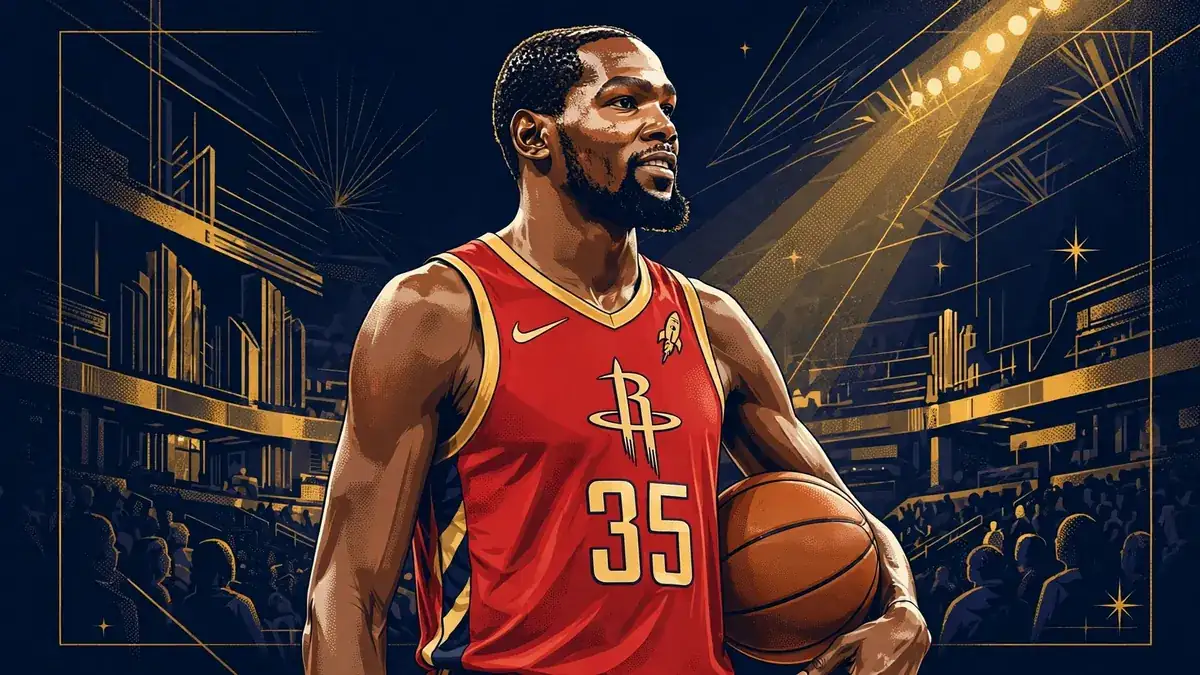
Early Life and Childhood in Washington, D.C.
Kevin Wayne Durant was born on September 29, 1988, in Washington, D.C., to Wanda Durant and Wayne Pratt. He grew up in Seat Pleasant, a small town in Prince George’s County, Maryland, just outside the capital, alongside his older brother Tony, his younger brother Rayvonne and his sister Brianna. Money was tight. His father left the family when Kevin was still a baby, and his mother raised the children largely on her own, working long hours while holding the household together.
Basketball arrived early and never left. Durant started playing organised ball as a young boy, and by the time he was ten he was already turning heads in local youth leagues for a combination that coaches did not know what to do with: he was tall for his age, yet he handled the ball and shot it like a guard. His grandmother Barbara Davis was a steady presence in those years, driving him to games and practices, and Durant has spoken often about how the women in his family kept him on track while the streets around him pulled in other directions.
His father returned to his life when Durant was around thirteen, and the two rebuilt their relationship through basketball — Wayne Pratt coached his son, drilled his footwork and taught him to study the game rather than just play it. The discipline stuck. Durant’s childhood was not a straight line to stardom; it was a grind of early mornings, long bus rides to tournaments and a mother who refused to let talent go to waste. That work ethic became the defining trait of his career: the skinny kid from Seat Pleasant outworked almost everyone he shared a court with.
Durant stands 6 feet 11 inches tall, a frame that made him a mismatch from the day he first picked up a ball. For the full picture of his physical profile, see Kevin Durant’s height on CelebAmerica. His height paired with guard skills is the reason scouts followed him before he could legally drive, and it is still the reason defenders struggle with him at 38.
High School Years: Montrose Christian and Oak Hill
Durant’s high school path took him through three schools, each step raising the level of competition. He started at National Christian Academy in Fort Washington, Maryland, then transferred to Montrose Christian School in Rockville, where he played under coach Stu Vetter and grew into a national recruit. At Montrose he averaged more than 23 points a game as a junior and was already ranked among the best players in his class in the country.
For his senior year he moved to Oak Hill Academy in Mouth of Wilson, Virginia, one of the most famous basketball programmes in America. The change was deliberate: Oak Hill played a national schedule against the best teams in the country, and Durant wanted to measure himself against them. He averaged 23.6 points, 10.2 rebounds and 3 blocks a game there, and he closed his high school career as a McDonald’s All-American and the MVP of the McDonald’s All-American Game in 2006. By graduation he was the consensus second-best prospect in the class of 2006, behind only Greg Oden, and every major college programme in the country wanted him.
What stood out even then was not just the scoring but the polish. Durant shot the ball with a high, clean release that was almost impossible to block at his height, and he moved without the ball like a player who had studied the greats. Coaches who saw him at Oak Hill described a teenager who practised like a professional — first in the gym, last out, obsessed with the details of his shot. That reputation followed him to college and then to the NBA, where it never faded.
One Season at Texas
Durant chose the University of Texas, and his single college season in 2006–07 remains one of the best freshman campaigns in the sport’s history. Playing for coach Rick Barnes, he averaged 25.8 points and 11.1 rebounds a game — numbers no freshman had put up in decades — while shooting 47.3 percent from the field and 40.4 percent from three-point range. He carried a young Texas team to a 25–10 record and the second round of the NCAA Tournament, where the Longhorns fell to USC.
The awards piled up in a way that had never happened for a freshman. Durant became the first first-year player to win the Associated Press College Player of the Year award, and he swept the Naismith Award, the Wooden Award and the Big 12 Player of the Year honour in the same season. He was a consensus first-team All-American. Opposing coaches ran double teams at him from the opening tip and he still scored; by February of that season, the only real debate about Durant was whether he or Ohio State’s Greg Oden would go first in the NBA draft.
He declared for the draft after that one season, and nobody in Austin argued with the decision. Texas retired his No. 35 jersey in 2009, and the year he spent in burnt orange is still talked about in the programme as the standard every recruit since has been measured against. The college game had given him a stage; the NBA was about to give him a career.
Drafted by Seattle and the Move to Oklahoma City
The Portland Trail Blazers took Greg Oden first overall in the 2007 NBA Draft, and the Seattle SuperSonics took Kevin Durant second. It was the last draft pick the Seattle franchise would ever make under that name. Durant signed a four-year rookie contract worth about $19.5 million and, at nineteen, became the face of a franchise in transition.
His rookie season answered every question about whether his game would translate. Durant averaged 20.3 points a game, won the 2008 NBA Rookie of the Year award by a wide margin, and showed a scoring touch that looked fully formed from the start. The team around him was thin — Seattle won just 20 games — but Durant’s development was the story of the season, and the front office knew it had found its cornerstone.
Then the franchise moved. In the summer of 2008 the SuperSonics relocated to Oklahoma City and became the Thunder, a change that still stings Seattle fans today. Durant went with the team, and in Oklahoma City he found the setting where he would grow from a promising scorer into one of the best players on the planet. The move also paired him with two young guards the Thunder had drafted — Russell Westbrook in 2008 and James Harden in 2009 — and that trio would shape the next decade of the Western Conference.
The Oklahoma City Rise: Scoring Titles and the 2014 MVP
Oklahoma City gave Durant room to grow, and he filled it fast. In his second season he jumped to 25.3 points a game, and in 2009–10 he won his first scoring title at 30.1 points a game, becoming the youngest scoring champion in league history at twenty-one. The Thunder won 50 games that season and pushed the eventual champion Los Angeles Lakers to six games in the first round of the playoffs. The league had a new star, and everyone knew it.
Durant won three more scoring titles in the next four years — 2011, 2012 and 2014 — and the Thunder reached the NBA Finals in 2012, where they lost to LeBron James and the Miami Heat in five games. Durant averaged 30.6 points in that series and was clearly the best player on his team, but Miami had the better roster and the experience. The defeat stung, and it set the tone for the years that followed: Durant was good enough to carry a team to the Finals, and the question was whether Oklahoma City could build a champion around him.
The peak of his Oklahoma City years came in 2013–14, when he won the NBA Most Valuable Player award. With Westbrook missing much of the season through injury, Durant carried the Thunder almost single-handedly, averaging 32.0 points, 7.4 rebounds and 5.5 assists a game and scoring 25 or more points in 41 consecutive games. His MVP acceptance speech became one of the most famous moments in modern basketball: with his mother Wanda in tears in the front row, he told her, “You the real MVP.” The line turned his mother into a folk hero and gave the award a human moment that fans still replay today.
The years after the MVP award brought frustration. Harden had been traded to Houston in 2012, a move the Thunder later regretted, and injuries hit the roster hard in 2015. In 2016 Oklahoma City came within one win of the Finals, taking a 3–1 lead over the Golden State Warriors in the Western Conference finals before losing three straight. That collapse was the last straw. Durant had spent nine seasons in the organisation, given it everything, and the championship had not come. When he became a free agent that summer, he faced the biggest decision of his life — and he made the one that changed how the league talked about him for years.
Golden State: Two Championships and Two Finals MVPs
On July 4, 2016, Kevin Durant announced he would join the Golden State Warriors, the 73-win team that had just beaten his Thunder in the conference finals. The reaction was fierce. Fans in Oklahoma City burned his jersey; rival players called the move soft; commentators said he had taken the easy road. Durant heard all of it and answered the only way that mattered to him — by winning.
The Warriors were already great, and Durant made them close to unbeatable. In 2016–17 he averaged 25.1 points a game and shot a career-best 53.7 percent from the field, and Golden State rolled through the playoffs with a 16–1 record, beating LeBron James and the Cleveland Cavaliers in five games in the Finals. Durant averaged 35.2 points in the series, hit the defining shot of the Finals — a pull-up three over James in Game 3 — and was named Finals MVP. A year later he did it again: another title over Cleveland, another Finals MVP, this time averaging 28.8 points a game in a four-game sweep.
His partnership with Stephen Curry defined those two seasons. Curry, the two-time MVP, welcomed Durant and adjusted his own game to make room, and the two stars meshed with a generosity that surprised people who expected friction. For the story of the guard who shared that stage with him, see Stephen Curry’s biography on CelebAmerica. Together with Klay Thompson and Draymond Green they formed one of the most talented lineups the league has ever seen, and the 2017 Warriors are still argued about as the best team of the modern era.
The third season in Golden State ended in pain. In the 2019 playoffs Durant strained his right calf, missed a month, and then returned for Game 5 of the Finals against Toronto despite the risk. Twelve minutes into the game he ruptured his Achilles tendon — one of the most serious injuries in basketball. The Warriors lost the series, and Durant left the franchise that summer with his legacy in California secure but his body in need of a full year of repair. Two titles, two Finals MVPs, and a permanent place in the argument about the greatest teams ever assembled: that is what the Golden State years gave him, and no amount of criticism about how he got there has erased it.
Brooklyn Nets: The Achilles Injury and the Big Three
Durant signed with the Brooklyn Nets in the summer of 2019 through a sign-and-trade deal worth four years and $164 million, knowing he would miss the entire first season while his Achilles healed. It was a remarkable show of faith on both sides: Brooklyn paid a fortune for a player who could not play, and Durant bet his prime on a franchise that had never won a championship. His friend Kyrie Irving signed the same summer, and the plan was for the two stars to build something new in New York.
He returned in December 2020 after eighteen months away, and the basketball was as good as ever — 26.9 points a game in 2020–21, with his old burst mostly intact and his shooting touch untouched. Midway through that season Brooklyn added James Harden, forming a trio that looked unstoppable on paper. In the second round of the playoffs against the eventual champion Milwaukee Bucks, Durant delivered one of the great individual performances of his career: 49 points, 17 rebounds and 10 assists in Game 5, then 48 points in a Game 7 overtime loss in which his foot was on the three-point line on the shot that would have won the series. The toe-on-the-line image became the symbol of the Brooklyn era — brilliance that fell a few inches short.
After that, the project fell apart. Irving’s refusal to take the COVID-19 vaccine kept him out of home games in New York, Harden grew unhappy and was traded to Philadelphia in February 2022, and Durant himself asked for a trade that summer before agreeing to return for one more season. The Nets’ grand plan had produced one playoff series win in four years. In February 2023, with the team going nowhere, Brooklyn finally moved him — to the Phoenix Suns, where another superteam was waiting to be built.
Phoenix Suns: The Trade and the Big Three That Was Not
The trade to Phoenix in February 2023 sent Durant and T.J. Warren to the Suns for Mikal Bridges, Cam Johnson, Jae Crowder and four first-round picks. The Suns already had Devin Booker, one of the league’s best young scorers, and the pairing was supposed to make Phoenix a title favourite. For a look at the guard Durant joined in the desert, see Devin Booker’s net worth on CelebAmerica. In the summer of 2023 the Suns added Bradley Beal, completing a trio of high-priced stars that cost the franchise nearly all of its draft capital and most of its depth.
On the court, Durant was as reliable as ever. He averaged 27.1 points a game in 2023–24 and shot over 52 percent from the field, and he and Booker formed one of the most skilled scoring partnerships in the league. But the roster around them was thin, the defence was inconsistent, and the Suns were swept out of the first round of the 2024 playoffs by the Minnesota Timberwolves. The 2024–25 season went worse: Phoenix missed the playoffs entirely despite one of the largest payrolls in NBA history, and the front office decided the experiment was over.
Durant’s two and a half seasons in Phoenix produced no playoff series win, and the criticism that had followed him since Golden State returned in a new form — that his teams kept falling short without the Warriors’ supporting cast. The numbers told a different story: he was still scoring at an elite level at 36, still shooting with rare efficiency, and still drawing the toughest defensive assignment every night. The problem in Phoenix was never Durant’s production. It was a top-heavy roster with no margin for error, and when the Suns decided to reset, Durant became the most valuable trade asset in the league.
Houston Rockets: The Seven-Team Trade and the Extension
In July 2025 the Phoenix Suns traded Kevin Durant to the Houston Rockets in a seven-team transaction involving thirteen players — the largest multi-team trade in NBA history. Houston sent Jalen Green, Dillon Brooks and draft picks to Phoenix, and Durant arrived to lead a young, rising Rockets roster that had spent years rebuilding and was ready for a veteran star. The fit made sense on both sides: Houston got a proven scorer and closer, and Durant got a team with energy, depth and a real chance to compete in the West.
He wasted no time. In his first season with Houston (2025–26) he averaged 26.0 points, 5.5 rebounds and 4.8 assists in 78 games, shooting 52.0 percent from the field, 41.3 percent from three-point range and 87.4 percent from the free-throw line — numbers that would be a career year for almost any other player and were simply another season of elite production for him. The Rockets were firmly in the Western Conference playoff mix, and Durant was their anchor in close games, the player the ball found when a possession had to produce points.
Then, in October 2025, he signed a two-year, $90 million extension with Houston that runs through the 2027–28 season, with the second year as a player option. The deal was notable for what he gave up: he was eligible for roughly $120 million over two years but accepted about $30 million less, a gesture that gave the Rockets room to keep their young core together. It was the same kind of pay cut he had once taken in Golden State, and it told the same story — Durant values winning and fit over squeezing every dollar from a contract. He is now 38 years old and under contract with Houston through at least the 2026–27 season. For the full picture of his age in context, see how old Kevin Durant is on CelebAmerica.
Four Olympic Gold Medals
Durant’s international career is unmatched in the history of American men’s basketball. He has won four Olympic gold medals — London 2012, Rio 2016, Tokyo 2020 and Paris 2024 — and no other man in the sport has ever won four. He is also the all-time leading scorer in USA Olympic basketball history, passing Lisa Leslie’s record during the Paris Games, a mark that covers both the men’s and women’s programmes.
He announced himself on the Olympic stage in London, leading the Americans with 19.5 points a game as the USA beat Spain in the final. In Rio he was the team’s best player again, averaging 19.4 points and carrying the scoring load in a gold-medal win over Serbia. Tokyo, played in 2021 after the pandemic delay, was his most complete Olympic performance: he averaged 20.7 points a game and scored 29 in the final against France, almost single-handedly holding off a late French rally.

Paris 2024 added the final gold under difficult circumstances. A calf strain kept him out of the entire group stage, and he returned off the bench — a role he accepted without complaint — to spark the Americans in the knockout rounds. He scored 15 points in the final against a French team led by Victor Wembanyama, and the USA held on 98–87. When the buzzer sounded, Durant had something no basketball player had ever owned: four gold medals, three of them won as the team’s leading scorer. His Olympic career is the cleanest part of his legacy — no controversy, no debate, just dominance on the biggest stage the sport offers.
The Money: Salary, Nike and Business
Kevin Durant’s fortune rests on three pillars: NBA salary, the Nike partnership and his investment business. The salary column alone puts him among the highest-paid athletes in history. Through the 2025–26 season he had banked about $505 million in NBA salary across nineteen seasons, according to contract trackers, and if he completes his current Houston deal his projected career NBA earnings reach approximately $598.2 million — a figure that would put him ahead of LeBron James in projected cumulative NBA salary, per Celebrity Net Worth.
His contract history tells the story of a rising salary cap and a player who was always worth the maximum. The rookie deal in Seattle was worth about $19.5 million over four years. Oklahoma City extended him for five years and about $86 million in 2010. In Golden State he signed a two-year, $54.3 million deal in 2016 and a two-year, $61.5 million deal in 2018, taking less than the maximum both times to help the Warriors keep their roster together. Brooklyn paid him four years and $164 million in 2019, and his four-year, $198 million extension in 2021 followed him to Phoenix. His recent seasons show the scale: $47.6 million in 2023–24, $51.2 million in 2024–25 and $53.3 million in 2025–26, before the Houston extension pays $43.9 million in 2026–27 and a $46.1 million player option in 2027–28.
The Nike deal is the second pillar, and it may be the most valuable one over his lifetime. Durant signed with Nike out of college, and his KD signature line has run since 2008. In April 2023 he signed a lifetime contract with the brand, becoming only the third NBA player to do so after Michael Jordan and LeBron James. The financial terms were not disclosed, but reports have put his annual Nike earnings at roughly $26 million, and Forbes estimated he earned approximately $49 million off the court in the twelve months ending in May 2026. Some outlets value the lifetime deal at close to $300 million over its full term, though that figure is an estimate rather than a confirmed number.
The third pillar is Thirty Five Ventures, the investment and media firm he co-founded in 2016 with his longtime business partner and manager Rich Kleiman. The firm, also known as 35V, invests in early-stage companies and runs Boardroom, a sports business media platform launched in 2019. Through it Durant has taken stakes in companies including the fitness tracker Whoop, the food delivery firm Postmates and a string of sports, tech and media startups. His off-court earnings now run into the tens of millions a year, and the portfolio is the reason his net worth keeps climbing even as his playing salary begins to level off. For the money side of his story in full, see Kevin Durant’s net worth on our sister site GuideNetWorth.
Net Worth Breakdown and Growth
Estimating a private fortune is an exercise in ranges, and Durant’s is a good example of why. Celebrity Net Worth puts him at $400 million in its November 2026 update, a figure that reflects his salary history, the Nike lifetime deal and the value of his investment portfolio. Athlon and Essentially Sports, writing in early 2026, cited an older Celebrity Net Worth figure of $300 million. Alux, using its own valuation model, put him at $165 million in October 2026 — a clear outlier that appears to underweight his private investments and the lifetime Nike deal. The honest reading is a range of $300 million to $400 million, anchored at the $400 million figure because it is the most recent estimate from the most widely cited source in this space.
How the fortune breaks down, on the public record:
| Source of Wealth | Estimated Contribution |
|---|---|
| NBA salary (banked, 2007–2026) | About $505 million in gross career earnings |
| Nike lifetime deal | About $26 million a year reported; terms undisclosed |
| Other endorsements | Forbes: about $49 million off court in the year to May 2026 |
| Thirty Five Ventures / Boardroom | Equity stakes in Whoop, Postmates and other startups; value not public |
| Sports team stakes | Minority stakes in the Philadelphia Union, Gotham FC and Paris Saint-Germain |
| Real estate | Property in Malibu and other cities; see below |
The growth curve is easy to trace. Public estimates had him near $120 million in 2016, around $150 million in 2018 and past $170 million in 2019, before the Brooklyn contract, the Nike lifetime deal and the investment portfolio pushed the figure toward $300 million by 2025 and $400 million in the latest update. Each new contract raised the floor, and each year of endorsements and investing raised the ceiling. The $90 million Houston extension keeps the salary column growing through 2028, and the Nike deal pays for life — which is why the fortune is likely to keep rising long after he stops playing.
The one number to remember: Durant has already earned more in NBA salary than almost any player who ever lived, and his projected $598.2 million in career salary would be the most in league history. The net worth figure gets the headlines, but the salary total is the fact that puts his career in perspective.
Real Estate, Cars and Investments
Durant’s spending habits are famously low-key for a player of his wealth, and his property record reflects that. His best-known purchase was a Malibu beach house he bought in 2017 for a reported $12.15 million, a modern oceanfront home he later put on the market. He has owned homes in the cities where he has played, including Oklahoma City and New York, and he has generally bought quietly, without the showpiece mansion purchases that mark some of his peers. There is no public record of a sprawling car collection, and Durant has said in interviews that he prefers simple tastes — a contrast with the flashier lifestyles of some NBA stars that has become part of his public image.
His investment record is far more active than his spending. Through Thirty Five Ventures he has backed more than forty companies, with a focus on sports, media, health and consumer tech. The stakes in Whoop and Postmates are the best known, and the firm also holds minority sports ownership: a stake in the Philadelphia Union of Major League Soccer, taken in 2020; an investment in NJ/NY Gotham FC of the National Women’s Soccer League; and a minority stake in Paris Saint-Germain, the French football club, acquired in 2024. Those team stakes are small in percentage terms but they carry real value and, in the case of Paris Saint-Germain, a global brand association that money alone cannot buy.
Boardroom, the media company inside 35V, has grown into a genuine business of its own, covering the business of sports with original reporting and video. It is the clearest sign of how Durant sees his second act: not as a retired athlete lending his name to products, but as an owner-operator in media and investing. The portfolio is the reason his net worth estimates keep rising — salary is capped by the collective bargaining agreement, but equity is not.
Personal Life and Family
Durant guards his private life closely, and he has kept it that way for nearly twenty years in the public eye. His closest family relationships are well documented: his mother Wanda, whose bond with him was immortalised in the “You the real MVP” speech; his father Wayne Pratt, who returned to his life as a teenager and coached him; his brother Tony, who played college basketball; and his sister Brianna. Family is the centre of his off-court world, and his mother remains a regular presence at his games.
He was previously engaged to WNBA player Monica Wright in 2013, and the engagement ended before a wedding. Since then he has not married and has no children that are publicly known, and he rarely discusses relationships in interviews. What he does discuss is basketball — constantly. Durant is one of the most active NBA stars on social media, where he talks about the game, argues with fans and critics, and watches film of players at every level. That openness is a double-edged sword, as the controversies below show, but it is also genuine: few superstars engage with the sport’s day-to-day conversation the way he does.
Off the court he is a keen fan of football — he supports the Washington Commanders and has talked about his love for the game since childhood — and he is a well-known gamer and music fan. He has said his perfect day off involves a gym, a film session and time with family, which sounds like a line until you realise his career is the proof of it. He is now 38 and still producing at an All-Star level, and the habits behind that longevity are the same ones he built as a teenager in Seat Pleasant.
Charity and Community Work
Durant’s charity work centres on his hometown and on education. In 2013 he donated $1 million to the American Red Cross to help victims of the tornado in Moore, Oklahoma, a gift that drew praise because it came within days of the disaster and without fanfare. In 2018 he committed $10 million over ten years to College Track, a programme that helps students from underserved communities get to and through college, funding the Durant Center in Prince George’s County, Maryland — the community where he grew up. The centre provides tutoring, college counselling and scholarships, and Durant has visited it regularly since it opened in 2019.
His foundations — the Kevin Durant Charity Foundation and the Durant Family Foundation — have funded basketball court renovations in Seat Pleasant and supported youth programmes in every city where he has played. He has also funded scholarships and school supplies in Oklahoma City, Brooklyn and Phoenix. The work is deliberately quiet: Durant rarely publicises donations, and most of what is known about them comes from the organisations themselves rather than from his own announcements. It is the same approach he takes to most things off the court — let the results speak.
Controversies and Public Moments
No honest biography of Kevin Durant skips the controversies, because they are part of why the public conversation about him is so charged. The biggest was the move to Golden State in 2016. To many fans it was a betrayal of the competitive spirit — joining the team that had just beaten you — and the criticism followed him for years, even after the championships. Durant has said he understands the reaction but stands by the choice, and the debate about it has never really ended.
In 2017 he admitted he had used alternate social media accounts to defend himself against critics online, a story that became known as the “burner account” episode and that he has since laughed about himself. In 2021 the NBA fined him $50,000 after private messages he sent to actor Michael Rapaport, containing homophobic and misogynistic language, were made public; Durant apologised publicly. His trade request from Brooklyn in the summer of 2022, followed by his return and then the eventual trade to Phoenix, added to a reputation for restlessness that his critics still cite.
None of these moments changed his standing as a player, and that is the interesting thing about them: the basketball has always been the answer. Every controversy has been followed by another season of elite production, and the public image that survives is less about the arguments than about the work. He remains one of the most argued-about players of his generation, and he seems comfortable with that.
Legacy and Where He Ranks All Time
Where does Kevin Durant rank among the greats? The case is strong and getting stronger. He is seventh on the NBA’s all-time scoring list, having passed Wilt Chamberlain during the 2025–26 season, and he is the only player in history with four Olympic gold medals. He has two championships, two Finals MVPs, a league MVP, four scoring titles and fifteen All-Star selections as of early 2026. Only a small group of players — Jordan, James, Kareem, Magic, Bird — can match that combination of individual and team honours.
The comparison that frames his career is with LeBron James, the player just ahead of him on the all-time scoring list and the defining figure of his generation. For the story of the rival who has shaped so much of Durant’s career, see LeBron James’s biography on CelebAmerica. James has the longevity and the all-round numbers; Durant has the purest scoring skill of the two and the better Finals record head to head. The debate will run for decades, and it is a measure of Durant’s standing that he belongs in it at all.
Among his own generation, the peers are Giannis Antetokounmpo and Stephen Curry. For the story of the two-time MVP who has carried Milwaukee for a decade, see Giannis Antetokounmpo’s biography on CelebAmerica. What sets Durant apart from both is versatility: he has won titles as the best player on a superteam, carried flawed rosters to the playoffs, and rebuilt his game after an Achilles injury that ends most careers. The injury is the hinge of his story — the player who came back from it at 32 and kept scoring 26 points a night is a different kind of great from the one who left Oklahoma City at 27.
His legacy will also include the business career. The Nike lifetime deal, Thirty Five Ventures and the team stakes give him a second act that most athletes never build, and the Houston extension suggests he is not done with the first one yet. When he does retire, the argument will be about placement rather than membership: he is already, by any reasonable measure, one of the twenty greatest players in NBA history, and the only open question is how high inside that group he finishes.
Frequently Asked Questions
How old is Kevin Durant?
Kevin Durant is 38 years old. He was born on September 29, 1988, in Washington, D.C., which makes him one of the oldest active stars in the NBA — and still one of the most productive, averaging 26.0 points a game in his first season with the Houston Rockets.
What is Kevin Durant’s net worth in 2026?
Kevin Durant’s estimated net worth in 2026 sits in a range of $300 million to $400 million. Celebrity Net Worth puts him at $400 million in its November 2026 update, while older estimates from early 2026 cited $300 million. The fortune comes from more than $500 million in NBA salary, a lifetime Nike deal and his Thirty Five Ventures investment portfolio.
What team does Kevin Durant play for?
Kevin Durant plays for the Houston Rockets. He was traded there from the Phoenix Suns in July 2025 in a seven-team deal involving thirteen players, the largest multi-team trade in NBA history. In October 2025 he signed a two-year, $90 million extension with Houston that runs through the 2027–28 season.
How tall is Kevin Durant?
Kevin Durant is 6 feet 11 inches tall (2.11 m). His height combined with guard-like ball handling and shooting is what makes him so hard to defend — he shoots over most defenders with a release that is almost impossible to block.
How many NBA championships has Kevin Durant won?
Kevin Durant has won two NBA championships, both with the Golden State Warriors in 2017 and 2018. He was named Finals MVP in both series, averaging 35.2 points a game in the 2017 Finals against Cleveland and 28.8 points a game in the 2018 sweep.
How many Olympic gold medals does Kevin Durant have?
Kevin Durant has four Olympic gold medals — London 2012, Rio 2016, Tokyo 2020 and Paris 2024. He is the only man in basketball history to win four Olympic golds, and he is the all-time leading scorer in USA Olympic basketball history.
What is Kevin Durant’s salary with the Houston Rockets?
Kevin Durant earned $53.3 million in the 2025–26 season with Houston. His two-year, $90 million extension signed in October 2025 pays him $43.9 million in 2026–27, with a $46.1 million player option for 2027–28. If he completes the deal, his projected career NBA earnings reach about $598.2 million.
What is Kevin Durant’s Nike deal?
In April 2023 Kevin Durant signed a lifetime contract with Nike, becoming only the third NBA player to do so after Michael Jordan and LeBron James. The financial terms were not disclosed, but reports put his annual Nike earnings at roughly $26 million, and his KD signature shoe line has run since 2008.
Final Thoughts
Kevin Durant’s biography is the story of a player who was doubted at every turn and answered every doubt on the court. The skinny kid from Seat Pleasant became the youngest scoring champion in league history. The free agent who was called soft for joining Golden State won two Finals MVPs. The star whose Achilles rupture was supposed to end his prime came back and kept scoring 26 points a night at 38. And the businessman who started an investment firm with his manager now holds a lifetime Nike deal and stakes in teams on two continents.
The numbers will keep growing — the Houston extension runs to 2028, the Nike deal runs for life, and the investment portfolio compounds every year. But the legacy is already set: four Olympic golds, two rings, a league MVP and a place among the twenty greatest players the game has ever seen. Whatever comes next in Houston, Durant has already earned his place in basketball history. For more stories like this one, browse the biography section on CelebAmerica.
Sources and Reporting
This biography was researched from live reporting and public records in November 2026. Net worth figures are estimates: Celebrity Net Worth puts Kevin Durant at $400 million in its November 2026 update, while earlier 2026 estimates cited $300 million; Alux’s model-based $165 million figure is treated here as a low outlier. Salary and contract figures are drawn from Celebrity Net Worth, Athlon and contract trackers including Fanspo; the $53.3 million figure for 2025–26 and the $43.9 million and $46.1 million extension figures are consistent across Celebrity Net Worth and Athlon. Forbes’ off-court earnings estimate of about $49 million for the year ending May 2026 is cited via Celebrity Net Worth. Career and Olympic details are drawn from NBA and Olympic reporting and from the outlets below.
How we estimated: we use named sources only, publish a range where those sources disagree, and anchor on the most recent estimate from the most widely cited source. Net worth is an estimate of a private fortune, not an audited number, and the true figure may differ from every published estimate. Salary totals are gross career earnings before tax, agent fees and expenses.
Sources: Celebrity Net Worth · Athlon Sports · Essentially Sports · Forbes · NBA · Olympics · Alux