Last updated: November 18, 2026 | By Celebamerica Editorial Staff
Muhammad Ali was worth an estimated $50 million when he died on June 3, 2016, according to Celebrity Net Worth, with other respected outlets placing the figure as high as $80 million — a range of $50 million to $80 million that reflects how differently his estate, licensing business, and name rights were valued. Born Cassius Marcellus Clay Jr. in Louisville, Kentucky, on January 17, 1942, Ali became the first boxer in history to win the heavyweight championship three times, lit the Olympic flame in Atlanta in 1996, and spent the last three decades of his life as one of the most recognised people on the planet.
This is the full story: the stolen bicycle that started it all, the Olympic gold at 18, the shock win over Sonny Liston, the three-and-a-half-year exile for refusing the Vietnam draft, the Rumble in the Jungle, the Thrilla in Manila, the money he made and lost, the 2006 deal that turned his name into a business worth tens of millions, and the Parkinson’s diagnosis that reshaped his final chapter. Every figure below is tied to a named source, and where sources disagree, the range is stated plainly.
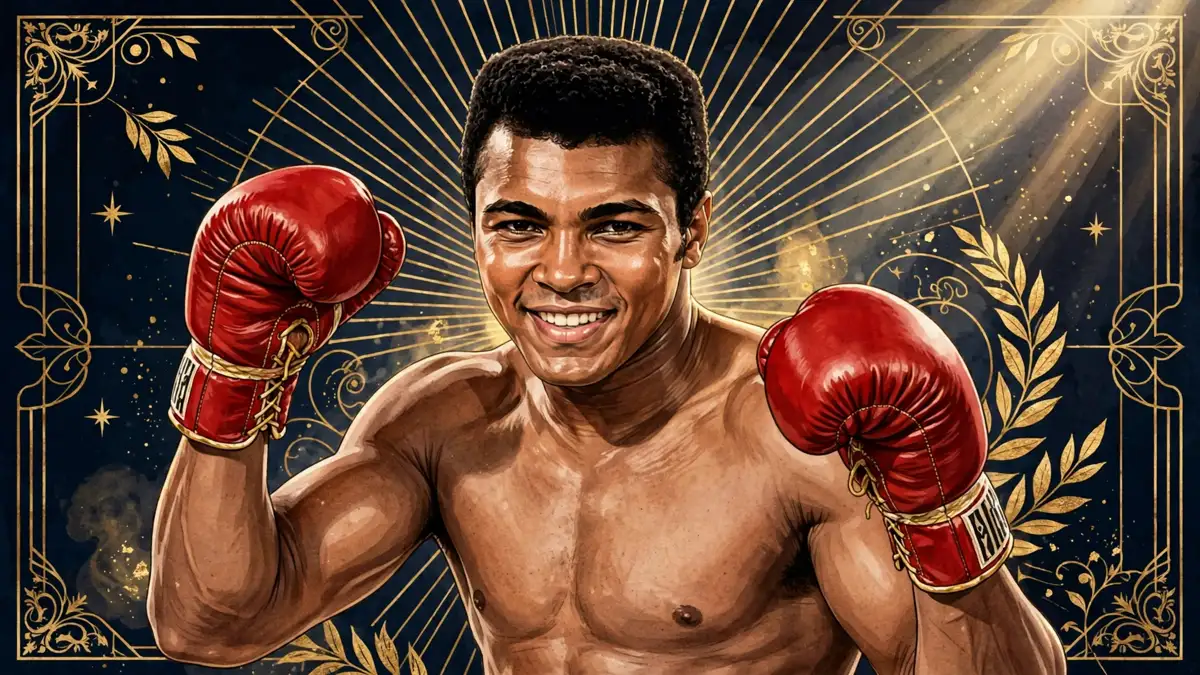
Quick Facts: Muhammad Ali at a Glance
| Full Name | Cassius Marcellus Clay Jr. (later Muhammad Ali) |
|---|---|
| Date of Birth | January 17, 1942 |
| Birthplace | Louisville, Kentucky, USA |
| Date of Death | June 3, 2016, Scottsdale, Arizona (aged 74) |
| Height | 6 ft 3 in (1.91 m) |
| Estimated Net Worth at Death | $50 million (Celebrity Net Worth); $50 million–$80 million range across sources |
| Professional Record | 56 wins, 5 losses, 37 knockouts |
| Peak / Primary Income Sources | Boxing purses (about $60–$70 million gross across his career), endorsements, book deals, and licensing of his name and image |
| Key Ventures / Works | The 2006 CKX licensing deal ($50 million cash for 80% of his commercial rights), G.O.A.T. Inc., the Muhammad Ali Center, books including “The Greatest: My Own Story” |
| Spouses | Sonji Roi (1964–1966), Belinda Boyd, later Khalilah Ali (1967–1977), Veronica Porché (1977–1986), Yolanda “Lonnie” Williams (1986–2016) |
| Children | Nine: Maryum, Rasheda, Jamillah, Muhammad Ali Jr., Hana, Laila, Khaliah, Miya, and Asaad |
| Major Honours | 1960 Olympic light-heavyweight gold; three-time heavyweight champion; Presidential Medal of Freedom (2005); Sports Illustrated Sportsman of the Century |
Table of Contents
- Early Life: The Louisville Kid Who Lost a Bicycle
- The Amateur Years and Rome 1960 Gold
- The Liston Upset and a New Name
- The Exile: Refusing Vietnam and Losing Everything
- The Comeback: Frazier, Foreman, and the Rumble in the Jungle
- The Third Crown and the Long Goodbye
- The Money: Purses, the 2006 Deal, and the Estate
- Homes, Memorabilia, and the Business of Being Ali
- Personal Life: Four Marriages and Nine Children
- Parkinson’s, the 1996 Flame, and the Final Years
- Legacy: The Greatest Beyond Boxing
- Frequently Asked Questions
- Final Thoughts: Why Ali Still Matters
- Sources and Reporting
Early Life: The Louisville Kid Who Lost a Bicycle
Muhammad Ali was born Cassius Marcellus Clay Jr. on January 17, 1942, in Louisville, Kentucky, in the segregated American South. His father, Cassius Marcellus Clay Sr., worked as a sign painter and muralist. His mother, Odessa Grady Clay, worked as a domestic cleaner. The family lived in a working-class Black neighbourhood, and young Cassius grew up in a city where Black children could not drink from the same water fountains as white children, could not sit where they liked in a cinema, and learned early that talent alone did not open every door.
He was not a natural student, and school never held his attention the way movement did. He was fast on his feet, loud, funny, and full of a confidence that teachers sometimes read as trouble. What changed his life was not a plan but a theft. When he was 12, his new bicycle was stolen outside the Louisville Home Show. A tearful Cassius reported it to a local police officer, Joe E. Martin, and told him he wanted to beat up whoever had taken it. Martin, who also ran a boxing gym in the basement of his home, told the boy he had better learn to fight first. Cassius took him up on it, and within weeks he was training at Martin’s Columbia Gym.
The gym gave him structure. He trained before and after school, ran in the early morning in army boots to strengthen his legs, and shadow-boxed in front of mirrors until the footwork became second nature. His first amateur bout came in 1954, and he won it by split decision. Over the next six years he built a reported amateur record of 100 wins against 5 losses, winning six Kentucky Golden Gloves titles, two national Golden Gloves titles, and the Amateur Athletic Union national title in 1960. The speed was already there — a heavyweight who moved like a middleweight, hands low, head slipping punches by inches, talking the whole time.
His family backed him. His father painted signs for local businesses and painted murals in Black churches; his mother kept the household running on modest wages. Neither was wealthy, and money was tight through his childhood, a fact Ali never forgot. In later years he spoke often about the Louisville of his youth — the segregated buses, the “colored” signs, the feeling of being told where he belonged — and it shaped the man he became as much as any trainer did.
The Amateur Years and Rome 1960 Gold
By 1960, Cassius Clay was the best amateur light-heavyweight in America. He travelled to Rome that September for the Olympic Games as an 18-year-old, and he won gold, beating Polish champion Zbigniew Pietrzykowski in the final. The victory made him a national figure before he had thrown a professional punch. He came home to Louisville a hero, and the story he told for years afterward — that he had thrown his gold medal into the Ohio River after being refused service at a Louisville restaurant because of his race — became part of his legend. The International Olympic Committee later presented him with a replacement medal at the 1996 Atlanta Games, and Ali himself gave different versions of the river story over the years, so the detail remains contested. What is not contested is the medal itself, or what it meant: an 18-year-old from segregated Kentucky standing on top of the amateur boxing world.
He turned professional on October 29, 1960, beating Tunney Hunsaker on points in his hometown. According to ESPN, as reported by Nicki Swift, he earned $2,000 for that first fight — roughly $18,000 in today’s money. A group of Louisville businessmen, the Louisville Sponsoring Group, signed him to a management contract for $18,000, and his early professional years were a careful climb: 19 straight wins before his first title shot, each fight a little harder than the last, each one building the brash public persona that made him famous and, to many white sportswriters of the era, deeply unwelcome.
The persona was deliberate. Ali understood, before almost any athlete of his generation, that the fight sold twice — once in the ring and once in the newspapers. He wrote poems predicting the round in which his opponents would fall, gave himself nicknames, and turned press conferences into theatre. The talk was not empty noise. Behind it was a fighter who trained with obsessive discipline and studied his opponents’ habits the way a chess player studies an opening.
The Liston Upset and a New Name
On February 25, 1964, in Miami Beach, Florida, the 22-year-old Cassius Clay faced Sonny Liston for the heavyweight championship of the world. Liston was one of the most feared men ever to hold the title — a former convict with wrecking-ball power who had destroyed Floyd Patterson in one round, twice. The odds were 7-to-1 against Clay. Most of the press corps expected a short, brutal night. Clay spent the build-up taunting Liston, calling him a “big ugly bear” and predicting a fifth-round knockout, and then he did something nobody expected: he made Liston miss, round after round, dancing, jabbing, and cutting the champion with speed Liston could not catch.
Liston failed to answer the bell for the seventh round, quitting on his stool with a shoulder injury. Cassius Clay was heavyweight champion of the world at 22. The next morning he announced that he had joined the Nation of Islam and that Cassius Clay was his “slave name.” He first took the name Cassius X, and then, in March 1964, Elijah Muhammad gave him the name Muhammad Ali. The name change split the country. The press, the boxing establishment, and much of white America refused to use it for years. Ali did not care. He had already decided that his name, like his fists, belonged to him.
He defended the title against Liston in a rematch in Lewiston, Maine, in May 1965, winning by first-round knockout in a fight still argued about six decades later — the famous “phantom punch” that dropped Liston and the photograph of Ali standing over him, shouting, that became one of the most reproduced sports images ever taken. Between 1965 and 1967 he defended the title eight more times, against Floyd Patterson, George Chuvalo, Henry Cooper, Cleveland Williams, and others. The Cleveland Williams fight in November 1966, in Houston, is still cited by boxing historians as the finest single performance of Ali’s career: three rounds of speed and precision that left Williams, a dangerous puncher, unable to land anything clean.
By early 1967, Ali was unbeaten in 29 professional fights, the undisputed heavyweight champion, and the most famous athlete alive. He was also about to give it all up.
The Exile: Refusing Vietnam and Losing Everything
In 1967, Ali was drafted to serve in the Vietnam War. On April 28, 1967, in Houston, Texas, he refused induction into the United States Army, citing his religious beliefs as a Muslim minister. “I ain’t got no quarrel with them Viet Cong,” he had said earlier, in words that were quoted around the world. The price was immediate and total. Within hours, the New York State Athletic Commission stripped him of his boxing licence. The World Boxing Association stripped him of his title. Every other state commission followed. He was convicted of draft evasion in June 1967 and sentenced to five years in prison and a $10,000 fine, though he remained free while he appealed.
For three and a half years — from March 1967 to October 1970 — Muhammad Ali could not box professionally anywhere in the United States. He was 25 years old, in his physical prime, and he lost the best years of his athletic life to a court case. He survived on speaking engagements at colleges, a Broadway musical called “Buck White” that closed after seven performances, and a 1970 computer-simulated “Super Fight” against a long-retired Rocky Marciano, a film that was released in theatres and, according to Nicki Swift, grossed $5 million. He was broke at times, and he was harassed, threatened, and called a traitor in much of the American press. He did not bend. “I have been warned that to take such a stand would put my prestige in jeopardy and could cause me to lose millions of dollars,” he said at the time. “But I have said it once and I will say it again. The real enemy of my people is here.”
The legal fight ended on June 28, 1971, when the United States Supreme Court ruled unanimously in Clay v. United States, overturning his conviction on a technical ground — the government had failed to explain why his conscientious-objector claim had been denied. The ruling came too late to restore his prime years, but it restored his name. In the decades since, the stand has been rejudged by history: in 2005, President George W. Bush awarded Ali the Presidential Medal of Freedom, the highest civilian honour in the United States, and the citation praised his courage as much as his boxing.
The Comeback: Frazier, Foreman, and the Rumble in the Jungle
Ali returned to the ring in Atlanta on October 26, 1970, stopping Jerry Quarry in three rounds. Five months later, on March 8, 1971, he met Joe Frazier at Madison Square Garden in the “Fight of the Century” — two unbeaten heavyweight champions, a purse split that made both men rich, and a global television audience that boxing had never seen before. Frazier won a 15-round unanimous decision, dropping Ali in the final round with a left hook. It was Ali’s first professional defeat, and for the first time the world saw him beaten. He took it the way he took most things: loudly, in public, and with a promise to come back.
He did. He rebuilt with wins over Quarry, Floyd Patterson, and others, and in January 1974 he beat Frazier in a rematch at Madison Square Garden. That set up the fight that defines his legend. On October 30, 1974, in Kinshasa, Zaire, Muhammad Ali challenged George Foreman for the heavyweight title in the “Rumble in the Jungle.” Foreman was 25, unbeaten in 40 fights, and had destroyed both Frazier and Ken Norton in two rounds each. Almost nobody gave Ali a chance. For seven rounds, Ali leaned on the ropes and let Foreman punch himself out — the “rope-a-dope” — absorbing punishment and talking to Foreman the whole time. In the eighth round, Ali came off the ropes and knocked Foreman down with a combination. Foreman did not get up. Ali was heavyweight champion again, at 32, in one of the great sporting upsets ever staged.
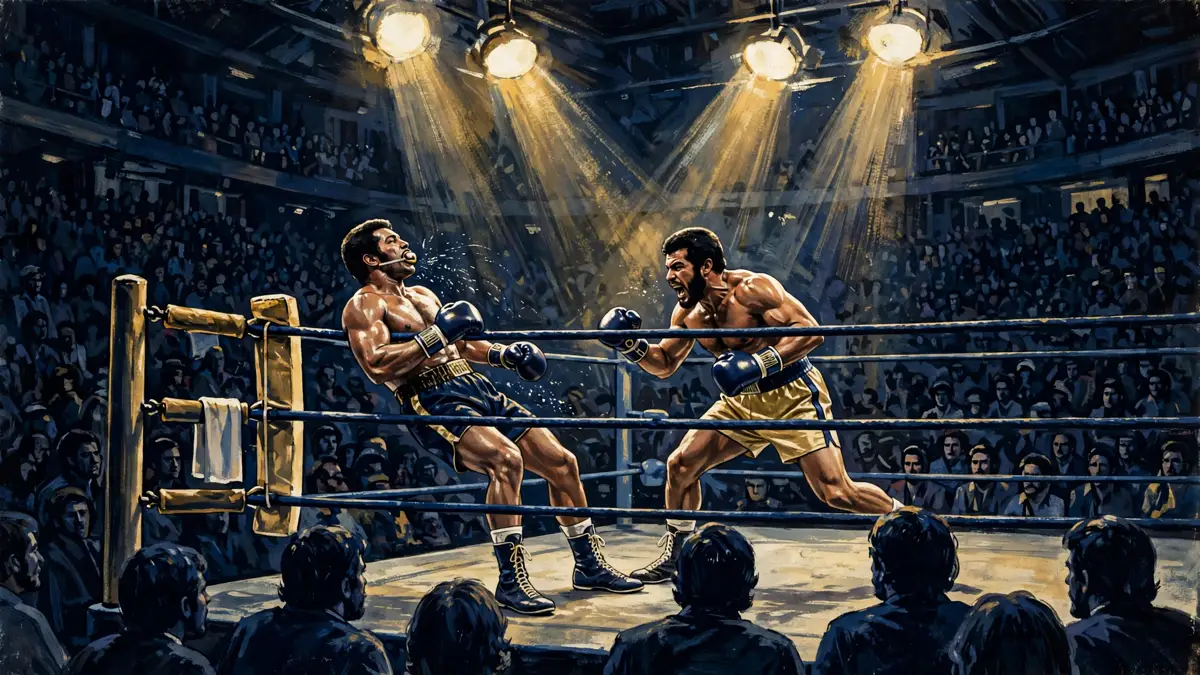
The third fight with Frazier came on October 1, 1975, in Manila, Philippines — the “Thrilla in Manila.” It was fought in brutal heat, and both men were pushed past the point most fighters ever reach. After 14 rounds of punishment, Frazier’s trainer Eddie Futch refused to let his man come out for the final round. Ali won, then collapsed in his corner and said afterward that it was the closest thing to death he had ever known. Frazier never forgave Ali for the cruel taunts that had filled the build-up, and the two men’s relationship stayed bitter for decades, a shadow across one of the great rivalries in sport.
The Ali–Frazier trilogy in brief: Frazier won the first meeting (March 8, 1971, New York), Ali won the second (January 28, 1974, New York), and Ali won the third (October 1, 1975, Manila). Three fights, 41 rounds, and a rivalry that still anchors every debate about the greatest heavyweight era in history.
The Third Crown and the Long Goodbye
Ali defended the title through 1976 and 1977, against Jean-Pierre Coopman, Jimmy Young, Richard Dunn, and Ken Norton in a third meeting that many observers thought Norton had won. The reflexes were going. He was taking punches he would once have slipped, and his speech had already begun to slow — a change friends noticed before doctors named it. In February 1978, in Las Vegas, he lost the title to Leon Spinks, a 24-year-old with only seven professional fights, in a 15-round split decision that shocked the sport.
Seven months later, on September 15, 1978, Ali beat Spinks in a rematch in New Orleans and became the first boxer in history to win the world heavyweight championship three times. He was 36. He announced his retirement in 1979, and for a few months it held. Then the money and the pull of the ring brought him back: a fight against Larry Holmes on October 2, 1980, in Las Vegas, in which Holmes — Ali’s former sparring partner — beat him so badly that his trainer Angelo Dundee stopped the fight after ten rounds. It was the only stoppage loss of Ali’s career, and it was painful to watch. His final fight came on December 11, 1981, against Trevor Berbick in Nassau, Bahamas. Ali lost on points. He was 39 years old, and he never fought again.
His final professional record stands at 56 wins and 5 losses, with 37 wins by knockout. The five defeats were to Joe Frazier, Ken Norton, Leon Spinks, Larry Holmes, and Trevor Berbick. He avenged three of them — Frazier twice, Norton twice, Spinks once — and the two he never avenged came at the very end, when he was already past his best. The record alone does not capture him, but it frames him: 21 years as a professional, three separate reigns as champion, and a career fought almost entirely against the best of his era.
The Money: Purses, the 2006 Deal, and the Estate
Muhammad Ali earned a fortune in the ring and, for much of his life, spent it almost as fast as it arrived. Contemporary estimates cited by Celebrity Net Worth put his gross boxing purses at roughly $60 million to $70 million across his career — a huge sum for the 1960s and 1970s, when even championship purses were a fraction of what today’s stars earn. His biggest single paydays came late: about $2.5 million for the third Frazier fight in 1975 (worth roughly $15 million in 2016 dollars, per Celebrity Net Worth), about $3.5 million for the first Leon Spinks fight in 1978, and a reported $7.9 million for the Larry Holmes fight in 1980. Early in his career the money was far smaller — $2,000 for his professional debut in 1960 — and it grew as his fame did.
The money leaked. Ali was famously generous, handing out cash to strangers, paying the bills of friends, and supporting a large entourage. He went through three divorces, each one expensive. And in the late 1970s, one estimate cited by Celebrity Net Worth put his net worth at only around $3.5 million — about $18 million in today’s money — despite two decades at the top of the sport. He was, in the words of one biographer, a man who earned like a king and managed money like a man who trusted everyone around him.
The turn came through his fourth wife, Lonnie, whom he married in 1986. In 1992, Lonnie incorporated Greatest of All Time, Inc. — G.O.A.T. Inc. — to centralise the management and licensing of Ali’s name, image, and intellectual property. It was the decision that saved the family’s finances. In April 2006, the publicly traded entertainment company CKX acquired an 80% interest in Ali’s commercial rights — his name, image, likeness, publicity rights, trademarks, copyrights, and existing licensing agreements. According to SEC filings cited by Celebrity Net Worth, the Muhammad Ali Family Trust received $50 million in cash for that 80% stake, while retaining the remaining 20%. Paying $50 million for 80% implied the whole licensing business was worth about $62.5 million at the time.
That 2006 deal is the anchor for every serious estimate of Ali’s wealth at death. Celebrity Net Worth puts his net worth at $50 million when he died in 2016. Forbes, as reported by CNBC, placed it closer to $80 million. Other outlets, including Wikipedia’s biographical record, put his estate between $50 million and $80 million. The honest answer is a range: $50 million to $80 million, with $50 million the most commonly cited figure and the $80 million end reflecting a fuller valuation of the licensing business the family retained. Our sister site’s money-focused profile of Muhammad Ali’s net worth breaks down the same figures in detail, and it lands on the same range.
The licensing business kept growing after his death. Muhammad Ali Enterprises was later acquired by Authentic Brands Group, and the Ali name still generates revenue from merchandise, memorabilia, documentaries, and brand partnerships — a posthumous income stream that keeps the estate active a decade after his death. Unlike many athletes whose earning power dies with them, Ali’s did not, because the 2006 deal and the trust structure turned his identity into a managed asset rather than a memory.
| Year | Money Moment | Figure (as reported) |
|---|---|---|
| 1960 | Professional debut vs Tunney Hunsaker | $2,000 purse |
| 1960 | Louisville Sponsoring Group management deal | $18,000 signing bonus |
| 1971 | “Fight of the Century” vs Joe Frazier | $2.5 million purse (about $15 million in 2016 dollars) |
| 1975 | Thrilla in Manila vs Joe Frazier | Multi-million purse; career purses by then in the tens of millions |
| 1978 | Estimated net worth, late 1970s | About $3.5 million (one contemporary estimate) |
| 1980 | Final big payday vs Larry Holmes | Reported $7.9 million purse |
| 1992 | G.O.A.T. Inc. founded by Lonnie Ali | Licensing centralised under family control |
| 2006 | CKX buys 80% of commercial rights | $50 million cash to the Family Trust; 20% retained |
| 2016 | Net worth at death | $50 million (Celebrity Net Worth); $50–$80 million range across sources |
Peer comparison puts the range in context. The heavyweight division Ali ruled produced the richest boxers of the next generation: Tyson Fury’s net worth is built on pay-per-view purses in the hundreds of millions, a scale of money that did not exist in Ali’s era. Ali earned less in raw dollars than today’s champions, but he earned it when boxing was the biggest sport in America and his name was worth more outside the ring than inside it.
Homes, Memorabilia, and the Business of Being Ali
Ali’s most visible assets late in life were homes, not companies. He and Lonnie bought a 9,300-square-foot house in Louisville, Kentucky, in 2006 for $1.875 million, and it sold for $2.2 million in 2016, the year he died, according to Nicki Swift. Their main home in his final years was in Scottsdale, Arizona, where he died after being hospitalised with respiratory complications. He also owned property in Michigan and kept ties to the Louisville home where he had grown up — the modest house on Grand Avenue, which was later restored and opened to the public as a museum.
The real asset was never real estate. It was the name. The 2006 CKX deal proved that “Muhammad Ali” as a brand — the image, the voice, the poems, the stance — could be valued in the tens of millions on its own, separate from any fight purse. Memorabilia added to the picture: fight-worn gloves, robes, and posters from the Liston, Foreman, and Frazier fights have sold at auction for hundreds of thousands of dollars each, and the market for Ali items remains among the strongest of any athlete’s. The family trust’s retained 20% stake in the licensing business, plus ongoing royalties, is why the estate’s value is quoted as a range rather than a single number — nobody outside the trust knows the exact revenue of the licensing deals signed since 2006.
Outside the ring, Ali’s business ventures were modest. He endorsed products through his career — from soft drinks to cars — and he recorded a spoken-word album, “I Am the Greatest,” in 1963, and appeared in films, including “The Greatest” in 1977, in which he played himself. He received a reported $200,000 advance for his 1975 autobiography “The Greatest: My Own Story,” written with Richard Durham, according to Jonathan Eig’s biography. None of these ventures made him rich on their own. The money story of Muhammad Ali is, at its core, a story about purses, then about a name — and about a wife who turned the name into a business before it was too late.
Personal Life: Four Marriages and Nine Children
Ali married four times. His first marriage, to Sonji Roi, a cocktail waitress, lasted from 1964 to 1966 and ended in divorce. His second, to Belinda Boyd — who later took the name Khalilah Ali — lasted from 1967 to 1977 and produced four children: Maryum, Rasheda, Jamillah, and Muhammad Ali Jr. His third, to actress and model Veronica Porché, lasted from 1977 to 1986 and produced two daughters, Hana and Laila. His fourth, to Yolanda “Lonnie” Williams, whom he had known since childhood in Louisville, began in 1986 and lasted until his death in 2016. Lonnie became the manager of his affairs, the founder of G.O.A.T. Inc., and the person most responsible for the financial order of his final decades.
He had nine acknowledged children: Maryum, Rasheda, Jamillah, Muhammad Ali Jr., Hana, Laila, Khaliah, Miya, and Asaad. Laila Ali followed him into boxing and retired unbeaten in 24 fights, the most famous of his children in the sport. Hana Ali co-wrote his 2004 book “The Soul of a Butterfly” and has managed parts of his legacy since his death. Muhammad Ali Jr., his only son, has lived a quieter and more troubled life, and has spoken publicly about his distance from the family. The divorces cost Ali millions across the 1970s and 1980s — a recurring theme in accounts of his finances — but the family structure he left behind was large, close in some branches and distant in others, and bound together by the trust Lonnie built.
Religion shaped his personal life as much as boxing did. He joined the Nation of Islam in 1964, a decision that cost him public support at the time and defined his refusal of the draft. In later years he moved toward mainstream Sunni Islam, made the Hajj pilgrimage to Mecca, and spoke of his faith as a private matter rather than a public argument. He was also, by all accounts, a man who loved company — entourages, jokes, magic tricks for children, and hours of conversation with strangers. The generosity that drained his bank account was the same generosity that made him beloved: he gave away money, cars, and time with a freedom that accountants found alarming and that the people around him never forgot.
His friendships crossed the sport. He admired and was admired by the boxers who came after him, and the respect ran both ways: Mike Tyson’s biography tells the story of a teenager who worshipped Ali, met him as a boy, and later carried the heavyweight torch Ali had lit — and Manny Pacquiao’s biography shows another fighter who, like Ali, turned boxing fame into political and public life. Ali’s influence on both men was direct and acknowledged, and it is one reason his name still comes up in every conversation about what a boxer can be outside the ring.
Parkinson’s, the 1996 Flame, and the Final Years
In 1984, three years after his last fight, Ali’s Parkinson’s disease diagnosis was made public. He was 42. The disease — a disorder of the nervous system that slows movement, stiffens muscles, and slurs speech — was widely linked by doctors and observers to the thousands of punches he had taken across 61 professional fights, though the precise cause in his case was never proven. His speech grew softer, his hands shook, and the fastest heavyweight who ever lived began to move slowly. He faced it in public, without hiding, and the sight of the once-loudest man in sport speaking in a near-whisper became one of the most affecting images of his later life.
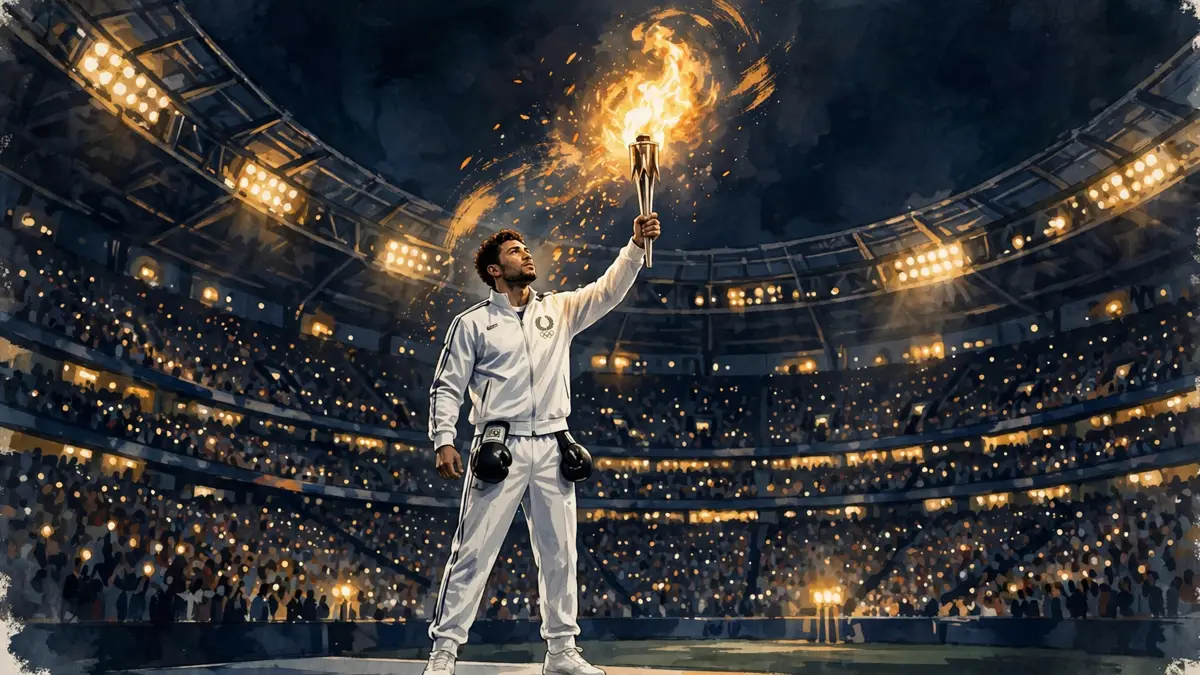
And then came the night that reset how the world saw him. On July 19, 1996, at the opening ceremony of the Atlanta Olympic Games, Muhammad Ali appeared at the top of the stadium steps, his hands trembling, and lit the Olympic cauldron. The crowd rose as one. It was the single most watched moment of those Games, and it turned a man many had written off into a symbol of endurance. The International Olympic Committee also presented him that year with a replacement for the 1960 gold medal he said he had lost in the Ohio River decades earlier.
His final years were spent largely out of the public eye, in Arizona with Lonnie, making occasional appearances — at the 2012 London Olympics, where he carried the Olympic flag, and at the Muhammad Ali Center in Louisville, which opened in 2005 as a museum and cultural centre dedicated to his life and values. He died on June 3, 2016, in Scottsdale, Arizona, aged 74, after being hospitalised with respiratory complications. The cause was reported as septic shock. His funeral in Louisville drew thousands to the streets and was watched around the world, with former President Bill Clinton delivering a eulogy and Billy Crystal and Bryant Gumbel among the speakers. He was buried in Cave Hill Cemetery in Louisville, in the city where the stolen bicycle had started everything.
Legacy: The Greatest Beyond Boxing
Muhammad Ali’s legacy does not fit inside boxing. Inside the ring, he was the first three-time heavyweight champion, the winner of fights — Liston in 1964, Foreman in 1974, Frazier in 1975 — that are still studied by trainers and argued about by fans. Outside it, he was the athlete who gave up his title and his prime years for a principle, and who was proved right by history. Sports Illustrated named him Sportsman of the Century in 1999, and the BBC named him Sports Personality of the Century the same year. The Presidential Medal of Freedom followed in 2005. No other boxer has been honoured at that level, and no other athlete of his era changed what an athlete was allowed to say.
He changed the business of sport, too. Before Ali, boxers were managed and spoken for; after him, athletes understood that their voice was part of their value. The trash talk, the poetry, the self-promotion — all of it is now standard in combat sports, and all of it traces back to the young man from Louisville who understood that people would pay to see a showman as well as a fighter. The modern heavyweight division, from Tyson Fury to the fighters who headline pay-per-view cards today, still works in the shadow of the model Ali built. Readers who want the fuller picture of the division he shaped can start with our celebrity biography archive, which covers the champions who followed him.
The Muhammad Ali Center in Louisville keeps the story alive — six floors of exhibits on his life, his faith, and the six core principles he named for the centre: confidence, conviction, dedication, giving, respect, and spirituality. It is both a museum and a working educational centre, and it is the most concrete answer to the question of what Ali left behind. The money — $50 million at death, $50 million to $80 million by the fullest accounting — matters, and it is documented in this article because that is what a biography of a wealthy public figure should do. But the reason people still search his name, still watch the Foreman fight, still quote the poems, is not the money. It is that Muhammad Ali was the rare athlete who was as large outside the ropes as he was inside them, and who stayed that way for the whole of his life.
Frequently Asked Questions
What was Muhammad Ali’s net worth when he died?
Muhammad Ali was worth an estimated $50 million when he died on June 3, 2016, according to Celebrity Net Worth. Other outlets, including Forbes as reported by CNBC, placed the figure closer to $80 million, so the honest range across sources is $50 million to $80 million. The 2006 sale of an 80% stake in his commercial rights for $50 million in cash is the documented anchor for the lower figure, while the higher end reflects a fuller valuation of the licensing business his family retained.
What was Muhammad Ali’s real name?
Muhammad Ali was born Cassius Marcellus Clay Jr. on January 17, 1942, in Louisville, Kentucky. He changed his name in 1964 after winning the heavyweight title from Sonny Liston and joining the Nation of Islam, first taking the name Cassius X before Elijah Muhammad gave him the name Muhammad Ali.
How many times did Muhammad Ali win the heavyweight title?
Muhammad Ali won the world heavyweight championship three times, becoming the first boxer in history to do so. He first won it from Sonny Liston in February 1964, regained it from George Foreman in the Rumble in the Jungle in October 1974, and won it a third time from Leon Spinks in September 1978.
Why did Muhammad Ali refuse to fight in Vietnam?
Ali refused induction into the US Army on April 28, 1967, on religious grounds as a Muslim minister, saying he had no quarrel with the Viet Cong. He was stripped of his titles and boxing licence, convicted of draft evasion, and barred from boxing for three and a half years during his athletic prime. The US Supreme Court unanimously overturned his conviction in June 1971 in Clay v. United States.
What was Muhammad Ali’s boxing record?
Muhammad Ali’s professional record was 56 wins and 5 losses, with 37 wins by knockout, across 61 fights from 1960 to 1981. His five defeats came against Joe Frazier, Ken Norton, Leon Spinks, Larry Holmes, and Trevor Berbick, and he avenged three of them in rematches.
When was Muhammad Ali diagnosed with Parkinson’s disease?
Muhammad Ali’s Parkinson’s disease diagnosis was made public in 1984, three years after his final fight. He was 42. The disease gradually slowed his speech and movement, but he remained a public figure for decades, most famously lighting the Olympic flame at the Atlanta Games in 1996.
How many wives and children did Muhammad Ali have?
Muhammad Ali married four times: Sonji Roi (1964–1966), Belinda Boyd, later Khalilah Ali (1967–1977), Veronica Porché (1977–1986), and Yolanda “Lonnie” Williams (1986 until his death in 2016). He had nine children: Maryum, Rasheda, Jamillah, Muhammad Ali Jr., Hana, Laila, Khaliah, Miya, and Asaad.
What is Muhammad Ali’s legacy today?
Ali’s legacy rests on three things: he was the first three-time heavyweight champion and the winner of some of the greatest fights ever staged; he sacrificed his titles and prime years for his refusal of the Vietnam draft, a stand later vindicated by the Supreme Court and honoured with the Presidential Medal of Freedom in 2005; and his name remains a global brand, managed through the Muhammad Ali Center in Louisville and a licensing business that still earns revenue a decade after his death.
Final Thoughts: Why Ali Still Matters
Muhammad Ali’s biography is not really a story about boxing. It is a story about a boy from segregated Louisville who lost a bicycle, found a gym, and decided that no one else would ever define him — not the boxing establishment, not the United States government, not the disease that slowed his speech in his forties. He won the heavyweight title three times, lost the best years of his career to a principle, came back and won it again, and then spent his final decades as a global ambassador for peace, faith, and generosity.
The money tells part of that story: $50 million at death by the most cited estimate, $50 million to $80 million across the full range of sources, anchored by a $50 million licensing deal that turned his name into a business. But the figure is not the point. The point is that sixty years after a 22-year-old shocked Sonny Liston in Miami Beach, the world still calls Muhammad Ali “The Greatest” — and nobody argues.
Sources and Reporting
How we estimated: Muhammad Ali died in 2016, so there is no living net worth to track — only an estate value at death. The anchor is Celebrity Net Worth’s $50 million estimate, published in its Muhammad Ali profile and in its June 2016 analysis of his wealth at death, and corroborated by Nicki Swift, EssentiallySports, and BiographyJoy, all of which cite the same $50 million figure. The upper end of the range comes from Forbes, as reported by CNBC, at about $80 million, and from Wikipedia’s biographical record, which places his estate between $50 million and $80 million. Where the two ends disagree, this article publishes the range and names the sources rather than picking one number. Fight purses are drawn from Celebrity Net Worth’s career-earnings reporting (gross purses of roughly $60 million to $70 million; $2.5 million for Frazier III; $3.5 million for Spinks I; a late-1970s net worth estimate of about $3.5 million) and from ESPN’s reporting of his $2,000 debut purse. The 2006 CKX deal figures ($50 million cash for 80%, 20% retained, implied value about $62.5 million) come from SEC filings as reported by Celebrity Net Worth. Career facts — dates, opponents, the Supreme Court ruling, the Parkinson’s diagnosis, the 1996 flame, the Medal of Freedom — are matters of public record reported by the BBC, The Guardian, USA Today, and the International Olympic Committee. Estimates of a private estate are, by nature, approximate; the trust that holds much of Ali’s wealth has never published a full inventory.
- Celebrity Net Worth — Muhammad Ali net worth profile and “What Was Muhammad Ali’s Net Worth At The Time Of His Death?” (updated October 2026)
- Nicki Swift — “How Much Was Muhammad Ali Worth When He Died?”
- EssentiallySports — “Muhammad Ali Boxing Earnings: How Much Money Did He Make?”
- Biography.com — Muhammad Ali biography and career record
- Encyclopaedia Britannica — Muhammad Ali biography and career record
- Olympics.com — 1960 Rome gold medal and 1996 Atlanta flame
- CNBC — Forbes reporting on Ali’s estate value
- BBC — Sports Personality of the Century and obituary coverage
- The Guardian — Parkinson’s diagnosis and obituary coverage
- USA Today — Divorces, family, and death coverage
By Celebamerica Editorial Staff. This article is an original biography written for celebamerica.com. Figures are estimates based on named public sources and may differ from private reality.