Stephen Curry biography 2026: Wardell Stephen Curry II, born March 14, 1988, in Akron, Ohio, is the Golden State Warriors point guard who changed how basketball is played — and built a fortune estimated between $240 million and $350 million along the way. Celebrity Net Worth puts the figure at $350 million as of November 2026, the highest of the major published estimates, while other outlets land closer to $240 million. The gap comes down to how his private business holdings are valued, not to any doubt about the money itself: Basketball-Reference and Spotrac contract records show more than $470 million in NBA salary alone through the 2025–26 season, and Forbes credited him with $124.7 million in earnings for 2026.
Curry is 38 years old in 2026, in his 18th NBA season, and still the most feared shooter on the planet. He owns four NBA championships, two MVP awards — including the only unanimous MVP vote in league history — and the all-time record for three-pointers made, a mark he pushed past 4,000 in March 2025. In September 2026 he signed a two-year, $116 million extension that keeps him a Warrior through the 2028–29 season, when he will be 41. This is the full story: the overlooked kid from Charlotte, the Davidson miracle run, the dynasty, the shoe-deal split that shook the sneaker world, and the business empire behind the fortune.
By Celebamerica Editorial Staff | Last updated: November 10, 2026
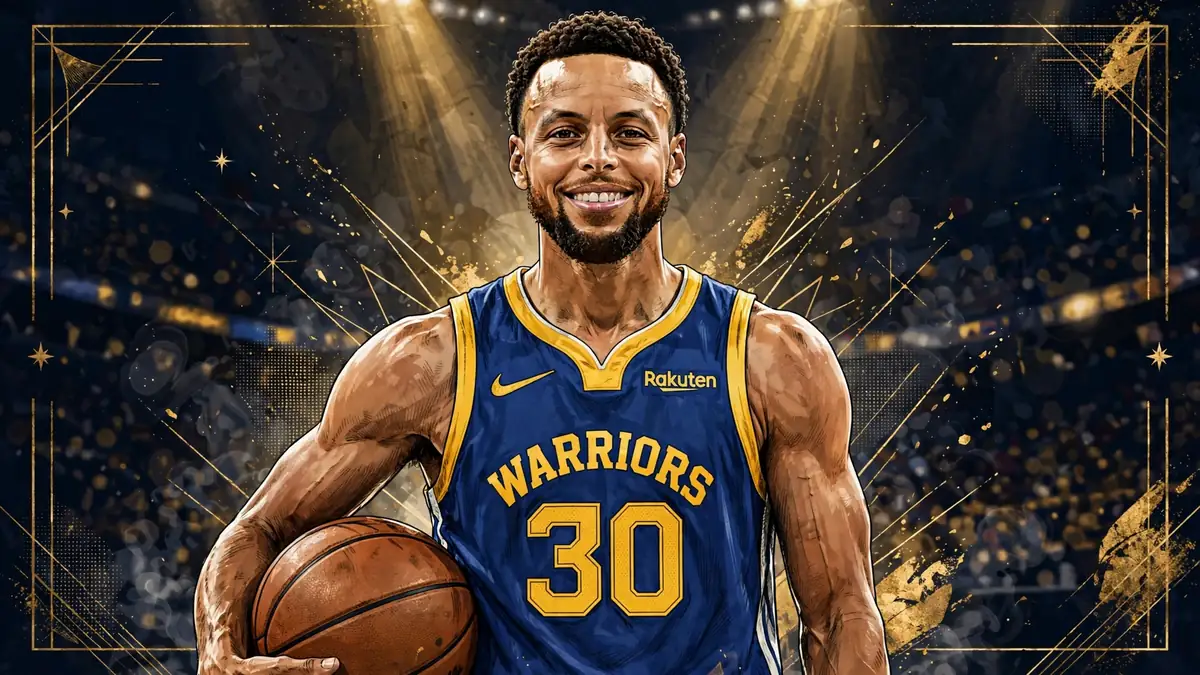
Stephen Curry Quick Facts
| Full Name | Wardell Stephen Curry II |
|---|---|
| Date of Birth | March 14, 1988 (38 years old in 2026) |
| Birthplace | Akron, Ohio, USA |
| Hometown | Charlotte, North Carolina |
| Height | 6 feet 2 inches (1.88 m) |
| Team | Golden State Warriors (2009–present) |
| Position | Point guard — jersey No. 30 |
| Estimated Net Worth (2026) | $240 million – $350 million (Celebrity Net Worth: $350 million) |
| NBA Salary (2026–27) | $62.6 million |
| Career NBA Salary (through 2025–26) | $470.1 million (Celebrity Net Worth / Spotrac) |
| Championships | 4 — 2015, 2017, 2018, 2022 |
| MVP Awards | 2 — 2015, 2016 (unanimous in 2016) |
| College | Davidson College (2006–2009) |
| Wife | Ayesha Curry (married July 2011) |
| Children | 4 — Riley, Ryan, Canon, Caius |
| Key Ventures | Curry Brand, Unanimous Media, Thirty Ink, Gentleman’s Cut bourbon, Eat. Learn. Play. Foundation |
Contents
- Stephen Curry Quick Facts
- Early Life: Growing Up in an NBA Household
- High School Years and the Recruiting Snub
- Davidson College: The Cinderella Run That Changed Everything
- The 2009 NBA Draft and the Warriors Gamble
- The Rise: Ankle Injuries, Then a Dynasty
- Four Championships and the Greatest Shooter Ever
- Paris 2024: Olympic Gold at 36
- The Money: Contracts, Endorsements and the Business Empire
- Net Worth Breakdown: Where the Fortune Sits
- Real Estate: The Atherton Years and the 2026 Sale
- Personal Life: Ayesha, Four Kids and Family
- Giving Back: Eat. Learn. Play. and Oakland
- Legacy: How Curry Changed Basketball Forever
- Stephen Curry Biography FAQs
- Final Thoughts
- Sources and Reporting
Early Life: Growing Up in an NBA Household
Wardell Stephen Curry II was born on March 14, 1988, at Summa Akron City Hospital in Akron, Ohio, while his father Dell Curry was playing for the Cleveland Cavaliers. The timing was pure chance — Dell’s NBA career took the family to Akron for one season — but the basketball bloodline was not. Dell Curry went on to play 16 seasons in the NBA and became one of the Charlotte Hornets’ most loved players, a sharpshooter whose name still hangs in the franchise’s record books. Stephen’s mother, Sonya Curry, was a college volleyball player at Virginia Tech who ran the household with the same discipline Dell brought to the court.
The family settled in Charlotte, North Carolina, where Dell spent most of his career with the Hornets. Stephen grew up inside NBA arenas. He tagged along to practices and shootarounds, sat courtside as a ball boy, and spent hours in the family driveway working on a shot that would one day rewrite the sport. His younger brother Seth Curry — now an NBA guard himself — and younger sister Sydel Curry grew up in the same gym-scented world. The Curry kids were raised on shooting drills, church on Sundays, and a firm rule from Sonya: schoolwork came before basketball, always.
That upbringing gave Stephen two things that still define him. The first was a shooting touch built on thousands of unsupervised repetitions, the kind of muscle memory no coach can install in a single summer. The second was a work ethic shaped by watching a professional athlete’s daily grind up close — the early mornings, the film study, the way Dell treated a Tuesday practice in February like it mattered. Stephen was small for his age and slight of build, but he was never short on reps.
Charlotte also gave him Ayesha Alexander. The two met as teenagers at a church youth group in the city — he was 15, she was 14 — and stayed in touch through high school and college before their friendship turned into something more. It is a detail that matters to the story, because the Currys’ marriage has been the steady center of a career that has swung from injury doubts to global fame.
High School Years and the Recruiting Snub
At Charlotte Christian School, Stephen Curry was the best player on the floor most nights and still not the player college coaches wanted. He led his team to three playoff appearances and a conference title as a junior, yet he finished his senior year listed at 6 feet tall and around 160 pounds. The scouting reports all read the same way: a gifted shooter, yes, but too small, too slight, and unable to finish at the rim against real size. Major Division I programs in North Carolina passed. Virginia Tech — his father’s school, and the program Stephen dreamed of playing for — offered only a walk-on spot.
Only three schools offered him a scholarship: Winthrop, VCU, and Davidson College, a small liberal-arts school about 20 minutes north of Charlotte. Davidson’s head coach, Bob McKillop, had been recruiting Curry since the tenth grade, long before anyone else saw what was coming. McKillop did not see a shooter who was too small. He saw a high basketball IQ, a quick release, and a kid who had been raised inside the game. Curry chose Davidson, stayed close to home, and in doing so changed the trajectory of both his life and the college itself.
The snub is the hinge of the whole biography. Every part of Curry’s later game — the deep range, the off-ball movement, the floater, the handle — was built because he could not overpower anyone. He had to out-skill them instead. The chip on his shoulder never really left, either. Years later, after two MVP awards and four rings, he would still talk about the coaches who looked at his frame and moved on.
Davidson College: The Cinderella Run That Changed Everything
Curry arrived at Davidson in the fall of 2006 as a 6-foot-2, 165-pound freshman and made an instant impact, averaging 21.5 points per game and becoming the first freshman in school history to score more than 1,000 points in a season. His first college game was a mess — 13 turnovers — but McKillop never wavered, and by season’s end Davidson was 29–5. The sophomore year is when the country started paying attention. Curry averaged 25.9 points per game, set the NCAA single-season record with 162 three-pointers, and was named Southern Conference Player of the Year for the second straight season.
Then came March 2008, one of the great tournament runs in college basketball history. Davidson entered the NCAA Tournament as a No. 10 seed and nobody outside North Carolina gave the Wildcats much of a chance. Curry scored 40 points against Gonzaga in the first round, then led a comeback win over second-seeded Georgetown, then dropped 33 on Wisconsin to reach the Elite Eight. He became one of only four players ever to score 30 or more points in each of his first four NCAA Tournament games. The run ended against top-seeded Kansas, 59–57, with Curry setting the single-season three-point record with his 159th make of the year in that very game. Kansas went on to win the national title. Davidson had lost by two points to the eventual champions.
As a junior, Curry moved to point guard and led all of Division I in scoring at 28.6 points per game. He finished his three-year Davidson career as the school’s and the Southern Conference’s all-time leading scorer with 2,635 points. He left after his junior season for the NBA draft, but the Davidson story did not end there. In May 2022 he returned to complete his degree, and that August the school retired his No. 30 jersey. The 2023 Apple TV+ documentary “Underrated” — produced by his own Unanimous Media — told the Davidson story properly for the first time, including the YouTube clips of Curry as an unknown underclassman that his classmates had filmed years earlier. Davidson’s enrollment and national profile never went back to what they were before him.
The 2009 NBA Draft and the Warriors Gamble
Curry declared for the 2009 NBA draft after his junior season at Davidson, and the same doubts followed him into the league. Scouts loved the shot and worried about everything else: could he defend NBA guards, could he stay healthy, could a 6-foot-2 guard with a slight frame run an offense for 82 games? The Golden State Warriors took him with the seventh overall pick anyway. The Minnesota Timberwolves passed on him twice in that same draft, taking two other point guards ahead of him — a decision that still gets brought up every time Curry plays in Minneapolis.
His rookie season answered the scoring question at once: 17.5 points, 5.9 assists and 1.9 steals per game, and a spot on the All-Rookie First Team. He finished second in Rookie of the Year voting. But the early years were not a straight climb. The Warriors were a losing team, and Curry’s ankles kept betraying him. He played only 26 games in the lockout-shortened 2011–12 season after repeated ankle sprains and surgery, and the whispers started that his body might never hold up to an NBA schedule.
That injury history is the reason for the most famous bargain in modern sports. In October 2012, Golden State signed Curry to a four-year, $44 million extension — a deal that looked fair at the time and laughable within three years. The ankles held. The shot kept getting deeper. And by the time that contract expired, Curry had already won a championship and an MVP award. The Warriors knew what they had, and in 2017 they made him the first player in NBA history to sign a $200 million contract: five years, $201 million. Four years later he became the first player to sign two $200 million-plus deals, with a four-year, $215.4 million extension in August 2021.
The Rise: Ankle Injuries, Then a Dynasty
The turnaround began with a new coach and a new style. When Steve Kerr arrived in 2014, he built the Warriors’ offense around Curry’s movement without the ball — sprinting off screens, pulling two defenders 30 feet from the basket, and opening the floor for everyone else. The results were immediate. Golden State won 67 games in 2014–15, Curry won his first MVP, and the Warriors beat the Cleveland Cavaliers in the Finals for the franchise’s first title in 40 years.
The next season was the one that sealed Curry’s place in history. In 2015–16 he became the first player ever voted MVP unanimously, led the league in scoring at 30.1 points per game, and joined the 50-40-90 club — shooting 50 percent from the field, 45 percent from three, and 90 percent from the line in the same season. He made 402 three-pointers, smashing his own single-season record of 286. The Warriors won 73 games, breaking the 1995–96 Chicago Bulls’ record of 72. The season ended in heartbreak — a seven-game Finals loss to LeBron James and the Cavaliers after leading 3–1 — but Curry’s individual season is still talked about as the greatest shooting season anyone has ever had.
What followed was the most talented stretch in modern NBA history. Kevin Durant joined Golden State in the summer of 2016, and the Warriors won back-to-back titles in 2017 and 2018, going 16–1 in the 2017 playoffs. Curry sacrificed shots and touches to make the partnership work, and the team was better for it. Our own profile of Kevin Durant’s age and career timeline traces how the two stars fit together during those championship years. When Durant left in 2019 and Klay Thompson tore his ACL in the Finals that same year, the dynasty looked finished. Curry broke his hand four games into the next season, and the Warriors finished with the league’s worst record.
He came back and proved the doubters wrong one more time. In 2020–21 he won his second scoring title at 32.1 points per game, and in 2022 — with Thompson back and a rebuilt roster around him — he led Golden State to a fourth championship, beating the Boston Celtics in six games. This time the Finals MVP was his, the one major award missing from his shelf. It was the title that changed how people ranked him: no longer just the greatest shooter, but one of the greatest point guards to ever play.
Four Championships and the Greatest Shooter Ever
Curry’s case as the greatest shooter in basketball history is not really an argument anymore. He passed Ray Allen for the all-time three-point record in December 2021, at Madison Square Garden, with Allen sitting courtside. On March 13, 2025, he became the first player in NBA history to make 4,000 career three-pointers. The gap between him and the rest of the record book is the story in itself:
| Player | Career Three-Pointers Made | Titles | MVPs |
|---|---|---|---|
| Stephen Curry | 4,000+ (first to reach the mark, March 2025) | 4 | 2 |
| Ray Allen | 2,973 | 2 | 0 |
| James Harden | 3,000+ (passed Allen in 2024) | 0 | 1 |
| Reggie Miller | 2,560 | 0 | 0 |
| Damian Lillard | 2,700+ (and climbing) | 0 | 0 |
Numbers alone do not capture what he did to the sport. Before Curry, a 30-foot shot early in the clock was a bad shot. After him, it is a weapon every team schemes around. Defenses now pick him up at half court. Coaches at every level — high school, college, youth leagues — teach spacing and shooting because the Warriors showed it could win titles. The modern NBA’s three-point boom, with teams attempting 35 or more threes a night, traces directly back to what Curry and the Warriors proved between 2015 and 2019.
The honors stack up beside the shooting records. Curry is an 11-time All-Star, a four-time All-NBA First Team selection, a two-time scoring champion, and the 2016 steals leader. He won the NBA’s Clutch Player of the Year award in 2024, a fitting honor for a player whose late-game shots — the double-bang against Oklahoma City in 2016, the dagger over the Clippers, the Olympic final in Paris — have become part of the sport’s permanent highlight reel. His career averages sit near 25 points, six assists and five rebounds per game across 17-plus seasons, all of them in a Golden State uniform.

Paris 2024: Olympic Gold at 36
One thing was missing from Curry’s resume for most of his career: an Olympic gold medal. He had skipped past USA Basketball cycles to rest his body, and by the time Paris 2024 came around he was 36 years old, playing in his first Olympics. The semifinal against Serbia nearly ended in disaster — Team USA trailed by 17 in the fourth quarter before Curry scored 36 points to drag the Americans back. The final against host nation France was even better theater.
With the gold medal hanging in the balance and the French crowd roaring, Curry hit four three-pointers in the final minutes — the last of them a falling, double-teamed heave over two defenders that has already become one of the most replayed shots in Olympic history. He finished with 24 points, and Team USA won 98–87. It was the perfect late-career chapter: the greatest shooter alive, on the biggest stage in the sport, doing exactly the thing that made him famous, with the whole world watching. Curry has said the Paris run ranks alongside his championships as a career highlight, and it is hard to argue — it was the one gap in a resume that no longer has any.
The Money: Contracts, Endorsements and the Business Empire
Stephen Curry’s money story has three acts, and the first one is the most instructive. He entered the league on a rookie-scale deal worth roughly $12.7 million over four years, then signed the four-year, $44 million extension in 2012 that the ankle injuries made possible. By 2017 that deal looked like the biggest bargain in sports, and the Warriors corrected it with the five-year, $201 million contract — the first $200 million deal in NBA history. The four-year, $215.4 million extension of August 2021 made him the first player ever to sign two $200 million-plus contracts. In August 2024 he added a one-year, $62.6 million extension for the 2026–27 season, and in September 2026 the two sides agreed to a two-year, $116 million extension running through 2028–29, with a player option on the final year.
| Contract | Years | Value |
|---|---|---|
| Rookie scale deal | 2009–2013 | About $12.7 million |
| First extension | 2013–2017 | $44 million over 4 years |
| First $200M deal | 2017–2022 | $201 million over 5 years |
| Second $200M deal | 2022–2026 | $215.4 million over 4 years |
| One-year extension | 2026–27 | $62.6 million |
| Two-year extension | 2027–2029 | $116 million (player option in final year) |
Through the 2025–26 season, Curry had earned $470.1 million in NBA salary, according to Celebrity Net Worth’s contract tally, which matches Spotrac’s records. If he plays out the 2026–27 season and exercises the player option on the 2028–29 season, his projected career on-court earnings reach $648.7 million — the most any NBA player has ever earned in salary. His 2026–27 salary of $62.6 million alone is more than most NBA franchises paid their entire roster a generation ago.
The off-court money is where the story gets interesting. Curry’s endorsement career began with a famous mistake by Nike: the company let him walk in 2013 over a sloppy pitch meeting, and Under Armour signed him for a reported $4 million a year, according to Forbes. The partnership became one of the great bets in sneaker history. Under Armour launched Curry Brand as a standalone label in 2020, modeled on Nike’s Jordan Brand, and in 2023 Curry signed a long-term extension, was named Curry Brand president, and received 8.8 million Under Armour shares worth about $75 million at the time. The relationship ended in November 2025, when the two sides announced a mutual split after 13 years, with Under Armour in the middle of a wider restructuring. The Curry 13, released in February 2026, was the final signature shoe from the partnership.
Curry spent the 2025–26 season as a sneaker free agent, rotating through Nike, Adidas, ANTA, Puma and others while the market came to him — a stretch Forbes noted when his annual earnings dipped to $124.7 million in 2026 from $156 million the year before. The wait paid off. In June 2026, Curry Brand announced a 10-year endorsement agreement with Chinese sportswear giant Li-Ning worth more than $400 million, according to Celebrity Net Worth. Forbes projects Curry will earn about $203.6 million in the 2026–27 season — $62.6 million in salary and roughly $141 million from endorsements and business ventures — which would make him the NBA’s highest-paid player. For the full contract-by-contract picture of his fortune, our sister site’s look at Stephen Curry’s net worth in detail breaks down the same numbers from the wealth angle.
Beyond shoes, his portfolio runs through Thirty Ink, the holding company that houses his business interests. Unanimous Media, the production company he founded in 2018, has a deal with NBCUniversal and produced the “Underrated” documentary and the “Holey Moley” television series. Gentleman’s Cut, his bourbon brand launched in 2023, put him into the spirits business alongside a long list of athlete founders. His other endorsements have included Chase, Rakuten — whose name sits on the Warriors’ jersey — Callaway Golf, Infiniti, Brita and Degree. He has also put money into early-stage companies, including fitness and technology startups, though the private nature of those stakes is exactly why published net worth estimates for Curry vary so widely.
The one-year snapshot: Forbes ranked Curry sixth among the world’s highest-paid athletes in 2026 at $124.7 million — behind Cristiano Ronaldo’s $300 million, but ahead of nearly every other basketball player on the planet. The 2026–27 projection of $203.6 million would be the biggest single-season haul of his career, driven by the Li-Ning deal kicking in.
Net Worth Breakdown: Where the Fortune Sits
So what is Stephen Curry actually worth? The honest answer is a range. Celebrity Net Worth, which tracks his contracts and deals most closely, puts the figure at $350 million as of November 2026. Other outlets land lower: InvestorMint estimated about $240 million in May 2026, and several biography sites cluster between $160 million and $240 million. Our own assessment, weighing the named sources against each other, is a range of $240 million to $350 million, anchored by Celebrity Net Worth’s $350 million at the top and the mid-range estimates near $240 million at the bottom.
Why the spread? Three reasons. First, NBA salary is public and precise, but business equity is not — the value of Curry Brand, his Unanimous Media stake, and his venture investments are private and can only be estimated. Second, the Li-Ning deal’s $400 million-plus value is a 10-year endorsement figure, not cash in hand, and different outlets count it differently. Third, taxes, agent fees, and lifestyle costs are invisible from the outside. What nobody disputes is the foundation: more than $470 million in career salary, a $400 million-plus shoe deal, and a business portfolio that keeps growing after basketball. A fair breakdown looks like this:
| Wealth Component | Estimated Value | Notes |
|---|---|---|
| NBA salary earned (through 2025–26) | $470.1 million | Contract records via Spotrac / Celebrity Net Worth |
| Li-Ning endorsement deal | $400 million+ over 10 years | Signed June 2026, per Celebrity Net Worth |
| Under Armour equity (2023 grant) | About $75 million at grant | 8.8 million shares, per Forbes / EssentiallySports |
| Business ventures | Not publicly valued | Curry Brand, Unanimous Media, Thirty Ink, Gentleman’s Cut |
| Real estate (at peak holdings) | $100 million+ portfolio | Bay Area properties; see below |
| Published net worth range (2026) | $240 million – $350 million | Celebrity Net Worth anchors the top at $350M |
For context, Curry’s fortune sits in the top tier of active NBA wealth but below the game’s billionaire class. LeBron James crossed $1 billion in net worth in 2022, according to Forbes, and Michael Jordan’s fortune runs into the billions on the back of the Jordan Brand. Curry’s path is different: he built his wealth almost entirely inside one franchise and one sport, and the business empire is still young. The Li-Ning deal and the 2026 extension mean his peak earning years are happening right now, at 38 — an unusual shape for an athlete’s financial career, and a sign of how long his prime has lasted.
It is worth comparing him with the other stars of his era. Nikola Jokic’s age and career timeline shows a fellow two-time MVP whose fortune was built on a very different path, while Devin Booker’s net worth profile covers the next generation of scoring guards who grew up copying Curry’s game. The through-line is the same: the shooters who changed the league are the ones cashing in on it.
Real Estate: The Atherton Years and the 2026 Sale
Curry’s real estate moves have tracked his career almost exactly. He and Ayesha bought their Atherton mansion — in one of the wealthiest enclaves in America, about 30 miles south of San Francisco — in December 2020 for $30 million, through a limited liability company. The estate covered about 1.7 acres with 17,761 square feet of living space, seven bedrooms, eight-and-a-half bathrooms, a guest house, a movie theater, a walnut orchard, and, of course, a private basketball court. It was the family headquarters for five years, the place where four kids grew up within earshot of an NBA superstar’s home gym.
In 2026, the Currys quietly sold that same estate in an off-market transaction for $29.1 million — about $900,000 less than they paid — according to reporting by SFGate, covered by Heavy and Basketball Network in August 2026. The buyer was an unnamed limited liability company, and the couple gave no public reason for the sale. It was the second time they had sold a home in Atherton: in 2021 they sold a different property there for $31.2 million to Singapore-based billionaire Forrest Li. The pattern suggests a deliberate reshaping of their Bay Area footprint rather than a retreat from it — the family keeps deep ties to the region through the Eat. Learn. Play. Foundation and the Warriors, and Curry also owns an $8 million condo unit at the Four Seasons Residences, a few blocks from the Warriors’ home court at Chase Center.
The Atherton sale is also a useful reality check on celebrity real estate. Even at the top of the market, a $30 million house is not a guaranteed profit — carrying costs, taxes, and the thin market for ultra-luxury homes all eat into returns. The Currys’ portfolio, at its peak valued at more than $100 million across their Bay Area holdings, is best read as a lifestyle choice with investment upside, not a flip. The house was where their children grew up. The $900,000 paper loss is a footnote next to that.
Personal Life: Ayesha, Four Kids and Family
Stephen and Ayesha Curry married on July 30, 2011, in Charlotte, in a ceremony at the church where they had met as teenagers. Ayesha — a cookbook author, television host, restaurateur, and entrepreneur in her own right — has built a business career that runs parallel to her husband’s, including her Sweet July brand and a string of cookbooks and food ventures. The two have been together since 2008, and their partnership is the most stable thing in a life lived under a spotlight.
The couple has four children: daughters Riley (born 2012) and Ryan (2015), and sons Canon (2018) and Caius (born May 2024). Riley became a minor celebrity herself as a toddler, stealing press conferences with her antics during the 2015 Finals run. The family is open about its faith — Curry’s “I can do all things” shoe inscription, a reference to Philippians 4:13, is one of the most quoted details of his career — and about the work of raising four kids while both parents run businesses and travel constantly.
Curry’s wider family is basketball royalty in miniature. His brother Seth has carved out a long NBA career as a sharpshooter in his own right, and the two have faced each other in the playoffs. His sister Sydel played college volleyball at Elon and later went into business with Ayesha. His parents, Dell and Sonya, divorced in 2021 after 33 years of marriage, a split that played out publicly and that Curry has spoken about only briefly and with care. His father remains a fixture at Warriors games, and the family, by all public accounts, has stayed close through it.
Off the court, Curry is a serious golfer — he has played in celebrity tournaments for years and is one of the best golfing athletes in any sport — and a visible figure in Bay Area life, from Warriors community events to his long-running support of Davidson. He is also famously disciplined about rest and recovery, a habit born from those early ankle problems: sleep, diet, and load management have kept a 38-year-old guard playing at an All-Star level in a league that keeps getting younger and faster.
Giving Back: Eat. Learn. Play. and Oakland
In 2019, Stephen and Ayesha Curry founded the Eat. Learn. Play. Foundation, focused on childhood nutrition, literacy, and safe places to play in Oakland, the city across the bay from the Warriors’ arena that has always been the franchise’s real home. The foundation’s numbers are striking: more than $100 million invested in resources and support for Oakland students, 35 million meals for kids and families facing food insecurity, $20 million for literacy programs and resources, more than a million new books distributed, and the overhaul of 24 schoolyards and six gyms, according to reporting by Basketball Network in August 2026.
The work earned Curry the 2026 Muhammad Ali Sports Humanitarian Award at the ESPY Awards in July 2026, where he spoke about what Oakland has meant to him. It is the kind of honor that fits the second half of his career: the player who once seemed like a fragile shooter is now one of the sport’s senior statesmen, and his foundation is the largest single commitment any active NBA player has made to one city. Curry has also been a longtime supporter of the Nothing But Nets campaign against malaria and has funded basketball courts and youth programs through Curry Brand, which ties its community work to the shoe business itself.
Legacy: How Curry Changed Basketball Forever
Every generation of basketball has a player who bends the sport toward them. George Mikan made the lane wider. Wilt Chamberlain made it taller. Michael Jordan made it global. Stephen Curry made it longer — he moved the game’s center of gravity 10 feet further from the basket, and the whole sport followed. Teams now draft for shooting first, run offenses built on spacing, and let their best players fire from the logo. None of that was normal before him. A generation of young guards — from Trae Young, whose deep-range game owes an obvious debt to Curry, to the kids in every driveway in America — learned the game by copying his shot.
The longevity is part of the legacy too. Most small guards fade by 33 or 34. Curry signed a $116 million extension at 38 that runs until he is 41, and Forbes projects his biggest earning year is still ahead of him. He did it by rebuilding his game as his body changed: less reliance on raw burst, more craft, better defense, smarter shot selection, and a conditioning program that has kept him available deep into his late thirties. The 2025–26 season saw him average around 26–27 points a night and play 43 games while managing a right knee injury — still, at 38, one of the dozen most dangerous offensive players alive.
There is also the one-franchise story. In an era of player movement, Curry has spent his entire career with the Golden State Warriors, the team that drafted him seventh overall when others passed. He is the franchise’s all-time leading scorer, its face for nearly two decades, and the reason the Warriors went from afterthought to dynasty to one of the most valuable franchises in sports. When he eventually retires, his No. 30 will hang in the rafters at Chase Center, and Davidson’s retired jersey will hang beside it in North Carolina. The biography will be simple to write and hard to match: the kid nobody recruited, the shooter nobody could guard, the businessman nobody saw coming.
For more on the stars who shared Curry’s era, see our celebrity biography collection, including profiles of his peers and rivals across the league.
Stephen Curry Biography FAQs
What is Stephen Curry’s net worth in 2026?
Stephen Curry’s net worth is estimated between $240 million and $350 million in 2026. Celebrity Net Worth puts the figure at $350 million as of November 2026, while other outlets land closer to $240 million. The range reflects how his private business holdings are valued — his NBA salary alone totals more than $470 million through the 2025–26 season, and his June 2026 Li-Ning deal is worth more than $400 million over 10 years.
How old is Stephen Curry?
Stephen Curry is 38 years old in 2026. He was born on March 14, 1988, in Akron, Ohio, and turns 39 on March 14, 2027. He is in his 18th NBA season and signed a two-year, $116 million extension in September 2026 that keeps him with the Golden State Warriors through the 2028–29 season, when he will be 41.
How tall is Stephen Curry?
Stephen Curry is 6 feet 2 inches tall (1.88 m) and weighs around 185 pounds. He entered high school at about 6 feet and 160 pounds, which is why major college programs passed on him, and he grew to his adult height during his sophomore year at Davidson College.
Who is Stephen Curry’s wife?
Stephen Curry’s wife is Ayesha Curry, a cookbook author, television host, restaurateur and entrepreneur. They met as teenagers at a church youth group in Charlotte, began dating in 2008, and married on July 30, 2011. The couple has four children: Riley, Ryan, Canon and Caius.
How many NBA championships has Stephen Curry won?
Stephen Curry has won four NBA championships with the Golden State Warriors, in 2015, 2017, 2018 and 2022. He also won two MVP awards (2015 and 2016, the second by unanimous vote), was named Finals MVP in 2022, and won Olympic gold with Team USA at Paris 2024.
What is Stephen Curry’s salary in the 2026–27 season?
Stephen Curry earns $62.6 million in salary for the 2026–27 NBA season, under a one-year extension signed in August 2024. Forbes projects his total earnings for the season at about $203.6 million, including roughly $141 million from endorsements and business ventures, which would make him the NBA’s highest-paid player.
Did Stephen Curry leave Under Armour?
Yes. Stephen Curry and Under Armour mutually ended their 13-year partnership in November 2025, with the Curry 13 released in February 2026 as the final shoe from the deal. In June 2026, Curry Brand signed a 10-year endorsement agreement with Chinese sportswear company Li-Ning worth more than $400 million, according to Celebrity Net Worth.
Where did Stephen Curry go to college?
Stephen Curry played college basketball at Davidson College in North Carolina from 2006 to 2009. He set the NCAA single-season record with 162 three-pointers as a sophomore and led the No. 10-seeded Wildcats to the 2008 Elite Eight, beating Gonzaga, Georgetown and Wisconsin before a two-point loss to eventual champion Kansas. He finished as Davidson’s all-time leading scorer with 2,635 points, completed his degree in May 2022, and had his No. 30 jersey retired that August.
Final Thoughts
Stephen Curry’s biography is a story about being underestimated and then making the underestimation look absurd. Too small for the big schools. Too fragile for the league. Too old to keep doing it at 38. At every turn he answered with work and with a shot that bent the sport around him. The numbers now speak plainly: four championships, two MVPs, the only unanimous MVP vote ever, 4,000 three-pointers, more than $470 million in career salary, a $400 million-plus shoe deal, and a fortune estimated between $240 million and $350 million.
What makes the story last is not the money, though. It is that Curry changed basketball and stayed himself while doing it — the same joyful, faith-grounded, family-first kid from Charlotte who spent his childhood in NBA gyms and never stopped shooting. The extension through 2029 means the story is not finished. At 41, he may still be pulling up from 30 feet, and defenses may still have no answer. That is the whole biography in one image.
Sources and Reporting
How we estimated: Every money figure in this article is tied to a named source. NBA salaries and contract values come from Spotrac’s contract records and Celebrity Net Worth’s salary tally, which agree on the $470.1 million career figure through 2025–26 and the $648.7 million projection through 2028–29. Net worth estimates conflict across outlets — Celebrity Net Worth at $350 million, InvestorMint near $240 million — so we publish the honest range of $240 million to $350 million and say which source anchors each end. Annual earnings figures come from Forbes’ highest-paid athletes reporting. The Li-Ning deal value, the Under Armour share grant, and the contract extension terms come from Celebrity Net Worth, Forbes, Parade, and ESPN/Associated Press reporting from September 2026. Real estate details come from SFGate’s reporting as covered by Heavy and Basketball Network in August 2026. Career and college facts are drawn from NBA.com, Basketball-Reference, and Davidson College records. Estimates are not private financial statements, and the true figure may differ.
Sources consulted: Celebrity Net Worth · Forbes · ESPN · NBA.com · Basketball-Reference · Parade · Spotrac · Davidson College