By Celebamerica Editorial Staff | Last updated: November 9, 2026
Sara Blakely turned a pair of scissors, a pair of pantyhose and $5,000 of her own savings into one of the most famous self-made fortunes in America. As of October 25, 2026, Forbes puts her net worth at about $1.4 billion, ranking her No. 29 on its 2026 list of America’s Richest Self-Made Women. She is the founder of Spanx, the shapewear brand she launched in 2000 and built for 21 years without a single outside investor, before Blackstone bought a majority stake in 2021 at a $1.2 billion valuation.
Other trackers put her a little lower. Celebrity Net Worth lists her at $1 billion, and several 2026 profiles cite Forbes’ own earlier figure of $1.3 billion. The honest range, then, is $1 billion to $1.4 billion, with Forbes’ real-time estimate of $1.4 billion as the anchor. The gap comes down to how much her remaining Spanx stake is worth now that the company is privately held and no longer fully hers, plus the cash she banked from the 2021 sale. This biography follows the whole arc: the Clearwater childhood, seven years of door-to-door fax-machine sales, the night she cut the feet off her pantyhose, the Oprah moment that changed everything, the Forbes cover, the Blackstone deal, her second brand Sneex, and the 2026 honours that put her in the National Inventors Hall of Fame.
Sara Blakely at a Glance
| Full Name | Sara Treleaven Blakely |
|---|---|
| Date of Birth | February 27, 1971 (see the note below — Britannica lists February 21, 1971) |
| Birthplace | Clearwater, Florida, United States |
| Age in 2026 | 55 |
| Education | Florida State University, bachelor’s degree in communications, 1993; Honorary Doctor of Humane Letters, FSU, 2026 |
| Estimated Net Worth | $1.4 billion (Forbes real-time estimate, October 25, 2026); range across sources $1 billion–$1.4 billion |
| Source of Wealth | Spanx (founder, part owner), proceeds from the 2021 Blackstone majority-stake sale, Sneex footwear |
| Best Known For | Founding Spanx; youngest self-made female billionaire (Forbes, 2012); inventor of footless control-top pantyhose |
| Spouse | Jesse Itzler, entrepreneur and Marquis Jet co-founder (married 2008) |
| Children | Four |
| Home Base | Atlanta, Georgia |
| Key Honours | Forbes cover 2012; TIME 100 (2012); National Inventors Hall of Fame inductee (2026) |
A note on her birth date: Wikipedia and the National Inventors Hall of Fame both give February 27, 1971, and this article uses that date. Britannica gives February 21, 1971. The two sources disagree by six days, and no primary record settles it publicly, so we flag the split rather than pick one quietly.
Table of Contents
- Sara Blakely at a Glance
- Early Life in Clearwater, Florida
- Florida State University and the Detour Years
- Seven Years Selling Fax Machines Door to Door
- The Scissors Moment: How Spanx Was Born
- Building Spanx From Her Own Savings
- The Oprah Breakthrough
- The Forbes Cover: Youngest Self-Made Female Billionaire
- The Blackstone Deal: Selling a Majority Stake
- Sara Blakely’s Net Worth in 2026: The Full Breakdown
- Sneex: The Second Act in Footwear
- Shark Tank and Life as an Investor
- Personal Life: Jesse Itzler, Four Children and the Atlanta Hawks
- Giving Back: The Foundation, the Red Backpack Fund and the Giving Pledge
- 2026 Honours: Inventors Hall of Fame and the FSU Doctorate
- How Sara Blakely Compares With Other Self-Made Women
- Setbacks, Pressure and the 2026 Spanx Restructuring
- Frequently Asked Questions
- Final Thoughts
- Sources and Reporting

Early Life in Clearwater, Florida
Sara Treleaven Blakely was born in Clearwater, Florida, in 1971, and grew up in a household that mixed courtroom logic with artistic thinking. Her father, John Blakely, was a trial attorney; her mother, Ellen, was an artist. That combination shows up all through her story: the lawyer’s habit of reading the fine print herself, and the artist’s eye for how something looks and feels on a real body.
Clearwater in the 1970s and 1980s was a beach town, not a business hub, and nothing in her childhood pointed at shapewear. What did point at the future was a dinner-table ritual her father ran. At family dinners he would ask Sara and her brother what they had failed at that week, and he celebrated the failures. The point, as Blakely has told it in interviews for years, was to take the sting out of failing — to treat a failed attempt as homework rather than a verdict. She has credited that habit, again and again, with the nerve to keep going through years of rejection later on.
She attended Clearwater High School, where she was a student who liked performing and public speaking more than she liked sitting still. Friends from those years describe a confident, funny teenager who was comfortable being the centre of attention. That comfort mattered later, when she had to pitch buyers, charm television producers and sell a product category that most people were embarrassed to talk about in public.
The family moved in circles where hard work was simply expected. Her father worked long hours in the courtroom; her mother kept a creative practice. Blakely has said she grew up believing that you made your own way, and that nobody was going to hand you a career. It is a plain belief, and it shaped the next two decades of her life in a straight line: no family money, no connections in fashion, no shortcut of any kind.
Florida State University and the Detour Years
Blakely went to Florida State University in Tallahassee and graduated in 1993 with a bachelor’s degree in communications. FSU’s own news service, reporting on her honorary degree in 2026, confirms the 1993 graduation date and the communications major. She was not a fashion student, not a business student, and not an engineering student. She studied how people talk to each other, which turned out to be the exact skill her business would run on.
After graduation she planned to become a lawyer like her father. She took the LSAT, the law-school entrance exam, and scored low. She has been open about that result rather than hiding it, and it is one of the more useful parts of her story: the door she expected to walk through stayed shut, so she had to find another one. She tried a few things in the years that followed, including a short stint working at Walt Disney World in Florida and a run at stand-up comedy in Atlanta, where she performed in clubs while holding down a day job. The comedy matters more than it looks. Selling shapewear to strangers, on television and in department stores, takes a performer who can read a room and keep talking when the room goes quiet. She learned that on small stages, for little money, years before Spanx existed.
None of this looked like a plan at the time. In her early twenties she was a communications graduate with a low LSAT score, a part-time comic and a theme-park employee. The thread that ties those years together is not a career ladder but a set of skills she was collecting without knowing it: how to take rejection, how to read people, how to keep going when a pitch falls flat. All three would be tested, daily, in the job she took next.
Seven Years Selling Fax Machines Door to Door
In the mid-1990s Blakely took a job selling fax machines door to door for Danka, an office-supply company, working first in Florida and then in Atlanta. She stayed for about seven years. It was cold-calling in the most literal sense: walk into an office uninvited, ask for the person who buys equipment, get told no, and walk to the next building. She has said her business card was ripped up in front of her at least once a week, and that the job taught her more about business than any classroom could.
The lessons were specific. She learned to handle rejection without taking it personally, to listen for what a buyer actually needed instead of reciting a script, and to keep her energy up through a long run of noes. She also learned how offices worked from the inside — who made decisions, how budgets were spent, and how a small purchase could still need five yeses. By 25 she had been promoted to national sales trainer, teaching other Danka reps how to sell. That promotion is easy to skip over, but it is a real marker: within a few years of graduating, she was the person a national company trusted to train its sales force.
Those seven years also built the $5,000 that started Spanx. She saved from her sales income, living modestly and putting money aside. When the idea arrived, she did not need to raise money or borrow it, because the fax-machine years had already given her the seed capital. It is worth pausing on that, because it explains so much of what followed: the woman who later refused outside investment for 21 years had already learned to fund herself.
The fax-machine years also gave her the problem Spanx would solve. She wore pantyhose under trousers to look smooth at work, and she hated how they felt and looked — the waistband rolled, the feet showed in open-toe shoes, and the whole garment fought the clothes it was supposed to help. She was not a fashion insider complaining about an abstract problem. She was a working woman, on her feet all day, annoyed by a product she had to wear. That is the kind of problem that makes a founder: personal, specific, and shared by millions of people who had never said it out loud.
The Scissors Moment: How Spanx Was Born
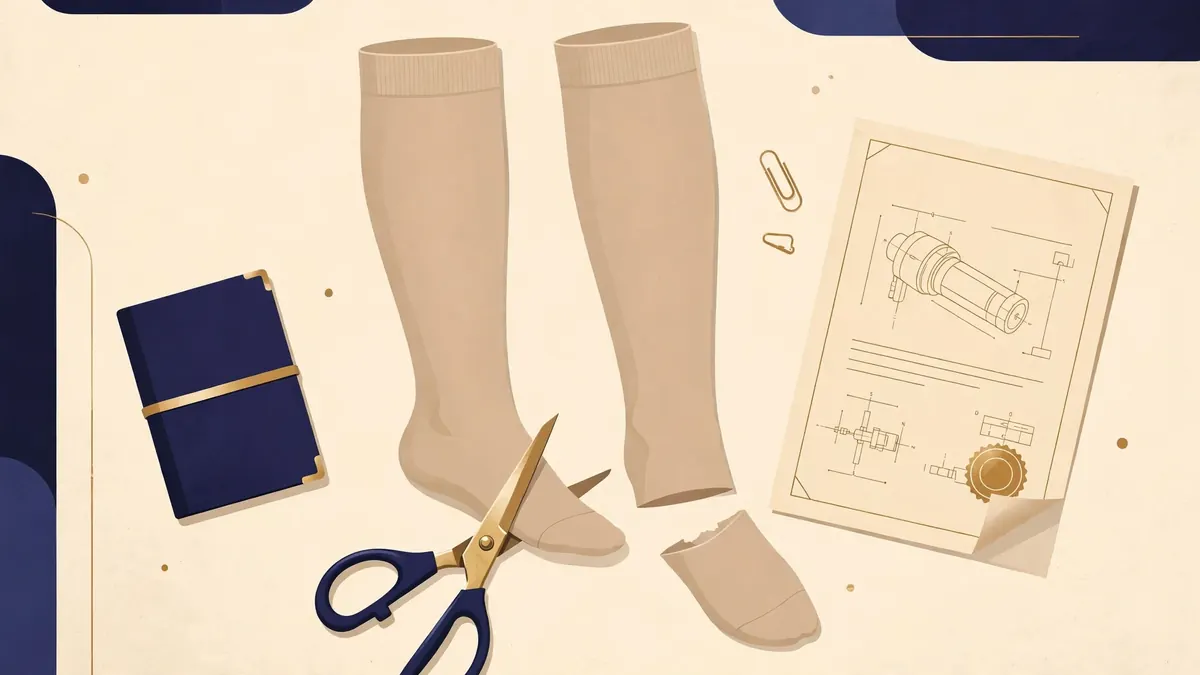
In 1998, Blakely was getting dressed for a party in Atlanta. She wanted to wear a pair of white pants, and she wanted a smooth look under them, with no visible panty line and no foot showing in her open-toe shoes. The undergarments she owned could not do both. So she took a pair of control-top pantyhose and cut the feet off with a pair of scissors. It worked. The cut-off pantyhose gave her the smooth line she wanted, stayed in place, and stayed invisible in her shoes.
Most people would have stopped there, pleased with a party trick. Blakely spent the next two years turning it into a company. She kept the idea secret from friends and family for a full year, worried they would talk her out of it. She researched the hosiery industry, visited mills, and learned how the garments were made. She wrote her own patent application using a textbook bought at Barnes & Noble, because hiring a patent lawyer would have cost money she did not want to spend. The patent — U.S. Patent 6,276,176, for footless body-shaping underwear — was granted in 2001, and it became the legal spine of the company.
She also had to name the thing. She liked the sound of “Spanks” — a play on the word spank — but settled on “Spanx” after trademark checks, registering the name for about $150. The “x” gave it a punchy, made-up feel, and the name stuck so hard that it later became a generic word for the whole category. She wrote the business plan herself, designed the packaging, and chose the brand’s tone: funny, direct, and written for real women rather than for the fashion trade.
One detail from this period says a lot about how she worked. She could not afford a proper office, so she ran the company from her Atlanta apartment. She could not afford a lawyer, so she wrote the patent herself. She could not afford a big launch, so she did the selling herself. Every constraint became a skill, and every skill stayed with the company as it grew.
Building Spanx From Her Own Savings
Spanx launched in 2000 with $5,000 — every dollar of it Blakely’s own savings from selling fax machines. There were no investors, no bank loans, no partners. She owned 100% of the company from the first day, and she would keep it that way for 21 years. That is the single most unusual fact in this biography, and it is the one that explains the fortune. Most founders give away large chunks of their companies to raise money; Blakely never had to, because the business made money from the start and she ploughed the profits back in.
The early selling was hands-on in a way that is hard to picture now. She cold-called buyers at department stores, flew to Dallas to pitch Neiman Marcus in person, and demonstrated the product in the ladies’ room of the store because that was where a buyer could actually try it on. The Neiman Marcus buyer placed an order, and then came Bergdorf Goodman, Saks Fifth Avenue and Bloomingdale’s. Within the first year, Spanx was on the shelves of the stores that set American fashion taste.
The numbers from those first years are small by later standards and enormous for a one-woman startup. Spanx took in about $4 million in sales in its first year and about $10 million in its second, according to Forbes and Fortune reporting that has been repeated across profiles ever since. The company was profitable from year one, which is why Blakely never needed outside money. She kept the operation lean, hired slowly, and kept control of every decision that touched the brand.
She also invented the marketing as she went. There was no budget for advertising, so she relied on word of mouth, clever packaging and her own willingness to talk about underwear on television without embarrassment. She sent products to celebrities and stylists, and she showed up herself, again and again, to tell the story. The story was the marketing: a young woman who cut up her pantyhose and built a company from it. It was simple, true and easy to retell, and it travelled.
The Oprah Breakthrough
In November 2000, less than a year after launch, Oprah Winfrey named Spanx one of her Favorite Things. It was the single biggest break of Blakely’s career, and it is still the moment most profiles start with. Oprah’s endorsement in 2000 was a force of nature in American retail: a product on that list sold out within days, and the brand behind it became a household name overnight.
Blakely has described how she got there. She sent samples to Oprah’s team, and she wrote a personal note explaining what the product did and why it mattered. When Oprah tried Spanx and liked it, the endorsement followed. There was no agency, no middleman, no paid placement — just a founder who believed in her product enough to send it to the most powerful tastemaker in America and wait for an answer.
The effect was immediate and lasting. Sales jumped, the brand gained national recognition, and retailers who had been cautious started calling her. But the deeper effect was on Spanx’s identity. Oprah’s audience trusted her judgment, and that trust transferred to a small brand from Atlanta that nobody had heard of a year earlier. Blakely still talks about Oprah as a mentor and a model, and Oprah later became a co-investor in the 2021 Blackstone deal — a neat closing of a loop that began with a sample box in 2000.
It is worth noting what did not happen after Oprah. Blakely did not sell the company, did not take on investors, and did not hand the brand to a big corporation. She kept building, slowly and profitably, on her own terms. The Oprah moment made Spanx famous; the discipline that followed made it valuable.
The Forbes Cover: Youngest Self-Made Female Billionaire
In March 2012, Forbes put Sara Blakely on its cover and named her the youngest self-made female billionaire in the world. She was 41. Forbes valued Spanx at about $1 billion at the time, and because Blakely owned all of it, with no debt and no outside shareholders, the whole value sat on her side of the ledger. It was a striking image for a magazine cover: a woman who had started with $5,000 and a pair of scissors, standing next to a number with nine zeroes.
The cover story landed because it broke every rule of how billionaires were supposed to be made. She had not inherited money, married into it, or raised venture capital. She had not gone to a famous business school or worked at a famous firm. She had sold fax machines, cut up her pantyhose, written her own patent, and built a profitable company one department store at a time. Forbes’ own reporting stressed the same points that every profile has repeated since: 100% ownership, zero debt, zero outside investment.
The same year, TIME magazine named her one of the 100 Most Influential People in the World. In 2014, Forbes ranked her the 93rd most powerful woman in the world. These were not vanity honours. They marked the moment when the business world stopped treating Spanx as a novelty and started treating its founder as a serious figure — someone whose way of building a company was worth studying, not just admiring.
The cover also changed Blakely’s public role. She became a regular guest on business television, a speaker on entrepreneurship, and later a guest investor on Shark Tank. She used the platform to talk about failure, about bootstrapping, and about the dinner-table ritual her father had run — the idea that failing at something every week was a habit worth keeping. The message was consistent: the billion dollars was not the point. The point was that a person with no money and no connections could build something real if they were willing to be told no for long enough.
The Blackstone Deal: Selling a Majority Stake
For two decades, people asked Blakely when she would sell Spanx. For two decades she said she would know when the day came. The day came on October 20, 2021, when Blackstone announced it was buying a majority stake in Spanx in a deal that valued the company at $1.2 billion. Blakely kept a significant equity stake and became Executive Chairwoman of a newly appointed, all-female board of directors.
The deal was unusual in its details. The Blackstone investment team was led entirely by women, under managing director Ann Chung, and the new Spanx board was all female. Co-investors included Oprah Winfrey, Reese Witherspoon and Whitney Wolfe Herd — three women who had each built their own companies. Blackstone’s own press release, dated October 20, 2021, confirms the $1.2 billion valuation and Blakely’s continuing significant stake. Business of Fashion reported the same day that the transaction valued Atlanta-based Spanx at $1.2 billion.
Blakely announced the sale herself on Instagram, in her own voice, telling followers that after 20 years of being asked when she would sell, the day had arrived. Then she did something that made headlines on its own: she gave every Spanx employee $10,000 in cash and two first-class plane tickets to anywhere in the world. The gesture cost millions and bought something no press release could — a story about a founder who shared the win with the people who had built the company with her.
The deal remade her fortune. Before it, her wealth was tied up in a private company she owned outright. After it, she held cash from the sale plus a minority stake in a company now owned mostly by Blackstone. Forbes estimated her net worth at $1.3 billion in the months after the deal, and the figure has moved between about $1 billion and $1.4 billion since, depending on the date and the method. The sale also ended the 21-year run of zero outside investment — a run that remains unmatched among founders of companies this size.
Leadership changed after the deal as well. In February 2024, Spanx named Cricket Whitton as chief executive and Jeanne Jackson as executive chair, with Blakely continuing as founder working alongside the new leadership. Forbes still lists her as founder and part owner, and the company’s own announcements describe her as working with the new team rather than stepping away.
Sara Blakely’s Net Worth in 2026: The Full Breakdown
The headline figure is Forbes’ real-time estimate of about $1.4 billion as of October 25, 2026. Forbes lists Spanx as her source of wealth, classifies her as self-made, and ranked her No. 29 on its 2026 list of America’s Richest Self-Made Women. That is the number this article anchors on, because Forbes tracks her fortune in real time and updates it against the private valuation of Spanx and her other holdings.
Other sources land lower, and the spread is honest rather than sloppy. Celebrity Net Worth, updated in August 2026, puts her at $1 billion. Several 2026 profiles cite Forbes’ own earlier figure of $1.3 billion, which was current in September 2025. A fair reading is a range of $1 billion to $1.4 billion, with the Forbes real-time figure at the top. The reason for the range is simple: Spanx is a private company, so nobody outside the deal room knows exactly what her remaining stake is worth, and the cash she took from the Blackstone sale is not public either. Any number in this range is an estimate, and any source that states one figure with total certainty is overstating what it knows.
| Year | Estimated Net Worth | Source and Context |
|---|---|---|
| 2012 | $1 billion | Forbes cover story; Spanx valued at about $1 billion, Blakely owned 100% |
| 2020 | Below $1 billion | Forbes; pandemic pressure on retail pulled the estimate down |
| Mid-2021 | About $750 million | Forbes; the low point before the Blackstone deal |
| Late 2021 | $1.3 billion | Forbes, after the Blackstone majority-stake sale at a $1.2 billion valuation |
| September 2025 | $1.3 billion | Forbes, as reported by Fortune |
| October 25, 2026 | $1.4 billion | Forbes real-time billionaires profile; No. 29 on America’s Richest Self-Made Women 2026 |
| August 2026 | $1 billion | Celebrity Net Worth, updated August 7, 2026 |
Where does the money sit? Three buckets, in rough order of size.
The Blackstone sale proceeds. When Blackstone bought a majority stake at a $1.2 billion valuation, Blakely sold most of what she owned. The exact split was never disclosed, and neither was the cash she took home, but a majority sale at that valuation means the proceeds were the largest single event in her financial life. This is the bucket that turned a paper fortune — a private company valued at a billion — into real, banked wealth.
Her remaining Spanx stake. She kept a significant minority equity position, and Forbes still describes her as founder and part owner. The value of that stake depends on what Spanx is worth today, and that is where the estimates diverge. Spanx’s annual revenue has been estimated in press reports at around $400 million in recent years, with about $220 million of that coming from its own website, according to industry trackers. The company has never confirmed a revenue figure publicly, so treat those as informed guesses, not facts.
Sneex, investments and other holdings. Her second brand, Sneex, is young and small next to Spanx, but it is a real asset with its own patents and awards. She is also a minority owner of the Atlanta Hawks, and she has made investments as a guest on Shark Tank and through her foundation’s work. None of these is large enough to move the headline figure on its own, but together they make the fortune less dependent on a single company than it was in 2012.
One more number belongs here, because it captures the scale of the return. She started with $5,000 and, 21 years later, sold a majority stake at a $1.2 billion valuation while owning 100% of the company. That is a 240,000-times return on the original money, achieved without a single outside investor and without giving up any equity along the way. No venture-backed founder can match that arithmetic, because venture money always costs equity. Blakely paid for growth with profits instead, and kept the whole company until she chose to sell part of it.
How we estimated: the anchored figure is Forbes’ real-time estimate of $1.4 billion as of October 25, 2026. The $1 billion–$1.4 billion range reflects Celebrity Net Worth ($1 billion, August 2026) and Forbes’ own earlier $1.3 billion figure (September 2025). Spanx is private, so revenue and the size of Blakely’s remaining stake are not public; figures for those are press estimates, marked as such.
Sneex: The Second Act in Footwear
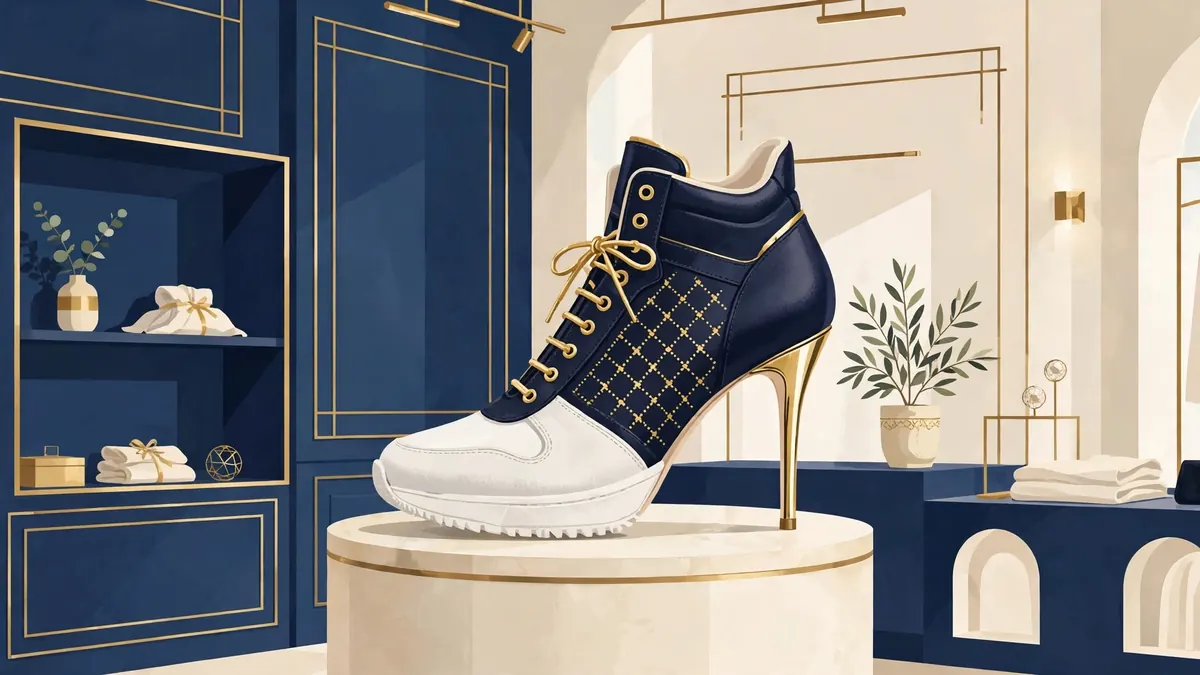
In August 2024, Blakely launched her second brand, Sneex, a footwear line built around a simple idea she had been carrying since long before Spanx: a high heel with the comfort of a sneaker. The shoes pair a stiletto-style heel with a sneaker sole and the kind of cushioning and support that running shoes use. The company calls the design a hybrid heel, and Blakely has said she first sketched the idea back in 2013, telling interviewers that her ambition before retirement was to design the world’s most comfortable high-heel shoe.
Sneex launched with prices starting at $395, placing it firmly in the luxury bracket, and it earned the Footwear News Achievement Award for Launch of the Year in 2024. In 2026 the brand added a new style called the Ballerina, reported by Fashion Manuscript in March 2026, and Sneex also picked up a 2026 ACE Award, according to industry profiles. The brand is small next to Spanx, but it matters for what it says about Blakely as a founder. She did not retire after the Blackstone sale. She went back to inventing — back to the same pattern of spotting a discomfort that millions of women live with and building a product around it.
The National Inventors Hall of Fame induction in 2026 fits the same pattern. Blakely was honoured for the Spanx invention — footless control-top pantyhose, U.S. Patent 6,276,176 — but the Hall of Fame’s own profile also notes Sneex as her continuing work as an inventor. The second brand is not a side project. It is the proof that the first one was not a fluke.
Shark Tank and Life as an Investor
Blakely has been a recurring guest investor on ABC’s Shark Tank, sitting in the guest shark’s chair across several seasons since 2012. The role suits her: she evaluates founders the way she built her own company, asking how they sell, what their margins are, and whether they actually need the money. She has invested in small consumer brands on the show, and she has become known for plain-spoken advice about bootstrapping — the idea that a founder should think twice before giving away equity for cash they could earn instead.
The Shark Tank appearances also made her a familiar face to viewers who had never bought shapewear. She is funny on camera, direct about money, and open about her failures, including the low LSAT score and the years of rejection selling fax machines. That openness is part of her public appeal, and it is also a business asset: founders who pitch her know she has sat on their side of the table.
Outside the show, she has invested in and advised other women-led companies, and she has used her platform to push for more women in investing. The Blackstone deal itself was part of that story — an all-female investment team, an all-female board, and co-investors who were themselves founders. She has said publicly that the deal mattered to her not just as a sale but as a moment for female entrepreneurs, and that framing has stuck to her public image ever since.
Personal Life: Jesse Itzler, Four Children and the Atlanta Hawks
Blakely married entrepreneur Jesse Itzler in 2008. Itzler co-founded Marquis Jet, the private-jet card company, and later became known as an author and endurance athlete. They live in Atlanta, Georgia, and have four children. The family keeps a relatively low profile for a household with two public founders, and Blakely rarely discusses her children in detail in interviews.
The couple’s best-known joint venture outside their own companies is sports. In 2015, Blakely and Itzler became minority owners of the Atlanta Hawks, the NBA team, as part of the ownership group led by Tony Ressler. The stake is a small part of her fortune, but it fits the pattern of her life in Atlanta: rooted in the city where she built Spanx, and invested in the institutions around her.
She has also spoken about the way she and Itzler run their household, including the habit of setting big shared goals — the kind of thing that sounds like a business plan applied to a marriage. Whether or not that appeals to every reader, it is consistent with everything else in this biography: a person who plans, writes things down, and treats a goal as a project with a deadline.
Giving Back: The Foundation, the Red Backpack Fund and the Giving Pledge
Blakely started the Sara Blakely Foundation in 2006, with a focus on education and entrepreneurship for women and girls. The foundation funds programmes that help women start businesses and finish their education, and it has been the main channel for her giving for two decades. In 2020, during the pandemic, the foundation partnered with GlobalGiving on the Red Backpack Fund, which gave $5,000 grants to women-owned small businesses hit by the crisis — the same amount, deliberately, that she had started Spanx with.
In 2013, she became the first female billionaire to sign the Giving Pledge, the commitment founded by Warren Buffett and Bill and Melinda Gates to give away at least half of one’s fortune during life or after death. She was also the youngest self-made female billionaire on the Forbes list when she signed, which made the gesture a statement as much as a promise: she was putting philanthropy at the centre of her public identity at the same moment her wealth became famous.
Her giving is tied closely to her own story. The Red Backpack Fund’s $5,000 grants were not a random number; they were the exact sum she had saved from selling fax machines. The foundation’s focus on women entrepreneurs is not generic charity; it is aimed at people in the position she was in at 27, with an idea and no money and nobody willing to fund it. That through-line — from her own start to the people she funds now — is the most consistent thread in her public life.
2026 Honours: Inventors Hall of Fame and the FSU Doctorate
2026 was a year of formal recognition for Blakely, and the two biggest honours arrived within a week of each other. On May 7, 2026, she was inducted into the National Inventors Hall of Fame at a ceremony in Washington, D.C., honoured for inventing footless control-top pantyhose and creating the Spanx brand. The Hall of Fame’s citation notes that she founded Spanx with a $5,000 personal investment and became the youngest self-made woman billionaire. The induction put her alongside inventors of Wi-Fi and other technologies in the 2026 class, and it was a rare honour for a consumer-brand founder: the Hall of Fame is run with the U.S. Patent and Trademark Office, and it treats a patent as the entry ticket.
Six days earlier, on May 1, 2026, Florida State University awarded her an Honorary Doctor of Humane Letters at its spring commencement, where she also spoke to graduates. FSU’s own news service reported that she graduated from the university in 1993 with a bachelor’s degree in communications, and that the honorary degree was the university’s 133rd. Her commencement address urged graduates to invest in themselves — the same advice, in different words, that her father had given at the dinner table: treat failure as homework, and keep going.
Together, the two honours close a loop that began in 1993, when a communications graduate with a low LSAT score left Tallahassee with no clear path. Thirty-three years later, the same university gave her its highest honour, and the country’s inventors’ hall put her name next to the people who built the modern world. Neither honour added a dollar to her net worth. Both say something about how her story is now told: not just as a business success, but as an invention.
How Sara Blakely Compares With Other Self-Made Women
Blakely’s fortune is smaller than those of the richest women on the Forbes lists, and that is the wrong way to look at her. The useful comparison is not the size of the number but the shape of the path. Oprah Winfrey built a media empire over decades and is worth several billion dollars by Forbes’ count. Rihanna built Fenty into a beauty giant and is a billionaire too. Kim Kardashian’s Skims made her a billionaire in the same shapewear-adjacent space Blakely created. All three are bigger fortunes. None of the three did it the way Blakely did.
What sets her apart is the ownership math. She held 100% of Spanx for 21 years, took no outside money, carried no debt, and funded growth from profits. Oprah, Rihanna and Kardashian all built their companies with partners, investors and corporate structures from early on. That is normal, and it is not a criticism — it is simply a different road. Blakely’s road is rarer, and it is the reason her story gets told in business schools: she is the cleanest example in modern business of a founder who kept everything until she chose to sell part of it.
Forbes’ own ranking makes the point in numbers. On its 2026 list of America’s Richest Self-Made Women, Blakely sits at No. 29 with about $1.4 billion. The women above her include media moguls, tech founders and heirs to family businesses who built on existing platforms. Blakely built on $5,000 and a pair of scissors. The ranking measures money; the biography measures how the money was made.
There is one more comparison worth making, and it is with her own past. In 2012 she was the youngest self-made female billionaire in the world. In 2026 she is a 55-year-old founder with a second brand, a Hall of Fame induction, and a fortune that has survived a pandemic dip, a majority sale, and a restructuring of the company she built. The number went up and down. The story only got longer.
Setbacks, Pressure and the 2026 Spanx Restructuring
No honest biography skips the hard parts, and Blakely’s story has plenty of them. The fax-machine years were seven years of daily rejection. The first two years of Spanx were two years of being told no by mills, lawyers and buyers who did not take a hosiery startup seriously. The pandemic hit Spanx hard: Forbes recorded her net worth dropping below $1 billion in 2020 and to about $750 million by mid-2021, as retail sales fell and the company’s valuation slid. She has spoken about those years as a test of the same patience she learned selling fax machines.
The most recent pressure is also the least confirmed, and it needs to be labelled as such. Celebrity Net Worth, in a profile updated on August 7, 2026, reports that Spanx went through a restructuring in 2026: that Blackstone exited its controlling position, that control passed to private credit firm HPS Investment Partners, and that Blakely left the board. The same profile reports weaker profitability, stronger competition in shapewear, and a private credit investor marking part of Spanx’s first-lien term debt at roughly 70 cents on the dollar in May 2026. We include this here because it is recent, relevant to her fortune, and published by a named source — but we could not confirm it against a second major outlet in our checks, and neither Spanx nor Blackstone has published a public statement on it that we could verify. Treat it as a single-source report, not as settled fact.
What is settled is that Spanx faces a tougher market than it did in 2012. Shapewear is now crowded, with Skims and a wave of direct-to-consumer brands competing for the same customers, and the company’s leadership has turned over since the Blackstone deal. None of that erases the fortune or the story, but it does explain why Forbes’ estimate for Blakely moves around: a private company’s value is a guess, and the guess gets harder when the market gets crowded.
Blakely’s own response, so far, has been to build elsewhere. Sneex is the clearest sign of that: a second brand, a second patent family, and a second market where she is the inventor rather than the incumbent. If Spanx’s hardest years are still ahead, the founder’s answer looks a lot like her first one — find a problem, build the product, and own the result.
Frequently Asked Questions
What is Sara Blakely’s net worth in 2026?
Forbes’ real-time estimate puts Sara Blakely’s net worth at about $1.4 billion as of October 25, 2026, ranking her No. 29 on its 2026 list of America’s Richest Self-Made Women. Other sources are lower — Celebrity Net Worth lists her at $1 billion — so the honest range is $1 billion to $1.4 billion. Most of the fortune comes from Spanx: the proceeds of the 2021 Blackstone majority-stake sale plus her remaining minority stake in the company.
How did Sara Blakely start Spanx?
In 1998, getting dressed for a party in Atlanta, she cut the feet off a pair of control-top pantyhose so she could wear white pants with a smooth look and no visible foot in open-toe shoes. She spent two years developing the idea, wrote her own patent application using a textbook from Barnes & Noble, and launched Spanx in 2000 with $5,000 of her own savings from seven years of selling fax machines door to door. She took no outside investment for 21 years.
How old is Sara Blakely?
Sara Blakely was born in 1971 in Clearwater, Florida, which makes her 55 in 2026. Her exact birth date is disputed between sources: Wikipedia and the National Inventors Hall of Fame give February 27, 1971, while Britannica gives February 21, 1971. This article uses February 27, the date carried by two of the three sources.
Does Sara Blakely still own Spanx?
She owns part of it. Blackstone bought a majority stake in Spanx in October 2021 at a $1.2 billion valuation, and Blakely kept a significant minority equity stake, becoming Executive Chairwoman. Forbes still lists her as founder and part owner. In February 2024, Spanx named Cricket Whitton as chief executive and Jeanne Jackson as executive chair, with Blakely continuing as founder alongside the new leadership.
Who is Sara Blakely’s husband?
Sara Blakely is married to entrepreneur Jesse Itzler, co-founder of Marquis Jet, since 2008. They live in Atlanta, Georgia, and have four children. Together, they became minority owners of the NBA’s Atlanta Hawks in 2015 as part of the ownership group led by Tony Ressler.
What is Sneex?
Sneex is the footwear brand Blakely launched in August 2024. It sells high heels built with sneaker-style support and cushioning — the company calls the design a hybrid heel — with prices starting at $395. Sneex won the Footwear News Achievement Award for Launch of the Year in 2024, added a Ballerina style in March 2026, and earned a 2026 ACE Award.
How much money did Sara Blakely start Spanx with?
She started Spanx with $5,000 of her own savings, earned over seven years selling fax machines door to door for Danka. She wrote her own patent application, trademarked the name “Spanx” for about $150, and never took a dollar of outside investment until Blackstone bought a majority stake in 2021 — 21 years after launch, at a $1.2 billion valuation.
What awards and honours has Sara Blakely received?
Forbes put her on its cover in 2012 as the youngest self-made female billionaire in the world, and TIME named her one of the 100 Most Influential People the same year. In 2026 she was inducted into the National Inventors Hall of Fame for the Spanx invention, and Florida State University awarded her an Honorary Doctor of Humane Letters on May 1, 2026. She was also the first female billionaire to sign the Giving Pledge, in 2013.
Final Thoughts
Sara Blakely’s biography is not really a story about a billion dollars. It is a story about a woman who kept a bad idea secret for a year because she was afraid people would talk her out of it, who wrote her own patent because she could not afford a lawyer, and who sold fax machines for seven years so she could save the $5,000 that started everything. The billion dollars is the receipt. The story is the patience.
As of late 2026, Forbes puts her fortune at about $1.4 billion, with other trackers as low as $1 billion — a range that reflects a private company, a majority sale, and a market that has grown more crowded since Spanx had the field to itself. What has not changed is the shape of the achievement: 100% ownership for 21 years, zero outside money, a profitable company from year one, and a founder who shared the win with her employees when the sale finally came.
The 2026 honours — the Inventors Hall of Fame, the honorary doctorate from the university she graduated from in 1993 — suggest how the story will be remembered. Not as a lucky break, and not as a fashion fad, but as an invention: a real solution to a real problem, built by a person who had no reason to believe it would work and kept going anyway. And with Sneex, she is still building. The scissors are long gone. The habit is not.
Sources and Reporting
This biography was researched from live reporting in November 2026. Key sources include Forbes (real-time billionaires profile and the 2012 cover story), Blackstone (press release, October 20, 2021), Spanx (company history), National Inventors Hall of Fame (2026 inductee profile), Florida State University News (honorary degree, April–May 2026), Britannica (biography), Wikipedia (biography), Celebrity Net Worth (profile updated August 2026), and Women’s Business Daily (founder profile, 2026). Figures are estimates tied to the named source and date given in the text; where sources disagree — the birth date, and the $1 billion–$1.4 billion net-worth range — the disagreement is stated rather than smoothed over. Spanx is a private company and does not disclose revenue, so revenue figures in this article are press estimates and are marked as such. If you spot an error, tell us — corrections are part of how this page stays accurate.