Lewis Hamilton height is 1.74 metres — about 5 feet 8.5 inches — as of November 2026. That is the figure most current profiles settle on, and it is the one this article anchors on: Athlon Sports lists him at 5 feet 8.5 inches (1.74 m), F1 Chronicle gives 174 cm, and the specialist height site CelebHeights puts him at 5 feet 8.5 inches barefoot. Britannica, updated on October 30, 2026, rounds the same man up to 5 feet 9 inches (1.75 m). The gap is half an inch of rounding, not a real disagreement about his body — and the maths below shows exactly why both numbers keep appearing.
Hamilton is a seven-time Formula 1 world champion, the winningest driver in the sport’s history with 106 Grand Prix victories, and since 2025 a Ferrari driver alongside Charles Leclerc. He was born on January 7, 1985, in Stevenage, England, which makes him 41 years old in the 2026 season. At 1.74 m he sits in the shorter half of the current Formula 1 grid, yet his height has never held him back: his fitness, racecraft and record speak for themselves, and modern weight rules have taken most of the old size advantage out of the sport anyway. This page answers the height question in full — the exact figure in every unit, why sources differ, how he compares with Leclerc, Max Verstappen and the rest of the grid, whether height helps or hurts a racing driver, and the career and money story that makes the number worth knowing.
By Celebamerica Editorial Staff | Last updated: November 11, 2026
| Full Name | Sir Lewis Carl Davidson Hamilton |
|---|---|
| Date of Birth | January 7, 1985 (41 years old in 2026) |
| Birthplace | Stevenage, Hertfordshire, England |
| Height | 1.74 m (174 cm) — 5 ft 8.5 in; commonly listed as 5 ft 9 in (1.75 m) when rounded up |
| Weight | About 73 kg (around 161 lb) |
| Team | Scuderia Ferrari (since 2025); previously Mercedes (2013–2024) and McLaren (2007–2012) |
| World Championships | 7 (2008, 2014, 2015, 2017, 2018, 2019, 2020) — tied with Michael Schumacher for the most ever |
| Grand Prix Wins | 106, the most in Formula 1 history (Formula1.com, November 5, 2026) |
| Pole Positions | 105, also an all-time record |
| Estimated Net Worth | About $450 million (Celebrity Net Worth, via Parade, April 2026); the Sunday Times Rich List put it at £435 million in 2026 |
| Primary Income Sources | Ferrari salary, endorsements, business ventures and investments |
| Key Ventures | Mission 44 foundation, Dawn Apollo Films, Lewis Hamilton Ventures, minority stake in the Denver Broncos |
Table of Contents
- How Tall Is Lewis Hamilton?
- Why Do Sources Disagree by Half an Inch?
- Lewis Hamilton Height in Centimetres, Feet and Inches
- How Tall Is Lewis Hamilton Compared to Other F1 Drivers?
- Does Height Matter in Formula 1?
- Early Life and Background
- Career Rise: From Karting to Seven World Titles
- The Ferrari Move
- The Money: Salary, Net Worth and Endorsements
- Assets and Lifestyle
- Personal Life
- Height, Fitness and Training
- Controversies and Talking Points
- Frequently Asked Questions
- Final Thoughts
- Sources and Reporting
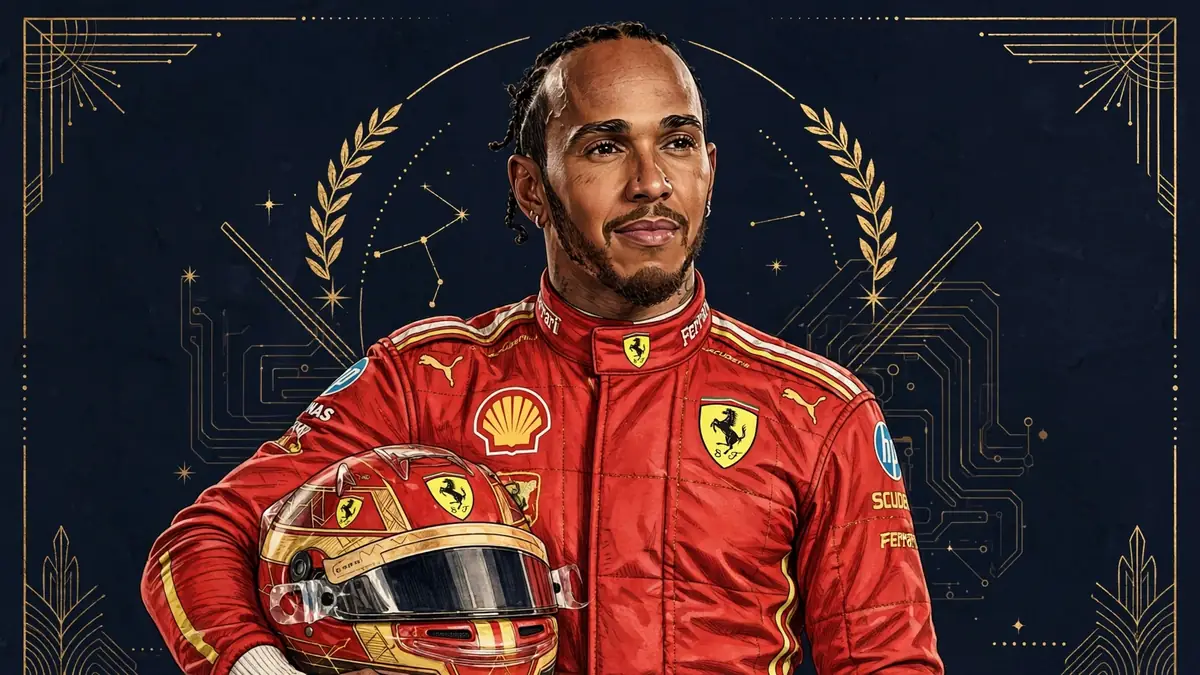
How Tall Is Lewis Hamilton?
Lewis Hamilton is 1.74 metres tall. In feet and inches that works out to 5 feet 8.5 inches, and in centimetres it is 174 cm. That is the anchored figure for this article, and it is the one the strongest current sources agree on. Athlon Sports, in a 2026 profile updated during the season, states it plainly: “Hamilton stands approximately 5 feet 8.5 inches (1.74 m) tall.” F1 Chronicle, in an article reviewed and updated in August 2026, says the same thing in metric first: “Lewis Hamilton is 174 cm tall, or 5 feet 8 inches,” then adds the finer point that 174 cm “converts to 5 feet 8 inches, or roughly 5 feet 8.5 inches on a more precise conversion.” The Italian Ferrari fan site ScuderiaFans also gives 1.74 metres, “approximately 5 feet 8 inches tall.” CelebHeights, a site that exists only to pin down celebrity heights, estimates him at 5 feet 8.5 inches (174 cm) barefoot, while noting that most media sources list him at 5 feet 9 inches.
So where does the 5 feet 9 inches figure come from? It is the rounded-up version of the same measurement, and it appears in some of the most respected places. Britannica, fact-checked by its editors and last updated on October 30, 2026, answers its own “How tall is Lewis Hamilton?” question with “5 feet 9 inches (1.75 meters) tall.” The Sport Review lists 175 cm / 5 feet 9 inches. These are not describing a different person, and they are not evidence that Hamilton grew an inch in his forties. They are what happens when 174 cm is rounded to the nearest whole inch, or when a 1.74 m measurement is written down as 1.75 m. The honest range, stated openly, is 1.74–1.75 m, or 5 feet 8.5 inches to 5 feet 9 inches — and the lower end of that range is the more precise one.
There is one set of numbers this article does not use: a handful of older profiles that list Hamilton at 5 feet 7 inches or even 170 cm. SportsBrief, for example, lists 5 feet 7 inches / 170 cm, and RacingNews365 once listed 1.74 m alongside a 5 feet 7 inches conversion that does not match its own metric figure. Those entries are stale or arithmetically wrong — 174 cm is not 170 cm, and 5 feet 7 inches is 170 cm, not 174 cm — so they are left out of the range rather than averaged in. A range should reflect real disagreement between careful sources, not copy errors.
The short answer: Lewis Hamilton is 5 feet 8.5 inches (174 cm / 1.74 m) tall. If you see 5 feet 9 inches (1.75 m), that is the same height rounded up to the nearest inch. He is 41 years old, weighs about 73 kg, and stands a little below the average height of the 2026 Formula 1 grid.
Why Do Sources Disagree by Half an Inch?
Half an inch sounds like a disagreement, but in this case it is mostly arithmetic. The metric figure is the stable one: almost every careful source lands on 174 cm or 1.74 m. The trouble starts when that number is turned into feet and inches, because 174 cm does not convert to a whole number of inches. One inch is exactly 2.54 cm, so 174 divided by 2.54 is 68.5 inches — five feet (60 inches) plus 8.5 inches. There is no rounding needed to say 5 feet 8.5 inches. But most height listings do not use half inches. A site that only prints whole inches has to choose: round 68.5 down to 68 inches (5 feet 8 inches) or up to 69 inches (5 feet 9 inches). F1 Chronicle rounds down and says 5 feet 8 inches; Britannica rounds up and says 5 feet 9 inches. Both started from the same 174 cm.
That explains the two most common figures. The other small differences come from how height is measured in the first place. A barefoot morning measurement is the tallest a person will read all day; by evening, the spine compresses slightly and the same person can measure a fraction shorter. Shoes add anything from half an inch to more than an inch depending on the sole. A driver photographed in racing boots beside a taller teammate can look shorter than his listed height, and a driver measured in trainers can look taller. None of this means the listings are guessing — it means height is a measurement with a small natural wobble, and honest reporting shows the wobble instead of hiding it.
There is also a reporting habit worth knowing about. Celebrity height pages often repeat the first number they find, and the first number for Hamilton was sometimes written as 5 feet 9 inches years ago, when 1.75 m was the figure doing the rounds. Once a rounded number is in circulation, it gets copied from site to site, and each copy makes it look more settled than it is. The 2026 profiles that go back to the metric figure — Athlon Sports, F1 Chronicle, ScuderiaFans — all land on 1.74 m, which is why this article anchors there and treats 1.75 m as the rounded form of the same measurement.
For readers who want a single number to remember: use 174 cm. It is the figure that survives conversion in both directions, it matches the specialist height trackers, and it is the number the freshest 2026 reporting agrees on.
Lewis Hamilton Height in Centimetres, Feet and Inches
Here is Hamilton’s height in every unit a reader is likely to search for, all converted from the anchored 174 cm figure so the numbers agree with each other instead of contradicting each other the way so many profile pages do.
| Unit | Height |
|---|---|
| Centimetres | 174 cm |
| Metres | 1.74 m (rounded listings say 1.75 m) |
| Feet and inches | 5 ft 8.5 in |
| Inches only | 68.5 inches |
| Feet (decimal) | 5.71 ft |
| Commonly listed (rounded up) | 5 ft 9 in (175 cm) |
| Commonly listed (rounded down) | 5 ft 8 in (174 cm) |
A quick check on the conversion: 5 feet is 152.4 cm, and 8.5 inches is 21.59 cm. Add them and you get 173.99 cm — 174 cm, to the nearest whole centimetre. The numbers close, which is the test a conversion has to pass. When a profile says 1.74 m in one line and 5 feet 7 inches in the next, it fails that test, because 5 feet 7 inches is 170 cm. That is how you can tell, without any inside information, which listings were checked and which were copied.
Hamilton’s weight is reported with the same small spread. Most current profiles put him at about 73 kg, which is roughly 161 lb. F1 Chronicle and RacingNews365 both give 73 kg, and the figure has been stable across his Ferrari seasons. At 174 cm and 73 kg, his body mass index works out to about 24 — in the healthy range, and lean for a man whose job involves withstanding several times his own body weight in cornering force. The weight matters more than the height in his sport, as the next sections explain.
How Tall Is Lewis Hamilton Compared to Other F1 Drivers?
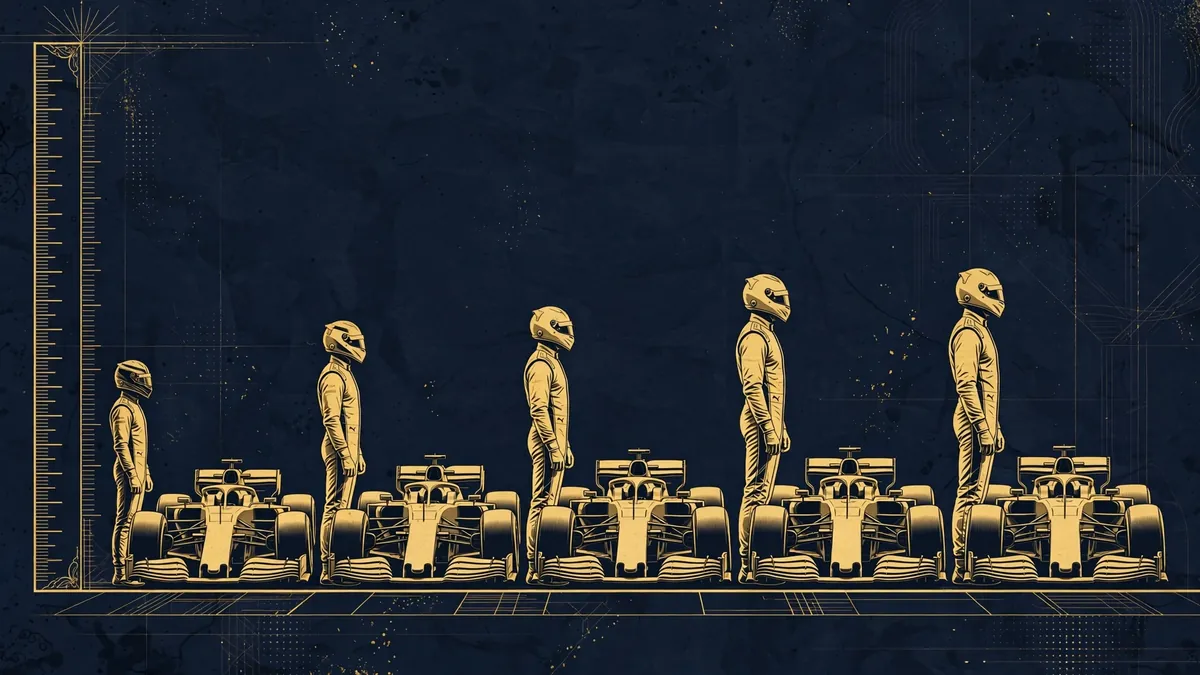
Hamilton is on the shorter side of the Formula 1 grid, but he is far from the shortest driver, and the spread across the grid is wider than most fans realise. His Ferrari teammate Charles Leclerc, at 180 cm, stands six centimetres taller than him — a gap F1 Chronicle notes has “never required unusual seat or pedal work for either driver at Ferrari.” That is the cleanest comparison available, because the two men drive the same car, sit in cockpits built to the same rules, and are photographed side by side most race weekends. Six centimetres is visible in a team photo and invisible in the lap times.
The table below puts Hamilton beside the drivers his career is most often measured against. The figures are the commonly listed heights for each driver, rounded to the nearest centimetre, and they carry the same rounding warning as Hamilton’s own number: a centimetre here or there is measurement noise, not a real difference worth arguing over.
| Driver | Commonly listed height |
|---|---|
| Lewis Hamilton | 174 cm (5 ft 8.5 in) |
| Charles Leclerc (Ferrari teammate) | 180 cm (5 ft 11 in) |
| Max Verstappen | 181 cm (5 ft 11 in) |
| Sebastian Vettel | 175 cm (5 ft 9 in) |
| Fernando Alonso | 171 cm (5 ft 7 in) |
| Carlos Sainz | 178 cm (5 ft 10 in) |
Two things stand out. First, Hamilton and Sebastian Vettel are almost the same height — a centimetre apart — and between them they hold eleven world championships, which is a neat reply to anyone who thinks a driver needs to be tall to be fast. Second, Fernando Alonso, at a commonly listed 171 cm, is shorter than Hamilton and has still raced at the front into his forties, winning two world titles and more than thirty Grands Prix. Max Verstappen’s height, commonly listed at 181 cm, puts the four-time champion seven centimetres above Hamilton — and the two men fought one of the closest title battles in the sport’s history in 2021, decided on the final lap of the final race. Height did not decide that championship. Racecraft, car pace and a controversial safety-car restart did.
The comparison that matters most inside Ferrari is the one with Leclerc, because teammates share data, engineers and garage space. Leclerc’s six-centimetre advantage has not translated into any visible edge in how either man fits the car. Modern Formula 1 cockpits are built around each driver: the seat is moulded to the driver’s body, the pedals move, the steering wheel position is set for the individual, and the survival cell is the same size for everyone. A taller driver folds himself in a little more; a shorter driver sits a little higher on his inserts. Both end up with their eyes in the same place relative to the halo and the front wing.
Against the wider grid, Hamilton sits below the middle. The tallest drivers on recent grids have been around 186–187 cm, and the shortest around 165–168 cm, which puts Hamilton a few centimetres under the average but well inside the normal range. He is taller than some race winners and shorter than others, and the list of champions is spread across the whole range — from the compact Alonso to the rangy Verstappen. If height were a real predictor of Formula 1 success, the record books would show it. They show the opposite: the two most successful drivers ever, Hamilton and Michael Schumacher, are 174 cm and 174 cm respectively in the most commonly cited listings, while the tallest drivers on the grid have never won a championship between them.
Does Height Matter in Formula 1?
It used to matter more than it does now, and the reason is weight. A Formula 1 car has a minimum weight, and for years a lighter driver handed his team a real advantage: the team could place ballast exactly where it wanted it, low in the car, to tune the balance. A heavier driver ate into that freedom. Height fed into the same calculation, because taller drivers tend to be heavier, and because a taller driver needs a slightly longer cockpit and a bigger seat. In the era when Hamilton won his first titles, a few kilograms could be worth a tenth of a second a lap, and teams noticed.
The rules have closed most of that gap. Formula 1 now sets a separate minimum weight for the driver and seat, raised to 82 kg for 2025, as F1 Chronicle notes in its height profile of Hamilton. If a driver weighs less than that, ballast is added to his seat to bring the total up to the minimum. The effect is that being light no longer buys lap time the way it once did, and being tall no longer costs it. Hamilton, at about 73 kg, carries ballast like every lighter driver on the grid; a taller, heavier teammate carries less. The cars are equalised by the rulebook before they ever reach the track.
What remains is packaging. A taller driver has longer legs to fold into a cockpit that is, by regulation, a fixed size, and longer arms to reach a steering wheel that sits close to his chest. Engineers work around it with pedal position, seat angle and steering-column length, and drivers adapt within a few sessions. A shorter driver has the opposite small problem: reaching the pedals comfortably while still seeing over the front of the car. Hamilton’s 174 cm is close to the sweet spot for both — tall enough to see clearly over the nose, short enough to fit without folding. It is one of the quieter reasons his longevity is possible: nothing about his body fights the car.
Height also matters in the physical demands of driving, though not in the way people assume. A Grand Prix lasts up to two hours, in a cockpit that can reach 50°C, with braking forces above 5G and cornering loads that push a driver’s head sideways with several times its own weight. The muscles that matter are the neck, the core and the forearms, and they are built in the gym, not given by height. Hamilton’s training — running, cycling, boxing, strength work and a famously strict diet — is built around those demands. His height is, in the end, a footnote to his fitness. The drivers who struggle physically are the ones who arrive underprepared, whatever their height.
There is one place where height genuinely shows: the podium photographs and the pre-race driver parade, where the grid lines up and the differences are visible to everyone. Hamilton standing beside Leclerc, or beside the 181 cm Verstappen, looks a little shorter, and that is where most of the search interest in his height comes from — people see the photo and ask the question. The answer, as this article has shown, is a number that flatters nobody and handicaps nobody: 174 cm, right in the working range of the sport’s greatest drivers.
Early Life and Background
Lewis Carl Davidson Hamilton was born on January 7, 1985, in Stevenage, a town in Hertfordshire, England. His father, Anthony Hamilton, is Black British with Grenadian roots, and his mother, Carmen Larbalestier, is white British. His parents separated when he was young, and he lived with his father and stepmother Linda, alongside his half-brother Nicolas, who was born with cerebral palsy and went on to become a racing driver himself. The family did not have money to spare: Anthony worked multiple jobs, including as an IT manager and contractor, to fund his son’s karting, and the story of the father remortgaging the house and working through the night to keep the karting programme alive is one Hamilton has told often, and one his father has confirmed in interviews.
Hamilton started karting at eight, after his father bought him a go-kart for Christmas, and he won the British cadet karting championship by the age of ten. At a motorsport awards dinner in 1995, the ten-year-old Hamilton walked up to McLaren team principal Ron Dennis and told him he wanted to race for McLaren one day. Dennis told him to call in nine years. Hamilton did — and Dennis kept his word, signing him to McLaren’s young driver programme in 1998, when Hamilton was thirteen. McLaren and Mercedes backed him through Formula Renault, Formula 3 and GP2, a ladder he climbed without the family wealth that funds most junior careers. He won the GP2 championship in 2006, his first season in the series, and McLaren promoted him to Formula 1 for 2007.
That background is the reason Hamilton’s story is told as more than a sporting one. He was the first Black driver to race in Formula 1, and in 2008 he became the first Black driver to win the world championship. He has spoken about racist abuse in karting and in Formula 1, including incidents in Spain in 2008, and about the isolation of being the only Black driver on the grid for most of his career. The Mission 44 foundation he later set up, covered below, grew directly out of that experience. His height, for the record, was never part of the story — nobody in karting ever suggested a 174 cm driver was too short or too tall. Karting seats are sized to the child, and the talent was visible long before the measurements mattered.
Career Rise: From Karting to Seven World Titles
Hamilton’s Formula 1 debut, with McLaren at the 2007 Australian Grand Prix, is still one of the great rookie seasons in the sport’s history. He finished on the podium in his first nine races, won four Grands Prix, and lost the championship by a single point to Kimi Räikkönen in the final race of the season. A year later, at the 2008 Brazilian Grand Prix, he overtook Timo Glock on the final corner of the final lap to take the fifth place he needed and win his first world championship by one point from Felipe Massa — then the youngest world champion the sport had seen, at 23. It was dramatic enough to become one of the most replayed finishes in Formula 1 history, and it set the tone for a career built on late braking, wet-weather brilliance and an ability to find speed where others could not.
The McLaren years after 2008 brought wins but no second title, and in 2013 Hamilton made the move that defined his career: leaving McLaren for Mercedes, a team that had won a single race in three seasons since returning as a constructor. The timing was perfect. Formula 1’s new hybrid engine rules arrived in 2014, Mercedes built the best power unit on the grid, and Hamilton won eleven races and his second championship that year. He added titles in 2015, 2017, 2018, 2019 and 2020, six championships in seven seasons, drawing level with Michael Schumacher’s record of seven in total. Along the way he passed Schumacher’s win record at the 2020 Portuguese Grand Prix, his 92nd victory, and went on to become the first driver in history to reach 100 wins and 100 pole positions.
The numbers as they stand in November 2026 are worth stating carefully, because they moved during the 2026 season itself. Formula1.com, in an article published on November 5, 2026 ahead of Hamilton’s 400th Grand Prix at São Paulo, credits him with 106 victories, 105 pole positions and seven world championships. Britannica, updated on October 30, 2026, agrees on 106 wins, and notes that the 106th was his first Grand Prix victory for Ferrari, at Barcelona on June 14, 2026. Older profiles that still say 105 wins were written before that Barcelona race; the 105 figure was correct at the end of 2025, when his wins were split 21 with McLaren, 84 with Mercedes and none yet with Ferrari. The record he chases now is an eighth world championship, which would break the tie with Schumacher and stand alone.
The Mercedes years also brought the rivalry that defined the hybrid era: first with Nico Rosberg, his teammate from 2013 to 2016, whose 2016 title win came after a season-long fight that ended with Hamilton winning the final four races but losing the championship by five points; then with Max Verstappen, whose 2021 title was decided at Abu Dhabi in circumstances examined below. Between the rivalries, Hamilton’s consistency was the story: from 2014 to 2020 he never finished lower than second in the championship, and he won at least one race in every season from his debut in 2007 until 2022 — a run of sixteen consecutive seasons with a victory.
The Ferrari Move
In February 2024, Hamilton shook Formula 1 by announcing he would leave Mercedes for Ferrari in 2025, ending a twelve-season partnership that had produced six of his seven world titles. The move was the sport’s biggest driver transfer in a generation: Ferrari is the oldest and most famous team in Formula 1, the team his childhood hero Ayrton Senna never drove for, and the team whose red cars had been the backdrop of the sport since 1950. Hamilton signed a multi-year deal reported to run for at least two seasons, with an option for a third in 2027, and arrived at Maranello in January 2025 to the kind of reception usually reserved for visiting heads of state.
His first Ferrari season, by his own admission, was a difficult one. The car was not a regular race winner, he took time to adapt to a new team, new engineers and a new way of working after twelve years at Mercedes, and the results did not match the hype of the announcement. A sprint-race win in China was the early highlight; the full Grand Prix victory did not come until June 2026, at Barcelona, his 106th career win and his first in red. That win mattered beyond the numbers: it made him the first driver to win Grands Prix for McLaren, Mercedes and Ferrari, and it answered the question that had followed him since the announcement — whether a driver in his forties could still win at the front in a new team.
The move also put him alongside Charles Leclerc, eight years his junior and the driver Ferrari had built its team around. The pairing has been one of the most closely watched in the sport, and the height difference between them — Leclerc at 180 cm, Hamilton at 174 cm — is the kind of small detail that gets noticed in team photos and launch events. Inside the garage it has been a non-issue, and both drivers have spoken about learning from each other: Leclerc about Hamilton’s experience and race management, Hamilton about Leclerc’s speed over a single lap. For readers who want the full picture of Hamilton’s life at his current stage, the age angle is covered in detail in our sister site’s piece on Lewis Hamilton’s age, which tracks his birthday, his forties and the records he is still chasing.
The Money: Salary, Net Worth and Endorsements
Hamilton is the highest-earning driver in Formula 1 history, and the money is part of why the height question keeps getting asked alongside the net-worth question: people want the full picture of the man, and the fortune is inseparable from the fame. The estimates disagree with each other by more than the height listings do, so this section states the range honestly and names the source behind each figure.
Celebrity Net Worth, the most widely cited tracker of celebrity fortunes, puts Hamilton’s net worth at $450 million — a figure Parade repeated in its 2026 profile, updated on April 26, 2026, which also reports his Ferrari base salary at $60 million a year and his total Ferrari package, with bonuses, at about $100 million a year. The Sunday Times Rich List, which measures British wealth in pounds and is generally treated as the most careful list of its kind, put him at £435 million in 2026. Other 2026 profiles give wider ranges: one puts him between $450 million and $550 million, another at $500 million to $600 million, and one lower outlier at $280 million. The honest range for this article is $450 million to $550 million, anchored on Celebrity Net Worth’s $450 million and the Sunday Times’ £435 million, which convert to roughly the same area. The full wealth story, with the contract history and the year-by-year breakdown, is told on our sister site in its Lewis Hamilton net worth profile.
The salary picture is clearer, because Forbes publishes it. Forbes reported Hamilton’s Ferrari salary at $70 million for 2025, the largest base salary on the grid, with about $500,000 in performance bonuses in that first Ferrari season, and estimated his total earnings for the twelve months ending May 1, 2026 at $100 million, including off-track income. Parade’s $60 million base figure and Forbes’ $70 million figure differ by ten million, which is why this article gives the base as a range — $60 million to $70 million a year — rather than picking one and pretending the other does not exist. Either way, it is the biggest driving contract in the sport’s history, and it made Hamilton the first Formula 1 driver to earn $100 million in a single calendar year, according to Sportico’s reporting in September 2025.
Endorsements have been the second pillar of the fortune. Hamilton’s long-term deals have included Tommy Hilfiger, with whom he has released fashion collections; Monster Energy; Puma; and IWC Schaffhausen, the watchmaker. He has also worked with brands in technology, luggage and beverages, and his off-track earnings — Forbes put them at about $20 million for the year to May 2026 — are among the highest of any driver. The commercial logic is simple: Hamilton is the most recognisable Formula 1 driver in the world, with a following that stretches well beyond motorsport into fashion, music and culture, and brands pay for that reach.
His business ventures have grown into a third pillar. He co-founded Dawn Apollo Films, the production company that co-produced the 2025 Formula 1 film starring Brad Pitt, which earned more than $633 million at the global box office and became the highest-grossing motor-racing film ever made. In September 2025 he rebranded his commercial holding vehicle from Project 44 to Lewis Hamilton Ventures. He is also a minority co-owner of the Denver Broncos NFL franchise, a stake he took in 2022, and he has invested in plant-based food and drink brands, including the Neat Burger chain. The 2025 Ferrari contract reportedly directs a share of certain salary components toward Mission 44, his charitable foundation, which works on education and employment access for young people from underrepresented backgrounds.
| Income stream | Reported figure |
|---|---|
| Ferrari base salary | $60 million to $70 million a year (Parade / Forbes) |
| Total Ferrari package with bonuses | About $100 million a year |
| Forbes total earnings, year to May 1, 2026 | $100 million (about $70 million on-track, $20 million off-track, plus bonuses) |
| Estimated net worth | $450 million to $550 million (Celebrity Net Worth $450 million; Sunday Times £435 million) |
| Endorsements | Tommy Hilfiger, Monster Energy, Puma, IWC, among others |
| Business | Dawn Apollo Films, Lewis Hamilton Ventures, Denver Broncos minority stake |
One thing the money tables cannot show is how the fortune was built: nineteen seasons of Formula 1 pay, from a rookie McLaren salary in 2007 through Mercedes contracts reported at $55 million to $60 million a year in his later seasons there, to the Ferrari deal now. No driver has ever earned more from the sport, and no driver has turned the earnings into a broader business and cultural portfolio as visibly as Hamilton has. The height that started this article is, by comparison, a small number — but it is the number people search for, and it sits beside a fortune that is anything but small.
Assets and Lifestyle
Hamilton’s life away from the track is as public as any driver’s, and it is also one of the parts of his story where careful reporting matters most, because property values and car prices get invented quickly. What is solidly reported is this: his working base during the season is in Monaco, the home of most Formula 1 drivers, and he has long kept a home in London, where he grew up. He has also spent long stretches in Los Angeles and New York, the two cities where his fashion and entertainment work is based. Exact property values are private and are not stated here, because no reliable public record fixes them.
His car collection is better documented, because he has talked about it himself and because the cars are photographed wherever he drives them. Reported members of the collection have included a Ferrari LaFerrari, a McLaren P1, a Pagani Zonda 760 LH built to his own specification, and a Mercedes-AMG One, the road car built around Formula 1 hybrid technology. He has also said he has sold cars as his tastes changed, including a Pagani Zonda he parted with, and he has spoken about moving toward electric cars for his road driving. The collection is a driver’s collection — chosen for how the cars drive, not only for what they cost — and it is one of the most written-about garages in sport.
The lifestyle around the cars is fashion, music and travel. Hamilton is a regular at fashion weeks, has walked runways and designed collections with Tommy Hilfiger, and was named a co-chair of the Met Gala in 2025. He has recorded music under a pseudonym, collaborated with artists including Christina Aguilera, and is a familiar face at grands prix after-parties and in the paddock’s social scene. He has also been open about the mental-health side of the life: the pressure of nineteen seasons at the front, the loneliness of the travel, and the work he does with a sports psychologist. None of that shows up in a height table, but it is the context that makes the height question human rather than a trivia entry.
Personal Life
Hamilton was born to Anthony Hamilton and Carmen Larbalestier, and his family remains close to his career. His father managed him through karting and the junior formulas before stepping back from the role in 2010; his mother has been a steady presence at races throughout his career. His half-brother Nicolas Hamilton, who was born with cerebral palsy, races in the British Touring Car Championship in a specially adapted car, and the two brothers have spoken about how Nicolas’s determination shaped Lewis’s own attitude to setbacks. Hamilton also has a half-sister, Samantha, and two half-brothers through his father.
His romantic life is the part of his story most often speculated about and least often confirmed. He was in a long-term relationship with the singer Nicole Scherzinger, on and off between 2007 and 2015, and since then he has been linked in the press to a series of public figures, most of which he has not confirmed. This article does not repeat unconfirmed relationship claims as fact. As of 2026 he has no wife and no children, and he has said in interviews that racing and his foundation work take up the time a family would need. His dog, Roscoe, an English bulldog with a large social-media following of his own, travels with him to races and is probably the most photographed member of his household.
Two commitments define his life off the track. The first is veganism: Hamilton adopted a plant-based diet in 2017 and has credited it with improving his energy and recovery, as well as aligning with his views on animal welfare and the environment. The second is Mission 44, the foundation he launched in 2021 with a personal commitment of £20 million, which funds programmes to help young people from underrepresented backgrounds into education and employment, including in motorsport itself. Through Mission 44 and the Hamilton Commission, the research project he set up with the Royal Academy of Engineering, he has pushed Formula 1 and British motorsport to recruit more widely — work that has earned him recognition well beyond the sport, including a knighthood in the 2021 New Year Honours, which is why his full name carries the title Sir.
Height, Fitness and Training
Hamilton is widely regarded as one of the fittest drivers on the grid, and his training is built around the specific demands of a Grand Prix rather than around looking a certain way. A race asks a driver to hold his head steady against cornering forces of 5G and more, to brake with a leg pressing more than 100 kg of force lap after lap, and to keep his heart rate high for up to two hours in cockpit temperatures that can reach 50°C. The training that prepares a body for that is a mix of running and cycling for endurance, boxing and strength work for the upper body and core, and neck exercises with weighted harnesses that look strange to outsiders and are routine to drivers. Hamilton’s sessions are long and frequent, and he has said he trains twice a day during the season when the schedule allows.
His diet is part of the same programme. He adopted a plant-based diet in 2017, and he has said it improved his energy levels and his recovery between races. He has also invested in plant-based food businesses, so the diet is a commercial interest as well as a personal one. Whether the diet itself is responsible for his longevity is impossible to prove — he was already one of the fittest drivers on the grid before 2017 — but the combination of diet, sleep discipline and training is the reason a 41-year-old can still race wheel to wheel with drivers fifteen years younger, including Lando Norris, whose own rise through McLaren has made him one of the men Hamilton now measures himself against on track.
The height question connects to the fitness story in one practical way: the cockpit. A driver’s seat is moulded to his body, and the driving position is set so his eyes sit at the right height relative to the halo and the mirrors. Hamilton’s 174 cm frame fits the Ferrari cockpit without the compromises a much taller driver needs, and without the pedal reach that a much shorter driver needs. His predecessor at Ferrari, Carlos Sainz, is listed at 178 cm, four centimetres taller, and the team changed little in the cockpit between the two men — a sign of how standardised the driving position has become. The seat, the belts and the headrest are the driver’s own; the car around them is the same.
Controversies and Talking Points
No honest profile of Hamilton can skip the 2021 Abu Dhabi Grand Prix, the race that decided the world championship against Max Verstappen and remains the most argued-over finish in modern Formula 1. Hamilton led the race comfortably until a late safety car, deployed after Nicholas Latifi’s crash, bunched the field. The race director allowed only the lapped cars between Hamilton and Verstappen to unlap themselves, the safety car came in a lap earlier than the usual procedure would have allowed, and Verstappen, on fresh tyres, passed Hamilton on the final lap to win the race and the championship. Mercedes protested, the protest was rejected, and the FIA’s later inquiry acknowledged human error in the application of the rules without changing the result. The race director was replaced before the next season. Hamilton, who had been magnanimous in defeat on the podium that night, did not speak publicly for weeks afterwards, and the episode is still cited whenever the sport debates its own governance.
Other controversies have been smaller and mostly off track. Hamilton has faced criticism in the British press over his tax affairs, including the use of an Isle of Man company for a private jet purchase — a structure his advisers have said was lawful and which he has said he was unaware of in detail — and he sold the jet in 2019. He has been fined for jewellery and underwear rule breaches under the FIA’s driver equipment regulations, most publicly at the 2022 Miami Grand Prix, where he arrived at a press conference wearing jewellery in protest at the crackdown. He has also been a lightning rod for online abuse, and he has used his platform to call it out, including after racist abuse following the 2021 British Grand Prix. None of these episodes has anything to do with his height, which is worth saying plainly: there is no height controversy in Hamilton’s career, no claim that he is taller or shorter than listed, and no dispute about his measurements. The only argument is the half inch of rounding covered at the top of this article.
Frequently Asked Questions
How tall is Lewis Hamilton?
Lewis Hamilton is 1.74 metres tall, which is 5 feet 8.5 inches (174 cm). Some sources, including Britannica, list him at 5 feet 9 inches (1.75 m) — that is the same height rounded up to the nearest whole inch. The honest range is 1.74–1.75 m.
How tall is Lewis Hamilton in cm?
Lewis Hamilton is 174 cm tall. That is the figure given by Athlon Sports, F1 Chronicle and ScuderiaFans in their 2026 profiles, and it converts exactly to 5 feet 8.5 inches.
How tall is Lewis Hamilton in feet?
Lewis Hamilton is 5 feet 8.5 inches tall. Profiles that only use whole inches round that to either 5 feet 8 inches or 5 feet 9 inches, which is why you will see both numbers online.
Is Lewis Hamilton taller than Charles Leclerc?
No. Charles Leclerc, Hamilton’s Ferrari teammate, is 180 cm tall — six centimetres taller than Hamilton’s 174 cm. The difference has never affected how either driver fits the car, because Formula 1 cockpits are moulded to each driver.
How old is Lewis Hamilton?
Lewis Hamilton was born on January 7, 1985, in Stevenage, England, which makes him 41 years old in the 2026 Formula 1 season. He made his Formula 1 debut in 2007 and is now in his 20th season in the sport.
How much does Lewis Hamilton weigh?
Lewis Hamilton weighs about 73 kg, which is around 161 lb. Formula 1 sets a minimum weight of 82 kg for the driver and seat combined, so lighter drivers like Hamilton carry ballast in the seat to reach the minimum.
How many world championships has Lewis Hamilton won?
Lewis Hamilton has won seven Formula 1 world championships — in 2008, 2014, 2015, 2017, 2018, 2019 and 2020 — tying Michael Schumacher’s record. He also holds the all-time records for Grand Prix wins (106) and pole positions (105) as of November 2026.
What is Lewis Hamilton’s net worth in 2026?
Lewis Hamilton’s net worth in 2026 is estimated at $450 million to $550 million, anchored on Celebrity Net Worth’s $450 million figure and the Sunday Times Rich List’s £435 million. His Ferrari base salary is reported at $60 million to $70 million a year, with total earnings of about $100 million a year including bonuses and endorsements.
Final Thoughts
Lewis Hamilton is 1.74 metres tall — 5 feet 8.5 inches, 174 cm — and the half inch of argument around that number is a rounding dispute, not a mystery. Britannica’s 5 feet 9 inches and Athlon Sports’ 5 feet 8.5 inches describe the same man, measured the same way, written down with different levels of precision. It is the kind of detail that only matters because Hamilton himself matters so much: the most successful driver in Formula 1 history, a seven-time world champion with 106 Grand Prix wins, now chasing an eighth title in Ferrari red at 41 years old, on a contract that pays him more than any driver has ever earned.
Height never made him and never held him back. He is shorter than his teammate, shorter than his great rival Verstappen, and taller than Alonso, and none of those comparisons predicts anything about who wins on Sunday. What predicts it is the record: sixteen consecutive seasons with a race win, seven championships across three teams, and a first Ferrari victory in 2026 that showed the speed is still there. For more profiles in the same series, browse CelebAmerica’s Celebrity archive, where his rivals and teammates are covered in the same detail.
Sources and Reporting
Height figures in this article come from Athlon Sports (2026 profile, 5 ft 8.5 in / 1.74 m), F1 Chronicle (August 2026 update, 174 cm), Britannica (updated October 30, 2026, 5 ft 9 in / 1.75 m), ScuderiaFans (1.74 m) and CelebHeights (5 ft 8.5 in barefoot estimate). Career records — 106 wins, 105 pole positions, seven championships, the 400th Grand Prix — come from Formula1.com (November 5, 2026) and Britannica. Net worth and salary figures come from Celebrity Net Worth via Parade (April 2026), the Sunday Times Rich List, and Forbes’ reporting on Formula 1 driver pay. Career history, the Ferrari move and the 2021 Abu Dhabi finale are drawn from Formula 1’s own reporting and Britannica’s biography.
How we estimated: the anchored height is 1.74 m because the freshest 2026 sources agree on that metric figure; the 5 ft 9 in listing is shown as its rounded form, not as a competing measurement. Net worth is given as a range ($450 million to $550 million) because published estimates disagree, and the range is anchored on Celebrity Net Worth and the Sunday Times. Salary is given as a range ($60 million to $70 million base) because Parade and Forbes differ. No private figure — Hamilton’s exact wealth, his property values, his contract’s private terms — is public, so every money figure here is an estimate from named sources, not an audited fact. Figures were checked against live sources on November 11, 2026.
Sources: Britannica | Athlon Sports | Formula 1 | F1 Chronicle | Parade | Forbes | Celebrity Net Worth