By Celebamerica Editorial Staff | Last updated: 7 November 2026
Jasprit Bumrah was born on 6 December 1993 in Ahmedabad, Gujarat, and by 2026 he had become the most feared fast bowler in world cricket — the first bowler ever to hold the No. 1 ranking in the ICC player rankings in all three formats, a T20 World Cup winner, and the ICC Men’s Cricketer of the Year for 2024. Most published estimates put his net worth at ₹60–70 crore (roughly $7–8 million) as of 2026, built on an ₹18 crore-a-season IPL deal with Mumbai Indians, a top-tier BCCI central contract, and one of the biggest endorsement portfolios of any Indian cricketer.
That headline figure needs a health warning, though. A close look at his documented contracts — ₹104.9 crore of IPL deals alone since 2013 — suggests the commonly quoted ₹60 crore figure may be on the low side. This biography tells the full story: the boy from Ahmedabad who lost his father young, the strange bowling action coaches tried to “fix”, the rise from a ₹10 lakh IPL contract to the highest-paid bowler in the league, the 2024 season that put him on top of the world, and the money, family and life behind the yorker king.
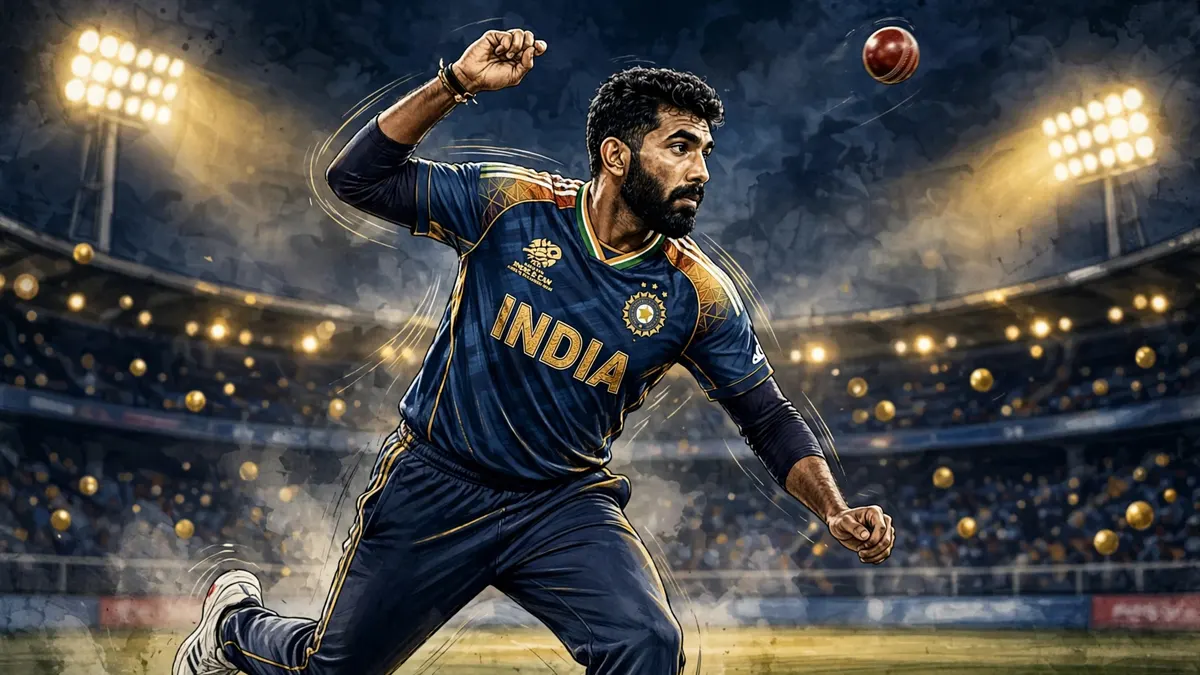
| Full Name | Jasprit Jasbirsingh Bumrah |
|---|---|
| Date of Birth | 6 December 1993 (32 years old as of November 2026) |
| Birthplace | Ahmedabad, Gujarat, India |
| Height | 5 ft 10 in (178 cm) — some profiles list 5 ft 9 in (175 cm) |
| Role | Right-arm fast bowler; India across all formats, Mumbai Indians in the IPL, Gujarat in domestic cricket |
| Estimated Net Worth (2026) | ₹60–70 crore (about $7–8 million) per published estimates; documented contracts suggest the true figure could be higher |
| Primary Income Sources | BCCI central contract, Mumbai Indians IPL salary (₹18 crore a season in 2025–26), match fees, brand endorsements |
| Key Career Marks | 234 Test wickets at 19.79; 2024 T20 World Cup Player of the Tournament; ICC Men’s Cricketer of the Year 2024; five IPL titles with Mumbai Indians |
| Spouse | Sanjana Ganesan (married 15 March 2021); son Angad, born September 2023 |
Table of Contents
- Early Life and Family in Ahmedabad
- The Unusual Action and the Road to Mumbai Indians
- International Breakthrough: ODI and T20I Debuts
- Test Career and the Making of a Great
- The 2024 Peak: World Cup Glory and ICC Honours
- Records and Career Statistics
- The Money: Contracts, IPL Earnings and Endorsements
- Net Worth in 2026: What the Numbers Really Say
- Height, Build and Physical Profile
- Personal Life: Marriage to Sanjana Ganesan and Family
- Houses, Cars and Lifestyle
- Injuries, Workload and the 2026 Season
- Frequently Asked Questions
- Final Thoughts
- Sources and Reporting
Early Life and Family in Ahmedabad
Jasprit Jasbirsingh Bumrah was born on 6 December 1993 in Ahmedabad, Gujarat, into a Punjabi Ramgarhia Sikh family. His father, Jasbir Singh, ran a small chemical business. His mother, Daljeet Bumrah, was a school teacher who later became vice principal at Nirman High School in Ahmedabad — the same school where her son studied.
Life changed early. Bumrah’s father died when Jasprit was five years old, and Daljeet raised her two children — Jasprit and his sister Juhika — on a teacher’s salary. Money was tight, and there was no family cricket background to lean on. What the household did have was a mother who refused to let her son’s unusual talent go to waste, even when it looked nothing like the cricket anyone else was teaching.
Young Jasprit played tennis-ball cricket in the streets and grounds around Ahmedabad, and that is where his bowling action was born. With no coach reshaping him, he developed a short, stuttering run-up, a stiff front arm and a slinging release that sent the ball down at serious pace from an angle batsmen struggled to read. Coaches who saw him later would call the action a problem to fix. At the time, it was simply how the boy bowled.
Daljeet enrolled him at Nirman High School, and it was there that his cricket began to get noticed. He played school cricket and age-group cricket for Gujarat, but he was not a teenage prodigy on the national radar. There was no Under-19 World Cup call-up, no early India A tour, none of the usual markers of a future star. Bumrah’s route to the top was slower, quieter and far less certain than the careers of most of his India teammates.
What set him apart, even then, was accuracy. Tennis-ball cricket rewards bowlers who can hit a yorker on demand, and Bumrah could. The toe-crushing yorker that would later become his trademark was not learned in a coaching manual — it was drilled in thousands of informal games on Ahmedabad’s dusty grounds, where a full toss got hit out of the park and a yorker was the only safe ball.
The Unusual Action and the Road to Mumbai Indians
The turning point came in the 2012–13 Syed Mushtaq Ali Trophy, India’s domestic T20 tournament. Playing for Gujarat, Bumrah’s awkward-looking action and pinpoint yorkers caught the eye of John Wright, the former New Zealand coach who was then scouting for Mumbai Indians. Wright saw past the action and saw the skill: a bowler who could land the ball where he wanted, at pace, under pressure.
Mumbai Indians signed him for the 2013 Indian Premier League season at ₹10 lakh — a modest base price for an unknown 19-year-old. His IPL debut, against Royal Challengers Bangalore, could hardly have gone better: his first wicket in the league was Virat Kohli. It was the kind of debut that makes scouts look clever, and it put Bumrah’s name in front of a national audience for the first time.
What followed was a patient apprenticeship. Mumbai Indians did not rush him. He played 11 matches in his debut season and then spent the next few years as a squad bowler, learning from Lasith Malinga — the Sri Lankan yorker master whose action, ironically, was the closest thing in world cricket to Bumrah’s own. Malinga’s mentorship mattered. The two men shared a belief that the yorker was not a party trick but a weapon, and Malinga helped Bumrah build the death-bowling game that would define his career.
By the time Mumbai Indians won their second IPL title in 2015, Bumrah was a regular in the side. His salary climbed with his reputation: from ₹10 lakh in 2013 to ₹7 crore a season when Mumbai retained him ahead of the 2018 mega auction, then ₹12 crore for the 2022–24 cycle, and finally ₹18 crore for 2025 and 2026 — the highest salary ever paid to a bowler in IPL history. Across 2013 to 2026, his IPL contracts add up to ₹104.9 crore in gross value, a figure that tells its own story about how far he travelled.

Along the way he became Mumbai Indians’ highest wicket-taker, passing Malinga with 183 wickets, and collected five IPL winners’ medals — 2013, 2015, 2017, 2019 and 2020. No other bowler has been so closely tied to one franchise’s success for so long. When Mumbai Indians talk about their identity, Bumrah’s death overs are part of it.
International Breakthrough: ODI and T20I Debuts
Bumrah’s international call-up came in January 2016, on India’s tour of Australia. He made his ODI debut on 23 January 2016 against Australia at Sydney, and his T20I debut three days later at Adelaide. It was a bold selection: India had picked a bowler with an action that looked like a coaching error and a first-class record that was solid rather than spectacular.
The selectors were vindicated fast. Bumrah finished the Australia T20I series as its leading wicket-taker, and by the end of 2016 he was India’s first-choice death bowler in white-ball cricket. His method was simple and brutal: yorkers at the death, a deceptive slower ball, and an economy rate that stayed low even when batsmen were swinging at everything.
The 2016 ICC T20 World Cup, played at home in India, gave him his first global stage. He took a wicket in every match of the tournament except one, and India reached the semi-finals. Two years later, at the 2019 ICC Cricket World Cup in England, he was India’s highest wicket-taker and one of the most economical bowlers of the whole tournament, conceding barely over four runs an over while bowling the hardest overs of the innings.
What made him different from other fast bowlers was that the yorker was not his only ball. Bumrah’s bouncer, delivered from the same short run-up and the same release point, climbed steeply at batsmen who had set themselves for a full ball. His slower ball, disguised by an identical arm speed, drew batsmen into shots they regretted. It was a four-ball attack — yorker, bouncer, slower ball and the hard length — all delivered from an action that gave batsmen almost no clues.
Test Career and the Making of a Great
For all his white-ball success, the question that followed Bumrah for years was whether his body and his action could survive Test cricket. The answer arrived on 5 January 2018, when he made his Test debut against South Africa at Cape Town — a selection that surprised many, since he had barely played first-class cricket at that point. He took his first Test wicket in that match and never looked back.
His first year in Test cricket was extraordinary. In 2018 he became the first Asian bowler to take five-wicket hauls in South Africa, England and Australia in the same calendar year. He took a five-wicket haul in Johannesburg to help India win a Test in South Africa, bowled India to victory at Trent Bridge in England, and starred in the Boxing Day Test at Melbourne as India won a Test series in Australia for the first time. Few bowlers in history have had a better first 12 months in the format.
In 2019 he became only the third Indian bowler to take a Test hat-trick, against West Indies in Jamaica. In 2022, when Rohit Sharma was ruled out of the rescheduled fifth Test against England at Edgbaston, Bumrah captained India — a rare honour for a fast bowler, and a sign of how far his standing in the team had risen.
The numbers explain the respect. By October 2026 he had taken 234 wickets in 52 Tests at an average of 19.79 — an average that puts him among the best fast bowlers of all time, not just of his era. His strike rate of 42.8 balls per wicket means he takes a wicket roughly every seven overs. He reached 200 Test wickets in just 44 Tests, the fastest Indian fast bowler to the mark, and 150 in 34 Tests, breaking a record that had stood for 110 years.
Perhaps the most telling statistic is his record away from home. Bumrah has taken five-wicket hauls in South Africa, England, Australia, New Zealand and the West Indies. He does not need friendly conditions. His pace, his angles and his control travel with him, and that is why captains trust him with the new ball in one innings and the old ball in the other.
The 2024 Peak: World Cup Glory and ICC Honours
If one year defines Bumrah’s career, it is 2024. It began in February, when he became the first Indian fast bowler to reach No. 1 in the ICC Test bowling rankings — and then the first bowler in history to hold the No. 1 ranking in all three formats at once. In the home Test series against England that followed, he took 19 wickets in four matches, including a nine-wicket haul in the Visakhapatnam Test.
June brought the ICC Men’s T20 World Cup in the West Indies and the USA. Bumrah was the tournament’s outstanding bowler: 15 wickets at an average of 8.26 and an economy rate of 4.17 runs per over. In the final against South Africa, with 30 runs needed off 30 balls and the game slipping away, his two overs at the death — conceding just six runs and taking the wicket of Marco Jansen — turned the match. India won by seven runs, ending an 11-year wait for an ICC title, and Bumrah was named Player of the Tournament.
The year ended with the Border-Gavaskar Trophy in Australia. India lost the series 3–1, but Bumrah was its defining player: 32 wickets in five Tests at an average of 13.06, a record haul for an Indian bowler in a series in Australia, including three five-wicket hauls and a nine-wicket match haul in Melbourne. He was named Player of the Series, and his performances carried an Indian attack that was otherwise struggling.
He finished 2024 as Test cricket’s leading wicket-taker with 71 wickets, and reached a career-high ICC rating of 908 points — the joint-16th highest rating any bowler has ever held. The ICC named him both Men’s Test Cricketer of the Year and Men’s Cricketer of the Year, the Sir Garfield Sobers Trophy. In 2025 he added the Wisden Leading Cricketer in the World award. By any measure, 2024 was one of the great individual years by a fast bowler in the modern game.
The 2024 season in numbers: 71 Test wickets (most in the world), 32 wickets in the Border-Gavaskar Trophy, 15 wickets at 4.17 runs per over in the T20 World Cup, ICC Men’s Cricketer of the Year, and a career-high rating of 908 points.
Records and Career Statistics
Bumrah’s record book reads like a list of things fast bowlers are not supposed to do. He is the fastest Indian pacer to 200 Test wickets, the first bowler to top the ICC rankings in all three formats, the first Indian fast bowler to top the Test rankings, and the only bowler to win a T20 World Cup Player of the Tournament award without scoring a run in the tournament.
| Format | Matches | Wickets | Average | Best Bowling | Five-Wicket Hauls |
|---|---|---|---|---|---|
| Test | 52 | 234 | 19.79 | 6/27 | 16 |
| ODI | 91 | 151 | 23.74 | 6/19 | 2 |
| T20I | 100 | 126 | 18.21 | 4/15 | 0 |
| IPL (Mumbai Indians) | 145 | 183 | 22.03 | 5/10 | 3 |
Career statistics per ESPNcricinfo, as of 5 October 2026. T20I figures include the 2026 season.
His trophy cabinet is just as full. With India he has won the 2024 T20 World Cup, the Asia Cup in 2016, 2018, 2023 and 2025, and a gold medal at the 2026 Asian Games. With Mumbai Indians he has five IPL titles. Individually he holds the Sir Garfield Sobers Trophy for 2024, the ICC Men’s Test Cricketer of the Year award for 2024, the Polly Umrigar Award for India’s best male cricketer in 2018–19 and 2021–22, a place among Wisden’s Cricketers of the Year for 2022, and the Wisden Leading Cricketer in the World award for 2025.
For comparison, his Test average of 19.79 sits below the career averages of most modern greats, and his strike rate of 42.8 is better than that of James Anderson, Stuart Broad or Dale Steyn at similar stages of their careers. The counter-argument — made most recently by former Pakistan captain Waqar Younis in October 2026 — is that Bumrah has played relatively few Tests (52 by late 2026), and his place among the all-time greats will depend on how many more he plays. It is a fair debate, and it is the main reason his workload is managed so carefully.
The Money: Contracts, IPL Earnings and Endorsements
Bumrah’s income comes from three streams: his BCCI central contract, his Mumbai Indians salary, and endorsements. None of the figures below are guesses — they come from board announcements, IPL retention lists and published reporting, and where the numbers are not public, this article says so.
BCCI central contract. Bumrah held the BCCI’s top grade, Grade A+, through the 2024–25 cycle, which paid a ₹7 crore annual retainer. In February 2026 the BCCI scrapped the A+ grade and moved to a three-tier structure, placing Bumrah in the new top tier, Grade A, for the 2025–26 cycle (1 October 2025 to 30 September 2026). The board did not publish new retainer amounts with the 2025–26 list; under the previous structure Grade A paid ₹5 crore a year. On top of the retainer he earns match fees of ₹15 lakh per Test, ₹6 lakh per ODI and ₹3 lakh per T20I.
IPL salary. This is the biggest single line in his earnings. His salary history with Mumbai Indians runs from ₹10 lakh in 2013 to ₹7 crore a season from 2018, ₹12 crore a season from 2022, and ₹18 crore a season for 2025 and 2026, when he became the highest-paid bowler in IPL history. His total gross IPL contract value from 2013 to 2026 is ₹104.9 crore.
| Period | IPL Salary (per season) |
|---|---|
| 2013 | ₹10 lakh |
| 2018–2021 | ₹7 crore |
| 2022–2024 | ₹12 crore |
| 2025–2026 | ₹18 crore (retained — highest-paid bowler in IPL history) |
| Total gross IPL contracts, 2013–2026 | ₹104.9 crore |
Endorsements. Bumrah is one of the most marketable cricketers in India. His brand list includes Asics, Dream11, boAt, OnePlus, BharatPe, Thums Up, Seagram’s Royal Stag, Zaggle, Cultsport, Performax Activewear, Zepto and Flipkart, with Skechers signing him as a brand ambassador in March 2025, JadeBlue — a luxury menswear brand from his hometown Ahmedabad — partnering with him in September 2025, and Uniqlo India naming him an endorser in March 2026. Reports put his portfolio at more than 20 brands, and the Economic Times has reported per-deal fees of ₹1.5–3 crore, which would put his annual endorsement income at roughly ₹8–15 crore. No brand has disclosed what it actually pays him, so the per-deal figures should be treated as reported estimates rather than fact.
| Income Source | Annual Value (2025–26) |
|---|---|
| BCCI central contract (Grade A) | ₹5–7 crore retainer (exact 2025–26 amount unpublished) + match fees |
| IPL salary (Mumbai Indians) | ₹18 crore |
| Endorsements (20+ brands) | Reported ₹8–15 crore a year |
| Estimated total annual earnings | ₹32–42 crore |
Net Worth in 2026: What the Numbers Really Say
Most published estimates put Jasprit Bumrah’s net worth in 2026 at ₹55–70 crore, or about $7–8 million. Sportsdunia gives about ₹60 crore ($7 million) in a profile last updated in September 2025; several other outlets land in the same range. It is the figure you will see repeated across the internet — and it deserves a closer look, because the arithmetic behind it does not quite add up.
The problem is simple. Bumrah’s IPL contracts alone total ₹104.9 crore in gross value from 2013 to 2026. Income at his level is taxed at close to 40 percent once surcharge and cess are added, which would leave roughly ₹60–65 crore from the IPL by itself — before a rupee of his BCCI retainer, his international match fees, or his endorsement income. A net worth of ₹60 crore would mean he had kept almost nothing from any of those other streams over a 13-year career. That is not impossible — athletes spend, invest badly and pay large teams — but it is unlikely, and at least one forensic profile of his earnings has made exactly this argument.
At the other end of the range, some outlets publish far higher figures. One profile puts his net worth at ₹100 crore (about $12 million) as of January 2026, and another at $15 million (about ₹125 crore). Neither explains its method, and the $15 million figure in particular looks like a round-number guess rather than a calculation.
Our honest assessment, based on the documented contracts and the published estimates, is a range of ₹60–100 crore (about $7–12 million) as of November 2026, with the published consensus of ₹60–70 crore at the bottom end and the documented earnings pointing toward the top. No board, franchise or brand publishes a player’s net worth, and Bumrah has never spoken publicly about his finances, so any single number is an estimate. What is not in doubt is the direction: he is among the highest-earning bowlers in the history of the game, and his wealth is built on contracts that are a matter of public record rather than on speculation.
How we estimated: we started from documented figures — ₹104.9 crore of IPL contracts, a ₹5–7 crore BCCI retainer, and a reported 20-plus brand portfolio — and compared them with the published estimates (Sportsdunia ₹60 crore, CricTracker ₹29–60 crore, and one outlier at ₹100 crore). Where sources disagree we publish a range and show the working, rather than picking the most flattering number.
Height, Build and Physical Profile
Bumrah stands 5 ft 10 in (178 cm) tall and weighs around 70 kg (154 lbs), according to his Wikipedia profile and several biographies. A minority of profiles list him slightly shorter, at 5 ft 9 in (175 cm), so the 178 cm figure is the one most sources agree on, with a small margin of disagreement.
For a fast bowler, he is not especially tall — and that is part of what makes his bowling so unusual. Most quicks rely on height to extract bounce; Bumrah generates his pace and bounce from a whippy, slingy action and a strong shoulder, releasing the ball from a lower, flatter trajectory that skids onto the bat. His short run-up, just a few paces, also hides the ball from the batsman for longer, and the hyperextended elbow in his delivery stride — entirely legal, and cleared by the ICC’s testing — adds to the sense that the ball arrives sooner than expected.
His build is lean rather than bulky, and his fitness regime is built around managing a body that bowls at 140-plus kph from an action that puts unusual stress on his back. That is the trade-off at the heart of his career: the action that makes him unplayable is also the action that makes him injury-prone, which is why his workload is managed more carefully than almost any other cricketer’s.
For a full breakdown of his listed height, how it compares with other fast bowlers, and why different sources give slightly different figures, see our sister site’s profile of Jasprit Bumrah’s height.

Personal Life: Marriage to Sanjana Ganesan and Family
Bumrah married sports presenter Sanjana Ganesan on 15 March 2021 in a private ceremony in Goa. Ganesan, born on 6 May 1991 in Pune, Maharashtra, is one of India’s best-known sports broadcasters, having worked as a presenter for the IPL and for major cricket broadcasters. The two had met through cricket broadcasting circles, and the wedding — held during a break in the cricket calendar — was a small, private affair with close family and a few teammates.
The couple welcomed their first child, a son named Angad, in September 2023. Bumrah announced the birth on social media with a photo of the newborn, and he has spoken since about how fatherhood changed his view of time away from home. He is famously private about his family life, rarely posting about his wife or son beyond occasional milestones, and Ganesan has continued her own broadcasting career alongside his.
His mother Daljeet remains a central figure in his life. Bumrah has said in interviews that she is the reason he plays — she worked double shifts as a teacher to fund his cricket, and he has credited her with keeping him grounded through the fame and money that followed. His sister Juhika, who works in the education sector, is the other close family member he mentions when he talks about home.
Away from cricket, Bumrah is known as a quiet, disciplined professional. He does not court controversy, keeps a small circle, and spends his time off in Ahmedabad and Mumbai with family. His social media following — more than 21 million on Instagram — makes him one of the most followed bowlers in the world, but his posts are mostly cricket, training and family, with none of the noise that follows some of his contemporaries.
Houses, Cars and Lifestyle
Bumrah owns homes in both Ahmedabad and Mumbai, according to published profiles — Ahmedabad is where he grew up and where his mother still lives, and Mumbai is his professional base with the Mumbai Indians. Neither property’s price has been reliably reported, and this article does not repeat the speculative valuations that circulate online.
His car collection has attracted more attention. Media reports have linked him to a Nissan GT-R and other premium cars, in line with what you would expect from a cricketer earning ₹18 crore a season from the IPL alone. As with the houses, the details come from lifestyle reporting rather than any official record, so they are best read as colour rather than fact.
He has also begun building an investment portfolio. Published profiles report a stake in a sustainable lifestyle and travel gear brand, and he has been linked to other early-stage investments, though the details are not public. What is clear is that his wealth is not sitting idle: between the IPL, the BCCI and endorsements, his annual earnings of ₹32–42 crore give him room to invest well beyond cricket.
The lifestyle itself is low-key by the standards of Indian cricket stardom. Bumrah does not flaunt wealth on social media, and the image he projects is that of a bowler who treats his body and his craft as the real assets. The money, by all accounts, follows the cricket rather than the other way around.
Injuries, Workload and the 2026 Season
No honest biography of Bumrah can skip the injuries. His action, his pace and his importance to India in every format mean that his body is managed like a scarce resource. He missed the 2022 T20 World Cup with a back injury, and he missed the 2025 Champions Trophy with another back problem, returning only in time for the IPL. A knee injury kept him out of India’s Test series against Sri Lanka in early 2026.
The workload debate follows him everywhere. In October 2026, former Pakistan captain Waqar Younis called him the standout white-ball bowler of the modern game but said he “still has a lot to prove” in Tests, pointing to his 52 Tests as a relatively small body of red-ball work. It was a fair observation and a familiar one: Bumrah’s numbers are extraordinary, but his Test career has been interrupted by injury and rest more than any of his rivals’.
The 2026 season itself was a managed one. He played 13 IPL matches for Mumbai Indians, taking only four wickets while carrying a niggle, and the BCCI rested him from the July 2026 T20I tours as part of its workload plan. He returned to gold-medal-winning form at the 2026 Asian Games in Aichi-Nagoya, and in October 2026 the BCCI named him in India’s Test squad for the two-match series in New Zealand starting 19 November 2026 in Wellington, with a place in the World Test Championship final at stake. He was left out of the ODI squads for the same tour, with the home Border-Gavaskar Trophy and the 2027 ODI World Cup in mind.
There are no off-field controversies of note in Bumrah’s career. His bowling action has been questioned by spectators over the years — the hyperextended elbow looks unusual — but it has been cleared by the ICC, and no formal complaint has ever been upheld. The only real argument around him is a cricketing one: how many more years his body will let him bowl like this, and how much of that time India can afford to give him.
Frequently Asked Questions
What is Jasprit Bumrah’s age in 2026?
Jasprit Bumrah is 32 years old as of November 2026. He was born on 6 December 1993 in Ahmedabad, Gujarat, which means he turns 33 in December 2026.
What is Jasprit Bumrah’s net worth in 2026?
Most published estimates put Jasprit Bumrah’s net worth at ₹60–70 crore (about $7–8 million) as of 2026. Our own assessment, based on his documented contracts — ₹104.9 crore of IPL deals alone since 2013 — is a wider range of ₹60–100 crore ($7–12 million), since the commonly quoted ₹60 crore figure is lower than his IPL earnings after tax would suggest.
Who is Jasprit Bumrah’s wife?
Jasprit Bumrah’s wife is Sanjana Ganesan, a sports presenter and broadcaster born on 6 May 1991 in Pune. They married on 15 March 2021 in Goa, and their son Angad was born in September 2023.
How tall is Jasprit Bumrah?
Jasprit Bumrah is listed at 5 ft 10 in (178 cm) tall by Wikipedia and most biographies, though a few profiles list him at 5 ft 9 in (175 cm). He weighs around 70 kg (154 lbs).
When did Jasprit Bumrah make his Test debut?
Bumrah made his Test debut on 5 January 2018 against South Africa at Cape Town. His ODI debut came earlier, on 23 January 2016 against Australia at Sydney, and his T20I debut on 26 January 2016 at Adelaide.
What is Jasprit Bumrah’s IPL salary in 2026?
Mumbai Indians retained Jasprit Bumrah for ₹18 crore a season for 2025 and 2026, making him the highest-paid bowler in IPL history. He joined the franchise for ₹10 lakh in 2013, and his total gross IPL contract value from 2013 to 2026 is ₹104.9 crore.
What are Jasprit Bumrah’s career statistics?
As of October 2026, Bumrah has taken 234 wickets in 52 Tests at an average of 19.79, 151 wickets in 91 ODIs, 126 wickets in 100 T20Is, and 183 wickets in 145 IPL matches for Mumbai Indians. His best Test figures are 6/27.
Did Jasprit Bumrah win Player of the Tournament at the 2024 T20 World Cup?
Yes. Bumrah was named Player of the Tournament at the 2024 ICC Men’s T20 World Cup, taking 15 wickets at an average of 8.26 and an economy rate of 4.17 runs per over as India beat South Africa in the final. He went on to win the ICC Men’s Cricketer of the Year award for 2024.
Final Thoughts
Jasprit Bumrah’s biography is the story of a bowler who should not have worked — the wrong action, the wrong build, the wrong background — and became the best in the world anyway. From a ₹10 lakh IPL contract to ₹18 crore a season, from tennis-ball cricket in Ahmedabad to the No. 1 ranking in all three formats, his career is a reminder that in cricket, as in most things, doing one thing better than anyone else matters more than looking the part.
What comes next depends on his body. If he stays fit through the New Zealand Tests and the home Border-Gavaskar Trophy, the next two years could add the one thing his career still lacks: a long, uninterrupted run at the top of Test cricket. Whatever happens, the 2024 season alone — the World Cup, the 71 Test wickets, the Sobers Trophy — has already secured his place among the great fast bowlers. The money, estimated at ₹60–100 crore, is the reward. The bowling is the reason.
Sources and Reporting
This biography was researched from live sources in November 2026. Career statistics are per ESPNcricinfo (as cited on Wikipedia, 5 October 2026). Contract and salary figures are per BCCI announcements and IPL retention lists as reported by Yardbarker, Durham CCC and imdevendra.com, whose forensic profile of his IPL contracts (₹104.9 crore gross, 2013–2026) underpins the net worth discussion. Net worth estimates are per Surprise Sports and Cricket Bat Pro, with the September 2025 Sportsdunia estimate as reported by imdevendra.com. Biographical details are per StarsUnfolded, CricTrends and CricBites. The October 2026 Waqar Younis comments and New Zealand Test squad news are per EuropeSays and Asia Daily.
How we estimated: no official body publishes a cricketer’s net worth. We built our range from documented income — ₹104.9 crore of IPL contracts, a ₹5–7 crore BCCI retainer, match fees, and a reported 20-plus brand endorsement portfolio — and set it against the published estimates, which mostly cluster at ₹55–70 crore. Where sources conflict, we publish the range and name the sources rather than presenting one number as fact. Estimates are not private financial records and may differ from reality.