Last updated: 7 November 2026 | By Celebamerica Editorial Staff
Sir Andy Murray’s net worth is estimated at $105 million to $149 million as of November 2026, with the Sunday Times Rich List’s May 2025 valuation of £110 million (about $149 million) anchoring the top of the range. The three-time Grand Slam champion and double Olympic gold medallist built that fortune the hard way: more than $64.6 million in official career prize money, a run of blue-chip endorsement deals, and a business portfolio that kept growing after he stopped playing. He is 39 years old, born 15 May 1987 in Glasgow, Scotland, and he retired from professional tennis after the Paris Olympics in August 2024 — ending a 19-year career that made him the most successful British tennis player of the Open Era.
What makes Murray’s story different from the other giants of his generation is the company he kept. He played his whole peak in the shadow of Roger Federer, Rafael Nadal and Novak Djokovic — three men who own 66 Grand Slam singles titles between them — and still carved out a place among them. He reached world No. 1, finished a year at the top of the rankings, won Wimbledon twice, ended a 77-year British wait for a home men’s champion, and became the only tennis player, man or woman, to win two Olympic singles gold medals. Then, three months after retiring, he did the unthinkable and coached Djokovic. This is the full story of how he got there, what he earned, and what he is doing now.
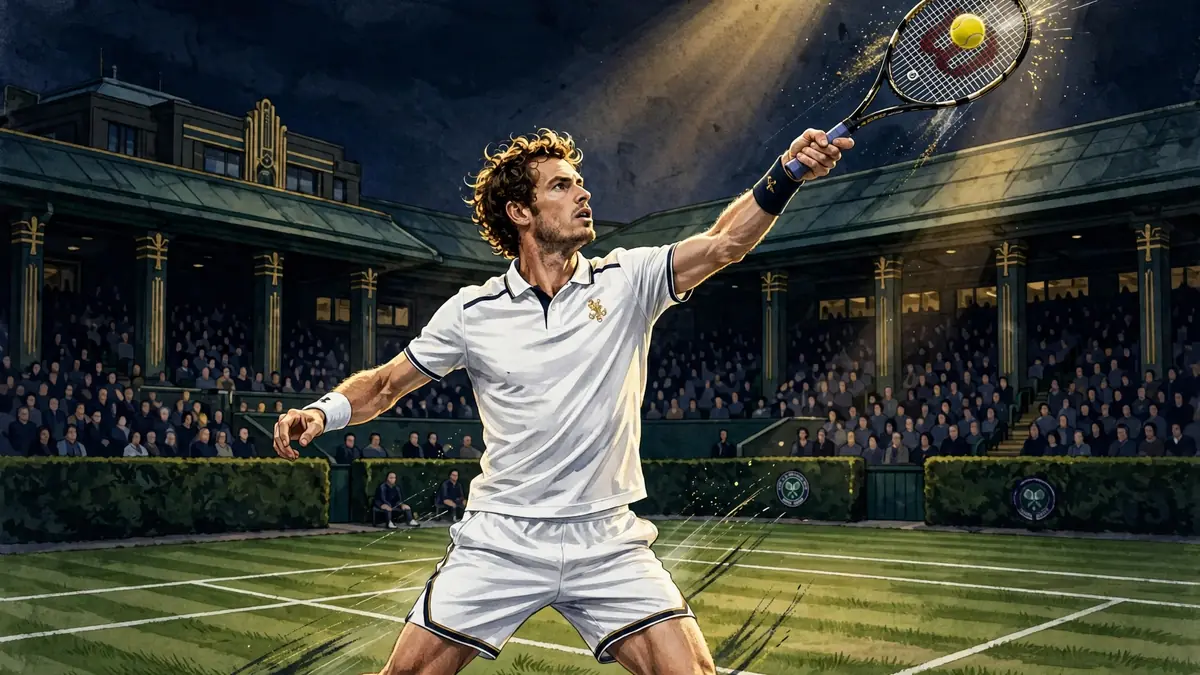
Andy Murray: Quick Facts
| Full Name | Sir Andrew Barron Murray |
|---|---|
| Date of Birth | 15 May 1987 (age 39 as of November 2026) |
| Birthplace | Glasgow, Scotland (raised in Dunblane) |
| Height | 6 ft 3 in (191 cm) |
| Estimated Net Worth | $105 million to $149 million — anchored by the Sunday Times Rich List, May 2025: £110 million (about $149 million) |
| Career Prize Money | US$64,687,542 (7th all-time, per ATP/Wikipedia) |
| Grand Slam Singles Titles | 3 — US Open 2012, Wimbledon 2013 and 2016 |
| Olympic Gold Medals | 2 — singles gold at London 2012 and Rio 2016 |
| Peak Ranking | World No. 1 for 41 weeks; year-end No. 1 in 2016 |
| Career Singles Titles | 46 ATP titles, including 14 Masters 1000 titles |
| Turned Professional | 2005 |
| Retired | 1 August 2024, after the Paris Olympics |
| Spouse | Kim Sears (married 11 April 2015); four children |
| Primary Income Sources | Tennis prize money, endorsements (Under Armour, Castore, Jaguar, Head), business ventures |
| Key Ventures | Cromlix House hotel, 77 Sports Management, AMC clothing line, Redrice Ventures, Manors |
Table of Contents
- Andy Murray: Quick Facts
- Early Life in Dunblane
- Junior Career and Turning Professional
- The Breakthrough Years
- Grand Slam Glory: Wimbledon and the US Open
- World No. 1 and the 2016 Season
- Olympic Golds and the Davis Cup
- Injuries, Hip Surgery and the Comeback
- Retirement and Coaching Djokovic
- The Money: Prize Money, Endorsements and Business
- Net Worth Breakdown and Growth
- Homes, Hotels and Investments
- Personal Life and Family
- Honours and Legacy
- Frequently Asked Questions
- Final Thoughts
- Sources and Reporting
Early Life in Dunblane
Andrew Barron Murray was born in Glasgow on 15 May 1987, the younger son of Judy Murray (née Erskine) and William Murray. The family lived in Dunblane, a small town in central Scotland, where his mother coached tennis at the local courts. His older brother Jamie, who would go on to become a doubles world No. 1 himself, was already hitting balls when Andy was still a toddler. Judy took Andy to the courts when he was three years old, and the game never really left him after that.
Tennis ran in the family on both sides. His maternal grandfather, Roy Erskine, had been a professional footballer in the late 1950s, playing for Hibernian among others — a link that helps explain Murray’s lifelong support for Hibernian FC, alongside Arsenal. But the early years in Dunblane were not all carefree. Murray was born with a bipartite patella, a condition in which the kneecap stays as two separate bones instead of fusing in childhood. It was not diagnosed until he was 16, and it shaped the way he trained and moved for the rest of his career.
He attended Dunblane Primary School, and he was eight years old in March 1996 when a gunman entered the school and killed 16 children and a teacher in what became known as the Dunblane massacre. Murray survived by taking refuge in the headmaster’s office. He has spoken about the day only rarely in the years since, and usually in the plainest terms — that it was something he carried with him, and that the town pulled together around the families. It is part of his story, but it is not the story. What defined his childhood far more, day to day, was the tennis court his mother ran and the older brother he was always trying to beat.
By the time he was a teenager, the family had made a decision that would shape his whole career: British tennis, for all its history, did not have the training setup a serious junior needed, so Murray spent long stretches training in Spain, at the Sánchez-Casal Academy in Barcelona. The clay courts, the heat, the daily grind against strong European juniors — it gave him a defensive game built on court coverage and patience, and a physical toughness that later became his trademark. He came home with a Spanish-inflected game and a Scottish accent, and neither ever left him.
Junior Career and Turning Professional
The first sign that Murray might be more than a promising junior came in 1999, when he became only the second British boy to win the 12-and-under title at the Orange Bowl in Florida, the unofficial world junior championship. He made his Wimbledon junior debut in 2002 as the youngest competitor in the boys’ event, and in September 2004 he won the US Open boys’ singles title, beating Sergiy Stakhovsky in the final. That same year he was named BBC Young Sports Personality of the Year.
He turned professional in 2005, at 17, and the climb was fast. His first ATP title came in San Jose in February 2006, when he beat Lleyton Hewitt in the final — a win that announced him as a player who could beat the best on a given day, not just a junior with potential. He finished 2006 ranked inside the world’s top 20, and by 2007 he was already being talked about as the future of British tennis, a label that carried weight in a country that had waited decades for a men’s champion.
The early professional years also set the pattern for his relationship with the British press: huge expectation, followed by close scrutiny of every loss. Murray handled it by keeping his circle small — his mother Judy, his brother Jamie, and a tight team of coaches and fitness staff — and by letting the results do the talking. The results, from 2008 onward, talked loudly.
The Breakthrough Years
Murray reached his first Grand Slam final at the 2008 US Open, where he lost to Roger Federer in straight sets. It was a defeat, but it put him in the conversation at the very top of the men’s game. Over the next four years he reached three more major finals — the 2010 and 2011 Australian Opens and Wimbledon 2012 — and lost all three. The Wimbledon final in 2012, a four-set loss to Federer on Centre Court, ended with Murray in tears during the runner-up speech, thanking the crowd and promising he would be back. British tennis fans, who had watched 74 years of near-misses since Fred Perry’s last Wimbledon title in 1936, felt the wait might never end.
It ended sooner than anyone expected. A month later, back on the same court at the London Olympics, Murray beat Federer in straight sets to win the singles gold medal, and added a silver in the mixed doubles with Laura Robson. The gold changed everything — not just the medal count, but the way the British public saw him. The dour, grumpy Scot of the tabloids became, overnight, a national hero. And the confidence from that win carried straight into New York, where in September 2012 he beat Novak Djokovic in a five-set US Open final that lasted nearly five hours. He was the first British man since Fred Perry in 1936 to win a Grand Slam singles title, and the first British player of either sex since Virginia Wade in 1977.
The breakthrough years also brought the first serious money. Prize money at the majors was climbing fast, and a Grand Slam champion with Murray’s profile — young, British, marketable, and suddenly a winner — could command endorsement fees that dwarfed his on-court earnings. Fred Perry had been his first sponsor as a junior; Adidas followed, and then, in 2015, a four-year deal with Under Armour reported to be worth £15 million. The business of Andy Murray was becoming as serious as the tennis.
Grand Slam Glory: Wimbledon and the US Open
If the US Open in 2012 broke the drought, Wimbledon in 2013 ended the wait that mattered most. Murray arrived at the All England Club that summer as the favourite, and he played like it, dropping just one set on the way to the final. There he met Djokovic again, and this time the match was not close: Murray won in straight sets, 6-4, 7-5, 6-4, in front of a Centre Court crowd that had waited 77 years for a British men’s champion. The roar when the final ball landed has been described as one of the loudest moments in British sporting history. He was awarded the OBE in the New Year Honours that followed, and named BBC Sports Personality of the Year for the first time.
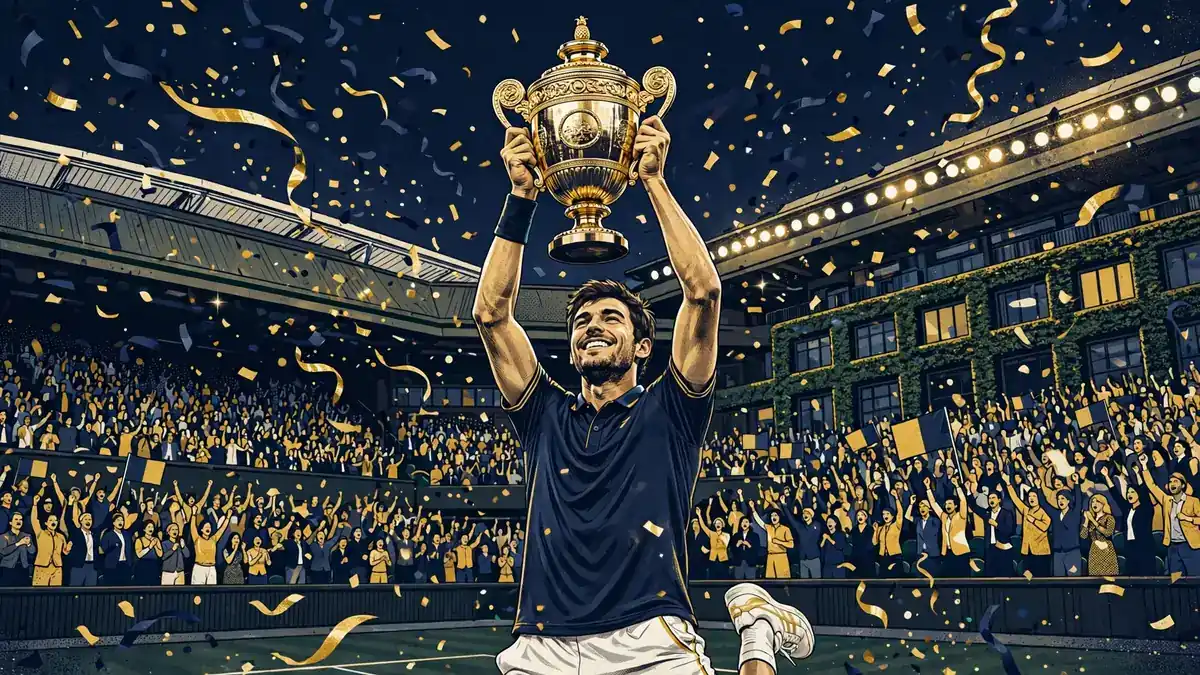
He won Wimbledon again in 2016, beating Milos Raonic in the final, again in straight sets. By then he was no longer the outsider breaking through; he was the world No. 1 in waiting, the man who had beaten the best players of his generation on the biggest stages. His third Grand Slam title confirmed what the 2013 win had suggested: the first one was not a fluke, and Murray belonged in the same breath as the three men who dominated his era.
Look at his full record and the scale of the achievement sharpens. Murray contested 11 Grand Slam singles finals and won three. He won 46 ATP singles titles, including 14 Masters 1000 titles — the tier just below the majors, where he regularly beat Federer, Nadal and Djokovic. He won 739 tour-level singles matches against 262 defeats. And he did it all while sharing an era with three of the greatest players who ever lived. Federer finished with 20 majors, Nadal with 22, Djokovic with 24. Murray’s three titles sit beside theirs not as a footnote but as proof of how hard it was to win anything at all in that era — every one of his finals, bar one, came against one of the Big Three.
| Player | Grand Slam Singles Titles | Career Prize Money (approx., ATP) |
|---|---|---|
| Novak Djokovic | 24 | About $187 million |
| Rafael Nadal | 22 | About $135 million |
| Roger Federer | 20 | About $131 million |
| Andy Murray | 3 | $64.7 million |
The gap in prize money tells its own story about the era Murray played in. He earned roughly half what Federer banked on court, despite reaching No. 1 and winning almost everything there was to win below the very top tier. But it also shows how much of his fortune came from elsewhere: endorsements, appearance fees and business deals filled the space that a fourth or fifth major might have filled, and his off-court earnings are the reason his net worth sits far above his prize money alone.
World No. 1 and the 2016 Season
The 2016 season was the best of Murray’s life, and one of the finest single seasons any British athlete has ever produced. He reached the final of the Australian Open in January, won the Italian Open and the Queen’s Club title in the summer, defended his Olympic gold in Rio, won Wimbledon for the second time, and then went on a run in the autumn that has rarely been matched: five titles in six weeks, including the Paris Masters, to overtake Djokovic and reach world No. 1 on 7 November 2016. He held the top ranking for 41 weeks in total and finished 2016 as the year-end No. 1 — the first British man ever to do so.
The season ended the way it had to end: with Murray beating Djokovic in the final of the ATP Finals in London, in a straight-sets match that decided the year-end No. 1 ranking on the spot. It was the perfect ending to a year in which he had played 87 matches and won 78 of them. He was named BBC Sports Personality of the Year for a third time, and in the New Year Honours he was knighted — Sir Andy Murray, at 29.
What is easy to forget, looking back, is how much physical punishment that season demanded. Murray’s game was built on defence: long rallies, endless running, turning defence into attack with passing shots hit on the stretch. It was a style that won him everything, and it was a style that wore his body down. The hip problems that would define the second half of his career were already there, quietly, in 2016. Within 18 months of reaching the top, he could barely walk without pain.
Olympic Golds and the Davis Cup
Two of Murray’s proudest achievements had nothing to do with individual rankings. The first was the Olympics. His gold medal at London 2012, won on Centre Court a month after his Wimbledon final defeat, was the moment British tennis stopped being a story about failure. Four years later in Rio, he beat Juan Martín del Potro in a four-set final to defend the title — becoming the only tennis player, male or female, to win two Olympic singles gold medals. He has said since that the Rio gold meant as much to him as either Wimbledon title, because defending an Olympic title, in a sport that only gets one shot at it every four years, is a different kind of pressure.
The second was the Davis Cup. In 2015 Murray almost single-handedly carried Great Britain to the title, winning 11 of the 12 rubbers he played across the year, including all three of his singles matches in the final against Belgium in Ghent. It was Britain’s first Davis Cup since 1936 — the same year Fred Perry won his last Wimbledon, the same drought that had haunted Murray’s whole career. He cried on court in Ghent, and nobody in British tennis blamed him. The Davis Cup win, the Olympic golds and the Wimbledon titles together form a set of achievements no other British tennis player has come close to matching.
The 2015 Davis Cup run: Murray won 8 singles rubbers and 3 doubles rubbers in a single Davis Cup year — a workload no player on a winning team had carried in the modern era. He played every tie, home and away, and finished the year with Britain holding the trophy for the first time in 79 years.
Injuries, Hip Surgery and the Comeback
The hip trouble that had been building through 2016 and 2017 became impossible to ignore in the summer of 2017. Murray withdrew from the US Open that year, and the pain only got worse. He had surgery on the hip in January 2018, and for a while it looked as though that might be the end. Then, in January 2019, on the eve of the Australian Open, he held a press conference in Melbourne and told the world he was in so much pain he could barely put his socks on — and that he expected to retire that year, possibly at Wimbledon, possibly right there in Australia.
It was one of the rawest press conferences in modern sport, and it changed the way people thought about him. The player who had been mocked for his on-court grumbling and his dour interviews was suddenly, plainly, a man in pain talking honestly about it. The Australian Open crowd gave him a send-off after a five-set first-round loss, and the farewell videos poured in. But Murray was not done. Later in January 2019 he had a hip resurfacing operation — a metal cap fitted to the joint — and began the long road back.
The comeback, when it came, was slower and stranger than anyone expected, and all the more impressive for it. He returned first in doubles, winning the Queen’s Club doubles title in June 2019 with Feliciano López, and then in singles, winning the European Open in Antwerp in October 2019 — his first singles title since the surgery, and his 46th overall. He never got back to the top ten, and he never won another major. But he played on for five more years, with a metal hip, beating top-ten players, reaching Grand Slam third rounds, and competing at a level that surgeons had told him would be impossible. For a player whose career had been defined by stubbornness, it was the most stubborn chapter of all.
Those final years were also when the public saw a different Murray: funnier, more relaxed, more willing to speak his mind on social media and in interviews, and generous with younger British players. He mentored the next generation, played doubles with them, and turned up for Davis Cup ties long after his body had stopped owing British tennis anything. When he finally announced that Paris 2024 would be his last tournament, the reaction was not sadness so much as gratitude — he had already given the sport more than anyone had a right to ask.
Retirement and Coaching Djokovic
Murray played his last professional match on 1 August 2024, in the men’s doubles quarter-final at the Paris Olympics, alongside Dan Evans. They lost to the American pair of Taylor Fritz and Tommy Paul, and Murray left the court to a standing ovation and a guard of honour from the other players. He was 37. He had played 1,001 tour-level singles matches, won 46 titles, and spent 41 weeks as world No. 1. The tributes that followed — from Federer, Nadal, Djokovic, and from every corner of British sport — all said the same thing: he had done it the hard way, in the hardest era, and he had never once taken a shortcut.
Three months later came the twist nobody saw coming. In November 2024 Djokovic announced that Murray would join his coaching team for the 2025 Australian Open. Two former world No. 1s, born a week apart in May 1987, who had played each other 36 times — Djokovic winning 25 of them — were now working together. The partnership lasted six months and six tournaments. The high point came in Melbourne, where Djokovic beat Carlos Alcaraz in a four-set quarter-final before tearing his left hamstring and retiring one set into his semi-final against Alexander Zverev. Results after that were mixed — early exits in Qatar and Indian Wells, a run to the Miami Open final, where Djokovic lost to the Czech teenager Jakub Mensik — and the two men announced in May 2025 that they had parted by mutual agreement.
Murray has said since that he does not regret the stint, even though the results disappointed him, and that coaching taught him how demanding the job is from the other side of the net. He has also said he would coach again, but on his terms: he has had offers, and in May 2026 he told Sky Sports he would like to work with a younger player, in the mould of the long partnership between Carlos Alcaraz and Juan Carlos Ferrero. Reports in September 2026 said he had agreed to work with the British No. 1 Jack Draper on a limited basis. For now, though, his priorities are his family and his businesses — and, by his own account, a lot of golf.
The Money: Prize Money, Endorsements and Business
Murray’s on-court earnings are the easiest part of his fortune to pin down, because the ATP publishes them. His official career prize money stands at US$64,687,542, which places him seventh on the all-time list — behind Djokovic, Nadal, Federer, and the three men who have since passed him, but ahead of every other British player by an enormous margin. In sterling terms that is a little over £50 million, earned across 19 seasons. It is a huge sum, and it is also less than half of his total estimated wealth. The rest came from the deals and businesses that a Grand Slam champion and Olympic hero can command.
His endorsement career followed the usual arc of a British sports star, but with unusually good timing. Fred Perry sponsored him first, when he was still a junior. Adidas came next, then the big one: a four-year deal with Under Armour signed in 2015, reported at the time to be worth £15 million. Under Armour put him in its global campaigns and dressed him for the biggest matches of his career, including both Wimbledon titles. His racket sponsor throughout was Head, and his other long-running deals included Jaguar — a sponsorship agreement signed in 2016 reported to be worth £1.5 million — Standard Life, the Royal Bank of Scotland, American Express and Amazon Prime Video.
The most interesting deal he ever signed, though, was the one that turned him from an endorser into an owner. In 2019 he moved to the British sportswear brand Castore, and instead of taking a straight fee he took equity in the company and launched his own clothing line, AMC, with the brand in November 2019 — the clothes made from recycled and regenerated materials. Castore has since been valued at more than £1 billion, and Murray’s minority stake is one of the most valuable single assets in his portfolio. It was a bet on a small British company by a man who understood, from his own career, what an underdog with good fundamentals can do.
More recent partnerships show the same pattern of picking British brands with room to grow. He has worked with Walker’s Shortbread, the potato supplier Albert Bartlett and the pet food company Purina, and in March 2026 he became a shareholder in Manors, a golf attire brand — a move that fits with the golf obsession that has filled much of his retirement. None of these deals is worth as much on its own as the Under Armour contract was. Together, though, they form a steady income stream that does not depend on winning tennis matches, which is exactly the point.
Net Worth Breakdown and Growth
There is no single confirmed figure for Andy Murray’s wealth, and honest reporting has to say so. The estimates differ because they measure different things: some count only liquid assets and known deals, others include business valuations and property, and none of them can see his private accounts. The range we publish — $105 million to $149 million — reflects that spread, and it is anchored at the top by the most respected source in British wealth reporting.
The Sunday Times Rich List, published in May 2025, put Murray’s wealth at £110 million, placing him joint 35th in its “40 Under 40” list of the richest people in the UK under 40, and reporting that his wealth had risen by £10 million over the previous year. At the exchange rate of the time, £110 million is about $149 million. Reporting in October 2026, after the 2026 Rich List, kept the figure at £110 million and ranked him joint-10th among the UK’s wealthiest sportspeople, alongside the England football captain Harry Kane. That is the figure we anchor on: £110 million, from the Sunday Times, in both 2025 and 2026.
The lower end of the range comes from the celebrity-finance trackers. Celebrity Net Worth’s long-standing estimate sits at about $105 million, and several outlets that follow its figure — including PlayersBio, which lists $100 million — cluster in the same area. Tennishead, the British tennis outlet, put the figure at £100 million to £110 million as of May 2025, which sits neatly between the two ends of our range. A few newer sites publish wider ranges, up to $165 million, but those figures rest on generous assumptions about business valuations and we do not use them as anchors.
| Source | Estimate | Date |
|---|---|---|
| Sunday Times Rich List | £110 million (about $149 million) | May 2025 (held at £110m in 2026 reporting) |
| Tennishead | £100 million to £110 million | May 2025 |
| Celebrity Net Worth | About $105 million | 2026 |
| PlayersBio | $100 million | November 2026 |
| Celebamerica estimate | $105 million to $149 million | November 2026 |
How the fortune was built, in plain terms: a little over £50 million in prize money, spread across 19 seasons; a run of endorsement deals that at their peak were worth several million pounds a year, including the £15 million Under Armour contract and the £1.5 million Jaguar deal; and a business portfolio that has grown steadily since he founded his management company in 2013. The Sunday Times figures show the direction of travel clearly enough: about £100 million in 2024, £110 million in 2025, and £110 million again in 2026 — a fortune that has held its value in retirement, because it was never dependent on prize money alone.
How we estimated this: we anchor on the Sunday Times Rich List (£110 million, May 2025) because it is the most rigorous published valuation of a British sportsperson’s wealth, and we set the floor at the Celebrity Net Worth figure (about $105 million) to reflect the lower published estimates. Prize money is the ATP’s official total. Business valuations are the latest reported accounts. Private wealth is never fully visible, so treat every published figure as an estimate.
Homes, Hotels and Investments
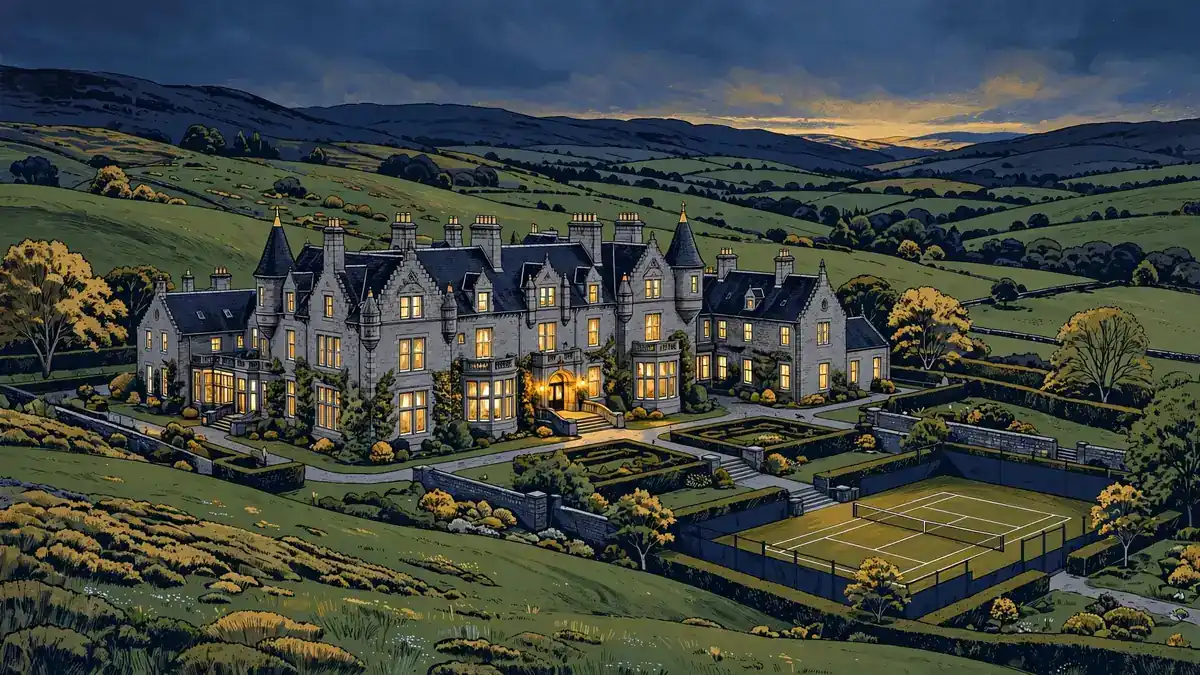
The most famous asset in Murray’s portfolio is a hotel he bought before he won his second Wimbledon. In 2013 he paid a reported £1.8 million for Cromlix House, a five-star country house hotel near Dunblane, close to where he grew up. He renovated it, reopened it in 2014, and it has since become one of Scotland’s best-regarded small hotels — named Scotland’s AA Hotel of the Year and awarded a Michelin Key in 2024. It was also the venue for his wedding reception in 2015. Reports in 2025 noted that the hotel business had lost money in some years — one report put the loss at around £350,000 in a single year — which is a useful reminder that owning a hotel is not the same as owning a gold mine. Even so, the property itself, the land and the brand have held their value, and it remains the centrepiece of his business interests.
Alongside the hotel sits the company that holds most of his business interests: 77 Sports Management, founded in 2013 with his advisers Matt Gentry and Gawain Davies. The firm manages athletes, invests in sports-related businesses and holds his stakes in companies like Castore. It was valued at £22.6 million in 2021, and its latest accounts, reported in 2026, put its value at just under £21.5 million. The small dip tells its own story about the difficulty of valuing private companies — and it is also why we publish a range for his net worth rather than a single number.
Beyond 77, Murray has been one of Britain’s most active athlete-investors. Through the Seedrs crowdfunding platform he has put money into more than 40 tech startups, and he has invested in the padel firm Game4Padel. In May 2025 he took a more formal step into finance, becoming an associate partner at Redrice Ventures, a venture capital firm. In March 2026 he added a stake in Manors, the golf clothing brand. His family home is in Surrey, where he lives with Kim and their four children, and he also retains property links in Scotland, including the hotel and the town he grew up in. He has never been a collector of cars or watches in the way some sports stars are — the Jaguar deal aside, his spending has always been quieter than his earning, and that is a large part of why the fortune has lasted.
Personal Life and Family
Murray married Kim Sears on 11 April 2015, in Dunblane Cathedral, with the reception at Cromlix House — the hotel he had bought two years earlier. Kim, born 10 December 1987, is the daughter of the tennis coach Nigel Sears, and the two had been together since 2005, when Murray was 18 and still finding his way on the tour. She has been a constant presence through the whole arc of his career: the early defeats, the Wimbledon wins, the hip surgeries, the comeback and the retirement. Those who know the couple describe Kim as the steady centre of a life that, for two decades, was lived out of suitcases.
They have four children: Sophia Olivia, born in February 2016; Edie, born in November 2017; Teddy Barron, born in October 2019; and Lola, born in March 2021. Murray has talked openly about how fatherhood changed his relationship with tennis — that losing hurt less once there were children waiting at home, and that the decision to retire was made easier by wanting to be present for them rather than on the road for 40 weeks a year. Since retiring he has said more than once that his priorities now are family first, and that he has turned down coaching work that would have meant long spells away from home.
Outside tennis, Murray is a keen golfer — a passion that has grown since retirement, and one that led to his investment in the Manors golf brand. He and his brother Jamie launched a YouTube channel, The Set, in 2026, a project that lets the two of them talk tennis on their own terms. He supports Hibernian and Arsenal, follows Scottish sport closely, and remains a vocal figure on issues he cares about, from gender equality in tennis — he has long insisted on correcting interviewers who forget the women’s game — to the welfare of young players coming through the system he once fought his way through.
Honours and Legacy
The honours list reads like a summary of a career that changed a sport in one country. He was appointed OBE in the 2013 New Year Honours, after the first Wimbledon title, and knighted in the 2017 New Year Honours, after the year-end No. 1 season. He won BBC Sports Personality of the Year three times — in 2013, 2015 and 2016 — a feat matched by very few British athletes, and he had already won the young version of the award in 2004. He was named the BBC’s Young Sports Personality of the Year before he had won a single ATP title, which tells you how early the expectation arrived.
His legacy is bigger than the trophy count, though. Before Murray, British men’s tennis was a byword for glorious failure: a century of waiting, a long line of nearly-men, and a national joke about rain and early exits. After him, Britain has Davis Cup winners, Olympic champions, and a generation of young players — Jack Draper chief among them — who grew up watching a Scot win Wimbledon and believing it could be done. He also changed what British tennis expected of itself: his training standards, his physical preparation and his refusal to accept second-best set a bar that the Lawn Tennis Association has spent a decade trying to build systems around.
There is also the question of where he sits in the history of the sport as a whole. Three Grand Slams will never match 20 or 24, and Murray would be the first to say so. But tennis historians increasingly judge him by a different measure: he was the fourth man in the greatest era the men’s game has ever seen, the one who broke into a three-way monopoly and held his place there for a decade. Federer, Nadal and Djokovic each had to go through Murray to win some of their biggest titles, and each of them has said, in retirement, that he made them better. That is a legacy no ranking can measure.
Frequently Asked Questions
How old is Andy Murray?
Andy Murray is 39 years old as of November 2026. He was born on 15 May 1987 in Glasgow, Scotland, and he retired from professional tennis at the age of 37, after the Paris Olympics in August 2024.
What is Andy Murray’s net worth?
Andy Murray’s net worth is estimated at $105 million to $149 million as of November 2026. The Sunday Times Rich List put his wealth at £110 million (about $149 million) in May 2025, while Celebrity Net Worth’s estimate sits at about $105 million. His fortune comes from $64.7 million in career prize money, major endorsement deals and businesses including Cromlix House hotel and 77 Sports Management.
How many Grand Slams did Andy Murray win?
Andy Murray won three Grand Slam singles titles: the US Open in 2012, Wimbledon in 2013 and Wimbledon again in 2016. He reached 11 Grand Slam finals in total, won 46 ATP singles titles including 14 Masters 1000 events, and spent 41 weeks as world No. 1, finishing 2016 as the year-end No. 1.
Who is Andy Murray’s wife?
Andy Murray’s wife is Kim Sears, the daughter of tennis coach Nigel Sears. They have been together since 2005 and married on 11 April 2015 in Dunblane, Scotland, with their wedding reception at Cromlix House hotel. The couple have four children: Sophia Olivia, Edie, Teddy Barron and Lola.
Why did Andy Murray retire?
Andy Murray retired because of long-running hip problems that had troubled him since 2017. He had hip surgery in January 2018, then a hip resurfacing operation in January 2019 that fitted a metal cap to the joint. He played on for five more years with the metal hip, but announced that the Paris Olympics in 2024 would be his last tournament, and played his final match on 1 August 2024 in the Olympic doubles quarter-final.
Did Andy Murray coach Novak Djokovic?
Yes. In November 2024, three months after retiring, Andy Murray joined Novak Djokovic’s coaching team for the 2025 Australian Open. The partnership lasted six months and six tournaments, with a high point in Melbourne where Djokovic beat Carlos Alcaraz in the quarter-finals. The two men parted by mutual agreement in May 2025, and Murray has said he would consider coaching again, ideally with a younger player.
What is Andy Murray doing now?
Since retiring, Andy Murray has focused on his family and his business portfolio. He runs his interests through 77 Sports Management, owns the Cromlix House hotel in Scotland, is an associate partner at Redrice Ventures, and became a shareholder in the golf brand Manors in March 2026. He also launched a YouTube channel, The Set, with his brother Jamie, plays a lot of golf, and has been linked with coaching work with Britain’s Jack Draper.
Where is Andy Murray from and where does he live?
Andy Murray was born in Glasgow, Scotland, and grew up in Dunblane, where he attended Dunblane Primary School and first played tennis on the local courts coached by his mother Judy. He now lives with his wife Kim and their four children at the family home in Surrey, England, while keeping close ties to Scotland through his Cromlix House hotel near Dunblane.
Final Thoughts
Andy Murray’s biography is, at its heart, a story about stubbornness. He was a boy from a small Scottish town who trained on Spanish clay, lost four Grand Slam finals before winning one, and kept coming back — from defeat, from surgery, from a metal hip that should have ended his career. He won three majors in the hardest era men’s tennis has ever known, finished a year as the best player on the planet, and then, when his body finally said enough, he walked away on his own terms at the Olympics and went straight back to the sport as a coach.
The money tells the same story as the tennis. A fortune of $105 million to $149 million, anchored by the Sunday Times’ £110 million valuation, was not built on one lucky deal. It was built the way his career was built: steadily, over 19 seasons, from prize money, from endorsements he chose carefully, and from businesses — a hotel, a management company, a clothing line, a string of startup bets — that kept working after the tennis stopped. That is why the figure held its value in retirement when so many athletes’ fortunes do not.
What endures, though, is not the money. It is the fact that a generation of British children grew up watching a Scot lift the Wimbledon trophy, and that British tennis will never again be a story about waiting. Murray ended the wait, and then he spent the rest of his career making sure the next generation would not have to wait so long. That is a legacy worth more than any Rich List figure.
Sources and Reporting
This biography was researched from live reporting and reference sources in November 2026. Career statistics, prize money and rankings are drawn from the ATP’s official records and Wikipedia’s biography of Andy Murray, which cites the ATP and the Sunday Times Rich List. The net worth anchor is the Sunday Times Rich List of May 2025 (£110 million), with the lower end of the range reflecting Celebrity Net Worth’s estimate of about $105 million and Tennishead’s May 2025 range of £100 million to £110 million. Endorsement and business details are drawn from reporting by BBC Sport, Tennishead and the British press, including the Under Armour deal (2015), the Jaguar agreement (2016), the Castore partnership and AMC launch (2019), the Cromlix House purchase (2013) and the 77 Sports Management valuations. Coaching and retirement details are drawn from NBC Sports, Sky Sports and Tennis World USA reporting in 2025 and 2026.
How we estimated: net worth figures for public figures are estimates built from public reporting, not audited financial statements. We publish a range where sources disagree and name the source behind each end of it. The Sunday Times Rich List anchors the top of our range because it applies a consistent valuation method to British wealth; the lower end reflects the celebrity-finance trackers. Private investments, taxes and debts are not publicly visible, so the true figure may differ.