By Celebamerica Editorial Staff | Last updated: 26 November 2026
Hardik Pandya’s biography is the story of a boy from Choryasi, a small town near Surat in Gujarat, who became one of the richest and most talked-about cricketers in India. As of November 2026, his net worth is estimated at ₹95–120 crore (roughly $11–15 million), anchored by Celebrity Net Worth’s $15 million figure and Indian reporting that puts the range at ₹95–120 crore. The money comes from a career that has now delivered almost everything the sport offers: four IPL titles with Mumbai Indians, an IPL title as captain of Gujarat Titans, and two T20 World Cups plus a Champions Trophy with India.
What makes the 33-year-old’s story worth telling in full is not just the wealth. In the space of three years he went from being booed by his own franchise’s fans to bowling the over that won India a World Cup, then watched his marriage end in public, then won two more ICC trophies and was traded to a third IPL franchise in one of the biggest swaps the league has ever seen. This biography covers all of it — the early years in Surat and Vadodara, the rise through Baroda and Mumbai Indians, the money and the garage, the family, and the controversies — with every figure tied to a named source.
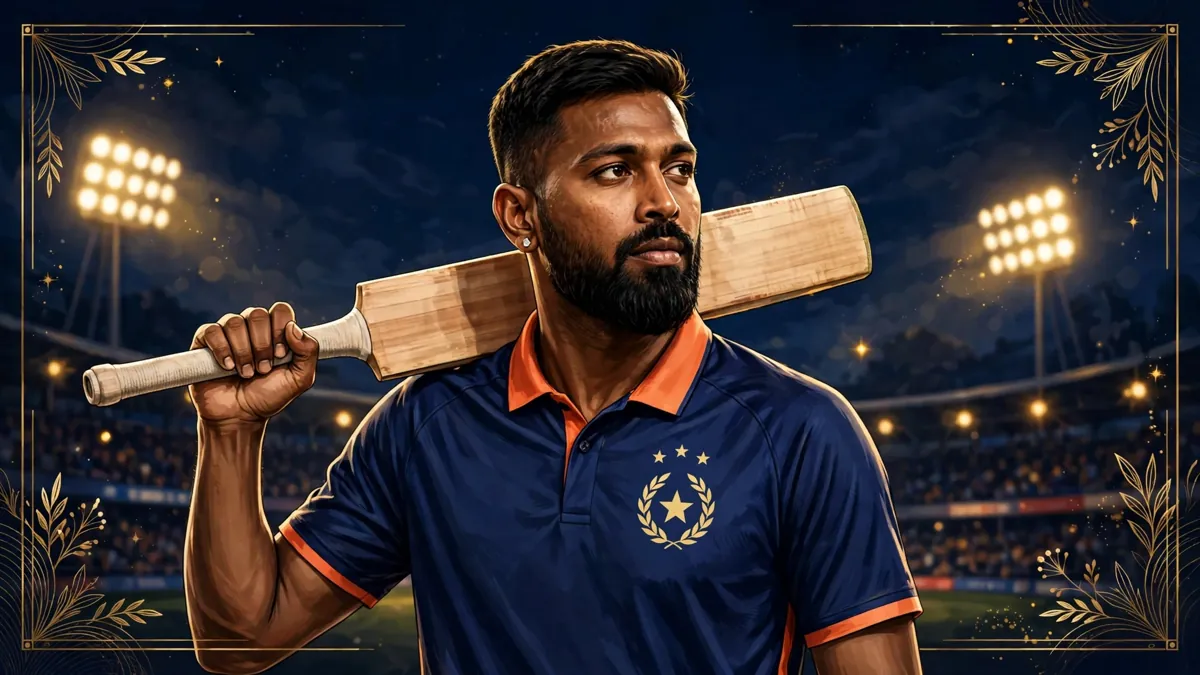
Quick Facts: Hardik Pandya at a Glance
| Full Name | Hardik Himanshu Pandya |
|---|---|
| Date of Birth | 11 October 1993 (age 33 as of November 2026) |
| Birthplace | Choryasi, Surat, Gujarat, India |
| Estimated Net Worth | ₹95–120 crore (about $11–15 million), per Celebrity Net Worth ($15 million) and Indian outlets reporting ₹95–120 crore |
| Primary Income Sources | IPL contracts, BCCI central contract, match fees, brand endorsements |
| Current IPL Team | Punjab Kings (traded from Mumbai Indians, 11 November 2026; fee ₹18 crore for IPL 2027) |
| International Debut | T20I: 26 January 2016 vs Australia; ODI: 16 October 2016 vs New Zealand; Test: 26 July 2017 vs Sri Lanka |
| Major Honours | T20 World Cup 2024 and 2026, Champions Trophy 2025, Asia Cup 2025, IPL titles 2015, 2017, 2019, 2020 (Mumbai Indians) and 2022 (Gujarat Titans, as captain) |
| Family | Elder brother Krunal Pandya (also an India cricketer); son Agastya (born July 2020); separated from Natasa Stankovic in July 2024 |
| Key Ventures | Brand endorsements with Dream11, Monster Energy, Gillette, Hyundai, Gulf Oil, boAt and others |
Table of Contents
- Early Life: From Choryasi to Vadodara
- Baroda Breakthrough and the Mumbai Indians Call
- India Debut and the 2017 Champions Trophy Heartbreak
- Four IPL Titles With Mumbai Indians
- Gujarat Titans Captaincy: A Title in Year One
- The 2024 T20 World Cup: Redemption in Barbados
- Champions Trophy and Asia Cup in 2025
- A Second T20 World Cup on Home Soil
- The Punjab Kings Trade and What Comes Next
- Hardik Pandya Net Worth in 2026
- Where the Money Comes From
- Homes, Cars and the Garage
- Personal Life: Family, Natasa Stankovic and Agastya
- Controversies and Setbacks
- How Hardik Pandya Compares With His Peers
- Frequently Asked Questions
- Final Thoughts
- Sources and Reporting
Early Life: From Choryasi to Vadodara
Hardik Himanshu Pandya was born on 11 October 1993 in Choryasi, a town on the edge of Surat in Gujarat. His father, Himanshu Pandya, ran a small car-finance business in Surat, and his mother, Nalini Pandya, kept the home. Hardik is the younger of two sons; his elder brother, Krunal Pandya, would also go on to play for India and become a fixture of the IPL. The two brothers grew up in a household where cricket was not a hobby but a plan.
When Hardik was still a boy, Himanshu made a decision that shaped both his sons’ lives: he shut the car-finance business in Surat and moved the family to Vadodara, a city with better cricket coaching and facilities. It was a gamble on two children. The family lived on a tight budget in those years — a detail Hardik has spoken about openly in interviews — and the brothers trained at the Kiran More cricket academy in Vadodara, where the former India wicketkeeper ran a respected coaching setup. Money was short enough that the boys sometimes travelled to practice on a single borrowed vehicle, and Hardik has said the family once went through a stretch where they survived on little more than instant noodles. Those stories are now part of his public image, but they were lived long before any of it was a brand.
School took a back seat early. Hardik studied at MK High School in Vadodara and left formal education after class nine to give cricket his full attention. It was a high-risk choice for a teenager from a family with no safety net, and it only looks sensible in hindsight because the cricket worked out. What the academy coaches saw in him was not polish but raw material: a strong build, a fast arm, and a willingness to hit the ball hard and take the game on. He batted in the middle order and bowled right-arm fast-medium — a combination India has always been short of, since genuine pace-bowling all-rounders are rare in Indian cricket.
Vadodara became home. The family settled in the Diwalipura area of the city, and Hardik still keeps a home there today, a 6,000 sq ft penthouse built by merging four flats. The brothers played their domestic cricket for Baroda, and the city watched them grow from academy kids into professionals. Krunal, two years older, reached the IPL first, but Hardik’s rise, once it started, was faster and louder.
Baroda Breakthrough and the Mumbai Indians Call
Hardik’s domestic breakthrough came in the 2015–16 season. Playing for Baroda in the Syed Mushtaq Ali Trophy, India’s domestic T20 competition, he announced himself as a power-hitter, clearing boundaries with a freedom that stood out even in a format built for it. Scouts noticed the same thing the academy coaches had: here was a young Indian player who could change a match in ten balls and then bowl four overs of genuine pace.
Mumbai Indians moved first. Ahead of the 2015 IPL season, the franchise signed the then 21-year-old for just ₹10 lakh — about $10,700 at November 2026 exchange rates, according to Celebrity Net Worth’s contract history. It was a base-price punt on an unknown domestic player, and it turned out to be one of the best-value signings in the league’s history. In his first season, Hardik played in a side full of stars and made an impression with cameos that were short, violent and memorable, including a quick-fire innings against Chennai Super Kings that put his name in front of a national television audience for the first time.
The IPL gave him two things domestic cricket could not: a stage and a pay cheque that changed his family’s circumstances. The ₹10 lakh contract was small by IPL standards, but for a family that had moved cities on a gamble, it was proof the gamble had paid. Within a year he was in the India T20 side. The speed of that jump — from Baroda’s domestic T20 team to an India cap in about twelve months — is one of the fastest ascents of any Indian cricketer of his generation.
India Debut and the 2017 Champions Trophy Heartbreak
Hardik made his T20 international debut on 26 January 2016 against Australia in Adelaide, and his ODI debut followed on 16 October 2016 against New Zealand. His Test debut came on 26 July 2017 against Sri Lanka in Galle, where he scored a century in his third Test — a 108 off 96 balls that showed his batting belonged at the highest level too. In all, he has played 11 Tests, scoring 532 runs with that one hundred, and he remains a white-ball specialist by design: his body and his bowling workload have kept him out of the Test side since 2018.
The first great heartbreak of his international career came at the 2017 Champions Trophy final at The Oval. Chasing Pakistan’s 338, India collapsed to 54 for 5, and Hardik walked in with the match all but gone. What followed was one of the great losing innings in Indian cricket: 76 off 43 balls, struck with clean, fearless hitting, before he was run out in a mix-up with Ravindra Jadeja. India lost by 180 runs, but Hardik’s innings became a reference point — proof that he could bat under the heaviest pressure in a final. He spoke about that defeat years later, in an ICC interview in 2025, as the moment that made the later triumphs taste sweeter.
By then he was a fixture of India’s white-ball plans: a middle-order hitter who could finish games, a fifth or sixth bowler who could bowl at the death, and one of the best fielders in the side. The 2019 World Cup in England was his first 50-over World Cup, and though India fell in the semi-final to New Zealand, Hardik’s role in the side was no longer in doubt. The Arjuna Award, India’s second-highest sporting honour, followed in 2018, recognising a rise that had taken him from the Kiran More academy to the national team in under four years.
Four IPL Titles With Mumbai Indians
Hardik’s first stint with Mumbai Indians, from 2015 to 2021, was the most successful period of his club career. The franchise won four IPL titles in that span — 2015, 2017, 2019 and 2020 — and Hardik was part of all four squads, growing from a raw finisher into a senior player trusted with the ball at the death and the bat in the final overs. His salary grew with his reputation: from that first ₹10 lakh deal to multi-crore retentions as one of the league’s most valuable Indian all-rounders.
The Mumbai dressing room also shaped him. He played under Rohit Sharma’s captaincy, alongside players like Jasprit Bumrah, with whom he would later share India’s biggest wins. The franchise’s culture — big-game players, a ruthless approach to finals — suited a cricketer whose best innings tend to come when the stakes are highest. His finishing ability became a calling card: he could walk in with 40 needed off 20 balls and make it look routine, and his bowling at the death, with its mix of slower balls and yorkers, gave his captains an option when the main quicks were done.
But the same years also brought the first serious physical test. A back injury that had troubled him for years worsened, and in October 2019 he underwent surgery in London. The recovery was long, and the layoff cost him months of cricket. When he returned, his bowling was managed carefully — he bowled less, and for a period barely bowled at all — which changed how India used him and, for a while, put his place in the side under question. The years 2020 and 2021 were therefore a mixed bag: IPL titles with Mumbai, but a body that needed constant management and a bowling workload that had to be rationed.
Gujarat Titans Captaincy: A Title in Year One
The 2022 mega-auction changed everything. With two new franchises entering the league, Hardik was picked up by the newly formed Gujarat Titans on an annual contract of ₹15 crore — about $1.61 million, per Celebrity Net Worth — and, more importantly, named captain. It was his first time leading a side at this level, and the scepticism was open: a player known for finishing games and for injuries was being asked to run a brand-new team.
He answered it in the most complete way possible. Gujarat Titans won the IPL in their debut season, beating Rajasthan Royals in the final at Ahmedabad, and Hardik led from the front — scoring runs, taking wickets, and captaining with a calm that surprised even his critics. It was the first IPL title won by a debutant franchise since the league’s early years, and it made Hardik one of a small group of players to have won the IPL both as a player and as a captain. The following year, 2023, Gujarat reached the final again, losing a rain-hit decider to Chennai Super Kings on the last ball — a defeat, but confirmation that 2022 had not been a fluke.
The captaincy also changed how the cricket world saw him. He was no longer just a finisher; he was a leader who could build a team culture from scratch. That reputation is what made his return to Mumbai Indians, at the end of 2023, one of the biggest stories of that off-season — and what made the season that followed one of the hardest of his career.
The 2024 T20 World Cup: Redemption in Barbados
Hardik returned to Mumbai Indians for the 2024 IPL season in a trade from Gujarat Titans, and took over the captaincy from Rohit Sharma, the man who had led the franchise to five titles. The reaction was brutal. Crowds booed him at home and away grounds, social media turned on him, and Mumbai finished the season at the bottom of the table. It was, by any measure, a miserable few months — and it came immediately before a World Cup.
What happened next is now one of the most famous turnarounds in Indian cricket. Named vice-captain for the 2024 T20 World Cup in the West Indies and the United States, Hardik produced a tournament that erased the IPL season in a fortnight. In the final against South Africa in Barbados on 29 June 2024, he delivered the two decisive moments of the match: first dismissing Heinrich Klaasen, who had been taking the game away from India, and then bowling the final over with 16 runs to defend. Off the first ball of that over, David Miller launched one towards long-off, where Suryakumar Yadav took a catch on the boundary rope that has since become one of the most replayed moments in Indian cricket. India won by seven runs. Hardik finished the tournament with 11 wickets and 144 runs, and afterwards became the first Indian to top the ICC T20I all-rounder rankings.
The win ended an 11-year wait for an ICC title, and it remade Hardik’s public standing overnight. The same crowds that had booed him in April were cheering him in July. His teammate Virat Kohli, who scored 76 in that final, announced his T20I retirement the same night, and Hardik’s own contribution — the wicket of Klaasen, the final over — became the defining image of the tournament. It was also a personal vindication for a player who had spent the first half of the year being told he was finished as a leader.
Champions Trophy and Asia Cup in 2025
The 2024 World Cup was not a one-off. India went on to win the 2025 Champions Trophy, beating New Zealand by four wickets in the final in Dubai on 9 March 2025, with Hardik in the side and contributing through the tournament — 99 runs in four innings, including a run-a-ball 45 against New Zealand in the group stage and 18 off 18 in the final itself. Later that year India won the Asia Cup in the UAE, beating Pakistan by five wickets in the final, with Hardik and Arshdeep Singh both in the squad.
Those two titles, inside a year of the World Cup, made this Indian side one of the most successful white-ball teams the country has produced. Hardik was one of only four players to feature in all three of India’s ICC title wins in that stretch, a group that also included his long-time new-ball partner Jasprit Bumrah. His role had shifted by then: less the young finisher, more the senior all-rounder whose overs and innings came at the moments that decided matches.
Then came a personal milestone that put him in the record books on his own. On 14 December 2025, against South Africa in Dharamsala, he dismissed Tristan Stubbs for his 100th T20I wicket and became the first Indian man to complete the double of 1,000 runs and 100 wickets in T20 internationals. It is the kind of record that captures his whole career in one line: he has done two jobs, batting and bowling, at international level, for a decade.
A Second T20 World Cup on Home Soil
India hosted the 2026 T20 World Cup with Sri Lanka, and went into it as defending champions. On 8 March 2026, at the Narendra Modi Stadium in Ahmedabad, India beat New Zealand by 96 runs in the final — 255 for 5 batting first, New Zealand bowled out for 159 — to become the first team ever to defend the T20 World Cup title. Hardik was central to the campaign: 217 runs in nine innings at a strike rate of 160.74, with two half-centuries, and nine wickets, earning him a place in the ICC Team of the Tournament.
The final was also his last international match to date. Since that night in Ahmedabad, he has not played competitive cricket — his last match of any kind was for Mumbai Indians against Kolkata Knight Riders on 24 May 2026 — and fitness has been the question hanging over the second half of his year. Reports in November 2026 noted he was yet to regain full fitness, which is part of the context for the trade that followed. But the achievement stands on its own: two T20 World Cups, a Champions Trophy and an Asia Cup in the space of 20 months, with Hardik in the side for all of them.
The Punjab Kings Trade and What Comes Next
On 11 November 2026, the IPL confirmed one of the biggest trades in its history: Hardik Pandya would move from Mumbai Indians to Punjab Kings ahead of the 2027 season, with fast bowler Arshdeep Singh heading the other way in a straight swap. The league’s official media advisory put the numbers plainly — Hardik joins Punjab at a fee of ₹18 crore, up from his existing ₹16.35 crore, while Arshdeep moves to Mumbai at his existing ₹18 crore — and Cricbuzz reported the deal had been formally approved by the BCCI after more than a week in the works.
The trade ends Hardik’s second stint with Mumbai, where he returned in 2024 and captained the side for three seasons, and makes Punjab Kings his third IPL franchise after Mumbai Indians and Gujarat Titans. For Punjab, it is a statement signing: a player with five IPL titles as a player and captain combined, and the experience of winning three ICC trophies in 20 months. For Mumbai, Arshdeep Singh — India’s leading wicket-taker in T20 internationals — fills a gap in their pace attack that they have struggled with for a while.
The open question is fitness. Hardik has not played since May 2026, and the trade is a bet by Punjab that he will be fit and firing for the 2027 season, with the mini-auction scheduled for 16 December 2026 in Goa. If he is, Punjab get a captaincy option, a finisher and a death bowler in one roster slot. If the body does not hold, the trade will be judged very differently. Either way, the move guarantees that the next chapter of this biography will be written in Punjab colours — a fresh start for a player whose career has been defined by them.
Hardik Pandya Net Worth in 2026
Hardik Pandya’s net worth in 2026 is estimated at ₹95–120 crore, or roughly $11–15 million. That range reflects genuine disagreement between the outlets that track it: Celebrity Net Worth puts him at $15 million, Indian outlet imdevendra.com reports ₹95–120 crore (about $11–14 million), CricToday puts the figure at around ₹91 crore, Gyan Pulse reports ₹100–110 crore, and cricketteamtimelines.com reports ₹90–105 crore. No audited figure exists — nobody outside his accountants knows the precise number — so the honest way to state it is as a range, with Celebrity Net Worth’s $15 million at the top end and the Indian estimates clustered just below it.
It is worth saying plainly what the number is not. It is not his career earnings. Celebrity Net Worth’s own contract history shows that his scheduled IPL franchise salaries alone totalled ₹122 crore (about $13.1 million) through the 2026 season, before bonuses, taxes, representation fees and other deductions — a gross earnings total, not money in the bank. Net worth subtracts spending, tax and the cost of a very expensive lifestyle from that gross, and adds investments and property. That is why the net-worth range sits below the career-earnings total, and why any outlet quoting a single precise figure for a cricketer’s wealth should be treated with care.
The direction of travel is clear, though. Each step of his career has paid more than the last: ₹10 lakh in 2015, ₹15 crore a year at Gujarat Titans, ₹16.35 crore a year retained by Mumbai Indians in 2025 and 2026, and now ₹18 crore a year at Punjab Kings for 2027. His wealth has grown in step with Indian cricket’s own boom — bigger broadcast deals, bigger IPL salaries, bigger endorsement fees — and he has been at the centre of it for a decade.
| Year | Milestone |
|---|---|
| 2015 | Signs for Mumbai Indians at ₹10 lakh; first IPL title |
| 2016 | India T20I and ODI debuts; first full IPL salary jump |
| 2018 | Arjuna Award; established as India’s first-choice pace-bowling all-rounder |
| 2019 | Back surgery in London; long layoff, bowling workload managed on return |
| 2022 | Joins Gujarat Titans at ₹15 crore a year; captains them to the IPL title in their debut season |
| 2024 | Returns to Mumbai Indians as captain; wins the T20 World Cup as vice-captain, bowling the final over of the final |
| 2025 | Champions Trophy and Asia Cup wins; first Indian man to 1,000 T20I runs and 100 T20I wickets |
| 2026 | Second T20 World Cup win on home soil; traded to Punjab Kings at ₹18 crore for IPL 2027 |
Where the Money Comes From
Hardik’s income has three pillars, and the balance between them has shifted over his career. The first and largest is the IPL. His contract history, as compiled by Celebrity Net Worth, runs from ₹10 lakh in 2015 to ₹15 crore a year at Gujarat Titans in 2022 and 2023, ₹15 crore on his return to Mumbai in 2024, ₹16.35 crore in each of the 2025 and 2026 seasons, and now ₹18 crore a year at Punjab Kings for 2027. Indian outlet imdevendra.com, which tracks his finances in detail, puts his annual on-field earnings above ₹19 crore before a single endorsement, once the BCCI retainer is added.
The second pillar is the BCCI central contract. Hardik sits in Grade B of the BCCI’s annual player retainership, worth an estimated ₹3 crore a year, according to imdevendra.com’s August 2026 update. Some older outlets still list him in Grade A at ₹5 crore, but that reflects an earlier contract cycle; the Grade B figure matches his current status as a white-ball-only player who no longer plays Test cricket. Match fees sit on top of the retainer — standard BCCI rates for limited-overs internationals — along with the prize money that comes with ICC titles: India’s 2026 T20 World Cup win alone carried a team prize of $3 million, about ₹27.5 crore, shared across the squad and support staff.
The third pillar is endorsements, and it is the one that has grown fastest. CricToday lists his brand associations as including Monster Energy, Dream11, Gillette, Hyundai, Gulf Oil, boAt, Oppo and Reliance Retail, and reports earnings of ₹2–3 crore per brand per year. Other reporting puts his endorsement portfolio at more than 25 brands at its peak. He is one of the most marketable cricketers in India — the tattoos, the fashion, the cars, the social media following — and brands pay for that visibility as much as for the cricket. Endorsement income is also the least transparent of the three pillars, which is another reason the net-worth range is wide: nobody outside his management knows exactly how many deals are live at any moment.
The estimate, in one line: ₹95–120 crore in 2026, per Celebrity Net Worth ($15 million) and Indian outlets reporting ₹95–120 crore — built on ₹122 crore of scheduled IPL contracts through 2026, a ₹3 crore BCCI retainer and a large endorsement portfolio. No audited figure exists, so treat the range, not a single number, as the answer.
Homes, Cars and the Garage
Hardik’s property portfolio is centred on two cities: Vadodara, where he grew up, and Mumbai, where he works. In Diwalipura, Vadodara, he owns a 6,000 sq ft penthouse built by merging four flats, with a home theatre, a personal gym, a 2,500 sq ft balcony garden and themed bedrooms for family members. MoneyMint and other outlets value it at ₹3.1–3.6 crore. In Mumbai he owns an apartment of around 3,838 sq ft in Rustomjee Paramount in Khar West, a building that counts actors among its residents, reported at around ₹30 crore by Indian lifestyle outlets. He has also been reported to rent a large apartment in Lower Parel with his brother. The Mumbai figure should be read as a reported estimate, not a verified transaction price — Indian outlets disagree on the exact value, and no sale deed is public.
The cars are the part of his lifestyle that gets the most attention, and the garage is genuinely one of the flashiest in Indian cricket. According to Alux’s November 2026 survey of his collection and IPL.com’s 2026 price list, the cars he still owns are worth about $3.1 million (roughly ₹27 crore) at Indian-market prices, while other Indian outlets put the total higher, at ₹38–45 crore, depending on which prices they use. The headline cars are a Ferrari 12Cilindri, bought in March 2026 after the World Cup win and valued at about ₹8.5–12 crore; a two-tone black and silver Rolls-Royce Phantom at about ₹9.5 crore; an orange Lamborghini Huracán EVO, bought in 2019, at about ₹4.1 crore; and a Lamborghini Urus SE, bought in October 2025, at about ₹4.57 crore.
| Car | Reported value |
|---|---|
| Ferrari 12Cilindri (2026) | About ₹8.5–12 crore — newest addition, bought after the 2026 World Cup win |
| Rolls-Royce Phantom | About ₹9.5 crore — two-tone black and silver |
| Lamborghini Urus SE (2025) | About ₹4.57 crore |
| Lamborghini Huracán EVO (2019) | About ₹4.1 crore — orange, his most photographed car |
| Lexus LM 350h | About ₹2.8–3.1 crore — reported as the first owned by an Indian cricketer |
| Mercedes-AMG G 63 | About ₹2.42 crore — bought in 2019 |
| Range Rover Vogue | About ₹2.11 crore |
| Porsche Cayenne | About ₹1.94 crore |
| Audi A6 | About ₹64 lakh — his first big personal purchase, in 2018 |
The collection has a history of its own. The first car in the story was not for Hardik at all: in August 2017, he and Krunal bought their father a red Jeep Compass, a thank-you for the move to Vadodara and the years of sacrifice. His own first major purchase was the white Audi A6 in April 2018. Since then the garage has grown with the career — each big contract seemingly marked by another car — and it is now a regular feature of his public image. Whether that is wise financial planning or expensive taste is a matter of opinion; what is not in doubt is that the cars are real, documented and photographed, unlike some of the wilder wealth claims that circulate about cricketers online.
Personal Life: Family, Natasa Stankovic and Agastya
Family runs through Hardik’s story from the first paragraph to the last. His father, Himanshu, made the move to Vadodara that started it all and died of a cardiac arrest in January 2021, a loss Hardik has spoken about as the hardest moment of his life. His mother, Nalini, remains a constant presence. His elder brother Krunal, also an India international and a long-time IPL player, has been his teammate, his roommate and his closest adviser — the two have shared flats in Mumbai, shared a dressing room at Mumbai Indians, and bought their father that first Jeep Compass together.
Hardik’s own family life has played out in public. He got engaged to Serbian model and actor Natasa Stankovic on 1 January 2020, and the couple married on 31 May 2020. Their son, Agastya, was born on 30 July 2020. For four years the family was a regular feature of his social media — birthday posts, holiday photos, Agastya in a tiny Mumbai Indians jersey. Then, on 18 July 2024, Hardik and Natasa announced their separation in a joint statement, saying they had decided to part ways after four years together and would continue to co-parent Agastya. Natasa moved back to Serbia with their son, and the split became one of the most covered celebrity separations in Indian sport that year.
It is worth being careful here, because this is the part of the story where speculation runs furthest ahead of fact. Reports of a large divorce settlement circulated widely in 2024, including claims that Natasa would receive a share of his wealth — but no figure was ever confirmed by either party, and no court filing has been made public. This article does not repeat those numbers, because they are unverified. What is verified is the separation itself, the joint statement, and the co-parenting arrangement the couple described. Reports in 2026 have linked Hardik with model Mahieka Sharma, who was seen with him during the World Cup celebrations, but neither has confirmed a relationship, and this article treats that as unconfirmed reporting rather than fact.
What is not in doubt is that Agastya remains central to his life. Hardik’s social media since the separation has featured his son often, and he has spoken about fatherhood as the thing that steadied him through the hardest year of his career. The 2024 World Cup win came weeks before the separation announcement — triumph and personal upheaval in the same month — which is part of why that summer is remembered as the most dramatic of his life.
Controversies and Setbacks
No honest biography of Hardik Pandya skips the controversies, because they shaped his career as surely as the trophies did. The biggest came in January 2019, when comments he made on the chat show Koffee with Karan drew widespread criticism. The BCCI suspended him (and teammate KL Rahul) from international cricket while it investigated, and he missed the ODI series in Australia and New Zealand that followed. He apologised, was reinstated after a few weeks, and returned to the side — but the episode cost him matches, endorsements and, for a time, public goodwill. It also changed how he carries himself in public: he has been markedly more guarded in interviews since.
The second long-running challenge has been his body. The back injury that led to surgery in London in October 2019 has never fully gone away, and it has dictated how much he can bowl and how often he can play. There were stretches — notably 2020 to 2022 — when he played as a specialist batter because his back would not allow a full bowling workload, and India had to plan around it. The fact that he bowled the final over of a World Cup final five years after that surgery is, in its own way, the most impressive part of the comeback.
The third was the captaincy backlash of 2024. Taking over Mumbai Indians from Rohit Sharma, the most successful captain in the franchise’s history, was always going to be difficult; the booing that followed was louder and uglier than anyone expected, and it followed him for the whole season. Mumbai finished last. What matters for this biography is what he did next: he did not answer the booing with words, he answered it in Barbados, with the ball in his hand and 16 runs to defend. That is the arc of his career in miniature — setback, silence, and then a performance that settles the argument.
How Hardik Pandya Compares With His Peers
Hardik’s value is best understood by comparing him with the other Indian stars of his era — not on net worth alone, where the figures are estimates anyway, but on what each man has actually won and earned. On that measure he holds his own against anyone.
| Player | Role | ICC titles with India | IPL story |
|---|---|---|---|
| Hardik Pandya | Pace-bowling all-rounder | T20 World Cups 2024, 2026; Champions Trophy 2025; Asia Cup 2025 | Five titles as player, one as captain (Gujarat Titans 2022); ₹18 crore at Punjab Kings for 2027 |
| Rohit Sharma | Opening batter, former India captain | T20 World Cup 2024; Champions Trophy 2025 | Five IPL titles as Mumbai Indians captain; net worth reported at $26 million by our sister site’s reporting |
| Virat Kohli | Top-order batter | T20 World Cup 2024; Champions Trophy 2025; 2011 ODI World Cup | One IPL title (Royal Challengers Bengaluru, 2025); the biggest commercial earner in Indian cricket |
| Jasprit Bumrah | Fast bowler | T20 World Cup 2024; Champions Trophy 2025 | Five IPL titles with Mumbai Indians; the best fast bowler in the world across formats |
| MS Dhoni | Wicketkeeper-batter, former captain | 2007 T20 World Cup; 2011 ODI World Cup; 2013 Champions Trophy | Five IPL titles as Chennai Super Kings captain; the standard every Indian captain is measured against |
The comparison that matters most is the one with MS Dhoni’s net worth story and career: Dhoni won everything as captain, but he did it as a wicketkeeper-batter. Hardik is the only Indian cricketer of his generation who has won major titles while doing two jobs — batting and bowling — in the same match. That scarcity is why franchises pay him ₹18 crore and why India has built its white-ball balance around him for a decade. There is no like-for-like replacement in Indian cricket: when he is injured, India does not just lose a batter or a bowler, it loses both at once, and the team has to change shape to cope. That is the real measure of his worth, and it is larger than any net-worth estimate.
Frequently Asked Questions
What is Hardik Pandya’s net worth in 2026?
Hardik Pandya’s net worth in 2026 is estimated at ₹95–120 crore, or roughly $11–15 million. Celebrity Net Worth puts the figure at $15 million, while Indian outlets report a range of ₹95–120 crore. No audited figure exists, so the range — not a single number — is the honest answer. His wealth comes from IPL contracts worth ₹122 crore in scheduled fees through 2026, a BCCI central contract, and a large endorsement portfolio.
How old is Hardik Pandya?
Hardik Pandya was born on 11 October 1993 in Choryasi, Surat, Gujarat, which makes him 33 years old as of November 2026. He made his India debut at 22, won his first IPL title at 21, and captained Gujarat Titans to an IPL title at 28.
Which IPL team does Hardik Pandya play for now?
Punjab Kings. On 11 November 2026, the IPL confirmed a trade sending Hardik from Mumbai Indians to Punjab Kings in exchange for fast bowler Arshdeep Singh, ahead of the 2027 season. Hardik joins Punjab at a fee of ₹18 crore, up from his ₹16.35 crore Mumbai fee. Punjab Kings are his third IPL franchise, after Mumbai Indians and Gujarat Titans.
How many T20 World Cups has Hardik Pandya won?
Two — in 2024 and 2026. In the 2024 final against South Africa in Barbados, he was vice-captain, dismissed Heinrich Klaasen and bowled the final over with 16 runs to defend as India won by seven runs. In the 2026 final against New Zealand in Ahmedabad, he scored 217 runs across the tournament and was named in the ICC Team of the Tournament as India became the first team to defend the title. He has also won the 2025 Champions Trophy and the 2025 Asia Cup.
What happened between Hardik Pandya and Natasa Stankovic?
Hardik Pandya and Natasa Stankovic announced their separation in a joint statement on 18 July 2024, after four years of marriage. They said they would continue to co-parent their son, Agastya, who was born in July 2020. Natasa moved back to Serbia with Agastya. Reports of a divorce settlement figure circulated widely but were never confirmed by either party, and no verified number exists.
What is Hardik Pandya’s IPL salary?
For IPL 2027, Hardik Pandya’s fee is ₹18 crore a year with Punjab Kings, following the trade confirmed on 11 November 2026. He earned ₹16.35 crore a year at Mumbai Indians in 2025 and 2026, ₹15 crore a year at Gujarat Titans in 2022 and 2023 and on his return to Mumbai in 2024, and just ₹10 lakh when Mumbai first signed him in 2015. His scheduled IPL contracts through 2026 totalled ₹122 crore, per Celebrity Net Worth.
How many runs and wickets does Hardik Pandya have in T20 internationals?
On 14 December 2025, against South Africa in Dharamsala, Hardik Pandya became the first Indian man to complete the double of 1,000 runs and 100 wickets in T20 internationals. In one-day internationals he has scored 1,904 runs in 94 matches, with 11 half-centuries and a highest score of 92 not out, per CricToday. In Tests he played 11 matches, scoring 532 runs with one century.
Where is Hardik Pandya from?
Hardik Pandya is from Gujarat. He was born on 11 October 1993 in Choryasi, near Surat, and his family later moved to Vadodara, where he and his elder brother Krunal trained at the Kiran More cricket academy and played domestic cricket for Baroda. He still keeps a home in Vadodara, alongside a residence in Mumbai.
Final Thoughts
Hardik Pandya’s biography does not fit the usual shape of a sports success story, because the setbacks are as large as the triumphs. He lost his father in 2021, was suspended in 2019, had back surgery the same year, was booed by his own fans in 2024, and saw his marriage end weeks after winning a World Cup. Any one of those could have ended a career. Instead, he is 33 years old, worth an estimated ₹95–120 crore, a two-time T20 World Cup winner, and the most expensive trade of the IPL’s 2027 cycle.
The thread that runs through it all is the one his coaches saw in Vadodara: a player who takes the game on when it matters most. The 76 off 43 in a lost Champions Trophy final, the final over in Barbados, the 217 runs in the 2026 World Cup — these are not the innings of a cautious man. His next chapter starts in Punjab, with a new franchise, a new fee of ₹18 crore, and the same open question that has followed him for years: will the body hold? If it does, Punjab Kings have bought one of the great white-ball careers in Indian cricket. If it does not, the trophies already won will still stand as the record of a remarkable one. For more Indian cricket stories, browse our celebrity biography archive.
Sources and Reporting
Figures and dates in this article were checked against reporting from Celebrity Net Worth (net worth $15 million; IPL contract history), IPL (official media advisory on the Punjab Kings trade, 11 November 2026), Cricbuzz (trade confirmation and BCCI approval), Wisden (trade analysis), ICC (tournament records and rankings), ESPNcricinfo (career statistics), Sportskeeda (2026 T20 World Cup final report and ICC title record), CricToday (net worth, endorsements and career numbers), Alux (car collection values, November 2026) and imdevendra.com (net worth range and BCCI contract grade).
How we estimated: Hardik Pandya’s net worth is an estimate, not a disclosed fact. We anchored it to Celebrity Net Worth’s $15 million figure and the ₹95–120 crore range reported by Indian outlets, and cross-checked it against his published IPL contract history (₹122 crore in scheduled fees through 2026, per Celebrity Net Worth), his BCCI Grade B retainer (₹3 crore a year) and reported endorsement earnings (₹2–3 crore per brand a year). Where sources disagreed — on the net-worth figure, on the car values, on the Mumbai apartment price — we published the range and named the sources, rather than picking the biggest number. Private wealth is never fully visible from outside; the range above is the honest statement of what is known. Figures are as of 26 November 2026.