By Celebamerica Editorial Staff | Last updated: November 26, 2026
Shaun White is the most famous snowboarder who ever lived — a three-time Olympic gold medalist, a five-time Olympian, and the athlete who turned a childhood heart defect into the starting point of one of the great careers in action sports. This Shaun White biography follows the whole arc: born September 3, 1986, in San Diego, California, White went from two open-heart operations before his first birthday to the top of the Olympic podium in Turin, Vancouver, and PyeongChang. As of November 2026, his net worth is estimated at about $65 million, according to Celebrity Net Worth, with other published estimates ranging from $45.5 million to $75 million.
It covers the prodigy years under Tony Hawk’s wing, the three gold medals, the skateboarding and music detours, the business empire he built after retirement — his Whitespace brand and The Snow League — and the personal life that kept him in the headlines long after his last competitive run in Beijing in 2022. White retired from competition at 35, walked away from the halfpipe on his own terms, and spent the next four years building the sport’s future instead of just riding in it.
| Full Name | Shaun Roger White |
|---|---|
| Date of Birth | September 3, 1986 (age 40 as of November 2026) |
| Birthplace | San Diego, California, United States |
| Nickname | “The Flying Tomato” |
| Height | 5 ft 8 in (173 cm) per Wikipedia; Celebrity Net Worth lists 1.75 m |
| Estimated Net Worth | About $65 million (Celebrity Net Worth, 2026); published range $45.5 million–$75 million |
| Olympic Medals | 3 gold medals — halfpipe, 2006 Turin, 2010 Vancouver, 2018 PyeongChang; five Olympic appearances |
| X Games Medals | 15 gold medals among 23 total X Games medals (Winter and Summer) |
| Primary Income Sources | Endorsements (Burton, Red Bull, Oakley, Target), prize money, Whitespace brand, The Snow League |
| Key Ventures | Whitespace (launched January 2022), The Snow League (founder), Shaun White Enterprises |
| Relationship Status | Single as of November 2026; engagement to actress Nina Dobrev ended September 2025 |
Table of Contents
- Early Life: Born With a Heart Defect
- The Prodigy Years and the X Games
- Olympic Career: Three Gold Medals Across 16 Years
- Beyond the Halfpipe: Skateboarding, Music, and Acting
- The Money: Net Worth, Endorsements, and Business Ventures
- Personal Life: Relationships and the Nina Dobrev Engagement
- Controversies and Legal Issues
- Legacy: What Shaun White Changed About Snowboarding
- Frequently Asked Questions
- Final Thoughts
- Sources & Reporting
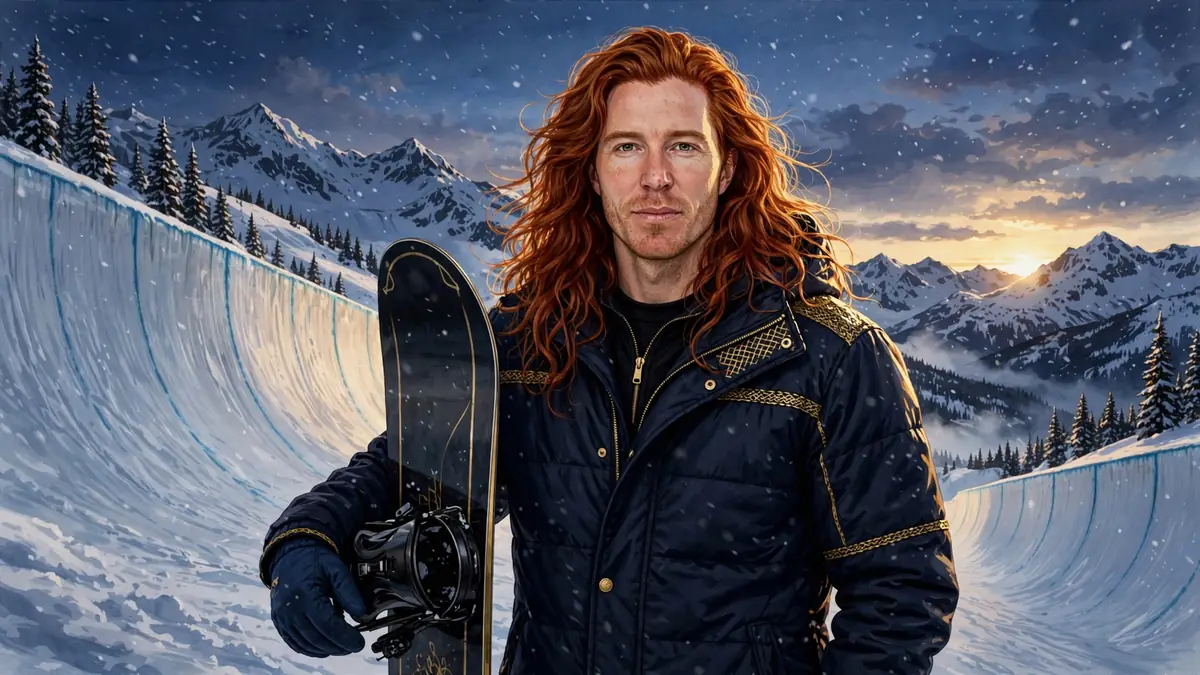
Early Life: Born With a Heart Defect
Shaun Roger White was born on September 3, 1986, in San Diego, California, the youngest of four children of Cathy and Roger White. His mother worked as a waitress and his father, who grew up surfing, worked for the water department in San Clemente. The family later settled in Carlsbad, and money was tight enough that the story of White’s childhood is usually told as a working-class one — a kid from a modest home who happened to be touched by rare talent.
What makes the beginning of that story remarkable is medical, not sporting. White was born with tetralogy of Fallot, a congenital heart defect in which poorly oxygenated blood is pumped around the body. He needed two open-heart operations before he was a year old, and doctors at the time were not sure how much physical activity his heart would ever allow. His parents have spoken about the fear of those first months, and White himself has always treated the surgeries as the first contest he won — the one that made everything after it feel possible.
Against that background, his childhood looks almost reckless. He was skateboarding, surfing, skiing, and playing soccer before he could read properly. His mother steered him toward snowboarding at age six because she thought it was safer than skiing, and she made him ride switch — backwards — so he would go slower. The trick backfired in the best way: learning to ride backwards first gave him a balance and board control that other riders took years to develop. He won his first snowboarding competition at seven, and by that same age he had his first sponsor — Burton Snowboards, a relationship that would last his entire competitive life.
The people who saw him early understood what they were watching. Skateboarding legend Tony Hawk met White when the boy was nine and became his mentor, taking the young rider under his wing and vouching for him in rooms where a child from Carlsbad would never otherwise have been heard. White collected five national amateur titles, turned professional in snowboarding at 13, and made his Winter X Games debut in 2000. He was still a teenager when the wider world started calling him a prodigy, and he was still young enough that his mother was driving him to contests. Shaun White’s age at every career milestone tells the story in numbers: a sponsor at seven, a professional at 13, an Olympian at 19, a three-time gold medalist by 31, retired at 35.
There is a temptation to treat the heart condition as a neat origin story, and White has never played it that way. He has talked about it plainly in interviews — the scars, the check-ups, the knowledge that his body had already been through something serious before he ever dropped into a halfpipe. It gave him, by his own account, a sense that fear was something to manage rather than obey. That attitude shows up again and again in his career: the willingness to attempt tricks other riders would not, and the calm that let him land them when it mattered most.
The Prodigy Years and the X Games
White’s rise ran through the X Games, the event that turned action sports from a subculture into a television product. He first competed at the Winter X Games in 2002, at 15, and won silver in the superpipe. A year later he won his first Winter X Games gold, and from 2003 onward he was the rider everyone else had to beat. Between 2003 and 2013 he won gold in the Winter X Games superpipe or slopestyle almost every single year — the lone exception was 2007, when he took silver. Britannica’s account of his career lists five slopestyle titles and a run of superpipe titles across 2003, 2006, and 2008 to 2013.
The 2002 season also delivered the first real setback of his career, and it shaped him. He missed qualifying for the United States team for the Salt Lake City Winter Olympics by three-tenths of a point — 0.3, the smallest margin the sport offers. He was 15, already famous inside snowboarding, and suddenly watching the Olympics from home. People who covered him at the time say the miss hardened him; he came back the next year and was named the X Games’ best athlete in 2003 after winning in both slopestyle and superpipe.
What set White apart from every other snowboarder of his generation was that he refused to stay in one season. He turned professional in skateboarding at 16 and became the first athlete ever to win gold medals at both the Winter X Games and the Summer X Games, taking vert skateboarding gold in 2007 and again in 2011. No snowboarder before him had crossed over like that, and none has matched it since. By the end of his competitive career he held 15 X Games gold medals — the most by any snowboarder — among 23 X Games medals in total, along with ten ESPY Awards, according to Wikipedia’s tally of his career.
The X Games years also made him rich and famous in a way no snowboarder had been before. Burton kept him at the center of its marketing, and mainstream sponsors followed: Red Bull, Oakley, Target, and later Hewlett-Packard and American Express. He was the rare action-sports athlete whose face sold products to people who had never watched a halfpipe contest. Forbes put him on its 30 Under 30 list, and by the end of the 2000s he was earning endorsement money on a scale that belonged to golfers and tennis players, not snowboarders. That commercial success is the base of the fortune examined in the money section below.
There was also a private halfpipe, built on his family’s property in the mountains, where he trained away from crowds — a detail that says a lot about how seriously he took preparation. White’s competitive edge was never just talent. He rehearsed runs the way a gymnast rehearses a routine, and his signature moves — the backside 1080, then the Double McTwist 1260 — were practiced hundreds of times before they were ever attempted in front of judges.
Olympic Career: Three Gold Medals Across 16 Years
White competed at five Winter Olympics — 2006, 2010, 2014, 2018, and 2022 — a span of 16 years that no other snowboarder has matched at the top level. He won gold at three of them, all in the men’s snowboard halfpipe, and finished fourth at the other two. The arc of those five Games is the spine of his biography, and each one tells a different story about where he was in life.
Turin 2006 was the arrival. He was 19, with a thick mop of red hair that had earned him the nickname “the Flying Tomato,” and he was already the most marketable athlete on the American team. Then he nearly threw it away: he fell on his first qualifying run and was in danger of missing the final entirely. He steadied himself, qualified, and in the final he clinched gold with a 46.8-point run, saving his best trick — a backside 1080 — for his last run of the day, as Britannica recounts. The image of the red-haired teenager with a gold medal around his neck became one of the defining pictures of those Games, and it made him a household name overnight.
Vancouver 2010 was the defense, and it was more dominant. White had spent the four years between Games inventing a new trick, the Double McTwist 1260 — two flips while completing three and a half twists — and he unveiled it in the Olympic final, winning gold by a wide margin. He had already secured the title before his final run, and he used that victory lap to attempt the trick anyway, in front of a home crowd that treated him like a rock star. It was the peak of his powers, and the moment when snowboarding’s biggest star looked untouchable.
Sochi 2014 was the stumble. White finished fourth in the halfpipe, off the podium for the first time at an Olympics, and withdrew from the slopestyle event before it began, saying the course was too risky. He was 27, and for the first time people asked out loud whether his best years were behind him. He answered the question slowly: he stepped back from competition, dealt with injuries, and rebuilt his riding around a new generation of tricks that younger riders were landing.
The rebuild nearly ended before PyeongChang. During a training session in New Zealand in October 2017, White crashed face-first into the edge of the halfpipe and needed 62 stitches in his face. He recovered in time for the 2018 Games, and what happened there is the most famous comeback of his career. In the men’s halfpipe final in PyeongChang, he landed a near-perfect final run to win his third gold medal, 12 years after his first, edging Japan’s Ayumu Hirano. He was 31, the oldest rider in the field, and he cried on the podium. It was the run that turned him from a great snowboarder into a figure people talk about the way they talk about great athletes in any sport.
Beijing 2022 was the farewell. Before the Games he announced that they would be his last, and at 35 he was competing against riders half his age. He fell on his final run in the halfpipe final and finished fourth, then stood at the bottom of the pipe as the crowd chanted his name and he wept openly. He announced his retirement immediately afterward. Five Olympics, three golds, two fourth-place finishes — and a career that began with a heart defect and ended with the whole sport standing to applaud him.
One detail worth noting for anyone comparing him with other winter athletes: White is listed at 5 ft 8 in (173 cm) by Wikipedia, while Celebrity Net Worth lists him at 1.75 m, which converts to about 5 ft 9 in. The half-inch gap is a reminder that even basic facts about celebrities get rounded in different directions, which is why this biography leans on the most widely cited figure and notes the difference rather than picking one silently. How tall Shaun White is breaks down the competing listings in full.

Beyond the Halfpipe: Skateboarding, Music, and Acting
Snowboarding made White famous, but he spent much of his career proving he was more than a snowboarder. The skateboarding crossover was the first proof. After turning professional on a skateboard at 16, he competed in the Summer X Games vert event and won gold in 2007 and 2011, making him the first athlete to win gold at both the winter and summer editions of the event. Tony Hawk, who had mentored him since childhood, watched his protégé become a genuine two-sport star — a rare thing in action sports, where the skills overlap less than they look like they should.
Music was the second act. White plays guitar and fronted the band the Bad Things, which released a debut album in 2013 and toured small venues while he was still competing at the highest level. The band was never a vanity project in the usual celebrity sense: it was a working rock band that played real shows, and White took it seriously enough that it produced one of the more difficult chapters of his life, covered in the controversies section below. He has kept playing since retiring, and music remains the part of his public life he talks about with the least calculation.
He also dabbled in acting and screen work. He made a cameo in the film Friends with Benefits (2011), did voice work on American Dad, and appeared in the Disney Channel snowboarding film Cloud 9 (2014). Ubisoft built a video game franchise around him, starting with Shaun White Snowboarding in 2008, followed by a sequel in 2009. And in 2023, the streaming service Max released Shaun White: The Last Run, a documentary that followed his final Olympic campaign in Beijing and his decision to retire. It is the best single film record of who he became at the end of his career — reflective, a little weary, and clear-eyed about what the sport had cost him.
After the 2010 Vancouver Olympics, White set up Shaun White Enterprises to bring his business deals under one roof, according to Wikipedia. That move looks, in hindsight, like the first step toward the second half of his biography: the athlete who started thinking like an owner a decade before he stopped competing. It is also why his post-retirement life has been so much more substantial than the usual athlete slide into nostalgia. He had been preparing for it for years.
The Money: Net Worth, Endorsements, and Business Ventures
Shaun White’s money story has two halves: the fortune he made as an athlete, and the businesses he built with it after he stopped competing. Neither half is an exact science, because White is a private individual who has never published his finances, and no tax filing or audited account confirms any total. What follows is the published record, with each figure tied to the outlet that reported it.
The headline figure: Celebrity Net Worth estimates Shaun White’s net worth at about $65 million as of 2026. That is the most widely cited figure on the internet, repeated by most outlets that cover him. Other published estimates sit lower or higher — NetWorthExplained puts the figure at $45.5 million, Yahoo and Reality Tea reporting cited $60 million in mid-2026, and one independent breakdown puts it at $75 million. The honest range on the published record is therefore $45.5 million to $75 million, anchored at $65 million. A fair reading is that White is worth somewhere in the tens of millions, with the exact number depending on how you value private stakes in private companies — above all his shares in Whitespace and The Snow League, which have no public price.
| Source | Estimate | Notes |
|---|---|---|
| Celebrity Net Worth | $65 million | Most widely cited; 2026 estimate |
| NetWorthExplained | $45.5 million | Lowest published estimate |
| Yahoo / Reality Tea | $60 million | Mid-2026 reporting, no sourcing given |
| NetWorthBreakdown | $75 million | Highest published estimate |
| Honest range | $45.5 million–$75 million | Anchored at $65 million (Celebrity Net Worth) |
How did a snowboarder get to $65 million? The first answer is endorsements. White was the most marketable athlete in action sports for nearly two decades, and the deals reflected it. Burton sponsored him from age seven until he launched his own brand. Red Bull, Oakley, and Target were long-term partners, joined at various points by Hewlett-Packard, American Express, and GoPro. One 2026 estimate puts his annual endorsement income at around $10 million at his peak, and while that number is itself an estimate, the scale is not in doubt: he was earning money on a level no snowboarder before him had reached. Prize money from the Olympics and the X Games contributed far less in cash terms — Olympic medals pay modest bonuses — but each medal raised the price of the next endorsement deal, which is how the math of a snowboarding fortune actually works.
The second answer is ownership. After the 2010 Olympics, White created Shaun White Enterprises to consolidate his deals, and the instinct behind it — own the brand, don’t just rent your face to one — drove everything that followed. In January 2022 he launched Whitespace, his own active lifestyle and snowboard brand, built around a clean white-stripe design language. His brother Jesse handles design while White tests the products, according to Utah Business, which covered White’s appearance at the 47G Zero Gravity Summit in Salt Lake City in October 2026. Whitespace has since earned credibility in both performance and fashion circles, including a co-branded board with Moncler, as Boardroom reported in 2026.
The bigger bet is The Snow League, the professional halfpipe competition series White founded to give snowboarding and freeskiing what it never had: one unified tour, a season champion, equal pay for men and women, and a broadcast product built for television rather than for brands. The league’s debut season opened at Aspen Snowmass in March 2025 with a $2.2 million purse — a record for snowboarding — and a multi-year broadcast deal with NBC and Peacock. The money behind it is serious: a $4.5 million seed round led by Will Ventures, a $15 million round announced in January 2025, and a further $15 million round in November 2025 anchored by 359 Capital and Left Lane Capital, with new investors including Bitkraft Ventures and WISE Ventures, the Wilf family’s investment arm, according to Sports Business Journal. Fenway Sports Group is also among the backers, and the league’s second season includes events at Park City in January 2027.
White has also stayed visible in the sport’s media life. He worked as a broadcaster around the Milano Cortina 2026 Winter Olympics, appeared at the 47G Zero Gravity Summit in October 2026 to talk about building businesses beyond snowboarding, and maintains an ongoing partnership with Chase Sapphire. None of these is a fortune-maker on its own, but together they describe a retired athlete who monetized his reputation carefully instead of spending it.
Real estate has been a smaller but real part of the picture. Realtor.com reported that White sold a Los Angeles home in 2024 for $3.9 million, and that he and Nina Dobrev bought a midcentury modern home together for $4.3 million in July 2023. Property records and listing reports are the most concrete numbers in any celebrity fortune, because a house sale leaves a paper trail that a private company stake does not.
For readers who want the money story in full, the net-worth angle is covered in depth elsewhere in our network: Shaun White’s net worth breakdown on GuideNetWorth walks through the estimate in detail, and how Shaun White built his $65 million fortune on NetWorthCraft covers the endorsement and business income stream by stream.

Personal Life: Relationships and the Nina Dobrev Engagement
White has always guarded his private life more than most celebrities of his fame, but the broad outline is public. Before his most famous relationship, he dated Sarah Barthel of the band Phantogram for seven years, from 2013 to 2019. The two were a low-key couple by celebrity standards, rarely photographed together and almost never discussed in interviews.
He met actress Nina Dobrev at a motivational seminar hosted by Tony Robbins in Florida in 2019, and the two began dating that year. They were first photographed together riding bikes in Malibu in March 2020, moved in together at the start of the COVID-19 pandemic, and made the relationship public in May 2020. For five years they were one of the more visible couples in the celebrity-sports world — she at his events, he at her premieres — and they supported each other through difficult stretches, including Dobrev’s recovery from a fractured knee after an e-bike accident in 2024.
The engagement was a set piece. In October 2024, White proposed at the Golden Swan restaurant in New York City, having tricked Dobrev into believing she was attending an intimate Vogue dinner with editor-in-chief Anna Wintour. He had his publicist send a fake invitation, waited under an arch of white roses in a Ralph Lauren suit, and proposed with a five-carat Lorraine Schwartz diamond ring — a stone one jeweler valued at between $220,000 and $270,000, according to Sports Illustrated. Dobrev announced it on Instagram on October 30, 2024, with the caption “RIP boyfriend, hello fiancé.” White wrote, “She said YES.”
The marriage never happened. On September 11, 2025, People reported that the couple had ended their engagement and broken up after five years together. A source close to the couple told the outlet it “was a mutual decision, and wasn’t an easy one, but it was made with love and a deep respect for one another.” Neither White nor Dobrev has spoken publicly about the split in detail. The signs had been visible for a few days — Dobrev walked the red carpet at the Toronto International Film Festival on September 7, 2025, without her engagement ring, and unpinned her proposal post from her Instagram grid. White, for his part, flew to Beijing days after the split to prepare a Snow League event in China. As of November 2026, he is single, and reporting since the split has described him as re-entering the dating scene. This biography states the position as of its last update, because relationship reporting moves fast and older articles still describe him as engaged.
Outside relationships, White’s personal life is defined by the things he has done since retiring: the businesses, the broadcasting, the music, and a public profile that is quieter than it was at his peak. He still snowboards for pleasure — Boardroom’s 2026 profile found him riding at Corvatsch in St. Moritz, Switzerland — but he has said the competitive clock has stopped, and the work now is building the sport for the next generation.
Controversies and Legal Issues
No honest biography of Shaun White skips the difficult chapters, and there are two that matter. The first dates to September 2012, when White was arrested in Nashville after an incident at a hotel. He pleaded guilty to vandalism and public intoxication, and the episode was widely reported at the time. He apologized and moved on, and it has not defined his public image — but it is part of the record.
The second is more serious. In 2016, Lena Zawaideh, the former drummer in White’s band the Bad Things, sued him, alleging sexual harassment and breach of contract. The case was settled out of court in 2017, and White apologized for using offensive language. The settlement’s terms were not disclosed. The episode resurfaced in public discussion around the 2018 Olympics, when White was asked about it at a press conference and gave an answer — dismissing the allegations as “gossip” — that he later apologized for, saying he had chosen his words poorly. The reporting on the case comes from established outlets, and this biography records the facts as reported: a lawsuit, a settlement, and an apology. It does not go further than the record supports.
Both episodes sit alongside a career that was otherwise unusually clean for someone famous from childhood. White has never faced doping allegations, never been involved in a financial scandal, and has kept his business dealings free of public disputes. The controversies above are included because a biography that omits them would be incomplete, not because they define him.
Legacy: What Shaun White Changed About Snowboarding
Shaun White’s legacy is not a medal count, though the count is impressive enough: three Olympic golds, five Olympic appearances, 15 X Games gold medals, ten ESPY Awards, and the record for the most Olympic gold medals by a snowboarder. His real legacy is that he changed what a snowboarder could be. Before him, snowboarders were counterculture figures with niche sponsors and modest incomes. After him, the sport’s biggest star was on cereal boxes, in video games, and on Forbes lists — and the next generation of riders grew up believing a snowboarding career could make them wealthy and famous.
He also changed the riding itself. The Double McTwist 1260 he unveiled in Vancouver forced every elite halfpipe rider to raise the technical level of their runs. The amplitude he brought to the pipe — going higher than anyone else — reset what judges expected. And his longevity proved that a snowboarder’s career did not have to end at 25; he was winning Olympic gold at 31 and competing at 35, an age at which most of his rivals had been retired for years.
The comparison with other Olympic greats puts his standing in perspective. Michael Phelps’ biography covers the most decorated Olympian of all time, a swimmer whose medal count dwarfs White’s but whose sport had a century of commercial infrastructure behind it. Simone Biles’ net worth story covers a gymnast who, like White, rebuilt a sport’s economics around her own stardom and came back from a break to win again. And Lindsey Vonn’s biography covers another Winter Olympics star who returned from injury and retirement talk to compete again — a parallel career in the same world of snow and speed. White belongs in that company: athletes who were not just the best at their sport but the reason their sport got bigger.
The final part of the legacy is still being written, and it is the business half. If The Snow League succeeds — a unified tour, a season champion, equal pay, a real broadcast audience — White will have done something rarer than winning medals: he will have fixed the structure of the sport he dominated. The league’s backers, from Fenway Sports Group to Left Lane Capital, are betting that he can. His appearance as a broadcaster at the Milano Cortina 2026 Winter Olympics, his first Games as a spectator since 2002, underlined the transition: the Flying Tomato is now the man building the stage, not the one performing on it. Readers who want to keep exploring can browse more in-depth celebrity biographies on CelebAmerica.
Frequently Asked Questions
How old is Shaun White?
Shaun White is 40 years old as of November 2026. He was born on September 3, 1986, in San Diego, California, which means he turned 40 in September 2026. He won his first Olympic gold medal at 19, his third at 31, and retired from competition at 35 after the Beijing 2022 Winter Olympics.
How many Olympic gold medals has Shaun White won?
Shaun White won three Olympic gold medals, all in the men’s snowboard halfpipe: Turin 2006, Vancouver 2010, and PyeongChang 2018. He competed at five Winter Olympics in total (2006, 2010, 2014, 2018, and 2022) and finished fourth at the two Games where he did not win gold, Sochi 2014 and Beijing 2022. He holds the record for the most Olympic gold medals by a snowboarder.
What is Shaun White’s net worth in 2026?
Celebrity Net Worth estimates Shaun White’s net worth at about $65 million as of 2026, the most widely cited figure. Other published estimates range from $45.5 million (NetWorthExplained) to $75 million (NetWorthBreakdown), so the honest range is $45.5 million to $75 million, anchored at $65 million. His fortune comes from endorsements with Burton, Red Bull, Oakley, and Target, plus his Whitespace brand and his stake in The Snow League. No official figure has ever been confirmed, because White has never disclosed his finances.
How tall is Shaun White?
Shaun White is listed at 5 ft 8 in (173 cm) by Wikipedia, while Celebrity Net Worth lists him at 1.75 m, which converts to about 5 ft 9 in. The small difference comes from rounding in different listings, and no official measurement has ever been published. He is shorter than most elite halfpipe riders, which makes his amplitude in the pipe — going higher than taller competitors — all the more remarkable.
Why is Shaun White called “the Flying Tomato”?
The nickname “the Flying Tomato” comes from his thick mop of long red hair, which was his most recognizable feature when he broke through at the 2006 Turin Olympics at age 19. Commentators coined it because his hair streamed behind him as he flew above the halfpipe, and it stuck for the rest of his career. White has embraced it, and it remains the nickname most fans know him by.
Is Shaun White still with Nina Dobrev?
No. Shaun White and actress Nina Dobrev ended their engagement and broke up in September 2025, People reported on September 11, 2025, after five years together. They had got engaged in October 2024, when White proposed at the Golden Swan restaurant in New York City with a five-carat Lorraine Schwartz diamond ring. A source close to the couple told People the split “was a mutual decision, and wasn’t an easy one.” As of November 2026, White is single.
What is The Snow League?
The Snow League is the professional halfpipe competition series founded by Shaun White. It gives snowboarding and freeskiing a unified tour with a season champion, equal pay for men and women, and a broadcast product built for television. Its debut season opened at Aspen Snowmass in March 2025 with a record $2.2 million purse and a multi-year broadcast deal with NBC and Peacock. The league has raised more than $34 million in funding, including a $4.5 million seed round led by Will Ventures and two $15 million rounds in January and November 2025, according to Sports Business Journal.
What is Whitespace, Shaun White’s brand?
Whitespace is Shaun White’s own active lifestyle and snowboard brand, launched in January 2022. It is built around a clean design language — a distinctive white stripe on the base of its snowboards — and sells boards, outerwear, and apparel. White’s brother Jesse handles design while White tests the products, and the brand has earned credibility in performance and fashion circles, including a co-branded board with Moncler. It is White’s main business venture alongside The Snow League.
Final Thoughts
Shaun White’s biography reads like three different lives stitched together. The first is the medical miracle: a baby born with a heart defect, operated on twice before his first birthday, who grew up to become the most decorated snowboarder in history. The second is the sporting life: three Olympic gold medals across 12 years, 15 X Games gold medals, and a crossover into skateboarding that no one else has matched. The third is the business life, still unfolding: a brand, a league, and a bet that snowboarding can be run like a real professional sport.
What ties the three together is a quality that is easy to miss behind the red hair and the medals. White was never just talented; he was deliberate. He rehearsed tricks hundreds of times, built a private halfpipe to train in, set up a company to manage his deals a decade before he retired, and walked away from competition at the moment he chose rather than the moment the sport chose for him. The heart defect gave him the first lesson — that fear is something to manage — and he spent the next forty years applying it.
As of November 2026, the story is not finished. The Snow League’s second season, the Whitespace brand’s growth, and White’s new role as a broadcaster and builder will decide whether his second act matters as much as his first. On the evidence so far, betting against him has never been a wise move.
Sources & Reporting
This article was researched from live reporting in November 2026. Key sources: Wikipedia (biography, Olympic record, X Games medals, ESPY Awards); Britannica (early life, Olympic career detail, the 62-stitch injury); Olympedia (Olympic results and biographical data); Celebrity Net Worth (the $65 million estimate); People (the September 11, 2025 report of the split from Nina Dobrev); Vogue (the October 2024 engagement account); Sports Business Journal (The Snow League’s November 2025 $15 million funding round); The Associated Press (White’s post-retirement role and The Snow League); Utah Business (Whitespace and The Snow League, October 2026); Boardroom (White’s second act as an entrepreneur, 2026); Realtor.com (the 2024 Los Angeles home sale and the $4.3 million purchase); Sports Illustrated (the engagement ring valuation). Net worth figures are estimates from the outlets named; White has never disclosed his finances, and no exact total is confirmed.
How we estimated: the headline net worth figure of about $65 million is anchored on Celebrity Net Worth’s 2026 estimate, the most widely cited figure for White, and is presented as a range of $45.5 million to $75 million to reflect the disagreement among published sources (NetWorthExplained at the low end, NetWorthBreakdown at the high end). Endorsement income, prize money, business stakes, and real estate are valued from published reporting only; private stakes in Whitespace and The Snow League have no public price, which is why the range is wide. Estimates may differ from private reality. Figures will be revisited if new reporting or filings emerge.