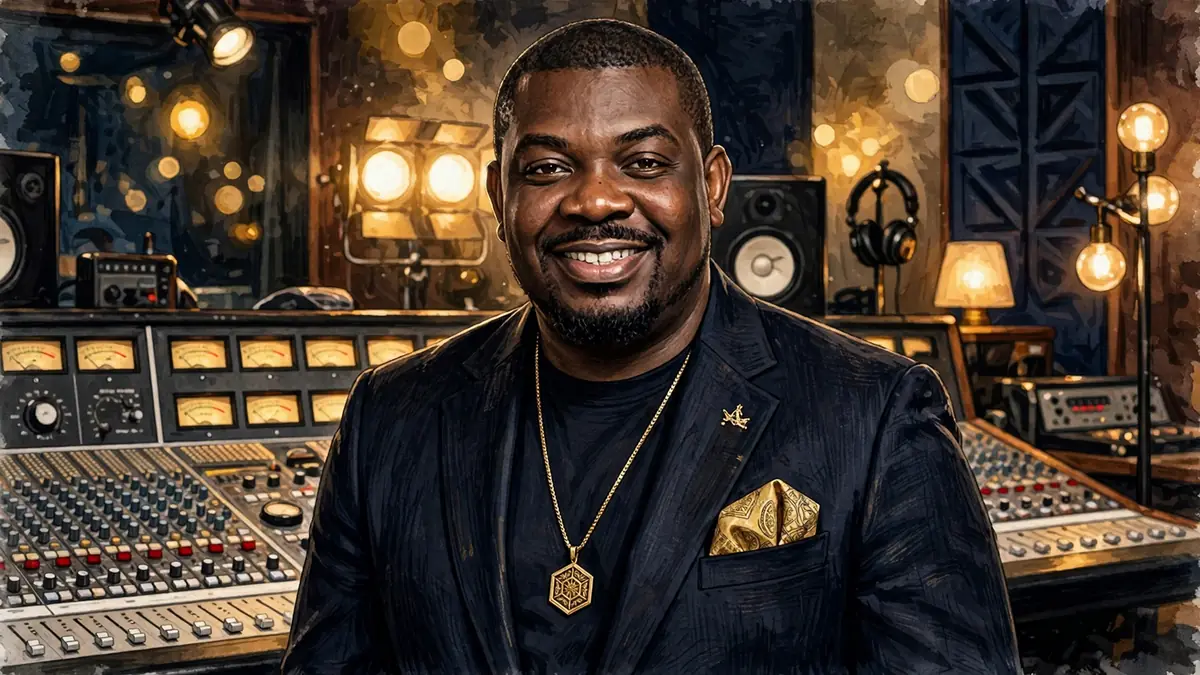
Don Jazzy biography: Michael Collins Ajereh, known to the world as Don Jazzy, is the Nigerian producer and music executive who built Mavin Records from nothing into the label behind Rema, Ayra Starr and Tiwa Savage — and then sold a majority stake in it to Universal Music Group in a deal reported at up to 200 million dollars. As of November 2026, his personal fortune is estimated at 25 million to 45 million dollars, a range that reflects how widely published estimates disagree, and how much of his wealth sits in private label equity rather than public pay cheques.
Born on 26 November 1982 in Umuahia, raised in the Ajegunle neighbourhood of Lagos, and once a McDonald’s security guard in London, Don Jazzy’s story runs from church drums at age 12 to the biggest music-business exit in African entertainment history. This biography follows every step: the Mo’ Hits years with D’Banj, the Kanye West chapter, the founding of Mavin Records in 2012, the 2019 Kupanda investment, the 2024 UMG deal, his businesses beyond music, and the private life he kept hidden for almost two decades.
Last updated: 25 November 2026. By Celebamerica Editorial Staff.
In this article
- Don Jazzy Quick Facts
- Early Life: From Umuahia to Ajegunle
- London Years: Church Drums and a McDonald’s Uniform
- Mo’ Hits Records: Building a Sound With D’Banj
- GOOD Music and the Kanye West Chapter
- Mavin Records: The Empire After the Split
- The Money: How Don Jazzy Built His Fortune
- The UMG Deal: What Mavin Was Really Worth
- Business Beyond Music: Jazzy Burger and Endorsements
- Houses, Cars and Lifestyle
- Personal Life: Marriage, Family and Faith
- Awards and Recognition
- Don Jazzy Net Worth Timeline
- Don Jazzy vs His Peers: How the Fortune Compares
- Controversies and Public Scrutiny
- Frequently Asked Questions
- Final Thoughts: The Bottom Line on Don Jazzy
- Sources and Reporting
Don Jazzy Quick Facts
| Full Name | Michael Collins Ajereh |
|---|---|
| Stage Name | Don Jazzy (also called Don Baba J) |
| Date of Birth | 26 November 1982 (age 43 as of November 2026) |
| Birthplace | Umuahia, Abia State, Nigeria |
| Hometown | Ajegunle, Lagos, Nigeria |
| Estimated Net Worth | 25 million to 45 million dollars as of November 2026 (see the money section for the full adjudication) |
| Primary Income Sources | Mavin Records equity and sale proceeds, music production and royalties, artist management, endorsements |
| Key Ventures | Mavin Records (founder and CEO, 2012–present), Mo’ Hits Records (co-founder, 2004–2012), Jazzy Burger (co-founder, 2022), Mavin Global Holdings |
| Education | Federal Government College Lagos; Ambrose Alli University, Ekpoma (Business Management) |
| Marital Status | Single; previously married to Michelle Jackson (2003–circa 2005) |
| Parents | Collins Enebeli Ajereh and Mrs Ajereh |
| Siblings | D’Prince (Charles Enebeli), James Collins Enebeli, Joy Solano |
Early Life: From Umuahia to Ajegunle
Michael Collins Ajereh was born on 26 November 1982 in Umuahia, the capital of Abia State in south-eastern Nigeria. His father, Collins Enebeli Ajereh, is from Isoko in Delta State, while his mother is an Igbo woman from Abia State. He is the first of four children. His younger brother Charles Enebeli would later become known as the singer D’Prince, and his other siblings are James Collins Enebeli and Joy Solano. The family moved to Lagos while Don Jazzy was still young, settling in Ajegunle, one of the city’s toughest and most musically fertile neighbourhoods.
Ajegunle shaped him. The area has produced a long line of Nigerian stars, and its street sound — a mix of highlife, reggae, hip-hop and local percussion — was the first music he absorbed. He found his way to instruments early: by the age of 12 he was playing the bass guitar and the piano, and he picked up traditional and percussion instruments along the way. Music in his household was not a hobby for spare time; it was tied to church life, and the church was where a young musician in Lagos learned discipline, harmony and performance in front of a live crowd.
He attended the co-educational Federal Government College Lagos for his secondary education, and it was there that the nickname “Don Jazzy” first stuck. After secondary school he enrolled at Ambrose Alli University in Ekpoma, Edo State, where he studied Business Management — a choice that looks prophetic now, given that his fortune would come less from performing than from running a music company. He did not finish that degree in the ordinary way, because in 2000 a different opportunity pulled him abroad.
London Years: Church Drums and a McDonald’s Uniform
In 2000, when Don Jazzy was 17, his uncle invited him to London to play the drums for a local church. It was his first trip outside Nigeria, and it turned into a stay of several years. London gave him two things that Lagos could not: a front-row seat to the UK music scene and a hard lesson in starting from the bottom. To pay his way he took a job as a security guard at McDonald’s — a detail he has never hidden, and one that now features in almost every profile of him because it captures the distance he travelled.
While working nights and weekends, he kept playing. He worked with a circle of UK-based Nigerian and African musicians, including the producer and artist JJC Skillz, Solek, Kas and Jesse Jagz, and the collective known as the 419 Squad. London’s studios taught him production as a craft rather than a pastime: arranging, mixing, layering drums over melody, and shaping a song so it worked on radio as well as in a club. It was also in London that he met D’Banj, the singer who would become his first great collaborator. The two men shared an instinct for hooks and for showmanship, and when the time came to build something of their own, they built it together.
Those London years explain a lot about the executive Don Jazzy later became. He learned to operate in a foreign market, to manage other people’s talent, and to treat music as a business with costs, contracts and deadlines. He returned to Nigeria not as a returning star but as a producer with a plan — and with a partner.
Mo’ Hits Records: Building a Sound With D’Banj
In 2004, Don Jazzy and D’Banj founded Mo’ Hits Records in Lagos. D’Banj was the label’s first artist, and Don Jazzy was its in-house producer, the man who made the beats that defined the label’s sound. The partnership produced a run of records that reshaped Nigerian pop: D’Banj’s No Long Thing (2005) and Rundown/Funk You Up (2006) carried the new sound into every corner of the country, and the label added Wande Coal, whose debut album Mushin 2 Mo’Hits (2009) is still talked about as a Nigerian classic, along with D’Prince, Dr SID and Kayswitch.
Don Jazzy’s producer tag — “It’s Don Jazzy Again!” — became one of the most recognisable sounds in African music. It was a signature in the literal sense: listeners heard it and knew, before the first verse, who had made the record. That kind of branding was rare for a producer in Nigeria at the time, and it turned Don Jazzy from a behind-the-scenes figure into a star in his own right. He won Producer of the Year at the Nigerian Music Awards in 2006, and the Headies would later honour him as Producer of the Year in 2011 and 2014.
Mo’ Hits was more than a label; it was a crew, a sound and a business model. Don Jazzy produced for his own artists, kept the costs inside the house, and built a catalogue that paid him every time a song was played, licensed or performed. It was the first version of the empire he would later build at Mavin — and it ended, in March 2012, in a split that dominated Nigerian entertainment news for months.
GOOD Music and the Kanye West Chapter
Before the Mo’ Hits split, Don Jazzy had already gone global. In 2011, Kanye West brought him on as an in-house producer for GOOD Music, working under the Very Good Beatz imprint. The placement was a recognition of what Don Jazzy had built in Lagos: a producer whose ear for melody and rhythm could sit beside American hip-hop’s biggest names without losing its Nigerian character.
His most famous credit from that period is “Lift Off”, featuring Beyoncé, on Watch the Throne, the 2011 joint album by Jay-Z and Kanye West. Don Jazzy co-produced the track, putting an African producer’s name on one of the most talked-about albums of the year. The GOOD Music chapter lasted only a couple of years — it wound down as the Mo’ Hits split consumed his attention — but it changed how the industry saw him. He was no longer just Nigeria’s best producer; he was a producer the world’s biggest artists wanted in the room.
Mavin Records: The Empire After the Split
On 7 May 2012, two months after the Mo’ Hits break-up was confirmed, Don Jazzy announced a new label: Mavin Records. The name came from the word “maven”, an expert, and the launch carried a promise — that Mavin would become, in his words, the powerhouse of African music. The founding roster mixed Mo’ Hits veterans with new signings: Wande Coal, D’Prince, Dr SID and Tiwa Savage, who joined in 2012 and became the label’s first great female star.
What followed was a decade of artist development that no other Nigerian label has matched. Reekado Banks, Korede Bello and Di’Ja arrived in the label’s early years, followed by Johnny Drille and Ladipoe. Then came the two signings that changed Mavin’s scale entirely. Rema joined in 2019 through Jonzing World, the label run by Don Jazzy’s brother D’Prince and distributed by Mavin; his single “Calm Down”, and its remix with Selena Gomez, became one of the biggest Afrobeats records ever made. Ayra Starr signed in 2021 at 18 and became, within two years, one of the most streamed African artists in the world. Readers who want the detail on Mavin’s two biggest current stars can read our profiles of Rema’s age and rise from Benin City and Ayra Starr’s net worth and early career.
Tiwa Savage’s time at Mavin deserves its own note, because it shows how Don Jazzy ran the label. She signed in 2012, released the hit singles “Kele Kele Love” and “Eminado”, and became the most prominent female Afrobeats star of the decade before leaving in 2019 to sign with Universal Music Group. The departure was friendly, and it set a pattern: Mavin developed stars, and when they outgrew the label they left with their relationship to Don Jazzy intact. That reputation — a label that builds artists rather than trapping them — is part of why parents and young singers trusted Mavin with their careers. For more on her own story, see our profile of Tiwa Savage’s age and career.
The current Mavin roster, as of late 2026, includes Rema, Ayra Starr, Magixx, Bayanni, Johnny Drille, Ladipoe, Lifesize Teddy, DJ Big N, Boy Spyce and Crayon, with Don Jazzy still running the label day to day as founder and CEO alongside COO Tega Oghenejobo. Mavin’s artists have passed 6 billion streams worldwide, according to Nigerian press reporting, and the label’s partnerships now run through Virgin Music Group, Republic and Interscope. It is the scale of that operation — not any single hit — that explains Don Jazzy’s fortune.
The Money: How Don Jazzy Built His Fortune
Don Jazzy’s wealth does not come from one pay cheque. It comes from four streams that stack on top of each other, and understanding them is the only way to make sense of the published estimates, which run from under 7 million dollars to over 70 million.
Label equity is the largest stream. As founder of Mavin Records and the holding company Mavin Global Holdings, Don Jazzy owned a large share of the label that Universal Music Group bought into in 2024. The exact size of his stake has never been disclosed, and neither has the price he personally received, but the deal’s reported valuation — 125 to 200 million dollars — is the anchor for every serious estimate of his wealth. The second stream is production and royalties: two decades of producer credits on records by D’Banj, Wande Coal, Tiwa Savage, Rema, Ayra Starr and many more, paying him as songs stream, are licensed and are performed. The third is endorsements, and the fourth is businesses outside music, covered in the section below.
So what is the honest number? Published 2026 estimates disagree sharply. At the low end, CreatorFanbase put him at 4.6 to 7.2 million dollars in November 2026, and BuzzNigeria at 10 million. The middle cluster is far more consistent: BiographyWallah at 15 million, Nigerian Queries at 17.5 million, MusicNG at 18 million, Afrokonnect at 20 million, WorldBio at 25 million. At the high end, First Nigerian (September 2026) gave a range of 25 to 40 million, iExclusive News put him at 30 to 50 million, Alux (November 2026) at 45 million, NBG Africa at 50 million, InvestGuiding at 52 million, and the most aggressive rankings reach 65 to 73 million.
Our adjudication, as of November 2026, is 25 million to 45 million dollars. The reasoning is simple: the low estimates predate the UMG deal or ignore label equity entirely, and the very high estimates treat the full Mavin valuation as if it were Don Jazzy’s personal bank balance, which it is not — he was one of several shareholders, alongside TPG Growth and Kupanda Capital, and he kept a minority stake rather than selling out. The 25 to 45 million range sits where the post-deal estimates cluster, it is anchored by First Nigerian’s 25 to 40 million and Alux’s 45 million, and it leaves room for the uncertainty that surrounds every private fortune in Nigerian music. No public filing, Forbes ranking or audited statement confirms any single figure, and any source that claims a precise number — including Afrokonnect’s claim that Forbes put him at 20 million, for which no Forbes ranking exists — should be treated with caution.
The one-line answer: Don Jazzy is worth an estimated 25 million to 45 million dollars as of November 2026. The range is wide because his wealth is mostly private label equity, not a public salary — and the honest reporting says so rather than picking a single invented number.
The UMG Deal: What Mavin Was Really Worth
The deal that changed Don Jazzy’s fortune was announced on 26 February 2024, when Universal Music Group said it had acquired a majority stake in Mavin Global, the Lagos label Don Jazzy founded in 2012. The terms were never disclosed by either side. What is on the record, from Billboard’s reporting of the sale process, is that Mavin was shopped at a valuation north of 125 million dollars, with a likely sale price in the 150 to 200 million range. Music Business Worldwide confirmed the shape of the deal: UMG took the majority, the private-equity backer TPG Growth exited fully, Kupanda Capital stayed on as a minority investor and strategic adviser, and Don Jazzy and COO Tega Oghenejobo stayed to run the company with autonomy over strategy and talent.
The deal did not come out of nowhere. In 2019, Mavin took its first major institutional money: Kupanda Holdings, a joint venture between Kupanda Capital and TPG Growth, invested in the label. TechCabal reported that TPG wrote a 10 million dollar cheque, and an analysis of UK Companies House filings by WeTalkSound put the post-money valuation of that round at roughly 9.5 million dollars, with the investors taking about 46 percent of the newly formed holding company. Five years later, the UMG deal valued the same business at fifteen to twenty times that figure — the largest exit in African entertainment history, by the trade press’s own description.
What did Don Jazzy personally take home? Nobody outside the deal knows, and this is where honest reporting has to stop and say so. He did not sell the whole company; UMG bought a majority, Kupanda kept a minority, and Don Jazzy kept a stake and his job. His gain is a mix of cash from the shares he sold and the rising value of the shares he kept, plus the fact that the world’s largest music company now distributes and funds his label. The deal closed under regulatory approval later in 2024, and in February 2025 UMG put all of its Nigerian business under Don Jazzy and Tega Oghenejobo, with Tega elevated to President and COO of Mavin Global. For a man who started as a security guard in London, it is the clearest possible proof that the business, not the fame, was always the point.
Business Beyond Music: Jazzy Burger and Endorsements
Don Jazzy has never relied on music alone. In 2022 he teamed up with the Nigerian entrepreneur Richard Chinedu Nnadi to launch Jazzy Burger, a fast-food chain that now has multiple branches across Nigeria. The venture fits his pattern: take a familiar consumer business, put a trusted personal brand on it, and let his social-media reach do the marketing. He has also built interests under Mavin Global Holdings beyond the label itself, including Mavin Energy and a clothing line, Mavin Clothing Line Ltd, launched in 2013, and he has put money into Nigerian tech startups, though the details of those investments are not public.
Endorsements have been a steady earner for more than a decade. Nigerian entertainment press reports deals with Samsung, signed in 2013 and reported at around 110 million naira; MTN, in deals reported at over 40 million naira; Loya Milk, reported at around 40 million naira; Konga, reported at around 15 million naira; and later partnerships with Betway, Globacom, the crypto exchange Quidax, and inDrive, whose 2025 “Dream Ride with Don Jazzy” campaign ran across nine African countries. These are reported figures from Nigerian outlets, not confirmed contract values, and they should be read as an indication of scale rather than exact income. What they show, taken together, is a man brands trust to move products — and a man who charges accordingly.
He is also famous in Nigeria for a different kind of spending: his giveaways. Don Jazzy regularly sends money to followers on social media who ask for help, sometimes in large amounts, and he has spoken openly about enjoying it. It is part of his public image — the generous big brother of Afrobeats — and it is also, in business terms, the cheapest marketing in the industry: every giveaway is a story, and every story keeps his name in front of millions of people who then stream Mavin’s music and eat at Jazzy Burger.
Houses, Cars and Lifestyle
Don Jazzy lives in Lagos, and Nigerian entertainment outlets credit him with a property portfolio that includes a mansion on Banana Island, the city’s most exclusive artificial island, reported at around 500 million naira, and a five-bedroom duplex in Lekki Phase 1 bought in 2012 and reported at 160 million naira. A third property in Maryland, Lagos, was reported as co-owned with D’Banj before their split. Taken together, some outlets value his real estate at more than 700 million naira. These figures come from Nigerian celebrity press, not from property registries, and they should be treated as reported claims rather than verified facts.
His car collection is reported along similar lines: a Porsche 911 Carrera reported at around 50 million naira, a Bentley Continental Flying Spur, a Cadillac Escalade and a Range Rover among the vehicles linked to his name. Again, these are press reports, and Don Jazzy himself rarely talks about what he owns. What is not in doubt is the lifestyle his wealth supports: first-class travel, a large household staff, and a social-media presence built on showing up — at concerts, at award shows, at his artists’ video shoots — as the smiling, approachable boss of the biggest label in the country.
Personal Life: Marriage, Family and Faith
For almost twenty years, Don Jazzy kept one part of his life completely private: he had been married. He married Michelle Jackson, a British model and writer, in 2003, when he was 20 and living in London. The marriage lasted about two years and ended in divorce. He revealed it publicly only in 2021, explaining that the split came down to his devotion to music — he was, in his own telling, so consumed by his career that the marriage could not survive it. He has no children from the marriage, and he is single as of November 2026. The revelation surprised even his closest fans, because Don Jazzy had spent his whole public life talking about music and saying nothing at all about his love life.
Family runs through his business as well as his biography. His father, Collins Enebeli Ajereh, is known in the industry as the Mavin Grandpa and is a familiar face at label events. His brother D’Prince runs Jonzing World, the label that brought Rema to Mavin, making the Ajereh family one of the few in Nigerian music where two brothers run two labels that feed the same empire. His mother, Mrs Ajereh, died of cancer in July 2022, a loss he announced on Instagram with a public tribute that drew messages from across the Nigerian entertainment world.
Faith is the other constant. Don Jazzy is a committed member of the Cherubim and Seraphim Church, the white-garment church he grew up in, and he has said so publicly more than once. It is the thread that connects the 12-year-old church drummer in Ajegunle to the 43-year-old label boss in Lekki: the music started in church, and the discipline he learned there never left him.
Awards and Recognition
Don Jazzy’s shelf holds the awards that matter most to a Nigerian producer. He won Producer of the Year at the Nigerian Music Awards in 2006, and the Headies — Nigeria’s biggest music awards — named him Producer of the Year in 2011 and again in 2014. He has also been recognised at the Nigerian Entertainment Awards and the City People Entertainment Awards, and his work on Watch the Throne put him on a Grammy-nominated album’s credits, even though the award itself went to others.
The recognition that counts most, though, is not a trophy. It is the fact that the biggest music company in the world bought into his label, that the biggest Afrobeats stars of the moment record for him, and that young producers across Africa study his catalogue the way students study a textbook. In the Nigerian industry, “Don Jazzy” is not just a name; it is a standard, and a compliment. To be called the next Don Jazzy is the highest praise a young producer can receive.
Don Jazzy Net Worth Timeline
| Year | Milestone |
|---|---|
| 2000 | Moves to London; works as a McDonald’s security guard while building production credits with JJC Skillz and the 419 Squad |
| 2004 | Co-founds Mo’ Hits Records with D’Banj; label equity and production income begin |
| 2006 | Named Producer of the Year at the Nigerian Music Awards |
| 2011 | Joins Kanye West’s GOOD Music as in-house producer; co-produces “Lift Off” on Watch the Throne |
| 2012 | Mo’ Hits splits in March; founds Mavin Records on 7 May; appears in the Nollywood film The Last 3 Digits |
| 2013 | Signs reported Samsung endorsement deal; launches Mavin Clothing Line |
| 2019 | Kupanda Holdings and TPG Growth invest in Mavin; Rema breaks out through Jonzing World; reported valuation around 9.5 million dollars |
| 2021 | Signs Ayra Starr; reveals his 2003 marriage and divorce publicly |
| 2022 | Launches Jazzy Burger with Richard Chinedu Nnadi; mother dies of cancer in July |
| 2024 | UMG buys a majority stake in Mavin Global; Billboard reports a 125 to 200 million dollar valuation — the largest exit in African entertainment |
| 2025 | UMG places all Nigerian business under Don Jazzy and Tega Oghenejobo; inDrive campaign runs across nine African countries |
| 2026 | Estimated net worth 25 million to 45 million dollars (November 2026 adjudication) |
Don Jazzy vs His Peers: How the Fortune Compares
Don Jazzy’s fortune looks different from his peers’ because it is built on ownership rather than performance. Wizkid and Davido earn their money on stage and from streaming; Don Jazzy earns his from the company that develops the artists. That difference is why the rankings move around so much: a performer’s income is visible, a label owner’s is not. The table below uses reported 2026 estimates from Alux (November 2026) and NBG Africa, and every figure in it is an estimate, not a verified balance sheet.
| Artist / Executive | Reported 2026 estimate |
|---|---|
| Wizkid | About 50 million dollars (Alux, November 2026) — touring, records and brand deals |
| Don Jazzy | 25 million to 45 million dollars (Celebamerica adjudication, November 2026); Alux puts him at 45 million |
| Davido | About 45 million dollars (Alux, November 2026) — touring, endorsements and his DMW label |
| Burna Boy | Among Nigeria’s richest musicians, though estimates vary widely; his wealth is touring-led |
| Olamide | About 12 million dollars (reported) — built on his YBNL label and a long recording career |
The comparison that matters most is the one with Wizkid, because it shows the two models side by side. Wizkid’s story is the performer’s story: from Ojuelegba to the world on the strength of his own voice, as our profile of Wizkid’s biography tells it. Don Jazzy’s story is the builder’s story: he made his fortune by finding other people’s voices and owning a share of the company that sells them. Both models work. Only one of them ends with the world’s largest music company buying into your business.
Controversies and Public Scrutiny
Don Jazzy’s public record is unusually clean for a man who has spent twenty years at the top of Nigerian music, but it is not empty. The biggest controversy of his career was the Mo’ Hits split itself. When he and D’Banj confirmed the break-up in March 2012, citing artistic differences, Nigerian media spent months picking over the reasons: money, control, D’Banj’s growing solo ambitions, and the GOOD Music deal that had pulled D’Banj toward America. Neither man has ever given a full public account of what happened, and the split has stayed, in their telling, a professional disagreement rather than a feud. They have appeared together since, and Don Jazzy has always credited the Mo’ Hits years as the foundation of everything that followed.
The second recurring subject is his private life — specifically, the fact that he kept his marriage secret for eighteen years. When he revealed it in 2021, the reaction was less scandal than surprise, and the story faded quickly because there was nothing scandalous in it: a young marriage, a divorce, and a man who chose his career. Beyond that, the criticism he attracts is the ordinary kind that follows a powerful label boss: fans of Mavin artists sometimes accuse him of favouring one star over another, and his habit of wading into social-media arguments has occasionally drawn fire. None of it has dented the business. If anything, his willingness to argue with fans in public is part of the brand: the billionaire producer who still replies to strangers on the internet.
Frequently Asked Questions
What is Don Jazzy’s real name?
Don Jazzy’s real name is Michael Collins Ajereh. He was born on 26 November 1982 in Umuahia, Abia State, Nigeria, and picked up the nickname “Don Jazzy” during his secondary school days at Federal Government College Lagos.
How old is Don Jazzy in 2026?
Don Jazzy is 43 years old as of November 2026. He was born on 26 November 1982, which makes him one of the longest-serving figures in Afrobeats — he started playing instruments at 12 and has been working in music for more than three decades.
What is Don Jazzy’s net worth in 2026?
Don Jazzy’s net worth is estimated at 25 million to 45 million dollars as of November 2026. Published estimates range from under 7 million to over 70 million, but the honest range sits where the post-UMG-deal estimates cluster: First Nigerian gave 25 to 40 million in September 2026, and Alux put him at 45 million in November 2026. His wealth is mostly private Mavin Records equity, so no single figure is verified.
Who owns Mavin Records now?
Universal Music Group owns a majority stake in Mavin Global, acquired in February 2024 in a deal Billboard reported at a valuation of 125 to 200 million dollars. Don Jazzy founded the label in 2012 and still runs it day to day as CEO, alongside COO Tega Oghenejobo, and he kept a minority stake. Kupanda Capital also kept a minority stake and an advisory role, while TPG Growth exited fully.
Why did Don Jazzy and D’Banj split?
Don Jazzy and D’Banj ended Mo’ Hits Records in March 2012, citing artistic differences. The two men have never given a full public account of the split, and it has stayed a professional disagreement rather than a feud. Two months later, Don Jazzy founded Mavin Records, and D’Banj went on to build his own solo career.
Is Don Jazzy married?
No, Don Jazzy is single as of November 2026. He was previously married to Michelle Jackson, a British model and writer, in 2003, when he was 20. The marriage lasted about two years and ended in divorce, and he kept it private until he revealed it publicly in 2021, saying his devotion to music had come first.
Which artists has Don Jazzy signed or discovered?
Don Jazzy’s signings across Mo’ Hits and Mavin include D’Banj, Wande Coal, D’Prince, Dr SID, Tiwa Savage, Reekado Banks, Korede Bello, Di’Ja, Johnny Drille, Ladipoe, Rema (through Jonzing World), Ayra Starr, Crayon, Magixx, Bayanni, Boy Spyce, DJ Big N and Lifesize Teddy. Rema and Ayra Starr are his two biggest global stars.
What businesses does Don Jazzy own besides Mavin Records?
Beyond Mavin Records, Don Jazzy runs Mavin Global Holdings, which covers ventures including Mavin Energy and a clothing line, and he co-founded Jazzy Burger, a fast-food chain launched in 2022 with entrepreneur Richard Chinedu Nnadi. He also earns from brand endorsements — reported deals include Samsung, MTN, Loya Milk, Konga, Betway, Globacom and inDrive — and he has invested in Nigerian tech startups.
Final Thoughts: The Bottom Line on Don Jazzy
Don Jazzy’s biography is the story of a man who understood, earlier than almost anyone in Nigerian music, that the real money was in owning the machine, not just feeding it. He started as a church drummer in Ajegunle, worked as a security guard in London, and built two record labels — Mo’ Hits with D’Banj, then Mavin on his own — that defined the sound of a generation. The Kanye West chapter gave him global credibility; the UMG deal gave him a fortune estimated at 25 million to 45 million dollars as of November 2026; and the roster he built — Rema, Ayra Starr, Tiwa Savage, Wande Coal and a dozen more — gave him a legacy no single hit could match.
What sets him apart is not talent alone. Plenty of Nigerian producers can make a hit. Don Jazzy made a company, kept it alive through a public split, a changing industry and the streaming revolution, and sold a majority of it to the biggest music business on earth while keeping the keys. That is why his biography matters beyond the gossip pages: it is the clearest case study in African music of how a producer becomes an owner, and how an owner becomes rich without ever needing to be the star on stage. More profiles of the people who shaped Afrobeats sit in our Biography section.
Sources and Reporting
This biography was researched from live reporting and reference sources, checked on 25 November 2026. The biographical facts — birth date and place, family, education, the London years, the Mo’ Hits founding and split, the GOOD Music chapter, the Mavin founding and roster — are documented in Wikipedia’s Don Jazzy profile and in the Nigerian press, including The Capital, BuzzNigeria and Duke International Magazine. The UMG deal’s shape and reported valuation come from Billboard’s reporting as summarised by Music Business Worldwide, MonoKromatik and WeTalkSound. The 2026 net-worth estimates cited are from Alux (November 2026), First Nigerian (September 2026), CreatorFanbase (November 2026), NBG Africa, iExclusive News, BiographyWallah and MusicNG. Endorsement and asset figures are reported by Nigerian entertainment outlets, including TopNews and BuzzNigeria; they are presented here as reported claims, not confirmed contract or registry values.
How we estimated: Don Jazzy has never published his finances, and no Forbes ranking of his wealth exists, despite some Nigerian sites claiming otherwise. We collected every published 2026 estimate we could find, from 4.6 million dollars to 73 million, and separated them into two groups: estimates that predate or ignore the February 2024 UMG majority-stake deal, which cluster at 10 to 20 million, and estimates published after it, which cluster at 25 to 50 million. Our range of 25 to 45 million dollars reflects the post-deal cluster, anchored by First Nigerian (25 to 40 million, September 2026) and Alux (45 million, November 2026), and it deliberately stays a range: his wealth is mostly private label equity, the UMG deal terms were never disclosed, and his exact Mavin stake is unknown. Readers should treat every published figure for Don Jazzy, including ours, as an estimate, not a fact.