Last updated: November 24, 2026 · By Celebamerica Editorial Staff
Ricky Ponting is one of the greatest cricketers who ever lived — and the most successful captain international cricket has ever seen. Born Ricky Thomas Ponting on December 19, 1974, in Launceston, Tasmania, he scored 13,378 Test runs and 13,704 one-day runs, won three World Cups, and led Australia to 220 victories in 324 matches as captain. As of November 2026, his net worth is estimated at $70 million to $75 million, anchored by Celebrity Net Worth’s $75 million figure updated November 21, 2026.
This Ricky Ponting biography covers the full arc: the kid who lived over the back fence from his local cricket club, the teenage prodigy hailed as the next Don Bradman, the ruthless captain of an all-conquering Australian side, the fall from the top, and the second act that has made him one of the most sought-after coaches in world cricket — head coach of Punjab Kings in the IPL and Washington Freedom in Major League Cricket in 2026.
Table of Contents
- Quick Facts: Ricky Ponting at a Glance
- Early Life in Launceston: The Boy from Mowbray
- Breaking Through: Tasmania, Then the Baggy Green
- Captain Ponting: The Winningest Leader in Cricket History
- World Cup Glory: 1999, 2003 and 2007
- The Batting Record: Runs, Centuries and the Numbers That Define Him
- The Money: How Ricky Ponting Built His Fortune
- Second Act: Coaching Mumbai, Delhi, Washington and Punjab
- Business Ventures, Endorsements and Ponting Wines
- Personal Life: Rianna, Family and the Ponting Foundation
- Controversies and Setbacks: The Honest Record
- Ponting vs His Peers: Where He Ranks Among the Greats
- Ricky Ponting Biography: Frequently Asked Questions
- Bottom Line
- Sources and How We Estimated
Quick Facts: Ricky Ponting at a Glance
| Full Name | Ricky Thomas Ponting AO |
|---|---|
| Date of Birth | December 19, 1974 (age 51 for most of 2026; turns 52 on December 19, 2026) |
| Birthplace | Launceston, Tasmania, Australia |
| Nickname | Punter |
| Height | 5 ft 9 in (175 cm) per Wikipedia; some profiles list 5 ft 10 in |
| Estimated Net Worth (2026) | $70 million – $75 million, anchored at $75 million (Celebrity Net Worth, updated November 21, 2026) |
| Playing Career | Australia 1995–2012; 168 Tests, 375 ODIs; Tasmania 1992–2013 |
| Career Runs | 13,378 Test runs; 13,704 ODI runs; 27,483 international runs; 71 international centuries |
| Captaincy Record | 220 wins in 324 matches as Australia captain (67.91% win rate) — the most wins by any captain in international cricket history |
| World Cups | 1999 (player), 2003 and 2007 (captain); Champions Trophies 2006 and 2009 (captain) |
| Major Honours | ICC Cricketer of the Year 2006 and 2007; ICC Hall of Fame 2018; Officer of the Order of Australia (AO) 2012 |
| Current Roles (2026) | Head coach, Punjab Kings (IPL); head coach, Washington Freedom (MLC); head of strategy, Hobart Hurricanes (BBL) |
| Spouse | Rianna Jennifer Cantor (married 2002) |
| Children | Emmy Charlotte, Matisse Ellie, Fletcher William |
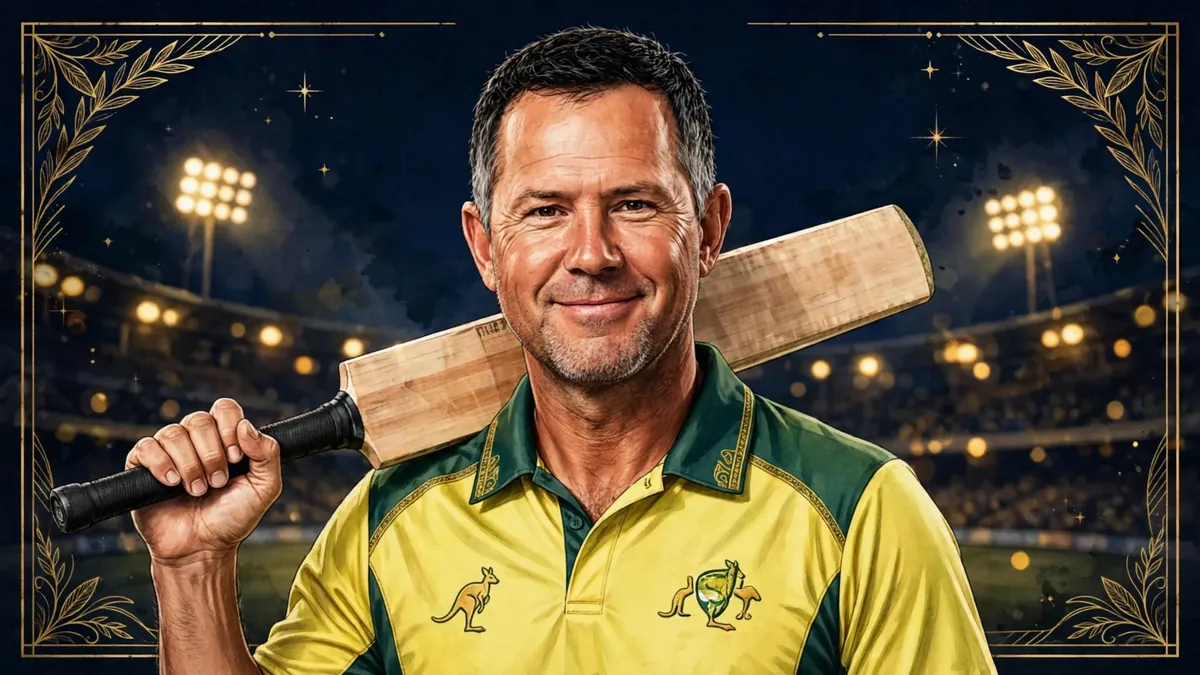
Early Life in Launceston: The Boy from Mowbray
Ricky Ponting was born in Launceston, Tasmania, on December 19, 1974, the eldest of Graeme and Lorraine Ponting’s three children. Cricket was not a hobby in the Ponting house; it was the family trade. His father played club cricket, his mother played for a local women’s side, and his uncle, Greg Campbell, played Test cricket for Australia. The boy grew up, in the words of Tasmania’s own sporting hall of fame, living “over the back fence from the Mowbray Cricket Club” — and he dreamed, from as early as anyone can remember, of playing cricket for his country.
The dream did not wait long to look real. Ponting scored four centuries for the under-13s in a Tasmanian cricket week, then two more when he was pushed up to the under-16s. He made his A-grade debut for Mowbray at 14, an age when most kids are still finding their feet in school cricket. The Tasmanian system, which has produced a long line of tough, self-reliant cricketers from a small island state, gave him exactly what he needed: hard wickets, older opponents, and nobody willing to make allowances for a prodigy.
He went to Mowbray Primary School and Brooks High School in Launceston. Away from cricket he played Australian rules football and golf — the golf habit would stay with him for life and later become the engine of his charity work. But cricket was always the centre of things. By his mid-teens, Tasmanian selectors were already talking about him as a player who would not stay in state cricket for long.
There is a detail in Ponting’s early story that tells you a lot about the man he became. He was not a polished academy product. He was a kid from a working-class Tasmanian suburb who learned the game on club grounds, against grown men, with a bat that was often too big for him. The aggression, the pull shot, the willingness to take on fast bowling — all of it was formed before he ever wore an Australian shirt. When people later called him the hardest competitor in world cricket, they were describing something that had been built in Launceston, not in a national academy.
Breaking Through: Tasmania, Then the Baggy Green
Ponting made his first-class debut for Tasmania in November 1992, aged 17 years and 337 days — the youngest Tasmanian ever to play a Sheffield Shield match. He scored 56 in his first innings, and the state knew it had something special. Within two seasons he was piling up Shield runs with a maturity that made his age look like a misprint, and the national selectors, who had been watching him since his teens, moved quickly.
His one-day international debut came on February 15, 1995, against South Africa in Wellington, at the age of 20. His Test debut followed on December 8, 1995, against Sri Lanka in Perth, where he earned cap number 366. The comparisons started at once. Australian cricket had been looking for its next great batsman since the days of Don Bradman, and the press wasted no time anointing the boy from Tasmania. Britannica records that he was “hailed as the new Don Bradman” before he had played a handful of Tests — a label that has crushed more than one young player.
Ponting’s early international years were not smooth. He was dropped, he struggled for consistency, and off-field troubles — dealt with honestly in the controversies section below — cost him his place and nearly his career. What saved him was not talent alone. He rebuilt his fitness, his discipline and his game, and by the late 1990s he was a fixture in the side: a number three batsman who scored quickly, fielded brilliantly at point and slip, and played every ball like it mattered. The 1999 World Cup in England, which Australia won with Ponting in the side, was the first sign of what the team around him was about to become.
By 2001, Ponting was the best batsman in an Australian team that was already the best in the world. He had the technique to play long innings and the temperament to dominate attacks. When Steve Waugh, the great captain of that era, stepped back from the one-day side in 2002, the job went to Ponting. When Waugh retired from Test cricket in 2004, Ponting took that job too. He was 27 when he became one-day captain and 29 when he took the Test side. He would hold both jobs through the most dominant stretch in Australian cricket history.
Captain Ponting: The Winningest Leader in Cricket History
The numbers attached to Ponting’s captaincy still stop people cold. As Australia captain he won 220 of 324 international matches — a win rate of 67.91% — making him the most successful captain in international cricket history by wins. In Tests alone he won 48 of the 77 matches he captained. No captain in the history of the game has won more international matches. That is the headline of his biography, and it is the reason his name sits at the top of every serious discussion about cricket leadership.
But the win count only tells half the story. Ponting inherited a great team and kept it great through a transition that has broken other captains. Waugh, McGrath, Warne, Gilchrist, Hayden, Langer — the legends of the early 2000s retired one by one during his tenure, and Ponting had to rebuild on the move while still winning. The 2005 Ashes loss in England, the first Ashes defeat under his leadership, could have defined him. Instead he answered with the 2005–06 season, scoring 1,483 runs at an average of 78 with seven centuries, and then a 5–0 Ashes whitewash at home in 2006–07.
His style as captain was unmistakably his own: attacking fields, fast bowlers hunting in pairs, and a batsman at number three who led by scoring runs rather than by speeches. He was also, by his own admission and by the record, a captain who learned on the job. The 2005 Ashes series exposed his inexperience in tight situations. The 2006–07 return showed a leader who had absorbed the lesson. That arc — defeat, adjustment, dominance — is what separates Ponting’s captaincy from a mere inheritance of a great team.
The torch has since passed. Australia’s current Test captain, Pat Cummins, leads a very different side in a very different era, and the contrast is instructive: Cummins captains a team that must fight for every series, while Ponting captained one expected to win them all. For a closer look at how the modern Australian captain’s career and fortune compare, see Pat Cummins’ net worth story. Ponting resigned the captaincy in March 2011 after Australia’s World Cup quarter-final loss to India, and he retired from Test cricket in December 2012. His final Test, against South Africa in Perth, was his 168th — equalling Steve Waugh’s Australian record at the time.
World Cup Glory: 1999, 2003 and 2007
Three World Cup winner’s medals is a record no other Australian cricketer holds in quite the same way, and Ponting’s part in each of the three was different. In 1999 he was a young batsman in Steve Waugh’s side, learning what tournament cricket demanded. In 2003 he was the captain, and in the final against India at the Wanderers in Johannesburg he played one of the great World Cup final innings: an unbeaten 140 from 121 balls, an assault that took the game away from India before it had properly started. Australia posted 359, India never got close, and Ponting lifted the trophy as skipper for the first time.
The 2007 World Cup in the Caribbean made him the only captain to win back-to-back World Cups — and he did it with a team that did not lose a single match in the tournament. Adam Gilchrist’s 149 in the rain-shortened final against Sri Lanka is the innings people remember, but Ponting’s tournament was the story of a captain at the peak of his powers: 539 runs at an average above 67, including a century against South Africa in the group stage. Add the Champions Trophy titles of 2006 and 2009, and Ponting holds the record for the most ICC tournaments won as a captain in men’s cricket.
Those tournament wins matter to his biography for a reason beyond the silverware. World Cups are where a cricketer’s reputation is fixed in the public mind, and Ponting’s 140 not out in the 2003 final is the single innings most fans name when they explain why he belongs in the all-time conversation. It was not a careful, grinding hundred. It was an innings of intent, played on the biggest stage, by a captain who had decided the final would be won on his terms. That is the Ponting story in miniature.
The Batting Record: Runs, Centuries and the Numbers That Define Him
Strip away the captaincy and the trophies and the numbers alone would still put Ponting among the greatest batsmen ever. He finished with 13,378 Test runs at an average of 51.85, with 41 Test centuries. In one-day internationals he scored 13,704 runs at 42.03, with 30 centuries. Combined, his 27,483 international runs are the most by any Australian, and his 71 international centuries stood as the third-highest total in history for years — behind only Sachin Tendulkar and, eventually, Virat Kohli, who moved past him.
The peak years were extraordinary. In January 2006, in his 100th Test against South Africa in Sydney, he scored 120 and 143 not out — a twin-century performance in a milestone match that summed up his appetite for the big occasion. The 2005–06 season brought 1,483 runs at 78 with seven centuries. He was named ICC Cricketer of the Year in 2006 and again in 2007, ICC Test Player of the Year in 2003, 2004 and 2007, and he won the Allan Border Medal — Australian cricket’s highest individual honour — a record four times, in 2004, 2006, 2007 and 2009. Wisden named him its Leading Cricketer in the World in 2003 and one of its Cricketers of the Year in 2006.
He was also one of the great fielders. His 196 Test catches were among the most ever taken by an outfielder, and his work at point — the diving stops, the run-outs, the sheer intimidation of batsmen who knew a quick single could end their innings — changed how teams thought about fielding in the covers. Only one player in history has appeared in 100 Test victories, and it is Ponting: the record is a quiet testament to how long he played at the top, and how often his team won while he was there.
One record has moved since he retired, and it is worth stating plainly. When Ponting retired in December 2012 he had the second-most Test runs of all time, behind only Sachin Tendulkar. In July 2025, England’s Joe Root moved past Ponting’s total of 13,378 to take second place on the all-time Test run list. Ponting now sits third. That is not a knock on his career — it is a measure of how long his numbers stood, and of the regard in which the next generation held them. For the full story of the man who passed him, read Joe Root’s biography on GuideNetWorth.
His opening partner through much of the great era, David Warner, was a different kind of batsman — all attack, all risk — and the contrast between Warner’s explosiveness and Ponting’s controlled aggression defined Australia’s batting for a decade. Warner’s own story is told in David Warner’s biography.
The Money: How Ricky Ponting Built His Fortune
As of November 2026, Ricky Ponting’s net worth is estimated at $70 million to $75 million. The anchor figure is $75 million, from Celebrity Net Worth, which updated its Ponting page on November 21, 2026. That figure sits at the top of a tight 2026 consensus: SurpriseSports also puts him at about $75 million, CricRadar lists $75 million, and SportsMonkie, Technosports, ICCT20WC, WealthyGarage and Skyblogs all land around $70 million. Sportsbet’s 2026 rich-list puts him at A$107 million — about US$70 million at current exchange rates — and calls him the richest cricketer outside India. A $95 million figure from e2-bet sits well above the consensus and looks like an outlier, possibly mixing currencies; we do not use it as an anchor.
Adjudication note: older profiles still floating around the web put Ponting at $15 million to $20 million — CricToday carries that range. That figure is stale and far below every 2026 estimate. It appears to date from before his coaching career took off and before the IPL coaching market matured. The 2026 consensus of $70 million to $75 million, led by Celebrity Net Worth’s freshly updated $75 million, is the honest range to use. We flag the old figure here so readers who have seen it elsewhere are not misled.
The fortune was built in three phases. The first was the playing career. Ponting played in the era before T20 leagues turned cricketers into multi-millionaires, but he was still among the best-paid Australian cricketers of his generation: a Cricket Australia central contract at the top band, match fees across 168 Tests and 375 ODIs, and a long run of endorsement deals. His IPL playing stints — Kolkata Knight Riders in the inaugural 2008 season and Mumbai Indians in 2013 — added league money at the end of his playing days.
The second phase is coaching, and it is the phase that moved the numbers. Ponting is, by several reports, the best-paid coach in the IPL. Sportsbet’s 2026 rich-list reports he earns “around three and a half crore a year” — roughly US$400,000 — as an IPL head coach, and he has now held head-coach roles at Mumbai Indians, Delhi Capitals and Punjab Kings, plus Washington Freedom in Major League Cricket. He holds two head-coach jobs at once in 2026, in two different leagues on two different continents, which is a rare and lucrative position. Add commentary work with Australian broadcasters, and his post-playing income may now rival what he banked as a player — a point SportsMonkie makes explicitly in its 2026 ranking.
The third phase is business and property. Ponting co-owns Ponting Wines, a Tasmanian vineyard producing premium wines, and has held endorsement deals across his career with brands including Kookaburra, Valvoline, Rexona, Pura Milk, Adidas and Swisse. He has also written books, including his autobiography Ponting: At the Close of Play (2013) and a series of annual diaries. None of these ventures is publicly valued, which is exactly why the net worth is a range and not a single audited number: cricketers do not publish their accounts, and private investments and property can move an estimate by tens of millions. The $70 million to $75 million range is the responsible way to state it.
| Income stream | What is known (sourced) |
|---|---|
| Playing contracts | Cricket Australia top-band central contract through his career; match fees for 168 Tests and 375 ODIs; IPL playing stints with Kolkata Knight Riders (2008) and Mumbai Indians (2013) |
| IPL coaching | Head coach, Mumbai Indians 2015–2016 (title 2015); Delhi Capitals 2018–2024; Punjab Kings 2025–present on a four-year deal; reported at around ₹3.5 crore a year (Sportsbet, 2026) |
| MLC coaching | Head coach, Washington Freedom from February 2024; MLC title in his first season |
| Commentary & media | Broadcast commentary with Australian networks; Big Bash League coverage; head of strategy, Hobart Hurricanes (BBL) since 2021 |
| Business | Co-owner, Ponting Wines (Tasmanian vineyard); book deals including the 2013 autobiography |
| Endorsements | Career deals with Kookaburra, Valvoline, Rexona, Pura Milk, Adidas and Swisse (per CricToday) |
Second Act: Coaching Mumbai, Delhi, Washington and Punjab
Most great players make poor coaches. Ponting is the exception that proves the rule, and his coaching record is now a biography in its own right. It began with Mumbai Indians: an advisory role in 2014, then head coach in 2015 and 2016, winning the IPL title in 2015. That title mattered — it showed he could take a star-filled dressing room and make it function as a team, the same problem he had solved as Australia captain.
The Delhi Capitals job, from 2018 to 2024, was the bigger test. Delhi were perennial underachievers when he arrived, a franchise that had never reached an IPL final. In his first full season he took them to the playoffs; in 2020 he took them to their first-ever final, where they lost to Mumbai Indians. Seven years, one final, four playoff appearances — and a reputation as the coach young players most wanted to work with. His seven-year term ended in July 2024 after Delhi missed the playoffs.
Two months later, in September 2024, Punjab Kings appointed him head coach on a four-year deal. The scale of the job was obvious: Punjab had not reached the playoffs since 2014 and had finished ninth in 2024. In his first season, with Shreyas Iyer as captain, Ponting took them to the top of the league table and then to the IPL 2025 final — their first final in 11 years — where they lost to Royal Challengers Bengaluru by six runs on June 3, 2025. The defeat stung, and Ponting said so plainly afterwards, but the transformation was undeniable: in one season he had made a laughing stock into contenders.
Across the Pacific, the same story played out faster. Appointed head coach of Washington Freedom ahead of Major League Cricket’s second season in February 2024, he led them to the MLC title in his first season, with Steve Smith captaining the side. Smith’s own career and fortune are covered in Steve Smith’s net worth story — the two men, once opponents in the Ashes, now work together in American cricket. Ponting has also served as an assistant coach with Australia, including around the 2019 World Cup, and has been head of strategy for the Hobart Hurricanes in the Big Bash League since 2021.
What makes the coaching career interesting is that it is not a victory lap. Ponting coaches like he played: demanding, detailed, and allergic to excuses. Players who have worked with him describe a coach who prepares obsessively and backs young players in big moments — the same instincts that made him pick Shreyas Iyer as his captain at Punjab and hand responsibility to uncapped Indian batters in a final. The coaching money follows the reputation: two head-coach jobs, in the IPL and MLC, plus a BBL strategy role, is a portfolio few coaches in world cricket can match.
Business Ventures, Endorsements and Ponting Wines
Ponting’s business life is quieter than his cricket, and that is by design. The best-documented venture is Ponting Wines, the Tasmanian vineyard he co-owns, producing premium wines from his home state. It is a fitting business for a Tasmanian: small, quality-focused, and rooted in the place he comes from. The winery’s wines carry his name, and the venture has become a fixture of Tasmania’s food and wine scene.
Endorsements ran alongside the playing career and continue in his coaching years. The brands associated with him over the years include Kookaburra — the bat-maker whose equipment he used through his career — along with Valvoline, Rexona, Pura Milk, Adidas and Swisse Wellness. He was never a billboard athlete in the style of some of his contemporaries; his commercial value came from credibility rather than glamour, and the brands that signed him were buying the reputation of the toughest competitor in the game.
His books are a modest but real income stream and, more importantly, a primary source for his own story. Ponting: At the Close of Play, his autobiography published in 2013, covers the playing career in his own voice, and his series of annual diaries recorded each cricket season as it happened. For a biographer, the diaries are gold: a captain writing about his own team, in real time, without the smoothing that memory applies years later.
Personal Life: Rianna, Family and the Ponting Foundation
Ponting married Rianna Jennifer Cantor in 2002. The couple have three children: daughters Emmy Charlotte and Matisse Ellie, and son Fletcher William, born on September 24, 2014. The family is based in Australia, and Ponting has always kept his private life out of the spotlight as far as a cricketer of his fame can. His wife has been a constant presence at his side, including at the 2016 photograph the public record shows of the couple together, and she is his partner in the work that matters most to them outside cricket.
That work is the Ponting Foundation, which Ricky and Rianna co-founded in 2008. The charity raises funds to help young Australians and their families fight cancer, and according to Tasmania’s sporting hall of fame the couple have raised more than $10 million for the cause. Golf days, fundraising events and public appeals drive the foundation, and Ponting’s own love of golf — a lifelong hobby from his Launceston childhood — is woven into it. In 2012 he was appointed an Officer of the Order of Australia (AO), with the citation recognising not only his cricket but his service to the community through the foundation.
He was inducted into the ICC Hall of Fame in July 2018, and into the Sport Australia Hall of Fame in 2015. In 2011 he had been named to the Australian Institute of Sport’s “Best of the Best”. The honours sit alongside the playing record, but those who know Ponting say the foundation is the part of his life he talks about with the most pride. For readers who want more long-form life stories in this series, our Biography section carries the full collection.
Controversies and Setbacks: The Honest Record
No honest biography of Ponting skips the rough patches, because the rough patches are part of why the rest of the story matters. Early in his career he was involved in a drunken altercation at a Kolkata nightclub, an incident that led to a fine and a temporary suspension from the Australian team. He was young, he was in the public eye for the first time, and he handled it badly. The episode is worth recording because of what followed: Ponting has spoken since about rededicating himself to the sport, rebuilding his fitness and discipline, and earning back the trust of his teammates and selectors. The comeback from that low point is the hinge of his career.
As captain he faced setbacks that were public and painful. The 2005 Ashes loss in England ended 16 years of Australian dominance and exposed his inexperience in tight finishes. The 2010–11 Ashes defeat at home — the first home Ashes loss in 24 years — came at the end of his captaincy and hastened its end. He was also the captain during the fraught 2008 Sydney Test against India, the “Monkeygate” series, where his handling of the controversy drew heavy criticism from Indian fans and media and tested his leadership in a way no scoreboard could. These were not scandals in the tabloid sense. They were the failures of a captain under pressure, and they belong in the record alongside the wins.
There were also the ordinary failures that every long career collects: lean runs with the bat, selection debates, and the slow decline of his final years, when the reflexes that had made him the best puller of a cricket ball in the world began to fade. He retired on his own terms in December 2012, rather than waiting to be dropped — a decision that said a lot about the pride that had carried him from Mowbray to the top of the game.
Ponting vs His Peers: Where He Ranks Among the Greats
Ponting’s place in history is best understood side by side with the other giants of his era. The table below uses the career numbers as they stand in November 2026.
| Player | Test runs |
|---|---|
| Sachin Tendulkar (India) | 15,921 — the most Test runs ever, with 100 international centuries |
| Joe Root (England) | Passed Ponting’s 13,378 in July 2025; now second on the all-time Test list |
| Ricky Ponting (Australia) | 13,378 — third all-time; 41 Test centuries, 71 international centuries, 27,483 international runs |
| Jacques Kallis (South Africa) | 13,289 — just behind Ponting, with 62 international centuries plus 292 Test wickets |
| Rahul Dravid (India) | 13,288 — the great wall of Indian cricket, 48 international centuries |
| Virat Kohli (India) | More than 9,000 Test runs; 82 international centuries — he moved past Ponting’s 71 |
The comparison that matters most is with Tendulkar. The Indian master scored more runs and more centuries, and nobody disputes his place at the top. But Ponting’s case rests on something Tendulkar never had: the captaincy record. Tendulkar captained India with modest results; Ponting captained Australia to 220 wins and three World Cups. If Tendulkar is the greatest batsman, Ponting is the greatest batsman-captain of the modern game — the only man who combined a top-three batting record with the most successful leadership record in history.
The modern comparisons are instructive too. Sachin Tendulkar’s biography tells the story of the one man ahead of Ponting on the runs list, while Virat Kohli’s biography covers the man who passed his century count and now chases Tendulkar’s 100. Ponting’s own standing has not shrunk as the numbers around him moved — if anything, the fact that it took until 2025 for anyone to pass his Test tally shows how durable his record was.
Ricky Ponting Biography: Frequently Asked Questions
Who is Ricky Ponting?
Ricky Thomas Ponting is an Australian cricket coach, commentator and former player, born December 19, 1974, in Launceston, Tasmania. He is widely regarded as one of the greatest batsmen of all time and the most successful captain in international cricket history, with 220 wins in 324 matches as Australia captain. He scored 13,378 Test runs and 13,704 ODI runs, won three World Cups, and in 2026 is head coach of Punjab Kings in the IPL and Washington Freedom in Major League Cricket.
How old is Ricky Ponting in 2026?
Ricky Ponting is 51 years old for most of 2026. He was born on December 19, 1974, and turns 52 on December 19, 2026. He made his Test debut at 20, became Australia’s one-day captain at 27, and retired from Test cricket at 37 in December 2012.
What is Ricky Ponting’s net worth in 2026?
Ricky Ponting’s net worth is estimated at $70 million to $75 million in 2026, anchored by Celebrity Net Worth’s $75 million figure updated November 21, 2026. Most 2026 estimates cluster around $70 million, and Sportsbet lists him at A$107 million (about US$70 million), calling him the richest cricketer outside India. Older $15 million to $20 million figures still appear online but are stale and well below the 2026 consensus. His fortune comes from his playing career, IPL and MLC coaching salaries, commentary, Ponting Wines and endorsements.
How many runs and centuries did Ricky Ponting score?
Ponting scored 13,378 Test runs at an average of 51.85 with 41 centuries, and 13,704 ODI runs at 42.03 with 30 centuries. His 27,483 international runs are the most by any Australian, and his 71 international centuries were the third-most in history when he retired. He also took 196 Test catches and is the only player to have appeared in 100 Test victories.
How many World Cups did Ricky Ponting win?
Ponting won three Cricket World Cups: in 1999 as a player under Steve Waugh, and in 2003 and 2007 as captain. His unbeaten 140 in the 2003 final against India is one of the great World Cup final innings. He also won the Champions Trophy as captain in 2006 and 2009, giving him the record for the most ICC tournaments won as a captain in men’s cricket.
Who is Ricky Ponting’s wife and family?
Ricky Ponting is married to Rianna Jennifer Cantor; the couple married in 2002. They have three children: daughters Emmy Charlotte and Matisse Ellie, and son Fletcher William, born September 24, 2014. Together they co-founded the Ponting Foundation in 2008, which has raised more than $10 million to help young Australians and their families fight cancer.
What is Ricky Ponting doing now in 2026?
In 2026 Ponting is head coach of Punjab Kings in the IPL, a job he took in September 2024 on a four-year deal; in his first season he took Punjab to the IPL 2025 final, their first in 11 years. He is also head coach of Washington Freedom in Major League Cricket, whom he led to the MLC title in 2024, and head of strategy for the Hobart Hurricanes in the Big Bash League since 2021. He also works as a cricket commentator.
How tall is Ricky Ponting?
Ricky Ponting is listed at 5 ft 9 in (175 cm) by Wikipedia. Some profiles, including CricToday, list him at 5 ft 10 in. The 5 ft 9 in figure from Wikipedia is the one most sources use, and the small gap between listings is a reminder that listed heights for athletes often vary by an inch depending on the source.
Bottom Line
Ricky Ponting’s biography is the story of a kid from Launceston who lived over the fence from his cricket club and ended up the most successful captain international cricket has ever seen. The numbers — 13,378 Test runs, 71 international centuries, 220 wins as captain, three World Cups — put him in the all-time conversation on their own. The second act, as a coach who has now taken Mumbai Indians to an IPL title, Delhi Capitals to their first final, Washington Freedom to an MLC title and Punjab Kings to their first final in 11 years, shows the competitiveness never left. As of November 2026 his fortune sits at an estimated $70 million to $75 million, anchored by Celebrity Net Worth’s $75 million figure, and his coaching career is still adding to it. The boy from Mowbray is still writing his story — now from the dugout.
Sources and How We Estimated
Career facts, statistics and captaincy record: Wikipedia (Ricky Ponting), Encyclopaedia Britannica (Ricky Ponting, updated October 10, 2026), Active Tasmania (Tasmanian Sporting Hall of Fame), and ESPNcricinfo. Net worth figures: Celebrity Net Worth ($75 million, updated November 21, 2026), SurpriseSports ($75 million), Sportsbet (A$107 million, 2026 rich-list), SportsMonkie ($70 million), CricToday (career details; $15–20 million figure flagged as stale), and CricRadar ($75 million). Coaching and 2025 IPL season: Wikipedia (2025 Punjab Kings season) and IANS reporting via New York Indian (September 18, 2024).
How we estimated: Ponting’s net worth is a published-estimate range, not an audited figure — cricketers do not publish their accounts. We took Celebrity Net Worth’s $75 million (updated November 21, 2026) as the anchor because it is the freshest named-source figure, and set the working range at $70 million to $75 million to cover the 2026 consensus ($70 million from SportsMonkie, Technosports, ICCT20WC, WealthyGarage and Skyblogs; A$107 million, about US$70 million, from Sportsbet). A $95 million figure from e2-bet was treated as an outlier and a $15 million to $20 million figure from CricToday as stale; both are flagged in the article rather than repeated as fact. Private investments, property and business stakes (including Ponting Wines) are not publicly valued, so the true figure may sit outside this range.