Marco Pierre White is the chef who changed British cooking, then walked away from it at the very top. Born in Leeds on 11 December 1961, he became the first British chef — and, at 33, the youngest chef in the world at the time — to win three Michelin stars. Then, in 1999, he retired from the kitchen and handed those stars back. This Marco Pierre White biography follows the whole arc: the Leeds childhood, the brutal classical training under the Roux brothers, the Harveys years, the television fame, and the franchise empire that followed.
As of November 2026, Marco Pierre White’s net worth is estimated at $30 million to $40 million. Celebrity Net Worth puts the figure at $30 million in its profile updated 6 July 2026, while TheRichest and several other outlets hold it at $40 million. No Rich List or Forbes valuation backs either number, so the honest answer is a range — and this article shows exactly where the money comes from, including the public company filings that tell a more modest story than the headline estimates.
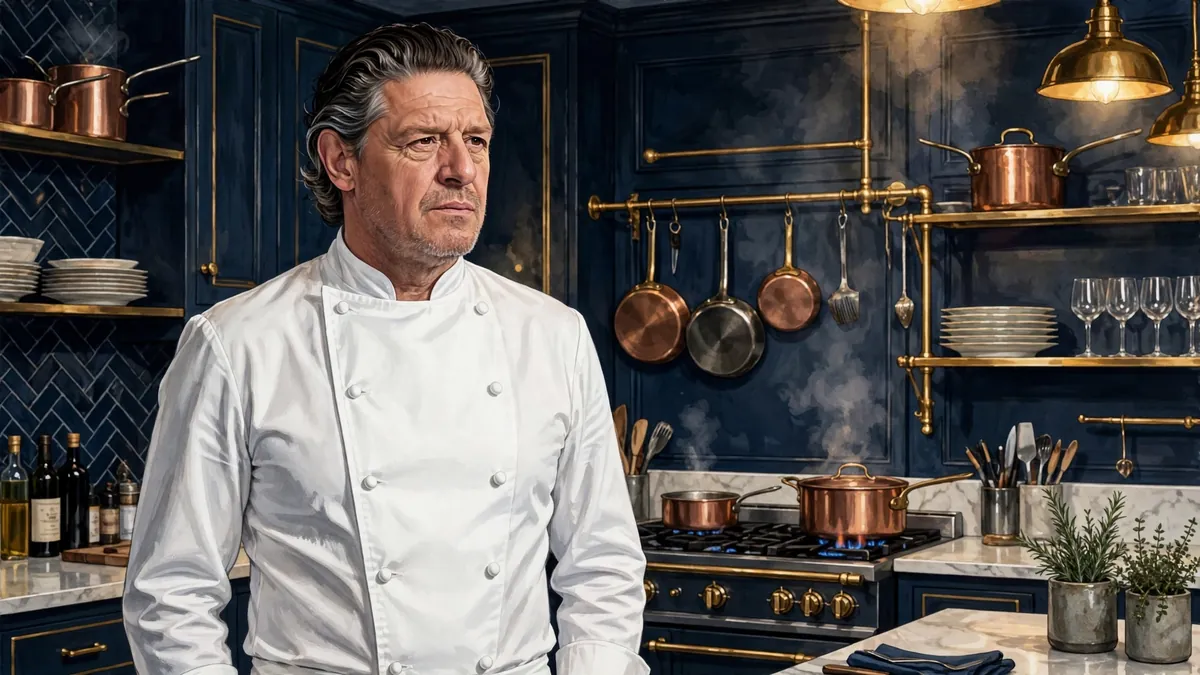
Marco Pierre White Quick Facts
| Full Name | Marco Pierre White |
|---|---|
| Date of Birth | 11 December 1961 (age 64 in November 2026) |
| Birthplace | Leeds, West Riding of Yorkshire, England |
| Nationality | British (English father, Italian mother) |
| Height | Listed at around 1.9 m (6 ft 3 in) by celebrity profile sites |
| Occupation | Chef, restaurateur, author, television personality |
| Estimated Net Worth | $30 million – $40 million (Celebrity Net Worth: $30M, July 2026; TheRichest: $40M) |
| Primary Income Sources | Restaurant franchises (Black and White Hospitality), television, books, brand work |
| Key Works | Harveys (1987), The Restaurant Marco Pierre White, White Heat (1990), The Devil in the Kitchen (2006), ITV’s Hell’s Kitchen |
| Defining Achievement | Three Michelin stars in January 1995, aged 33 — first British chef to hold them |
| Spouses | Alex McArthur (1988–1990), Lisa Butcher (1992–1993), Matilde Conejero (2000–2012) |
| Children | Four — Letitia, Marco Pierre White Jr., Luciano and Mirabelle |
| Official Website | marcopierrewhite.co |
Table of Contents
- Marco Pierre White Quick Facts
- Early Life: A Leeds Childhood Marked by Loss
- Training Under the Greats: Roux, Koffman and Blanc
- Harveys and the Road to Three Michelin Stars
- Three Michelin Stars at 33 — and Giving Them Back
- Retirement in 1999: Walking Away at the Top
- The Business Empire: Steakhouses, Franchises and Black and White Hospitality
- Where the Money Comes From: Income Streams and the Fortune Breakdown
- Net Worth Timeline: From Seven Pounds to a Multi-Million Fortune
- Television Career: Hell’s Kitchen and Life on Screen
- Books: White Heat and The Devil in the Kitchen
- The Mentor: Gordon Ramsay, Mario Batali and a Generation of Chefs
- Personal Life: Three Marriages and Four Children
- Controversies and Public Rows
- Legacy: The Godfather of Modern British Cooking
- Marco Pierre White FAQs
- Final Thoughts
- Sources and Reporting
Last updated: 24 November 2026. By Celebamerica Editorial Staff.
Early Life: A Leeds Childhood Marked by Loss
Marco Pierre White was born on 11 December 1961 in Leeds, in the West Riding of Yorkshire, the third of four sons. His father, Frank White, was a chef. His mother, Maria-Rosa Gallina, was an Italian immigrant from the Veneto region of Italy. Food was in the house from the start, but so was hardship. His mother died of a cerebral haemorrhage when Marco was six years old, a loss he has described in interviews as the defining event of his life. He was raised in Leeds after that, attending Allerton High School, and the grief of those early years hardened into the drive that later made him famous — and feared — in professional kitchens.
Leeds in the 1960s and 1970s was not a city with a fine-dining scene. White has often said he learned to cook from his father and from the Italian food of his mother’s family, and that the kitchen was the one place where he felt in control. School did not hold him. He left Allerton High without qualifications that pointed anywhere, and by his mid-teens he had decided the only trade worth learning was cooking. His first formal step was the Hotel St. George in Harrogate, followed by the Box Tree in Ilkley, a restaurant with a serious reputation in Yorkshire. Those early jobs taught him the basics of a professional kitchen: long hours, strict hierarchy, and the idea that a dish either met the standard or it did not.
What set White apart even then was an appetite for the hardest rooms in the business. He did not want a comfortable job in a provincial hotel. He wanted London, and he wanted the kitchens that other young cooks only read about. In 1981, at 19, he arrived in the capital with £7.36 in his pocket, a box of books and a bag of clothes, according to the widely repeated account of that journey. The sum has become part of his legend — a young cook with almost nothing, betting everything on talent and nerve.
Training Under the Greats: Roux, Koffman and Blanc
London in the early 1980s was ruled by French cooking, and White went straight to its centre. He started as a commis at Le Gavroche, the Mayfair restaurant run by Albert and Michel Roux, the brothers who had brought serious French gastronomy to Britain. The Roux kitchen was a finishing school in discipline: classical technique, exacting standards, and a brigade system that left no room for ego. White absorbed it all, and he has credited the Roux brothers ever since as the foundation of everything he later did.
From Le Gavroche he moved to Pierre Koffman at La Tante Claire in Chelsea, then to Raymond Blanc at Le Manoir aux Quat’ Saisons in Oxfordshire, and he also worked under Nico Ladenis at Chez Nico. Each kitchen added something: Koffman’s precision and his famous pig’s trotter, Blanc’s warmth and his insistence on produce, Ladenis’s intensity. White was not a quiet trainee. He was fast, obsessive and openly ambitious, and the older chefs around him noticed. By his early twenties he had done the rounds of the best kitchens in the country and was ready to run one of his own.
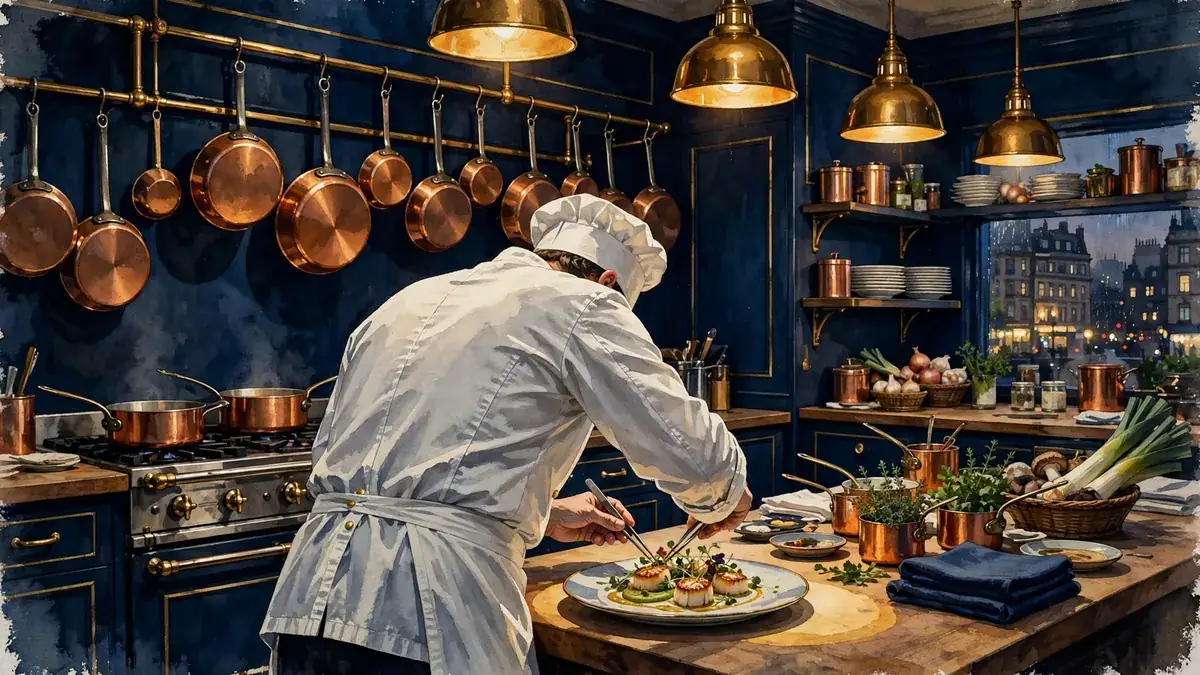
The training years also explain the style that made him famous. White’s cooking was French at its core, but he stripped away the fuss. He believed in a handful of ingredients, cooked with total focus, and plated with drama. That approach — classical technique, minimal decoration, maximum flavour — became the template for a generation of British chefs, and it started in those London kitchens of the early 1980s.
Harveys and the Road to Three Michelin Stars
In 1987, at 25, White opened Harveys on Wandsworth Common in south London. It was a small dining room, but within a year it had its first Michelin star, and a second followed a year later. He also picked up the Newcomer Award at the 1987 Catey Awards, run by The Caterer magazine. Harveys quickly became the most talked-about restaurant in Britain — not only for the food, but for the man running it. White was young, volcanic and utterly sure of himself, and the dining room crackled with that energy.
Harveys was also a training ground. The chefs who passed through its kitchen read like a roll call of modern British cooking: Gordon Ramsay, Phil Howard, Stephen Terry and Éric Chavot all worked there. Ramsay, who arrived as a young cook with his own ambitions, has described White as the single biggest influence on his career — the chef who taught him what a kitchen at the highest level actually demanded. The relationship between the two men would later turn sour in public, but the debt Ramsay owes White is not in doubt, and it is a large part of White’s lasting claim on culinary history.
From Harveys, White moved on to become chef-patron of The Restaurant Marco Pierre White in the Hyde Park Hotel, and later ran the Oak Room. Each step raised the stakes. The food stayed French in spirit — precise, rich, uncompromising — and the reputation grew with every review. By the early 1990s, White was no longer just a talented young chef. He was the figure other chefs measured themselves against, and the press had given him a label that stuck: the “enfant terrible” of British cooking.
Three Michelin Stars at 33 — and Giving Them Back
In January 1995, at the age of 33, Marco Pierre White won his third Michelin star. He became the first British chef ever to hold three stars, and the youngest chef in the world at the time to reach that status. It was the summit of the profession, and he had reached it in less than a decade of running his own kitchens. The achievement has never been matched in quite the same way: a working-class boy from Leeds, with no formal qualifications, had beaten the French at their own game on British soil.
The stars brought fame, and fame brought pressure. White has said in the years since that the Michelin system began to feel like a cage — inspectors judging every plate, the restaurant held hostage to a standard that never let up. He described himself as a prisoner of the system he had spent his career trying to conquer. That feeling, more than any single event, explains what happened next. In 1999 he announced his retirement from the kitchen and returned all three of his Michelin stars, a gesture no chef of his standing had ever made. He cooked his final meal for a paying customer on 23 December 1999 at the Oak Room, and then he walked out of the kitchen for good.
The record that still stands: White remains the youngest chef to have received three Michelin stars, and the first British chef to do it. He won the third star in January 1995 at 33, and he is the only chef of his stature to have voluntarily returned all three.
Retirement in 1999: Walking Away at the Top
Retiring at 38, with three Michelin stars and the most feared reputation in British cooking, looked like madness from the outside. Inside the trade, plenty of chefs understood it. The life White had built was punishing: sixteen-hour days, a kitchen run on fear and perfectionism, and a public image that had become a burden. He has spoken about the toll it took, and about wanting a life beyond the pass. Retirement was not a holiday. It was a pivot — from cooking for a few dozen diners a night to building a business that could scale his name far beyond one dining room.
The first move was as a restaurateur rather than a chef. Together with businessman Jimmy Lahoud, he set up White Star Line Ltd, a company that ran a string of large restaurants, including the vast Titanic restaurant, which the BBC’s 2026 series Rise of the Rockstar Chef says could pass as many as 4,000 guests through in a single night. The partnership with Lahoud lasted several years before ending in 2007. The scale was the point: White had learned that a name, properly used, could fill rooms he would never need to cook in himself.
He did not disappear from public view. If anything, retirement made him more visible, because television and books let him reach audiences that a restaurant never could. But the kitchen itself was finished for him as a daily workplace. He has returned to cook for special occasions and for television, but he has never gone back to running a pass full-time. The decision still defines him: the chef who won everything and then gave it back.
The Business Empire: Steakhouses, Franchises and Black and White Hospitality
After the White Star Line years, White’s business model settled into a shape he has kept ever since: he lends his name, his menus and his training, and other people’s money builds the restaurants. In 2008 he opened his first steakhouse, MPW Steak & Alehouse in London’s Square Mile, with James Robertson. The two men also ran the Kings Road Steakhouse & Grill in Chelsea from 2010, and in May 2016 the two restaurants were brought together as the London Steakhouse Co.
The bigger play began in 2010, when White met hotelier Nick Taplin, owner of the four-star Cadbury House hotel in North Somerset. Taplin wanted to improve the food across his hotel estate, and in October 2010 he opened a Marco Pierre White Steakhouse Bar & Grill at Cadbury House as a franchisee. Restaurants at Hoole Hall and The Cube followed quickly. As more hotel owners asked for a Marco Pierre White restaurant of their own, White and Taplin set up a master franchise in 2013 and launched Black and White Hospitality, the company that still runs the model today.
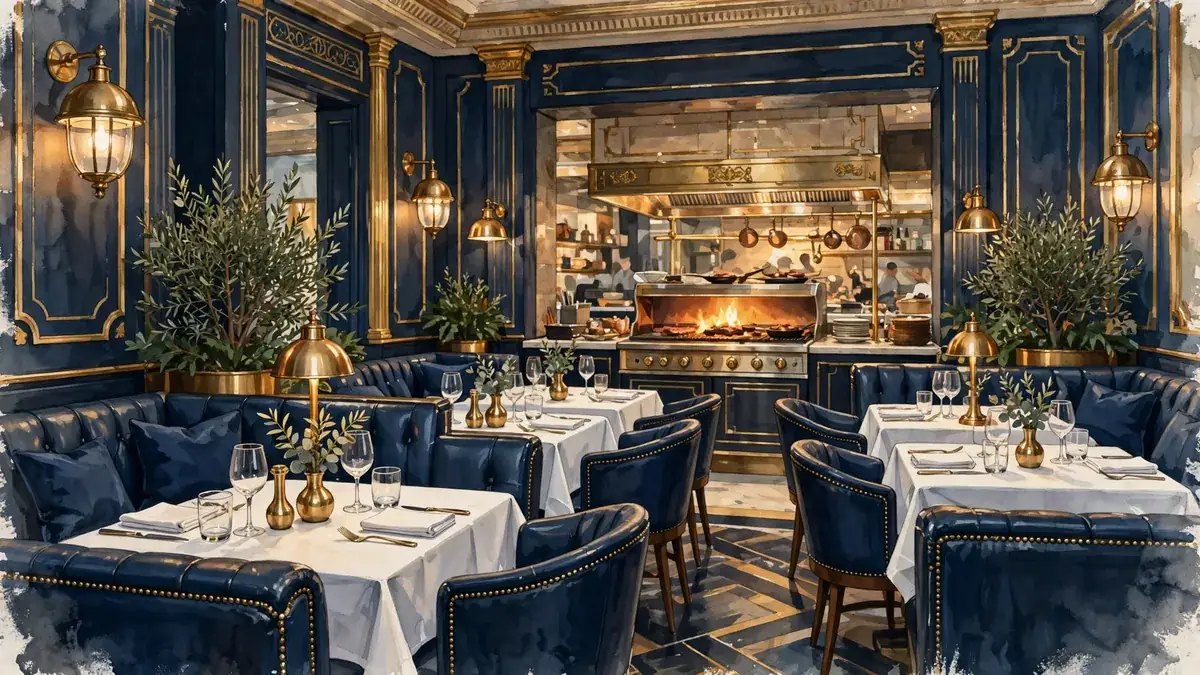
Black and White Hospitality offers franchise rights to eight Marco Pierre White brands, including the Steakhouse Bar & Grill, Mr White’s English Chophouse, Wheeler’s of St James’s Oyster Bar & Grill Room, Koffmann & Mr White’s, Marco’s New York Italian, Wheeler’s Fish & Chips, Bardolino Pizzeria Bellini & Espresso Bar, and the Marconi Coffee and Juice Bar. The idea is simple and it suits hotels: the property owner funds the build and the operation, while White’s company supplies the brand, the menus and the training. Dozens of sites now carry the name, from the UK and Ireland to Dubai.
The public filings tell a more grounded story than the headline net worth figures. Black and White Hospitality Ltd, the company co-founded by White and Taplin in 2013, reported net liabilities of £659,753 at 30 September 2025, up from £619,851 a year earlier, according to its unaudited abridged accounts at Companies House. A separate family hotel company, Corsham Estate Ltd, reported net assets of £1,135,117 at 31 March 2026, with the register naming his son Luciano Pierre White as its controller. Neither filing shows what White himself is paid, because small companies do not file a profit and loss account — but they are a useful check on the bigger numbers. The franchise business is real and wide, and it is also a business whose own balance sheet is modest. That gap is worth knowing, and it is why this article gives a range rather than a single figure.
Where the Money Comes From: Income Streams and the Fortune Breakdown
White’s fortune was built in two distinct phases. The first, from 1987 to 1999, was the chef’s phase: restaurants he ran himself, book advances, and the beginnings of television. The second, from 1999 to today, is the brand phase: franchising, television fees, books and endorsements. The second phase is where the money is. A chef cooking for forty covers a night can earn a good living; a name on dozens of hotel restaurants, plus television, can earn a fortune.
Here is how the income breaks down, based on the public record and the named estimates. No source publishes White’s actual contracts, so the split below is an informed reading of what is known, not a set of audited figures.
| Income Stream | What It Is | Share of the Fortune |
|---|---|---|
| Restaurant Franchises | Black and White Hospitality master franchise; steakhouse, chophouse and Italian brands in hotels across the UK, Ireland and the Gulf | Largest — roughly half the estimated wealth |
| Owned Restaurants | London Steakhouse Co. sites and earlier ventures including White Star Line Ltd | Meaningful, built up over 25 years |
| Television | ITV’s Hell’s Kitchen, Hell’s Kitchen Australia, MasterChef Australia, BBC’s Rise of the Rockstar Chef | Steady fees across two decades |
| Books | White Heat, The Devil in the Kitchen, Marco Pierre White in Hell’s Kitchen and other titles, still in print | Long tail — royalties and reprints |
| Brand Work | Endorsements and campaigns, including a long association with Knorr, plus knives and kitchen products | Smaller, but regular |
How does that compare with the chefs he trained and the chefs he competes with? The gap is wide, and it says something about the different paths in modern cooking. Gordon Ramsay’s net worth is put at around $220 million by Celebrity Net Worth — a fortune built on a global restaurant group and a television empire that White never pursued. Wolfgang Puck’s net worth is estimated at about $120 million, built the same way White’s was — a name on restaurants, products and television — but on an American scale. Jamie Oliver’s net worth is estimated at around $300 million, built on publishing, television and food campaigns. White sits below all three, because he chose a narrower model: franchising through hotels rather than building a global group of his own. What he gave up in scale he kept in freedom — no restaurant group to run, no daily service to survive.
Why the range, not a single number: Celebrity Net Worth, the most recently dated source (updated 6 July 2026), says $30 million. TheRichest and FamousIntel say $40 million. A detailed November 2026 analysis by WealthFuture noted that the $30 million figure is unverified — no Rich List or Forbes valuation supports it — and pointed to the Companies House filings above. We anchor on $30 million as the freshest dated estimate and give $30 million to $40 million as the honest range.
Net Worth Timeline: From Seven Pounds to a Multi-Million Fortune
| Year | Milestone | Money Picture |
|---|---|---|
| 1981 | Arrives in London aged 19 with £7.36 | Effectively nothing — a commis cook’s wage |
| 1987 | Opens Harveys; first Michelin star within a year | First real earnings as a chef-patron |
| 1990 | White Heat published | Book income begins; cult status grows |
| 1995 | Third Michelin star — first British chef to hold three | Peak earning power as a working chef |
| 1999 | Retires and returns his stars | Trading salary for ownership and brand income |
| 2007–2009 | ITV’s Hell’s Kitchen; White Star Line partnership ends | Television fees become a regular income line |
| 2010–2013 | First franchise at Cadbury House; Black and White Hospitality launches | Franchise model starts to scale |
| 2017 | Hosts Hell’s Kitchen Australia | International television fees |
| 2026 | Rise of the Rockstar Chef on BBC Two; estimates at $30M–$40M | Wealth held in brand, property and royalties |
The shape of that timeline is the story of the article: a man who earned his money the hard way, in kitchens, and then learned to earn it the easy way, by letting other people pay to use his name. The fortune is not the product of one deal. It is the product of forty years of a name that never lost its value, even after its owner stopped cooking.
Television Career: Hell’s Kitchen and Life on Screen
White was a television figure before he was a household name. The BBC documentary Boiling Point in 1999 followed him through his final year in the kitchen and fixed his image in the public mind: brilliant, volatile, impossible to work for, and impossible to look away from. That image became the basis of his television career. Where other celebrity chefs sold warmth, White sold intensity, and it worked.
His biggest television role came in September 2007, when he became head chef on ITV’s Hell’s Kitchen. The show was a hit, and White returned to host the fourth series in 2009. He went on to host Hell’s Kitchen Australia on the Seven Network in 2017, and he has appeared as a judge and guest on MasterChef Australia and MasterChef Australia: The Professionals. His other credits include Marco’s Great British Feast on ITV in 2008, the American series The Chopping Block, and Kitchen Burnout. In 2026 he returned to the BBC for Rise of the Rockstar Chef, a three-part series that put him back at the table with Gordon Ramsay and Heston Blumenthal.
Television also explains why White’s name stayed valuable long after he left the kitchen. A chef who cooks for forty people a night is known to forty people. A chef who terrifies contestants on prime-time television is known to millions, and that recognition is what hotels pay for when they sign a franchise deal. The screen career and the business career feed each other, and both trace back to the reputation built at Harveys.
Among television chefs, White belongs to a generation that turned cooking into prime-time entertainment. Guy Fieri’s biography shows the American version of the same arc — a chef who became a television brand — while Emeril Lagasse’s biography traces the earlier Food Network model that made the whole genre possible. White’s version was darker and more British, but the mechanism was the same: the kitchen as theatre, and the chef as the star.
Books: White Heat and The Devil in the Kitchen
White’s first book, White Heat, published in 1990, is the most influential cookbook of its era in Britain. Photographed in stark black and white by Bob Carlos Clarke, it mixed recipes with images of life inside Harveys — the sweat, the shouting, the plates. It was part cookbook, part manifesto, and it made White a cult figure among young cooks. Copies still change hands for serious money, and the book is still cited by chefs today as the one that showed them what a kitchen could be.
His memoir, first published as White Slave in 2006 and reissued as The Devil in the Kitchen in 2007, is a different kind of book: a raw, funny and often brutal account of his life, his marriages, his feuds and his kitchens. It sold widely and has been reprinted ever since, and it remains the best single source for White in his own words. A tie-in book, Marco Pierre White in Hell’s Kitchen, was published by Ebury Press on 23 August 2007 alongside the ITV series. Together, the books have given him a steady royalty income for more than three decades — the long tail that keeps paying long after the plates have been cleared.
The Mentor: Gordon Ramsay, Mario Batali and a Generation of Chefs
If White had never cooked another dish after 1995, his place in history would still be secure because of the chefs he trained. The most famous is Gordon Ramsay, who worked under White at Harveys and has called him the greatest influence on his career. Ramsay learned White’s discipline, his standards and his French technique — and then built an empire on them that dwarfs his mentor’s. Gordon Ramsay’s age — he was born in 1966, five years after White — puts the relationship in perspective: a young cook in his twenties learning from a chef barely older than himself who had already conquered the profession.
The full story of that mentorship, and of Ramsay’s rise from a broke young cook to a $220 million fortune, is told in Gordon Ramsay’s biography on GuideNetWorth, our sister site — it is the natural companion piece to this one, because the two careers are really one story told twice. Other chefs who trained under White include Mario Batali and Curtis Stone, along with Phil Howard, Stephen Terry and Éric Chavot from the Harveys years. Between them, White’s protégés have won Michelin stars, built restaurant groups and become television stars in their own right. That is a legacy no single restaurant can match.
The relationship with Ramsay has not always been warm. The two men fell out publicly in the years after Ramsay left White’s kitchen, trading insults in the press, and the row became part of both men’s public stories. They have since appeared together again — most recently on the BBC’s Rise of the Rockstar Chef in 2026 — and the old fire seems to have cooled into something closer to mutual respect. Whatever the state of the friendship, the professional debt runs one way, and Ramsay has never denied it.
Personal Life: Three Marriages and Four Children
White’s personal life has been as eventful as his career. He has been married three times. His first marriage was to Alex McArthur in 1988; the couple had a daughter, Letitia, before divorcing in 1990. His second marriage, to model Lisa Butcher, followed in 1992 after a famously brief engagement of three weeks, and ended in divorce the following year. His third marriage, to Matilde Conejero in 2000, lasted the longest and produced three children — Marco Pierre White Jr., Luciano and Mirabelle — before the couple split in 2012.
He has four children in total, and family runs through the business as well as the biography: his son Luciano is named as the controller of Corsham Estate Ltd, the family hotel company whose accounts were cited earlier in this article. White has spoken openly about the cost of his career on his family life — the hours, the temper, the years when the kitchen came first — and about the loss of his mother at six as the wound that shaped him. He has also said that cooking was, for a long time, the only thing he knew how to do well, and that everything else in his life was learned the hard way.
Outside the kitchen, White is known for his love of fishing and the countryside, a contrast to the noise of his public image. He has kept homes in Wiltshire and London, and he has spoken about wanting a quieter life as he gets older. At 64, with a grown family and a business that runs without him standing at a stove, he has something close to it — a life built on a name he earned before he was forty.
Controversies and Public Rows
No honest biography of Marco Pierre White can skip the controversies, because they are part of why he is famous. The most widely reported came during the first series of ITV’s Hell’s Kitchen in 2007, when a remark White made on the show drew a complaint from the Commission for Racial Equality. An ITV spokesman defended the programme, saying viewers had been warned about its content before broadcast, and the matter ended there — but it confirmed the reputation White already had: a chef who said what he thought, on camera, without filtering it first.
A second public row came in 2017, when a dispute with MasterChef Australia judge Matt Preston — who had made comments about White’s son — preceded White’s decision to host the rival Hell’s Kitchen Australia on the Seven Network. White has never been shy about settling scores in public, and his feuds, particularly the long-running one with Gordon Ramsay, have filled newspaper columns for decades. None of these episodes involved the law, and none of them damaged his business. If anything, they fed the image that sells his books and his television shows: the chef who refuses to behave.
There is a fair question about whether the behaviour that made White famous would survive in a modern kitchen. The shouting, the throwing of plates, the bullying of young cooks — all of it was normal in the kitchens of the 1980s and is now, rightly, seen differently. White himself has acknowledged that the trade has changed, and that the kitchens he ran would not be acceptable today. That honesty is part of his appeal now: a man from a harder era, describing it without apology and without pretending it was gentle.
Legacy: The Godfather of Modern British Cooking
White is often called the “godfather of modern cooking”, and the label fits. Before him, British fine dining was French food cooked by Frenchmen, or by Britons who had learned to imitate them. White took the French tradition, made it his own, and then taught a generation of British chefs to do the same. Ramsay, Howard, Terry, Batali, Stone — the line of descent from Harveys runs through the whole of modern British cooking, and through much of the television cooking that followed it.
His other legacy is the model he built after retirement. The franchise system run by Black and White Hospitality showed that a chef’s name could be a business in itself, separate from the chef’s hands. Dozens of chefs have followed that path since, licensing their names to hotels and restaurant groups. White did it first, and he did it after giving up the thing that made the name valuable in the first place — a gamble that paid off because the name, by then, was bigger than the kitchen.
For readers who want more chef life stories in this vein, our Biography section carries full profiles of the chefs, actors and public figures whose careers shaped their fields. White’s story sits comfortably among them — a life that began with £7.36 in a London station and ended, so far, with three Michelin stars returned, a franchise empire, and a fortune estimated at $30 million to $40 million.
Marco Pierre White FAQs
What is Marco Pierre White’s net worth in 2026?
Marco Pierre White’s net worth is estimated at $30 million to $40 million as of November 2026. Celebrity Net Worth puts it at $30 million in its profile updated 6 July 2026, while TheRichest and other outlets hold it at $40 million. No Forbes or Rich List valuation exists, so the range is the honest answer; the fortune comes mainly from his restaurant franchises, television work, books and brand deals.
How old is Marco Pierre White?
Marco Pierre White was born on 11 December 1961 in Leeds, England, which makes him 64 years old in November 2026. He turns 65 in December 2026. He won his third Michelin star at 33, in January 1995, and retired from the kitchen at 38 in 1999.
Why did Marco Pierre White give back his Michelin stars?
White retired from the kitchen in 1999 and returned all three of his Michelin stars because he no longer wanted to be judged by inspectors. He has described himself as a prisoner of the system he had spent his career trying to conquer, and he wanted a life beyond the daily pressure of holding three stars. He cooked his final meal for a paying customer on 23 December 1999 at the Oak Room.
Who did Marco Pierre White train and mentor?
White’s most famous protégé is Gordon Ramsay, who worked under him at Harveys and has called White the greatest influence on his career. He also trained Mario Batali and Curtis Stone, along with Phil Howard, Stephen Terry and Éric Chavot at Harveys. His protégés have gone on to win Michelin stars, build restaurant groups and become television stars in their own right.
What restaurants does Marco Pierre White own?
White no longer cooks in a kitchen daily. His restaurant interests run through Black and White Hospitality, the master franchise he launched with Nick Taplin in 2013, which licenses eight brands — including the Marco Pierre White Steakhouse Bar & Grill, Mr White’s English Chophouse and Wheeler’s of St James’s — to hotels and property owners. He also co-owns the London Steakhouse Co., formed in 2016 from his Steak & Alehouse and Kings Road Steakhouse sites.
Is Marco Pierre White married?
No. Marco Pierre White has been married three times and is divorced. He married Alex McArthur in 1988 (divorced 1990), model Lisa Butcher in 1992 (divorced 1993), and Matilde Conejero in 2000 (split in 2012). He has four children: Letitia, Marco Pierre White Jr., Luciano and Mirabelle.
What is Marco Pierre White’s most famous book?
White Heat, published in 1990, is White’s most famous book — a mix of recipes and stark black-and-white photographs of life inside Harveys that became the most influential cookbook of its era in Britain. His memoir, first published as White Slave (2006) and reissued as The Devil in the Kitchen (2007), is the best account of his life in his own words.
What TV shows has Marco Pierre White hosted?
White was head chef on ITV’s Hell’s Kitchen from 2007 and returned to host its fourth series in 2009. He hosted Hell’s Kitchen Australia in 2017, appeared on MasterChef Australia and MasterChef Australia: The Professionals, and fronted Marco’s Great British Feast (2008) and The Chopping Block. In 2026 he appeared on BBC Two’s Rise of the Rockstar Chef alongside Gordon Ramsay and Heston Blumenthal.
Final Thoughts
Marco Pierre White’s life reads like a dare: arrive in London with £7.36, learn from the best kitchens in the country, open your own restaurant at 25, win three Michelin stars by 33, and then hand them back at 38 and start again. Few chefs have ever reached the top as fast, and none has walked away from it as completely. The franchise empire, the television career and the books that followed were not a retirement — they were a second career, built on a name that the first career had made priceless.
The money, honestly stated, is $30 million to $40 million — a fortune by any measure, but a modest one next to the chefs he trained. That gap is the real measure of the man. White chose freedom over scale, and a life outside the kitchen over a restaurant group. The three stars are gone, the kitchen is quiet, and the name still fills dining rooms from North Somerset to Dubai. That is a legacy most chefs would trade their stars for.
Sources and Reporting
This biography was researched from live sources in November 2026. Figures are estimates drawn from named outlets, and where those outlets disagree we publish a range and say so. No figure in this article is invented, and no quote is fabricated.
- Celebrity Net Worth — net worth estimate of $30 million, profile updated 6 July 2026; biographical detail on early life, Harveys and the three Michelin stars.
- TheRichest — net worth estimate of $40 million; career and personal-life detail.
- WealthFuture — November 2026 analysis of the $30 million estimate, Companies House filings for Black and White Hospitality Ltd and Corsham Estate Ltd, and the BBC’s Rise of the Rockstar Chef.
- Wikipedia — career chronology, restaurant history, television credits and the Black and White Hospitality franchise model.
- FamousIntel — biographical detail, marriages, television history and the $40 million estimate.
- BBC — Rise of the Rockstar Chef (2026) and Boiling Point (1999).
- Companies House — public filings for Black and White Hospitality Ltd and Corsham Estate Ltd.
How we estimated: Celebrity Net Worth (updated 6 July 2026) anchors the figure at $30 million; TheRichest and FamousIntel put it at $40 million. We publish the range $30 million to $40 million because no Forbes or Sunday Times Rich List valuation exists and the public company filings show a smaller, more modest balance sheet than the headline estimates suggest. Private wealth — property, savings, private deals — is not public, so any estimate may differ from the private reality. Figures are rounded and dated; they will move as new information appears.