By Celebamerica Editorial Staff | Last updated: November 25, 2026
Steve Martin’s net worth in 2026 is an estimated $140 million to $150 million. Celebrity Net Worth, the tracker most outlets cite for Martin, lists his fortune at $150 million in its page updated in November 2026, while Parade reported $140 million in January 2026, also citing Celebrity Net Worth. The $10 million gap is a revision between two dates, not a dispute over the scale of the fortune: every credible tracker puts Martin in the $140 million to $180 million band, and the number below is anchored on the freshest figure, $150 million from Celebrity Net Worth.
That fortune was not built on one hit. Martin has earned money in six different businesses across six decades: arena stand-up in the 1970s, more than 50 films, hit comedy albums, Grammy-winning bluegrass records, bestselling books, and — since 2021 — a Hulu series that pays him at least $1 million per episode, according to Variety. Sitting underneath it all is a second fortune most fans never see: a private art collection Celebrity Net Worth estimates at $50 million to $100 million, built up since the late 1960s and punctuated by one of the most profitable single painting sales in Hollywood history.
Steve Martin Quick Facts
| Full Name | Stephen Glenn Martin |
|---|---|
| Date of Birth | August 14, 1945 (age 81 in November 2026) |
| Birthplace | Waco, Texas, United States |
| Estimated Net Worth (2026) | $140 million – $150 million (anchored on Celebrity Net Worth, $150 million, updated November 2026) |
| Primary Income Sources | Stand-up comedy, film acting and writing, television (Only Murders in the Building), comedy and bluegrass albums, books and plays, live touring with Martin Short |
| Key Ventures / Works | The Jerk, Three Amigos, Roxanne, Planes, Trains and Automobiles, Father of the Bride, Only Murders in the Building, The Crow (Grammy-winning bluegrass album), Shopgirl, Born Standing Up |
| Biggest Single Assets | Art collection estimated at $50 million – $100 million; California and New York real estate |
| Spouse | Anne Stringfield (married 2007); previously Victoria Tennant (1986–1994) |
| Children | One daughter, born December 2012 |
| Major Honours | Five Grammy Awards, Primetime Emmy Award (1969), Mark Twain Prize for American Humor (2005), Kennedy Center Honors (2007), Honorary Academy Award (2013), AFI Life Achievement Award (2015) |
Table of Contents
- Steve Martin Quick Facts
- Early Life: From Waco to Disneyland
- The Stand-Up Years: Arenas, Albums and Walking Away
- Film Career: The Jerk to Father of the Bride and Beyond
- The Money: Where the Fortune Comes From
- Only Murders in the Building: The Late-Career Payday
- Music and Books: The Banjo and the Bestseller Lists
- The Art Collection: A Second Fortune on the Wall
- Real Estate: Beverly Hills, Montecito and Manhattan
- Net Worth Breakdown and Growth Timeline
- Personal Life: Marriage, Fatherhood and Privacy
- How Steve Martin Compares to Other Comedy Legends
- Frequently Asked Questions
- Bottom Line
- Sources and Reporting

Early Life: From Waco to Disneyland
Stephen Glenn Martin was born on August 14, 1945, in Waco, Texas, the son of Mary Lee Stewart and Glenn Vernon Martin, a real estate salesman and aspiring actor. The family moved to California while Steve was still a boy, settling first in Inglewood and then in Garden Grove, where he attended Garden Grove High School. He has an older sister, Melinda. The Waco birthplace is worth stating plainly because a handful of low-quality net worth pages list other towns; Britannica and Wikipedia both record Waco, Texas, and that is the birthplace used here.
Martin’s first job is one of the best-known origin stories in American comedy. As a teenager he worked at the newly opened Disneyland, selling guidebooks on weekends and through the summer, and later worked in the park’s magic shop, where he learned card tricks, juggling and patter from the older magicians. The lessons stuck: his whole stage act would later be built on magic tricks, banjo playing, balloon animals and deliberately silly props rather than conventional jokes.
After high school he studied at Santa Ana College, then Long Beach State College, where he took drama and English poetry classes, and later transferred to UCLA in 1967, majoring in philosophy. While still a student he was performing his comedy-and-banjo act in Los Angeles nightclubs and writing jokes for other performers. In 1967 he was offered his first major writing job, on The Smothers Brothers Comedy Hour, the hit CBS variety show. The job won him a Primetime Emmy Award in 1969 — his first major honour, earned before he was 25 — and put him inside the television writers’ rooms where his career would be made.
The early years were lean. Martin spent the late 1960s and early 1970s as a jobbing writer and club comic, opening for rock bands and playing rooms where the audience often had no idea who he was. He has described those years in his memoir Born Standing Up (2007) as a slow grind of small rooms, bad hotels and material that had to be rebuilt night after night. The payoff, when it came, was sudden and enormous.
The Stand-Up Years: Arenas, Albums and Walking Away
Martin’s stand-up breakthrough arrived through television. Frequent appearances on The Tonight Show Starring Johnny Carson in the early 1970s, followed by repeated guest-hosting slots on Saturday Night Live, turned a cult club act into a national craze. By 1977 he was playing concert halls and arenas — a scale almost unheard of for a stand-up comic at the time — with audiences in the tens of thousands chanting along to routines about cats, happy feet and the arrow through the head.
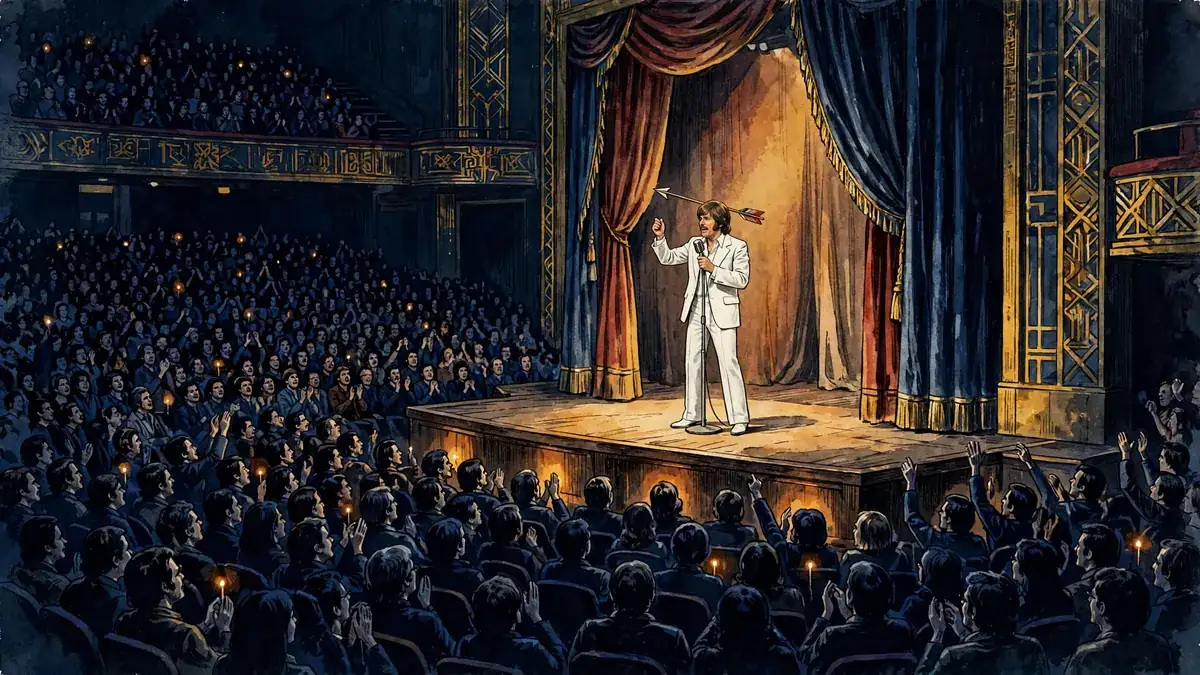
The comedy albums were a serious income stream in their own right. Let’s Get Small (1977) and A Wild and Crazy Guy (1978) both sold in huge numbers for spoken-word comedy records; the latter carried “King Tut”, a novelty song that became a genuine pop hit and remains his best-known recording. A third album, Comedy Is Not Pretty!, followed in 1979. In an era before streaming, platinum comedy albums plus arena ticket sales plus television fees made Martin one of the highest-paid live performers in America — and he was still in his early thirties.
Then, in 1981, he stopped. Martin has said many times that the arena act had become a trap: the same routines, the same props, audiences who wanted the old bits word for word. He walked away from stand-up at the absolute peak of its earning power to concentrate on films, a decision that looks financially reckless in the short term and wise in the long term, because it freed him to build the multi-decade film, writing and music career that actually produced most of his wealth. He did not return to regular live comedy for more than three decades; when he did, it was on his own terms, touring theatres with Martin Short and a bluegrass band rather than playing arenas alone.
For a net worth picture, the stand-up years matter for two reasons. First, the arena and album money of 1977–1981 gave Martin his first serious capital — the seed money that let him start collecting art and buying property while his film career was still young. Second, the decision to quit protected the brand: he never became a nostalgia act grinding out the same hour, which is a large part of why studios, publishers and, much later, Hulu were still paying him top rates in his seventies.
Film Career: The Jerk to Father of the Bride and Beyond
Martin’s film career began with writing. He co-wrote and starred in The Jerk (1979), the rags-to-riches comedy directed by Carl Reiner, which earned $73.7 million at the box office — the equivalent of roughly $300 million in today’s money. Parade reports that Martin was paid $600,000 upfront for the film plus 50% of the gross profits, a profit-participation deal that turned a modest salary into a very large payday as the film kept earning. It was the first of several occasions when Martin’s habit of writing his own starring vehicles paid him twice: once as an actor, once as a writer with a share of the profits.
The 1980s made him a film star. Dead Men Don’t Wear Plaid (1982), The Man with Two Brains (1983) and All of Me (1984) — all with Carl Reiner — were followed by ¡Three Amigos! (1986), Roxanne (1987), a modern retelling of Cyrano de Bergerac that Martin wrote and that remains one of his most admired performances, and Planes, Trains and Automobiles (1987) opposite John Candy. Dirty Rotten Scoundrels (1988) with Michael Caine and Parenthood (1989) closed out a decade in which Martin was rarely out of the top tier of comedy box office.
The 1990s kept the run going with a different register: the warm family comedies. He wrote and starred in L.A. Story (1991), then played George Banks in Father of the Bride (1991) and its 1995 sequel, both major hits, and headlined Leap of Faith (1992). Later films included Bowfinger (1999), which he wrote, the Cheaper by the Dozen films (2003, 2005), the Pink Panther remakes, It’s Complicated (2009) and voice work in Home (2015). Across roughly 55 films, Martin’s box-office record runs into the billions of dollars in aggregate grosses — and, just as importantly for his wealth, his pay rose with each decade as his quote climbed from the $600,000 of The Jerk to eight-figure fees by the 2000s.
One payday stands out in the reporting. For the 2006 remake of The Pink Panther, Parade reports Martin was paid $25 million to star, plus an additional $3 million to rewrite the script. Even allowing for the usual gap between reported and actual pay, it is the largest single film fee attached to his name in the public record, and it arrived in the same year as his most famous art sale — a year, 2006, that did more for his net worth than any other single year of his career.
The Money: Where the Fortune Comes From
Steve Martin’s wealth is unusual among comedians because it does not rest on one income stream. Six sources have fed it, in different proportions, across different decades. The table below is our own estimate breakdown, built from the named, reported figures in this article — not an audited balance sheet, and the ranges are honest about that.
| Income stream | What is known |
|---|---|
| Film acting and writing | Roughly 55 films over 45+ years; fees rose from $600,000 plus profit share on The Jerk (1979) to $25 million plus $3 million writing on The Pink Panther (2006), per Parade. Residuals from a deep catalogue continue to pay. |
| Television | Only Murders in the Building: at least $1 million per episode for Martin as of November 2026, per Variety; earlier Variety reporting put the leads at $600,000 per episode in 2021. Martin is also co-creator and executive producer, which carries backend participation. |
| Stand-up and live touring | Arena tours and platinum comedy albums in 1977–1981; theatre tours with Martin Short since 2015, including a Netflix special in 2018. Variety and Celebrity Net Worth note the Short partnership has generated tens of millions of dollars in ticket sales. |
| Music | Five Grammy Awards; bluegrass albums with the Steep Canyon Rangers, including The Crow (2009), Rare Bird Alert (2011) and two albums with Edie Brickell. Touring, recording and publishing income across 15+ years. |
| Books and plays | Bestselling novella Shopgirl (2000), memoir Born Standing Up (2007), novel An Object of Beauty (2010), plus plays Picasso at the Lapin Agile, Bright Star (Broadway, 2016) and Meteor Shower (2017). Advances, royalties and stage licensing. |
| Art collection | Estimated at $50 million to $100 million by Celebrity Net Worth. Includes a Hopper bought for a reported $10 million in 1999 and sold for $26.9 million in 2006. |
| Real estate | California, New York and North Carolina properties held over decades; a Montecito home listed at $11 million in 2015 and a Beverly Hills home sold for $2.22 million in 2019. |
Two features of this mix deserve emphasis. First, Martin has been paid as a creator, not only as a performer: writing fees, profit shares, co-creator credit and executive-producer stakes recur through his career, and creator pay compounds in a way that acting fees alone do not. Second, the wealth is old and seasoned. The art and the property were bought decades ago and have appreciated for 30 to 50 years; the $150 million figure is as much a story about holding good assets for a very long time as it is about any single salary.
Readers comparing Martin with other wealthy comedians should keep that mix in mind. A comic whose fortune is one giant sitcom syndication deal has a different risk profile from one whose money is spread across film residuals, a television salary, touring, publishing and a museum-grade art collection. Martin’s is the second kind — diversified before diversification was a talking point.
How the range works: Celebrity Net Worth lists $150 million (updated November 2026); Parade reported $140 million in January 2026, citing Celebrity Net Worth. Smaller trackers range up to $180 million. We anchor on $150 million and report the range $140 million to $150 million as the credible band. One site, NetWorthExplained, publishes a $389.6 million figure, but it labels its own calculation “Grade C — mostly modeled” and says documented numbers cover only a small share of the figure. It is a model, not a sourced estimate, and it is not used here.
For readers who want the wider picture of how comedy fortunes are built on this site, our net worth archive collects the same treatment for other stars, with the same sourcing rules.
Only Murders in the Building: The Late-Career Payday
The most lucrative chapter of Martin’s seventies began in 2021, when Hulu premiered Only Murders in the Building, the comedy-mystery series Martin co-created with John Hoffman and stars in as Charles-Haden Savage, a washed-up television actor who solves murders in his Manhattan apartment building with two unlikely neighbours. His co-stars are his longtime friend and touring partner Martin Short and Selena Gomez, whose own rise from Disney star to global pop and beauty-business figure is covered in our Selena Gomez biography.
The show was a hit from its first season and has run into a sixth season by late 2026, earning Martin three Primetime Emmy nominations, two Screen Actors Guild nominations, a Golden Globe nomination and a Peabody nomination for the series. The pay rose with the success. Variety reported in 2021 that the three leads were earning $600,000 per episode; in November 2026 Variety reported that all three were earning at least $1 million per episode as the show entered its sixth season. Across roughly 60 episodes to date, that per-episode rate makes the series one of the largest single earnings sources of Martin’s career — and because he is co-creator and executive producer, his stake goes beyond the acting fee.
The show also revived Martin’s public profile with a younger audience that had never seen his films, which in turn fed the touring business: the Martin Short double act, which had already been selling out theatres since 2015, found a new generation of ticket buyers. It is a neat illustration of how Martin’s career has worked for 60 years — each new venture feeding the older ones, rather than replacing them.
Music and Books: The Banjo and the Bestseller Lists
Martin’s banjo playing is not a hobby that got out of hand; it is a second professional career with its own Grammys. He has won five Grammy Awards in total, including Best Bluegrass Album for The Crow (2009), recorded with the Steep Canyon Rangers. Further albums followed — Rare Bird Alert (2011), Love Has Come for You (2013) and So Familiar (2015), the last two made with Edie Brickell — along with years of touring the bluegrass festival and theatre circuit. The money here is modest next to film fees, but it is steady, it is his own, and it keeps him touring in his eighties.
The writing career is bigger money and, arguably, more important to his standing. The novella Shopgirl (2000) was a bestseller that Martin adapted into a 2005 film in which he starred. The Pleasure of My Company followed in 2003, and his memoir Born Standing Up: A Comic’s Life (2007) is regarded as one of the best show-business memoirs ever written — a candid account of the stand-up years that also functions as a masterclass in how a comedy career is built. An Object of Beauty (2010), a novel set in the New York art world, drew directly on his life as a collector and was a bestseller in its own right.
On stage, Martin wrote the play Picasso at the Lapin Agile (1993), the book and music for the Broadway musical Bright Star (2016, with Edie Brickell) and the comedy Meteor Shower (2017). Broadway and regional licensing, book advances and royalties add a layer of income that most film stars never touch — and they also explain why Martin’s name still appears on bestseller lists and theatre marquees in years when he has no film out.
The Art Collection: A Second Fortune on the Wall
If there is one part of Steve Martin’s wealth that surprises people, it is the art. Martin began collecting in the late 1960s, when his first significant purchase was a work by Los Angeles artist Ed Ruscha, and he has been buying seriously ever since. Celebrity Net Worth estimates the collection today at $50 million to $100 million, while stressing that its exact holdings and current market value have not been independently appraised. Even at the bottom of that range, the art is worth roughly a third of his entire fortune — and it is the asset class that has appreciated most.

The collection’s centrepiece story is Edward Hopper. In December 1987 Martin bought Hopper’s 1927 painting Captain Upton’s House at Sotheby’s for $2.31 million. In 1999 he bought another Hopper, the 1955 painting Hotel Window, from the Forbes magazine collection for a reported $10 million. In November 2006 he sold Hotel Window at Sotheby’s for $26.9 million — a record price for the artist at the time, and a profit of roughly $17 million on a single painting held for seven years. The unsold Captain Upton’s House, bought for $2.31 million in 1987, is estimated by Celebrity Net Worth to be worth $20 million to $30 million today on comparable Hopper sales — a market estimate, not a formal appraisal, but an indication of how the collection has grown.
The rest of the collection, as reported over the years, has included works by Pablo Picasso, Roy Lichtenstein, Willem de Kooning, David Hockney, Georges Seurat, Francis Bacon and Lucian Freud, as well as contemporary American artists such as Eric Fischl and Cindy Sherman. Martin has written about art, set a novel in the art world, and served on museum boards; he collects like a scholar, not a speculator, which is precisely why the collection has held its value. For net worth purposes the lesson is plain: the art is not decoration on top of the fortune. It is a large part of the fortune, bought early, held for decades, and sold rarely and well.
Real Estate: Beverly Hills, Montecito and Manhattan
Martin’s property history follows the same pattern as his art: buy well, hold for decades, sell rarely. His main Los Angeles home is an English country-style estate in the Beverly Hills Post Office area, bought in 1995 from actors Corbin Bernsen and Amanda Pays. In 1997 he bought the contemporary house next door for $995,000; he sold that second property in 2019 for $2.22 million, more than double what he paid for it 22 years earlier.
Other holdings reported over the years include a contemporary home in Montecito, California, which Variety reported he listed for $11 million in 2015; a one-bedroom condo in a full-service pre-war building on Manhattan’s Upper West Side; and a custom-built stone manor in the mountains between Greenville, South Carolina and Asheville, North Carolina. Celebrity Net Worth notes that he has owned luxury real estate in California, New York and the Caribbean. No public record gives a current total value for the portfolio, so no figure is assigned to it in the breakdown above — but three decades of coastal California and Manhattan property, bought early and held long, is a substantial store of value in its own right, and it sits alongside the art as the illiquid backbone of the fortune.
Net Worth Breakdown and Growth Timeline
Putting the reported figures together gives a picture of how the $140 million to $150 million estimate is composed. The figures below are our own estimate breakdown, assembled from the named sources in this article; they are not an audited accounting, and the art and property lines are ranges precisely because their current values are not public.
| Component | Estimated value |
|---|---|
| Art collection | $50 million – $100 million (Celebrity Net Worth estimate; unappraised) |
| Film and television earnings (career, after tax and spending) | Largest single cash source; includes the $25 million plus $3 million Pink Panther payday and at least $1 million per Only Murders episode |
| Real estate | Undisclosed total; includes Beverly Hills estate (owned since 1995), Montecito home (listed $11 million, 2015), Manhattan condo and a North Carolina mountain manor |
| Stand-up, touring and albums | Arena and album income 1977–1981; theatre tours with Martin Short since 2015; five Grammy-winning records |
| Books, plays and royalties | Bestselling books and Broadway licensing; ongoing residuals and royalties from film, television and publishing |
| Total estimate (2026) | $140 million – $150 million, anchored on Celebrity Net Worth ($150 million, November 2026) |
The timeline shows how slowly, and then how suddenly, the fortune grew:
| Year | Milestone |
|---|---|
| 1967–1969 | First writing job on The Smothers Brothers Comedy Hour; Primetime Emmy win in 1969. First art purchase (Ed Ruscha) around the same period. |
| 1977–1979 | Arena stand-up peak; platinum comedy albums; “King Tut” hit; The Jerk earns $73.7 million and Martin takes $600,000 plus half the gross profits. |
| 1981 | Quits stand-up at the peak to concentrate on films. |
| 1986–1991 | Three Amigos, Roxanne, Planes, Trains and Automobiles, Father of the Bride; buys Hopper’s Captain Upton’s House for $2.31 million in 1987; buys Beverly Hills estate in 1995. |
| 1999–2006 | Buys Hopper’s Hotel Window for a reported $10 million (1999); Pink Panther payday of $25 million plus $3 million writing (2006); sells Hotel Window for $26.9 million (2006). |
| 2007–2016 | Marries Anne Stringfield (2007); Born Standing Up published (2007); Grammy for The Crow (2009); daughter born (2012); tours with Martin Short; Bright Star on Broadway (2016). |
| 2021–2026 | Only Murders in the Building premieres; per-episode pay rises from $600,000 (2021, Variety) to at least $1 million (November 2026, Variety); Celebrity Net Worth updates his fortune to $150 million. |
Two things stand out in that timeline. First, the fortune was built in layers, with each decade adding a new income stream rather than replacing the last. Second, the two biggest single paydays — the Pink Panther fee and the Hopper sale — both landed in 2006, nearly thirty years into the career. Martin’s wealth is a story of patience as much as talent: early money invested in art and property, held for decades, and harvested late.
Personal Life: Marriage, Fatherhood and Privacy
Martin guards his private life more carefully than almost any star of his stature, and the reporting reflects that. He was married to actress Victoria Tennant from 1986 to 1994. In 2007 he married Anne Stringfield, a writer and former editor at The New Yorker, in a surprise ceremony at his Los Angeles home. In December 2012, at the age of 67, Martin became a father for the first time; the couple have one daughter, whose name they have never made public.
Late fatherhood changed his working life in visible ways. The touring schedule with Martin Short is built around short runs rather than long hauls, and Martin has spoken about structuring his year around family time in a way the younger, arena-filling version of himself never did. He lives between Los Angeles and New York, keeps his family out of the press, and has never used his private life as publicity — a discipline that, over six decades, has kept him free of the scandal cycles that have damaged other fortunes in this business.
There are no major controversies or legal disputes attached to Martin’s name in the public record. The closest thing to a public embarrassment in his collecting life came in 2004, when a painting he had bought as a work by the German artist Heinrich Campendonk was identified by experts as a forgery; Martin returned it and wrote about the experience with characteristic good humour. It cost him money and pride, but it is a footnote in a collecting career that has otherwise been remarkably sure-footed.
How Steve Martin Compares to Other Comedy Legends
Martin’s $140 million to $150 million puts him in the upper tier of stand-up comedians turned film stars, but not at the very top — and the comparison is instructive about how different careers produce different fortunes.
| Comedian | Reported net worth (Celebrity Net Worth) |
|---|---|
| Jerry Seinfeld | Close to $1 billion — built on Seinfeld syndication, one of the richest deals in television history. Read our Jerry Seinfeld biography for the full story. |
| Eddie Murphy | Around $200 million — film franchises, stand-up specials and a long run of eight-figure paydays. See our Eddie Murphy biography. |
| Steve Martin | $140 million – $150 million — film, television, touring, books, music and a $50 million-plus art collection. |
| Chris Rock | Around $60 million — stand-up, film and television, with a career interrupted by a costly divorce settlement. |
| Martin Short | Around $50 million — a long career in film and television, now boosted by Only Murders in the Building alongside Martin. |
The pattern is clear. Seinfeld’s fortune comes from owning a piece of one of the most syndicated shows ever made. Murphy’s comes from fronting film franchises. Martin’s comes from breadth: no single deal made him rich, but six careers, each profitable, plus art and property bought early and held for decades, added up to the same neighbourhood. Love Money’s ranking of the richest stand-up comedians, published in November 2026 and based on Celebrity Net Worth figures, places Martin joint 15th — a reminder that the richest comics are not always the funniest, and the funniest are not always the richest, but Martin is one of the few who belongs on both lists.
It is also worth noting what Martin’s fortune is not. It is not a tech fortune, not an inheritance, and not the product of a single windfall. It is sixty years of working, saving, collecting and holding — the least glamorous path to $150 million, and the one most likely to last.
Frequently Asked Questions
What is Steve Martin’s net worth in 2026?
Steve Martin’s net worth in 2026 is estimated at $140 million to $150 million. Celebrity Net Worth lists his fortune at $150 million in its page updated in November 2026, while Parade reported $140 million in January 2026, also citing Celebrity Net Worth. We anchor on the fresher $150 million figure and report the $140 million to $150 million range as the credible band.
How much does Steve Martin make per episode of Only Murders in the Building?
At least $1 million per episode, according to Variety’s November 2026 survey of television salaries, which reported that Martin, Martin Short and Selena Gomez were each earning at least that much as the show entered its sixth season. Variety had earlier reported the three leads at $600,000 per episode in 2021. Martin is also co-creator and executive producer, so his stake goes beyond the acting fee.
How old is Steve Martin?
Steve Martin was born on August 14, 1945, in Waco, Texas, which makes him 81 years old in November 2026. He began his career as a teenager working at Disneyland and won his first Emmy Award for writing at age 23.
How much is Steve Martin’s art collection worth?
Celebrity Net Worth estimates Steve Martin’s art collection at $50 million to $100 million, while noting its exact holdings and current market value have not been independently appraised. His most famous transaction was the sale of Edward Hopper’s Hotel Window, bought for a reported $10 million in 1999 and sold at Sotheby’s for $26.9 million in November 2006.
What was Steve Martin’s biggest movie payday?
His largest reported single film fee was for the 2006 remake of The Pink Panther: Parade reports he was paid $25 million to star plus an additional $3 million to rewrite the script. His earliest big payday was The Jerk (1979), for which he received $600,000 upfront plus 50% of the gross profits on a film that earned $73.7 million.
Is Steve Martin still performing stand-up comedy?
Not in the old arena format. Martin quit stand-up in 1981 at the height of his fame and did not return to regular live comedy for decades. Since 2015 he has toured theatres with Martin Short in a two-man show combining stand-up, music and stories, including the Netflix special An Evening You Will Forget for the Rest of Your Life (2018).
Who is Steve Martin married to?
Steve Martin has been married to writer Anne Stringfield since 2007. They have one daughter, born in December 2012, when Martin was 67. He was previously married to actress Victoria Tennant from 1986 to 1994. Martin keeps his family life private and has never made his daughter’s name public.
Why do some websites say Steve Martin is worth $389 million?
One site, NetWorthExplained, publishes a $389.6 million figure, but it labels its own calculation “Grade C — mostly modeled” and says documented numbers cover only a small share of the figure. It is a computer model built from published pay rates, not a sourced estimate. The credible trackers — Celebrity Net Worth ($150 million), Parade ($140 million) and other outlets — all put Martin in the $140 million to $180 million band, and that is the range used in this article.
Bottom Line
Steve Martin’s net worth in 2026 is an estimated $140 million to $150 million, anchored on Celebrity Net Worth’s $150 million figure from November 2026. It is a fortune built the slow way: arena stand-up and platinum albums in the 1970s, more than 50 films, a bestselling writing career, Grammy-winning bluegrass records, and — since 2021 — at least $1 million an episode from Only Murders in the Building. Underneath it all sits a $50 million to $100 million art collection and decades of well-bought real estate, assets bought early and held for a lifetime. At 81, Martin is still earning at the top of his profession, still touring, still writing, and still collecting — which is why the number keeps moving up rather than down.
Sources and Reporting
By Celebamerica Editorial Staff. This article was researched from live sources in November 2026. Figures are estimates from named outlets, not audited financial statements, and the true state of any private individual’s finances is never public.
How we estimated: the headline figure is anchored on Celebrity Net Worth ($150 million, page updated November 2026), cross-checked against Parade ($140 million, January 2026, citing Celebrity Net Worth) and other 2026 trackers ($150 million–$180 million). Where sources disagree we publish the range and name the anchor. Salary and sale figures are attributed to the outlet that reported them (Variety for television pay, Parade for film fees, Sotheby’s auction records via Celebrity Net Worth for the Hopper sale). The NetWorthExplained $389.6 million figure is disclosed and set aside because the site itself grades it “mostly modeled”. Art and property values are estimates, not appraisals, and are labelled as such.
- Celebrity Net Worth — Steve Martin net worth profile ($150 million, updated November 2026; art collection $50 million–$100 million; Only Murders pay; Hopper sales)
- Parade — Steve Martin’s net worth in 2026 ($140 million; The Jerk and Pink Panther pay details)
- Variety — television salary reporting (Only Murders in the Building, $600,000 per episode in 2021; at least $1 million per episode, November 2026)
- Britannica — Steve Martin biography (born August 14, 1945, Waco, Texas; career overview)
- Wikipedia — Steve Martin biography and filmography (birthplace, honours, film and book lists)
- Love Money — ranking of the richest stand-up comedians (November 2026; Steve Martin joint 15th at $150 million)
- Sotheby’s — auction records for Edward Hopper’s Hotel Window (sold November 2006, $26.9 million)