Last updated: November 21, 2026 · By Celebamerica Editorial Staff
David Chang’s net worth in 2026 is estimated at $20 million, according to Celebrity Net Worth, a figure Parade repeated in its 2026 reporting. The Korean-American chef behind Momofuku built that fortune from a 27-seat East Village noodle bar that opened in 2004, a restaurant group that now spans New York, Las Vegas and Los Angeles, a retail brand led by its Chili Crunch condiment, and a media career that runs from Netflix’s Ugly Delicious to The Dave Chang Show podcast. Famous Intel and Net Worth Forum carry the same $20 million estimate, which makes it the most consistently cited number in 2026 reporting.
That does not mean every source agrees. Net Worth Post puts Chang at $50 million, and Net Worth Breakdown goes as high as $85 million. The honest range is therefore $20 million to $85 million, with $20 million as the anchored figure because it comes from the most-cited tracker and is repeated by the most outlets. Two numbers you will find online should be thrown out: a blogspot post claiming $200 million to $500 million, which cites no source at all, and the InsiderTrades page for “David D. Chang,” who is a different person entirely — the chief executive of Allogene Therapeutics, a biotech company, with no connection to the chef. This article shows the working behind the $20 million anchor, where the higher estimates come from, and what Chang actually earns from restaurants, retail and television.
David Chang: Quick Facts
| Full Name | David Chang |
|---|---|
| Date of Birth | August 5, 1977 |
| Age (2026) | 49 years old |
| Birthplace | Vienna, Virginia, United States |
| Estimated Net Worth (2026) | $20 million (anchored); honest range $20 million – $85 million |
| Primary Income Sources | Momofuku restaurant group, Momofuku Goods retail brand, television and streaming, podcast, books |
| Key Ventures & Works | Momofuku Noodle Bar (2004), Momofuku Ko, Momofuku Ssäm Bar, Ugly Delicious, The Dave Chang Show, Eat a Peach (2020), Lucky Peach magazine |
| Awards | James Beard Rising Star Chef of the Year (2007), James Beard Outstanding Chef (2008), two Michelin stars for Momofuku Ko (2009) |
| Spouse | Grace Seo Chang (married 2017) |
| Children | Two — a son, Hugo, and a daughter |
In This Article
- In This Article
- David Chang: Quick Facts
- Early Life and Background
- The Rise of Momofuku
- Where the Money Comes From
- The Momofuku Brand Beyond the Dining Room
- Net Worth Breakdown and Peer Comparison
- Career and Wealth Timeline
- Assets and Lifestyle
- Personal Life
- The Chili Crunch Trademark Row
- Frequently Asked Questions
- Bottom Line
- Sources and Reporting
Early Life and Background
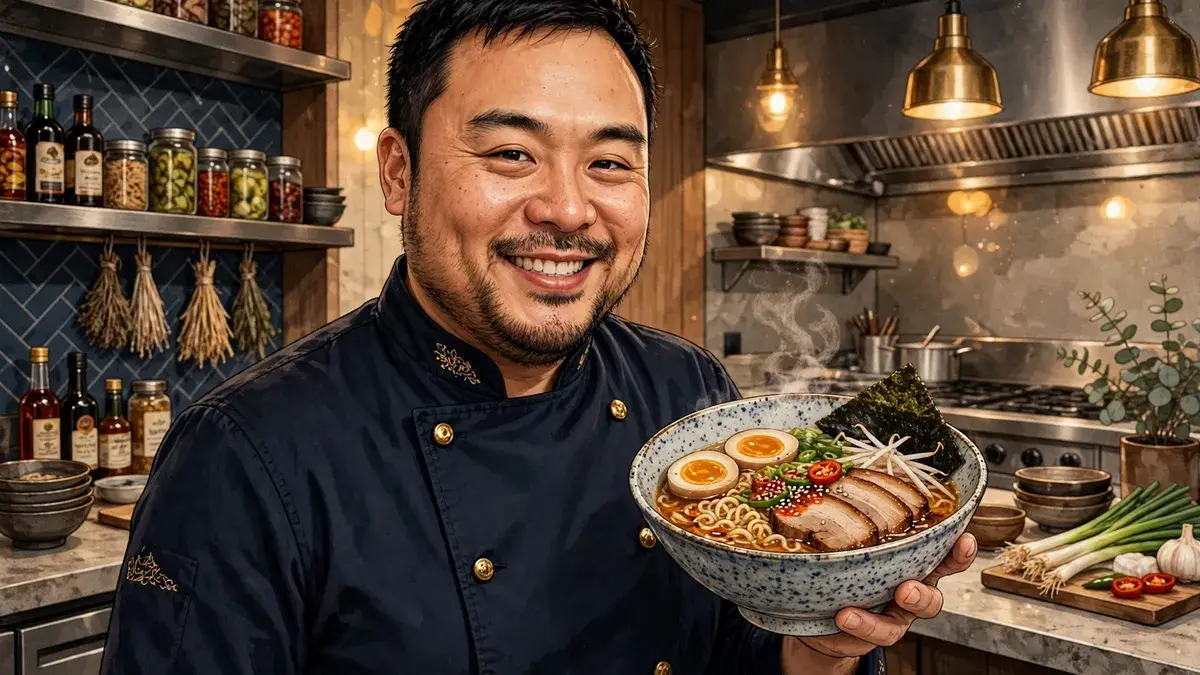
David Chang was born on August 5, 1977, in Vienna, Virginia, to Korean immigrant parents. His father ran a golf store, and the family lived a comfortable suburban life in the Washington, D.C. area. Food was a constant presence at home — Korean dishes cooked by his mother — but nothing in his childhood pointed toward a career in a kitchen. At school he was a keen golfer, following his father’s interest in the game, and he went on to study at Trinity College in Hartford, Connecticut, graduating in 1999.
After college, Chang did what plenty of bright graduates did in late-1990s New York: he went into finance. He worked in the financial world for about two years, and by his own later accounts he hated it. The job paid well and bored him, and he walked away from it to enrol at the French Culinary Institute in New York — the school now known as the Institute of Culinary Education. It was a sharp turn, from a desk job to the bottom of a kitchen hierarchy, and it shaped everything that followed. For the fuller story of his family, schooling and early jobs, see our David Chang biography.
Chang’s father had hoped his son would take a steadier path. The golf store was a family business built on long hours and thin margins, and the expectation in many Korean immigrant households of that generation was a profession — medicine, law, finance — with a clear ladder. Chang tried the ladder first: finance in New York, a good salary, and two years of growing certainty that he was in the wrong room. He was also a serious golfer in his teens, good enough that golf could have been a career of its own, and the discipline of the game — practice, repetition, small corrections — shows up in the way he later ran kitchens. When he left finance for culinary school, he was not chasing fame; he was chasing work that felt honest. The decision cost him his father’s approval for a while, a tension he writes about at length in Eat a Peach, and it is worth remembering when the net worth numbers get thrown around: the $20 million figure was built by a man who walked away from a safe salary to start again at the bottom of a kitchen.
Chang’s training was deliberately wide. He worked at Craft, Tom Colicchio’s New York restaurant, and at Café Boulud, Daniel Boulud’s fine-dining flagship. Both kitchens taught him discipline and French technique. But the food that pulled at him was not French. He travelled to Japan to study ramen properly — the broth, the noodles, the pace of a noodle bar — and came home convinced that a small, focused noodle shop could work in New York. He also spent time in the kitchen at a soba shop, learning how a tiny, single-minded restaurant survives on repetition and craft rather than on a long menu.
That idea — one thing, done obsessively well — became the whole Momofuku philosophy. Chang has said many times since that he opened his first restaurant with no real business plan and a small amount of money borrowed from family. He did not set out to build an empire. He set out to serve the ramen he had eaten in Japan, in a room small enough that he could watch every bowl leave the pass.
The Rise of Momofuku
Momofuku Noodle Bar opened in 2004 in New York’s East Village. It had 27 seats, a short menu, and a bowl of ramen that quickly became one of the most talked-about dishes in the city. The pork buns — steamed buns filled with pork belly, hoisin, scallion and cucumber — became a signature almost overnight, copied by restaurants across the country. Lines formed down the block. Food writers who had ignored the East Village started treating a noodle bar as serious cooking.
Chang moved fast after that first hit. Momofuku Ssäm Bar opened in 2006, built around Korean ssäm — meat and fillings wrapped in lettuce — and a late-night menu that drew chefs and industry people after their own shifts. In 2008 he opened Momofuku Ko, a 12-seat counter restaurant serving a tasting menu, and in the same year the bakery that became Milk Bar, founded with pastry chef Christina Tosi. Ko earned two Michelin stars in 2009, a rare honour for a restaurant of its size, and Chang collected the James Beard Foundation’s Rising Star Chef of the Year award in 2007 and its Outstanding Chef award in 2008.
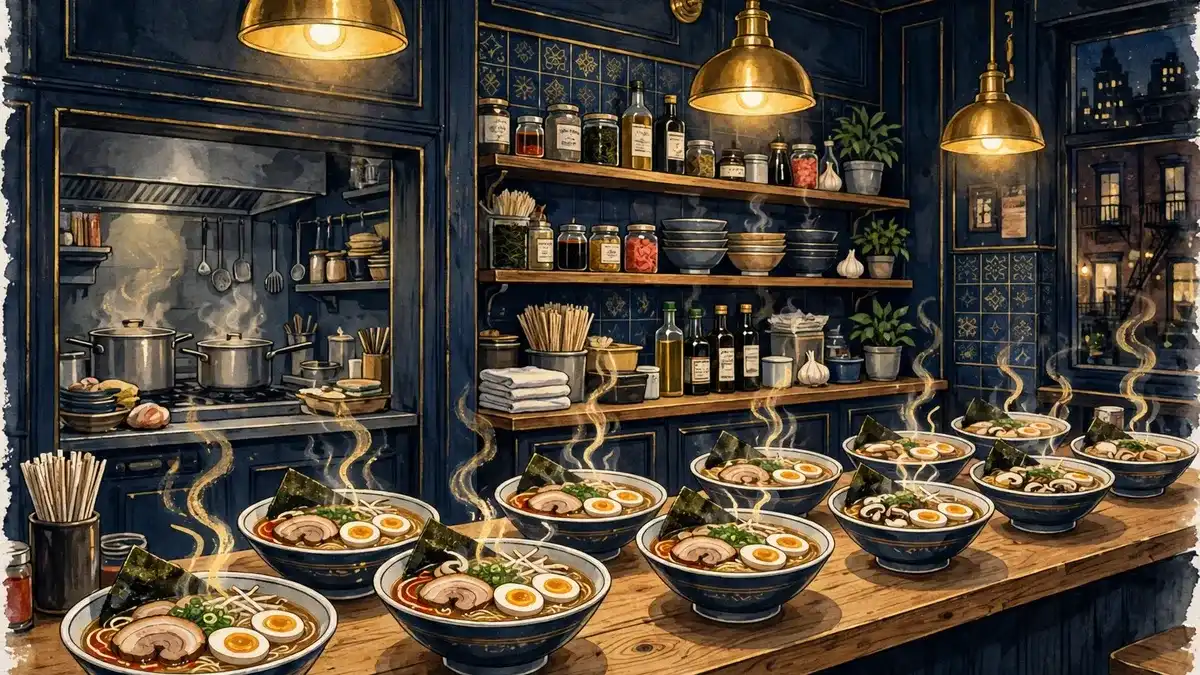
The group kept growing, but not always smoothly. Momofuku opened restaurants in Sydney and Toronto, then pulled back from some locations when the economics did not work. The Las Vegas and Los Angeles restaurants, and the Washington, D.C. spot, showed that the brand could travel — but also that a chef-led group has limits. By 2026, reporting put the active restaurant count at nine locations, a smaller, tighter group than the sprawling empire some coverage imagines. That discipline matters for the net worth picture: Chang’s restaurants are a real business, not a franchise machine, and their value sits in the brand and the operating company rather than in hundreds of units.
Alongside the restaurants, Chang built a media career that few chefs of his generation matched. He founded the food magazine Lucky Peach in 2011, which ran until 2017 and won awards for its writing and design. He published the Momofuku cookbook in 2009 and his memoir, Eat a Peach, in 2020 — a book that dealt openly with his depression, his difficult relationship with his father, and the pressure of running a growing business. On television he fronted PBS’s The Mind of a Chef, then Netflix’s Ugly Delicious (2018–2020) and Breakfast, Lunch & Dinner (2019). In 2019 he launched The Dave Chang Show, a podcast that became one of the most-listened-to food shows in the United States and a steady income stream of its own.
One of the most public moments of his career came in 2020, when Chang appeared on Who Wants to Be a Millionaire and won the $1 million top prize — the first celebrity contestant to do so. He donated the winnings to the Southern Smoke Foundation, a charity that supports food and beverage workers in crisis. The win was real money, but it went to charity, not into his own net worth, and it is worth saying so plainly because some net worth pages list it as though it were income.
Where the Money Comes From
Chang’s fortune comes from four places, and understanding the split is the key to understanding why estimates range from $20 million to $85 million. The four streams are restaurants, retail goods, media, and books and speaking. No single one of them is huge on its own. Together, over twenty years, they add up to the anchored $20 million figure — and the argument over the higher estimates is really an argument about how much the retail brand is worth.
Restaurants. The Momofuku restaurant group is the oldest and most visible part of the business. Nine active locations in 2026, according to current reporting, generate real operating profit, but restaurants are a low-margin business and Chang has never franchised the brand at scale. The value here is the equity in the operating company and the brand itself, not a pile of cash. A chef who owns his restaurants outright is wealthier on paper than his bank balance suggests, and poorer in cash than a television star with the same net worth number. That is Chang’s position: most of his wealth is tied up in businesses he runs.
Momofuku Goods. The retail arm, launched in 2020, sells the Chili Crunch condiment, soy sauces, noodles and other pantry products. Legal 500’s reporting on the trademark dispute noted that Momofuku goods were sold in more than 300 stores, and the brand has kept expanding into grocery retail since. This is the fastest-growing part of the business and the reason some estimates run far above $20 million: if you value a growing consumer brand at a multiple of its revenue, the equity stake alone can look like tens of millions. The catch is that no one outside the company has seen the revenue or the valuation, so the $50 million and $85 million figures are guesses built on that multiple, not on disclosed numbers.
Television, streaming and podcasting. Ugly Delicious ran for two seasons on Netflix, Breakfast, Lunch & Dinner for one, and The Mind of a Chef on PBS before that. Netflix does not publish what it pays a host, so no honest article can quote a per-episode fee for Chang, and this one will not try. What can be said is that a Netflix-fronted chef with two shows commands serious fees, plus ongoing residuals and the profile that drives everything else — book sales, speaking dates, brand deals. The Dave Chang Show, running since 2019, adds podcast advertising and sponsorship revenue year after year, and it keeps Chang in the public ear between television projects.
Books and other work. The Momofuku cookbook (2009) was a bestseller in its category, and Eat a Peach (2020) sold strongly on the back of Chang’s television profile. Book advances and royalties for a chef of his standing are meaningful but not fortune-making — low six figures per book in most cases, not millions. Speaking engagements, judging appearances and the occasional brand partnership add smaller amounts. None of these streams alone explains a $20 million fortune; the point is that they have stacked, year after year, for two decades.
Why the estimates disagree: Celebrity Net Worth, Parade, Famous Intel and Net Worth Forum all anchor on $20 million. Net Worth Post says $50 million and Net Worth Breakdown says $85 million. The gap is almost entirely about Momofuku Goods: value the retail brand aggressively and the number jumps; value it conservatively and it stays near $20 million. Until Chang or the company discloses a valuation, $20 million is the figure with the most support, and $20 million to $85 million is the honest range.
The Momofuku Brand Beyond the Dining Room
The most interesting part of Chang’s business in 2026 is not a restaurant at all. Momofuku Goods, launched in 2020, sells the sauces, noodles and condiments that the restaurants made famous — Chili Crunch first, then soy sauces, tamari, seasoned salts and dried noodles. The idea was simple: the flavours people queued for in the East Village could be sold in a jar, and a jar scales in a way a 27-seat dining room never will. Legal 500’s reporting on the trademark dispute put the brand in more than 300 stores, and distribution has kept widening into grocery chains and online retail since.
That shift — from chef to brand owner — is what separates Chang from most of his peers. Gordon Ramsay licenses his name to restaurants and television formats; Bobby Flay built a television career on top of his restaurants. Chang built a consumer product company inside a restaurant group, and the product company is the part with the most room to grow. A restaurant can serve a few hundred people a night; a jar of chili oil can sit on a shelf in every state. That is why the net worth estimates split so widely: the people who say $50 million or $85 million are valuing a consumer brand, not a chef.
The brand has also had to learn lessons the restaurants never taught. Grocery retail means shelf space, pricing, supply chains and packaging — skills no culinary school covers. The Chili Crunch trademark row of 2024 was the sharpest of those lessons, and it showed that a brand built on an Asian food tradition answers to the community that created the tradition. Chang’s response — backing down, apologising, and keeping the product on sale — kept the business intact, but it also showed the limits of treating a condiment like a piece of intellectual property.
There is a second brand story that often gets folded into Chang’s numbers by mistake: Milk Bar. The bakery opened in 2008 inside the Momofuku group, founded with pastry chef Christina Tosi, and it became a separate company in its own right, with its own stores and its own valuation. Tosi runs it, and its value belongs to her and her investors, not to Chang’s balance sheet. Any net worth page that adds Milk Bar’s worth to Chang’s is double-counting, and this article does not do so. The same care applies to Lucky Peach, the magazine Chang founded in 2011: it was a critical success and a money-loser, closed in 2017, and it added to his reputation far more than to his bank account.
What the brand story means for the $20 million anchor is straightforward. The restaurant group is a mature, profitable business worth a solid but not spectacular sum. The retail brand is younger, faster-growing and harder to value — worth $5 million on a cautious reading and many times that on an optimistic one. The media work is the engine that feeds both: every Netflix series and every podcast episode puts the Momofuku name in front of people who may never eat in the restaurants but will buy a jar of Chili Crunch. The three parts reinforce each other, and that is the real shape of Chang’s fortune: not a pile of cash, but a loop in which fame sells sauce, sauce funds restaurants, and restaurants justify the fame.
Net Worth Breakdown and Peer Comparison
The table below is our own estimate of how the anchored $20 million is made up. These are not disclosed figures — Chang has never published his finances — but a breakdown built from the four income streams above, the size of the businesses, and the pattern of similar chef fortunes. Treat it as a guide to where the money sits, not as an audited statement.
| Component | Estimated Value |
|---|---|
| Momofuku restaurant group equity | $7 million |
| Momofuku Goods retail brand equity | $5 million |
| Media, podcast, books and speaking (career earnings retained) | $5 million |
| Investments and savings | $3 million |
| Total (anchored estimate) | $20 million |
If the higher estimates are right, the difference sits almost entirely in the second row. A $50 million total would mean the retail brand is worth roughly $30 million rather than $5 million; an $85 million total would mean it is worth more than $60 million. Both are possible if Momofuku Goods keeps growing and is one day sold or valued by an outside investor — but neither has been confirmed, which is why this article anchors on $20 million.
Against his peers, Chang sits in the middle of the celebrity-chef table. Gordon Ramsay’s net worth is estimated at around $220 million, built on a global restaurant empire, television formats and licensing on a scale Chang has never attempted. Wolfgang Puck’s net worth is estimated at around $120 million, and Guy Fieri’s at around $100 million. Bobby Flay’s net worth is estimated at around $60 million — the closest comparison, since Flay, like Chang, built his fortune on restaurants first and television second. Chang’s $20 million puts him well behind the television-first chefs and comfortably ahead of most working chefs who never built a brand at all.
| Chef | Estimated Net Worth |
|---|---|
| Gordon Ramsay | ~$220 million |
| Wolfgang Puck | ~$120 million |
| Guy Fieri | ~$100 million |
| Bobby Flay | ~$60 million |
| David Chang | ~$20 million |
Figures for peers are the widely cited Celebrity Net Worth estimates. For more chef fortunes, browse our net worth section.
Career and Wealth Timeline
| Year | Milestone |
|---|---|
| 1977 | Born August 5 in Vienna, Virginia |
| 1999 | Graduates from Trinity College, Hartford, Connecticut |
| 2000 | Leaves finance for the French Culinary Institute; kitchen stints at Craft and Café Boulud follow |
| 2004 | Opens Momofuku Noodle Bar, East Village, New York — 27 seats |
| 2006 | Momofuku Ssäm Bar opens |
| 2007 | James Beard Rising Star Chef of the Year |
| 2008 | Momofuku Ko and Milk Bar open; James Beard Outstanding Chef |
| 2009 | Two Michelin stars for Momofuku Ko; Momofuku cookbook published |
| 2011 | Founds Lucky Peach magazine (runs until 2017) |
| 2018 | Ugly Delicious premieres on Netflix |
| 2019 | Launches The Dave Chang Show podcast |
| 2020 | Momofuku Goods launches; wins $1 million on Who Wants to Be a Millionaire and donates it to the Southern Smoke Foundation; Eat a Peach published |
| 2024 | Chili Crunch trademark dispute; Momofuku backs down in April |
| 2026 | Net worth anchored at $20 million by Celebrity Net Worth and Parade; honest range $20 million – $85 million |
Assets and Lifestyle
Here is where an honest article has to say what it does not know. There is no public record of David Chang owning a portfolio of houses, a car collection or a string of investment properties, and this article will not invent one. Unlike some celebrity chefs who collect real estate, Chang’s wealth sits in the businesses he owns and runs. He lives in the New York area, where Momofuku is based, and he has kept his home life out of the property pages.
What can be documented is the business footprint: the restaurant group, the retail brand, and the media work. The restaurants themselves — their leases, their equipment, their brand value — are the assets. Momofuku Goods, with its grocery distribution, is an asset that grows in value every year the brand expands. And the name itself is an asset: a chef who can front a Netflix series and sell a jar of chili oil in 300 stores owns something no landlord can take away.
That structure also explains why the higher net worth estimates are so hard to pin down. A restaurant lease is worth what the business earns from it; a retail brand is worth what a buyer would pay for it; a television profile is worth what the next deal brings. None of those numbers is published, so the only honest way to count Chang’s assets is to name the businesses and say what they do, rather than to attach a price to a house or a car he has never been shown to own. The businesses are the fortune, and they are also the work — which is why Chang still talks like a cook who happens to own companies, rather than a businessman who happens to cook.
Chang’s lifestyle, as he presents it publicly, is notably unflashy for a man with a $20 million estimate. He talks about cooking at home for his children, about the restaurants he eats at rather than the ones he owns, and about the grind of running a business rather than the rewards of it. That fits the pattern of his career: the money has always been a by-product of the cooking, not the other way round.
Personal Life
Chang married Grace Seo Chang in 2017. The couple have two children: a son, Hugo, born in 2019, and a daughter. Chang keeps his family life largely private — his wife and children appear in his social media only rarely, and he has said that becoming a father changed the way he cooks and the way he runs his business. The memoir Eat a Peach is the fullest public account of his private life: his relationship with his father, who ran a golf store and expected his son to follow a safer path; his struggles with depression; and the anger and drive that powered the early years of Momofuku.
That openness about mental health is unusual among chefs of his standing, and it is part of why his public image has held up through the controversies of his career. He has spoken about therapy and about the pressure of being the public face of a company with hundreds of employees. Fatherhood, by his own account, softened some of that drive without removing it — the restaurants still demand long hours, but the podcast and the retail brand let him work in ways that keep him closer to home.
Chang’s Korean-American identity runs through his work in a way that goes beyond the menu. Momofuku’s food mixes Korean flavours with Japanese technique and American ingredients, and Chang has used his platform to talk about Asian-American representation in food media — a subject that came back sharply during the Chili Crunch dispute, when the criticism came largely from within the Asian-American food community he counts as his own.
The Chili Crunch Trademark Row
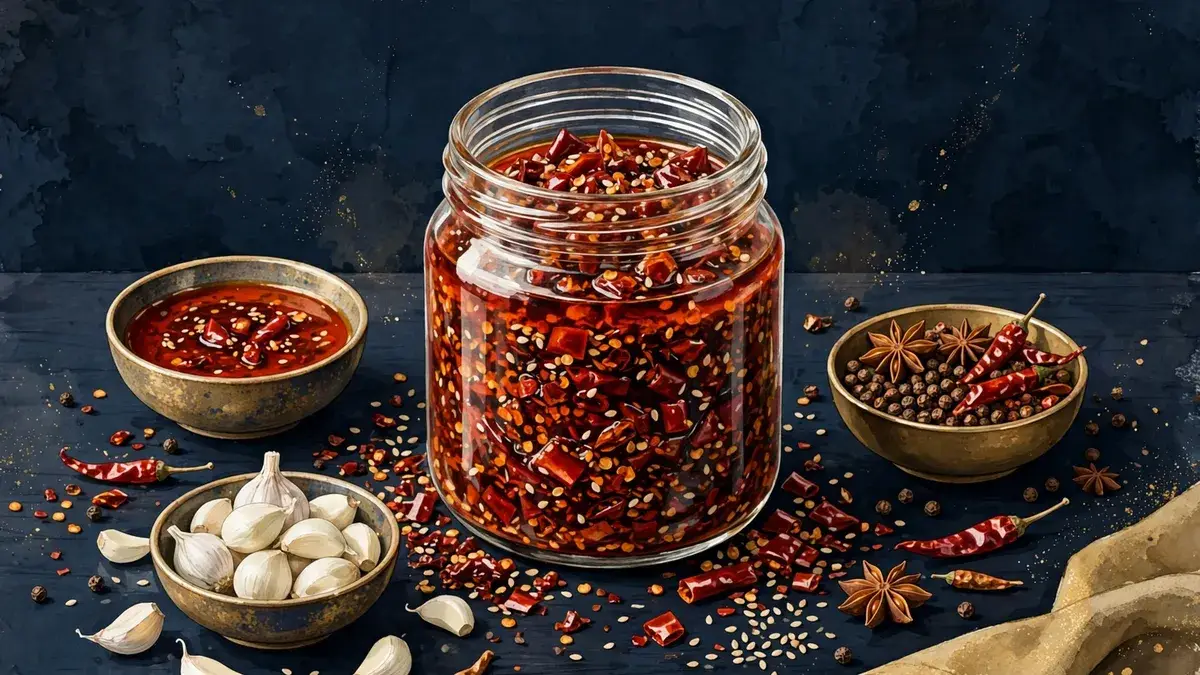
No account of Chang’s recent career is complete without the Chili Crunch affair of 2024, the biggest public controversy of his working life. Momofuku had been selling its Chili Crunch condiment since 2020, and in 2023 the company acquired the trademark for “Chile Crunch” — spelled with an “e” — from a Colorado company, Chile Colonial, after a legal settlement. In March 2024, Momofuku applied to trademark “Chili Crunch” — with an “i” — and sent cease-and-desist letters to seven smaller businesses using the term, most of them small brands founded by Asian Americans.
The reaction was swift and fierce. The recipients shared their letters on social media, The Guardian reported the story on April 4, 2024, and the complaints went viral. The argument from the small brands was simple: chili crunch — like chili crisp — is a generic term for a condiment with deep roots in Chinese and wider Asian cooking, and no one company should own it. Chang was accused of using his size and fame to bully smaller, often minority-owned businesses, and the criticism stung all the more because it came from the community he had long claimed as his own.
Momofuku first stood by its actions, saying it was obliged to defend its trademark or risk losing it. But within days the company reversed course. On April 12, 2024, Momofuku said it would not defend its trademark on the name “chile crunch” after the outcry, and Chang apologised on his podcast, saying he wanted to apologise to everyone in the Asian-American and Pacific Islander community who felt hurt or marginalised by the company’s actions, and admitting that had he known chili crunch was effectively the same as chili crisp, the product would never have been named that way. The Associated Press reported the climbdown the same day.
The episode did not damage the retail brand’s sales in any lasting, documented way — Chili Crunch is still sold widely — but it left a mark on Chang’s reputation and on the way Momofuku handles its brand. It also showed, for anyone counting the money, that the retail business is the part of the empire most exposed to public opinion: a restaurant can survive a bad review, but a grocery product lives or dies on whether shoppers trust the name on the jar.
Frequently Asked Questions
What is David Chang’s net worth in 2026?
David Chang’s net worth is estimated at $20 million in 2026, according to Celebrity Net Worth, a figure Parade repeated in its 2026 reporting and Famous Intel and Net Worth Forum also carry. Some sources go higher — Net Worth Post says $50 million and Net Worth Breakdown says $85 million — so the honest range is $20 million to $85 million, with $20 million as the anchored figure.
How did David Chang make his money?
Chang made his money from four streams: the Momofuku restaurant group, founded with the Noodle Bar in 2004; the Momofuku Goods retail brand, led by its Chili Crunch condiment; television and streaming, including Netflix’s Ugly Delicious and Breakfast, Lunch & Dinner; and his podcast The Dave Chang Show, plus books including Eat a Peach. Most of his wealth sits in equity in the restaurant and retail businesses rather than in cash.
How old is David Chang?
David Chang is 49 years old as of November 2026. He was born on August 5, 1977, in Vienna, Virginia, to Korean immigrant parents.
Who is David Chang’s wife?
David Chang’s wife is Grace Seo Chang. The couple married in 2017 and have two children — a son, Hugo, born in 2019, and a daughter. Chang keeps his family life largely private.
What is Momofuku?
Momofuku is the restaurant group David Chang founded in 2004 with the Momofuku Noodle Bar, a 27-seat ramen shop in New York’s East Village. It grew to include Momofuku Ssäm Bar, the two-Michelin-starred Momofuku Ko, and restaurants in Las Vegas, Los Angeles and Washington, D.C., plus the Momofuku Goods retail brand. The name means “lucky peach” in Japanese.
Does David Chang still own Momofuku?
Yes. David Chang remains the founder of Momofuku and is involved in the restaurant group and the Momofuku Goods retail brand. The bakery he founded with Christina Tosi in 2008, Milk Bar, later became a separate company, but the core Momofuku restaurants and retail business remain his.
What happened with the Chili Crunch trademark?
In March 2024, Momofuku sent cease-and-desist letters to seven small businesses using the term “Chili Crunch,” most of them small Asian American-owned brands. After a public backlash, Momofuku said on April 12, 2024, that it would not enforce the trademark, and Chang apologised on his podcast. Momofuku had acquired the “Chile Crunch” mark from Chile Colonial in 2023.
What is David Chang doing now in 2026?
In 2026 Chang continues to run the Momofuku restaurant group and the Momofuku Goods retail brand, and he hosts The Dave Chang Show podcast, which he launched in 2019. His television work includes Netflix’s Ugly Delicious and Breakfast, Lunch & Dinner, and his memoir Eat a Peach was published in 2020.
Bottom Line
David Chang’s net worth in 2026 is an estimated $20 million, anchored by Celebrity Net Worth and repeated by Parade, Famous Intel and Net Worth Forum. The honest range runs to $85 million, and the whole argument sits in how much the Momofuku Goods retail brand is worth — a number nobody outside the company has seen. What is not in doubt is how the money was made: a 27-seat noodle bar in 2004, two Michelin stars, a Netflix career, a podcast, and a jar of chili oil that turned a restaurant brand into a grocery brand. Chang is not the richest celebrity chef — Gordon Ramsay’s $220 million is ten times his figure — but few chefs have turned so small a start into so durable a business, and the retail brand still has room to grow. If Momofuku Goods is ever sold or valued by an outside investor, the $20 million anchor will need revising. Until then, it is the figure with the most support.
Sources and Reporting
How we estimated this: We compared the latest published estimates — Celebrity Net Worth and Parade (2026), Famous Intel, Net Worth Forum, Net Worth Post ($50 million) and Net Worth Breakdown ($85 million) — then checked them against Chang’s documented career: the Momofuku restaurant group, the Momofuku Goods retail launch in 2020, his Netflix and podcast work, and his books. Where sources disagree, we publish the range and name who says what. Net worth figures for public personalities are estimates built from public reporting, not audited financial statements. We excluded two figures found online: a blogspot post claiming $200 million to $500 million, which cites no source, and the InsiderTrades page for “David D. Chang,” the Allogene Therapeutics chief executive, who is a different person. The Chili Crunch dispute is reported from the Associated Press (April 12, 2024), QSR Magazine and Legal 500; the restaurant count comes from 2026 reporting.
Sources consulted: Parade, Celebrity Net Worth, Famous Intel, Net Worth Forum, Net Worth Post, Net Worth Breakdown, Associated Press, QSR Magazine, Legal 500, Ravex Life.