Last updated: November 12, 2026 — by Celebamerica Editorial Staff
Wolfgang Puck’s net worth in 2026 is estimated at $120 million. That is the figure Celebrity Net Worth carries after its August 2025 update, and it is the same number Parade puts on him in its 2026 profile, updated in August 2026. Alux’s November 2026 ranking of the richest celebrity chefs lands on the same $120 million. A few trackers run higher or lower — one chef-focused site said $130 million in 2023, while an older profile still shows $70 million — but the careful, current sources agree on $120 million, and that is the number this article anchors on.
Puck did not build that fortune by standing at one stove. He built it the way a founder builds a company: one famous restaurant became a brand, the brand became three companies, and those three companies now cover fine dining, catering, airport counters, grocery shelves, cookbooks, and television. Spago made him famous. The licensing machine behind Spago made him rich. At 77, he is still cooking the Oscars Governors Ball — March 15, 2026 was his 32nd year feeding Hollywood’s biggest night — and still opening restaurants around the world.
This article works through the whole picture: where the $120 million comes from, how each source arrived at its number, the restaurants and deals behind it, the real estate, the family, and how Puck’s fortune stacks up against the other chefs who turned cooking into big business.
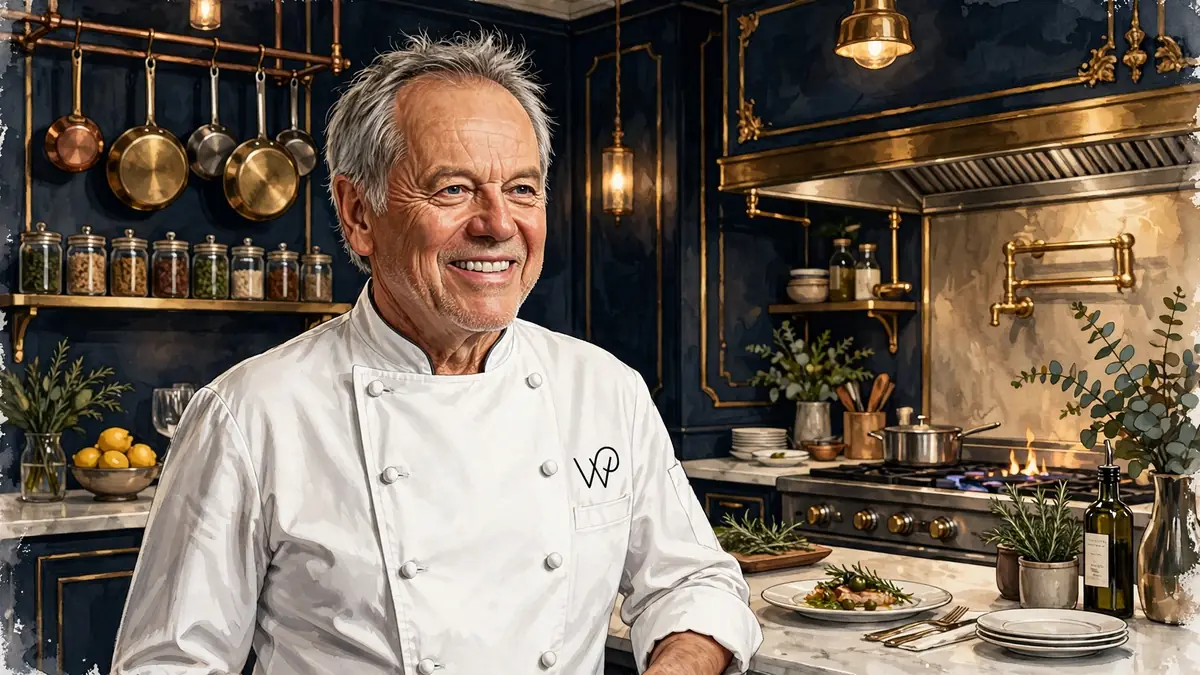
Quick Facts: Wolfgang Puck
| Full Name | Wolfgang Johannes Topfschnig (later Wolfgang Johannes Puck) |
|---|---|
| Date of Birth | July 8, 1949 |
| Age | 77 (as of November 2026) |
| Birthplace | Sankt Veit an der Glan, Carinthia, Austria |
| Estimated Net Worth | $120 million (as of November 2026) |
| Primary Income Sources | Fine-dining restaurants, catering, brand licensing, consumer products, cookbooks, television |
| Key Ventures | Spago, CUT, Chinois, Wolfgang Puck Fine Dining Group, Wolfgang Puck Catering, Wolfgang Puck Worldwide Inc. |
| Signature Role | Official chef of the Academy Awards Governors Ball for 32 years |
| Spouse | Gelila Assefa (married 2007) |
| Children | Four sons: Cameron, Byron, Oliver, Alexander |
| Current Home | Los Angeles, California |
Table of Contents
- Quick Facts: Wolfgang Puck
- How Much Is Wolfgang Puck Worth in 2026?
- How We Estimated the Figure
- Early Life in Austria
- From Apprentice Kitchens to Ma Maison
- Spago and the Birth of California Cuisine
- The Wolfgang Puck Companies: Three Businesses, One Name
- CUT, Chinois and the Fine-Dining Empire
- The Oscars Governors Ball: Thirty-Two Years at Hollywood’s Table
- Television, Cookbooks and the Celebrity Chef Brand
- Where the Money Comes From
- Real Estate and Assets
- Net Worth Growth Over the Years
- How Puck Compares to Other Celebrity Chefs
- Personal Life and Family
- Philanthropy
- Controversies and Public Record
- Frequently Asked Questions
- Final Thoughts: The Bottom Line
- Sources and Reporting
How Much Is Wolfgang Puck Worth in 2026?
The short answer is $120 million. The longer answer is that the number has been steady for years, and the steady part is what makes it believable. Celebrity Net Worth lists Puck at $120 million with an update dated August 21, 2025. Parade’s 2026 profile, published in January 2026 and updated August 7, 2026, gives the same figure in plain words: “Wolfgang Puck’s net worth in 2026 is estimated at a scrumptious $120 million.” Alux, ranking the richest celebrity chefs in November 2026, places him fifth at $120 million. Three independent trackers, three different editorial teams, one number.
That kind of agreement is rare in celebrity wealth reporting, where the same person can be listed at wildly different figures depending on which site you open. Puck’s case is tighter because his wealth is tied to visible, countable things: restaurants with addresses, a catering company with named clients, products on grocery shelves. Nobody has to guess whether a private tech stake exists. The business is the fortune, and the business is out in the open.
There is still a range, and an honest article should show it. Famous Chefs, a chef-focused site, put Puck at $130 million in a 2023 profile, which suggests the top end of the plausible range sits about $10 million above the anchor. Wealtholino still shows $70 million, but that page is visibly stale — it lists his age as 69, which dates its facts to around 2018. Celebrity Birthdays lists $90 million. A couple of low-quality aggregators throw out numbers from $12 million to $160 million, but those pages carry obvious errors (one lists his birth year as 1995) and no working method behind the figures. Strip out the stale and the sloppy, and the honest range is $120 million to $130 million, anchored at $120 million because that is where the two most current, most careful sources agree.
The anchor: $120 million — Celebrity Net Worth (updated August 21, 2025) and Parade (2026, updated August 7, 2026). Plausible range: $120 million to $130 million. Figures below $100 million trace to stale pages that have not been updated in years.
How We Estimated the Figure
No celebrity net worth is an audited fact. Puck’s companies are private, he has never published a balance sheet, and no tax return is public. Every number in this article is an estimate built from public reporting, and the method matters more than the number itself. Here is how the $120 million holds together.
First, the sources were weighed by freshness and method. Celebrity Net Worth says its figures are calculated from public sources and, where provided, private tips from the celebrity or their representatives. Parade’s 2026 profile is dated and updated in 2026, and it cross-checks the restaurant count (21 fine-dining restaurants) and the company structure against Puck’s own operation. Alux’s November 2026 ranking states its basis outright: public reporting, company valuations, and deal and earnings figures run through an internal valuation model. Those three are the spine of the estimate.
Second, the outliers were checked, not ignored. Famous Chefs’ $130 million from 2023 is the only serious figure above the anchor, and it also claims Puck earns around $20 million a year from his culinary work — a number no other source repeats, so this article treats it as that site’s own estimate rather than a confirmed salary. Wealtholino’s $70 million and Celebrity Birthdays’ $90 million are both older snapshots that have not kept up with the business. TheMost10’s 2026 table jumps to $160 million with no sourcing at all. None of these move the anchor, but they set the edges of the range.
| Source | Figure | Date | How much weight we give it |
|---|---|---|---|
| Celebrity Net Worth | $120 million | Updated Aug 21, 2025 | High — the standard tracker, regularly updated |
| Parade | $120 million | Published Jan 2026, updated Aug 7, 2026 | High — current, dated, checks the business |
| Alux | $120 million | November 2026 | High — fresh ranking with a stated method |
| Famous Chefs | $130 million | 2023 | Medium — sets the top of the range |
| Celebrity Birthdays | $90 million | Undated | Low — no method shown |
| Wealtholino | $70 million | Stale (lists age 69) | Low — facts years out of date |
Third, the figure was tested against the business itself. Twenty-one fine-dining restaurants, more than 80 Express outlets, a catering arm that serves the Academy Awards, and a licensing arm putting his name on products in supermarkets and airports — that is a business that can plausibly be worth nine figures to its owner. One aggregator, NetWorthBreakdown, models the restaurant group as generating more than $300 million a year in revenue, but that number is that site’s own model, not a disclosed figure, so this article does not present it as fact. What can be said plainly is that the scale of the operation fits a $120 million personal fortune and would not fit a $12 million one.
Early Life in Austria
Wolfgang Puck was born Wolfgang Johannes Topfschnig on July 8, 1949, in Sankt Veit an der Glan, a small town in Carinthia in southern Austria, close to the Italian and Slovenian borders. His mother was Maria Worth. His father, a butcher, left before Wolfgang was born. In 1956, when Wolfgang was seven, Maria married Josef Puck, who adopted the boy and gave him the surname the world now knows. The marriage brought a half-brother and two half-sisters into the family.
The childhood was spare. Puck has described a house with no indoor plumbing and simple food on the table, a long way from the dining rooms he would one day run. That background shows up in the way he talks about cooking even now: as a craft learned by doing, not a theory learned from books. If you want the full arc of that childhood into his adult career, Wolfgang Puck’s full biography on our sister site GuideNetWorth covers the same story from the biography angle, with more on his family and early years.
As a teenager he began an apprenticeship in a local hotel kitchen, the standard route into cooking in post-war Austria. It was hard, repetitive work — peeling, chopping, cleaning — and it taught him the discipline that fine dining runs on. He then trained in France, working in some of the country’s best kitchens and absorbing the classical French technique that would shape everything he cooked afterward. The French training matters because it is the base layer under his later California cooking: the sauces, the stocks, the respect for ingredients, all learned the strict way before he ever broke the rules.
The 2021 documentary Wolfgang, directed by David Gelb, tells this part of the story on screen — the Austrian childhood, the French kitchens, the move to America — and it is the best single watch for anyone who wants Puck’s early life in his own words. He has never hidden where he came from, and he still talks about it as the reason he works the way he does.
From Apprentice Kitchens to Ma Maison
Puck moved to the United States when he was 24, in 1973, with French training and very little else. His first American job was at La Tour in Indianapolis, where he spent two years cooking French food for a Midwestern audience. Two years in Indianapolis taught him something the French kitchens had not: how American diners actually eat, what they expect, and how far a menu can bend before it breaks.
In 1975 he moved to Los Angeles and became chef at Ma Maison in West Hollywood, where he was also a part-owner. Ma Maison was the making of him in America. It was a French restaurant, but Puck began bending the rules there — lighter sauces, local California produce, dishes that owed as much to the farmers’ market as to the French canon. The Hollywood crowd noticed. Ma Maison became the room where the city’s film and music people ate, and Puck became the chef they asked for by name.
The first cookbook followed in 1981: Modern French Cooking for the American Kitchen, built from his Ma Maison recipes. Cookbooks would become a steady part of the business — more than a dozen over his career — but the first one mattered most, because it put his name in front of home cooks across the country a year before he opened his own restaurant. By the time Spago opened, people already knew the name on the door.
Spago and the Birth of California Cuisine
In 1982, Puck and his then-wife and business partner Barbara Lazaroff opened Spago on the Sunset Strip in West Hollywood. It was a gamble on a new idea: a restaurant with an open kitchen, where diners could watch the cooking, and a menu that mixed French technique with California ingredients and a few ideas borrowed from Asia. The smoked salmon pizza — salmon, dill, caviar on a thin crust — became the signature dish, and it is still the dish people mean when they say “Wolfgang Puck” in one breath.
Spago worked because it broke the formal rules of fine dining without lowering the standard of the food. The room was light and full of art, the kitchen was on display, and the crowd was the entertainment industry itself. Within a few years it was one of the most famous restaurants in America, and Puck was no longer just a chef — he was a name, a brand, and the first person to prove that a chef could be a celebrity in the modern sense. Food writers now call him arguably the first celebrity chef, and the claim holds up: before Puck, chefs were staff. After him, they were stars.
Fifteen years later, in 1997, Puck and Lazaroff moved Spago to Beverly Hills, where it still sits today. The Beverly Hills Spago has been counted among the Top 40 Restaurants in the United States since 2004, and it won the James Beard Foundation’s Outstanding Service Award in 2005. The move was also a business decision — Beverly Hills put the flagship where its customers already lived — and it showed the pattern that would define Puck’s career: the restaurant is the advertisement, and the brand is the business.
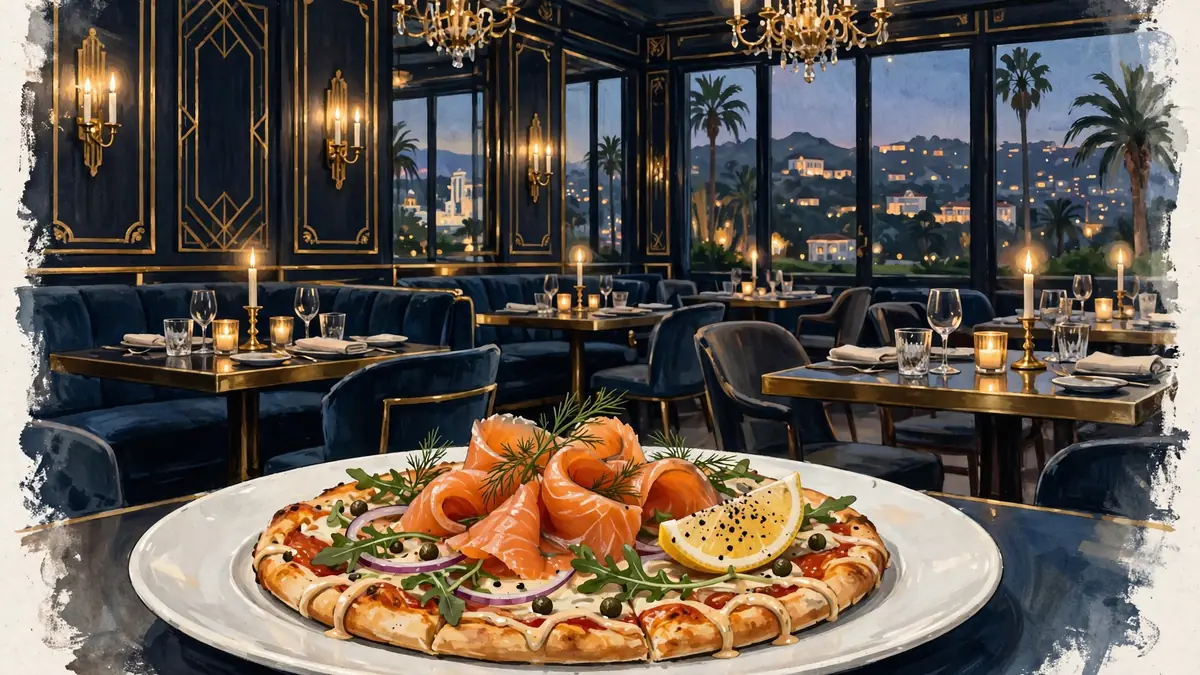
The Wolfgang Puck Companies: Three Businesses, One Name
The move that turned a famous chef into a wealthy one was structural, not culinary. Puck split his operation into three companies under the Wolfgang Puck Companies umbrella, each doing a different job:
- Wolfgang Puck Fine Dining Group — the high-end restaurants: Spago, CUT, Chinois, and the rest of the fine-dining portfolio.
- Wolfgang Puck Catering — large-scale catering for the Academy Awards Governors Ball and other high-profile events.
- Wolfgang Puck Worldwide, Inc. — the licensing and consumer-products arm: franchises, airport and casual outlets, cookbooks, canned foods, coffee, and kitchen merchandise.
That split is the whole financial story in miniature. The Fine Dining Group makes the reputation. Catering makes big-ticket event money. Worldwide takes the name and puts it on things that scale — a frozen pizza sells in thousands of stores without Puck standing in a kitchen, and a licensing fee arrives whether or not he lifts a pan. Parade reports that he owns 21 fine-dining restaurants worldwide, and the wider operation runs to more than 80 Wolfgang Puck Express outlets, plus franchises and counters in airports and supermarkets. The exact count shifts as locations open and close, but the shape is stable: a small number of famous rooms at the top, and a wide base of licensed and casual outlets underneath.
The genius of the structure is that the top feeds the bottom. Spago’s fame is what lets an airport counter charge a premium for a turkey sandwich with Puck’s name on it, and the licensing money is what lets the fine-dining rooms keep their standards without chasing volume. One food-business writer put it bluntly: Spago is the marketing department, and Worldwide is the money. The $120 million sits in the middle of that loop.
CUT, Chinois and the Fine-Dining Empire
After Spago, Puck built the portfolio one concept at a time. Chinois on Main opened in Santa Monica in 1983, a year after Spago, bringing Asian flavors into his French-California cooking — an early bet on fusion that now looks obvious but was a risk at the time. Granita, a seafood restaurant in Malibu, followed in 1991 as his fourth restaurant. Each opening added a room, a cuisine, and a little more proof that the name could travel.
The biggest single addition came in 2006, when he opened CUT, a contemporary steakhouse, in the Beverly Wilshire hotel. CUT won a Michelin star in 2007, and the Singapore CUT, at Marina Bay Sands, won one in 2016. Spago Beverly Hills held two Michelin stars from 2009 before later losing them, according to Parade’s reporting. Across the group, Puck’s restaurants currently hold two Michelin stars. CUT now has locations in Beverly Hills, Las Vegas, London, New York City, Washington D.C., Bahrain, and Singapore, and Spago has spread to Las Vegas, Maui, Istanbul, Budapest, and Singapore.
The Las Vegas move deserves a note of its own. When Puck opened Spago in Las Vegas in 1992, the city was not yet a fine-dining destination, and plenty of people thought he was wasting the brand. Today his Vegas portfolio — Spago, CUT at the Venetian, Wolfgang Puck Bar & Grill at MGM Grand — is one of the anchors of the whole business. The same pattern repeated in Singapore, London, and Istanbul: go in early, carry the name, and let the room prove itself. Few chefs have ever expanded that far without watering down the food, and that restraint is part of why the name still commands a premium.
The Oscars Governors Ball: Thirty-Two Years at Hollywood’s Table
Every year, after the Academy Awards ceremony ends, about 1,500 of the most famous people in the world walk into the Governors Ball — the Academy’s official after-party — and eat Wolfgang Puck’s food. He has cooked it for more than three decades. March 2025, the 97th Academy Awards, was his 31st year running the Ball. March 15, 2026 was his 32nd.
The job is enormous. Puck and his team prepare tens of thousands of individual plates in a single night — passed appetizers, small plates, desserts — for a guest list that includes every winner, every nominee, and the people who run the industry. His son Byron has worked alongside him at the Ball in recent years, after spending time cooking in a restaurant near Barcelona before joining the family business. The menu changes every year, with nods to the season and the moment; the 2026 menu carried a Spanish accent, in keeping with the year’s theme.
The Ball pays, but its real value is different. There is no better advertisement in the world than feeding the Oscars. Every March, the biggest names in film eat his food on camera, and every March, the catering arm of his company gets a fresh wave of inquiries from people planning weddings, galas, and corporate events. The Governors Ball is the reason Wolfgang Puck Catering can charge what it charges, and it is one of the clearest examples in the food world of a prestige job that also happens to be a profit center.
Television, Cookbooks and the Celebrity Chef Brand
Puck was on television before “celebrity chef” was a job title. He played himself on Frasier, had a recurring role as himself on Las Vegas, and made a cameo in The Weather Man. He has appeared as a guest judge and mentor across cooking television, and in 2003 he became a syndicated recipe columnist through Tribune Content Agency, putting his recipes in newspapers across the country every week.
The television work matters to the net worth for a simple reason: it keeps the name in front of people who will never eat at Spago. A viewer who watches him judge a dish on TV is a future customer for a cookbook, a frozen pizza, or an airport sandwich. The cookbooks — more than a dozen, starting with Modern French Cooking for the American Kitchen in 1981 — work the same way, turning a restaurant reputation into a product that sells while he sleeps.
He took the TV route further than most of his peers, but he never let it swallow the restaurants. That is the difference between Puck and a pure television chef: the restaurants came first, the TV followed, and the restaurants are still the proof that the TV is real. Guy Fieri’s biography tells the opposite version of the same story — a chef who built his fortune mostly through television — and the contrast shows why Puck’s wealth has lasted: his is built on rooms and companies, not on a single contract.
Where the Money Comes From
Puck has never disclosed his income, and no official salary is public. What follows is an honest breakdown of the streams, built from the known structure of his three companies and the figures the sources do report. One independent aggregator, NetWorthBreakdown, models the $120 million as roughly $60 million from the restaurant group, $25 million from endorsements and licensing, $20 million from catering and events, $10 million from television and media, and $5 million from cookbooks and products. Those are modeled numbers, not disclosed ones, and this article presents them as that site’s model — but they line up well with how the business actually works, so they are worth showing.
| Income Stream | How it works | Role in the fortune |
|---|---|---|
| Fine-dining restaurants | 21 restaurants including Spago and CUT, in Beverly Hills, Las Vegas, London, Singapore, and more | The largest single piece; the restaurants are the asset itself |
| Catering | Wolfgang Puck Catering, including 32 years of the Oscars Governors Ball and other high-end events | High-ticket event fees and a steady corporate book |
| Licensing and consumer products | Wolfgang Puck Worldwide: Express outlets, airport counters, grocery products, cookware, coffee | The scalable piece — fees and royalties that do not depend on his time |
| Television and media | Guest judging, appearances, a syndicated recipe column since 2003 | Keeps the brand visible and feeds the other streams |
| Cookbooks | More than a dozen books since 1981 | Steady backlist income and brand reinforcement |
One chef-focused outlet, Famous Chefs, estimates his annual earnings at around $20 million a year from his culinary work. That number is not repeated by any other source, so treat it with care — it is one site’s estimate, not a confirmed salary. What is safe to say is that the licensing arm is the most profitable part of the machine per hour of his time. A fine-dining restaurant is a hard business with thin margins; a licensing fee on a grocery product is close to pure profit. Puck understood that split earlier than almost any other chef, and it is the main reason his fortune is larger than chefs who stayed behind one stove.
The key insight: fine dining made Puck famous, but it is not where most of the money sits. The licensing and consumer-products arm — the name on grocery shelves, airport counters, and Express outlets — is what turns a famous restaurant into a nine-figure fortune.
Real Estate and Assets
Real estate is the most visible part of Puck’s wealth, because property sales leave a public record. Celebrity Net Worth reports two homes that anchor the picture. In 2013, Wolfgang and Gelila paid $14 million for a 12,289-square-foot home in Los Angeles known as Villa Les Violettes. The eight-bedroom estate sits on 1.25 acres and includes an outdoor kitchen, a swimming pool, a spa, a tennis court, and a library. It is the family home, and it is also the single biggest asset he is known to own.
Earlier, in 2003, Puck bought a 6,025-square-foot, five-bedroom home in Beverly Hills for $3.675 million. He put it on the market for $8.495 million in 2015 — a paper gain of nearly $5 million on that one property, and a neat illustration of how Los Angeles real estate has padded celebrity fortunes over the last two decades. No later sale price is publicly confirmed, so this article does not claim a final number.
Beyond property, the assets are the businesses themselves: his stake in the Fine Dining Group, the catering company, and Worldwide Inc. Those stakes are private and have never been valued in public, which is exactly why the net worth is an estimate and not a fact. A restaurant group with 21 fine-dining rooms and a licensing arm is worth a great deal on paper, but its value depends on buyers, on the strength of the brand, and on whether the name keeps its shine after the founder steps back. At 77, Puck is still working, and the brand is still his. That is worth something no spreadsheet captures.
Net Worth Growth Over the Years
There is no year-by-year balance sheet for Puck, so the growth story has to be told through the business milestones and the source record. The shape of it is clear: a long, slow build in the 1980s and 1990s, then a sharp rise as the licensing arm grew in the 2000s, then a long plateau at around $120 million as the empire matured.
| Period | What happened | Effect on the fortune |
|---|---|---|
| 1975–1982 | Ma Maison, then the first cookbook in 1981 | Working chef with a growing name; no serious wealth yet |
| 1982–1997 | Spago opens; Chinois (1983), Granita (1991); Spago moves to Beverly Hills (1997) | Restaurant wealth builds; the brand becomes valuable |
| 1997–2006 | Wolfgang Puck Companies take shape; U.S. citizenship in 1999 | The three-company structure turns fame into scalable income |
| 2006–2016 | CUT opens (2006) and wins a Michelin star; global expansion; CUT Singapore star in 2016 | Fine-dining portfolio peaks; licensing grows |
| 2013 | $14 million Villa Les Violettes purchase | Real estate becomes a major visible asset |
| 2023–2026 | Trackers settle on $120 million; 32nd Oscars Governors Ball in March 2026 | Plateau at the anchored figure; the business keeps running |
Why has the number stayed flat at $120 million for several years instead of climbing? Partly because the trackers update slowly, and partly because the business is mature. Puck is not raising venture money or selling stakes, so there are no new valuations to push the estimate up. A flat number here is a sign of a stable, private business, not a stalled one — and it is more honest than the wild swings some aggregators publish for other celebrities.
How Puck Compares to Other Celebrity Chefs
Puck’s $120 million puts him near the top of the chef rich list, but not at it. Alux’s November 2026 ranking of the richest celebrity chefs gives the clearest current picture, and it is worth laying out because it shows how different business models produce different fortunes. For more on the chefs in this table, browse our celebrity net worth profiles — the same reporting standard, applied across the food world.
| Chef | Estimated Net Worth (Alux, Nov 2026) | How they made it |
|---|---|---|
| Gordon Ramsay | $220 million | Television empire plus a global restaurant group |
| Jamie Oliver | $200 million | Cookbooks, campaigns, and branded products |
| Guy Fieri | $130 million | Food Network contracts and restaurants |
| Wolfgang Puck | $120 million | Fine dining, catering, and licensing |
| Emeril Lagasse | $80 million | Television, restaurants, and product lines |
| Bobby Flay | $60 million | Food Network, restaurants, and cookbooks |
The comparison is instructive. Gordon Ramsay’s age and career timeline shows a chef who built his fortune the loudest way — a television empire on top of a restaurant group — and it put him nearly $100 million ahead of Puck. Jamie Oliver’s age profile covers a chef whose cookbook sales run into the millions and whose campaigns made him a household name in Britain and beyond. Fieri sits just above Puck at $130 million, per Celebrity Net Worth, on the back of a three-year, $100 million Food Network deal signed in 2023 — the largest television contract in the food world.
Puck’s position is different in kind, not just in size. Ramsay, Oliver, and Fieri all lean on television contracts that can end. Puck leans on rooms and companies he owns. Bobby Flay’s net worth — $60 million, per Celebrity Net Worth and Parade — shows the other end of the same scale: a great television chef with a smaller restaurant footprint. Puck sits exactly where his model predicts: richer than the pure television chefs, behind the ones who combined television with a global business at full volume. And he got there first. Every chef on this list is, in one way or another, following a path Puck cut in the 1980s.
Personal Life and Family
Puck has been married three times. His first wife was Marie France Trouillot, whom he married in 1975; they divorced in 1980, before Spago made him famous. In 1983 he married Barbara Lazaroff, an interior designer who became his business partner and co-founded the brand with him — she was central to the original Spago’s design and to the company’s early growth. They had two sons, Cameron and Byron, and divorced in 2003, but remained business partners afterward.
In 2007 he married Gelila Assefa, an Ethiopian-born designer and philanthropist, in a three-day celebration in Capri, Italy. They live in Los Angeles and have two sons, Oliver and Alexander. Gelila plays a creative role in the restaurant group’s look and design, and in 2010 she founded the Dream for Future Africa Foundation. Puck became a United States citizen in 1999, and in late 2023 he became a grandfather when Cameron’s son Maxwell was born.
The family is now part of the business in a visible way. Byron, his son with Barbara, has cooked alongside him at the Oscars Governors Ball in recent years after training in a restaurant near Barcelona. That matters for the fortune, because a family business with a next generation in the kitchen is worth more than one that ends with its founder. Puck has not announced any succession plan in public, but the shape of one is already there.
Philanthropy
Puck’s charitable work is older than his fame. In 1982, the same year Spago opened, he and Barbara Lazaroff co-founded the Puck-Lazaroff Charitable Foundation, which supports the annual American Wine & Food Festival. That festival benefits Meals on Wheels, and it has raised more than $15 million since it began. It is one of the longest-running chef-led charity efforts in America, and it runs every year without fail.
He is also the honorary chair chef of the “Five Star Sensation” benefit in Cleveland, Ohio, which raises money for the Ireland Cancer Center at University Hospitals — an event reported to bring in around $10 million for the cause. The pattern is consistent with the rest of his career: use the name, the kitchen, and the guest list to move money toward something that lasts. None of this is performative charity attached to a launch. It predates the brand, and it has outlasted most of the restaurants he opened along the way.
Controversies and Public Record
For a man who has been famous for more than forty years, Puck’s public record is strikingly clean. There are no major scandals, lawsuits, or public feuds attached to his name in the sources reviewed for this article. That is unusual in the restaurant world, where labor disputes, failed partnerships, and public blowups are common, and it is worth saying plainly rather than inventing drama to fill a section.
What has drawn comment over the years is business, not behavior. The loss of Spago Beverly Hills’ two Michelin stars after 2009 was noted by food writers, though the restaurant’s standing as one of America’s top rooms never depended on the stars alone. The split from Barbara Lazaroff in 2003 ended a marriage and a business partnership at the same time, and the fact that the two kept working together afterward says more about both of them than any single headline did. Beyond that, the record is one of steady expansion, steady charity, and a reputation that has survived four decades of food trends. If a controversy appears in the future, this section should be updated — but as of November 2026, there is nothing of substance to report.
Frequently Asked Questions
How much is Wolfgang Puck worth in 2026?
Wolfgang Puck’s net worth in 2026 is estimated at $120 million. Celebrity Net Worth lists him at $120 million after an August 2025 update, Parade’s 2026 profile gives the same figure, and Alux’s November 2026 ranking of the richest celebrity chefs also puts him at $120 million. A few sources run higher or lower — one chef-focused site said $130 million in 2023 — so the honest range is $120 million to $130 million, anchored at $120 million.
How did Wolfgang Puck make his money?
He made it through three companies under the Wolfgang Puck Companies umbrella: the Fine Dining Group (21 restaurants including Spago and CUT), Wolfgang Puck Catering (including 32 years of the Oscars Governors Ball), and Wolfgang Puck Worldwide Inc. (licensing, Express outlets, grocery products, cookbooks, and kitchen merchandise). The licensing arm is the most scalable part of the business — his name on products in supermarkets and airports earns fees without him standing in a kitchen.
How many restaurants does Wolfgang Puck own?
Parade’s 2026 profile says he owns 21 fine-dining restaurants worldwide, including Spago and CUT locations. Beyond fine dining, the wider operation runs to more than 80 Wolfgang Puck Express outlets, plus franchises and counters in airports and supermarkets. The best-known rooms are Spago in Beverly Hills, CUT in Beverly Hills, and Chinois in Santa Monica.
Is Wolfgang Puck still the Oscars chef?
Yes. He has cooked the Academy Awards Governors Ball, the official Oscars after-party, for more than 30 years. March 2025 was his 31st year, and March 15, 2026 marked his 32nd year feeding around 1,500 guests at Hollywood’s biggest night. His son Byron has worked alongside him at the Ball in recent years.
Who is Wolfgang Puck’s wife?
Wolfgang Puck is married to Gelila Assefa, an Ethiopian-born designer and philanthropist. They married in 2007 in a three-day celebration in Capri, Italy, and live in Los Angeles with their two sons, Oliver and Alexander. He was previously married to Marie France Trouillot (1975–1980) and to Barbara Lazaroff (1983–2003), his business partner and the mother of his older sons.
How many children does Wolfgang Puck have?
He has four sons: Cameron and Byron, from his marriage to Barbara Lazaroff, and Oliver and Alexander, from his marriage to Gelila Assefa. In late 2023 he became a grandfather when Cameron’s son Maxwell was born.
How old is Wolfgang Puck?
Wolfgang Puck was born on July 8, 1949, in Sankt Veit an der Glan, Austria, which makes him 77 years old as of November 2026. He moved to the United States at 24, opened Spago at 33, and is still cooking the Oscars Governors Ball more than four decades later.
Where is Wolfgang Puck from?
He is from Sankt Veit an der Glan, a small town in Carinthia in southern Austria, near the Italian and Slovenian borders. He was born Wolfgang Johannes Topfschnig and took the surname Puck when his stepfather Josef Puck adopted him. He trained in Austria and France before moving to the United States in 1973, and he became a U.S. citizen in 1999. He now lives in Los Angeles.
Final Thoughts: The Bottom Line
Wolfgang Puck’s $120 million is the most honest number in celebrity-chef wealth reporting, because it is the one the careful sources agree on and the business itself supports. He did not get rich from one restaurant, one show, or one deal. He got rich by understanding, earlier than anyone else in his trade, that a famous restaurant is a brand, and a brand is a business that can be split three ways: rooms that make the reputation, catering that makes the event money, and licensing that makes the scale.
The lesson of his career is not about cooking. Plenty of chefs cook as well as Puck. The lesson is about structure. Spago opened in 1982. Forty-four years later, the name still opens doors in Beverly Hills, Las Vegas, London, and Singapore, and the man who built it is still standing in the kitchen at the Oscars. That kind of staying power is rare in any industry, and it is why the fortune has lasted as long as the fame. At 77, with a son working beside him and a company built to outlive its founder, the $120 million looks less like a peak and more like a floor.
Sources and Reporting
This article was researched from live reporting in November 2026. Net worth figures are estimates drawn from public sources, not audited facts, and they may differ from private reality. The main sources are:
- Celebrity Net Worth — Wolfgang Puck net worth profile, updated August 21, 2025 ($120 million; real estate details)
- Parade — “Wolfgang Puck’s Net Worth (2026)”, published January 2026, updated August 7, 2026 ($120 million; 21 restaurants; Michelin stars)
- Alux — “Richest Celebrity Chefs in 2026”, November 2026 ($120 million; peer ranking; 32nd Oscars year)
- Wikipedia — Wolfgang Puck biography (birth name and date, marriages, children, restaurant history, awards)
- FamousIntel — Wolfgang Puck biography and net worth profile, updated May 26, 2026 ($120 million; family details)
- Famous Chefs — Wolfgang Puck net worth profile ($130 million, 2023; annual earnings estimate)
- Wealtholino — Wolfgang Puck net worth profile ($70 million; noted as stale)
How we estimated: the anchored figure of $120 million comes from Celebrity Net Worth and Parade, confirmed by Alux’s November 2026 ranking. Where sources disagree, this article publishes the range ($120 million to $130 million) and says which source anchors it, rather than picking the highest number. Income-stream splits are modeled estimates based on the known structure of the Wolfgang Puck Companies, not disclosed financials. Real estate figures come from Celebrity Net Worth’s reporting of public property records. Figures may change as new information emerges, and this page will be updated when it does.