By Celebamerica Editorial Staff | Last updated: November 19, 2026
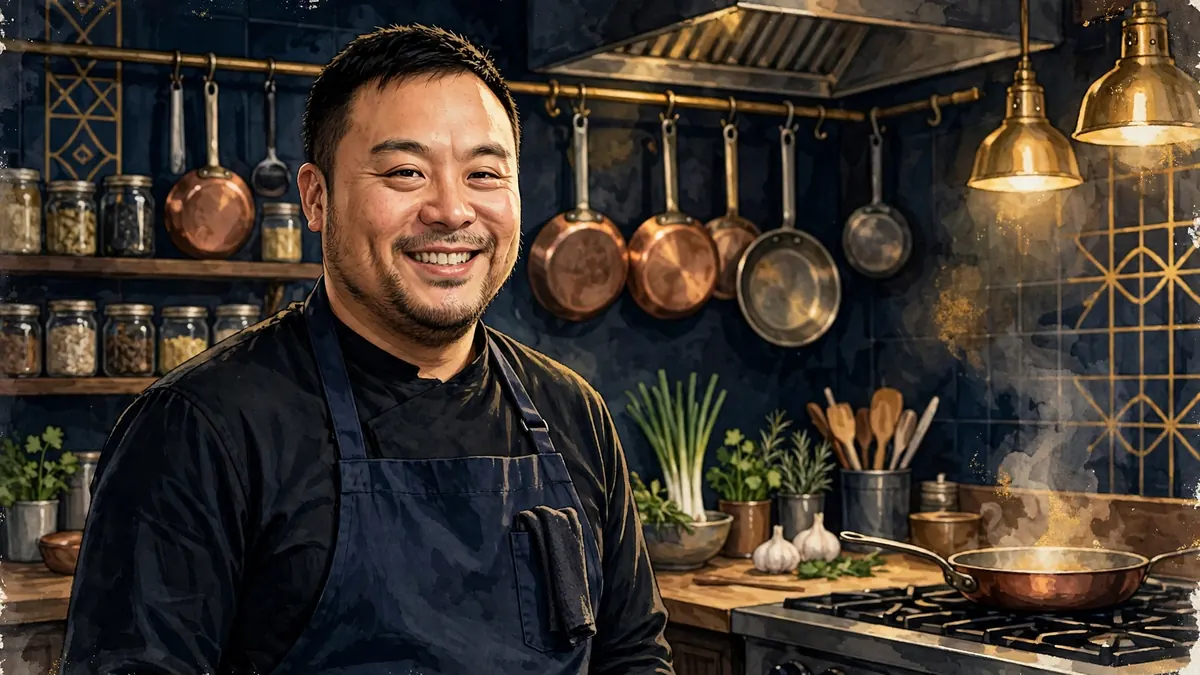
David Chang is an American chef, restaurateur, author, podcaster, and television host who built the Momofuku restaurant group from a 27-seat noodle bar in New York’s East Village into one of the most talked-about food brands in the world. Born on August 5, 1977, in Arlington, Virginia, to Korean immigrant parents, Chang went from teaching English in Japan and working in finance to earning two Michelin stars, writing a New York Times best-selling memoir, and hosting Netflix’s Ugly Delicious.
As of November 2026, David Chang’s net worth is estimated at $20 million, according to Celebrity Net Worth, as reported by Parade in January 2026. Other outlets put the figure higher — some as high as $50 million — so an honest range for 2026 is $20 million to $50 million, with the $20 million figure the best-anchored one because it comes from the most widely cited source. Chang has never confirmed a personal fortune himself, and restaurant wealth is hard to pin down: thin margins, private company stakes, and a retail arm that now brings in more revenue than the dining rooms. This biography walks through the whole story — the Virginia childhood, the false starts, the Noodle Bar gamble, the Michelin years, the television career, the Chili Crunch trademark row, and the family life that changed how he cooks and leads.
Quick Facts: David Chang at a Glance
| Full Name | David Chang (Korean name: Chang Seok-ho, 장석호) |
|---|---|
| Date of Birth | August 5, 1977 |
| Age in 2026 | 49 years old (turns 49 in August 2026) |
| Birthplace | Arlington County, Virginia, United States |
| Hometown | Vienna, Virginia |
| Parents | Woo Chung Hi “Sherri” Chang (born in Kaesong) and Chang-Jin Pil, later Joseph P. Chang (born in Pyongyang) |
| Education | Georgetown Preparatory School; Trinity College, Hartford (religious studies, class of 1999); French Culinary Institute, New York |
| Estimated Net Worth (2026) | $20 million (Celebrity Net Worth, via Parade, January 2026); wider published range $20 million–$50 million |
| Primary Income Sources | Momofuku restaurants, Momofuku Goods retail (Chili Crunch, noodles, seasoned salts), television, books, podcasting |
| Key Ventures | Momofuku Noodle Bar (2004), Momofuku Ko (2008–2023), Ssäm Bar (2006–2023), Lucky Peach magazine (2011–2017), Momofuku Goods, Majordōmo, Fuku |
| Television | Ugly Delicious (Netflix, 2018), Breakfast, Lunch & Dinner (2019), The Next Thing You Eat (2021), Dinner Time Live with David Chang (2024–present) |
| Books | Momofuku (2009), Eat a Peach (2020), Cooking at Home (2021) |
| Spouse | Grace Seo Chang (married 2017) |
| Children | Two sons, including Hugo, born March 2019 |
| Awards | Five James Beard Awards, including Rising Star Chef of the Year (2007) and Outstanding Chef; two Michelin stars for Momofuku Ko (2009–2023); Culinary Hall of Fame inductee (2024) |
Table of Contents
- Quick Facts: David Chang at a Glance
- Early Life and Family Background
- From Finance to the French Culinary Institute
- The Momofuku Noodle Bar Gamble of 2004
- Building the Momofuku Empire
- Michelin Stars, James Beard Awards, and Recognition
- The Money: Net Worth, Income Streams, and the Business
- Momofuku Goods and the Chili Crunch Trademark Row
- Television, Books, and Podcasting
- The Million-Dollar Game Show Win
- Personal Life: Marriage, Fatherhood, and Family Loss
- Criticism, Kitchen Culture, and the Trademark Backlash
- How David Chang Compares With Other Celebrity Chefs
- Net Worth Timeline: 2004 to 2026
- Frequently Asked Questions About David Chang
- Final Thoughts: The Bottom Line on David Chang
- Sources and Reporting
Early Life and Family Background
David Chang was born on August 5, 1977, in Arlington County, Virginia, and grew up in Vienna, Virginia, a suburb of Washington, D.C. His Korean name is Chang Seok-ho. His parents had both emigrated from Korea as adults in the 1960s. His mother, Woo Chung Hi — known as Sherri — was born in Kaesong, and his father, Chang-Jin Pil, later Joseph P. Chang, was born in Pyongyang. Both came from the Korean peninsula’s divided halves, and both carried the habits of people who had rebuilt a life from scratch in a new country. Chang grew up with two older brothers and one sister in a household where food was Korean at home and American everywhere else.
His father owned a golf supply store, and young David played golf competitively through his school years. It was the kind of steady, respectable path his parents could picture for him, and for a long time he followed it. He attended Georgetown Preparatory School, a Jesuit boys’ school in Maryland, and then Trinity College in Hartford, Connecticut, where he majored in religious studies. He has said he picked the subject partly out of distance from his family’s Presbyterian faith — he wanted to study religion on his own terms rather than inherit it. Nothing in those years pointed toward a kitchen. He did not grow up dreaming of being a chef, and he did not cook seriously as a teenager.
After graduating from Trinity in 1999, Chang drifted through the kind of jobs that look like a search for direction. He taught English in Japan, living in a small town a little over an hour south of Osaka, where he started paying real attention to the food around him — the ramen shops, the izakaya counters, the care put into a single bowl. He bussed tables. Back in New York, he took finance jobs. The money was fine and the work left him cold. The Japan years mattered more than they seemed at the time: they gave him a palate, a set of reference points, and a feeling that food could be a life’s work rather than a hobby. But the turn did not come quickly. He was 22, out of college, and still unsure what he was for.
The family story also carried weight that only became public much later. His father had worked in commercial kitchens himself and spoke about the work in unglamorous terms, warning his son off it. His mother would later face cancer. Chang has written openly in his memoir about depression, anger, and the pressure of being the son of immigrants who had sacrificed for his education. That pressure — to make the sacrifice worth it, to pick something safe — is a thread that runs through his whole career, from the finance detour to the decision, finally, to cook anyway.
From Finance to the French Culinary Institute
In 2000, Chang enrolled at the French Culinary Institute in New York City — now known as the International Culinary Center — and started over as a student in a French kitchen. It was a deliberate break with everything he had studied. The training was classical French technique: stocks, sauces, knife work, the brigade system, the discipline of a line. He graduated and went to work as a line cook at The Mercer Kitchen, Jean-Georges Vongerichten’s restaurant, then moved to Craft, Tom Colicchio’s restaurant, and later to Café Boulud, Daniel Boulud’s fine-dining room. Three of the most respected kitchens in New York, one after another, in the space of a few years. He was learning the top of the trade from the people who defined it.
He left Café Boulud when his mother was diagnosed with cancer, a reminder that the career he had chosen was already pulling him away from home at the moments that counted. And then he did something his French training had not prepared him for: he went back to Japan for about two years to study noodles. He worked in ramen shops and izakaya, teaching English on the side to support himself, learning how broth is built, how noodles are pulled and timed, how a tiny counter with a dozen seats can hold a whole philosophy of cooking. The French kitchens had taught him technique and order. Japan taught him restraint, repetition, and the idea that a single dish done right could be enough.
That combination — French discipline plus Japanese counter culture, plus a Korean-American palate — became the whole basis of Momofuku. It is easy, looking back, to make it sound like a plan. At the time it was closer to a bet: that New York would pay attention to a chef who cooked the food he actually loved, in a room with no tablecloths, no reservations system worth the name, and no interest in what a fine-dining restaurant was supposed to look like. He was 26 when he came home from Japan. Within two years he would open his first restaurant with borrowed money and no safety net.
The Momofuku Noodle Bar Gamble of 2004
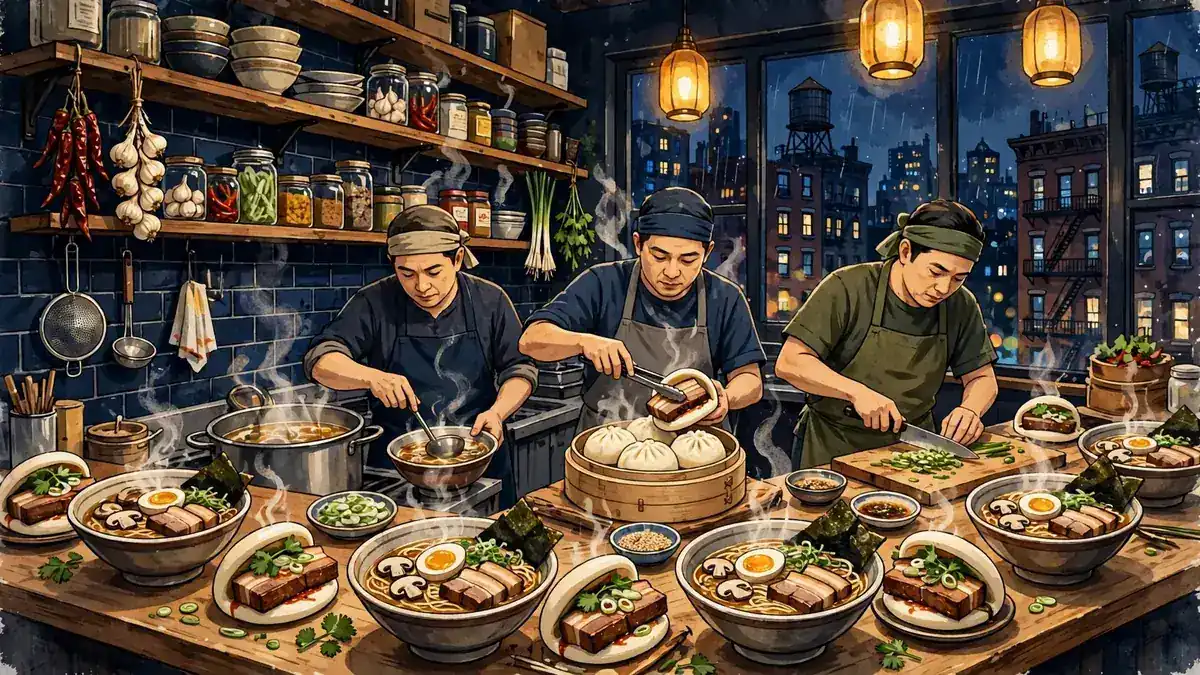
In 2004, David Chang opened Momofuku Noodle Bar in Manhattan’s East Village with about $130,000 borrowed from his father and some of his father’s friends. The room held roughly 27 to 30 seats. The menu was short: ramen, pork belly buns, a few small plates. The name came from Momofuku Ando, the inventor of instant ramen — a nod to the food that had hooked Chang in Japan, and a signal that this place would take humble food seriously. The first reviews were not kind to everything on the menu, and the early months were a grind. Running a restaurant, Chang found, was a struggle at first: thin margins, long hours, a tiny room that needed to turn tables to survive.
What saved it was the food itself. The pork belly buns — pillowy steamed buns filled with pork belly, hoisin, scallions, and cucumber — became the dish people talked about, photographed, and came back for. The ramen was rich and unapologetic. Word spread through the city’s food writers and then through the dining public, and the little room started to fill. Bon Appétit would later call Momofuku the most important restaurant in America, and The New York Times credited it with a central role in the rise of contemporary Asian-American cuisine. That sounds like overnight success in hindsight. In the room, it was two years of cooking, adjusting, and holding on.
The Noodle Bar also set the template for everything that followed: small rooms, counter seating, loud music, no white tablecloths, and food that mixed Korean, Japanese, and Chinese influences with French technique. Chang was not inventing a cuisine from nothing — he was cooking the food of his own life, the Korean food of home, the Japanese food of his twenties, the French food of his training, and letting the combinations stand on their own. Other chefs in New York were doing tasting menus behind closed doors. Chang was serving pork buns to a line out the door.
Building the Momofuku Empire
Success at the Noodle Bar gave Chang room to expand, and he moved fast. In August 2006 he opened Momofuku Ssäm Bar, also in the East Village, a bigger, louder room built around large-format dishes meant for sharing — the ssäm, the bo ssäm pork shoulder, the whole-animal feasts that became a signature. In March 2008 he opened Momofuku Ko, a 12-seat counter on First Avenue where reservations opened online ten days ahead and vanished in minutes. Ko was the fine-dining end of the same idea: a tasting menu served at a counter, no ceremony, all focus on the plate. In May 2010 came Má Pêche in midtown Manhattan, which closed in June 2018. Milk Bar, the bakery and dessert shop founded by Christina Tosi, who had worked in the Momofuku kitchens, grew out of the same group and later became its own company.
The expansion did not stop at New York. Momofuku opened Seiōbo in Sydney, Australia, and a cluster of restaurants in Toronto, including Noodle Bar Toronto and Kōjin. In the United States the group added Momofuku CCDC in Washington, D.C., a Las Vegas location, and Majordōmo in Los Angeles, a big, sprawling restaurant that showed Chang could work at scale without losing the counter energy. Fuku, the fried-chicken sandwich spinoff, took the pork-bun idea into fast casual. The group also opened Bāng Bar, Kāwi, and Ando, and in more recent years Peach Palace at New York’s John F. Kennedy International Airport and Super Peach, which opened in Los Angeles in November 2025. As of 2025 and into 2026, the current restaurants listed for the group include Noodle Bar, Bāng Bar, Momofuku, Majordōmo, Kabawa, and Fuku, with Kabawa taking over the old Ko space in early 2025.
Not every opening survived. Toronto’s restaurants closed. Má Pêche closed in 2018. And in 2023 the group made its hardest cuts: Ssäm Bar closed on September 30, 2023, and Ko closed on November 4, 2023, after fifteen years. The closures were part of a plan put in place when Marguerite Zabar Mariscal took over as chief executive of Momofuku in 2019 — a shift toward the parts of the business that could scale, especially retail, and away from the grinding economics of small fine-dining rooms. Ko’s final service was reported by Eater and Restaurant Business as the end of an era for New York dining, and it was: a two-Michelin-starred room that had changed what fine dining could look like, closing because the business had moved on.
The scale of the group at its peak was real — more than a dozen restaurants across three countries at various points — but the restaurant business is a hard way to get rich. Margins in a full-service restaurant run thin even in a good year, and Momofuku’s rooms were small, labor-heavy, and expensive to run in New York. Chang has been open about that: he told The New Yorker as far back as 2008 that he could be richer if he did not spend so much on benefits and pay for his staff. The empire was a reputation engine and a creative engine first, and a money engine second. The money, when it came, came from what the reputation made possible — television, books, and, later, grocery shelves.
Michelin Stars, James Beard Awards, and Recognition
The awards arrived quickly and kept coming. In 2009, a year after it opened, Momofuku Ko was awarded two Michelin stars. It held those two stars every year until its closure in 2023 — fourteen straight years at the top of the guide’s scale, a run few restaurants anywhere can match. The stars mattered beyond the room itself: they proved that a counter with no tablecloths and no dress code could sit beside the grand dining rooms of the city, and they gave Chang a credential that opened every door that followed.
The James Beard Foundation honored him repeatedly. He won the Rising Star Chef of the Year award in 2007, Best Chef: New York City in 2008, and went on to collect five James Beard Awards in total, including the Outstanding Chef award. Food & Wine named him a Best New Chef, Bon Appétit named him Chef of the Year, and in 2024 he was inducted into the Culinary Hall of Fame. The Momofuku cookbook, published in October 2009 with Peter Meehan, became a New York Times bestseller. His memoir Eat a Peach, published in September 2020, did the same.
Awards tell only part of the story. The deeper recognition was influence: a generation of chefs who opened small rooms, served food from their own backgrounds without apology, and treated a counter as a stage. Chang did not invent Korean-American cooking, and he would be the first to say so — but he made it the center of a New York restaurant conversation, and the city’s dining scene bent around him for a decade. That influence is also why the 2023 closures landed as news beyond the food pages: Ko was not just a restaurant, it was a reference point.
The Ko record, in one line: opened March 2008, two Michelin stars in 2009, held every year through its final service on November 4, 2023. Ssäm Bar, opened August 2006, closed September 30, 2023. Both closures were announced by the group itself and reported by Eater and Restaurant Business.
The Money: Net Worth, Income Streams, and the Business
David Chang’s net worth in 2026 is estimated at $20 million, according to Celebrity Net Worth, as reported by Parade in January 2026. That is the figure this biography anchors on, because it is the most recent and most widely cited estimate from a named source, and because it is consistent with the same outlet’s earlier reporting. The range across other outlets runs higher: TheCelebsInfo put the figure at $23 million as of 2023, Net Worth Post put it at $50 million, and a handful of lower-quality sites have published figures of $60 million, $75 million, $85 million, and even $500 million. Those top-end numbers have no named reporting behind them and contradict each other by an order of magnitude, so they are not used here. The honest 2026 range is $20 million to $50 million, with $20 million the anchor.
Why the spread? Chang’s wealth sits in a private company, not in a public stock or a published salary. Nobody outside Momofuku’s accounts knows the exact value of his stake, and restaurant valuations swing with revenue, debt, and the market for the brand. A chef’s fortune also mixes things that are hard to price: equity in a restaurant group, a retail brand, book advances, television fees, and a podcast. Different estimators weigh those pieces differently, and some simply copy each other. Readers should treat every chef net worth figure — this one included — as an informed estimate, not a bank statement.
That said, the shape of the money is clear, and it has changed over time. In the early years, the income was restaurant income: ownership stakes in a growing group, plus a chef’s salary. Restaurants are a thin-margin business, and Chang has never hidden that. The second stream was media — television hosting fees, book advances and royalties, and podcasting — which pays better per hour than a dining room and scales without adding tables. The third stream, and now the largest by revenue, is retail. Momofuku Goods, the consumer packaged goods arm, sells Chili Crunch, noodles, and seasoned salts in grocery stores across the United States. Parade reported that the retail arm raised around $29 million in funding in 2023 and passed $67 million in revenue in 2024. That revenue belongs to the company, not to Chang personally, but it is what makes his equity stake valuable — a jar of Chili Crunch scales in a way a 27-seat dining room never could.
Television and books add the rest. Ugly Delicious ran on Netflix, Dinner Time Live runs now, and the podcast The Dave Chang Show has run for years with sponsors. Book advances for a New York Times best-selling author are real money, though they are one-off payments rather than a salary. Speaking engagements, listed by booking agencies, add a further stream; All American Speakers lists Chang as a speaker on food, culture, and business. None of these streams has a published figure attached, and this biography does not invent one. What can be said is that the balance of his income has moved steadily away from the pass and toward the shelf and the screen — the same move the restaurant closures of 2023 signaled.
| Income stream | What it is, and what is known |
|---|---|
| Momofuku restaurants | Ownership stake in the restaurant group: Noodle Bar, Majordōmo, Las Vegas, Bāng Bar, Kabawa, Fuku, and others. Thin margins; the reputation engine of the whole business. |
| Momofuku Goods (retail) | Chili Crunch, noodles, seasoned salts. About $29 million raised in 2023; revenue over $67 million in 2024, per Parade. The fastest-growing part of the business. |
| Television | Host and creator fees from Netflix (Ugly Delicious, Breakfast, Lunch & Dinner, The Next Thing You Eat) and Dinner Time Live (2024–present). Fees are not public. |
| Books | Momofuku (2009), Eat a Peach (2020), Cooking at Home (2021). Two New York Times bestsellers; advances and royalties not public. |
| Podcasting | The Dave Chang Show, with sponsorship and advertising revenue. Figures not public. |
| Speaking and appearances | Paid speaking engagements via booking agencies; fees vary by event and are not public. |
For readers comparing him with the chefs who dominate the net worth charts, the gap is the point. Gordon Ramsay’s net worth sits far above Chang’s, built on a global television and restaurant operation many times the size of Momofuku. That is not a failure on Chang’s part — it is a different business. Ramsay built a franchise; Chang built a brand with a point of view, and then turned that point of view into a grocery product. The comparison that matters is not the total but the path: from a borrowed $130,000 to a retail brand doing tens of millions in annual revenue, without ever selling the restaurants’ soul for a fast expansion.
Momofuku Goods and the Chili Crunch Trademark Row
Momofuku Goods started selling Chili Crunch — a crunchy, spicy chili oil with dried peppers, sesame seeds, garlic, and shallots — in 2020. It was a natural product for the brand: the kind of condiment Chang’s kitchens had always made in-house, jarred for home cooks. The line grew into noodles and seasoned salts, and the grocery business grew with it. In 2023 the retail arm raised about $17.5 million in growth funding led by Siddhi Capital, part of roughly $29 million raised over two rounds, and by 2024 the business was reporting revenue above $67 million, with earlier reporting putting 2023 sales near $50 million. Those are company revenues, not personal income, but they explain why the retail arm now matters more to Chang’s wealth than any single restaurant.
In the spring of 2024, that success produced the most public fight of Chang’s career. Momofuku had acquired the trademark for “chile crunch” — spelled with an “e” — from the Denver company Chile Colonial in 2023, as part of a legal settlement. In March 2024, Momofuku sent cease-and-desist letters to several small companies using the terms “chili crunch” or “chile crunch” on their own products, including the Malaysian food brand Homiah and the frozen food brand MìLà, telling them to stop within 90 days. Momofuku had also filed with the U.S. Patent and Trademark Office for the “chili crunch” spelling. The Guardian first reported the letters on April 4, 2024, and the reaction was swift and harsh, especially from the Asian-American and Pacific Islander food community: chili crisp and chili crunch are generic terms for a condiment with a long history, and small producers saw a big brand trying to fence off a shared word.
Chang and Momofuku first defended the move, saying a trademark holder is obliged to defend its mark or risk losing it. Within a week, the position collapsed. On April 12, 2024, Chang used an episode of his podcast, The Dave Chang Show, to apologize and announce that Momofuku would not enforce the trademark for either spelling. “Our activity here — our choice — is to do nothing,” he said. The company said it had heard the feedback and understood that the term “chili crunch” carries broader meaning for many people. The episode is now the standard case study in how a beloved food brand can misread its own community — and in how quickly an apology can stop the damage when it is real. The trademark for “chile crunch” remains held by Momofuku, but the company does not police it.
The row did not dent the retail business in any lasting way that is visible in the reporting: Momofuku Goods continued to sell its Chili Crunch in standard, hot honey, black truffle, and extra spicy versions, and the brand kept growing. But it left a mark on Chang’s public image, and it sits alongside the kitchen-culture honesty of Eat a Peach as the two moments where his ambition and his values visibly collided. Both are part of the biography, not footnotes to it.
Television, Books, and Podcasting
Chang’s television career began in earnest with Ugly Delicious, which premiered on Netflix in 2018. The show was not a cooking competition and not a travelogue in the usual sense: each episode took a single food — pizza, fried chicken, tacos, home cooking — and used it to talk about culture, identity, immigration, and who gets to decide what counts as authentic. It ran for two seasons and made Chang a television host in his own right, not just a chef who appeared on television. He followed it with Breakfast, Lunch & Dinner in 2019, a travel and food series, and The Next Thing You Eat in 2021. In 2024 he began hosting Dinner Time Live with David Chang, a live cooking show, and in 2026 he debuted a travel and food show called The Detour with David Chang.
His books trace the same arc as his career. Momofuku, written with Peter Meehan and published in October 2009, was a cookbook that doubled as a manifesto: recipes from the restaurants, plus the story of how they came to be. Eat a Peach, written with Gabe Ulla and published in September 2020, was the memoir — candid about depression, anger, suicidal thoughts, and the harshness of his early kitchens in a way few chef memoirs had been. It became a New York Times bestseller and is now the single most important written source on his life. Cooking at Home or, How I Learned to Stop Worrying About Recipes (And Love My Microwave), written with Priya Krishna and published in October 2021, took the opposite tone: a practical, relaxed home cookbook that argued good food does not need ceremony.
The podcast The Dave Chang Show has been the place where his thinking is most unfiltered — long conversations about food, business, and culture, and the platform where he issued the Chili Crunch apology in 2024. He also co-founded Lucky Peach, the food magazine, in 2011 with Peter Meehan and Chris Ying. It ran for 25 quarterly issues until 2017 and became a cult object among food readers: funny, strange, and serious about cooking in equal measure. Its closure was a loss to food writing, and its back issues still trade hands among fans.
Chang’s place among television chefs is distinct from the competition-show stars. Guy Fieri’s biography is the story of a chef who became a television brand through sheer volume and energy; Giada De Laurentiis’s biography and Rachael Ray’s biography trace two more chefs who built daytime television careers around approachable home cooking. Chang’s television work is closer to documentary than to demonstration: he uses food to ask questions about who we are, and that is why his shows have lasted in the culture even when they have not lasted as long on the schedule. Readers who want more chef stories can browse the rest of our Biography section, where the same treatment is given to the chefs who shaped modern American food television.
The Million-Dollar Game Show Win
On November 29, 2020, David Chang became the first celebrity ever to win the $1 million top prize on the American version of Who Wants to Be a Millionaire. He was playing for the Southern Smoke Foundation, a Houston-based crisis relief organization for people working in the hospitality industry, at a moment when the pandemic had left restaurant workers in desperate need. The final question asked who was the first president to have electricity in the White House. Chang did not know the answer. With his last lifeline, he phoned his friend Mina Kimes, the ESPN analyst, who guessed — with seconds to spare and no great confidence — that it was probably Benjamin Harrison. She was right.
The gamble was real. If he had answered wrong, his winnings would have dropped to $32,000. If he had walked away, he would have kept $500,000. He went with Kimes’s guess and won the full million, all of it donated to Southern Smoke. He was the first contestant in 11 years to win the top prize, and the first celebrity winner in the show’s history. He posted afterward that his “gambling problem finally pays off” and thanked Kimes, writing that he was still “cheating off” smart friends after all these years. The win was a bright spot in a bleak year for the restaurant world, and it fit the story of his career: a risk taken in public, for other people, that paid off because he trusted someone else’s judgment at the exact moment it counted. His father, Joseph, had died of bile duct cancer in June 2020, five months before the win aired — a loss Chang has spoken about rarely and plainly, and one that hung over the whole episode for viewers who knew the family story.
Personal Life: Marriage, Fatherhood, and Family Loss
David Chang married Grace Seo Chang in 2017. The couple’s first son, Hugo, was born in March 2019, and they have since had a second son. Fatherhood changed Chang’s public voice in a visible way: the chef who built his name on intensity and long hours began talking about balance, about leaving the kitchen at a reasonable time, about the kind of father he wanted to be. Eat a Peach, published when Hugo was a toddler, is in part a book about that change — about a man looking at the anger he carried into his kitchens and deciding not to pass it on.
The family losses of 2020 shaped him too. His father, Joseph P. Chang, died of bile duct cancer in June 2020 at the age of 78. His mother, Sherri, has also faced cancer. Chang has kept most of his family life private — Grace rarely appears in his public work, and his sons are kept out of the spotlight — but the memoir and his interviews make the shape of it clear: a son of immigrants who built something his parents could not have imagined, and who is now raising children of his own in a world his parents’ sacrifices made possible. He has spoken about wanting his children to know Korean food and Korean culture as a living thing, not a lesson, and about the strangeness of becoming a public figure whose private life is a subject of search results.
His height is one of the small details readers keep asking about, and the published sources disagree: some biographies list him at about 5 feet 7 inches, others at 5 feet 9 inches. Neither figure comes from Chang himself, and this biography does not settle the question — it is noted in the FAQs below as an open discrepancy between secondary sources. What is certain is the outline of the life: born in Virginia in 1977, married in 2017, a father of two, a son who lost his father in 2020, and a chef who has spent the last few years trying to build a business that does not demand the life it used to.
Criticism, Kitchen Culture, and the Trademark Backlash
Chang’s career has had two real controversies, and both are worth stating plainly. The first is the kitchen culture he describes in Eat a Peach. His early kitchens were harsh places: shouting, pressure, anger used as a management tool. Chang does not excuse it in the memoir — he describes his own behavior, his depression, and the damage it did to the people around him, and he writes about trying to change. Some readers and former staff have praised the honesty; others have noted that honesty after the fact is not the same as having run a kind kitchen at the time. The book is the record, and it is unusually frank for a chef memoir. It is also the reason the story of his later years — the CEO hire, the closures, the retail pivot — reads as a deliberate change of direction rather than a series of accidents.
The second is the Chili Crunch trademark row of 2024, covered in full above: cease-and-desist letters to small producers, a backlash led by the AAPI food community, and an apology and reversal within a week. The criticism was that a brand built on celebrating Asian food was using trademark law to claim a generic Asian condiment name. The defense — that a trademark must be defended or lost — was legally coherent and publicly unconvincing, and Chang’s own apology said as much. The episode cost him goodwill with some of the chefs and writers who had championed him longest, and it remains the sharpest single criticism of his business judgment.
There are no other major legal or personal scandals attached to his name in the public record. No lawsuits, no arrests, no fraud claims. For a public figure with two decades in the spotlight, that is a notably clean record, and it is part of why the trademark row landed as hard as it did: it was out of character for a chef whose reputation was built on openness and generosity, from the staff benefits he funded at his own expense to the million dollars he gave away on television.
How David Chang Compares With Other Celebrity Chefs
Chang occupies a particular place among celebrity chefs: respected by other chefs in a way television stars often are not, famous enough to host Netflix shows, and wealthy in the tens of millions rather than the hundreds. That combination is rarer than it looks. Many television chefs have bigger fortunes and less respect inside professional kitchens. Many Michelin-starred chefs have more respect and far less money. Chang has both, in moderation, and the tension between the two — the artist and the businessman — is the story of his career.
Gordon Ramsay’s age and career make the contrast clearest: Ramsay is a decade older, with a global restaurant and television operation that dwarfs Momofuku, and a fortune reported in the hundreds of millions. Ramsay built scale; Chang built taste. Guy Fieri built a television empire on energy and accessibility, with a restaurant and endorsement business to match. Giada De Laurentiis and Rachael Ray built daytime television careers that turned home cooking into a brand. Chang’s path ran the other way: he built the restaurants first, earned the stars, and only then turned the reputation into media and retail. The order matters, because it is why his name carries weight with chefs who would roll their eyes at a television cook.
| Chef | What defines the career |
|---|---|
| David Chang | Two Michelin stars for Momofuku Ko; founder of Momofuku; Netflix host; Momofuku Goods retail; memoirist. Fortune anchored at $20 million (2026). |
| Gordon Ramsay | Global restaurant group plus a vast television operation; multiple Michelin stars across his restaurants; fortune reported in the hundreds of millions. |
| Guy Fieri | Television-first career built on diners, drive-ins, and big personality; restaurant and endorsement empire alongside the shows. |
| Giada De Laurentiis | Daytime television cooking star who turned Italian home cooking into cookbooks, products, and restaurants. |
| Rachael Ray | Daytime television and magazine career built on fast, approachable meals; one of the longest-running food television brands. |
The comparison also shows what Chang has not done: he has never franchised his name at scale, never fronted a cooking competition, and never turned Momofuku into a licensing machine. Whether that is a missed opportunity or a choice is a matter of taste. What it has meant is a smaller fortune and a cleaner reputation — and, in the retail pivot, a second act that may yet close the gap.
Net Worth Timeline: 2004 to 2026
| Year | Milestone |
|---|---|
| 2004 | Opens Momofuku Noodle Bar with about $130,000 in borrowed money. Net worth: effectively zero, plus debt. |
| 2006 | Opens Ssäm Bar. The group is now a business, not a single room. |
| 2008–2009 | Opens Momofuku Ko; wins two Michelin stars in 2009. Momofuku cookbook becomes a bestseller. Reputation, and earning power, jump. |
| 2011 | Co-founds Lucky Peach magazine. Media income begins to matter alongside restaurant income. |
| 2017 | Marries Grace Seo Chang. Lucky Peach closes after 25 issues. |
| 2018 | Ugly Delicious premieres on Netflix. Television becomes a major income stream. |
| 2020 | Eat a Peach becomes a bestseller. Wins $1 million on Who Wants to Be a Millionaire and donates it all to the Southern Smoke Foundation. Momofuku Goods launches Chili Crunch. |
| 2023 | Momofuku Goods raises about $17.5 million in growth funding; retail revenue nears $50 million. Ssäm Bar and Ko close. Net worth estimates in the low tens of millions. |
| 2024 | Momofuku Goods revenue passes $67 million, per Parade. The Chili Crunch trademark row erupts and is resolved with an apology. Dinner Time Live begins. |
| 2026 | Net worth estimated at $20 million (Celebrity Net Worth, via Parade), with a wider published range of $20 million to $50 million. Retail, television, and books now outweigh restaurant income. |
The arc is the story in miniature: a borrowed $130,000 in 2004, a Michelin-starred restaurant group by 2009, a television and publishing career through the 2010s, and a retail brand in the 2020s that now does more revenue in a year than the restaurants ever did. The fortune is modest next to the biggest celebrity chefs, and it is real. It was built the slow way, and it was built twice — once in dining rooms, once on grocery shelves.
Frequently Asked Questions About David Chang
Who is David Chang?
David Chang is an American chef, restaurateur, author, podcaster, and television host, born on August 5, 1977, in Arlington, Virginia, to Korean immigrant parents. He is the founder of the Momofuku restaurant group, which he started with the Momofuku Noodle Bar in New York’s East Village in 2004, and the host of Netflix’s Ugly Delicious. His Korean name is Chang Seok-ho.
What is David Chang’s net worth in 2026?
David Chang’s net worth is estimated at $20 million in 2026, according to Celebrity Net Worth, as reported by Parade in January 2026. Other outlets have published higher figures, up to $50 million, so an honest range is $20 million to $50 million. The money comes from his stake in the Momofuku restaurant group, the Momofuku Goods retail brand, television, books, and podcasting. Chang has never confirmed a figure himself.
How did David Chang become famous?
Chang became known after opening Momofuku Noodle Bar in 2004, where his pork belly buns and ramen drew attention from New York food writers. Momofuku Ko, opened in 2008, earned two Michelin stars in 2009 and held them until it closed in 2023. His Netflix series Ugly Delicious, which began in 2018, made him a television star, and in 2020 he became the first celebrity to win $1 million on Who Wants to Be a Millionaire, donating the prize to the Southern Smoke Foundation.
What restaurants does David Chang own?
Chang founded the Momofuku restaurant group. Its current restaurants include Momofuku Noodle Bar, Bâng Bar, Momofuku, Majordōmo in Los Angeles, Kabawa, and Fuku, along with locations in Las Vegas and Super Peach in Los Angeles. Earlier restaurants included Momofuku Ko (2008-2023), Ssäm Bar (2006-2023), Má Pêche (2010-2018), and locations in Toronto and Sydney.
Is Momofuku Ko still open?
No. Momofuku Ko closed on November 4, 2023, after fifteen years, having held two Michelin stars since 2009. Momofuku Ssäm Bar closed earlier the same year, on September 30, 2023. The closures were part of a shift under Momofuku chief executive Marguerite Zabar Mariscal toward the retail business, Momofuku Goods. The old Ko space at 8 Extra Place later became Kabawa, which opened in early 2025.
Who is David Chang’s wife?
David Chang is married to Grace Seo Chang. The couple married in 2017. Their first son, Hugo, was born in March 2019, and they have since had a second son. Chang has said fatherhood changed how he thinks about work and about the kitchen culture he describes in his memoir Eat a Peach.
What was the Chili Crunch trademark controversy?
In March 2024, Momofuku sent cease-and-desist letters to small food companies using the terms “chili crunch” or “chile crunch”, after acquiring the “chile crunch” trademark from Chile Colonial in 2023. The letters drew a backlash, especially from the Asian-American food community, since chili crisp is a generic condiment term. On April 12, 2024, Chang apologized on his podcast, The Dave Chang Show, and said Momofuku would not enforce the trademark.
How tall is David Chang?
Published biographies disagree on David Chang’s height: some list him at about 5 feet 7 inches, while others list him at 5 feet 9 inches. Neither figure comes from Chang himself, so neither can be treated as confirmed. He was born on August 5, 1977, which makes him 49 years old in 2026.
Final Thoughts: The Bottom Line on David Chang
David Chang’s story is not really a story about money. It is a story about a kid from Vienna, Virginia, who studied religion, worked in finance, taught English in Japan, and then bet $130,000 of borrowed money on a 27-seat noodle bar — and was right. The restaurants made him a chef. The Michelin stars made him a name. Television made him famous. And the grocery shelf, of all things, made him wealthy: a jar of Chili Crunch now does what a dining room never could, which is scale.
The honest number, as of November 2026, is $20 million, anchored to Celebrity Net Worth via Parade, with a wider published range up to $50 million. It is a modest fortune next to the biggest television chefs, and it was built the hard way, in a business where most people lose money. The closures of Ko and Ssäm Bar in 2023 closed one chapter; the retail brand and the television work opened another. If the next few years belong to Momofuku Goods the way the last twenty belonged to the restaurants, the next estimate will be higher. For now, the biography stands on its own: a Korean-American kid who cooked the food of his own life, and changed what American restaurants look like in the process.
Sources and Reporting
This biography was researched from live sources in November 2026, including Wikipedia’s biography of David Chang, Parade’s January 2026 net worth report, reporting on the Momofuku Ko closure from Eater and Restaurant Business, The Guardian’s April 2024 reporting on the Chili Crunch trademark letters, and coverage of the Millionaire win from Mic and QSR Web. Figures are attributed to named sources in the text. Where sources disagree — most notably on net worth and on height — this article publishes the range and says so, rather than picking one number and hiding the rest.
How we estimated: the $20 million anchor comes from Celebrity Net Worth as reported by Parade in January 2026. The $20 million to $50 million range reflects other published estimates, including $23 million from TheCelebsInfo (2023) and $50 million from Net Worth Post. Figures above $50 million published by low-quality aggregator sites were checked and set aside because they cite no reporting and contradict each other. Chang’s wealth sits in a private company, so every published figure is an estimate; the true number may differ from the private reality.
Sources consulted: Wikipedia, Parade, Celebrity Net Worth, Momofuku, Eater, The Guardian, James Beard Foundation, Michelin Guide, Netflix.