Anderson Silva’s biography reads like the rise, reign and reinvention of mixed martial arts itself. Born Anderson da Silva on April 14, 1975, in São Paulo, Brazil, the fighter known as “The Spider” held the UFC middleweight championship for 2,457 days — still the longest title reign in UFC history — won 16 fights in a row inside the Octagon, and then, after his MMA career ended, rebuilt himself as a boxer in his late forties. As of November 2026, his net worth is estimated at $14 million to $16 million, with Surprise Sports putting the figure at $14 million in October 2026 and ExclusiveTak reporting a $15 million to $16 million range in early 2026.
This Anderson Silva biography covers the full story: a poor childhood in Curitiba, the Chute Boxe gym that shaped him, the seven-year title reign that made him the face of the UFC, the night Chris Weidman ended it, the broken leg, the failed drug tests, the long goodbye in the Octagon, and the boxing comeback that carried him past his 50th birthday. Along the way we sort out what he actually earned, where the money came from, and what his life looks like now in Los Angeles with his wife Dayane and their five children.
Last updated: November 19, 2026. By Celebamerica Editorial Staff.
Quick Facts: Anderson Silva at a Glance
| Full Name | Anderson da Silva |
|---|---|
| Nickname | “The Spider” |
| Date of Birth | April 14, 1975 (age 51 as of November 2026) |
| Birthplace | São Paulo, Brazil; raised in Curitiba, Brazil |
| Nationality | Brazilian-born; naturalized United States citizen since July 2019 |
| Height / Reach | 6 ft 2 in (1.88 m) / 77.5 in (197 cm) |
| Division | Middleweight (also fought at light heavyweight and welterweight early on) |
| MMA Record | 34 wins, 11 losses, 1 no contest (46 bouts, 1997–2020) |
| UFC Title Reign | Middleweight champion, October 2006 – July 2013; 2,457 days, 10 title defenses, 16 straight UFC wins |
| Estimated Net Worth | $14 million – $16 million as of 2026 (Surprise Sports: $14 million, October 2026; ExclusiveTak: $15–$16 million, January 2026) |
| Primary Income Sources | UFC fight purses and pay-per-view points, boxing purses, endorsements (Nike, Burger King), UFC antitrust settlement payout |
| Wife / Children | Dayane Silva; five children — Kalyl, Gabriel, Kaory, Joao Vitor and Kauana |
| Residence | Los Angeles, California |
| Honors | UFC Hall of Fame, Pioneer Era Wing, inducted July 2023 |
Table of Contents
- Quick Facts: Anderson Silva at a Glance
- Early Life: From São Paulo to Curitiba
- First Steps in Combat Sports and Early MMA
- Arrival in the UFC and the Title Win
- The Title Reign: Seven Years on Top
- Signature Wins That Defined the Reign
- The Fall: Weidman, the Knockout and the Broken Leg
- Drug Tests, Suspension and the Long Road Back
- The Last UFC Years and the Adesanya Passing of the Torch
- The Boxing Second Act
- The Money: Net Worth, Earnings and the UFC Settlement
- Endorsements and Business Ventures
- Homes, Cars and Lifestyle
- Personal Life: Wife, Children and Citizenship
- Legacy, Records and the Greatest-of-All-Time Debate
- Anderson Silva FAQs
- Final Thoughts: The Spider’s Place in History
- Sources and How We Estimated
Early Life: From São Paulo to Curitiba
Anderson da Silva was born on April 14, 1975, in São Paulo, Brazil, to parents Juarez and Vera Lucia da Silva. Money was short, and much of his childhood was spent in Curitiba, in the south of Brazil, where he was raised largely by an aunt and uncle. The arrangement was common in working-class Brazilian families of the time, and it put young Anderson in a household where discipline was expected and spare time was filled with sport rather than idleness.
Curitiba gave him two things that shaped everything that followed: a gym culture and a way out. He started jiu-jitsu as a child, then added taekwondo, capoeira and Muay Thai during his teenage years, the mix of disciplines that the UFC itself notes in his official Hall of Fame biography. He was not a prodigy handed a smooth path. He was a poor kid from a big Brazilian city who found that he could learn to fight, and that fighting could pay.
The nickname came early and stuck for life. “The Spider” — A Aranha in Portuguese — was a nod to the long limbs, the reach, and the way he seemed to control distance in a fight, wrapping opponents up from angles they did not expect. Years later, when he was the most feared striker in the sport, the name fit so well that it became a brand in itself.
What is often missed in retellings of his youth is how late the payoff arrived. Silva turned professional in MMA in 1997, but he spent the next nine years grinding through small shows in Brazil and Japan before the UFC ever called. The fame, the money and the records all came after thirty. His story is not one of overnight success; it is one of a fighter who stayed in the sport long enough for the sport to catch up with him.
First Steps in Combat Sports and Early MMA
Silva won his professional MMA debut in 1997 against Raimundo Pinheiro, and over the next few years he built his name on the Brazilian circuit and in Japan’s Shooto promotion. In 2001 he beat Hayato Sakurai to win the Shooto middleweight championship, a result that announced him to the wider MMA world: Sakurai was one of the best pound-for-pound fighters of that era, and Silva outworked him over three rounds.
His next stop was Pride Fighting Championships, then the biggest MMA promotion on the planet. Silva debuted there in 2002 with a win over Alex Stiebling, but Pride also handed him the first real setbacks of his career. He lost to Daiju Takase by triangle choke in December 2002, and then to Yushin Okami by disqualification in January 2003 after an illegal kick. Two losses in a row, in front of the biggest crowds he had ever fought in front of, could have ended the run before it started. Instead they taught him the lesson that defined his prime: never let a fight drift into someone else’s game.
He rebuilt in England’s Cage Rage promotion, where in 2004 he beat the hard-hitting Lee Murray to win the Cage Rage middleweight title. Murray was a feared brawler, and Silva’s win — a decision earned by picking Murray apart from range — showed the style that would later rule the UFC: patience, distance, counters, and sudden, violent finishes. By the time the UFC signed him in 2006, Silva was 31 years old, a veteran of nine years, and a fighter with a complete skill set: black-belt level jiu-jitsu, sharp Muay Thai, taekwondo kicks, and boxing hands. He had trained at the famed Chute Boxe Academy in Curitiba, a gym known for producing aggressive strikers, and he carried that schooling with him for the rest of his career.
He also boxed professionally before the UFC, splitting two early bouts in 1998 and 2005 — a loss to Osmar Luiz Teixeira and a win over Julio Cesar de Jesus. Almost nobody remembers those two fights, but they matter to the second half of this biography: when Silva returned to boxing after leaving the UFC, he was not starting from zero.
Arrival in the UFC and the Title Win
Silva’s UFC debut remains one of the most startling introductions in the promotion’s history. On June 24, 2006, at UFC Fight Night 5 in Las Vegas, he faced Chris Leben, a tough, durable middleweight who had never been stopped. Silva knocked him out in 49 seconds. Leben barely landed a punch. The crowd, the commentators and the UFC’s matchmakers all saw the same thing at the same time: this was not a normal middleweight.
One fight later, at UFC 64 on October 14, 2006, Silva fought Rich Franklin for the middleweight championship. Franklin was a popular champion and a heavy favourite in some quarters, but Silva finished him in the first round, pinning him against the fence and landing knees from the Muay Thai clinch until the referee stepped in. The knockout took less than three minutes, and it began a reign that would last 2,457 days.
The speed of the rise is worth pausing on. Silva went from UFC debutant to champion in less than four months and two fights. Fighters usually need years to earn a title shot; Silva needed one performance. The UFC had signed a 31-year-old veteran from Pride and Cage Rage, and within a single summer he had become the face of its middleweight division.
The Title Reign: Seven Years on Top
From October 2006 to July 2013, Anderson Silva was the UFC middleweight champion. He defended the belt ten times, won sixteen fights in a row in the UFC, and set records that still stand more than a decade later. No other UFC champion has held a title as long. The numbers alone make the case, but the manner of the reign is what people remember: Silva fought like a man who believed he could not be hit, hands low, chin up, slipping punches by inches and answering with knees, elbows and kicks that ended fights in an instant.
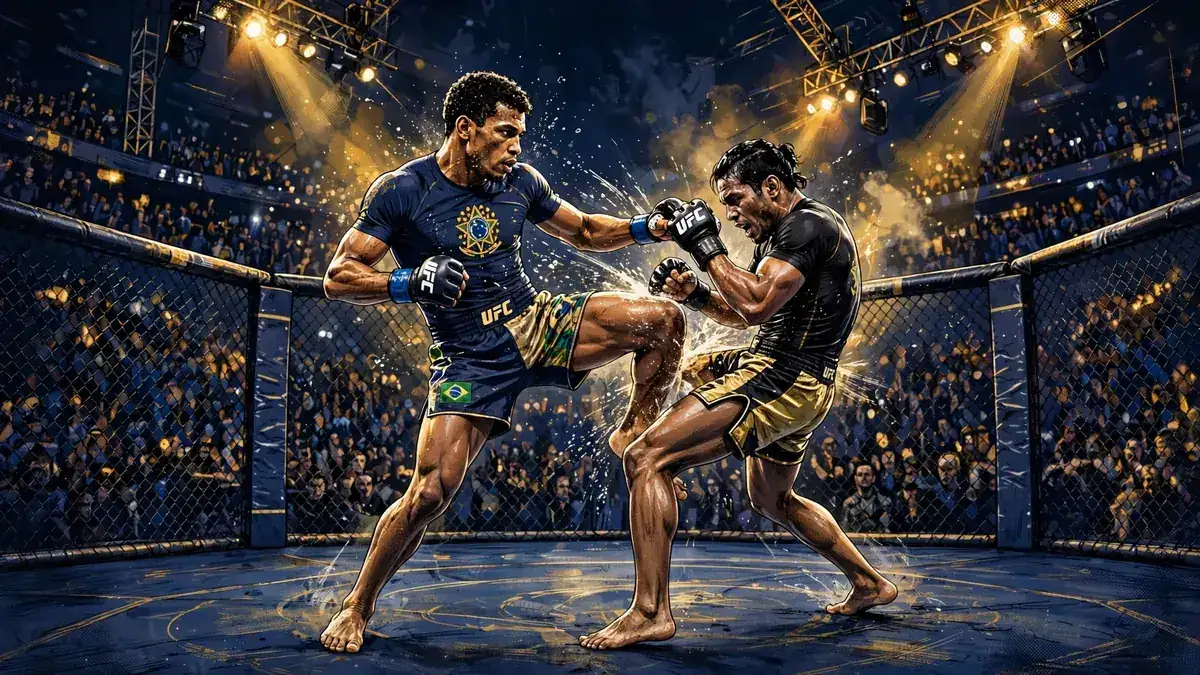
The reign had a shape. The early defenses were demolitions: Travis Lutter submitted in February 2007, Nate Marquardt stopped in the first round that July. In March 2008, Silva unified the UFC and Pride middleweight titles by submitting Dan Henderson, the Pride champion, with a rear-naked choke in the second round at UFC 82 — a win that settled any argument about who was the best middleweight on earth. Patrick Côté lasted until a knee injury ended their fight in October 2008; Thales Leites and Demian Maia both went the distance in 2009 and 2010, in fights where Silva’s showboating drew criticism even as he won every round.
That showboating is part of the story, and it deserves an honest telling. At his peak Silva sometimes toyed with opponents, dropping his hands, daring them to hit him, dancing away from punches. Fans loved it when it worked and turned on him when it did not. The UFC’s president Dana White publicly criticised the Maia fight. Silva heard the criticism, and for his next defense he delivered one of the great comebacks in the sport’s history — which is where the signature wins below come in.
Measured against the other long-reigning champions, Silva’s run stands alone. The table below puts his reign next to the next-longest in UFC history, using the promotion’s own records.
| Champion | Division | Title reign (approx.) |
|---|---|---|
| Anderson Silva | Middleweight | 2,457 days (2006–2013) |
| Demetrious Johnson | Flyweight | 2,142 days (2012–2018) |
| Georges St-Pierre | Welterweight | 2,064 days (2008–2013) |
| José Aldo | Featherweight | 1,848 days (2011–2015) |
Georges St-Pierre’s biography covers the other great reign of that era — the Canadian welterweight champion whose 2,064-day run overlapped with Silva’s, and with whom fans spent years dreaming of a superfight that never happened. The two men ruled side by side, and the debate over which reign was greater has never really been settled.
Signature Wins That Defined the Reign
Every great champion has a handful of nights that explain them. Silva had at least five.
Chael Sonnen, UFC 117, August 2010. Sonnen dominated Silva for four and a half rounds, taking him down again and again and landing more strikes than anyone had ever landed on the champion. With less than two minutes left, Silva caught Sonnen in a triangle armbar and forced the tap. It remains one of the most famous comebacks in MMA history, and it turned a one-sided beating into a legend.
Vitor Belfort, UFC 126, February 2011. Belfort was a former champion with fast hands and real knockout power. Silva ended the fight in the first round with a front kick to the face — a technique almost nobody threw in MMA at the time — that knocked Belfort out cold. The kick is still replayed in highlight reels today, and it is the single most famous strike of Silva’s career.
Dan Henderson, UFC 82, March 2008. The unification fight. Henderson was the Pride middleweight and light heavyweight champion, an Olympic wrestler with a granite chin. Silva survived the first round, then took Henderson’s back in the second and finished him with a rear-naked choke. It was the first time Henderson had ever been submitted, and it proved Silva could win on the ground as well as on the feet.
Chael Sonnen, UFC 148, July 2012. The rematch was the biggest middleweight fight of its time, and this time Silva left nothing to chance. He stopped Sonnen with a knee to the body and punches in the second round, closing the rivalry 2–0 and defending his title for the tenth time — a middleweight record.
Stephan Bonnar, UFC 153, October 2012. Moving up to light heavyweight, Silva toyed with the much bigger Bonnar against the fence, then finished him with a knee to the body in the first round. It was a reminder that the champion’s skills travelled up a weight class, and it fed the endless talk of a superfight with light heavyweight king Jon Jones, whose biography traces a career that ran on a parallel track to Silva’s — another generational talent whose prime overlapped with The Spider’s, and another name in every greatest-of-all-time conversation.
Those five nights explain why Silva was ranked number one pound-for-pound in the world for years. He did not just win; he won in ways nobody had seen before, against opponents who had never been beaten that way.
The Fall: Weidman, the Knockout and the Broken Leg
Every reign ends, and Silva’s ended the way his had begun — suddenly, violently, and in front of a stunned crowd. On July 6, 2013, at UFC 162 in Las Vegas, Silva fought Chris Weidman, an unbeaten challenger with strong wrestling. Silva spent the first round showboating, hands down, taunting Weidman to hit him. In the second round Weidman did, landing a left hook that knocked the champion out cold. The 2,457-day reign was over in a single punch.
The rematch, at UFC 168 on December 28, 2013, was worse. In the second round Silva threw a low leg kick. Weidman checked it with his knee, and Silva’s left leg snapped — a broken tibia and fibula, one of the most gruesome injuries ever seen in the Octagon. Silva was stretchered out, underwent surgery the same night, and had a titanium rod inserted into his tibia. Doctors quoted a recovery of three to six months, but the real question was whether a 38-year-old champion would ever fight again at all.
His disclosed purse for that night was $600,000, according to figures released by the Nevada State Athletic Commission and reported by Sportsnet — the same basic purse he had earned for the first Weidman fight, before any pay-per-view share. The numbers are a reminder of how the UFC’s pay worked in that era: the disclosed purse was only part of the deal, and the real money for a champion came from the pay-per-view points that were never made public.
Drug Tests, Suspension and the Long Road Back
Silva returned a year later, in January 2015, and beat Nick Diaz by unanimous decision at UFC 183. The win was short-lived. Days later it emerged that Silva had failed both pre-fight and post-fight drug tests, testing positive for the anabolic steroids drostanolone and androsterone. The win was overturned to a no contest.
Silva’s defence was that the substances came from a contaminated supplement, and that he had taken them to help heal his broken leg rather than to gain an edge. The Nevada State Athletic Commission was not persuaded. In August 2015 it suspended him for one year, fined him 30 percent of his $600,000 purse, and ordered him to forfeit his win bonus. The hearing was a public humiliation for a fighter who had been the sport’s clean-cut standard-bearer, and it remains the darkest chapter of his career. It is also the chapter his critics return to whenever the greatest-of-all-time debate comes up.
A second failed test followed in 2017, but that one ended differently: the United States Anti-Doping Agency (USADA) later determined the result came from a contaminated legal dietary supplement, and the suspension was overturned. The two episodes are often lumped together, but they are not the same story — the first cost him a year of his career and a win, the second was cleared. Any honest biography has to carry both facts, and to note that Silva himself always maintained he never knowingly cheated.
What the drug-test saga cost him is hard to measure in money, but it was real. Nike ended its endorsement deal with him after the 2015 failure. Sponsors who had paid for the image of an untouchable champion walked away. And the comeback, when it came, was against younger men in a division that had moved on without him.
The Last UFC Years and the Adesanya Passing of the Torch
Silva fought seven more times in the UFC after the leg break, and won only one of them. He lost a close decision to Michael Bisping in London in February 2016, lost to Daniel Cormier on two days’ notice at UFC 200 that July, and then beat Derek Brunson by decision in February 2017 — his last UFC win. After that came three more losses: to the rising star Israel Adesanya in February 2019, to Jared Cannonier by first-round stoppage in May 2019, and to Uriah Hall by fourth-round stoppage on October 31, 2020, in his final MMA fight.
The Adesanya fight deserves its own paragraph, because it was the clearest passing of the torch the division has ever seen. Adesanya had grown up idolising Silva, copying his style, studying his fights. At UFC 234 in Melbourne, the student fought the master for three rounds, and won a unanimous decision. The two men embraced afterwards, and Adesanya spoke openly about what Silva had meant to him. Israel Adesanya’s biography tells the other side of that night — how the young challenger from New Zealand and Nigeria became the new face of the middleweight division, and how Silva, even in defeat, gave him the fight that proved he belonged.
By the time Silva left the UFC in November 2020, his final record in the promotion’s last nine fights read one win, seven losses and one no contest. It is a harsh line to end on, and it has led some to say he fought too long. But the other side of the argument is that he never stopped competing against the best, and that he walked away on his own terms, with his health and his family intact. His professional MMA record closed at 34 wins, 11 losses and 1 no contest across 46 bouts.
The Boxing Second Act
Most fighters retire and stay retired. Silva went back to boxing. In June 2021, at 46 years old, he faced former world champion Julio César Chávez Jr. in Guadalajara, Mexico, and beat him by split decision over eight rounds — a result almost nobody predicted. Three months later he knocked out former UFC champion Tito Ortiz in the first round of another boxing match in Hollywood, Florida. Two wins, two different kinds of proof: he could still outbox a real boxer, and he could still knock out a fellow MMA veteran.
The third fight was the biggest of the three. On October 29, 2022, in Glendale, Arizona, Silva fought Jake Paul, the YouTuber turned professional boxer, in front of a large pay-per-view audience. Silva lost by unanimous decision, knocked down in the final round, but he went the distance against a man 22 years younger and landed clean punches throughout. It was a loss that added to his bank balance and his legend in equal measure.
Then came the trilogy bout with his old rival Chael Sonnen — this time in a boxing ring in São Paulo on June 15, 2024, five two-minute rounds billed as Silva’s last fight in Brazil. It ended in a draw, an exhibition that gave two old rivals one last shared stage and gave the Brazilian crowd one last look at their hero. Silva’s professional boxing record stands at 4–2 including his two early-career bouts, with the Sonnen exhibition not counting toward the official tally.
And then, remarkably, there was one more win. On December 19, 2025, on the undercard of the Jake Paul vs. Anthony Joshua fight in Miami, the 50-year-old Silva stopped former UFC welterweight champion Tyron Woodley by second-round technical knockout, as reported by Bleacher Report. It was his first appearance since the Paul loss three years earlier, and it showed that The Spider, at an age when almost every fighter is long retired, could still put on a striking clinic. Whether he fights again is an open question; what is no longer in question is that his second act in boxing outlasted almost everyone’s expectations.
The Money: Net Worth, Earnings and the UFC Settlement
So what is Anderson Silva actually worth? The honest answer is a range, because the sources disagree and none of them can see inside his bank account. Surprise Sports, updating its profile in October 2026, puts his net worth at $14 million. ExclusiveTak, updated in January 2026, reports $15 million to $16 million. Older profiles from Wealthy Gorilla and PlayersBio still carry $8 million, but those figures have not moved in years and predate his boxing purses and the UFC settlement below — they read as stale, not as current. One low-quality outlier lists $18 million, but it is not supported by any named reporting and we do not rely on it. The best reading of the evidence as of November 2026 is a range of $14 million to $16 million, anchored at the lower end by Surprise Sports’ October 2026 figure.
| Source | Figure | Date |
|---|---|---|
| Surprise Sports | $14 million | October 2026 |
| ExclusiveTak | $15–$16 million | January 2026 |
| Wealthy Gorilla | $8 million | Older, unchanged for years |
| PlayersBio | $8 million | Older, unchanged for years |
The earnings underneath the estimate break down into four parts. First, the UFC purses. PlayersBio totals his disclosed UFC earnings at $8,732,000 — but disclosed purses are only the show money and win bonuses reported to athletic commissions. They leave out the pay-per-view points that were the real money for a champion headlining events, so the true UFC total was far higher. Surprise Sports estimates his total career earnings at roughly $13.5 million excluding endorsements and bonuses, a figure that sits in the same area as the disclosed-purse total once the missing pieces are allowed for.
Second, the boxing purses. The Paul fight in October 2022 was the biggest payday of his boxing career, on a pay-per-view card that drew a mainstream audience far beyond MMA. The Chávez Jr. and Ortiz fights paid well too, and the Woodley win in December 2025 came on another major card. Exact purses for these bouts were not publicly disclosed, which is why this biography does not invent them.
Third, endorsements, covered in the next section. And fourth, a payout nobody saw coming: the UFC antitrust settlement. In February 2025 a Nevada federal judge approved a $375 million settlement in Le v. Zuffa, the long-running case in which fighters accused the UFC of using exclusive contracts and market power to suppress wages. Middle Easy reported in September 2025 that Silva would receive $10,334,240.72 — the largest individual payout in the settlement, covering 1,088 fighters who competed between 2010 and 2017. Each fighter’s share was calculated at 32.7 percent of their total bout pay from that period, plus $14,179.33 per fight; Silva fought 12 times in the window, including seven title defenses, and the settlement’s math put his bout compensation at roughly $30 million. Funds were set for distribution by September 19, 2025, through the claims administrator Angeion Group.
That settlement figure needs careful handling. It is a payout, not a salary, and it reflects bout pay from 2010 to 2017 — the heart of his championship years. It does not, on its own, set his net worth, because taxes, expenses, management fees and the years since all eat into it. But it does explain why the 2026 estimates of $14 million to $16 million sit well above the older $8 million figures: a seven-figure settlement landing in 2025 changes the math, and the older profiles were written before it existed.
The estimate in one line: $14 million to $16 million as of November 2026 — Surprise Sports at $14 million (October 2026) and ExclusiveTak at $15–$16 million (January 2026), with the 2025 UFC antitrust payout of about $10.3 million the freshest money in the picture. Older $8 million figures are stale and predate both the settlement and his boxing purses.
For a sense of scale, the peer group tells its own story. Khabib Nurmagomedov’s net worth is built on a shorter, undefeated career and a different kind of post-fighting business, while Silva’s fortune was built the old way: a decade of title fights, pay-per-view shares, and a late-career pivot into boxing that kept the cheques coming after the UFC years ended. Fighters of Silva’s era earned less per fight than today’s stars, and the settlement is, in a real sense, the sport paying him late for the years when it paid him least.
Endorsements and Business Ventures
At his peak, Silva was one of the most marketable fighters in the UFC. Nike signed him in 2011, putting him in the same stable as the biggest names in world sport, and Burger King also backed him — the two deals most often named in profiles of his career. The Nike deal ended after the 2015 failed drug test, which shows how closely the money was tied to the image: when the image cracked, the sponsor left.
He also built a business of his own. In 2011, Silva co-founded 9INE, a sports marketing agency, with the Brazilian football star Ronaldo Nazário. The venture was an early sign that Silva understood something many fighters learn too late — that a fighting career ends, and that the years after it need a plan. 9INE worked with athletes and brands in Brazil, and it gave Silva a commercial footing beyond the cage.
Other income came from the usual channels for a fighter of his standing: seminar and appearance fees, a share of merchandise, and later, the boxing purses described above. He never built a product empire to match the business ventures of some of his peers, and this biography does not pretend otherwise. His wealth is a fighter’s wealth — earned in the cage and the ring, topped up by endorsements and one large legal settlement — rather than a businessman’s fortune.
Homes, Cars and Lifestyle
Silva has lived in Los Angeles, California, for well over a decade, and the city is where he raised his family and based his training. The UFC’s own Hall of Fame announcement in March 2023 described him as residing in Los Angeles with his wife Dayane and their five children. Beyond that, the details of his property are private, and this biography does not repeat unverified claims about specific houses or their prices.
What is known is that his lifestyle has always been quieter than his fighting style. He is not a fixture of the celebrity party circuit, and he has never cultivated the flashy public image that some fighters use to sell pay-per-views. Interviews through the years describe a family man who trains, goes home, and keeps his circle small. The cars and watches that fill other fighters’ social media feeds are largely absent from his. The money, as far as anyone can tell, went to family, to training, and to a life in Los Angeles that he built over a decade rather than a year.
That restraint matters to the net worth picture. A fighter who earned tens of millions across two decades and spent modestly is more likely to still hold a large share of it than one who spent lavishly. It is one of the reasons the $14 million to $16 million range is credible: the earnings are documented, the settlement is documented, and there is no public record of the kind of spending that would have burned through them.
Personal Life: Wife, Children and Citizenship
Anderson Silva married Dayane Silva, a former gymnast, and the couple have five children: three sons, Kalyl, Gabriel and Joao Vitor, and two daughters, Kaory and Kauana. The family has been the centre of his life outside fighting for as long as he has been famous, and he has spoken often about fighting for them rather than for himself.
In July 2019, Silva became a United States citizen in a mass naturalisation ceremony at the Los Angeles Convention Center, taking the oath alongside his son Kalyl, then 20, and his daughter Kaory, then 23. Sportsnet reported at the time that Silva had sought citizenship for a decade, and that he had spent the previous ten years living in Los Angeles, with his children there for seven. His wife Dayane and his other children — Gabriel, then 22, Joao, then 14, and Kauana, then 18 — were still going through the naturalisation process at that point. The ceremony was a personal milestone rather than a career move: a Brazilian who had made his life in America, making it official.
His children have followed him into combat sports in different ways. Kalyl Silva has fought as a professional mixed martial artist and boxer, and Gabriel has also competed. It is a familiar pattern in fighting families — the father’s gym becomes the children’s gym — and it means the Silva name is likely to be heard in combat sports for another generation. You can read more about the family and the house they built their life around in our biography archive, which collects the life stories of the fighters, actors and stars covered on this site.
Legacy, Records and the Greatest-of-All-Time Debate
Where does Anderson Silva rank? The honest answer is that it depends on what you value, and the debate will run for as long as people argue about MMA. On the numbers, the case is overwhelming: the longest title reign in UFC history at 2,457 days, the longest win streak in UFC history at 16 fights, ten middleweight title defenses, and a pound-for-pound number one ranking held for years. No middleweight has come close to the reign since, and Israel Adesanya — the man who beat him in 2019 — has spoken of Silva as the standard he measured himself against.
On the other side of the argument sit the failed drug tests, the showboating that cost him the Weidman fight, and the 1–7–1 record in his final nine UFC outings. His critics say the second half of his career stains the first. His supporters say the first half was so dominant that nothing in the second half can touch it, and that a 38-year-old champion coming back from a broken leg was always going to lose to younger men.
Both sides have a point, and this biography does not pick one. What can be said without argument is that Silva changed what a middleweight could be. Before him, the division was a wrestler’s division. After him, every middleweight had to learn to strike, to move, to defend the clinch, and to respect the front kick. He brought Muay Thai into the mainstream of American MMA, and he did it with a style — loose, creative, unafraid — that fighters are still copying today.
The Hall of Fame made it official. In March 2023 the UFC announced Silva would enter the Hall of Fame as the 19th member of the Pioneer Era Wing, with the induction ceremony held during International Fight Week in Las Vegas that July. The Pioneer Wing is for fighters who turned professional before November 2000, and Silva, who debuted in 1997, qualified with room to spare. It was the sport’s formal recognition of what the record books already said.
There is also the matter of longevity. Silva’s professional fighting career spans 1997 to 2025 — 28 years from his MMA debut to his win over Tyron Woodley at age 50. Almost no fighter in combat sports history has competed at a high level across three decades. That span, more than any single record, is what his biography will be remembered for: a man who started fighting as a poor kid in Curitiba and was still winning fights as a 50-year-old grandfather in Miami.
Anderson Silva FAQs
How old is Anderson Silva?
Anderson Silva was born on April 14, 1975, in São Paulo, Brazil, which makes him 51 years old as of November 2026. He turned professional in MMA in 1997 and was still winning boxing matches at age 50, when he stopped Tyron Woodley in December 2025.
What is Anderson Silva’s net worth in 2026?
Anderson Silva’s net worth is estimated at $14 million to $16 million as of November 2026. Surprise Sports puts the figure at $14 million (October 2026), while ExclusiveTak reports $15 million to $16 million (January 2026). Older profiles listing $8 million are stale and predate his boxing purses and his roughly $10.3 million payout from the UFC antitrust settlement in 2025.
How long was Anderson Silva the UFC champion?
Silva held the UFC middleweight championship for 2,457 days, from October 14, 2006, when he knocked out Rich Franklin at UFC 64, until July 6, 2013, when Chris Weidman knocked him out at UFC 162. It is the longest title reign in UFC history, and included a record 16 consecutive UFC wins and 10 title defenses.
What is Anderson Silva’s MMA record?
Anderson Silva’s professional MMA record is 34 wins, 11 losses and 1 no contest across 46 bouts, from his debut in 1997 to his final fight against Uriah Hall in October 2020. His professional boxing record stands at 4–2, including his two early-career bouts, with wins over Julio César Chávez Jr., Tito Ortiz and Tyron Woodley.
Who did Anderson Silva beat to win the UFC title?
Silva won the UFC middleweight title by knocking out Rich Franklin in the first round at UFC 64 on October 14, 2006, using knees from the Muay Thai clinch. His most famous title defenses came against Dan Henderson, Chael Sonnen (twice), Vitor Belfort — finished with a front kick to the face at UFC 126 — and Yushin Okami.
Why did Anderson Silva leave the UFC?
Silva’s UFC contract ended after his loss to Uriah Hall on October 31, 2020, his final MMA fight, and the two sides parted ways in November 2020. He was 45, had won only once in his last nine UFC fights, and wanted to box. He has since boxed Julio César Chávez Jr., Tito Ortiz, Jake Paul, Chael Sonnen in an exhibition, and Tyron Woodley.
Who is Anderson Silva’s wife and how many children does he have?
Anderson Silva is married to Dayane Silva, a former gymnast. They have five children: sons Kalyl, Gabriel and Joao Vitor, and daughters Kaory and Kauana. The family lives in Los Angeles, California, where Silva became a United States citizen in July 2019 alongside his son Kalyl and daughter Kaory.
Is Anderson Silva in the UFC Hall of Fame?
Yes. In March 2023 the UFC announced that Silva would be inducted into the UFC Hall of Fame as the 19th member of the Pioneer Era Wing, and the induction ceremony took place during International Fight Week in Las Vegas in July 2023. The Pioneer Wing honours fighters who turned professional before November 2000; Silva debuted in 1997.
Final Thoughts: The Spider’s Place in History
Anderson Silva’s biography ends, for now, not with a farewell but with a second-round stoppage of Tyron Woodley at the age of 50. That is a fitting place to leave it. His career had three acts — the long climb, the seven-year reign, and the boxing comeback — and each one would have been enough for most fighters. Together they add up to the longest championship reign in UFC history, a Hall of Fame induction, a fortune estimated at $14 million to $16 million, and a family life in Los Angeles built over a decade.
He was not a perfect champion. The failed drug tests and the late-career losses are part of the record, and this biography has not hidden them. But the record also says this: for seven years, no middleweight on earth could beat him, and for 28 years, from a gym in Curitiba to a ring in Miami, he kept finding ways to win. That is why the name still matters, and why the debate over the greatest fighter of all time will always have to pass through Anderson Silva.
Sources and How We Estimated
How we estimated: Anderson Silva’s net worth is an estimate, not a bank statement. We compared dated estimates from named outlets — Surprise Sports ($14 million, October 2026) and ExclusiveTak ($15–$16 million, January 2026) — against older $8 million figures from Wealthy Gorilla and PlayersBio, which we treat as stale because they predate his boxing purses and the 2025 UFC antitrust settlement payout of about $10.3 million reported by Middle Easy. Where sources disagreed we published a range rather than a single number, and we did not invent any purse, property value or business figure. Private taxes, expenses and investment results are unknown and are not reflected in any published estimate.
Named sources consulted for this biography: UFC (Hall of Fame announcement, March 2023; career records), Sportsnet (US citizenship ceremony, July 2019; UFC 168 purse reporting), Surprise Sports (net worth $14 million, October 2026), ExclusiveTak (net worth $15–$16 million, January 2026), Wealthy Gorilla (net worth $8 million, older profile), PlayersBio (career details; disclosed UFC earnings $8,732,000), Middle Easy (UFC antitrust settlement payout $10,334,240.72, September 2025; Sonnen exhibition draw, June 2024), Bleacher Report (Tyron Woodley TKO win, December 2025), EssentiallySports (Los Angeles residence and citizenship, updated December 2025), Heavy (leg injury and drug-test suspension reporting), LowKick MMA (Nevada Athletic Commission hearing, August 2015), GiveMeSport and F4WOnline (Sonnen boxing trilogy announcement, May 2024). All figures are attributed in the text; where reporting conflicted, the range and the disagreement are stated openly.