Joe Budden was born Joseph Anthony Budden II on August 31, 1980, in East Harlem, New York City, and raised in Jersey City, New Jersey. He first reached the public as a rapper, with the 2003 club hit “Pump It Up,” and then rebuilt himself into one of the most talked-about voices in hip-hop media. As of November 2026, his estimated net worth sits in a range of $15 million to $25 million, anchored at about $20 million by Celebrity Net Worth, and the money now comes mostly from podcasting, not from record sales.
That second act is the real story of this Joe Budden biography. The rap career gave him a name, a Grammy nomination, and a loyal core audience. The broadcasting career gave him something rarer in hip-hop: ownership. After walking away from Complex, from Spotify, and from a major-label system that had shelved his albums, Budden built The Joe Budden Network into a fan-funded business that The New York Times reported was on pace to generate more than $20 million in 2025 revenue, and that Forbes ranked among the highest-earning podcast operations in the world in July 2026. This page traces the whole arc — the Harlem and Jersey City beginnings, the Def Jam years, Slaughterhouse, the television run, the Spotify exit, the Patreon model, the money, the family, and the legal trouble — with named sources for every figure that matters.
By Celebamerica Editorial Staff | Last updated: November 19, 2026
Joe Budden Quick Facts
| Full Name | Joseph Anthony Budden II |
|---|---|
| Date of Birth | August 31, 1980 (age 46 in 2026) |
| Birthplace | East Harlem, New York City, New York, USA |
| Raised | Jersey City, New Jersey |
| Estimated Net Worth | $15 million–$25 million, anchored at about $20 million (Celebrity Net Worth, July 2025) |
| Peak / Primary Income Sources | The Joe Budden Network — Patreon memberships, advertising, live shows; music catalog and royalties; television hosting |
| Key Ventures / Works | “Pump It Up” (2003); debut album Joe Budden (2003); Slaughterhouse; Mood Muzik mixtape series; Everyday Struggle (Complex, 2017); State of the Culture (Revolt, 2018–2020); The Joe Budden Podcast (2015–present) |
| Children | Two sons: Trey Budden (born May 11, 2001) and Lexington Budden (born December 15, 2017) |
| Marital Status | Not married; formerly engaged to Cyn Santana (2018–2019) |
Table of Contents
- Joe Budden Quick Facts
- Joe Budden Early Life: Harlem Roots and Jersey City
- The Pump It Up Breakthrough
- Def Jam, Shelved Albums and the Mood Muzik Years
- Slaughterhouse and the Shady Records Years
- Everyday Struggle, State of the Culture and the Spotify Years
- The Joe Budden Podcast and the Patreon Model
- The Money: Income Streams and the Net Worth Question
- Net Worth Growth Over Time
- Forbes 2026 and the REVOLT Return
- Personal Life: Family, Cyn Santana and Fatherhood
- Legal Issues and Public Controversies
- What Joe Budden Is Doing in 2026
- Frequently Asked Questions
- Final Thoughts
- Sources and Reporting
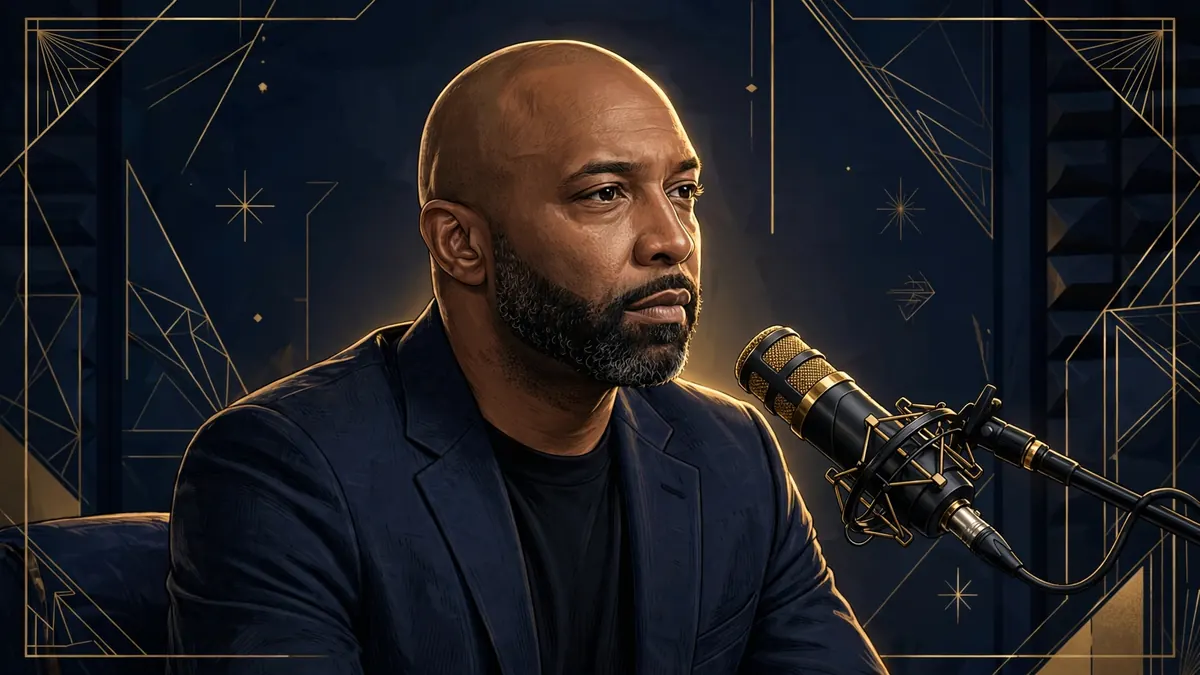
Joe Budden Early Life: Harlem Roots and Jersey City
Joseph Anthony Budden II was born on August 31, 1980, in East Harlem, a part of Manhattan with a long musical history of its own. His family moved across the Hudson River to Jersey City, New Jersey, while he was still a child, and Jersey City is the place he calls home in most accounts of his youth. The move shaped him in two ways that show up again and again in his later work: he grew up close enough to New York to absorb its rap scene at first hand, and far enough from its centre to develop the outsider’s eye that later made him such a sharp, and often blunt, commentator on it.
Budden started rapping as a teenager, working his way through the mixtape circuit that was still the main route into hip-hop in the late 1990s and early 2000s. There was no viral shortcut then. A young rapper proved himself on street tapes, on local radio, and in rooms full of people who had heard every boast before. Budden’s early tapes showed the quality that would define his whole career: a confessional, detail-heavy writing style, more interested in his own doubts and mistakes than in the usual victory lap. That honesty won him a following long before a major label came calling, and it is also what kept that following loyal when the label years went wrong.
By the early 2000s he had enough noise around him to attract real industry attention. He signed with Def Jam Recordings in 2002, at the age of 21, and the deal looked like the classic breakthrough story: a talented young New Jersey rapper, signed to the most famous label in hip-hop, with a debut album on the way. What happened next is a lesson in how quickly that story can turn. The debut did arrive, and it did well. The follow-up did not, and the years that followed taught Budden a set of business lessons — about ownership, about who controls a release date, and about what a contract is really worth — that he would later apply, ruthlessly, to his podcasting career.
The Pump It Up Breakthrough
On May 8, 2003, Budden released “Pump It Up,” the lead single from his debut album, produced by Just Blaze. The record was built for clubs and for radio: a pounding beat, a hook that stuck after one listen, and a vocal performance that sounded hungry rather than polished. It worked. The single reached No. 38 on the Billboard Hot 100, putting it inside the top 40, and climbed to No. 13 in the United Kingdom. It turned up in the film 2 Fast 2 Furious and in the video game Madden NFL 2004, two placements that pushed it far beyond the rap audience that already knew his name.
The industry noticed. At the 46th Annual Grammy Awards in 2004, “Pump It Up” was nominated for Best Male Rap Solo Performance, a rare honour for a debut single, and it was also nominated for Best Original or Adapted Song at the 2004 Black Reel Awards for its use in 2 Fast 2 Furious. Budden did not win the Grammy, but the nomination changed how he was seen: he was no longer just a mixtape rapper with a local buzz, but a recording artist with a hit that the wider music business had formally recognised.
A month after the single, on June 10, 2003, the self-titled debut album Joe Budden arrived through On Top Entertainment, distributed by Def Jam. It debuted at No. 8 on the Billboard 200, selling about 95,000 copies in its first week, and reached No. 1 on the US Rap chart and No. 2 on the US R&B chart, according to Celebrity Net Worth. For a debut, those were strong numbers, and they suggested a long major-label career ahead. In hindsight, they were the high point of his time as a Def Jam artist, not the start of a steady climb.
The one-hit question, answered honestly: “Pump It Up” remains Budden’s biggest commercial single by a wide margin, and some profiles reduce his rap career to that one song. That is unfair to the work that followed. His independent albums and the Mood Muzik mixtapes earned him a reputation among rap fans as one of the most skilled lyricists of his generation, even while the charts moved on. The hit paid the bills; the mixtapes built the audience that would later follow him into podcasting.
Def Jam, Shelved Albums and the Mood Muzik Years
The trouble started almost as soon as the debut album had run its course. Budden recorded a second album, The Growth, and Def Jam shelved it. The label and the artist disagreed about direction and timing, and in the major-label system of the 2000s, that disagreement had only one winner. Budden eventually left Def Jam, and the shelved album became a symbol of everything he would later say was wrong with the traditional record business: an artist could do the work, deliver the record, and still watch it sit in a drawer because someone else controlled the release schedule.
He answered the only way an independent rapper could in that era: he went back to the mixtapes. The Mood Muzik series, which had begun in 2003 with Mood Muzik: The Worst of Joe Budden, became his real catalogue. Mood Muzik 2: Can It Get Any Worse? followed in 2005, Mood Muzik 3: For Better or For Worse in 2007, and Mood Muzik 3: The Album in 2008, with Mood Muzik 4: A Turn 4 the Worst arriving in 2010. The tapes were raw, long, and personal, and they circulated exactly the way mixtapes were supposed to — hand to hand, blog to blog, fan to fan. They kept his name alive through years when he had no major-label album in the shops, and they built the kind of audience that buys tickets and, years later, pays for a subscription: people who felt they knew him, not just his hit.
Alongside the tapes, Budden released a run of independent studio albums that critics rated far more highly than the sales figures suggested. Halfway House came out in digital-only form on October 28, 2008. Padded Room followed in February 2009, and Escape Route later the same year. Each one leaned into the confessional writing that had always been his strength, and each one sold modestly. In total he would release eight studio albums as a solo artist, with only the debut coming through a major label. The pattern was set: the music earned respect and a steady, modest living, but it never again produced a hit on the scale of “Pump It Up.” That gap between respect and revenue is the hinge of his whole biography, because it pushed him toward a second career where the audience, not a label, would pay him directly.

Slaughterhouse and the Shady Records Years
In 2008, Budden joined forces with three other lyricists — Royce da 5’9″, Joell Ortiz, and Crooked I, now known as Kxng Crooked — to form the supergroup Slaughterhouse. The name came from a track the four had recorded together, and the idea was simple: four rappers known for dense, technical writing, in one group, with no weak link. The self-titled debut album Slaughterhouse arrived on August 11, 2009, through E1 Music, and it did what the group had promised: it showed four very different voices pushing each other to write harder.
The group’s profile rose fast enough to attract Eminem’s attention. Slaughterhouse officially signed with Eminem’s Shady Records on January 12, 2011, a deal that put them on one of the most watched labels in rap. Their second studio album, Welcome to: Our House, was released on August 28, 2012, and it was the group’s commercial peak: it debuted at No. 2 on the Billboard 200 and No. 1 on the Billboard Top Rap Albums chart, selling about 52,000 copies in its first week. For Budden, it was a second taste of the major-label charts, nearly a decade after his debut, and it came as part of a group rather than as a solo star.
The group never quite turned that peak into a lasting run. Plans for further albums stalled, the members drifted back to solo work, and Slaughterhouse eventually split, with Celebrity Net Worth recording the group as disbanded. Budden’s own account of those years, given in interviews and on his podcast, is consistent with the story of his solo career: the music was strong, the business around it was not, and the people who controlled the money and the release dates were not the people making the records. He also appeared on VH1’s Love & Hip Hop: New York, which widened his audience beyond rap fans and gave television viewers a first look at the blunt, argumentative personality that would later carry his broadcasting career. By 2018, he had made his decision: he retired from recording and turned to broadcasting full time.
That retirement is worth pausing on, because it was not a surrender. Budden was 38, with a Grammy nomination, two charting albums behind him in different configurations, and a reputation as a rapper’s rapper. He walked away from the recording booth at the moment when many artists would have settled into a comfortable run of features and nostalgia tours. He did it because the podcast he had started three years earlier was already paying better, reaching further, and — the point he kept returning to — belonging to him.
Everyday Struggle, State of the Culture and the Spotify Years
The broadcasting career began before the retirement was formal. On April 17, 2017, Budden began co-hosting Everyday Struggle, a daily morning show for Complex, alongside DJ Akademiks and Nadeska Alexis. The show was built around argument: two or three hosts, a stack of rap news, and opinions delivered without the softening that television usually demands. Budden was good at it at once. His takes were sharp, his delivery was unhurried, and his willingness to say the unpopular thing made clips of the show travel far beyond its own audience. He left the show in December 2017, after a run of about eight months, amid disagreements over business terms — a pattern that would repeat, and that he would later describe as a choice to keep control of his own work rather than rent his name to someone else’s platform.
His next television move came quickly. On May 14, 2018, he announced a partnership with Sean Combs and Revolt, creating and producing the talk show State of the Culture, which premiered on September 10, 2018. He hosted it alongside Remy Ma, and the show ran from 2018 to 2020. It gave him a second national television platform in two years, and it put him back in business with Revolt, a relationship that would matter again in 2026, when the two sides struck a very different kind of deal.
In August 2018, Budden signed a deal to bring his podcast to Spotify and expand the show to a twice-weekly schedule, with new episodes every Wednesday and Saturday. The Spotify years raised the show’s reach and its pay. Celebrity Net Worth reports that under the Spotify deal he was making about $2 million a year in total, a solid figure that still left him feeling underpaid for the audience he was delivering. On August 27, 2020, he announced he was leaving Spotify at the end of his contract, after a public financial disagreement with the streaming service. The split was noisy, and Budden did not hide his view that the platform had profited from his work without paying him its fair share. The lesson he took from Spotify was the same one he had taken from Def Jam: a deal that looks generous on the day it is signed can look very different once the audience, and the revenue, grow beyond it.
The Joe Budden Podcast and the Patreon Model
The Joe Budden Podcast began in 2015, three years before he retired from recording, and it is the centre of everything that followed. What started as a conversational show about hip-hop grew into a network, with spinoff shows, a rotating cast of co-hosts, and, by 2026, more than 900 episodes of the flagship show alone. The format never really changed: Budden and his co-hosts talk, argue, laugh, and disagree about music, culture, sports, and their own lives, for hours at a time, and the audience treats the hosts like people they know. The New York Times, in its July 2025 profile, called him the “Howard Stern of hip-hop,” a label that captures both the length of the shows and the loyalty of the listeners.
The business model changed in February 2021, and that change is the most important financial decision of his life. On February 3, 2021, Budden announced that he was leaving Spotify behind and bringing exclusive podcast content to the crowdfunding service Patreon. He also announced that he was joining Patreon’s board as Creator Equity Advisor — the role is also described as Head of Creator Equity — with a brief to push for fairer deals for creators. The arrangement was equity-oriented rather than a guaranteed upfront payment, according to reporting on the deal, and its precise financial terms have not been independently established. What is clear is the direction of travel: instead of taking a cheque from a platform in exchange for exclusivity, Budden bet that his own audience would pay him directly, month after month, and keep the ownership with him.
The bet paid off in public, and in numbers that are unusually well documented for a private media business. In July 2025, The New York Times published a profile headlined “How Does This Podcast Star Make $20 Million a Year?” based on interviews with Budden and his chief executive, Ian Schwartzman, with figures confirmed by a Patreon spokesperson. The Times reported that the Joe Budden Network was averaging about $1.04 million a month on Patreon in 2025, with about 70,000 paying subscribers on tiers from $5 to $50 a month, putting annual Patreon revenue above $12 million. With advertising and other income added in, Schwartzman told the Times the network was on pace to generate more than $20 million in total revenue in 2025. The same reporting noted that the network set aside about $1.5 million a year for its co-hosts combined — Lamar “Ice” Burney, Trevor “Queenzflip” Robinson, Melyssa Ford, Antwan “Ish” Marby, Parks Vallely, and Marc Lamont Hill — and that it used dozens of contractors, a reminder that the headline revenue figure is the network’s income, not one man’s take-home pay.
A month earlier, the numbers had surfaced in a messier way. In June 2025, Budden posted an edited screenshot to Instagram Stories that appeared to show more than $903,000 in monthly membership revenue and more than 154,000 active subscribers across four paid tiers. The two sets of figures look different because they measure different things: the Times figure of 70,000 is paying subscribers, while the screenshot figure counts active members on the platform, a wider group that includes people on free or trial access. The episode also showed how closely the audience watches the money: the screenshot was picked apart within hours, and the co-hosts spent a full episode arguing about it on air. For a biography, the point is simpler — by mid-2025, the podcast was the biggest podcast on Patreon by paying subscribers, a fact Patreon itself confirmed to the Times, and the subscription income alone was running at more than a million dollars a month.
The Money: Income Streams and the Net Worth Question
So how much is Joe Budden actually worth? The honest answer is a range, because no private individual’s balance sheet is public, and the outlets that track celebrity wealth disagree about how to count a business like his. Celebrity Net Worth, the most widely cited source on his fortune, puts his net worth at about $20 million, a figure it updated on July 24, 2025, after the Times profile. Other 2026 trackers land nearby: one puts the range at $15 million to $25 million with Celebrity Net Worth as the anchor, and another lists $25 million flat. This page uses the range of $15 million to $25 million, anchored at about $20 million, because it reflects both the agreement at the centre and the uncertainty at the edges.
The older figure of $6 million still turns up on biographical compilation sites, and it needs to be addressed directly, because readers will find it. That number dates from his rap years, before the podcast business took off, and it no longer matches what major outlets reported about his media company in 2025 and 2026. A $6 million figure made sense when his income was record sales, touring, and television fees. It does not make sense after two years in which the network alone was reported to be generating about $20 million a year in revenue. The gap is not a rounding error; it is the difference between two careers, and the stale number belongs to the first one.
Just as important is the difference between revenue and net worth, which many profiles blur. The $20 million a year that the Times and Forbes report is what the network brings in, before costs. The network pays co-hosts, producers, editors, and dozens of contractors, covers studio costs in Fort Lee, New Jersey, and pays platform fees. Budden’s personal wealth is what is left after those costs, after taxes, and after years of spending, saved and invested — plus the value of the things he owns, above all his stake in the network itself and his music catalog. That is why a $20 million year of network revenue and a $20 million personal net worth can both be true at the same time, and why treating the annual revenue figure as his fortune would be a mistake.
His income now comes from five main streams. Patreon memberships are the largest, at more than $12 million a year by the Times’ 2025 reporting. Advertising and sponsorship reads on the free and paid shows add a second large stream, and live shows and touring add a third, with tickets and merchandise sold directly to the same audience that pays for the subscriptions. The music catalog — the debut album, the Slaughterhouse records, and the long tail of the mixtapes — still pays royalties, though at a far smaller scale than the podcast. Television work, including the Revolt shows, adds fees on top. What ties the streams together is ownership: the network, the catalog, and the audience relationship all sit with Budden and his company, not with a label or a platform, and that ownership is the asset that the net worth figure is really trying to price.
There is one more comparison worth making, because it shows how unusual his model is. Most podcasters who earn eight figures do it through a big platform deal: a guaranteed cheque from Spotify, SiriusXM, or iHeart in exchange for exclusivity. Budden earns his eight figures the other way round, from tens of thousands of individual fans paying $5 to $50 a month. The rapper-turned-broadcaster Snoop Dogg’s net worth story shows the more familiar path — decades of music, television, and brand deals stacking into a large fortune — while Jay-Z’s biography shows the extreme version of the same idea, a rapper who turned music into a business empire. Budden’s version is smaller than either, and it is built on a different foundation: not a catalog of hits, but a direct line to an audience that pays every month.
Net Worth Growth Over Time
The table below is an estimate, built from the dated reporting named in each row. It is not an audited account, and the early rows are wider than the later ones because the reporting from those years was thinner. What it shows, in broad strokes, is a fortune that stayed modest through the rap years and then rose sharply once the podcast became a subscription business.
| Period | Estimated Net Worth | What Was Driving It |
|---|---|---|
| 2003–2005 | Under $1 million | Debut album sales and “Pump It Up” royalties; Def Jam advance and touring income, offset by label costs |
| 2006–2010 | $1 million–$3 million | Independent albums and the Mood Muzik tapes; Slaughterhouse debut; television appearances |
| 2011–2015 | $3 million–$6 million | Shady Records album Welcome to: Our House; solo catalog; Love & Hip Hop fees; the $6 million figure most trackers cited in this era |
| 2016–2018 | $5 million–$8 million | Everyday Struggle and State of the Culture fees; the podcast’s early growth; Spotify deal signed August 2018 |
| 2019–2021 | $8 million–$12 million | Spotify years at about $2 million a year (Celebrity Net Worth); Patreon move in February 2021; Head of Creator Equity role |
| 2022–2024 | $12 million–$18 million | Patreon subscriptions scaling up; advertising and live shows; network hiring and studio costs rising alongside revenue |
| 2025–2026 | $15 million–$25 million | Times-reported $1.04 million a month on Patreon, 70,000 paying subscribers; network on pace past $20 million in 2025 revenue; Forbes No. 15 highest-paid podcaster, $20 million earnings, July 2026 |
Two things stand out in that timeline. First, the biggest jump comes after 2021, not after 2003. The hit single made him famous; the subscription model made him wealthy. Second, the range widens as the numbers get bigger, which is honest: a private media company’s value depends on how you price future subscription income, and reasonable people can disagree by several million dollars. The anchor stays the same, though — Celebrity Net Worth at about $20 million, with Forbes’ $20 million earnings figure for the year to June 2026 pointing the same way.
Forbes 2026 and the REVOLT Return
On July 30, 2026, Forbes published its annual list of the highest-paid podcasters, covering earnings from June 2025 to June 2026, and Budden was on it. He ranked No. 15, with estimated earnings of $20 million, in a top 20 whose combined earnings Forbes put at $638 million. The list was led by Joe Rogan, whose age and career put him at No. 1 with $82 million for The Joe Rogan Experience, followed by the TBPN hosts at $70 million and Steven Bartlett’s net worth story at No. 3 with $45 million for The Diary of a CEO. Charlamagne Tha God was No. 10 with $27 million, and Dax Shepard’s biography sits at the same end of the list, with $25 million for Armchair Expert. Budden’s reaction, reported by HotNewHipHop in August 2026, was modest: he took the ranking as recognition of the network’s work rather than as a personal payday, a response in keeping with a man who has spent years arguing that the business, not the host, is the story.
Forbes’ methodology matters here, and it is worth stating plainly. The list counts earnings paid to the talent over the twelve-month window — advertising, sponsorships, licensing, platform payments, revenue sharing, and live events — before taxes and before agents and managers take their cut. It is an earnings figure, not a wealth figure, and it counts what the show generated for its host, not what the host kept. That is why Budden can appear on the list at $20 million in earnings while his net worth is also estimated at about $20 million: one is a year’s income, the other is everything he has kept and built over a career.
Then, in November 2026, came the newest chapter, and it brought his story full circle. On November 10, 2026, REVOLT and Budden announced a multi-year partnership bringing the Joe Budden Network to national television, with Joe Budden Network Presents premiering on November 13, 2026, on Friday nights at 10 p.m. ET. The deal covers the flagship podcast and other network shows, including Pod Wives and The Ian and Marc Show, hosted by his business partner Ian Schwartzman and Marc Lamont Hill. The financial terms were not disclosed. What was disclosed, and what makes the deal different from his earlier television work, is its structure: REVOLT is licensing the programming, not buying it. Ownership of the shows and the catalog stays with Budden, along with creative control over what airs. Eight years after State of the Culture, a show Revolt owned and Budden hosted, he returned to the same network as an owner licensing his own work to it. He had walked away from Complex in 2017 and from Spotify in 2020 over value and ownership; in 2021 he rebuilt on Patreon on his own terms; in 2026, a television network came to him on those terms.
Personal Life: Family, Cyn Santana and Fatherhood
Budden has two sons, from two relationships, and fatherhood is the part of his personal life he talks about most openly, and most often, on his own show. His oldest son, Trey Budden, was born on May 11, 2001, when Budden was 20, to his former partner Angie. Trey has since tried his own hand at music, and Budden has spoken on air about the strangeness of watching his son enter the same business that shaped his own twenties.
His second son, Lexington Budden, was born on December 15, 2017, to Budden and his then-partner Cyn Santana, a model and reality television personality. The couple had begun dating in 2016, and their relationship played out in public on Love & Hip Hop: New York. They became engaged in December 2018, shortly after Lexington’s birth, and the engagement ended in the spring of 2019, after about four months. Cyn Santana has said the split followed cheating claims, which Budden has not publicly answered in detail. The two have continued to co-parent Lexington, and both have spoken about putting their son first despite the end of the relationship. Budden has never married, and as of November 2026 he is not reported to be in a public relationship.
That co-parenting relationship is also the context for one of the more difficult episodes in his personal life, which is covered in the next section. What matters here is the shape of it: a man who became a father at 20, again at 37, and who has built a broadcasting career in which his family life is discussed, argued over, and revisited on air, week after week, in front of an audience that feels it knows all three of them. Few public figures live that openly with their private life, and fewer still have made that openness into a business model.
Legal Issues and Public Controversies
A biography that skipped Budden’s legal trouble would be incomplete, and one that exaggerated it would be unfair. The record, as reported, contains three episodes that are worth stating plainly, with their outcomes attached.
In 2010, Budden was sued by Hudson County, New Jersey, for unpaid child support, and a warrant was issued by the county sheriff’s office. The episode dates from the years when his income was at its lowest, between the Def Jam years and the podcast boom, and it is a reminder that the early-2010s version of Joe Budden was not a wealthy man. He has since spoken about his financial mistakes in that period, and the warrant is part of the public record of them.
On March 30, 2012, he spent a night in jail and missed a Slaughterhouse concert in his hometown over a $75 parking ticket. The incident is minor, and it is included here because it is often cited in profiles of him, not because it says much about his character: an unpaid ticket, a night in a cell, a missed show. It belongs in the record, and it belongs there at its true size.
The third episode is more serious, and its outcome matters more than the allegation. In 2014, Budden was briefly wanted by the New York Police Department after allegedly assaulting his then-girlfriend and stealing her cell phone. He turned himself in and appeared in Manhattan Criminal Court on charges of assault, grand larceny, and robbery. A judge later dismissed all charges against him. That dismissal is the end of the legal story, and it should be reported with the same prominence as the arrest: the charges were brought, and the charges were dismissed. Later claims about his private life that circulated online in 2020, including alleged court documents published by gossip outlets, have not been verified by a court or by a reputable newsroom, and this page does not repeat them as fact.
Beyond the courtroom, Budden’s public controversies have mostly been arguments: with co-hosts, with other rappers, with platforms, and with his own audience. The Rory and Mal split in 2021, when his longtime co-hosts Rory Farrell and Jamil “Mal” Clay left the show after a public dispute over finances and respect, was the most watched of these, and it reshaped the podcast’s cast. The show survived it, and the argument itself became part of the show’s mythology: a podcast about honesty, having an honest argument about money, in public. That is the pattern of his controversies in general — loud, public, and argued out on the record, rather than settled quietly behind closed doors.
What Joe Budden Is Doing in 2026
As of November 2026, Budden is 46, hosting The Joe Budden Podcast several times a week from his Fort Lee, New Jersey, studio, running the Joe Budden Network with Ian Schwartzman, and appearing on television again through the new REVOLT licensing deal. The podcast remains the centre of the operation: the flagship show, the spinoffs, the Patreon memberships, and the live events that turn listeners into ticket buyers. He is not recording music, and he has given no sign of returning to it; the retirement he announced in 2018 has held.
What has changed in 2026 is the scale of the recognition. The Forbes ranking in July put him on a list with Rogan, Bartlett, Charlamagne, and Shepard, and the REVOLT deal in November put his network on national television without giving up ownership. Both are the payoff for decisions made years earlier — the 2021 move to Patreon, the refusal to re-sign with Spotify on terms he thought were unfair, the insistence, at every step, that the shows and the catalog stay his. For a man who started the decade as a rapper with a shelved album, that is a striking place to end up: not the richest podcaster in the world, and not the most famous rapper of his generation, but one of the few people in either business who owns what he built.
Frequently Asked Questions
Who is Joe Budden?
Joe Budden, born Joseph Anthony Budden II, is an American broadcaster and former rapper. He first became known for his 2003 hit single “Pump It Up” and as a member of the hip-hop supergroup Slaughterhouse, and he is now best known as the host of The Joe Budden Podcast and the founder of The Joe Budden Network.
How old is Joe Budden in 2026?
Joe Budden was born on August 31, 1980, in East Harlem, New York City, and raised in Jersey City, New Jersey. He turned 46 on August 31, 2026.
What is Joe Budden’s net worth in 2026?
Joe Budden’s estimated net worth in 2026 is $15 million to $25 million, anchored at about $20 million by Celebrity Net Worth (updated July 24, 2025). The figure is an estimate, not a public balance sheet. Older figures of about $6 million date from his rap years and no longer reflect his podcast business.
How much does Joe Budden make from his podcast?
According to The New York Times (July 2025), The Joe Budden Network averaged about $1.04 million a month on Patreon, with about 70,000 paying subscribers, putting annual Patreon revenue above $12 million. With advertising and other income, the network was on pace to generate more than $20 million in total revenue in 2025, and Forbes estimated his earnings at $20 million for the year to June 2026. Those are network revenue and earnings figures, not his personal take-home pay.
Why did Joe Budden leave Spotify?
Budden signed an exclusive deal with Spotify in August 2018, and on August 27, 2020, he announced he was leaving at the end of his contract after a public financial disagreement with the service. In February 2021 he moved his podcast to Patreon, where fans pay directly, and took the role of Creator Equity Advisor (Head of Creator Equity) at Patreon.
Is Joe Budden still making music?
No. Budden retired from recording in 2018 and has focused on broadcasting since then. His music catalog, including his 2003 debut album Joe Budden, the Mood Muzik mixtapes, and the two Slaughterhouse albums, still earns royalties, but he has released no new music as a recording artist since his retirement.
Is Joe Budden married?
No, Joe Budden has never married. He was engaged to model and reality television personality Cyn Santana in December 2018, after the birth of their son Lexington, and the engagement ended in the spring of 2019. The two co-parent their son. His older son, Trey, was born in 2001 to his former partner Angie.
What is Joe Budden doing now in 2026?
In 2026 Budden hosts The Joe Budden Podcast from Fort Lee, New Jersey, runs The Joe Budden Network with CEO Ian Schwartzman, ranked No. 15 on Forbes’ July 2026 list of the highest-paid podcasters with $20 million in estimated earnings, and signed a multi-year licensing deal with REVOLT, with Joe Budden Network Presents premiering on November 13, 2026.
Final Thoughts
Joe Budden’s biography is really two biographies in one. The first is the familiar rap story: a talented kid from East Harlem and Jersey City, a hit single at 22, a Grammy nomination, a major-label deal that went wrong, and a long run of respected independent records that never quite paid what they were worth. The second is the story that makes him worth writing about in 2026: a broadcaster who learned, twice, what it costs to let someone else own your work, and who then built a business in which the audience pays him directly, month after month, for shows he owns outright.
The numbers tell that second story plainly enough. A net worth estimated at $15 million to $25 million, anchored at about $20 million. A network averaging $1.04 million a month on Patreon, with 70,000 paying subscribers. A No. 15 ranking on Forbes’ 2026 highest-paid podcasters list, with $20 million in earnings. A television deal, signed in November 2026, that licenses his shows to REVOLT without selling them. None of those figures is exact, and this page has said so at every step. What is exact is the direction: up, and under his own control.
Readers who want more stories like this one will find the rest of our celebrity biographies on CelebAmerica, covering rappers, podcasters, actors, and athletes who took the long way to the top. Budden’s route was longer than most, and more public than most, and that is why it still holds attention more than twenty years after “Pump It Up” first played in a club.
Sources and Reporting
How we estimated: Every money figure in this article is tied to a named source, with the source’s date where known. Celebrity Net Worth (updated July 24, 2025) anchors the net worth estimate at about $20 million; this page publishes the wider range of $15 million to $25 million to reflect other 2026 trackers and the uncertainty in valuing a private media company. Forbes’ July 30, 2026 ranking is an earnings figure for the twelve months to June 2026, not a wealth figure. The New York Times’ July 2025 profile is the source for the Patreon figures ($1.04 million a month, 70,000 paying subscribers, more than $20 million in network revenue), with the figures confirmed by Patreon. Where sources disagreed — the $6 million older figure, the 154,000 active members in the June 2025 screenshot versus the 70,000 paying subscribers reported by the Times — the article states both figures and explains the difference. Estimates may differ from private reality; no personal balance sheet, tax return, or contract has been made public.
Named sources consulted for this article: Forbes (Highest-Paid Podcasters of 2026, July 30, 2026); The New York Times (“How Does This Podcast Star Make $20 Million a Year?”, July 2025); Celebrity Net Worth (Joe Budden net worth, updated July 24, 2025); Billboard (chart positions for “Pump It Up,” the debut album, and Welcome to: Our House); Complex (Everyday Struggle); XXL (Forbes list coverage, July 31, 2026); Patreon (Creator Equity Advisor role and subscriber figures, via the Times); Variety (podcast industry coverage). Chart and release dates were checked against the artist’s discography as recorded by Wikipedia and the outlets above. This article was written from original research for CelebAmerica and is not a copy of any article on a sister site.