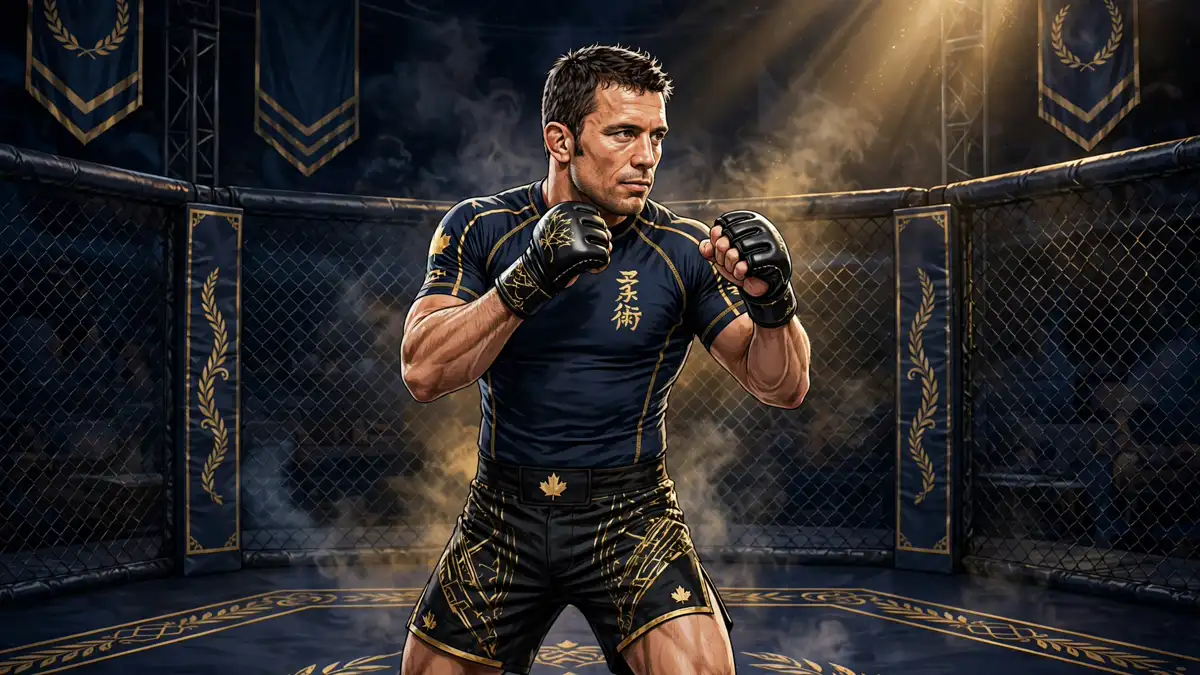
Georges St-Pierre is a Canadian former mixed martial artist, a two-division UFC champion, and one of the most respected fighters the sport has ever produced. Born on May 19, 1981, in the small town of Saint-Isidore, Quebec, he finished his professional career with a record of 26 wins and 2 losses, three welterweight title reigns, nine consecutive title defences, and a middleweight crown won four years after he had walked away from the sport.
As of November 2026, Georges St-Pierre’s net worth is estimated at $20 million to $30 million. Celebrity Net Worth puts the figure at $20 million, while Players Bio and Sports Brief both report $30 million and BounceMojo reports $25 million. The fortune was built on UFC fight purses and pay-per-view shares, a long list of endorsement deals, acting work that included a role in a Marvel blockbuster, and his 2013 memoir The Way of the Fight. This biography traces the full arc: the bullied schoolboy from rural Quebec, the rise to the top of the UFC, the money, the comeback, and the life he built after fighting.
By Celebamerica Editorial Staff | Last updated: November 9, 2026
Quick Facts
| Full Name | Georges St-Pierre |
|---|---|
| Nickname | GSP, Rush |
| Date of Birth | May 19, 1981 |
| Birthplace | Saint-Isidore, Montérégie, Quebec, Canada |
| Nationality | Canadian |
| Height | 5 ft 10 in (1.78 m) |
| Estimated Net Worth (2026) | $20 million – $30 million |
| Professional MMA Record | 26 wins, 2 losses |
| UFC Titles | Welterweight champion (three times), Middleweight champion (2017) |
| Title Defences | Nine consecutive welterweight title defences |
| Retired | December 2013 (welterweight champion); formally February 21, 2019 |
| Hall of Fame | UFC Hall of Fame, Class of 2020; Canada’s Sports Hall of Fame |
| Best-Known Acting Role | Georges Batroc in Captain America: The Winter Soldier (2014) |
| Primary Income Sources | UFC purses and pay-per-view shares, endorsements, acting, book sales, speaking |
Table of Contents
- Quick Facts
- Early Life in Saint-Isidore
- From Bullied Schoolboy to Kyokushin Black Belt
- The Road to the UFC
- First Title and the Serra Upset
- The Nine-Defence Reign
- Retirement, Comeback and the Middleweight Crown
- The Money: How GSP Built His Fortune
- Fight Earnings and Endorsements
- Net Worth Breakdown and Growth
- Acting, Books and Business
- Personal Life and the Georges St-Pierre Foundation
- Legacy: Where GSP Ranks Among the Greats
- Frequently Asked Questions
- Final Thoughts
- Sources & Reporting
Early Life in Saint-Isidore
Georges St-Pierre was born on May 19, 1981, in Saint-Isidore, a small French-speaking town in the Montérégie region of Quebec, to Roland and Pauline St-Pierre. He grew up with two younger sisters in a household that was, by his own account, loving but far from wealthy. Saint-Isidore was the kind of place where everyone knew everyone, and where a shy, slight boy stood out for the wrong reasons.
School was hard for the young Georges. Older classmates bullied him, stealing his clothes and his lunch money, and the experience left a mark that would shape everything that followed. He has spoken about those years many times since, not with bitterness but as the starting point of his story — the reason a seven-year-old boy walked into a karate dojo and never really walked out. His father Roland, who had trained in Kyokushin karate himself, enrolled him so he could learn to defend himself. The dojo gave him something school never had: a place where effort was rewarded, where respect was earned, and where the shy kid from Saint-Isidore could start to believe he was capable of more.
Before fighting ever paid a dollar, St-Pierre worked the jobs that were available to a young man in Montreal’s South Shore. He spent time as a bouncer at a nightclub called Fuzzy Brossard and worked for six months as a garbageman to pay for his school fees. Those jobs are a small detail, but they say a lot about the man: the discipline he later showed in the cage was built in years when nobody was watching, and when the work was unglamorous. He attended École Pierre-Bédard for high school, where he held the school record for chin-ups, and later studied at Cégep Édouard-Montpetit.
From Bullied Schoolboy to Kyokushin Black Belt
St-Pierre began learning Kyokushin karate at the age of seven, first from his father and then from a Kyokushin master. Kyokushin is the full-contact style of karate — no pads, bare-knuckle sparring, conditioning that hardens the body as much as the mind — and it gave him a base that would stay with him for his whole career. He earned his black belt at twelve, an unusually young age, and the confidence that came with it changed how he carried himself. The bullying stopped, not because he fought anyone, but because he no longer looked like a target.
When he was around sixteen, his karate teacher died, and St-Pierre began to branch out. He took up wrestling, Brazilian jiu-jitsu and boxing, building the complete skill set that mixed martial arts demands. He trained at the Renzo Gracie Jiu-Jitsu Academy in New York, earning his brown belt in Brazilian jiu-jitsu from Renzo Gracie on July 21, 2006, and his black belt under Bruno Fernandes in September 2008. Later he joined Greg Jackson’s camp in Albuquerque, New Mexico, training alongside fighters such as Rashad Evans and Donald Cerrone, before settling at the Tristar Gym in Montreal under head coach Firas Zahabi, who became his lifelong cornerman and strategist.
The through-line of those years was obsession with detail. St-Pierre studied film, tracked his opponents’ habits, and prepared for fights the way a chess player prepares for a match. That reputation — the most prepared fighter in the sport — was built long before he ever held a belt. It was also built on an unusual quality for a fighter: he treated his body as a long-term investment, bringing in specialists for gymnastics, sprinting and strength work, and keeping his weight cut disciplined even between fights.

The Road to the UFC
St-Pierre turned professional in 2002, debuting with the Universal Combat Challenge (UCC) in Canada. He won his first fights with the kind of completeness that made scouts take notice: a karate striker who could also wrestle, who could also grapple, and who never seemed rattled. The spark had been lit years earlier, when as a teenager in 1993 he rented a video of an early UFC tournament and watched Royce Gracie submit much larger men with technique alone. The idea that skill could beat size stayed with him.
His UFC debut came at UFC 46 in January 2004, against the highly ranked Karo Parisyan. St-Pierre won by unanimous decision, announcing himself to the biggest stage in the sport in his very first appearance. He followed it with wins that built his name quickly, and by October 2004 he was fighting Matt Hughes — the dominant welterweight champion of the era — at UFC 50. Hughes caught him in an armbar with one second left in the first round. It was St-Pierre’s first professional loss, and it taught him something he carried for the rest of his career: in this sport, a fight is never over until it is over.
He rebuilt with a string of wins over top contenders, and by 2006 he was ready for a second shot. The loss to Hughes had not dented his standing; if anything, the way he responded to it — winning, learning, improving between every fight — became the template for his whole career. He never lost twice to the same mistake, and he never lost the same fight twice.
First Title and the Serra Upset
St-Pierre won the UFC welterweight championship for the first time at UFC 65 in November 2006, stopping Matt Hughes by technical knockout in the second round. The student had beaten the master, and the welterweight division had a new champion. He defended the belt against Josh Koscheck at UFC 74, but then came the night that still defines his career as much as any win.
At UFC 69 in April 2007, St-Pierre faced Matt Serra, a heavy underdog who had earned his shot through the reality show The Ultimate Fighter. Serra knocked him out in the first round. It remains one of the biggest upsets in UFC history. St-Pierre has said since that the loss humbled him and forced him to rebuild his approach — to take nothing for granted, to prepare for every opponent as if they were the best fighter he would ever face. The response was immediate and total. He won the interim welterweight title by beating Hughes again at UFC 79 in December 2007, then unified the belts by stopping Serra in their rematch at UFC 83 in April 2008, in front of a roaring crowd in Montreal. Both losses avenged. Both men beaten in rematches. The message was clear: St-Pierre did not just win titles, he corrected his defeats.
The record that matters most: St-Pierre’s professional record stands at 26 wins and 2 losses, and he avenged both defeats. He beat Matt Hughes twice after losing to him, and he stopped Matt Serra in their rematch. No opponent ever held a win over him at the end of his career.
The Nine-Defence Reign
What followed the Serra rematch was the most dominant run the welterweight division has ever seen. St-Pierre defended his title nine consecutive times — a division record — against a murderer’s row of challengers. The list reads like a hall of fame ballot: Jon Fitch at UFC 87, B.J. Penn at UFC 94, Thiago Alves at UFC 100, Dan Hardy at UFC 111, Josh Koscheck at UFC 124, Jake Shields at UFC 129 in Toronto in front of 55,724 fans, Carlos Condit at UFC 154 in Montreal, and Nick Diaz at UFC 158. He closed the run against Johny Hendricks at UFC 167 in November 2013, winning a controversial split decision that many observers scored for Hendricks.
The numbers behind the reign are staggering. St-Pierre held the record for the most wins in UFC title bouts, and his combined title streak of 2,204 days was the second-longest in UFC history. He was ranked the number one welterweight in the world for years by Sherdog and other publications, and Rogers Sportsnet named him Canadian Athlete of the Year in 2008, 2009 and 2010 — three years running, an honour no fighter had taken before. Fight Matrix lists him as the top welterweight of all time and the most accomplished fighter in MMA history.
His style was not built on knockouts, though he had plenty of them. It was built on control: a jab that kept opponents at range, takedowns timed to the second, and ground control that drained the fight out of world-class opponents. Critics sometimes called his fights cautious. His answer was always the same — he fought to win, and he won, again and again, against the best of his generation. He also coached opposite Josh Koscheck on season 12 of The Ultimate Fighter, a run that ended with his dominant win over Koscheck at UFC 124.
Retirement, Comeback and the Middleweight Crown
In December 2013, weeks after the Hendricks fight, St-Pierre announced he was stepping away from the sport. He vacated the welterweight title while still champion. He spoke about the mental toll of the championship grind, the pressure of constant media and drug-testing demands, and the need to live a normal life for a while. Canada’s Sports Hall of Fame later noted that he took the hiatus to prioritise his mental health — a candid admission that was rare for an athlete at the top of his sport in 2013, and one that has aged well as the conversation around athletes and mental health has changed.
For nearly four years, he stayed away. Then, in November 2017, he returned at UFC 217 in New York — not at welterweight, but at middleweight, against champion Michael Bisping. Four years out of the cage, a new weight class, a champion who had never been submitted. St-Pierre submitted Bisping with a rear-naked choke at 4:23 of the third round, winning the middleweight championship and becoming only the fourth fighter in UFC history to hold titles in two divisions. The comeback was complete, and it was perfect: one fight, one title, no excuses.
He vacated the middleweight belt a month later, citing health issues, and on February 21, 2019, he announced his formal retirement from MMA. He left with the record, the titles, the hall of fame spot already waiting, and something rarer still: he retired on his own terms, with his health and his legacy intact. In 2020, the UFC inducted him into its Hall of Fame as part of the Class of 2020, in the Modern Wing.
The Money: How GSP Built His Fortune
Georges St-Pierre was one of the first UFC fighters to become a genuine pay-per-view draw, and that is where most of his money came from. At his peak he was the biggest box-office name in the sport after the heavyweights, headlining cards in Montreal and Toronto that sold out in minutes and drew hundreds of thousands of buys. His disclosed base pay was modest by today’s standards — $200,000 to show and $200,000 to win at UFC 158, for example — but the disclosed purse was only a fraction of what a champion of his standing took home. The real money sat in the pay-per-view points written into his contract, the share of each event’s buys that went to the headliner.
Celebrity Net Worth, which puts his net worth at $20 million, has analysed his pay in detail. For UFC 154 in November 2012, his disclosed earnings were $470,000 — a $200,000 appearance fee plus a $270,000 win bonus. For UFC 158 in March 2013, his disclosed purse was $400,000, but Celebrity Net Worth estimated his pay-per-view bonus at up to $2.85 million on 950,000 buys, for a total of around $3.25 million for one night’s work. The same analysis put his total per-fight earnings at $5 million to $6 million at the height of his career, once endorsements were added. St-Pierre himself once claimed in a 2011 interview that a fight was worth $4 million to $5 million to him, and that he earned $15 million a year from endorsements — claims Celebrity Net Worth described as exaggerations, while noting that his real earnings were still enormous by the standards of the sport at the time.
Surprise Sports, which reports the highest figure in circulation at $60 million, lists his total UFC career earnings at $7,037,000 in disclosed purses alone. Wealthy Garage, citing Legit.ng’s May 2026 compilation, reports that he earned about $11 million in fight purses across his career, including roughly $6 million for the UFC 217 comeback win over Bisping. The gap between the disclosed $7 million and the $11 million figure reflects the difference between base pay reported to athletic commissions and the fuller picture that includes bonuses. Either way, the fighting itself was only part of the story. The endorsements were the other half.
Fight Earnings and Endorsements
At his peak, St-Pierre held around 14 endorsement deals, each paying six figures, according to Celebrity Net Worth’s reporting. The headline names were Under Armour, which built a whole line around him in Canada, and Electronic Arts, which put him on the cover and in the marketing of its EA Sports UFC video games. He also worked with brands in nutrition, training equipment and apparel, and his clean-cut, bilingual, media-friendly image made him the most sponsor-friendly fighter in the sport. He was the fighter a brand could put on a billboard in Montreal and in Toronto, in English and in French, without worrying about the headline the next morning.
The table below sets out the key paydays that are a matter of public record. Disclosed purses are the figures reported to athletic commissions; total take-home was higher once pay-per-view points and endorsements were added.
| Event | Disclosed Pay / Notes |
|---|---|
| UFC 154 (Nov 2012) vs Carlos Condit | $470,000 disclosed ($200,000 to show, $270,000 win bonus) |
| UFC 158 (Mar 2013) vs Nick Diaz | $400,000 disclosed; estimated $3.25 million total with pay-per-view share on 950,000 buys (Celebrity Net Worth) |
| UFC 167 (Nov 2013) vs Johny Hendricks | Estimated $5–6 million total for the night, per-fight peak range (Celebrity Net Worth) |
| UFC 217 (Nov 2017) vs Michael Bisping | About $6 million reported for the comeback win (Wealthy Garage, citing Legit.ng) |
| Career disclosed UFC purses | $7,037,000 (Surprise Sports); about $11 million including bonuses (Wealthy Garage) |
| Peak annual earnings | $12–15 million per year at his peak, including endorsements (Celebrity Net Worth) |
Beyond the cage, his income streams have been steady rather than flashy. He has never chased the kind of headline business empire some fighters build, and that is part of why his wealth has held up. His spending was famously disciplined — he lived in Montreal, trained at Tristar, and reinvested in his own preparation rather than in a lavish lifestyle. The money went into his training, his team, and his foundation, not into a fleet of cars or a property portfolio splashed across social media.
Net Worth Breakdown and Growth
Published estimates of St-Pierre’s net worth disagree, which is normal for a retired athlete whose finances are private. Here is what the named sources say, and how the range of $20 million to $30 million is built.
| Source | Estimate |
|---|---|
| Celebrity Net Worth | $20 million (updated August 2024) |
| Players Bio | $30 million (updated November 2026) |
| Sports Brief | $30 million (updated April 2026) |
| BounceMojo | $25 million (2026) |
| Net Worth Mag | $25 million |
| Surprise Sports | $60 million (outlier — far above every other published estimate) |
The honest picture is a range, not a single number. Celebrity Net Worth anchors the low end at $20 million, and several 2026 sources put him at $25 million to $30 million. The $60 million figure from Surprise Sports stands alone — no other major source comes close to it, and it appears to count gross career earnings and speculative asset values rather than net wealth after taxes, management fees and expenses. We treat it as an outlier and do not use it as the headline figure.
His fortune breaks down into four parts. Fight earnings are the foundation: disclosed purses of around $7 million to $11 million, plus pay-per-view points that Celebrity Net Worth estimates pushed his biggest nights to $3 million to $6 million each. Endorsements are the second pillar: around 14 deals at his peak, each worth six figures, with Under Armour and EA Sports the headline names. Acting and media work are the third: a Marvel film, a Disney+ series, other film roles, and his memoir The Way of the Fight. The fourth is the long tail — speaking engagements, his training app and online presence, appearances, and the ongoing value of being one of the most respected names in the sport, seven years after his last fight.
| Period | What Changed |
|---|---|
| 2002–2006 | Early career and first title; modest purses, first sponsors; net worth under $1 million |
| 2007–2010 | Second title reign begins; pay-per-view points and major endorsements arrive; Canadian Athlete of the Year three years running |
| 2011–2013 | Peak earning years, $12–15 million a year at the top; UFC 129 draws 55,724 fans in Toronto |
| 2014–2016 | Hiatus; acting roles including Captain America: The Winter Soldier; book royalties |
| 2017–2019 | Comeback win at UFC 217 worth about $6 million; formal retirement in 2019 |
| 2020–2026 | Hall of Fame induction; speaking, foundation work and media; fortune steady at $20–30 million |

Acting, Books and Business
St-Pierre’s most famous work outside the cage is his role as Georges Batroc in Marvel’s Captain America: The Winter Soldier (2014), where he fought Chris Evans in the film’s opening action sequence. The part was written for a fighter — Batroc is a French mercenary and martial artist in the comics — and St-Pierre played it straight, with the same quiet intensity he brought to the octagon. He reprised the role in the Disney+ series The Falcon and the Winter Soldier in 2021. He also appeared in Kickboxer: Vengeance (2016) and Cartels (2016), and has worked as a stunt performer and fight choreographer.
His book, The Way of the Fight, published in 2013 with co-author Zac Robinson, is the most revealing document of his career. It is part memoir, part philosophy: the bullying, the karate, the fear before fights, the discipline of preparation, and the mental health struggles that led to his 2013 hiatus. It sold well in Canada and remains the best first-person account of what it felt like to carry the UFC’s welterweight division for seven years. He has also been involved in training ventures, including a fitness and training app, and he remains a regular presence at UFC events as a commentator and ambassador for the sport in Canada.
Unlike many fighters of his generation, St-Pierre never built a noisy business empire, and he never needed to. His brand was discipline, and it translated into steady, long-term income: speaking engagements, appearances, brand work, and the kind of reputation that keeps the phone ringing years after retirement. He is a sought-after motivational speaker, represented by Speakers Canada, and his talks draw on the same themes as his book — preparation, resilience, and the mental side of performance.
Personal Life and the Georges St-Pierre Foundation
St-Pierre has guarded his private life more carefully than almost any fighter of his fame. He is not publicly married, has never confirmed a wife or long-term partner, and reporting as of 2026 describes him as single. He lives in Montreal, Quebec, and his public life since retirement has centred on three things: training, his foundation, and speaking about mental health and bullying.
The Georges St-Pierre Foundation is the vehicle for that work. It supports anti-bullying initiatives and youth sports, drawing directly on his own childhood — the boy who was bullied at school and found his way out through karate. He has spoken to young people across Canada about the experience, and about the mental health pressures that led to his 2013 break from the sport. In an era when athletes are more open about these subjects than ever, St-Pierre was ahead of the curve: he stepped away at the height of his powers because he needed to, and he said so plainly.
He remains close to his family — his parents Roland and Pauline, and his two younger sisters — and to his team at Tristar Gym in Montreal, where head coach Firas Zahabi remains his mentor and friend. He trains daily, stays in fighting shape, and has repeatedly shut down talk of another comeback, including speculation about a superfight with Khabib Nurmagomedov that never materialised. His answer has been consistent: he is happy, he is healthy, and the chapter is closed.
Legacy: Where GSP Ranks Among the Greats
Ask ten MMA writers to name the greatest fighter of all time and St-Pierre will appear on nearly every list. The case for him is built on completeness: no other fighter combined his striking, wrestling and grappling at such a high level, for so long, against such strong opposition. Jon Jones and Anderson Silva have their own claims, and the debate will run forever, but St-Pierre’s record has a quality neither of them can match — he avenged both of his losses, and he retired with no unresolved rival holding a win over him.
The numbers back the argument. Twenty-six wins against two losses. Three welterweight title reigns. Nine consecutive defences. A middleweight title won after four years away. The record for the most wins in UFC title bouts. The second-longest combined title streak in UFC history at 2,204 days. Canadian Athlete of the Year three years running. A place in the UFC Hall of Fame and in Canada’s Sports Hall of Fame. Fight Matrix calls him the most accomplished fighter in MMA history and the top welterweight of all time.
His influence runs deeper than the record book. He changed how fighters prepare, bringing in specialists for gymnastics, sprinting and strength work at a time when most camps still trained the old way. He changed how fighters carry themselves, showing that a champion could be polite, bilingual, media-friendly and sponsor-safe without losing an ounce of edge. And he changed the conversation around mental health in combat sports, stepping away in 2013 and talking about it openly when few athletes did. The sport he left is bigger, richer and more professional than the one he joined in 2004, and he is one of the main reasons why.
| Fighter | Career Record | Net Worth (2026 estimates) |
|---|---|---|
| Georges St-Pierre | 26–2, two-division champion | $20–30 million |
| Anderson Silva | 34–11, middleweight champion | About $14 million (Celebrity Net Worth) |
| Jon Jones | 28–1, two-division champion | About $10 million (Celebrity Net Worth) |
| Conor McGregor | 22–6, two-division champion | About $200 million (Celebrity Net Worth) |
| Khabib Nurmagomedov | 29–0, lightweight champion | About $40 million (Celebrity Net Worth) |
The comparison shows where St-Pierre sits. McGregor’s fortune dwarfs everyone in the sport, built on whiskey and boxing, not fighting purses. But among the fighters whose wealth came mainly from the cage, St-Pierre’s $20 million to $30 million puts him near the top — ahead of Silva and Jones on the published estimates, and behind only McGregor and Khabib among the all-time greats. It is a fortune built the hard way: one fight at a time, over fifteen years, with no shortcuts.
Frequently Asked Questions
How old is Georges St-Pierre?
Georges St-Pierre was born on May 19, 1981, in Saint-Isidore, Quebec, Canada. He turned 45 in May 2026. He retired from professional MMA in February 2019 at the age of 37, after a career that ran from 2002 to 2017 in the cage.
What is Georges St-Pierre’s net worth in 2026?
Georges St-Pierre’s net worth is estimated at $20 million to $30 million in 2026. Celebrity Net Worth puts the figure at $20 million, while Players Bio and Sports Brief both report $30 million and BounceMojo reports $25 million. The fortune comes from UFC fight purses and pay-per-view shares, endorsements with brands such as Under Armour and EA Sports, acting roles, and his book The Way of the Fight.
What is Georges St-Pierre’s UFC record?
Georges St-Pierre finished his professional MMA career with a record of 26 wins and 2 losses. His only defeats came against Matt Hughes at UFC 50 in 2004 and Matt Serra at UFC 69 in 2007. He avenged both losses, beating Hughes twice more and Serra in their UFC 83 rematch in Montreal.
Why did Georges St-Pierre retire in 2013?
St-Pierre retired as the reigning UFC welterweight champion in December 2013, saying he needed time away from the sport. He later spoke openly about the mental strain of the championship grind and the pressure of constant drug-testing scrutiny and media demands. He took a four-year break before returning in 2017 to win the middleweight title at UFC 217.
Did Georges St-Pierre win UFC titles in two weight classes?
Yes. St-Pierre won the UFC welterweight championship three times between 2006 and 2013, defending it nine consecutive times, and then won the middleweight championship by submitting Michael Bisping at UFC 217 in November 2017. He became only the fourth fighter in UFC history to hold titles in two divisions.
What movies has Georges St-Pierre acted in?
His best-known acting role is Georges Batroc in Marvel’s Captain America: The Winter Soldier (2014), a part he later reprised in the Disney+ series The Falcon and the Winter Soldier (2021). He also appeared in Kickboxer: Vengeance (2016) and Cartels (2016), and has worked as a stunt performer and fight choreographer.
Is Georges St-Pierre married?
No. Georges St-Pierre is not publicly married and has kept his private life out of the spotlight throughout his career. He has never confirmed a wife or long-term partner in public, and reporting as of 2026 describes him as single. He lives in Montreal, Quebec, and spends much of his time on training, his foundation, and speaking work.
Is Georges St-Pierre in the UFC Hall of Fame?
Yes. St-Pierre was inducted into the UFC Hall of Fame as part of the Class of 2020, in the Modern Wing. He is also a member of Canada’s Sports Hall of Fame, and was named Canadian Athlete of the Year by Rogers Sportsnet in 2008, 2009 and 2010.
Final Thoughts
Georges St-Pierre’s story is the rare sports biography that holds up from every angle. The bullied kid from Saint-Isidore became the most complete fighter of his generation, the most dominant welterweight in UFC history, and then — four years after walking away — a two-division champion. He did it without scandal, without a bitter ending, and without ever losing the respect of the people he fought. His fortune, estimated at $20 million to $30 million, was earned the way his reputation was: one disciplined decision at a time, over fifteen years, with the receipts to show for it.
What lasts is not the money, though. It is the standard he set. Fighters still study his preparation. Promoters still point to his conduct as the model for a champion. And young people in Quebec and far beyond still hear his story — the boy who was bullied, who found karate, who kept going — and see a path of their own. That is the real measure of Georges St-Pierre, and it is why his biography will be read long after the pay-per-view numbers are forgotten.
Sources & Reporting
How we estimated: Net worth figures are estimates drawn from published sources, not from private financial records. Celebrity Net Worth reports $20 million (updated August 2024); Players Bio and Sports Brief report $30 million; BounceMojo and Net Worth Mag report $25 million. We publish the range of $20 million to $30 million because the sources disagree, and we flag the $60 million figure from Surprise Sports as an outlier that no other major source supports. Fight pay figures come from disclosed purses reported to athletic commissions and from Celebrity Net Worth’s pay-per-view analysis. Where sources conflict, we say so. Estimates may differ from private reality.
Sources consulted for this biography include: Wikipedia, Celebrity Net Worth, Canada’s Sports Hall of Fame, MMA USA, Players Bio, Sports Brief, BounceMojo, Surprise Sports, IMDb, and UFC. Career facts — dates, opponents, results and records — were cross-checked against Wikipedia and MMA USA. All source links point to the outlets’ homepages or the specific article pages returned by live search on November 9, 2026.