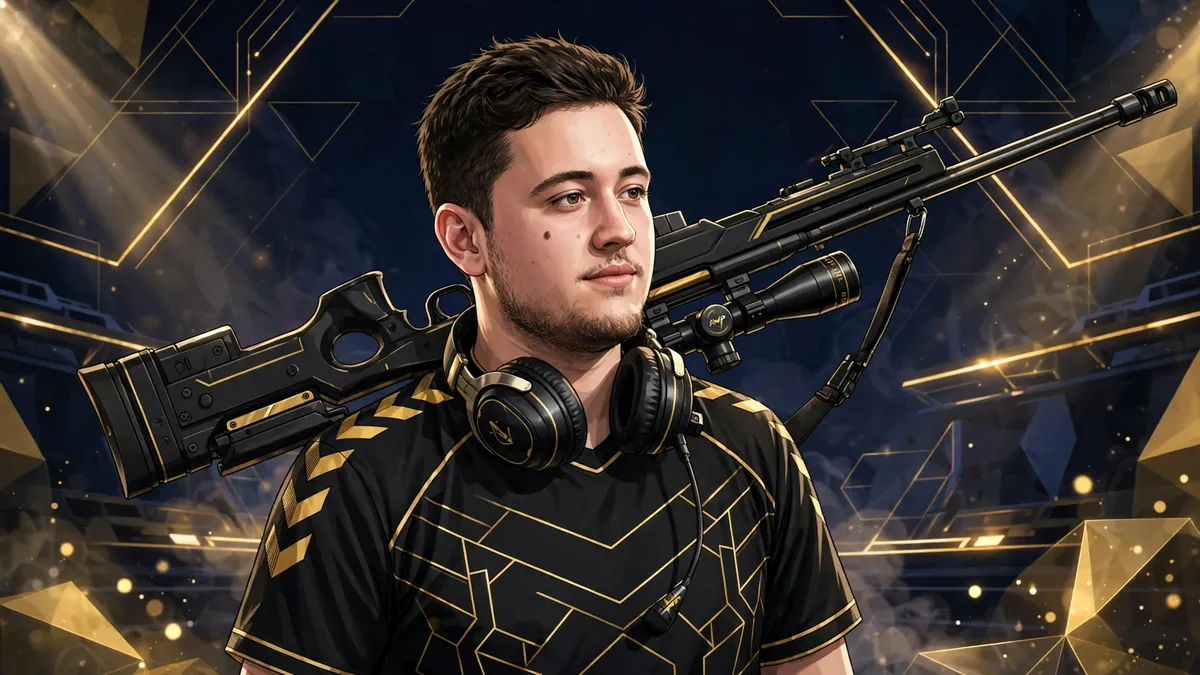
Mathieu Herbaut, known to the world as ZyWoo, is the most decorated individual player in the history of Counter-Strike. Born on 9 November 2000 in Lens, France — the very day the original Counter-Strike went on sale — he has spent his entire top-level career with one team, Team Vitality, winning three Majors and being named HLTV Player of the Year four times, more than any player who has ever played the game. As of November 2026, his net worth is estimated at $3.5 million to $4.5 million, anchored by Skin.Land’s November 2026 range, with a reported Team Vitality salary of about €100,000 a month and $2,366,234.31 in career prize money from 151 tournaments, according to Esports Earnings.
This biography traces the full arc: a seven-year-old in a northern French mining town who fell in love with a shooter on the day he was born, the local LAN circuit that spotted him, the October 2018 move to Vitality that changed French Counter-Strike, the two Player of the Year crowns he won before he could legally drink in the United States, the home-soil Major in Paris, the move to Counter-Strike 2, and the 2025 season — two more Majors, a 30-match winning streak and a fourth world No. 1 ranking — that settled the argument about where he stands among the greats.
Last updated: 16 November 2026 · By Celebamerica Editorial Staff
Table of Contents
- Quick Facts
- Early Life in Lens: The Boy Born on Counter-Strike Day
- The Nickname: Why They Call Him “The Chosen One”
- Joining Team Vitality in 2018
- 2019–2020: The Teenager Who Became World No. 1
- The Paris Major 2023: A First Major on Home Soil
- The Move to Counter-Strike 2
- 2025: The Perfect Season — Two Majors and a Grand Slam
- The Money: Salary, Prize Money and Sponsorships
- Net Worth Breakdown: Where the Estimate Comes From
- Playing Style: What Makes ZyWoo Different
- ZyWoo vs s1mple: The Greatest of All Time Debate
- Personal Life: Private by Choice
- Controversies and Setbacks
- Career Timeline
- Frequently Asked Questions
- Final Thoughts
- Sources and Reporting
Quick Facts
| Full Name | Mathieu Herbaut |
|---|---|
| Known As | ZyWoo (stylised ZywOo) |
| Date of Birth | 9 November 2000 (age 26 as of November 2026) |
| Birthplace | Lens, Pas-de-Calais, France |
| Nationality | French |
| Game | Counter-Strike 2 (formerly Counter-Strike: Global Offensive) |
| Team | Team Vitality (October 2018 – present) |
| Role | Primary AWPer, also plays rifle |
| Estimated Net Worth | $3.5 million – $4.5 million (Skin.Land, November 2026) |
| Career Prize Money | $2,366,234.31 from 151 tournaments (Esports Earnings) |
| Reported Salary | About €100,000 per month (reported by French media, never confirmed by player or team) |
| Major Championships | 3 — BLAST.tv Paris Major 2023, BLAST.tv Austin Major 2025, StarLadder Budapest Major 2025 (MVP at all three) |
| HLTV Player of the Year | 4 times — 2019, 2020, 2023, 2025 (all-time record) |
| Other Honours | Forbes 30 Under 30 (2021); Esports Breakthrough Player of the Decade (Esports Awards, 2025); Intel Grand Slam Season 5 (2025) |
| Primary Income Sources | Team Vitality salary, tournament prize money, Major sticker revenue, sponsorships (ASUS ROG, NVIDIA) |
Early Life in Lens: The Boy Born on Counter-Strike Day
Mathieu Herbaut was born on 9 November 2000 in Lens, a former coal-mining town in the Pas-de-Calais department of northern France. The date is the first of many coincidences that have followed him: 9 November 2000 is the day the original Counter-Strike, the Half-Life mod that would grow into one of the biggest esports on the planet, went on sale. Team Vitality itself leans into the story, calling him “l’Élu” — the Chosen One — born on the day the game was released.
He started playing Counter-Strike when he was seven years old. There was nothing unusual about a French boy of his generation spending afternoons at a computer, but the hours stacked up in a way they did not for other children. Family and friends who watched him play in those early years describe the same thing that coaches and analysts would later describe on the biggest stages in the world: an unnatural calm, and a sense for where opponents were going to be before they got there. He did not rage, he did not panic, and he did not miss often.
Lens is not Paris. It is a working-class town of around 30,000 people, closer to Lille and the Belgian border than to the capital, and its sporting identity has always been the football club RC Lens and the Stade Bollaert-Delelis. There was no esports academy waiting for a talented teenager there. ZyWoo’s route into professional play ran through the French local LAN circuit — the small, crowded tournaments in cybercafés and community halls where French Counter-Strike has always found its players. He made his name in those rooms first, winning local events and catching the eye of the people who scout the French scene, before any international audience had heard of him.
That local grounding matters to the story. French Counter-Strike has a long tradition of producing brilliant individual players, from the 1.6 era through to the modern game, and its scene has always been held together by LANs rather than by online ladders. ZyWoo grew up inside that tradition. By the time he was sixteen and seventeen he was already spoken about in French circles as the next great one, a reputation that reached the ears of the biggest French organisation in esports just as it was preparing to enter Counter-Strike.
For readers keeping track of the numbers, how old ZyWoo is today is a question that comes up constantly because he achieved so much so young — he was 19 when he was first ranked the best player in the world, and 22 when he won his first Major.
The Nickname: Why They Call Him “The Chosen One”
Every great player in Counter-Strike picks up a nickname, and most of them are earned in a single match. ZyWoo’s has followed him since before he turned professional, and it comes from the coincidence of his birthday. Born on the day Counter-Strike launched, he was cast by the French scene as the player the game had been waiting for — “The Chosen One”, or in French, “l’Élu”.
It could have been a burden. Teenage prodigies in esports are labelled constantly, and the label usually outlives the form that earned it. In ZyWoo’s case the nickname stuck because the results kept justifying it. He was the youngest player ever ranked No. 1 in the world by HLTV, at 19. He has now been ranked No. 1 four times — in 2019, 2020, 2023 and 2025 — a record no other player holds. And in August 2025 the Esports Awards made the nickname official in a different way, naming him Esports Breakthrough Player of the Decade at the ceremony that closed the Esports World Cup.
The other name that follows him around is simpler: GOAT, the greatest of all time. That one is argued about far more, and this article takes it up properly in the comparison section below. What is not argued about is the nickname’s origin. He was, quite literally, born on Counter-Strike day, and the game has never really let him go since.
Joining Team Vitality in 2018
In October 2018, Team Vitality — the French organisation founded by Fabien “Neo” Devide — launched its Counter-Strike division, and ZyWoo was the centrepiece of the project. He was 17 years old, about to turn 18, and had never played a match at the top level of international Counter-Strike. Vitality built the team around him anyway.
It was a gamble that looks obvious only in hindsight. Vitality was a big name in French esports, but its Counter-Strike roster was brand new, and the international scene in late 2018 was dominated by Astralis, the Danish team that would go on to win three Majors in a row. A teenager with no top-tier experience was being asked to lead a new team into that field, and to do it as the primary AWPer — the sniper role that carries a team’s firepower and, when it misfires, its blame.
The gamble paid off faster than anyone at the club could have expected. ZyWoo finished his first full year as a professional as the best player on the planet. Vitality’s own account of those years is blunt about it: he joined in 2018 and “immediately established himself as the best player on the planet”. Within months of his debut he was posting numbers that veterans with a decade of experience had never reached, and by the end of 2019 the conversation about him had changed from whether he would become great to how great he already was.
One fact has defined his career ever since that signing: he has never played for another top-tier team. In an era when the best players in Counter-Strike change organisations every year or two, ZyWoo has spent his whole professional life — from October 2018 to today, more than eight years — with Vitality. The club renewed his contract in April 2024, announcing that he would stay in Paris through 2026, with club president Fabien Devide calling him the face and franchise player of the organisation. Later reporting has suggested the deal may run longer still, but the club itself has only confirmed the renewal through 2026, and this article treats the longer figure as unconfirmed.
That loyalty cuts both ways. It gave Vitality a player to build a dynasty around, and it gave ZyWoo a stable home in a scene where rosters turn over constantly. It also means his entire legacy is tied to one jersey, one city and one organisation — a rarity in modern esports, and part of why French crowds treat him the way they do.
2019–2020: The Teenager Who Became World No. 1
ZyWoo’s first full season, 2019, is still one of the great debut years in the history of the game. He was 18 for most of it and 19 when the year ended. He won his first HLTV MVP medals, carried Vitality to finals they had no business reaching, and in January 2020 HLTV named him its Player of the Year for 2019 — the youngest No. 1 in the ranking’s history, and the first player to take the crown in his debut season at the top level.
He did it again in 2020. A second consecutive Player of the Year award put him alongside the very best to have played the game, and it did so in a year when the pandemic had moved competition online and stripped away the arena crowds. The online era is often held against players of that period, but ZyWoo’s numbers held up in every setting, and nobody who watched him doubted the ranking.
The two years that followed were the first real test of his career. He was ranked No. 2 in the world in both 2021 and 2022 — still elite, still the best player on his team by a distance, but no longer No. 1, and still without a Major title. Oleksandr “s1mple” of Natus Vincere took the No. 1 ranking in both years, and s1mple’s team won the Stockholm Major in 2021 while ZyWoo’s Vitality kept falling short in the biggest matches. The French scene, which had anointed him the Chosen One at 18, began to ask whether the prophecy had a ceiling.
Those two years also brought the first recognition from outside esports. In 2021 ZyWoo was named to the Forbes 30 Under 30 list, a sign that his profile had grown beyond the Counter-Strike audience. Inside the game, though, the question was narrower: could he win a Major? The answer would come in Paris, in front of a home crowd, in the final CS:GO Major ever played.
The Paris Major 2023: A First Major on Home Soil
The BLAST.tv Paris Major in May 2023 was the last Major of the Counter-Strike: Global Offensive era, and it was played in France. For ZyWoo, who had waited five years for a Major title, the setting could not have been more loaded: a home crowd, a French team, and the final chance to win a CS:GO Major before the game moved on to Counter-Strike 2.
Vitality won it. They beat GamerLegion in the final, and ZyWoo was named the tournament MVP — his first Major MVP award, earned in front of a crowd chanting his name. He was 22 years old. The images from that weekend, of a French crowd roaring for a French player lifting a Major trophy in Paris, are the defining pictures of his career so far, and they are the ones that get replayed every time his legacy is discussed.
The Paris Major also closed the book on the 2021–22 doubts. ZyWoo finished 2023 ranked No. 1 in the world for a third time, becoming only the second player, after s1mple, to win the HLTV Player of the Year award three times. He ended the year ranked No. 1 again in the new game, Counter-Strike 2, and Vitality were crowned the best team in the world by HLTV at the end of 2023.

The Move to Counter-Strike 2
Counter-Strike 2 replaced CS:GO in the summer of 2023, and the change worried a lot of people who had built careers on the old game. A new engine, new smoke physics, new movement — any of it could have dulled the instincts that made ZyWoo special. It did not. He finished 2023 as the No. 1 player in the new game, and the transition became another piece of evidence for the argument that his gift is not mechanical but mental: he reads the game, whatever version of it is running.
He was ranked No. 3 in the world in 2024, a year in which Vitality rebuilt around him and the team went through the kind of roster churn that follows a Major win. The year was quiet by his standards — no Major, no No. 1 ranking — but it ended with the April 2024 contract renewal that tied him to Vitality through 2026, and with the roster settling into the shape that would produce the most dominant season in the history of the game.
What followed in 2025 is covered in the next section, and it is the part of this story that changed the GOAT debate from a two-horse race into something much closer to a coronation.
2025: The Perfect Season — Two Majors and a Grand Slam
The 2025 season is the best single year any Counter-Strike player has ever had. Vitality won 30 matches in a row, a streak that stood as one of the longest in the game’s history, and collected seven titles across the year. ZyWoo won his second Major at the BLAST.tv Austin Major, taking his second Major MVP award in the process and becoming only the third player ever to win multiple Major MVP awards. Then, on 14 December 2025, he won his third: the StarLadder Budapest Major, again as tournament MVP, making him the Major MVP at all three of his Major wins.
The year also brought the Intel Grand Slam, Season 5 — a $1 million bonus paid to a team that wins four big ESL and BLAST events inside a set window. Vitality completed it in April 2025, and the bonus was shared across the roster. It is a team prize, not a personal one, but it sits on ZyWoo’s record as the clearest marker of just how far ahead of the field Vitality were that year.
He was named HLTV Player of the Year for 2025, his fourth, and the only fourth in history. Vitality’s own summary of the season calls it a year that “bordered on perfection”, and the numbers back that up: two Majors, both with MVP awards, a Grand Slam, a 30-match win streak, IEM Katowice and the ESL Pro League, and a fourth world No. 1 ranking. In 2026 he kept the form going, dominating the IEM Kraków final and adding the PGL Cluj-Napoca title, and his tally of HLTV MVP medals moved past 30 — the most any player has ever collected. The count itself keeps moving with every event he plays, which is why this article gives it as “more than 30” rather than a fixed number.
By the end of 2025 the debate about the greatest Counter-Strike player of all time had changed shape. It used to be a comparison between s1mple’s peak and ZyWoo’s longevity. After 2025, ZyWoo held the record for Player of the Year awards, three Majors with three Major MVPs, and the most MVP medals in history. The comparison section below lays the numbers out side by side.
The Money: Salary, Prize Money and Sponsorships
ZyWoo’s money comes from three places that stack up year after year: his Team Vitality salary, his share of tournament prize money, and the sponsorship and sticker income that follows a player who has won three Majors. None of the figures are public in the way a footballer’s wages are, because esports contracts are covered by non-disclosure agreements, so every number in this section is either a matter of public record or a reported figure that this article flags as such.
The salary is the biggest piece, and also the least certain. French media have reported that ZyWoo earns about €100,000 a month — roughly €1.2 million a year — under the contract he signed in the March–April 2024 renewal, a figure repeated by several outlets including FarmSkins and Skin.Land. Neither ZyWoo nor Vitality has ever confirmed the number, and this article treats it as reported rather than verified. For scale, the independent outlet Pro Gamer puts his monthly pay in a $105,000 to $125,000 band after his contract extension, which sits in the same territory as the French reporting. Either way, he is among the best-paid players in Counter-Strike, and the pay reflects his position: he is not just Vitality’s best player, he is the player the whole organisation is built around.
The prize money is the one figure that is exact. Esports Earnings, which tracks tournament payouts, records ZyWoo’s career prize-money total at $2,366,234.31 from 151 tournaments. That is his personal share as recorded by the site, and it does not include his salary, his sticker money or his sponsorships. It also does not include the Grand Slam bonus, which is a team prize. The number is high for Counter-Strike, where prize pools are smaller than in games like Dota 2, and it is still climbing: every event Vitality wins adds to it.
Sticker money is the part of a Counter-Strike player’s income that outsiders most often miss. At every Major, Valve sells in-game stickers bearing the players’ signatures and autographs, and the players and their teams receive a share of the sales. A player as popular as ZyWoo — a three-time Major winner, playing for the biggest French organisation, with a signature that French fans buy in volume — earns a meaningful amount from stickers at every Major he attends. The exact figures are not published, and this article does not guess at them, but the income stream is real and it is one of the reasons Major appearances matter financially as well as competitively.
Sponsorships are the third leg. ZyWoo’s personal partnerships have included ASUS ROG and NVIDIA, the hardware brands that sit closest to competitive Counter-Strike, and his value to sponsors has grown with every Major and every Player of the Year award. He also earns from Vitality’s own commercial deals, which are built in large part around his profile. None of these deals are disclosed, so this article names the brands that have been publicly associated with him and does not put a number on them.
The full money picture, with the estimate range and the sources behind each figure, is set out on CelebAmerica’s ZyWoo net worth profile, which breaks down the $3.5 million to $4.5 million range in detail.
Net Worth Breakdown: Where the Estimate Comes From
ZyWoo’s net worth is estimated at $3.5 million to $4.5 million as of November 2026. The anchor for that range is Skin.Land, updated 9 November 2026, which puts him at $3.5–4.5 million; FarmSkins lands in the same band, and Wikibious gives a slightly wider $3–5 million, which sits comfortably around the same midpoint of roughly $4 million. The figure is built from the reported Vitality salary, the $2,366,234.31 in career prize money, Major sticker revenue and sponsorships, minus tax and agent fees.
Not every source agrees, and the disagreement is worth explaining because it shows why ranges matter. Surprise Sports gives $1.5 million, but its own table dates that figure to 2023 — before the 2024 contract renewal, before the 2025 Grand Slam bonus and before the two 2025 Majors — so it is stale and this article sets it aside. Pro Gamer, writing in 2026, puts him above $5 million, which is higher than the Skin.Land band and reflects a more generous reading of the same salary and prize-money figures. The $3.5–4.5 million range is the one with the most support across independent outlets, and it is the one this article publishes, with the wider readings noted rather than hidden.
| Income stream | What is known |
|---|---|
| Team Vitality salary | Reported ~€100,000 per month (~€1.2 million a year) under the 2024 renewal; reported, never confirmed by player or team |
| Tournament prize money | $2,366,234.31 from 151 tournaments (Esports Earnings, public record) |
| Intel Grand Slam bonus | $1 million team bonus, Season 5, completed April 2025 (shared across the roster) |
| Major sticker revenue | Share of Valve sticker sales at each Major; not publicly disclosed |
| Sponsorships | ASUS ROG, NVIDIA and other hardware brands; deal values not disclosed |
| Net worth estimate | $3.5 million – $4.5 million (Skin.Land, November 2026); wider readings $3–5 million (Wikibious) and $5 million-plus (Pro Gamer) |
Two things should be said plainly about this estimate. First, no audited balance sheet exists for ZyWoo, so no published number can be treated as a fact — it is an estimate built from the public pieces, and the range is the honest way to present it. Second, the trajectory is upward: he is 26, under contract with the best team in the world, and his biggest paydays — the 2025 Majors and the Grand Slam — are recent. Whatever the exact figure is today, it is higher than it was a year ago, and it is likely to keep rising while he stays at this level.
Playing Style: What Makes ZyWoo Different
Ask analysts what makes ZyWoo special and they rarely start with his aim. Plenty of players can shoot. They start with his calm and his reading of the game. Vitality’s own profile of him describes “Olympic calm and game sense bordering on pure instinct”, and that is the quality that shows up in every highlight reel: he is rarely rushed, rarely out of position, and rarely caught by a play he has not already anticipated.
His role is primary AWPer, the sniper, and he plays it in a way that breaks the usual rules of the position. Most AWPers are passive by design: they hold angles, wait for the other team to walk into their crosshair, and let their riflers do the running. ZyWoo plays the AWP like a rifle. He pushes, he takes duels he has no business taking, and he wins them often enough that teams have to plan for him as a roaming threat rather than a fixed one. It is a style that only works because his decision-making is so fast — he knows when the aggressive play is right, and he knows when to sit still.
He is also unusually complete. Many great AWPers are a liability with a rifle in their hands; ZyWoo is not. He can pick up an AK or an M4 and play at the same level, which means Vitality never has to build its tactics around protecting him. That flexibility is part of why his teams have been able to change shape around him so often without losing their edge.
The numbers tell the same story as the eye test. He holds the record for the most HLTV MVP medals, with more than 30, and he is the only player with four Player of the Year awards. He also holds the record for the most kills in a single series, 143, a mark that speaks to the way he can take over a match entirely. And he has done it while playing the most tactically demanding role in the game, on a team that has changed its pieces around him repeatedly.
There is a comparison that comes up whenever his style is discussed: he is often described as the Counter-Strike equivalent of a complete forward in football, a player who scores, creates and defends in the same match. The comparison is imperfect, but the point behind it is sound. ZyWoo does not have a weak part of his game that opponents can attack, and after eight years at the top, nobody has found one.
ZyWoo vs s1mple: The Greatest of All Time Debate
For most of the last decade, the argument about the greatest Counter-Strike player of all time has been a two-man race: ZyWoo against Oleksandr “s1mple” Kostyliev of Natus Vincere. The two have traded the No. 1 ranking back and forth since 2018, and for years the case for each of them was easy to state. S1mple had the higher peak and the most dominant individual seasons; ZyWoo had the longevity and the consistency. Then 2025 happened, and the numbers moved decisively.
Here is where the two stand, on the measures that matter most:
| Measure | ZyWoo |
|---|---|
| HLTV Player of the Year awards | 4 (2019, 2020, 2023, 2025) — all-time record |
| Major championships | 3 (Paris 2023, Austin 2025, Budapest 2025) |
| Major MVP awards | 3 (MVP at all three of his Major wins) |
| HLTV MVP medals | More than 30 — all-time record |
| Years ranked world No. 1 | 4 |
| Teams played for at top level | 1 (Team Vitality, 2018–present) |
S1mple’s case remains formidable. He was HLTV Player of the Year three times (2018, 2021, 2022), won the Stockholm Major in 2021 with the MVP award, and produced individual seasons — above all 2021 and 2022 — that many analysts still call the highest peak any player has reached. Our s1mple biography sets out his side of the story in full, and it is a story that deserves to be read alongside this one: no honest account of ZyWoo’s career is complete without the rival who pushed him to be better.
The third name in the comparison is Nicolai “dev1ce” Reedtz, whose four Major titles with Astralis remain the most by any player. Dev1ce’s case rests on team success rather than individual awards — he was never ranked world No. 1 — which is why the GOAT debate usually comes down to ZyWoo and s1mple. But dev1ce’s four Majors are a reminder that team trophies and individual honours measure different things, and that ZyWoo’s three Majors, all with MVP awards, combine both kinds of greatness in a way no other player’s record does.
There is a wider comparison worth making, too. In League of Legends, Lee Sang-hyeok — known as Faker — is the player every discussion of greatness in esports eventually returns to, a one-team legend who has defined his game for more than a decade. ZyWoo’s career has begun to rhyme with Faker’s in the ways that matter: one team, one city, a record that keeps growing, and a claim to be the greatest ever to play his game. Our Faker biography covers that parallel in detail, and it is worth reading for anyone who wants to see how rare ZyWoo’s kind of career is across all of esports.
The honest answer to the GOAT question, as of November 2026, is that ZyWoo has the strongest case on the record. Four Player of the Year awards, three Majors, three Major MVPs, the MVP-medal record, and a career spent entirely with one team. S1mple’s peak was higher; dev1ce’s team trophy count is higher. But no player has combined individual honours, team success and longevity the way ZyWoo has — and at 26, he is still adding to the record.
Personal Life: Private by Choice
ZyWoo keeps his private life out of the public eye, and there is less to report here than for most athletes of his profile — which is itself a choice worth respecting. He has never made his relationships public, and no partner, marriage or children have ever been reported by a reputable outlet. This article does not speculate about any of it.
What is known is that he still lives in France and remains close to his roots in the north of the country, and that his family supported his gaming from the start — the seven-year-old who was allowed to spend his afternoons on Counter-Strike became the teenager whose family backed a professional career that most parents would have talked their child out of. He has spoken in interviews about the support he received at home, and about the way the French scene, rather than any academy or agency, raised him as a player.
Outside the server he is famously low-key. He does not court controversy on social media, he rarely gives interviews that stray beyond the game, and his public image is built almost entirely on what he does with a mouse and keyboard. That restraint is part of why his reputation has survived eight years at the top without a scandal: there is very little of him on offer beyond the player, and the player has never given anyone a reason to doubt him.
His height is a question that comes up often in searches, and the honest answer is that no verified figure has ever been published by a reputable source. Various fan sites give numbers, but none of them is sourced, and this article does not repeat them. The same applies to his weight and other personal measurements: if a number is not attached to a source, it does not belong here.
What can be said is that his life outside the game is small and deliberately so — family, close friends, the team — and that the fame that surrounds him in France has not changed the way he carries himself. Teammates describe him as quiet in the team room and unshakeable on stage, and the two descriptions are really the same quality seen from different angles.
Controversies and Setbacks
There is no major controversy attached to ZyWoo’s name, and that absence is part of the story. In eight years at the top of a scene that produces a scandal every season — roster disputes, cheating accusations, contract fights, social-media rows — he has not been involved in any of them in a meaningful way. No cheating allegation has ever been made against him, no contract dispute has ever gone public, and no public falling-out with a teammate has ever surfaced.
The setbacks in his career have been sporting ones, and they are the ones that make the story interesting. The two years as world No. 2 in 2021 and 2022, when s1mple took the crown and Vitality could not win a Major, were the closest thing to a crisis his career has had. The move to Counter-Strike 2 in 2023, which could have ended the career of a player built for the old game, was a risk that he handled by finishing the year as world No. 1. And the 2024 season, ranked No. 3 and without a Major, was the kind of year that ends most players’ claims to greatness — the year before the greatest season in the game’s history.
There is one more setback worth naming, because it is the one that shaped him: the early years of his career were played in the shadow of Astralis, the Danish team that won three Majors in a row and set a standard that no team has matched since. ZyWoo’s first seasons were measured against that dynasty, and the fact that his own team eventually built something comparable in 2025 — a 30-match winning streak, seven titles, two Majors — is the clearest sign of how far he and Vitality have come.

Career Timeline
| Year | Milestone |
|---|---|
| 2000 | Born 9 November in Lens, France — the day the original Counter-Strike goes on sale |
| 2007 | Starts playing Counter-Strike, aged seven |
| 2018 | Joins Team Vitality in October, aged 17, as the club launches its Counter-Strike division; makes his top-tier debut |
| 2019 | Named HLTV Player of the Year for the first time — the youngest No. 1 in history, at 19 |
| 2020 | Second consecutive HLTV Player of the Year award |
| 2021 | Ranked world No. 2; named to the Forbes 30 Under 30 list |
| 2022 | Ranked world No. 2 for a second year |
| 2023 | Wins the BLAST.tv Paris Major (MVP) — his first Major, on home soil; third HLTV Player of the Year award; Counter-Strike 2 replaces CS:GO |
| 2024 | Renews his Vitality contract through 2026; ranked world No. 3 |
| 2025 | Wins the BLAST.tv Austin Major (MVP) and the StarLadder Budapest Major (MVP); completes the Intel Grand Slam Season 5 ($1 million team bonus); 30-match winning streak; named Esports Breakthrough Player of the Decade; fourth HLTV Player of the Year award |
| 2026 | Wins IEM Kraków and PGL Cluj-Napoca; MVP medal tally passes 30; turns 26 on 9 November |
Frequently Asked Questions
Who is ZyWoo?
ZyWoo is the professional name of Mathieu Herbaut, a French Counter-Strike 2 player for Team Vitality. Born on 9 November 2000 in Lens, France, he is the primary AWPer for Vitality — the only top-tier team he has ever played for — and the most decorated individual player in Counter-Strike history, with four HLTV Player of the Year awards and three Major championships.
How old is ZyWoo?
ZyWoo is 26 years old as of November 2026. He was born on 9 November 2000 in Lens, France, and turned 26 on 9 November 2026 — the same date the original Counter-Strike went on sale in 2000, which is why he is nicknamed “The Chosen One”.
How many Majors has ZyWoo won?
ZyWoo has won three Majors: the BLAST.tv Paris Major in 2023, the BLAST.tv Austin Major in 2025 and the StarLadder Budapest Major in December 2025. He was named tournament MVP at all three — the only player to win Major MVP at every Major he has won.
How many times has ZyWoo been HLTV Player of the Year?
Four times — in 2019, 2020, 2023 and 2025 — more than any other player in history. He was 19 when he won the first, making him the youngest world No. 1 HLTV has ever named, and he is the only player to have been ranked No. 1 in four separate years.
What is ZyWoo’s net worth?
ZyWoo’s net worth is estimated at $3.5 million to $4.5 million as of November 2026. Skin.Land, updated 9 November 2026, gives the $3.5–4.5 million range, FarmSkins lands in the same band, and Wikibious gives a wider $3–5 million. The figure is built from his reported Vitality salary, $2,366,234.31 in career prize money, Major sticker revenue and sponsorships. No audited balance sheet exists, so it is an estimate, not a fact.
What is ZyWoo’s salary at Team Vitality?
French media have reported that ZyWoo earns about €100,000 a month — roughly €1.2 million a year — under the contract he signed in the 2024 renewal. The figure has never been confirmed by ZyWoo or by Vitality, so it should be read as reported rather than verified. Independent outlet Pro Gamer puts his monthly pay in a $105,000 to $125,000 band, which sits in the same territory.
How much prize money has ZyWoo won in his career?
According to Esports Earnings, ZyWoo has won $2,366,234.31 in career prize money from 151 tournaments. That figure covers tournament payouts only — it does not include his salary, sticker revenue or sponsorships, and it does not include the $1 million Intel Grand Slam team bonus Vitality earned in 2025.
Is ZyWoo the greatest Counter-Strike player of all time?
On the record, he has the strongest case: four HLTV Player of the Year awards (a record), three Majors with three Major MVP awards, the record for HLTV MVP medals with more than 30, and a career spent entirely with one team. His great rival s1mple has three Player of the Year awards and one Major, with a higher individual peak in 2021–22, while dev1ce holds the most Major titles with four. ZyWoo’s combination of individual honours, team success and longevity is unmatched — and at 26, he is still adding to it.
Final Thoughts
ZyWoo’s story is unusual in esports for how little of it is about money, and how much of it is about patience. He was called the Chosen One before he had played a professional match, and for two years — 2021 and 2022 — it looked as if the nickname might be the high point of his career. Then came Paris, then came Counter-Strike 2, then came 2025, the greatest single season any player has ever had. At 26 he holds the records that matter most: four Player of the Year awards, three Majors, three Major MVPs, more than 30 MVP medals. His net worth, estimated at $3.5 million to $4.5 million, is the financial echo of that record — a reported salary of about €100,000 a month, more than $2.3 million in prize money, and the sticker and sponsorship income that follows a three-time Major champion.
What happens next is the interesting question. He is under contract with the best team in the world, he is still in his prime, and the records he holds are the kind that grow rather than shrink. If he wins a fourth Major, the GOAT debate ends. If he does not, the debate will run for years — and it will run, in large part, because he made it a debate at all. For readers who want the money side of his story in full, the ZyWoo net worth profile breaks down the estimate, and for more on the players who define this era, the site’s biography archive carries the full set of profiles. Few careers in esports reward a second read the way his does — and fewer still are still being written.
Sources and Reporting
How we estimated: Every figure in this article is tied to a named source and a date. Where sources disagree — most of all on the salary and the net worth — the article shows the range and says why, instead of picking one number and presenting it as a fact. The net worth anchor is Skin.Land’s November 2026 range of $3.5–4.5 million, supported by FarmSkins in the same band and Wikibious at $3–5 million; the stale $1.5 million figure from Surprise Sports is dated to 2023 and set aside. The salary figure, about €100,000 a month, is reported by French media and repeated by several outlets, but no player or organisation has confirmed it, and this article flags it as reported rather than verified. The prize-money figure, $2,366,234.31 from 151 tournaments, comes from Esports Earnings and is a matter of public record. No audited balance sheet exists for ZyWoo, so no published number can be treated as a fact, and estimates may differ from private reality.
Sources: Team Vitality (player profile and contract-renewal announcement); HLTV (Player of the Year rankings, Major MVP awards and MVP-medal records); Wikipedia (ZywOo career record and Major results); Esports Earnings (career prize money); Skin.Land (net-worth range, November 2026); Forbes (30 Under 30, 2021); Esports Awards (Breakthrough Player of the Decade, 2025).