By Celebamerica Editorial Staff | Last updated: 16 November 2026
Sha’Carri Richardson’s net worth in 2026 is estimated at $4 million, according to Celebrity Net Worth, as reported by Parade in February 2026. The American sprinter, world champion in the 100 metres and Olympic gold medallist in the 4x100m relay, has built that fortune almost entirely away from the track itself: her race winnings are modest, while her Nike contract and a portfolio of brand deals do the heavy lifting.
Other outlets put her in a wider band. TheMost10 lists her at $5 million, TheCityCeleb at $3 million, and Creebhills at $2 million, while Paperblog gives a $1 million to $5 million range. That spread is honest, not sloppy: sprinters’ endorsement contracts are private, so every public figure is an estimate. This article anchors on the $4 million figure from Celebrity Net Worth and works through the money behind it — the reported Nike deal, the prize money, the bonuses, the house in Florida, and the season that tested her in 2025.
Quick Facts: Sha’Carri Richardson
| Full Name | Sha’Carri Richardson |
|---|---|
| Date of Birth | 25 March 2000 |
| Birthplace | Dallas, Texas, USA |
| Age in 2026 | 26 |
| Estimated Net Worth (2026) | $4 million (Celebrity Net Worth, via Parade, Feb 2026); published range $2 million–$5 million |
| Primary Income Sources | Nike endorsement contract; brand deals with Beats by Dre, Sprite, Olay, Android, Oikos, Powerade and Danone; prize money; appearance fees; bonuses |
| Key Achievements | World champion 100m (Budapest 2023, 10.65); Olympic gold 4x100m relay and silver 100m (Paris 2024); World champion 4x100m relay (Budapest 2023, Tokyo 2025) |
| Personal Bests | 100m: 10.65 (2023); 200m: 21.92 (2023) |
| Coach | Dennis Mitchell |
| Partner | Christian Coleman, fellow American sprinter |
| Home | Clermont, Florida (valued around $580,000–$605,000 in 2026) |
Table of Contents
- Quick Facts: Sha’Carri Richardson
- Early Life and Dallas Roots
- LSU, the NCAA Record and Turning Pro
- The 2021 Suspension and the Comeback
- World Champion in Budapest 2023
- Paris 2024: Olympic Gold and Silver
- The 2025 Season and Tokyo Worlds
- How She Makes Her Money
- The Nike Deal
- Endorsements Beyond Nike
- Prize Money, Appearance Fees and Bonuses
- Net Worth Breakdown
- Assets: Her Florida Home and Lifestyle
- Personal Life and Christian Coleman
- Net Worth Growth Over the Years
- How She Compares With Sprinting Peers
- What Comes Next in 2026
- Frequently Asked Questions
- Bottom Line
- Sources and Reporting
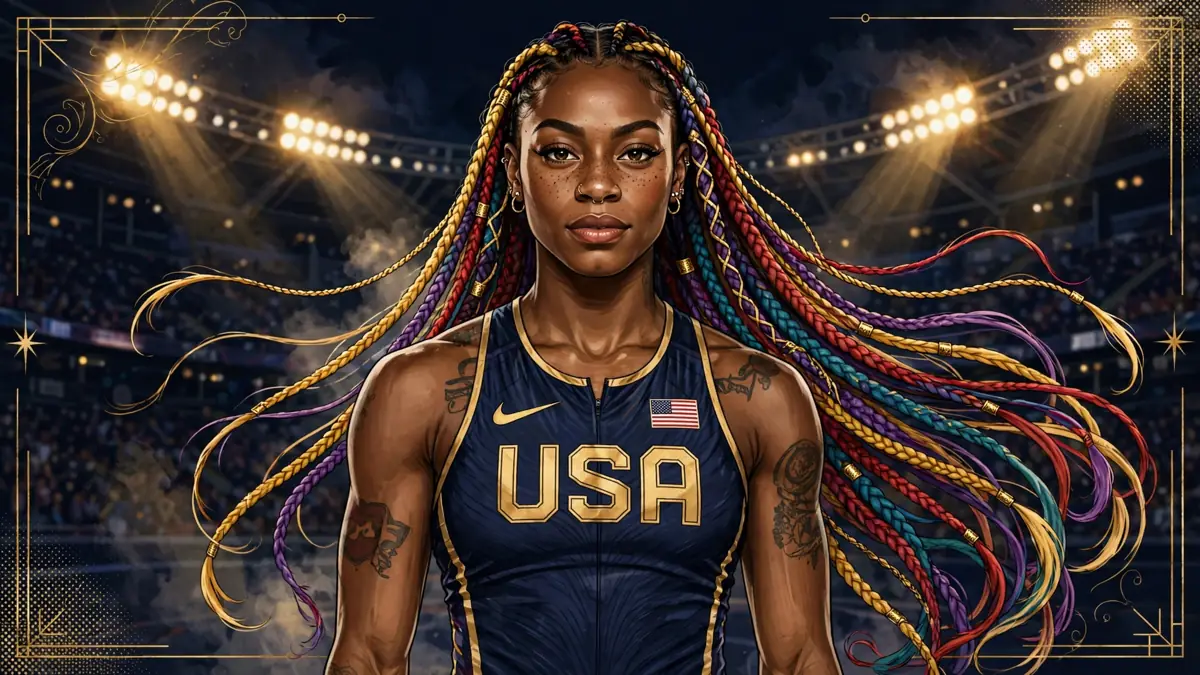
Early Life and Dallas Roots
Sha’Carri Richardson was born on 25 March 2000 in Dallas, Texas, and raised largely by her grandmother, Betty Harp, alongside her aunt. Her grandmother was the steady centre of her childhood, driving her to practice, keeping her grounded, and later becoming the person Richardson thanked first on the biggest stages of her career. Dallas named a track after her in 2023, a homecoming honour that says plenty about what she means to the city.
She ran at Carter High School in Dallas, where her speed marked her out early. Coaches noticed not just the raw pace but the way she carried herself on the track — loud, expressive, and utterly sure of herself. That self-belief later became her trademark, from the coloured hair to the long nails to the interviews where she spoke her mind without hedging.
Her biological mother died in 2021, in the week before the US Olympic trials. Richardson learned the news from a reporter during an interview, a moment she later described as devastating. She has spoken since about running with her mother’s memory in mind, and about her grandmother and aunt as the family who raised her. For readers who want the full life story, our sister site carries a Sha’Carri Richardson biography that covers her background in more depth, while her key details are on our own pages — how old Sha’Carri Richardson is and Sha’Carri Richardson’s height.
LSU, the NCAA Record and Turning Pro
Richardson went to Louisiana State University (LSU) in 2018, one of the great sprint programmes in American college sport. Her single season there was enough to rewrite the record books. At the 2019 NCAA Championships in Austin, Texas, she won the 100m in 10.75 seconds — a world under-20 record at the time — and ran the 200m in 22.17. She did both on the same day, a double that announced a generational talent.
She left LSU after her freshman year and turned professional in 2019, signing with Nike. The decision was not a gamble so much as a recognition of what was already obvious: she was ready for the senior circuit, and the money on offer for a sprinter of her profile was far beyond anything college athletics could provide at the time. She began training under Dennis Mitchell, the former Olympic sprinter who won gold in the 4x100m relay at Barcelona 1992 and bronze in the 100m, and who remains her coach today.
Her first years as a professional were a steady climb. She ran 10.86 at the US Olympic trials in June 2021 to win the 100m and book her place at the Tokyo Olympics. She was 21, the fastest woman in America, and headed for her first Games. Then everything stopped.
The 2021 Suspension and the Comeback
Days after winning the trials, Richardson tested positive for marijuana and accepted a 30-day suspension from the US Anti-Doping Agency. The ban cost her the individual 100m at the Tokyo Olympics, and she was left off the relay squad too. She has said she used marijuana to cope with the grief of her mother’s death, and she took responsibility for the failed test without blaming anyone else.
The episode could have ended her career. Instead it defined the second act of it. Nike kept her endorsement through the suspension — a decision that mattered enormously, both financially and as a public signal that the brand was standing by her. Other sponsors stayed quiet rather than cutting ties, and the public response was largely sympathetic: the ban, for a substance that does not enhance sprinting performance, struck many observers as harsh.
She came back in 2022 with a point to prove and spent the year rebuilding her form. The results were uneven at first — sprinting at world level forgives nothing — but by 2023 she was running the best races of her life. The comeback story, from a missed Olympics to a world title in two years, is the core of her public image and a large part of why brands want her: she is not just fast, she is a story people follow.
World Champion in Budapest 2023
The 2023 World Athletics Championships in Budapest were Richardson’s arrival as the best sprinter on the planet. She won the 100m final in 10.65 seconds, a championship record and her personal best, beating Shericka Jackson of Jamaica and Shelly-Ann Fraser-Pryce. She came from lane nine — the outside lane, the one nobody wants — and still won by a clear margin.
She added gold in the 4x100m relay, anchoring the American team, and bronze in the 200m in 21.92. Three medals at a single World Championships, including the blue-riband event, made her the face of American sprinting heading into the Olympic year. It also changed her commercial value overnight: world champions in the 100m command appearance fees and endorsement money that also-rans never see.

Paris 2024: Olympic Gold and Silver
Paris 2024 delivered the medals that had eluded her in Tokyo. In the 100m final at the Stade de France, Richardson took silver in 10.87 seconds behind Julien Alfred of Saint Lucia, who won in 10.72. It was not the gold she wanted, but it was an Olympic medal in the event that defines sprinting — and it came three years after she had watched the Tokyo final from home.
Days later she anchored the United States to gold in the women’s 4x100m relay, running the final leg to bring the team home. The relay gold mattered in ways that went beyond the medal itself: it was her first Olympic title, it confirmed her as a closer under pressure, and it gave her the images — arms spread, roaring at the crowd — that brands build campaigns around. Her Paris haul sits alongside the great American Olympic sprinting performances, and the comparison is natural: Simone Biles’ net worth story from the same Games shows how Olympic gold in Paris translated into lasting commercial value for America’s biggest stars, and Katie Ledecky’s net worth tells a similar story from the swimming pool.
World Athletics paid $50,000 to each individual gold medallist at the Paris Olympics, a first for the sport, with relay teams sharing a $50,000 bonus between their members. Richardson’s share of the relay bonus was therefore a modest slice of that $50,000 — useful money, but a rounding error next to her endorsement income, which is the point of the next sections.
The 2025 Season and Tokyo Worlds
The 2025 season was the hardest of Richardson’s career since the suspension. An injury disrupted her training and delayed the start of her outdoor season. She finished fourth at the Golden Grand Prix in Tokyo early in the year and ninth at the Prefontaine Classic in Eugene, results far below her standard. As defending world champion she held an automatic bye into the 100m at the World Championships in Tokyo, which spared her the pressure of qualifying through the US trials.
Off the track, the summer brought trouble. On 27 July 2025 she was arrested at Seattle-Tacoma International Airport and charged with fourth-degree domestic violence assault after an alleged altercation with her boyfriend, fellow sprinter Christian Coleman. According to reports citing the police report, surveillance footage showed her shoving Coleman and throwing a pair of headphones at him. Coleman declined to press charges or to be treated as a victim, and the case was cleared, according to those reports. Richardson pleaded not guilty at her arraignment on 28 July. She was released the following day and competed at the US championships days later, running 11.07 in her 100m heat before withdrawing from the semi-finals, citing injury.
At the World Championships in Tokyo she could not defend her 100m title, finishing fifth in the final in 10.94 seconds as Melissa Jefferson-Wooden won gold. But the championships ended on a high: Richardson anchored the American women’s 4x100m relay team — Jefferson-Wooden, Twanisha Terry, Kayla White and Richardson — to gold in 41.75 seconds, ahead of Jamaica and Germany. Coleman won gold with the men’s relay team the same weekend. The relay gold closed a turbulent season with a reminder of what she can still do at her best, and she has since signalled a full comeback push for the 2026 season, telling rivals she is “truly shocking” herself in training, according to Pulse in October 2026.
How She Makes Her Money
Richardson’s income breaks into four streams, and their sizes are wildly unequal. Endorsements are the engine. Race winnings and appearance fees come second. Prize money and bonuses are third, and media and public appearances are a smaller, growing fourth. The table below sets out the shape of it.
| Income Stream | What It Means for Richardson |
|---|---|
| Endorsements | Nike contract (reportedly $20 million over five years, unconfirmed), plus Beats by Dre, Sprite, Olay, Android, Oikos, Powerade, Danone, Apple Music. The dominant share of her wealth. |
| Race winnings | Diamond League meeting wins pay around $10,000 each; a strong season adds tens of thousands, not hundreds. |
| Bonuses | World Athletics paid $50,000 per individual Olympic gold in Paris 2024; relay gold was a $50,000 team bonus shared between members. World Championship gold also carries a $50,000 bonus from World Athletics. |
| Appearance fees | Top sprinters command five-figure fees per Diamond League appearance; exact figures are private and vary by meeting. |
| Media & appearances | Interviews, fashion features, campaign shoots and speaking engagements. The Nike x Jacquemus work sits here as well as in endorsements. |
The honest truth about track and field economics is that even the fastest woman in the world earns a working wage from running itself. Parade put her sprinting salary at typically $45,000 to $55,000 a year. That is the sport’s open secret, and it is why the endorsement portfolio — not the stopwatch — decides her net worth. For a wider look at how Olympic and track stars convert medals into money, see the net worth profiles on CelebAmerica.
The Nike Deal
Nike is the foundation of Richardson’s fortune. She signed with the brand when she turned professional in 2019, and the relationship has survived the hardest stretch of her career — Nike kept her during the 2021 suspension, when dropping her would have been the easy option. That loyalty is part of why the deal grew.
In March 2024 she signed a new five-year deal with Nike, reported by Essentially Sports and others to be worth around $20 million. The figure has never been confirmed by Nike or by Richardson, and it should be treated as reported, not verified. If the reported figure is close to accurate, it would make her one of the highest-paid female track athletes on endorsement value alone, at roughly $4 million a year before tax, agent fees and expenses.
What is confirmed is the visibility Nike gives her. She is the face of the brand’s collaboration with French fashion designer Simon Porte Jacquemus — the Nike x Jacquemus Spring 2024 collection, including the “Le Swoosh” campaign — which put her in high-fashion territory few track athletes ever reach. Her face was also prominent in Nike’s Paris Olympics advertising, alongside LeBron James. That kind of placement is worth more than the contract’s headline number: it keeps her in front of audiences who never watch a Diamond League meet.
The $20 million question: the reported five-year Nike figure is the single most repeated number in Richardson’s financial story, and also the least verified. No filing, press release or on-record statement confirms it. Treat it as the best available report, not as a fact — and remember that a $20 million contract paid over five years is not $20 million in the bank, but annual payments, taxed, with an agent’s share taken off the top.
Endorsements Beyond Nike
Nike may be the anchor, but Richardson’s portfolio is unusually broad for a track athlete, and breadth is what protects her income if any single deal ends. The brands, as reported by Parade and others:
- Sprite — she became the first female athlete to sign an endorsement deal with Sprite in 2024, a landmark that underlined her appeal beyond sport.
- Beats by Dre — the headphone brand fits her image as a music and culture figure as much as an athlete.
- Olay — a beauty deal as a brand ambassador, taking her into the cosmetics market.
- Android — a tech partnership in the Google phone campaigns.
- Oikos — the yoghurt brand, a classic athlete nutrition tie-in.
- Powerade — she became a brand ambassador for the sports drink in 2024.
- Danone — she collaborated with Danone in April 2024 around women’s sport.
- Apple Music — a partnership reflecting her public love of music and culture.
None of these deals has a publicly confirmed value, and this article will not guess at them. What they show, taken together, is a deliberate strategy: food, drink, beauty, tech, fashion and sport, each reaching a different audience. That is the portfolio of someone being marketed as a cultural figure, not just a runner — and it is the reason her net worth has held up through a difficult 2025 season in which her results dipped.

Prize Money, Appearance Fees and Bonuses
Track and field pays its stars in small, scattered amounts rather than a salary. A Diamond League meeting win pays around $10,000, and the Diamond League final pays more. A good season of Diamond League racing might bring in $50,000 to $100,000 in prize money for a top sprinter — real money, but a fraction of one Nike payment.
Appearance fees are where meetings compete for stars. Organisers pay leading athletes simply to show up, because a Richardson on the start list sells tickets and television time. Those fees are private and vary by meeting, by season and by form, but for a world champion they run into five figures per race. Over a full season of eight to ten meetings, appearance fees can match or beat prize money.
Bonuses add the occasional windfall. World Athletics paid $50,000 to individual gold medallists at Paris 2024, the first time Olympic champions in track and field received prize money from the sport’s governing body, and relay teams shared $50,000. Her 2023 world title also carried a World Athletics bonus. None of this is life-changing money on its own. Added up over a career, though, and combined with the endorsement base, it helps explain how a 26-year-old sprinter reaches a $4 million net worth.
Net Worth Breakdown
So how does the $4 million estimate hold together? No athlete’s private finances are public, so any breakdown is an informed reconstruction from the reported numbers, not an audit. Here is ours, built from the sources named in this article:
| Component | Estimate and Basis |
|---|---|
| Endorsement contracts (accumulated) | The largest share. Nike payments since 2019, the reported 2024 five-year deal, plus Sprite, Beats by Dre, Olay, Android, Oikos, Powerade, Danone and Apple Music. After tax, agent fees (typically 10–20% for track athletes) and living costs, multi-year deals of this size comfortably build a seven-figure balance. |
| Prize money and appearance fees | Accumulated since 2019: Diamond League winnings, appearance fees, World Athletics bonuses. Likely in the low six figures over her career so far. |
| Real estate | Home in Clermont, Florida, valued around $580,000–$605,000 in 2026 (MansionsRadar, September 2026). |
| Other assets | Vehicles and personal items are not publicly documented in any reliable source, so no value is assigned here. |
| Total estimate | $4 million (Celebrity Net Worth, via Parade, February 2026). Published range across outlets: $2 million–$5 million. |
Why the range is so wide is worth spelling out. TheMost10 puts her at $5 million (April–May 2025), TheCityCeleb at $3 million, Creebhills at $2 million in its text, and Paperblog at $1 million–$5 million. These outlets are not working from filings — none exist for a private individual — but from the same reported contract figures and their own assumptions about tax and spending. Celebrity Net Worth’s $4 million sits in the middle of that spread, which is why this article anchors on it. A reader who sees a single confident number for any athlete’s wealth should treat it with the same caution: it is an estimate, and the honest version carries a range.
Assets: Her Florida Home and Lifestyle
Richardson lives in Clermont, Florida, in Central Florida, in a home valued at about $580,000 in 2026, according to MansionsRadar, which put the figure at $605,000 in its September 2026 update. Clermont sits in Lake County, a short drive from Orlando, and has become a popular base for athletes training in Florida’s climate.
That is the one hard asset figure available for her, and it is modest by celebrity standards — a working athlete’s house, not a mansion portfolio. No reliable source documents a collection of properties, and this article does not invent one. Her cars are likewise not a matter of public record in any source worth citing; the social media images of luxury vehicles that circulate around athletes are usually borrowed for shoots, not owned, and are not treated here as assets.
Her visible lifestyle spending is real but restrained in the scheme of things: the coloured hair, the nails, the fashion. Those are also, in a sense, business expenses — the look is the brand, and the brand is what Nike and Sprite pay for. The distinction between spending and investment blurs for a public figure whose image is her product.
Personal Life and Christian Coleman
Richardson is not married, as of 2026. Her partner is Christian Coleman, the American sprinter who won the 100m at the 2019 World Championships and is one of the fastest men in history over 60 metres indoors. The two are the most talked-about couple in track and field, and the attention has financial consequences of its own: joint campaigns, shared appearances, and a stream of “power couple” coverage that keeps both of them in the news between races.
Some outlets have started adding their fortunes together. Bharat Horizon put their combined net worth at about $7 million in early 2026, while Kenya Frontline has run the combined figure as high as $12 million by May 2026. Both numbers are speculative, they disagree with each other by a wide margin, and they are not Richardson’s net worth. Her figure stands alone at $4 million, and this article reports it that way. Combining a couple’s money into one headline is a common trick of celebrity finance coverage; it makes a bigger number and a worse estimate.
The relationship has also brought difficulty into public view. The July 2025 airport incident, covered in the season section above, involved Coleman directly, and both athletes had to compete at the national championships days later under intense scrutiny. They closed the season together on the top of the podium in Tokyo, anchoring their respective relay teams to gold on the same weekend.
Net Worth Growth Over the Years
Richardson’s wealth has followed her career arc: a sharp rise, a stall, then a second rise on the back of the world title and the Olympic medals.
| Year | Career Position and Money Picture |
|---|---|
| 2019 | Turned pro after the NCAA record; first Nike contract. Net worth modest — a signing bonus and a first year of endorsements, likely well under $1 million. |
| 2020 | Pandemic season, few races, income mainly from the Nike base deal. Little growth. |
| 2021 | Won the Olympic trials, then the suspension. Nike stood by her, so the endorsement base survived; prize money was lost with the season. |
| 2022 | Comeback year. Rebuilding form and visibility; endorsements steady, results uneven. |
| 2023 | World 100m champion in 10.65, plus relay gold and 200m bronze. Commercial value jumped; appearance fees and new deals followed. |
| 2024 | Olympic silver and relay gold in Paris; new five-year Nike deal reported at $20 million; first female athlete signed by Sprite. The biggest single year of wealth growth. |
| 2025 | Difficult season: injury, ninth at the Prefontaine Classic, fifth in the 100m at Tokyo Worlds, but relay gold. Endorsement income held the net worth steady rather than growing it. |
| 2026 | Estimated $4 million (Celebrity Net Worth, via Parade). A comeback season, if it comes, is the next growth lever. |
The pattern is typical of sprinters and unusual among celebrities in general: the money arrives in lumps tied to championships, not in a steady climb. One world title can be worth more, commercially, than three quiet seasons.
How She Compares With Sprinting Peers
Richardson’s $4 million puts her in the middle tier of track and field wealth — far above most professional sprinters, who earn a fraction of it, and far below the sport’s all-time commercial giants. The comparison is instructive, because it shows what endorsement power, rather than medals alone, is worth.
| Sprinter | Career in Brief |
|---|---|
| Usain Bolt | The benchmark. Eight Olympic golds, world records in the 100m and 200m that still stand, and a global brand that outlasted his career. Bolt’s commercial reach dwarfs every other sprinter’s — the gap between his wealth and Richardson’s is the gap between a once-in-a-generation global icon and a current star. |
| Noah Lyles | The American men’s sprint star and Richardson’s counterpart — Olympic 100m champion in Paris 2024, multiple world titles, and a similarly brand-led income built on personality as much as speed. The two anchor the current American sprint scene together. |
| Shelly-Ann Fraser-Pryce | The Jamaican great with multiple Olympic and world 100m titles across a career spanning four Olympics. Longevity, not a single peak, built her standing. |
| Julien Alfred | The Saint Lucian who beat Richardson to 100m gold in Paris 2024 — a reminder that one race can reshape the commercial order overnight. |
What separates Richardson from most of her peers is not the medal count — Fraser-Pryce has more — but the marketability. The hair, the nails, the fashion work with Jacquemus, the Sprite first: she sells a look and a story, and sponsors pay for both. That is also her risk. A brand built on image needs the image to stay in the public eye, which is why the 2026 comeback matters to her bank balance as well as her medal collection.
What Comes Next in 2026
Richardson has already signalled that 2026 is a comeback year, telling rivals she is surprising herself in training, according to Pulse in October 2026. The calendar gives her the stage: a full Diamond League season, the US championships, and the build towards the next global championships. A return to 10.7-second form would restore her appearance fees, renew sponsor interest, and put the next contract cycle in her favour. Another injury-hit year would do the opposite.
The commercial question is whether her endorsement base holds through a second difficult season. Nike’s loyalty in 2021 suggests the brand values her beyond results, but contracts have terms, and form eventually matters. Her best move, financially and athletically, is the same one: run fast, stay healthy, and let the stopwatch do the talking. If she does, the $4 million figure will look conservative within a couple of years. If she does not, the endorsements will carry her for a while — and then the conversation changes.
Frequently Asked Questions
What is Sha’Carri Richardson’s net worth in 2026?
Sha’Carri Richardson’s net worth in 2026 is estimated at $4 million, according to Celebrity Net Worth, as reported by Parade in February 2026. Other outlets range from $2 million (Creebhills) to $5 million (TheMost10), so the honest published range is $2 million to $5 million, anchored at $4 million.
How much is Sha’Carri Richardson’s Nike deal worth?
Her Nike deal, signed in March 2024, is reportedly worth $20 million over five years, according to Essentially Sports and other outlets. The figure has never been confirmed by Nike or Richardson, so it should be treated as a report rather than a verified fact. She first signed with Nike when she turned professional in 2019, and the brand kept her through her 2021 suspension.
How does Sha’Carri Richardson make her money?
Endorsements are her main income: Nike, Sprite, Beats by Dre, Olay, Android, Oikos, Powerade, Danone and Apple Music. Race winnings are comparatively small — Parade puts a sprinter’s salary at typically $45,000 to $55,000 a year — with Diamond League wins paying around $10,000 each, plus appearance fees and World Athletics bonuses, including $50,000 for individual Olympic gold in Paris 2024.
What happened to Sha’Carri Richardson at the 2021 Olympics?
She won the 100m at the US Olympic trials in 10.86 seconds, then tested positive for marijuana and accepted a 30-day suspension, which cost her a place at the Tokyo Olympics. She has said she used marijuana to cope with grief after her mother’s death. Nike kept her endorsement, and she returned to win the world 100m title in 2023.
What medals did Sha’Carri Richardson win at the Paris 2024 Olympics?
She won silver in the 100m in 10.87 seconds, behind Julien Alfred of Saint Lucia, and gold in the women’s 4x100m relay, anchoring the United States team. The relay gold was her first Olympic title.
How old is Sha’Carri Richardson and where is she from?
Sha’Carri Richardson was born on 25 March 2000 in Dallas, Texas, which makes her 26 years old in 2026. She was raised in Dallas by her grandmother, Betty Harp, ran at Carter High School, and spent one season at Louisiana State University (LSU) before turning professional in 2019.
Who is Sha’Carri Richardson’s boyfriend?
Her boyfriend is Christian Coleman, the American sprinter and 2019 world 100m champion. The two are the most talked-about couple in track and field. Some outlets report a combined net worth of $7 million to $12 million for the pair, but those figures are speculative and should not be confused with Richardson’s own estimated net worth of $4 million.
Where does Sha’Carri Richardson live?
She lives in Clermont, Florida, in Central Florida, in a home valued at about $580,000 to $605,000 in 2026, according to MansionsRadar. Clermont is a popular training base for athletes, a short drive from Orlando.
Bottom Line
Sha’Carri Richardson’s net worth in 2026 is estimated at $4 million, anchored by Celebrity Net Worth via Parade, inside a published range of $2 million to $5 million. It is a fortune built on a brand, not on prize money: a reported $20 million Nike deal, a portfolio stretching from Sprite to Olay, and a story — suspension, comeback, world title, Olympic gold — that sponsors want to be part of.
The 2025 season showed how quickly that story can wobble, and 2026 will show whether it steadies. She has the talent to add to the figure substantially; the question is whether her body and her focus hold up for a full season. Whatever happens on the track, the money lesson of her career is already clear: in modern sprinting, the race is only half the job, and the other half is everything that happens after the finish line.
Sources and Reporting
How we estimated: Richardson’s net worth is an estimate, not a disclosed figure. We anchored on Celebrity Net Worth’s $4 million estimate as reported by Parade (updated 1 February 2026) and checked it against TheMost10 ($5 million), TheCityCeleb ($3 million), Creebhills ($2 million) and Paperblog ($1 million–$5 million). The reported $20 million Nike deal comes from Essentially Sports and is unconfirmed by Nike. Her Florida home value comes from MansionsRadar (September 2026). The 2025 season and arrest details are drawn from Pulse, Canadian Running Magazine and Essentially Sports. Career facts were checked against Revolt and Unite News. Where sources conflicted we published a range and named the anchor; private contract values and personal finances are not public, so all figures should be read as estimates. This article was last updated on 16 November 2026.