Lee Sang-hyeok, known to the world as Faker, is the greatest League of Legends player who has ever lived. Born on May 7, 1996, in Seoul, South Korea, he joined SK Telecom T1 as a 17-year-old in 2013 and won the World Championship in his very first season. Thirteen years later he is still the mid laner for the same organisation, now called T1, with a record six World titles, two Mid-Season Invitational crowns, ten LCK championships, and a contract that runs through 2029.
As of November 2026, Faker is 30 years old and his net worth is estimated at between $10 million and $25 million, with the most-cited anchor at $25 million. Nobody outside T1 knows the exact number: his salary has never been officially disclosed, and the value of the T1 stake he has held since 2020 depends on a private company valuation. What is public is the shape of the fortune — a reported salary of around $6 million a year, a 5.66% equity stake in T1, more than $2 million in career prize money, and endorsement and streaming income on top. This biography follows the full story, from a quiet Seoul childhood to the Hall of Legends, the Asian Games gold medals, and the national honours that arrived in 2026.
Last updated: November 12, 2026 · By Celebamerica Editorial Staff
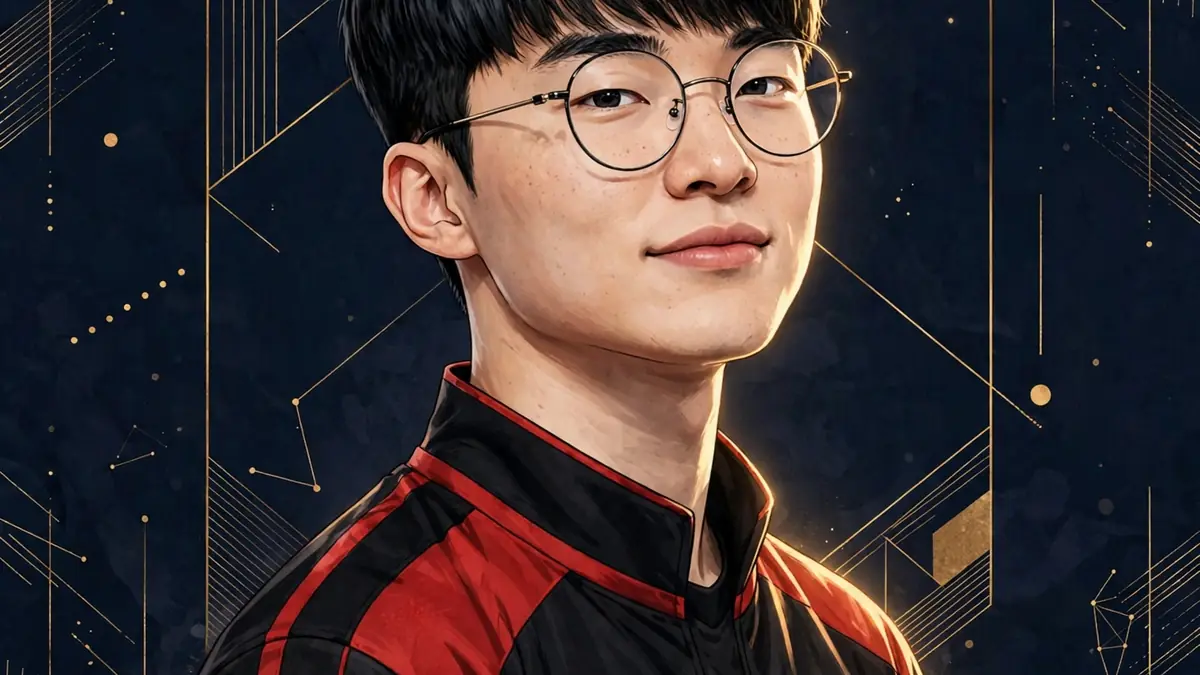
Quick Facts
| Full Name | Lee Sang-hyeok (이상혁), known as Faker |
|---|---|
| Date of Birth | May 7, 1996 |
| Birthplace | Gangseo District, Seoul, South Korea |
| Age (2026) | 30 years old |
| Team / Role | T1, mid laner — with the organisation since 2013, under contract through 2029 |
| World Championships | 6 — 2013, 2015, 2016, 2023, 2024, 2025 (all-time record) |
| Other Major Titles | 2× Mid-Season Invitational (2016, 2017), 10× LCK champion, Esports World Cup 2024 |
| Estimated Net Worth (2026) | $10–25 million (estimates disagree; anchored at $25 million — see breakdown) |
| Reported Salary | Around $6 million per year (Korean press estimate; T1 has never confirmed it) |
| T1 Equity | Part-owner since 2020; stock option for 6,156 shares, 5.66% of T1 if exercised |
| Career Prize Money | Over $2 million (Esports Earnings / Liquidpedia, as of early 2026) |
| Nickname | The Unkillable Demon King |
Table of Contents
- Quick Facts
- Faker’s Early Life in Seoul
- How Faker Was Discovered
- The 2013 Debut and First World Title
- The Dynasty Years: 2015, 2016 and the LCK Titles
- The Lean Years and the 2022 Final
- The Second Peak: Three Straight Worlds Titles
- Worlds 2026 and the End of the Streak
- Hall of Legends, Asian Games Gold and National Honours
- The Money: Salary, T1 Ownership and Prize Winnings
- Faker’s Net Worth in 2026
- Assets and Investments: Faker Tower and Beyond
- Personal Life: Private, Frugal and Charitable
- Faker vs the Other Esports Greats
- Records and Legacy
- Frequently Asked Questions About Faker
- Final Thoughts
- Sources and How We Estimated
Faker’s Early Life in Seoul
Lee Sang-hyeok was born on May 7, 1996, in the Gangseo District of Seoul, South Korea, and grew up in a modest household raised mainly by his father and his grandparents. By every account from those who knew him then, he was a quiet boy who kept to himself, did well enough at school without standing out, and spent his free hours in front of a computer. He was not a child star, not a prodigy groomed from birth, and nothing in his early years pointed at a stadium career. The game that changed his life arrived almost by accident: he started playing League of Legends in 2011, when he was 15, and within months he was beating players far older and far more experienced than him.
Seoul in the early 2010s was the perfect place for that accident to happen. South Korea already treated competitive gaming as a real sport, with televised matches, packed PC bangs on every street, and a ladder system where the best amateurs were watched closely by professional scouts. Sang-hyeok climbed the Korean solo queue at a speed that made people pay attention. He played under the name GoJeonPa, a reference to a Korean historical figure, and his win rate at the top of the ladder was the kind of number that gets screenshotted and passed around. He was still in school, still living at home, and still unknown outside a small circle of hardcore players. That circle, though, included the people who ran SK Telecom T1, the most serious team in the country.

His family background stayed out of the spotlight even after he became famous, and that was by design. Faker has always guarded his private life, and his father has rarely spoken to the press. What is known is that the household was not wealthy, that his father supported the gaming once it became clear his son had a rare gift, and that Sang-hyeok himself has described a childhood that was ordinary in every way except the hours he put into the game. That ordinariness matters to the story, because it is the gap between where he started and where he ended up that makes the biography worth telling: no famous parents, no academy system, no head start — just a teenager in Gangseo who happened to be better at one game than anyone else on the planet.
How Faker Was Discovered
The scouting story has become esports folklore, and the facts behind it are simple. In late 2012 and early 2013, SK Telecom T1 was building a second League of Legends roster and looking for a mid laner. Their scouts noticed a solo queue account tearing through the Korean ladder and traced it to a 16-year-old schoolboy. The team invited him for a trial. He passed it. In February 2013, at 17, Lee Sang-hyeok signed with SK Telecom T1 and took the in-game name Faker.
The name itself came from the game, not from a marketing meeting. He had used “Faker” as one of his account names, and it stuck. Within the team he was the youngest player by some distance, surrounded by veterans who had already played on big stages. The coaching staff’s first job was not to teach him the game — he already understood it better than most professionals — but to teach him how to play it inside a team: how to talk, how to trust a jungler, how to lose a lane gracefully and win the game anyway. Those are the skills that separate a ladder star from a professional, and Faker picked them up fast enough that by the spring of 2013 he was starting.
There is a detail from this period that tells you a lot about the player he would become. In his first months as a professional he was known inside the team for staying behind after practice to play more, and for studying replays of his own mistakes rather than his highlights. Coaches who worked with him in those years have described a player who treated every lost team fight as a puzzle to solve. That habit never left him. Thirteen years later, after six world titles, he is still described the same way by teammates: the first to arrive, the last to leave, and the harshest judge of his own play.
The 2013 Debut and First World Title
Faker’s professional debut came in the spring of 2013, in Korea’s Champions league, and it did not take long for the rest of the world to learn his name. In his first split he was already outplaying established mid laners, and the play that made him famous arrived in the summer of that year: a one-versus-one kill on Ryu, the star mid laner of the KT Rolster Bullets, using Zed — a duel so clean that it is still shown in highlight reels more than a decade later. The Korean broadcasters started calling him the Unkillable Demon King, a nickname that has followed him ever since.
The 2013 World Championship in Los Angeles was his first trip outside Korea for a tournament, and he was 17 years old. SK Telecom T1 went through the tournament dropping only a single game in the group stage, then beat Najin Black Sword and Royal Club in the knockouts. In the final, against China’s Royal Club, T1 won 3-0, and Faker was named the best player of the tournament. He had been a professional for less than a year. No player that young had ever won the World Championship before, and none has since.
The speed of it all is worth pausing on. Most esports careers take years to reach a world final; Faker reached one in his first season and won it. The prize money for that first title was modest by today’s standards — the whole tournament’s purse was a fraction of what modern Worlds pay — but the title itself changed his life. He went from a schoolboy in Gangseo to the face of Korean esports in eight months, and the expectations that came with that have never really gone away. Every season since, the question asked of Faker has been the same one: can he do it again?
The Dynasty Years: 2015, 2016 and the LCK Titles
The answer, for the next three years, was yes, again and again. After a quieter 2014, when T1 failed to qualify for the World Championship, the team rebuilt around Faker and came back with one of the most dominant runs the game has ever seen. In 2015 they won the Mid-Season Invitational’s predecessor events, swept the Korean league, and then won the 2015 World Championship in Berlin, losing only one game in the entire tournament. Faker’s play that year — on champions like Ryze, Lulu and Cassiopeia — set a standard for mid lane play that other teams spent years trying to copy.
2016 was even better. T1 won the Mid-Season Invitational in Shanghai, beating Counter Logic Gaming in the final, and then won the World Championship again in Los Angeles, this time in a five-game final against Samsung Galaxy that is still ranked among the best series ever played. Faker was the Finals MVP of that run, and at 20 years old he already had three World titles, two of them back to back. The Korean league titles kept coming too: by the end of this period he had collected a stack of LCK championships that would eventually reach ten, a domestic record that no other player has come close to matching.
What made those teams so hard to beat was not one star player but the way Faker made everyone around him better. His champion pool was the widest in the game — he could play the assassins, the control mages, the utility picks, and the off-meta surprises, which meant opponents could never ban him out of a series. His laning was famously clean: he rarely died, rarely lost farm, and punished the smallest positional mistake. And his team fighting, the part of the game where a mid laner has to make split-second calls about where to stand and when to commit, was the best in the world. Rivals from that era, interviewed years later, tend to say the same thing: you could prepare for T1, but you could not prepare for Faker having a good day.
There were also the first signs, during these years, of the commercial side of his career taking shape. T1’s red jersey became one of the best-selling items in Korean esports, and Faker’s face was on it. Sponsors came — first Korean brands, then global ones — and his stream, when he played it, drew audiences that dwarfed most traditional sports broadcasts in the country. He was still a quiet young man who gave short answers in interviews, but the industry around him was already treating him as a franchise player, the kind of asset a team builds a decade around.
The Lean Years and the 2022 Final
The years after 2016 were harder. League of Legends got more competitive: Chinese teams grew stronger, European teams closed the gap, and T1’s roster turned over again and again while Faker stayed. He reached the World Championship final in 2017 and lost to Samsung Galaxy. He missed the tournament entirely in 2018. He reached the semi-finals in 2019 and 2021, losing both times. For a player whose early career had been a straight line upward, this was the first real test of his staying power — and it is the part of the story that separates him from every other great who burned bright and faded.
What happened instead is that Faker changed his game. The flashy assassin plays of his teens gave way to something more controlled: Azir, Orianna and Ryze became his signature champions, the control mages who win games through positioning and patience rather than solo kills. His kill numbers dropped and his win rate stayed high. Teammates from those years describe a player who had become the team’s brain, calling the shots in the late game and keeping younger players calm when a series turned against them. It was a different kind of greatness, less spectacular and harder to put in a highlight reel, and it kept T1 competitive through seasons when their roster, on paper, was not the best in Korea.
The 2022 season brought the old Faker back into the spotlight. With a new young roster — Zeus, Oner, Gumayusi and Keria around him — T1 went 18-0 in the LCK spring regular season, won the spring title, and reached the World Championship final in San Francisco. They lost that final 3-2 to DRX, a run that ended in heartbreak, but the message of the season was clear: at 26, an age when most professional gamers have already retired, Faker was still one of the two or three best mid laners in the world, and he was doing it with a team full of players who had grown up watching him. The final loss hurt, and he said so publicly, which for Faker counts as an emotional outburst. Then he signed on for more.
The Second Peak: Three Straight Worlds Titles
The three years that followed are the second half of the legend, and in some ways the more impressive half. In 2023, Faker missed part of the summer season with an arm injury — the first serious injury of his career — and T1 looked lost without him. He returned for the World Championship in Seoul, played through the pain, and led T1 to the title in front of a home crowd at the Gocheok Sky Dome, beating China’s Weibo Gaming 3-0 in the final. It was his fourth World title, seven years after his third, and the arena’s reaction when he lifted the Summoner’s Cup is the single most-watched moment in Korean esports history.

2024 brought the fifth. T1’s road to the final in London was harder — they entered the tournament as Korea’s fourth seed, the weakest of the Korean teams on paper — and the final against Bilibili Gaming went to five games. Faker was named Finals MVP, and the win made him the first player in history with five World titles. The year also brought the Esports World Cup title in Riyadh and, in the summer, the announcement that he would be the first inductee into the new LoL Esports Hall of Legends, with an in-game event and a signature Ahri skin built around his career.
Then came 2025, and the sixth. T1 beat KT Rolster 3-2 in the World Championship final in Chengdu on November 9, 2025, completing three straight titles — a run no team in the game’s history had ever achieved. Faker was 29, playing his thirteenth season, and still the player the team turned to when a series was on the line. By the end of that night he had played more professional games, won more titles, and earned more prize money than any League of Legends player who has ever lived. The debate about the greatest of all time, which had been a real debate in the mid-2010s, was over. He had won it by a distance.
The number that ends the debate: six World Championships across twelve years (2013, 2015, 2016, 2023, 2024, 2025). The next-best player in history has three. Faker has twice as many as anyone else who has ever played the game — and he won the sixth at 29, an age when almost every other great had already retired.
Worlds 2026 and the End of the Streak
The 2026 season is the freshest chapter of this biography, and it ended in a way nobody inside T1 expected. Faker turned 30 in May 2026 and played the season with the same roster core — Doran, Oner, Peyz and Keria around him — chasing a fourth straight World title, something no team in League of Legends history had ever done. The year was uneven: T1 were good enough to reach the World Championship semi-finals but never looked like the dominant side of the previous three autumns, and they finished the season without a trophy for the first time since 2021, having failed to reach a single grand final all year.
At Worlds 2026, T1 beat Movistar KOI 2-0 in the Swiss stage in late October to book a quarter-final place, then beat Karmine Corp 3-1 in the quarter-final in early November — their sixth straight quarter-final appearance at the tournament. The run ended on November 9, 2026, in Allen, Texas, when Bilibili Gaming beat T1 3-1 in the semi-final. The defeat ended more than one streak at once: T1’s three-year reign as world champions, and a 13-series unbeaten run against Chinese LPL teams in World Championship best-of-five matches that stretched back 13 years. Bilibili Gaming went on to face Gen.G in the grand final in New York, while T1 finished the tournament in third or fourth place.
Faker’s own reaction, given to Riot Games’ broadcast team after the loss, was measured, as it always is. He said Bilibili Gaming had prepared better, and he spoke about the year as a whole rather than the single series. But the result changes the frame of this biography in one clear way: the six titles now sit behind him rather than ahead of him, and the question for 2027 is whether a 31-year-old Faker, under contract through 2029, can build a third peak — or whether the 2023–2025 run will stand as the closing act of the greatest career the game has seen. Nothing in his history suggests he is done. He has rebuilt his game twice already, and the contract he signed in 2025 was built on the belief, shared by T1, that he has more left.
Hall of Legends, Asian Games Gold and National Honours
The honours outside the game have piled up as fast as the titles inside it. On May 22, 2024, Riot Games announced Faker as the inaugural inductee into the LoL Esports Hall of Legends, the new hall of fame for the sport, with the formal induction held at The Shilla Seoul on June 6, 2024. John Needham, Riot’s president of esports, called him “the most iconic and influential figure in League of Legends and esports history.” He was voted in unanimously by a panel of players, peers and industry veterans. The induction came with an in-game celebration and the Immortalized Legend Ahri skin, one of the most talked-about cosmetic releases the game has ever had.
His international career with South Korea has been just as decorated. At the Hangzhou Asian Games — the 2022 edition, held in 2023 after a pandemic delay — he captained the South Korean team to the gold medal in League of Legends, beating Chinese Taipei 2-0 in the final on September 29, 2023, in the first-ever Asian Games medal competition for the game. The gold also brought him exemption from South Korea’s mandatory military service, the prize every Korean athlete chases. In October 2026, according to Korea Post’s own announcements, he won a second straight Asian Games gold at Aichi-Nagoya. He is the only Korean esports player with two Asian Games gold medals.
Then came the national honours that no esports player had ever received. In January 2026, Faker became the first esports athlete to receive the Cheongnyong Medal, the highest class of South Korea’s Order of Sport Merit. And on October 23, 2026, Korea Post issued a set of ten commemorative stamps honouring him — the first time a South Korean commemorative stamp issue has been devoted to a single athlete — with 112,000 of the 140,000 sheets sold within hours of release, according to Korea Post. The stamp designs cover his career from the 2013 debut to the 2023–2025 title run. A postage stamp is a strange honour for a video game player, and that is exactly the point: in South Korea, Faker has crossed over from esports star to national figure, the way a World Cup footballer or an Olympic champion would.
The Money: Salary, T1 Ownership and Prize Winnings
Faker’s money story has three pillars, and each one is public enough to describe honestly and private enough that no exact total exists. The first pillar is salary. Korean press reports have put his T1 salary at around $6 million a year, and some outlets have suggested $7–8 million a year in more recent reporting. T1 has never confirmed any number, and Faker has never discussed his pay. What is certain is that he is among the highest-paid players in esports, and that his pay has risen with every contract: the three-year deal he signed in 2020, the extension that followed, and the four-year extension announced in July 2025 — at T1’s home game in Incheon on July 27, 2025 — that keeps him at the organisation through 2029, when he will be 33. No terms were disclosed for that deal, which is normal for T1, and the salary figures quoted in the press are estimates, not filings.
The second pillar is the one that makes Faker different from every other player: he is a part-owner of the team he plays for. When he signed the three-year contract in 2020, the deal included a stock option for 6,156 shares of T1, equal to about 5.66% of the company if exercised — a stake that reporting at the time valued in the low tens of millions of dollars, and which has grown in value as T1’s profile has grown. It is the reason his net worth is so hard to pin down: the stake’s value depends entirely on what T1 itself is worth, and T1 is a private company that publishes no valuation. Some analysts have put the stake at $13 million or more; others have suggested far higher numbers if T1 is valued at several hundred million dollars. The honest statement is that the stake is real, the percentage is public, and the dollar value is a guess.
The third pillar is prize money, and this one is exact. Esports Earnings, which tracks tournament payouts, credits Faker with $1,922,085 from 74 tournaments between 2013 and 2025, and Liquidpedia’s tally passed $2.1 million by early 2026, making him the first League of Legends player ever to pass $2 million in career prize money. The single biggest cheques came from the World Championships — the 2025 title alone was worth $1 million to the team — but prize money is the smallest of the three pillars. In esports, as in traditional sport, the salary and the equity are where the real money sits.
Around those three pillars sits the rest: endorsements, streaming and appearance income. Faker has worked with brands including Razer and Secretlab, and his streams and public appearances draw audiences that sponsors pay for. None of those deals has a public value, which is why every net worth estimate for him comes with a range rather than a single confident number. For a fuller look at how the numbers break down, our sister site’s money-focused profile covers Faker’s net worth in detail, from his salary to his T1 equity stake.
Faker’s Net Worth in 2026
So what is Faker worth in 2026? The honest answer is a range, and the range is wide because the sources disagree. At the cautious end, Esports Insider and ClutchPoints put the figure at around $10 million, built from the reported salary, the prize money, the Faker Tower property and the endorsements. In the middle, Surprise Sports and Win.gg put it at $20–25 million, giving more weight to the T1 equity stake. At the optimistic end, some outlets have suggested $25–50 million, assuming a high valuation for T1. Our anchor is $25 million, inside a $10–25 million evidence range — the same anchor our sister site uses — because it sits where the most detailed recent reporting converges, and because it treats the equity stake with the respect it deserves without assuming a valuation nobody has published.
| Source | Estimate | Basis |
|---|---|---|
| Esports Insider (Jan 2026) | Around $10 million | Salary, prize money, property, endorsements |
| ClutchPoints | Around $10 million | Salary, prize money, T1 stake, endorsements |
| Surprise Sports (Oct 2026) | $25 million | Salary, equity, prize money, sponsorships |
| Guide Net Worth (Oct 2026) | $25 million, in a $20–40 million range | Salary, 5.66% T1 stake, prize money |
| Aussyelo (2026) | $25–50 million | Assumes a high T1 valuation |
The growth of that fortune follows the shape of his career. In 2013, a 17-year-old rookie on a first contract, he was earning a professional salary and little else. By 2016, with three World titles, he was one of the best-paid players in the game. The 2020 contract changed the maths entirely, because it turned a salary into an ownership stake — the moment Faker stopped being just an employee of T1 and became a part-owner of it. The 2023–2025 title run then pushed the value of that stake up, because a team that wins three straight World Championships is worth more than one that does not. And the 2025 extension through 2029 locks in four more years of top-end salary at the back end of his career, which is when most athletes’ earnings fall off a cliff. Faker’s have not.
One more thing worth saying plainly: every one of these numbers is an estimate, before tax, agent fees and expenses, and Faker has never disclosed his finances. Anyone who quotes a single exact figure for his net worth is guessing with more confidence than the evidence allows. The range is the story — and the range, even at its cautious end, makes him the richest League of Legends player in history.
Assets and Investments: Faker Tower and Beyond
Faker’s best-known asset outside the game is a building. He owns a property near his childhood home in Seoul — known to fans as Faker Tower — which he rents out to businesses. Esports Insider reported the purchase as part of its net worth breakdown, and it fits the pattern of his financial life: quiet, property-based, and unshowy. There are no reports of a supercar collection, no yacht, no watch habit splashed across social media. The man who has earned more from League of Legends than anyone in history lives, by all accounts, much as he always has.
Beyond the building and the T1 stake, little is public about his investments, and that is probably deliberate. Unlike many athletes who launch clothing lines, restaurants or venture funds, Faker has kept his business footprint narrow: the team he plays for, the property he owns, and the brand deals that come to him. The T1 stake is the investment that matters most, because it ties his wealth directly to the organisation he has spent his whole career building. If T1 grows, he grows with it. That alignment is rare in sport, and it is one of the reasons the 2020 contract was seen as a landmark deal when it was signed — a player being paid partly in the future of his own team.
It is also worth noting what he has not done with his money. Faker is famous in Korea for his frugality: he has spoken in interviews about spending very little, eating simply, and saving most of what he earns. The image is not a pose — teammates and journalists who have known him for years describe the same habits. In a sport where young stars routinely burn through their first big contracts, the most successful player in its history is also one of its most careful with money. That discipline is part of why the estimates, even the cautious ones, are so large: thirteen years of top-end earnings, mostly saved rather than spent, add up.
Personal Life: Private, Frugal and Charitable
For a man watched by millions, Faker’s personal life is almost entirely off the record, and that is how he wants it. He has never confirmed a public relationship, he rarely posts about his life away from the game, and interviews with him tend to stay on League of Legends because he steers them there. He turned 30 in May 2026, and he is listed at 176 cm tall, a detail covered in our profile of Faker’s height. Beyond those basics, the public record is thin by design.
What is known paints a picture of a man who has changed very little despite the fame. He is famously frugal, has spoken about spending little of what he earns, and lives simply in Seoul. He is also known for giving money away quietly: reported donations include 30 million won for COVID-19 relief in 2020 and contributions to flood relief in South Korea, given without the publicity that usually follows a celebrity gift. His closest public relationships are the ones inside T1 — the teammates he has played with for years, the coaches who have been with him since his teens, and the staff who run the organisation he part-owns. The game has been his life since he was 15, and by all accounts he likes it that way.
That privacy has become part of his public image rather than a gap in it. In a sport full of streamers who broadcast their lives, Faker is the exception: the player who shows up, plays, wins, and goes home. Fans respect it, sponsors have learned to work around it, and it has arguably helped his longevity — thirteen years at the top of a game that burns players out in three or four is easier when the rest of your life is calm, private and under your own control.
Faker vs the Other Esports Greats
Every sport has its greatest-of-all-time argument, and esports is no different — except that in League of Legends, the argument ended years ago. The honest way to measure Faker is to put him next to the best players in other games and see what the comparison shows. In Counter-Strike, the equivalent figure is s1mple, the Ukrainian AWPer whose peak with Natus Vincere produced a Major title and a pile of individual awards; s1mple’s biography follows a similar arc of a prodigy who carried his team for a decade, but s1mple has one Major to Faker’s six World titles, and he has never owned a stake in his own team. In Valorant, TenZ built a career on highlight plays and a huge streaming audience, but his trophy cabinet is thinner still. The gap is not about talent — it is about time. Faker has stayed at the top for thirteen years. Nobody else in esports has done that.
The streaming side of the comparison is just as lopsided. Tyler “Ninja” Blevins turned Fortnite into a mainstream phenomenon and became the most famous streamer on the planet — Ninja’s age and career timeline shows a star who peaked fast and cashed in through sponsorships and media deals — but Ninja never won a world championship, because streaming and competing are different jobs. Pokimane, one of the biggest names in streaming, built an empire on personality and consistency; Pokimane’s biography is a story of business sense and audience loyalty, not of competitive titles. Faker is unusual because he has both: the competitive record of a champion and the commercial pull of a star, without ever making streaming his main job.
| Player | Game | Biggest Achievement | Career Length at the Top |
|---|---|---|---|
| Faker | League of Legends | 6× World champion, 10× LCK champion | 2013–present (13 years) |
| s1mple | Counter-Strike | 1× Major champion, 3× HLTV Player of the Year | 2016–present |
| Ninja | Fortnite / streaming | Mainstream streaming pioneer, no world title | 2018–present |
| Pokimane | Streaming | One of the most-followed streamers in the world | 2013–present |
The table makes the point more clearly than any superlative could. Longevity is the rarest thing in esports, and Faker has more of it than anyone. That is the record that will be hardest to break — not the six titles, remarkable as they are, but the thirteen years.
Records and Legacy
Put the records together and they read like a list no other player will ever match. Six World Championships, the most by any player, won across twelve years. Ten LCK titles, a domestic record. Two Mid-Season Invitational titles. The first player inducted into the LoL Esports Hall of Legends. The first League of Legends player to pass $2 million in career prize money, and the first to record 700 career victories. More than 1,785 professional games played at a win rate of about 66.5%, according to mid.gg’s tally of his career. A first World title won at 17, one of the youngest champions the tournament has ever had. Two Asian Games gold medals, a Cheongnyong Medal, and a set of national postage stamps.
But the legacy is bigger than the list. Faker changed what a professional gamer could be. Before him, esports careers were short, salaries were modest, and players were treated as disposable. He showed that a player could stay with one organisation for a whole career, become a part-owner of it, earn a fortune, and be honoured by his country for it. The contract he signed in 2020 — salary plus equity — became a template that agents and teams across esports now point to. The Hall of Legends was created, in part, because his career had outgrown the existing ways of honouring players. And the stamps, the medal, and the Asian Games golds show a country that now treats its best gamer the way it treats its best athletes.
There is also the question of what comes next. His contract runs through 2029, when he will be 33 — an age at which no League of Legends player has ever competed at the top level. If he plays out that deal, he will have spent sixteen years with one team, a run of loyalty that has no parallel in modern sport, traditional or electronic. Whether he wins a seventh World title or not, the story is already complete in the ways that matter: the boy from Gangseo became the standard by which every player after him is measured, and the game he plays is bigger because he played it. You can browse more profiles like this one in our biography section.
Frequently Asked Questions About Faker
What is Faker’s real name?
Faker’s real name is Lee Sang-hyeok (이상혁). He was born on May 7, 1996, in Seoul, South Korea, and has played under the name Faker since joining SK Telecom T1 in 2013.
How old is Faker in 2026?
Faker is 30 years old in 2026. He was born on May 7, 1996, and turned 30 on May 7, 2026. He is under contract with T1 through 2029, when he will be 33.
How many World Championships has Faker won?
Faker has won six League of Legends World Championships — in 2013, 2015, 2016, 2023, 2024 and 2025 — more than any other player in history. He also has two Mid-Season Invitational titles (2016, 2017) and ten LCK championships.
What is Faker’s net worth in 2026?
Faker’s net worth in 2026 is estimated at $10–25 million, anchored at $25 million. Esports Insider and ClutchPoints put it near $10 million, while Surprise Sports and Win.gg put it at $20–25 million. The range reflects the unknown value of his 5.66% stake in T1; Faker has never disclosed his finances.
What team does Faker play for, and how long is his contract?
Faker plays mid lane for T1, the organisation he joined as SK Telecom T1 in 2013. He signed a four-year contract extension in July 2025 that runs through 2029. No terms were disclosed.
Is Faker a part-owner of T1?
Yes. When Faker signed a three-year contract in 2020, the deal included a stock option for 6,156 shares of T1 — about 5.66% of the company if exercised — making him a part-owner of the team he plays for.
How tall is Faker?
Faker is listed at 176 cm tall, which is about 5 feet 9 inches. His height is one of the most-searched facts about him, alongside his age and his net worth.
Is Faker retired?
No. Faker is still an active professional player for T1. His contract runs through 2029, and although T1 lost in the semi-finals of Worlds 2026, he has given no sign of retiring and has rebuilt his game successfully twice before.
Final Thoughts
Faker’s biography is, in the end, a story about time. Thirteen years at the top of a game that discards its stars in three. Six World titles spread across twelve years, with a seven-year gap between the third and the fourth. A fortune built slowly — salary, equity, prize money, property — by a man famous for spending almost none of it. And a set of honours, from the Hall of Legends to a national postage stamp, that no esports player had ever received before him.
The 2026 semi-final defeat does not change that story; it completes a chapter of it. The three-year reign is over, the streak against Chinese teams is over, and the question now is whether the greatest player the game has ever seen has one more peak in him. His contract says he has four more years to find out. Whatever happens next, the record is already his: the Unkillable Demon King, the six-time world champion, the boy from Gangseo who became the standard for everyone who came after.
Sources and How We Estimated
This biography was researched from live reporting in November 2026, including LoL Esports, Liquipedia, Esports Insider and Riot Games. Title counts, dates and prize money were cross-checked against Liquipedia’s tournament records and Esports Earnings. The Worlds 2026 result was confirmed from November 9, 2026 reporting by Sheep Esports, Insider Gaming and Kbizoom. The Hall of Legends induction, Asian Games gold medals, Cheongnyong Medal and Korea Post stamp issue were confirmed from Riot Games’ announcements and Korea Post’s October 2026 releases.
How we estimated: Faker has never disclosed his finances, and T1 has never published his salary or a company valuation, so no exact net worth exists in public. Our $10–25 million range, anchored at $25 million, combines the named sources in the table above: a reported salary of around $6 million a year (Korean press estimate), a 5.66% T1 equity stake whose dollar value depends on an unpublished valuation, over $2 million in verified career prize money, and endorsement and property income. Where sources disagreed, we published the range and named the sources rather than picking a single invented figure. Estimates are before tax, fees and expenses, and may differ from private reality.