Cindy Crawford is 60 years old in 2026, and her life reads like two stories folded into one: the small-town Illinois girl who was supposed to become a chemical engineer, and the woman who became one of the most recognisable faces on the planet. Born Cynthia Ann Crawford on February 20, 1966, in DeKalb, Illinois, she went from detasseling corn in a summer job to the cover of Vogue, a Super Bowl Pepsi commercial, her own MTV show, and a skincare business that made her one of the richest models in history.
Her personal fortune was estimated by Forbes at $225 million in August 2021, with roughly 90 percent of it tied to her 50 percent stake in the skincare brand Meaningful Beauty. Celebrity Net Worth puts the combined figure she shares with her husband, businessman Rande Gerber, at $400 million as of November 2026. Both numbers are real; they measure different things, and this biography keeps them labelled so the difference stays clear. Last updated November 16, 2026. By Celebamerica Editorial Staff.

Quick Facts
| Full Name | Cynthia Ann Crawford |
|---|---|
| Date of Birth | February 20, 1966 (age 60 in 2026) |
| Birthplace | DeKalb, Illinois, United States |
| Height | 5 ft 9.5 in (1.77 m) |
| Occupations | Model, actress, television host, entrepreneur, author |
| Years Active | 1983–present |
| Estimated Net Worth | $225 million individual (Forbes, August 2021); $400 million combined with husband Rande Gerber (Celebrity Net Worth, November 2026) |
| Primary Income Sources | Meaningful Beauty skincare (50% stake), Cindy Crawford Home furniture, modelling contracts, endorsements, licensing |
| Key Ventures & Works | Meaningful Beauty (co-founded 2004), MTV’s House of Style (host, 1989–1995), 1992 Pepsi Super Bowl commercial, memoir Becoming (2015) |
| Spouses | Richard Gere (1991–1995); Rande Gerber (married 1998–present) |
| Children | Presley Walker Gerber (1999–2026) and Kaia Jordan Gerber (born 2001) |
| Agency | Storm Management (London), among others |
Table of Contents
- Quick Facts
- Early Life in DeKalb, Illinois
- The Valedictorian Who Left Northwestern
- Discovery: A Cornfield Photo and Elite
- The Rise of a Supermodel
- Pepsi, MTV and Pop-Culture Fame
- Acting, Fitness Videos and Books
- Meaningful Beauty and the Business Turn
- The Money: How the Fortune Was Built
- Net Worth Timeline
- Cindy Crawford Among Her Peers
- Personal Life: Gere, Gerber and Family
- A Family Loss in 2026
- Legacy and Influence
- Frequently Asked Questions
- Final Thoughts
- Sources & Reporting
Early Life in DeKalb, Illinois
Cindy Crawford grew up about 65 miles west of Chicago in DeKalb, a university town built around Northern Illinois University, and her childhood had nothing to do with fashion. Her father, John Daniel Crawford, worked as an electrician. Her mother, Jennifer Sue Crawford-Moluf, worked as a bank teller. The family lived a plain Midwestern life, and Crawford has described it in interviews as warm, disciplined and ordinary — the kind of upbringing where a teenager detasseled corn in the summer because that was the job available.
She was the middle child of four in some tellings and the eldest daughter in others, depending on how the family is counted: she has two sisters, Chris and Danielle, and a younger brother, Jeffery, who died of childhood leukaemia at the age of three. That loss landed early and hard. Crawford has spoken about it across her career as the event that taught her, while still a child, that life could turn without warning — and people who have followed her since say it shaped the seriousness she carried into an industry not known for it.
DeKalb in the late 1970s and early 1980s was not a place that produced models. There were no agencies, no castings, no fashion weeks. What it did produce, in Crawford’s case, was a student who treated school as the way out and the way up. She was a strong student from the start, and by her senior year at DeKalb High School she stood at the top of her class.
The Valedictorian Who Left Northwestern
Crawford graduated from DeKalb High School in 1984 as class valedictorian. The achievement came with an academic scholarship to study chemical engineering at Northwestern University, one of the most selective programmes of its kind in the country. It was, by any measure, the safe and impressive path: a full ride into a serious profession, for a young woman from a working-class family who had done everything right.
She lasted one quarter. The modelling work that had started as a side job kept pulling, and by the end of her first term she made the decision that defines the whole story — she left Northwestern to model full time. It was a gamble her teachers and family watched with understandable worry. Chemical engineering scholarships do not come twice, and the modelling business in the mid-1980s was famously short-lived for most of the young women who tried it.
The choice looks obvious in hindsight and reckless at the time, which is exactly why it matters to the biography. Crawford did not drift into modelling because school had failed her. She walked away from a top-tier academic future on purpose, because she had read the odds of her own moment correctly: the industry was about to change, and the girls who arrived first would own it. Within two years she was in New York, and within five she was on the cover of Vogue.
Discovery: A Cornfield Photo and Elite
The discovery story is one of the best-known in fashion, and it starts in a cornfield. In the summer before her senior year, Crawford was working a detasseling job in a DeKalb cornfield when a local newspaper photographer took her picture. The photograph ran in the paper, and a local modelling scout noticed it. She was 16.
At 17 she entered Elite Model Management’s Look of the Year contest and finished as runner-up. The result mattered less than the door it opened: Elite was the most powerful agency in the business, and a strong showing in its contest was a direct line to Chicago, then to New York. She signed with Elite and began working steadily — local jobs at first, then bigger ones, building a book while she finished high school and started at Northwestern.
The mole above her lip became part of the story almost immediately. Early in her career, photographers and retouchers routinely airbrushed it out, and Crawford was told more than once that it was a flaw she should consider removing. She refused. The mole stayed, and within a few years it had become her signature — the single most recognisable beauty mark in fashion, and a quiet statement about refusing to be edited into someone else. It is the detail that still identifies her in a photograph before anything else does.
The Rise of a Supermodel
Crawford moved to New York City in 1986 to pursue modelling full time, and the timing could hardly have been better. The late 1980s were the years when a small group of models stopped being anonymous faces and became celebrities in their own right — the group later called the original supermodels. Crawford stood at the centre of it, alongside Naomi Campbell, Linda Evangelista, Christy Turlington and Claudia Schiffer.
The work came fast. She walked the runways for Chanel, Versace, Dolce & Gabbana, Christian Dior, Calvin Klein, Ralph Lauren, Michael Kors and Valentino, and her face filled magazine covers at a pace few models before her had matched — hundreds of covers across her career, including repeated appearances on Vogue in its American, British and international editions. In January 1990 she appeared on the British Vogue cover photographed by Peter Lindbergh, alongside Campbell, Evangelista, Turlington and Tatjana Patitz — the image that, more than any other single photograph, announced the supermodel era. The five women on that cover would be cast together again within months in George Michael’s “Freedom! ’90” video, a moment that pushed models from the fashion pages into mainstream pop culture.
What set Crawford apart inside that group was range. Campbell had the runway, Evangelista the chameleon transformations, Turlington the classic elegance. Crawford had the commercial reach: she could sell a couture gown on a Paris runway in the morning and a soft drink to middle America in the evening, and both audiences believed her. That commercial instinct would later define the second half of her career, when she stopped being only the face in front of the camera and started owning the businesses behind it.
By 1995, Forbes named her the highest-paid model in the world. Reporting from the period puts her peak-year earnings in the mid-1990s at around $6.5 million a year — a figure that looks modest beside today’s influencer economics, but which, in the mid-1990s, made her the top earner in her profession. She was 29, at the top of a career most models leave by 25, and she was already planning what came next.
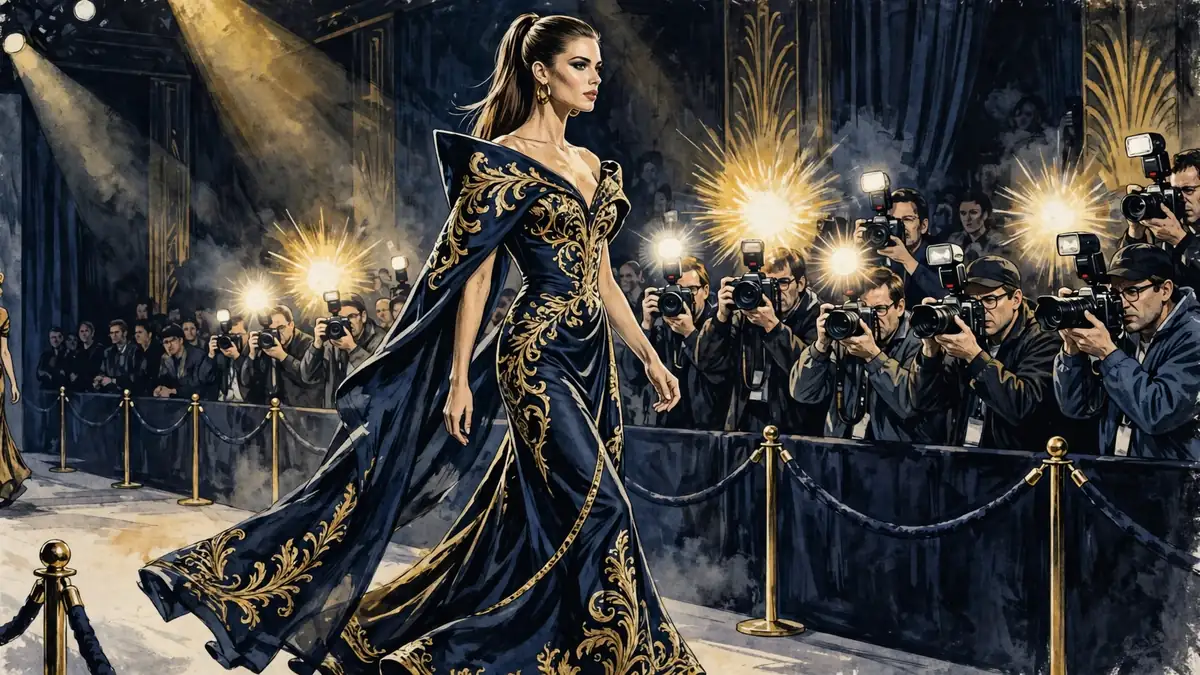
The supermodel group she belonged to has been written about so often that the label can sound like a marketing slogan, but the economics were real. Before the late 1980s, models were hired hands; after it, the top names negotiated their own rates, chose their own campaigns and lent their names to products. Crawford understood that shift earlier than most of her peers and used it better. Her contemporary Naomi Campbell remained the runway’s defining star, while Crawford built the broader commercial portfolio — television, fitness, beauty, furniture — that would outlast the runway years by decades.
Pepsi, MTV and Pop-Culture Fame
Two moments carried Cindy Crawford out of the fashion world and into the living rooms of people who had never bought a copy of Vogue. The first was the Pepsi commercial that aired during the 1992 Super Bowl. In it, Crawford pulled up to a beachside drink stand in a red sports car, in white shorts and a tank top, and drank a can of Pepsi while two young boys watched. The spot ran for a minute, cost a fortune, and became one of the most talked-about commercials of the decade. It was parodied, referenced and replayed for years, and it fixed Crawford in the public mind not as a distant couture figure but as the all-American girl next door — which, in the literal sense, she was.
Pepsi knew what it had. The company brought the commercial back in 2018 for Super Bowl LII, this time with Crawford’s son Presley appearing alongside her, a full-circle moment that played on twenty-six years of nostalgia. The original ad remains one of the most famous television commercials ever made, and it is still the first thing many people name when asked how they first heard of her.
The second moment was MTV’s House of Style, which Crawford hosted from 1989 to 1995. The show took fashion television out of the trade press and onto a youth channel, with Crawford as the guide — interviewing designers, visiting shoots, explaining the industry to an audience that had never seen it from the inside. It ran for six years, made her a television personality in her own right, and gave her a skill the runway never had: talking to a camera, in her own words, for a mass audience. That skill paid off for the rest of her career, from talk-show appearances to the product pitches that would later sell millions of dollars of skincare.
Between the two, Crawford crossed a line that very few models had crossed before her: she stopped being famous only among people who followed fashion, and became famous among people who followed nothing at all except television. It was the first sign of the businesswoman she would become — someone who understood that a face is an asset, and that the asset is worth more when it reaches beyond a single industry.
Acting, Fitness Videos and Books
Like most supermodels of her era, Crawford tried acting. Her film debut came in 1995 with Fair Game, an action thriller in which she played the female lead opposite William Baldwin. The film was a commercial and critical disappointment, and Crawford was candid about it afterwards — acting, she said, was harder than it looked, and her first attempt showed it. She took smaller roles after that, including a part in the 1990s television series and guest spots, but she never chased a film career with the same focus she had given modelling. The attempt is worth recording because it shows the limits of the supermodel moment: fame could open a door in Hollywood, but it could not keep you in the room.
The fitness videos were a different story. Beginning in 1992, Crawford released a series of workout videos that sold well and ran for years — a natural extension of a body that was itself a brand, and a product that reached the same mass audience as the Pepsi ad. She followed them in 1996 with Cindy Crawford’s Basic Face: A Makeup Workbook, a guide to the beauty routines she had learned across a decade in front of cameras.
Her most personal book came much later. Becoming, published by Rizzoli in September 2015 and written with Katherine O’Leary, is a memoir built around photographs from across her career, with Crawford’s own reflections on the decades behind them. It covers the cornfield, the mole, the supermodel years, the marriages, the children and the businesses — and it reads as the work of someone looking back at a career she had spent twenty years steering, rather than one that had simply happened to her. The book landed well with readers and critics, and it remains the fullest account of her life in her own words.
The mole that stayed. Early in her career, retouchers airbrushed out the mole above Crawford’s lip, and she was advised to have it removed. She kept it. Within a few years it was her signature — proof that the feature an industry calls a flaw can become the thing people remember.
Meaningful Beauty and the Business Turn
The move that made Cindy Crawford rich was not a modelling contract. It was a skincare line she co-founded in 2004 with French cosmetic specialist Jean-Louis Sebagh, built around a melon extract from the south of France that Sebagh claimed had unusual antioxidant properties. The brand was called Meaningful Beauty, and it sold the way Crawford sold everything: directly to the public, on television, with her own face and her own voice doing the pitching.
The model was infomercial and direct-response television at first, then retail and online. It worked because the pitch was believable in a way most celebrity beauty lines are not — Crawford was 38 when the brand launched, selling anti-ageing skincare to women her own age, using her own skin as the evidence. Sales grew steadily, and by the 2010s the brand was reported to be generating more than $100 million a year.
Forbes valued Meaningful Beauty at an estimated $400 million in 2021, and reported that Crawford owned 50 percent of it — a stake worth roughly $200 million on that valuation, and the source of about 90 percent of her individual net worth at the time. The numbers matter because they explain the shape of her fortune: this is not a woman who saved modelling fees. It is a woman who turned a face into equity, and equity into a nine-figure asset.
She repeated the formula in furniture. The Cindy Crawford Home collection, launched with the retailer Rooms To Go, put her name on sofas, beds and dining sets sold across the United States — and reporting in 2026 put the collection’s annual sales above $250 million. It is a less glamorous business than skincare and a steadier one: furniture does not depend on a face staying young, and it reaches customers who would never buy a serum. Between the two brands, Crawford built something her modelling peers mostly did not: revenue that keeps arriving whether or not she is photographed.
The business turn also changed how she worked. She retired from full-time modelling in 2000, at 34, and has appeared only selectively since — a magazine cover here, a campaign there, a runway return for a special occasion. The choice was deliberate. She had spent fifteen years as the product; the next twenty-five would be spent owning the products. Few models of her generation managed the transition as completely, and fewer still managed it while keeping the public goodwill that makes a beauty brand sell.
The Money: How the Fortune Was Built
Cindy Crawford’s net worth is one of the most misquoted figures in celebrity finance, because two different numbers circulate and most pages print only one of them. Here is the honest version, with both numbers labelled and sourced.
Forbes estimated Crawford’s individual net worth at $225 million in August 2021, when it ranked her among America’s richest self-made women. The magazine reported that roughly 90 percent of that figure came from her 50 percent stake in Meaningful Beauty, valued on a brand valuation of about $400 million. She dropped off the Forbes self-made women list the following year, not because her fortune shrank but because the cut-off rose sharply — by 2026 the list counted only self-made billionaire women. That is the individual figure: the money that is hers, from her own businesses.
Celebrity Net Worth, by contrast, publishes $400 million — and says plainly on its own page that it is a combined figure shared with her husband, Rande Gerber. The extra value comes largely from Gerber’s side of the household: he co-founded the tequila brand Casamigos with George Clooney, which Diageo bought in 2017 for up to $1 billion, and he built the Gerber Group hospitality business. OK Magazine’s October 16, 2026 profile repeats the $400 million combined figure and adds the Forbes $225 million individual one, which is the correct way to carry both.
For the full picture of how the two sites frame her wealth, our sister site’s Cindy Crawford net worth coverage breaks down the same combined-versus-individual split, and GuideNetWorth’s Cindy Crawford age profile carries the same $400 million combined figure with the Forbes individual number alongside it.
| Figure | Outlet | Date / Note |
|---|---|---|
| $225 million (individual) | Forbes | August 2021; about 90% from the 50% Meaningful Beauty stake |
| $400 million (combined) | Celebrity Net Worth | Snapshot November 5, 2026; combined with husband Rande Gerber |
| $400 million (combined) | OK Magazine | October 16, 2026; cites the Forbes $225M individual figure |
| $400 million (brand value) | Forbes | 2021 valuation of Meaningful Beauty; her 50% stake ≈ $200M |
| Up to $1 billion | Diageo / trade reporting | 2017 sale of Casamigos, co-founded by husband Rande Gerber — his asset, not hers |
Where did the money actually come from, year by year? The shape of it is straightforward. In the 1980s and 1990s, the income was modelling fees — runway, campaigns, covers — peaking at roughly $6.5 million a year in the mid-1990s, when Forbes called her the highest-paid model in the world. The Pepsi, Revlon and Omega campaigns added endorsement fees on top of the modelling day rates, and the fitness videos and House of Style hosting added television income. None of that, added up, reaches nine figures.
The nine figures came from ownership. Meaningful Beauty, from 2004 onward, turned a fee-based career into an equity-based one: instead of being paid to hold a product, she owned half the company selling it. The home collection did the same in furniture. That is the difference between Crawford and most of the models who earned more than she did in any single year — they rented out their faces, and she bought the shop.
Real estate has played a smaller, quieter role. Crawford and Gerber have owned homes in Malibu and Beverly Hills across the years, including a Malibu property they sold in 2018 and a Beverly Hills home they listed in the years since, but property has never been the engine of the fortune the way the businesses have. Cars, likewise, are a footnote rather than a portfolio: she has been photographed with the usual luxury cars of a wealthy Los Angeles household, but there is no sourced collection to catalogue, and this biography does not invent one.
Net Worth Timeline
| Year | Milestone | Money Note |
|---|---|---|
| 1983 | Elite Look of the Year runner-up at 17 | Modelling career begins |
| 1986 | Moves to New York; signs with Elite full time | Runway and campaign fees begin in earnest |
| 1989–1995 | Hosts MTV’s House of Style | Television income; mass-audience fame |
| 1992 | Pepsi Super Bowl commercial; first fitness video | Endorsement peak begins |
| 1994–1995 | Highest-paid model in the world (Forbes) | ≈ $6.5M a year at peak |
| 2000 | Retires from full-time modelling | Fee income falls; business income rises |
| 2004 | Co-founds Meaningful Beauty with Jean-Louis Sebagh | Equity replaces fees as the main engine |
| 2015 | Publishes memoir Becoming | Book income; brand value rises |
| 2017 | Husband’s Casamigos sells to Diageo for up to $1B | Household wealth jumps; combined figures rise |
| 2021 | Forbes estimates her individual fortune | $225M, ≈ 90% from Meaningful Beauty |
| 2026 | Combined figure stands at $400M (Celebrity Net Worth) | Meaningful Beauty past 20 years; home collection above $250M a year |
Cindy Crawford Among Her Peers
The original supermodels took different paths after the runway years, and the comparison says a lot about Crawford’s choices. Naomi Campbell, her closest contemporary, stayed closest to fashion itself — still walking runways and fronting campaigns into her fifties, and still the industry’s most commanding runway presence. Our profile of Naomi Campbell’s age and career follows a woman who never really left the catwalk. Crawford left it at 34 and built companies instead.
Heidi Klum, a generation younger, took the television route — hosting and judging, building a broadcasting career that kept her on screen long after modelling ended. Her story, told in our Heidi Klum biography, is the closest parallel to Crawford’s House of Style years, but Klum stayed in television while Crawford moved into product ownership. Gisele Bündchen, the highest earner of the generation that followed, built her fortune on endorsement fees at a scale Crawford’s era never offered; our Gisele Bündchen age profile covers a career that stayed closer to the camera. Crawford’s path — equity in businesses she co-founded — is the one that looks most like a founder’s story rather than a model’s.
| Model | Era | Post-Runway Path |
|---|---|---|
| Cindy Crawford | Late 1980s–1990s | Co-founded Meaningful Beauty and a home collection; equity-led fortune |
| Naomi Campbell | Late 1980s–present | Stayed in fashion; still walking and campaigning |
| Heidi Klum | 1990s–2000s | Television hosting and judging; broadcasting career |
| Gisele Bündchen | 2000s–2010s | Endorsements at record scale; environmental advocacy |
None of these paths is better than the others; they are different answers to the same problem, which is what a model does when the runway years end. Crawford’s answer — own the brands, not just the campaigns — is the one that produced the largest durable fortune relative to her era’s fee levels, and it is the reason her name still appears on Forbes lists a quarter-century after she stopped modelling full time.
Personal Life: Gere, Gerber and Family
Crawford’s first marriage was one of the most photographed of the early 1990s. She married actor Richard Gere in Las Vegas in December 1991, after a relationship that had put two of the decade’s most famous faces in the same frame for years. The marriage lasted four years and ended in divorce in 1995. Both have spoken about it sparingly since, and Crawford has described the split without bitterness — two young, famous people whose lives pulled in different directions.
Her second marriage has lasted nearly three decades. She met businessman and former model Rande Gerber, and the two married on May 29, 1998. Gerber built the Gerber Group, a hospitality company behind bars and restaurants, and co-founded Casamigos tequila with George Clooney — the sale of which to Diageo in 2017 for up to $1 billion is the largest single event in the household’s finances, and the reason the combined net worth figure is so much larger than her individual one.
The couple have two children: Presley Walker Gerber, born July 2, 1999, and Kaia Jordan Gerber, born September 3, 2001. Kaia followed her mother into modelling and acting, and has built a career of her own — read our profile of Kaia Gerber’s net worth and career for the full story of the daughter who inherited the family business in the most literal sense. Presley modelled as well, and the two children grew up largely out of the tabloid glare their parents had lived under, in a household that Crawford has described as deliberately normal by Los Angeles standards.
The family lived for years in Malibu, where Crawford and Gerber built a modern beach house that became one of the most photographed celebrity homes in California, before moving to a Beverly Hills property. Crawford has kept her public statements about family life short and consistent: the children came first, the work fitted around them, and the businesses were built so that she could be present rather than travelling.
A Family Loss in 2026
On September 20, 2026, the family’s private life became public in the hardest way. Presley Gerber, Crawford’s 27-year-old son, died at a rehabilitation facility in Santa Monica, California. The Los Angeles County Medical Examiner’s records list the date of death as September 20, and the family’s representative confirmed the death the same week, asking for privacy. The Santa Monica Police Department said officers were called to the facility that morning after a report of a possible overdose, and that detectives were investigating the death as a suspected overdose, with no indication of foul play. The medical examiner completed an autopsy but deferred a finding on the cause and manner of death pending further testing — and as of the last reporting in October 2026, no official cause had been announced.
Crawford and her family said nothing publicly for nearly a month. On October 18, 2026, she posted a tribute on Instagram, signed by herself, Rande Gerber and Kaia Gerber: “We are beyond heartbroken to lose our beloved son and brother. We feel so blessed to have had Presley in our lives for 27 years.” The post was a black-and-white photograph of Presley, and it was the family’s first public word on the loss. Reporting since then — by People, Parade, the Los Angeles Times and others — has treated the details with restraint, and this biography does the same: the facts above are what the authorities and the family have said, and the cause of death remains officially undetermined. Presley had spoken openly in past years about his struggles with addiction, and his family has asked for privacy as the investigation continues.
Any biography written in 2026 has to carry this fact, and it has to carry it without turning a family’s grief into content. Presley Gerber was a model, a son and a brother, and the loss sits at the centre of the family’s year. It does not change the record of Crawford’s career, and it is not presented here as though it does.
Legacy and Influence
Cindy Crawford’s legacy rests on three things, and they arrived in order. First, she was one of the five women who turned modelling from a job into a celebrity profession — the group whose faces on the January 1990 British Vogue cover announced that models could be famous in their own right, with their own names, rates and audiences. Second, she was the supermodel who crossed over furthest into mass culture: the Pepsi commercial and House of Style reached people who never looked at a fashion magazine, and they made her a household name in a way runway work alone never could.
Third, and most lastingly, she showed what a model could do with the fame once the runway years ended. The equity model she built with Meaningful Beauty — own the brand, sell it yourself, keep half — has been copied by a generation of celebrities since, from beauty lines to drinks brands to fashion labels. Most of those copies have failed; the original worked because the product was real, the pitch was her own skin, and the audience believed her. That is a business lesson, not a modelling one, and it is the reason her fortune outlasted her career.
Her daughter Kaia’s career is the most visible part of the legacy — a second generation of the same profession, launched with the same agency world her mother entered forty years earlier — but the deeper legacy is the template: a face can be a business, a business can outlive a career, and a woman who leaves a top university programme at 18 to bet on herself is not necessarily making a mistake. Readers who want more stories in the same mould will find them in our celebrity biography collection, where the same long-form standard applies to every profile.
Frequently Asked Questions
How old is Cindy Crawford in 2026?
Cindy Crawford is 60 years old in 2026. She was born Cynthia Ann Crawford on February 20, 1966, in DeKalb, Illinois, and she turned 60 on February 20, 2026.
What is Cindy Crawford’s net worth in 2026?
It depends which figure you mean. Forbes estimated her individual net worth at $225 million in August 2021, with about 90 percent of it coming from her 50 percent stake in Meaningful Beauty. Celebrity Net Worth publishes $400 million, but says plainly that it is a combined figure shared with her husband, Rande Gerber, whose Casamigos tequila sale added greatly to the household’s wealth.
Who is Cindy Crawford married to?
Cindy Crawford has been married to businessman Rande Gerber since May 29, 1998. She was previously married to actor Richard Gere from 1991 to 1995.
Who are Cindy Crawford’s children?
Cindy Crawford has two children with Rande Gerber: Presley Walker Gerber, born in 1999, and Kaia Jordan Gerber, born in 2001. Kaia is a model and actress. Presley, also a model, died on September 20, 2026, at the age of 27; the official cause of death had not been announced as of October 2026.
How was Cindy Crawford discovered?
Crawford was discovered at 16 while working a summer detasseling job in a cornfield near DeKalb, Illinois, when a local newspaper photographer took her picture. At 17 she entered Elite Model Management’s Look of the Year contest and finished as runner-up, which led to her signing with Elite.
What is Meaningful Beauty?
Meaningful Beauty is the skincare brand Cindy Crawford co-founded in 2004 with French cosmetic specialist Jean-Louis Sebagh, built around a melon extract from the south of France. Forbes valued the brand at about $400 million in 2021 and reported that Crawford owns 50 percent of it — a stake worth roughly $200 million and the source of about 90 percent of her individual fortune.
What made Cindy Crawford famous?
Crawford became one of the original supermodels of the late 1980s and 1990s, appearing on hundreds of magazine covers and walking for Chanel, Versace, Dior and Valentino. She crossed into mass fame with the 1992 Pepsi Super Bowl commercial and as host of MTV’s House of Style from 1989 to 1995, and she later built a business empire around Meaningful Beauty and her home collection.
Did Cindy Crawford go to college?
Yes, briefly. She graduated from DeKalb High School in 1984 as class valedictorian and earned an academic scholarship to study chemical engineering at Northwestern University. She left after one quarter to pursue modelling full time.
Final Thoughts
Cindy Crawford’s biography is the story of a woman who made the same bet twice — first at 18, when she left a chemical engineering scholarship to model, and again at 38, when she put her name and her own face behind a skincare brand instead of collecting another endorsement fee. Both bets paid off because the same judgement sat behind them: she read her moment correctly, and she backed herself rather than the safe option.
The numbers tell the second half of the story plainly. Her individual fortune stands at $225 million on Forbes’ 2021 estimate, built almost entirely on a 50 percent stake in Meaningful Beauty, and the combined household figure with Rande Gerber is $400 million. Those are the figures to quote, with the labels attached, and they are the reason she still appears on wealth lists a quarter-century after she stopped modelling full time.
The first half of the story — the DeKalb cornfield, the valedictorian speech, the mole she refused to remove, the Pepsi ad, the six years on MTV — is why the second half worked at all. A brand sells when the person selling it is believed, and Crawford spent fifteen years becoming believable before she ever sold a jar of cream. That is the thread running through the whole life, from a summer job in Illinois to a nine-figure business: she understood, earlier than almost anyone in her profession, that a face is not a career. It is the start of one.
Sources & Reporting
Every figure in this article is tied to a named source. The biographical facts — birth date and place, family, education, discovery, career milestones, marriages and children — follow Wikipedia and Encyclopaedia Britannica, both of which carry full citations of their own. The net worth figures come from Forbes (August 2021 individual estimate of $225 million, Meaningful Beauty valued at about $400 million, her 50 percent stake worth roughly $200 million), Celebrity Net Worth ($400 million combined figure, snapshot November 5, 2026) and OK Magazine (October 16, 2026, repeating both figures with the labels attached). The reporting on Presley Gerber’s death follows People, Parade and the Los Angeles Times via their October 2026 coverage, and the Los Angeles County Medical Examiner’s records as reported by those outlets; the cause of death remains officially undetermined, and this article reports only what the authorities and the family have said.
How we estimated: net worth figures for private individuals are estimates, not audited accounts. Where sources disagree — most of all on the net worth, where the $400 million figure is a combined number shared with her husband — this article says so plainly instead of dressing one number up as a fact. The individual figure ($225 million, Forbes 2021) is the anchor for her own fortune; the combined figure ($400 million, Celebrity Net Worth 2026) describes the household. Estimates may differ from private reality, and figures from 2021 have not been re-valued here.
Sources consulted: Wikipedia · Britannica · Forbes · Celebrity Net Worth · OK Magazine · People · Parade · Los Angeles Times