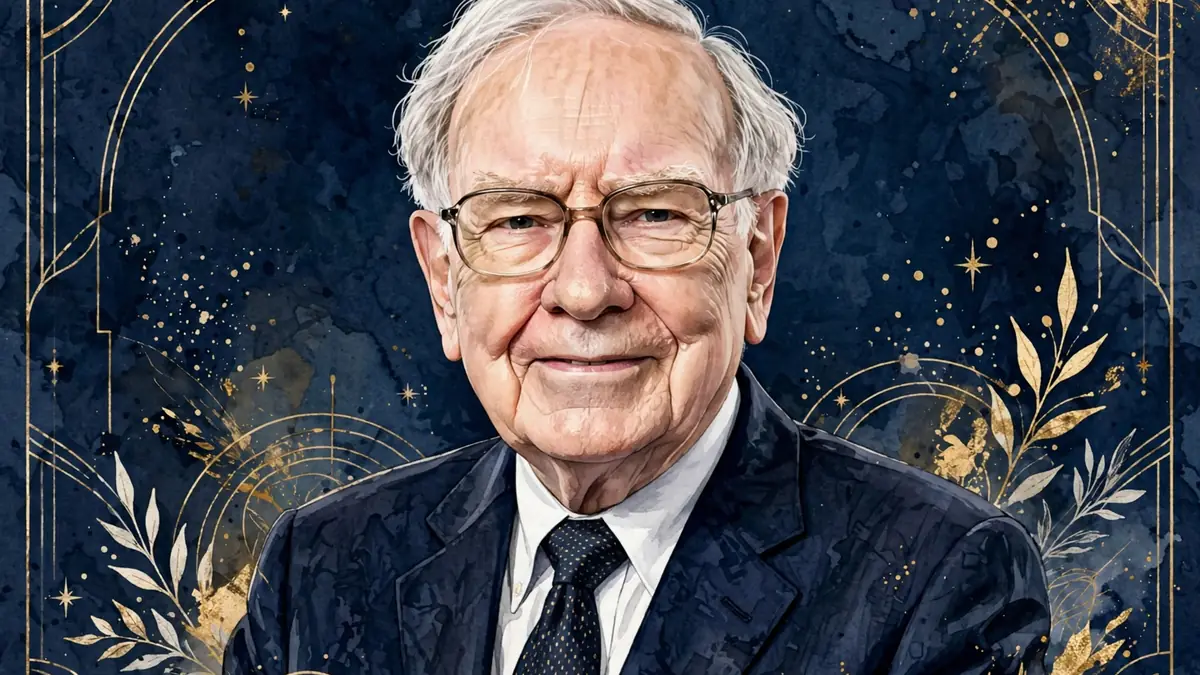
Warren Buffett is 96 years old in 2026. He was born on August 30, 1930, in Omaha, Nebraska, which means he turned 96 on August 30, 2026 — and he did it in a year when his working life changed more than it had in six decades. On January 1, 2026, Greg Abel took over as chief executive of Berkshire Hathaway, and on September 18, 2026, Buffett handed the chairman’s seat to his son Howard, becoming chairman emeritus. Forbes put his fortune at $148.9 billion in January 2026, making him the ninth-richest person in the world at 96.
That is the short answer. The longer story is more interesting: Buffett has now lived 20 years past the average American man’s life expectancy, he ran a trillion-dollar company into his mid-90s, and he is still giving away billions while his successors run the business he built from a failing textile mill. This page works through his age in full — the date, the milestones, the 2025–2026 handover, his health and daily life at 96, his money at 96, and how he compares with the other billionaires of his generation.
Last updated: November 12, 2026 · By Celebamerica Editorial Staff
Warren Buffett at a Glance: Quick Facts
| Full Name | Warren Edward Buffett |
|---|---|
| Date of Birth | August 30, 1930 |
| Age in 2026 | 96 years old (turned 96 on August 30, 2026) |
| Birthplace | Omaha, Nebraska, United States |
| Estimated Net Worth | $145 billion – $155 billion (Forbes: $148.9 billion, January 2026) |
| Current Role | Chairman emeritus and board director, Berkshire Hathaway (since September 18, 2026) |
| Former Roles | Chairman (1970–2026) and CEO (1965–2025) of Berkshire Hathaway |
| Successors | Greg Abel (CEO, from January 1, 2026); Howard Buffett (chairman, from September 18, 2026) |
| Primary Income Sources | Berkshire Hathaway stock, dividends, insurance and operating businesses |
| Known For | Value investing, Berkshire Hathaway, the annual Omaha shareholders meeting, the Giving Pledge |
| Spouse | Astrid Menks (married 2006); first wife Susan Thompson Buffett (1952–2004) |
| Children | Susan, Howard and Peter Buffett |
| Residence | Omaha, Nebraska — the same house he bought in 1958 for $31,500 |
Contents
- Warren Buffett at a Glance: Quick Facts
- How Old Is Warren Buffett in 2026?
- Warren Buffett’s Birthday and Birthplace
- Warren Buffett’s Life by Age: A Timeline
- Early Life: A Child Investor in Omaha
- Education: Learning from Benjamin Graham
- The Career That Built Berkshire Hathaway
- Berkshire Hathaway at 96: The Empire He Built
- Warren Buffett’s Net Worth at 96
- Stepping Down: The 2025–2026 Handover
- Health and Daily Life at 96
- Family and Personal Life
- Giving It Away: Philanthropy at 96
- Buffett at 96 vs. Other Billionaires
- Controversies and Criticism
- Frequently Asked Questions
- Bottom Line
- Sources and Reporting
How Old Is Warren Buffett in 2026?
Warren Buffett is 96 years old in 2026. The maths is simple and it is worth spelling out, because a surprising number of older profiles still list him as 95: he was born on August 30, 1930, so he was 95 until his birthday in the summer of 2026 and 96 from August 30, 2026 onward. Any article that calls him 95 in late 2026 is out of date. Wikipedia, Forbes and the September 2026 reporting on his chairman handover all agree on 96.
That makes Buffett one of the oldest people ever to run a company of Berkshire Hathaway’s size. He was 94 when he announced his retirement as CEO in May 2025, 95 when Greg Abel actually took the job on January 1, 2026, and 96 when he gave up the chairman’s seat on September 18, 2026. His long-time partner Charlie Munger, who died in November 2023, was 99 — and Buffett has often joked that Munger set the pace. For scale: the average American man lives to about 76, according to the Social Security Administration’s actuarial tables, so Buffett has already lived two decades longer than that average.
Buffett turns 97 on August 30, 2027, and he will turn 100 on August 30, 2030 — a birthday the investing world will certainly mark, given that he has spent more than 80 of those years in the markets.
Age check: Born August 30, 1930 → 96 years old in late 2026. If you are reading this before August 30, 2027, he is 96; after that date, 97. His 100th birthday falls on August 30, 2030.
Warren Buffett’s Birthday and Birthplace
Buffett was born Warren Edward Buffett on August 30, 1930, in Omaha, Nebraska, the second of three children and the only son of Howard Buffett, a stockbroker who later served in the U.S. Congress, and Leila Stahl Buffett. Omaha is not a detail in his story — it is the whole setting. He grew up there, built his fortune there, still lives in the same modest house he bought in 1958, and holds Berkshire’s annual meeting there every spring.
His father moved the family to Washington, D.C. in 1943, when Howard Buffett was elected to Congress, and young Warren spent his teenage years delivering newspapers in the capital before the family returned to Omaha. That Washington spell matters: it is where the paper route that taught him about compounding small sums into real money took place, and where he filed his first tax return at the age of 14, claiming a $7 deduction for his bicycle.
The birthday itself has become a small annual event in business news. Each August 30, outlets note his age and his latest Berkshire moves; in 2026 the birthday arrived between the two halves of his handover — eight months after Abel became CEO and less than three weeks before he gave up the chairmanship. His star sign is Virgo, for readers who keep track of such things, though Buffett himself has always put more faith in annual reports than in astrology.
Warren Buffett’s Life by Age: A Timeline
Buffett’s life reads like a compounding curve — small sums and small lessons early, then scale that never really stopped. Here are the ages that matter:
| Age | Year | Milestone |
|---|---|---|
| 6 | 1936 | First business: buys six-packs of Coca-Cola from his grandfather’s grocery store and resells the bottles door to door for a small profit. |
| 11 | 1942 | Buys his first stock — three shares of Cities Service preferred at $38 each, with his sister Doris. |
| 13 | 1943 | Starts delivering newspapers in Washington, D.C., after his father is elected to Congress. |
| 14 | 1944 | Files his first tax return, deducting $7 for his paper-route bicycle. |
| 16 | 1947 | Graduates high school in Washington, D.C., having saved around $5,000 from paper routes, pinball machines and other small ventures. |
| 19 | 1949 | Reads Benjamin Graham’s The Intelligent Investor — the book that shapes his whole approach. |
| 20 | 1950 | Graduates from the University of Nebraska; applies to Harvard Business School and is turned down. |
| 21 | 1951 | Earns a master’s in economics from Columbia Business School, studying under Graham; buys his first GEICO shares the same year. |
| 25 | 1956 | Founds the Buffett Partnership in Omaha with about $105,000 from seven backers. |
| 29 | 1959 | Meets Charlie Munger, who becomes his partner and closest adviser for the next 64 years. |
| 34 | 1965 | Takes control of Berkshire Hathaway, a struggling New England textile mill. |
| 39 | 1969 | Winds up the partnership, saying he cannot find bargains worth buying. |
| 41 | 1972 | Buys See’s Candies for $25 million — the deal Buffett later called his first great business lesson in pricing power. |
| 58 | 1988 | Starts building the Coca-Cola stake that becomes one of Berkshire’s defining holdings. |
| 61 | 1991 | Steps in as interim chairman of Salomon Brothers during its Treasury bond scandal. |
| 76 | 2006 | Pledges the bulk of his fortune to charity and begins annual gifts to the Gates Foundation and family foundations. |
| 80 | 2010 | Signs the Giving Pledge with Bill Gates; Berkshire buys the BNSF railroad in its biggest deal to date. |
| 86 | 2016 | Berkshire starts buying Apple stock — a stake that later peaks near $174 billion. |
| 93 | 2023 | Charlie Munger dies at 99; Buffett writes that Berkshire could not have been built without him. |
| 94 | 2025 | Announces at the May annual meeting that he will step down as CEO at year-end. |
| 95 | 2026 | Greg Abel becomes CEO on January 1, 2026. |
| 96 | 2026 | Steps down as chairman on September 18, 2026; son Howard becomes chairman and Buffett becomes chairman emeritus. |
Two things stand out from that table. First, the investing started absurdly early — an 11-year-old buying stock in 1942 is not a cute story, it is the start of an 84-year run in the markets. Second, the biggest deals came late: the railroad purchase at 80, the Apple stake at 86. Buffett’s own line about compounding — that it works like a snowball rolling downhill — is the story of his life in one image.
Early Life: A Child Investor in Omaha
Warren Buffett grew up in a house where the stock market was dinner-table conversation. His father, Howard Buffett, ran a small Omaha brokerage, Buffett-Falk & Co., and later served four terms in Congress. His mother, Leila, kept the household running while her son, by all accounts, spent his free hours reading stock tables and counting money.
The famous early ventures are all documented in biographies and Buffett’s own retellings: selling chewing gum and Coca-Cola door to door at six, collecting bottle caps, buying a pinball machine with a friend at 15 and placing it in a barber shop, then using the proceeds to buy more machines. By 16 he had saved around $5,000 — a serious sum in 1947 — and he used some of it to buy a 40-acre farm in Nebraska with his father, which he then rented out.
His first stock purchase, at 11, is the story he tells most often, and not because it went well. He bought three shares of Cities Service preferred at $38 each, watched the price fall to $27, and sold at $40 for a small profit — only to see it climb toward $200. The lesson he took from it, repeated in shareholder letters for decades, was patience: the money was made by holding, not by trading in and out. It is a lesson he has repeated so often that it now reads like his personal motto.
School was never his strong suit in the conventional sense. He has said he was bored by much of it, and his grades at the Wharton School of the University of Pennsylvania, where he enrolled at 17, were unremarkable. What he was good at was numbers, odds and people — he ran a paper route with hundreds of customers, kept careful records, and learned early that a reliable small income, reinvested, beats a windfall spent.
Education: Learning from Benjamin Graham
Buffett’s formal education has a twist that business-school applicants still quote: Harvard Business School turned him down. He had applied after two years at Wharton and was rejected, a decision he later treated as a lucky break. Instead he went to the University of Nebraska, graduating in 1950, and then to Columbia Business School — because that was where Benjamin Graham taught.
Graham, co-author of Security Analysis and author of The Intelligent Investor, is the single biggest intellectual influence on Buffett’s career. Buffett read The Intelligent Investor at 19 and has called it “by far the best book on investing ever written.” At Columbia he studied under Graham and David Dodd, earning his master’s in economics in 1951, and then talked his way into a job at Graham’s investment firm, Graham-Newman Corp., where he worked from 1954 until Graham retired in 1956. His starting salary there was $12,000 a year.
Graham’s core idea — buy a dollar’s worth of assets for fifty cents, insist on a margin of safety, and treat a share as a piece of a business rather than a lottery ticket — stayed with Buffett for life. Charlie Munger later widened the lens, pushing Buffett from buying cheap, mediocre companies toward buying great companies at fair prices. The Graham years gave him the discipline; Munger gave him the ambition. Together they shaped the Berkshire method.
Buffett has never collected honorary degrees or academic titles beyond that Columbia master’s, and he has never pretended to. His education, in his own telling, was the market itself: 84 years of buying, holding, selling, and — most of all — reading annual reports. He still reads for five or six hours a day, a habit he has kept into his 90s.
The Career That Built Berkshire Hathaway
Buffett’s career divides into three clear acts. The first was the partnership years. In 1956, aged 25, he returned to Omaha and set up the Buffett Partnership with about $105,000 from seven backers, including family. He ran it from a spare room, charged no management fee beyond a share of profits above a threshold, and wrote plain-English letters to his partners explaining what he was doing. By 1962 the partnership controlled about $7.2 million, and by the time he wound it up in 1969 it had compounded at roughly 30 percent a year — far ahead of the market.
The second act was Berkshire itself. In 1962 he began buying shares in Berkshire Hathaway, a New England textile company, at around $7.50 a share. By 1965 he had control, and he spent the next decade unwinding the textile business and using its cash to buy insurance companies, starting with National Indemnity in 1967. Insurance float — the premiums collected before claims are paid — became the fuel for everything that followed: a pool of low-cost capital he could invest for years before it was needed. It is the single most important financial idea in his career, and it is why Berkshire’s insurance arm sits at the heart of the empire.
The third act was the conglomerate. Through the 1970s, 1980s and beyond, Berkshire bought whole businesses — See’s Candies, the Buffalo News, Nebraska Furniture Mart, Dairy Queen, NetJets — and built large stock positions in Coca-Cola, American Express, Gillette and, later, Apple and Bank of America. The textile mill that started it all closed in 1985. By the 2020s, Berkshire was a $1 trillion company spanning insurance, railroads, energy, manufacturing and retail, and Buffett’s annual letter to shareholders had become the most-read document in American business.
Through all of it, Buffett kept the same habits: a $100,000 salary he has drawn for decades, an office in Omaha with no computer on his desk, and a calendar built around reading and the annual meeting. The career is the age story in reverse — the older he got, the bigger the numbers became, and the less his daily life changed.
Berkshire Hathaway at 96: The Empire He Built
By the time Buffett turned 96, Berkshire Hathaway was a company almost unrecognisable from the textile mill he took over at 34. Its market value stood at roughly $1.09 trillion, according to Stock Analysis figures cited in September 2026 reporting, and it owned outright a collection of businesses that reads like a cross-section of the American economy: GEICO and National Indemnity in insurance, BNSF Railway, Berkshire Hathaway Energy, Precision Castparts in aerospace parts, See’s Candies, Dairy Queen, Nebraska Furniture Mart, NetJets and dozens more.
The stock portfolio he assembled is just as striking. As of December 31, 2025, Berkshire’s four biggest holdings — Apple, American Express, Coca-Cola and Moody’s — had cost a combined $9.089 billion and were worth $158.617 billion, according to figures reported by the Motley Fool in September 2026. That gap between cost and value is the cleanest single measure of Buffett’s investing record: buy well, hold for decades, and let the businesses do the work.
Apple deserves its own paragraph because it shows how Buffett kept adapting into his 80s and 90s. Berkshire began buying Apple in 2016, when Buffett was 86, and the stake grew to nearly $174 billion — the largest single holding in Berkshire’s history. He later trimmed it sharply during 2024, selling down a large part of the position as the price rose. The decision drew debate, but it fits the pattern of his whole career: he buys when the price is right and sells when it no longer is, whatever the headlines say.
The railroad deal is the other late-career landmark. In 2010, aged 80, Buffett spent about $26 billion in cash (roughly $34 billion including assumed debt) to buy the BNSF Railway outright — Berkshire’s biggest acquisition at the time. He called it an “all-in wager on the economic future of the United States,” and it has paid off steadily ever since. Precision Castparts followed in 2016 for about $32 billion. The pattern is plain: the older Buffett got, the larger the cheques became, because the pile of cash to deploy kept growing. Berkshire’s cash hoard passed $340 billion in early 2025, a record that Buffett himself found hard to spend — good businesses at fair prices had become scarce, and he refused to overpay.
One more number captures the scale: a single Berkshire Hathaway Class A share, which Buffett was buying for about $19 in 1965, traded above $700,000 in 2024. He has never split the A shares, a deliberate choice so that shareholders think like owners rather than traders. It is a small, stubborn detail — and very much in character.
Warren Buffett’s Net Worth at 96
Buffett’s fortune at 96 is best stated as a range, because the trackers move with Berkshire’s share price. Forbes estimated his net worth at $148.9 billion in January 2026, ranking him the ninth-richest person in the world. Bloomberg’s October 2026 figures put him near $150 billion, and real-time estimates cited by The Profile in late 2026 ran as high as about $155 billion. Our anchor is the Forbes January 2026 figure of $148.9 billion, inside a working range of $145 billion to $155 billion.
Almost all of it sits in Berkshire Hathaway stock. Buffett owns roughly a sixth of the company he built, and his fortune rises and falls with its share price — which is why the range matters more than any single number. He takes a $100,000 salary, has drawn it for decades, and has no stock options, no bonuses and no golden parachute. The money is the shares, and the shares are the company.
The figure would be far larger if he had not spent the last two decades giving it away. Since 2006 he has donated tens of billions of dollars in Berkshire stock — annual gifts to the Gates Foundation and to foundations run by his children — and he has said the rest will follow. His 2024 annual gift alone was worth $5.3 billion, the largest of his life to that point. Without that giving, his net worth would comfortably exceed $200 billion. That is a deliberate choice, not an accident, and it is why his net-worth ranking has drifted down the Forbes list even as Berkshire kept growing: he is, quite literally, giving the fortune away faster than the market can rebuild it.
| Source | Date | Estimate |
|---|---|---|
| Forbes | January 2026 | $148.9 billion (9th-richest in the world) |
| Bloomberg | October 2026 | About $150 billion |
| Real-time trackers | October–November 2026 | About $155 billion |
| Our working range | November 2026 | $145 billion – $155 billion, anchored on Forbes $148.9B |
For readers comparing him with younger tech founders: Buffett’s fortune was built over 60 years of compounding, not a single IPO. That is the point of the age story. He started at 11, and the last 20 years added more dollars than the first 60 combined — the snowball effect, in real numbers.
Stepping Down: The 2025–2026 Handover
The defining event of Buffett’s 95th and 96th years was the handover he had planned for decades. At Berkshire’s annual meeting on May 3, 2025, in Omaha, Buffett announced that he would step down as chief executive at the end of the year and that the board had unanimously appointed Greg Abel, then vice chairman for non-insurance operations, as president and CEO effective January 1, 2026. The crowd of tens of thousands at the CHI Health Center gave him a long standing ovation. Abel, 64, had been named as the eventual successor in 2021, so the announcement surprised nobody — but the finality of it did.
Abel took over on January 1, 2026, as scheduled. Buffett stayed on as chairman, and the board rewired its bylaws in late 2025 to formalise the split between the chairman and CEO roles. Then, on September 18, 2026, Berkshire issued a press release: Buffett was stepping down as chairman effective immediately, becoming chairman emeritus and staying on the board, while his son Howard Buffett — a Berkshire director since 1993 — became chairman. In a letter to shareholders that week, Buffett wrote: “Father Time always wins.” He was 96.
The split is deliberate. Abel, who ran Berkshire Hathaway Energy and the non-insurance businesses, handles day-to-day management and capital allocation. Howard, a farmer and philanthropist who has served on the board for 33 years, guards the culture and values — Buffett’s own words in the announcement were that Howard would guard the company’s culture, “both worth more than anything on our balance sheet.” Buffett himself remains a director and a major shareholder, and he has said he will keep coming to the office and advising when asked.
Early signs under Abel have been steady rather than dramatic. Berkshire reported third-quarter 2026 results on November 7, 2026 — Abel’s third quarter as CEO — with operating earnings down 5.8 percent year on year, but buybacks accelerated to $9.6 billion, the busiest quarter for repurchases in years. Berkshire’s stock has outpaced the S&P 500 by more than 18 percentage points since the end of September 2026. The message from Omaha is continuity: the same businesses, the same discipline, a new name on the door.
The handover in one line: CEO to Greg Abel on January 1, 2026; chairman to Howard Buffett on September 18, 2026; Warren Buffett, 96, stays on the board as chairman emeritus and Berkshire’s largest individual shareholder.
Health and Daily Life at 96
For a 96-year-old, Buffett’s public health record is strikingly quiet. As of late 2026 there have been no reports of serious illness, and the low-key health coverage that does exist notes normal age-related slowing at public appearances rather than any acute condition. He appeared in good form at the May 2025 annual meeting, spoke for hours, took questions from shareholders, and was back on stage for the handover announcements in 2026. His own explanation for his longevity is typically blunt: good genes, a job he loves, and a diet he describes with pride rather than apology.
That diet is famous. Buffett has said he eats “like a six-year-old,” and the details are well documented: Cherry Coke (he has said he drinks several cans a day), ice cream, hamburgers and a McDonald’s breakfast chosen by the price of the market that morning — a cheaper meal when stocks are down. He owns Dairy Queen and See’s Candies, and he is, by his own account, their most loyal customer. Doctors would not prescribe it; Buffett, at 96, is the living counter-example his fans always cite.
His daily routine has barely changed in decades. He reads for hours — newspapers, annual reports, trade magazines — and has said that reading is the single habit that matters most in investing. He works from a plain office in Omaha, drives himself, and lives in the same five-bedroom house he bought in 1958 for $31,500. The house is worth far more now, but he has never seen the point of moving. “I am happy there,” he has said of Omaha, in various forms, for most of his life.
One physical detail readers often ask about is his height, which we have profiled separately in our look at Warren Buffett’s height and how he measures up against other business leaders. The broader point stands: at 96, Buffett’s age is visible in the usual ways — slower steps, a softer voice — but his judgement, by every account from inside Berkshire, has stayed sharp.
Family and Personal Life
Buffett married Susan Thompson in 1952. They had three children — Susan, Howard and Peter — and remained married until Susan’s death in 2004, though they had lived apart for many years while staying close. Susan Buffett was a singer and a philanthropist in her own right, and her death at 72 was the hardest personal blow of his life. In 2006 he married Astrid Menks, his long-time companion, in a quiet Omaha ceremony.
His children have all carved out their own paths. Howard Buffett, born in 1954, is a farmer, photographer and philanthropist who has served on Berkshire’s board since 1993 and took the chairman’s seat from his father in September 2026. Susan Buffett, born in 1953, runs the Sherwood Foundation in Omaha. Peter Buffett, born in 1958, is a musician and composer who has written music for film and television. None of them works inside Berkshire’s operating businesses — a deliberate choice by their father, who has said he does not believe in dynastic succession and that his children should earn their own way. For the full story of his life, from Omaha paperboy to Berkshire chairman, our sister site’s Warren Buffett biography covers the journey in detail.
Buffett’s friendships are part of his personal story too. His 64-year partnership with Charlie Munger, who died at 99 in November 2023, was the defining professional relationship of his life; Buffett’s tribute in the 2023 annual letter called Munger the architect of modern Berkshire. His friendship with Bill Gates — bridge partner, fellow philanthropist and co-founder of the Giving Pledge — is the other great bond, and it is why the two men’s charitable work is so closely linked. Gates, whose own life is covered in our Bill Gates biography, has called Buffett the most important influence on his philanthropy.
Giving It Away: Philanthropy at 96
If the age story has a second half, it is the giving. In 2006, aged 76, Buffett pledged to give away the bulk of his Berkshire fortune, beginning annual gifts of stock to the Gates Foundation and to four family foundations. In 2010 he and Bill and Melinda Gates launched the Giving Pledge, asking the world’s richest people to commit at least half their wealth to charity. More than 240 billionaires have since signed on, including Mark Zuckerberg — whose own story is told in our Mark Zuckerberg biography.
The scale is hard to grasp. Buffett’s annual gifts have run into the billions every year since 2006, and his June 2024 donation — worth about $5.3 billion — was the largest single annual gift of his life. All told, he has given away tens of billions of dollars in Berkshire shares, and his will directs that the remainder go to a charitable trust run by his children, to be spent within a decade of his death. The plan is explicit: the fortune he spent 70 years building is meant to be spent, not inherited.
Where does it go? The biggest share has gone to the Gates Foundation, funding global health, vaccines and poverty programmes. The family foundations — the Susan Thompson Buffett Foundation, the Howard G. Buffett Foundation, the Sherwood Foundation and the NoVo Foundation — work on education, food security, women’s health and conflict zones. Howard Buffett’s foundation, in particular, has become a major funder of food-security work in Africa and Ukraine. Buffett himself takes no role in choosing the grants. “I know how to make money,” he has said in various forms over the years. “The people I give it to know how to spend it.”
At 96, the giving has a sharper edge than it did at 76. Buffett has written that the annual gifts will continue while he is alive and that the trust will move fast after he is gone — no perpetual foundation, no family office managing the money for generations. It is, in its own way, the last investment decision of his career: give it away while it can still do the most good.
Buffett at 96 vs. Other Billionaires
Buffett’s age sets him apart from every other person near the top of the rich lists. The founders who dominate today’s rankings are a generation younger, and the gap shows up in the numbers:
| Person | Born | Age in 2026 | Source of Fortune |
|---|---|---|---|
| Warren Buffett | August 30, 1930 | 96 | Berkshire Hathaway |
| Bill Gates | October 28, 1955 | 71 | Microsoft |
| Jeff Bezos | January 12, 1964 | 62 | Amazon |
| Elon Musk | June 28, 1971 | 55 | Tesla, SpaceX |
| Mark Zuckerberg | May 14, 1984 | 42 | Meta |
The comparison is not really about money — Musk and Bezos have both held the top spot in recent years, and Buffett has slipped down the rankings as he gives his fortune away. It is about time. Musk was 55 in 2026, and our profile of Elon Musk’s age shows a founder still in the middle of his building years. Bezos, 62, is profiled in our Jeff Bezos net worth piece as a founder who stepped back from Amazon’s top job at 57. Buffett, at 96, is 41 years older than Musk and 25 years older than Gates — and he ran his company longer than any of them has been alive in business.
He is also an outlier among billionaires in how he lives. No yacht, no private jet fleet (he owns NetJets, but flies commercial when it suits him), no string of mansions. The house in Omaha, the Cherry Coke, the $100,000 salary — the habits of a man who made his money by never spending it. That contrast with the tech generation is part of why the age question draws so much search interest: people are not just asking how old he is, they are asking how someone that old stayed that sharp, that rich and that calm about giving it all away.
Controversies and Criticism
A 96-year-old public figure with a 60-year record cannot avoid controversy, and Buffett has had his share — though his list is short by the standards of billionaires.
The earliest big test came in 1991, when he stepped in as interim chairman of Salomon Brothers after a Treasury bond trading scandal. He testified before Congress and told employees: “Lose money for the firm, and I will be understanding. Lose a shred of reputation for the firm, and I will be ruthless.” The firm survived; the line became famous.
In 2011, a senior Berkshire executive, David Sokol, resigned after it emerged he had bought shares in Lubrizol shortly before recommending Berkshire acquire the company. Buffett said he had been unaware of Sokol’s trading and accepted the resignation, but the episode drew criticism that he had been slow to act. The same year, Buffett’s New York Times op-ed “Stop Coddling the Super-Rich” — arguing that the wealthy should pay higher taxes — made him a hero to some and a target to others, including critics who noted that his own tax rate was lower than his secretary’s, a fact he had volunteered himself.
Investment mistakes have drawn their share of scrutiny too. Berkshire took a roughly $3 billion writedown on Kraft Heinz in 2019, an investment Buffett has called a mistake, and his airline holdings — sold at a loss during the pandemic in 2020 — are another entry on the list. He has never hidden them: the annual letters catalogue the errors alongside the wins, which is part of why investors trust the letters as much as they do.
None of these episodes has dented his standing in a lasting way, and none of them touches his age story directly. But they round out the picture: a 96-year-old who has been wrong in public, admitted it in writing, and kept going.
Frequently Asked Questions
How old is Warren Buffett in 2026?
Warren Buffett is 96 years old in 2026. He was born on August 30, 1930, in Omaha, Nebraska, and turned 96 on August 30, 2026. He will turn 97 on August 30, 2027, and 100 on August 30, 2030.
When was Warren Buffett born?
Warren Buffett was born on August 30, 1930, in Omaha, Nebraska, in the United States. He is the second of three children and the only son of Congressman Howard Buffett and Leila Stahl Buffett. His star sign is Virgo.
Is Warren Buffett still alive?
Yes. As of November 2026, Warren Buffett is alive and active at 96. He stepped down as Berkshire Hathaway’s CEO on January 1, 2026, and as chairman on September 18, 2026, but he remains on the board as chairman emeritus and is Berkshire’s largest individual shareholder. There have been no reports of serious illness.
Is Warren Buffett still the CEO of Berkshire Hathaway?
No. Greg Abel became president and CEO of Berkshire Hathaway on January 1, 2026, after Buffett announced the handover at the May 2025 annual meeting. Buffett then stepped down as chairman on September 18, 2026, with his son Howard Buffett becoming chairman. Warren Buffett is now chairman emeritus and remains a board director.
How old was Warren Buffett when he started investing?
Warren Buffett was 11 years old when he bought his first stock in 1942 — three shares of Cities Service preferred at $38 each, bought with his sister Doris. He had already been selling chewing gum and Coca-Cola door to door since the age of six, and by 16 he had saved around $5,000 from paper routes and small ventures.
What is Warren Buffett’s net worth at 96?
Forbes estimated Warren Buffett’s net worth at $148.9 billion in January 2026, ranking him the ninth-richest person in the world. Bloomberg’s October 2026 figures put him near $150 billion, and real-time trackers ran as high as about $155 billion. Our working range is $145 billion to $155 billion, anchored on the Forbes figure. Almost all of it is held in Berkshire Hathaway stock.
Who took over from Warren Buffett?
Two people split Buffett’s old roles. Greg Abel, 64, Berkshire’s former vice chairman for non-insurance operations, became president and CEO on January 1, 2026, and runs the company day to day. Howard Buffett, Warren’s son and a Berkshire director since 1993, became chairman on September 18, 2026. Warren Buffett stays on the board as chairman emeritus.
How old will Warren Buffett be in 2030?
Warren Buffett will turn 100 years old on August 30, 2030. He will be 97 in 2027, 98 in 2028, 99 in 2029 and 100 in 2030 — the same age his late partner Charlie Munger nearly reached before his death at 99 in November 2023.
Bottom Line
Warren Buffett is 96 years old in 2026 — born August 30, 1930, in Omaha, Nebraska — and his 96th year was the year he finally let go of the company he spent 60 years building. Greg Abel runs Berkshire Hathaway now, Howard Buffett chairs its board, and the Oracle of Omaha watches from the chairman emeritus seat with a fortune Forbes put at $148.9 billion in January 2026 and a giving plan that will send most of it to charity. The age is the story, but it is not the whole story: the man who bought his first stock at 11, took over a failing textile mill at 34 and bought a railroad at 80 is still, at 96, the clearest proof in business that time in the market beats timing the market. You can browse more profiles like this one in our Celebrity section.
Sources and Reporting
Figures in this article are estimates based on public reporting, not private records. Our headline age (96 in 2026) comes from Buffett’s birth date of August 30, 1930, confirmed by Wikipedia and by September 2026 reporting from TheStreet and the Motley Fool, which both describe him as 96. The net-worth range of $145 billion to $155 billion is anchored on Forbes’ January 2026 estimate of $148.9 billion, with Bloomberg’s October 2026 figure near $150 billion and real-time estimates near $155 billion. The handover dates — Greg Abel as CEO from January 1, 2026, and Howard Buffett as chairman from September 18, 2026 — come from Berkshire Hathaway’s own announcements and September–November 2026 reporting by Reuters, CNBC, the Motley Fool and TheStreet. Berkshire’s market value near $1.09 trillion and the top-four holdings figures are drawn from the same September 2026 reporting. Career details, including the 1956 partnership, the 1965 Berkshire takeover, the 1972 See’s Candies purchase and the 2010 BNSF deal, are documented in Buffett’s shareholder letters and in biographies by Roger Lowenstein and Alice Schroeder.
How we estimated: we use named sources and publish a range wherever they disagree. Forbes’ dated estimate anchors the net-worth figure; Bloomberg and real-time trackers set the top of the range. Private wealth is never visible in full, so any net-worth figure is an estimate and will move with Berkshire Hathaway’s share price. Where a fact could not be verified against a named source, it was left out.
Sources consulted: Forbes, Bloomberg, Wikipedia, The Motley Fool, TheStreet, Reuters, CNBC, Berkshire Hathaway, The Profile.