By Celebamerica Editorial Staff | Last updated: November 6, 2026
Harry Styles has an estimated net worth of $200 million in 2026, according to Celebrity Net Worth, whose profile was last updated on August 28, 2026. That is the anchor figure for this article — the best-known published estimate, and the one most outlets still quote. It is not the only number in circulation, and it is not an audited personal balance sheet. The Sunday Times Rich List 2026 puts him higher, at £235 million (about $317 million) in reporting from October 2026, while a modeled October 2026 estimate from Net Worth Radar reaches $325 million. The honest published range for Harry Styles in 2026 is therefore $200 million to $325 million, and the rest of this article explains why the gap is so wide, what sits behind each figure, and which parts of his fortune are backed by hard public evidence.
The hard evidence is unusually strong for a pop star. Billboard Boxscore reports that his Love On Tour grossed $617.3 million from more than five million tickets across 169 shows between 2021 and 2023. His touring company, Erskine Touring, filed UK accounts showing £102.5 million in turnover and £67.8 million in pre-tax profit for the year ended March 2023. In 2026 he returned with a fourth solo album, Kiss All the Time. Disco, Occasionally, released March 6, 2026, which debuted at No. 1 on the Billboard 200, and a Together, Together tour built around long residencies, including a 30-night run at Madison Square Garden in New York. None of that turns a tour gross into take-home pay — venues, promoters, production, crew, management, commissions and tax all come out first — but it does explain why every serious estimate of his wealth now starts in the hundreds of millions.
| Full Name | Harry Edward Styles |
|---|---|
| Date of Birth | February 1, 1994 |
| Birthplace | Redditch, Worcestershire, England |
| Age in 2026 | 32 |
| Estimated Net Worth (2026) | $200 million (Celebrity Net Worth, updated August 28, 2026); published range $200 million–$325 million |
| Primary Income Sources | Solo touring, recorded music and streaming, One Direction catalog royalties, acting, fashion and brand work |
| Key Ventures | Erskine Records (his own label), Pleasing (beauty and lifestyle brand, launched 2021), Gucci campaigns |
| Biggest Tour | Love On Tour (2021–2023): $617.3 million gross, 169 shows, per Billboard Boxscore |
| 2026 Tour | Together, Together — residencies in seven cities, including 30 nights at Madison Square Garden |
| Awards | Three Grammy Awards, including Album of the Year for Harry’s House (2023); six Brit Awards |
Contents
- Early Life and Background
- One Direction: The Boy Band Years
- The Solo Breakthrough
- Age and Birthday in 2026
- The Money, Broken Down: Where the Fortune Comes From
- The Touring Machine
- Albums, Streaming and Erskine Records
- Pleasing, Gucci and Fashion Money
- Acting Roles and Film Pay
- Real Estate and Assets
- Net Worth Growth Timeline
- Is He the Richest One Direction Member?
- Personal Life
- Tax, Scrutiny and the Liam Payne Tribute
- Frequently Asked Questions
- Final Thoughts
- Sources and Reporting
Early Life and Background
Harry Edward Styles was born on February 1, 1994, in Redditch, Worcestershire, England, and grew up in Holmes Chapel, Cheshire, with his mother Anne Twist, his father Desmond Styles, and his older sister Gemma. His parents separated when he was young, and his mother later remarried. The family home in Holmes Chapel was ordinary by any measure: a village childhood, school at Holmes Chapel Comprehensive, and a part-time job in a bakery before fame arrived. That bakery job has become one of the best-known details of his early life, partly because it makes the scale of what followed so easy to picture — a teenager serving customers in Cheshire one year, and a global pop star the next.
Music was already part of his life before television found him. As a schoolboy he sang lead in a band called White Eskimo, which won a local battle of the bands competition. He was 16 when he auditioned for The X Factor in 2010 as a solo singer, performing Stevie Wonder’s “Isn’t She Lovely.” The judges sent him through, but at bootcamp the solo run ended — and the show’s producers put him together with four other boys who had also auditioned alone: Niall Horan, Zayn Malik, Liam Payne and Louis Tomlinson. The group was named One Direction. They finished third in the series. Within a year they were signed, and within two they were one of the biggest acts on the planet.
What matters for the money story is how young he was when the earning started, and how long it has now been running. Styles has been earning at arena scale since he was 17, and at stadium scale since his early twenties. Sixteen years of that, with almost no fallow period — the band years, then a solo career that started the moment the band paused — is the base on which the fortune sits. He never had a second career to fall back on, and he never needed one. He also never had a public financial blow-up, a bankruptcy, or a lavish-spending scandal of the kind that has cut other young stars’ fortunes in half. The money story here is accumulation, not rescue.
One Direction: The Boy Band Years
One Direction released five studio albums between 2011 and 2015 — Up All Night, Take Me Home, Midnight Memories, Four and Made in the A.M. — and sold more than 70 million records worldwide, according to reporting by TheStreet. The group became the defining boy band of the 2010s, with sold-out arena and stadium tours on every continent, a merchandising operation that ran at full tilt, and a fan base that bought everything the band put its name to. For Styles, those five years were the foundation: the first tens of millions, the global name recognition that made a solo career possible, and a share of a catalog that still earns today.
The touring numbers from the band years still hold up. According to Billboard Boxscore, One Direction grossed a combined $583.6 million from touring between 2012 and 2015, selling 7.1 million tickets. That money was split five ways, then reduced by the usual costs — production, promoters, management, tax — so no single member walked away with a fifth of the gross. Even so, each member was left with tens of millions of dollars from those years alone, before a single album royalty or merchandise check is counted. Some secondary estimates put the band’s total touring gross higher, at just over $663 million, but the Billboard Boxscore figure is the one trade publications cite, and it is the figure used here.
The band went on indefinite hiatus in early 2016, after Zayn Malik had already left in March 2015. The split was handled in the way that has since become the template for a clean boy-band break: no public falling-out, no lawsuit, no rival tell-all. Each member signed solo deals, and Styles signed with Columbia Records. Reports at the time put his solo deal in the region of $75 million, though that figure was widely repeated rather than confirmed by the label, and it should be read as a reported deal value — covering several albums, advances and marketing — rather than cash in hand. What is certain is that he did not start his solo career from zero. He started it as the most recognizable member of the biggest band of the decade, with a record deal, a label of his own in the works, and a fan base ready to follow him.
The catalog has kept paying ever since. One Direction passed 20 billion streams on Spotify by February 2024, according to reporting by Net Worth Radar. Spotify does not pay a fixed rate per stream, as its own royalty guide explains, so that stream count cannot be turned into a neat dollar figure — but streams on that scale keep adding to each member’s royalties years after the band stopped recording. For Styles, the band years are not a closed chapter in financial terms. They are a royalty stream that runs in the background while the solo career does the heavy lifting.
The Solo Breakthrough
Styles launched his solo career in 2017 with a self-titled debut album that went straight to No. 1 on the Billboard 200. The sound was a deliberate step away from One Direction: rock-leaning, 1970s-flavoured, built around live instruments and his own songwriting. The first single, “Sign of the Times,” set the tone, and the album’s success answered the only question that mattered — whether the audience would follow him without the band. They did. The debut tour, Harry Styles: Live on Tour, ran for 80 dates and grossed $63 million, according to Billboard reporting cited by StudyCountry — a strong start, and a fraction of what was coming.
Fine Line, released in December 2019, was the commercial leap. It featured “Watermelon Sugar,” which spent four weeks at No. 1 on the Billboard Hot 100 and won the Grammy Award for Best Pop Solo Performance in 2021, and “Adore You.” The album has sold more than 8 million copies worldwide, according to InfoCelebs, and it broke records for first-week sales by an English male artist. Both Fine Line and its successor appear on Rolling Stone’s 500 Greatest Albums lists. The album turned Styles from a successful former boy-band member into a serious album artist with a catalog that critics took seriously — and that matters financially, because critically respected albums sell for longer and stream more steadily than hits that fade in a season.
Harry’s House, released in May 2022, took him to another level again. It won Album of the Year at the 65th Grammy Awards in 2023, one of his three Grammy wins, and its lead single “As It Was” spent 15 weeks at No. 1 on the Billboard Hot 100, one of the longest-running No. 1 singles in chart history. The album made him the only former One Direction member to win a Grammy, and the only one with two Billboard Hot 100 No. 1 singles. By the time Harry’s House had done its work, Styles was no longer competing with his old bandmates. He was competing with the biggest solo stars in the world, and winning.
Then came the pause. After Love On Tour ended in July 2023, Styles went quiet for more than two years — no album, no tour, few public appearances. In an industry that punishes absence, the quiet period was a gamble. It paid off. He returned in January 2026 with “Aperture,” the first single from his fourth solo album, and the comeback dominated music news for weeks. The fourth album, Kiss All the Time. Disco, Occasionally, was released on March 6, 2026, executive produced by Kid Harpoon, and debuted at No. 1 on the Billboard 200 with 430,000 equivalent album units in its first week — the biggest debut of 2026 at the time, and a 60.8% jump over Harry’s House, according to Toronto Times reporting. It included 186,000 vinyl copies, a record for a male artist since vinyl tracking began in 1991, and made him the first solo artist since Alicia Keys to debut at No. 1 with each of his first four albums. The pause had not cost him his audience. If anything, it had made the return bigger.
Age and Birthday in 2026
Harry Styles was born on February 1, 1994, which makes him 32 years old in 2026. He turned 32 in February of this year, a few weeks after releasing “Aperture” and a month before his fourth album arrived. The birthday matters to the money story in a way that goes beyond trivia: he is 32, at the peak of his touring power, with four No. 1 solo albums behind him and a catalog that spans a boy-band career and a solo career that is now nine years old. Most pop stars who reach this level of wealth do it later, or burn out earlier. Styles has done it by staying at the top for a decade and a half without a serious dip.
His age also puts the Sunday Times Rich List ranking in context. The list’s 40 Under 40 ranks the biggest fortunes held by people aged 40 or under, and Styles, at 32, sits 23rd on it in the 2026 reporting — one of the youngest names near the top, and one of the few whose fortune comes from music rather than inheritance, property development or tech. For readers who want the full picture of how old he is and how his age lines up with each stage of his career, our sister site has a dedicated look at Harry Styles’ age in 2026, from his X Factor audition at 16 to his 32nd birthday. That piece covers the birthday and the timeline in detail; this article stays with the money, and the two tell the same story from different sides.
The timeline is worth laying out plainly, because it shows how compressed his career has been. He was 16 at his X Factor audition in 2010, 17 when One Direction’s debut album came out, 21 when the band released its final album, 22 when the hiatus began, 23 when his solo debut topped the charts, 25 when Fine Line arrived, 28 when Harry’s House won Album of the Year, and 32 when his fourth album debuted at No. 1 with the biggest opening week of 2026. There was no slow build and no late breakthrough. He has been famous for more than half his life, and he has been rich for most of it. The question for the next decade is not whether he can keep earning — the 2026 tour and the 2027 stadium dates already announced suggest he can — but whether he wants to keep touring at this intensity, or shift toward the quieter, steadier income of catalog, business and property.
The Money, Broken Down: Where the Fortune Comes From
No single figure for Harry Styles’ net worth is audited, so the honest way to present it is as a range with the sources named and dated. Celebrity Net Worth puts him at $200 million, on a profile last updated August 28, 2026. The Sunday Times Rich List 2026 puts him at £235 million, about $317 million, ranking him 23rd on its 40 Under 40 list, as reported by The Standard and covered in October 2026 by CelebrityFees. A modeled estimate from Net Worth Radar, updated October 26, 2026, puts him at $325 million, inside a range of $288 million to $365 million. Older and lower estimates still circulate — Parade quoted $140 million in a piece that predates the current Celebrity Net Worth update, and some smaller sites still list $120 million — but those figures were made before the 2026 album and tour, and they do not reflect the year he has just had.
There is one wrinkle in the Sunday Times figure that deserves a straight answer, because readers who check it themselves will find two different numbers. Net Worth Radar’s October 2026 breakdown says the Sunday Times Rich List gave him £225 million (about $280 million) in May 2026, and notes the paper has tracked his rise from £58 million in 2019, to £100 million in 2022, to £175 million in 2024, to £225 million in its latest list. The £235 million figure comes from later 2026 reporting of the list, as covered by The Standard and TheStreet. The difference is timing and rounding in how the list was reported through the year, not a dispute about the order of magnitude: on either reading, the Sunday Times figure sits well above the Celebrity Net Worth estimate, at roughly $280 million to $317 million. This article uses the £235 million figure as the top of the published range in line with the October 2026 reporting, and flags the £225 million May figure wherever the May list is the source.
Why do the two main sources disagree by more than $100 million? Because they measure different things. The Sunday Times builds its figures from UK company accounts and identifiable assets in Britain — the filings of his touring and record companies, and property he can be tied to. Celebrity Net Worth estimates career earnings and what a star has kept after tax, fees and spending. Neither has counted the full 2026 tour takings yet, and neither can see his bank accounts. Net Worth Radar’s $325 million model starts from the Sunday Times figure and adds the money earned on the 2026 tour since the Rich List was compiled, plus new album, streaming and publishing income since May — which is why it lands highest. All three are estimates. None of them is a fact he has confirmed. He has never publicly stated his net worth, and he never comments on the figures.
The range, in one place: $200 million (Celebrity Net Worth, August 28, 2026) — £225 million, about $280 million (Sunday Times Rich List, May 2026) — £235 million, about $317 million (Sunday Times Rich List 2026, October 2026 reporting) — $325 million, range $288–365 million (Net Worth Radar modeled estimate, October 26, 2026). Our working range for this article: $200 million to $325 million, anchored at $200 million.
| Source | Figure | Date | Method |
|---|---|---|---|
| Celebrity Net Worth | $200 million | Updated August 28, 2026 | Career-earnings estimate |
| Sunday Times Rich List | £225 million (about $280 million) | May 2026 list | UK company accounts and identifiable assets |
| Sunday Times Rich List | £235 million (about $317 million) | October 2026 reporting | Same method; later reporting of the 2026 list; 23rd on 40 Under 40 |
| Net Worth Radar | $325 million (range $288–365 million) | October 26, 2026 | Modeled: Sunday Times base plus 2026 tour and album income |
| Parade (older) | $140 million | Before the 2026 update | Citing an older Celebrity Net Worth figure |
Underneath the headline range, the shape of the fortune is clearer than the exact total. Touring is the biggest driver, by a wide margin. Recorded music and streaming come next, boosted by a catalog that now spans four solo albums and five One Direction albums. Then come his companies — Erskine Records and the touring business behind it — his beauty brand Pleasing, fashion work led by Gucci, acting fees, and a property portfolio across London and New York that has grown steadily for more than a decade. The sections that follow take each of those in turn, with the numbers that are actually on the record.
The Touring Machine
Touring is where Harry Styles’ fortune was made, and the numbers are the most solid in this whole article because Billboard Boxscore publishes them. Love On Tour, which ran from September 2021 to July 2023, grossed $617.3 million and sold 5,023,682 tickets across 169 performances, according to Billboard Boxscore. At the time it closed, it was the fourth-highest-grossing tour in Boxscore’s 30-plus-year history, and the eighth-most-attended. It also passed One Direction’s entire career touring gross — $583.6 million across 2012 to 2015 — which is a useful measure of how far his solo drawing power had come. The tour’s 15-date run at Madison Square Garden alone grossed $63.1 million and sold 277,000 tickets, the highest-grossing headline engagement in Boxscore history at the time. Four shows at Wembley Stadium in London grossed $37.3 million from 335,394 tickets.
That $617.3 million is gross box-office revenue, and it is important to be plain about what it is not. It is not Styles’ salary, and it is not his take-home pay. Venues, promoters, production, crew, transport, management, agents and tax all take their share before the artist sees a penny, and on a tour of that scale the production alone runs into tens of millions. TheStreet reports that Styles was estimated to have pocketed $1 million to $2 million per show on Love On Tour — an estimate, not a filing, but a plausible one that would put his personal take from the tour in the region of $170 million to $340 million before tax, which is roughly consistent with the top end of the published net-worth range. Other secondary estimates put his personal share lower, at 15 to 20 percent of gross after costs, or roughly $90 million to $120 million. The honest answer is that the exact split is private, and the range of informed guesses is wide. What is not in doubt is that Love On Tour was the single biggest earning event of his life.
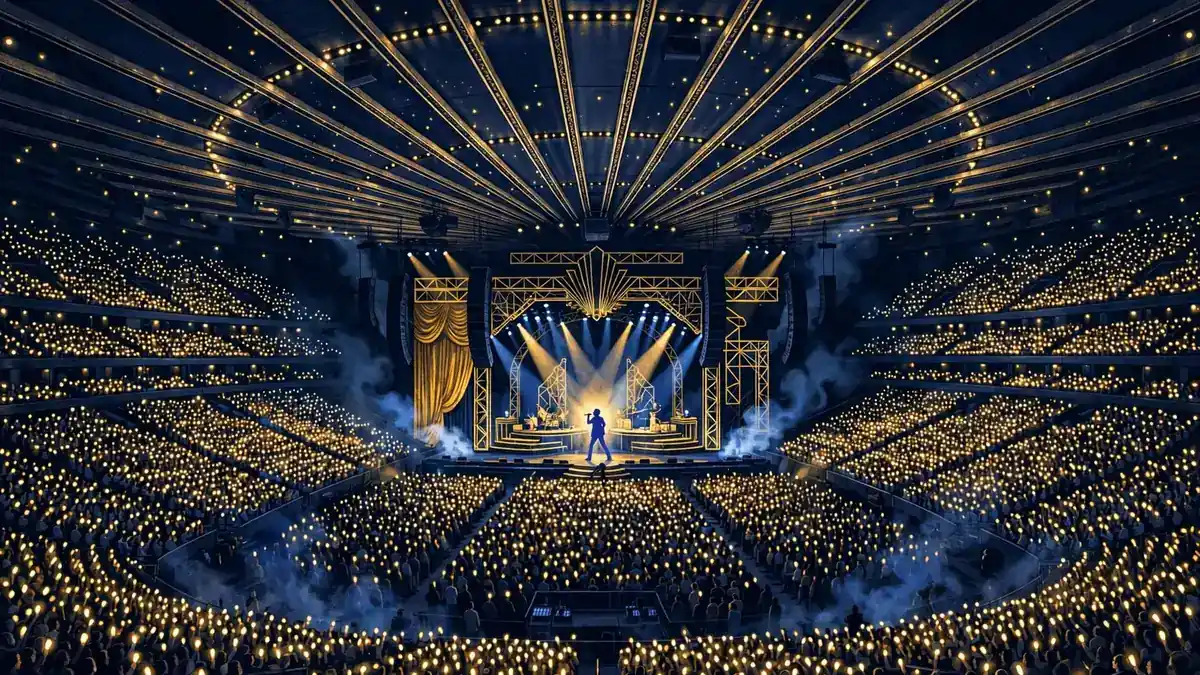
The 2026 tour, Together, Together, is built differently, and the difference matters for the money. Instead of playing 169 shows in 87 cities, as Love On Tour did, Styles is playing 50 shows in just seven cities in 2026 — Amsterdam, London, São Paulo, Mexico City, New York, Melbourne and Sydney — with long residencies in each. The New York run is the centrepiece: 30 shows at Madison Square Garden from August 26 to October 31, 2026, every Wednesday, Friday and Saturday, his only United States dates of the year, announced by MSG Entertainment in January 2026. By the end of that run he will have headlined 52 solo shows at the Garden, passing his own previous record of 15 consecutive nights there in 2022. London brings 12 nights at Wembley Stadium, a run that set a Guinness World Records title for the longest residency by a musician at Wembley.
Residencies are cheaper to run than a travelling tour — the stage stays put, the crew stays put, the trucks stay parked — and they let an artist charge more per night for a scarcer ticket. Pollstar estimated in January 2026 that combined grosses in the $200 million range were a logical estimate for the 30 MSG shows, while warning that its $400 average ticket price was a guess. A PR source quoted by the Mirror put Styles’ personal take from the whole Together, Together tour at £100 million, about $135 million — but that is an unattributed PR estimate, not a filing, and it should be treated with care. What can be said with confidence is that the 2026 tour is already the second-biggest earning run of his career, and that its final Boxscore numbers, when they are published after the MSG run closes on Halloween, are the most likely trigger for the next round of net-worth revisions. The 2027 extension — 25 new dates across 12 cities in North America and Europe, including two stadium shows in Toronto on May 7 and 8, 2027, and a return to Wembley in August 2027 — means the tour income will keep coming well into next year.
One more touring detail belongs here, because it shows how the business is structured. The money from his tours flows through his own companies, not through a promoter’s payroll. His touring company, Erskine Touring, reported £102.5 million in turnover and £67.8 million in pre-tax profit for the year ended March 2023, and £86.0 million in turnover the following year, with £51.826 million of profit attributed to its largest-entitled member for the year ended March 2024, according to reporting by Net Worth VIP and GuideNetWorth. Those are company figures, not a personal bank balance — turnover is revenue, profit is calculated before tax and before distributions, and a company’s profit is not the same as the money its owner takes home — but they are the closest thing to hard financial evidence that exists for any pop star, and they are the reason the Sunday Times, which reads these filings, puts him so much higher than Celebrity Net Worth does.
Albums, Streaming and Erskine Records
Styles has released four solo albums: Harry Styles (2017), Fine Line (2019), Harry’s House (2022) and Kiss All the Time. Disco, Occasionally (March 6, 2026). All four debuted at No. 1 on the Billboard 200. The first three were released through his own label, Erskine Records, which he co-founded and owns, alongside Columbia Records. Owning the label changes the money in a direct way: instead of taking an artist royalty from a label that owns the recordings, he holds a stake in the company that releases them, and the label’s profits flow back to him. The Erskine Records group reported £70.74 million of net assets at December 2024, with £10.51 million of turnover and £0.98 million of profit before tax for the year, according to reporting by Net Worth VIP. Again, those are company figures — net assets are not cash, and a label’s turnover is not its owner’s income — but a label with £70 million in net assets is a real asset, and it is one that most pop stars do not have.
Streaming is the steady earner underneath the album headlines. His solo catalog — “As It Was,” “Watermelon Sugar,” “Adore You,” “Sign of the Times,” “Golden,” “Late Night Talking” — streams in the billions, and the One Direction catalog adds to it. “As It Was” spent 15 weeks at No. 1 on the Billboard Hot 100, and “Watermelon Sugar” spent four weeks there. Secondary estimates put his annual music royalties and streaming income at $8 million to $12 million a year, but those are modeled guesses, and this article does not present them as fact. What can be said is that the catalog earns every day, whether he is on stage or not, and that the 2026 album has refreshed it: Kiss All the Time. Disco, Occasionally opened with 430,000 equivalent album units, including 186,000 vinyl copies, and its first single “Aperture” was released on January 22, 2026. Vinyl matters here more than it might seem — a vinyl sale is worth far more than a stream, and 186,000 vinyl copies in a first week is a record for a male artist since tracking began in 1991.
Songwriting is the quieter half of the music money. Styles writes or co-writes most of his material, and publishing royalties — the money paid when a song is played, streamed, covered or used — go to the songwriter as well as the performer. That is a second income stream from the same songs, and it runs for the life of the copyright. He has also written for other artists in the past, including songs recorded by Ariana Grande and others, though his own catalog is now so large that outside writing is a footnote rather than a driver. The point is structural: he owns more of his music business than most stars at his level, through his label, his songwriting and his catalog, and that ownership is what turns big grosses into retained wealth rather than one-off paydays.
Pleasing, Gucci and Fashion Money
In November 2021, Styles launched Pleasing, a beauty and lifestyle brand built around nail polish, skincare and clothing, with a deliberately gender-neutral pitch. It was his first business outside music, and it was launched in his own name, under his own company, rather than as a licensed endorsement where a brand pays a star to lend a face. That distinction matters: an endorsement pays a fee, and the fee ends. A brand he owns keeps its profits, and its value grows if it succeeds. Pleasing has since expanded from its first nail-polish drops into skincare, fragrance and apparel, with pop-up shops in London and New York and a steady online trade. No revenue figure for Pleasing has been published, and this article does not invent one. What can be said is that it is a real operating business with real products and real customers, not a vanity line, and that it sits inside the same company structure as his music — which is why the Sunday Times counts it where a simple earnings estimate would not.
His fashion work runs alongside Pleasing rather than through it. Styles has been the face of Gucci campaigns since 2018, fronting the house’s tailoring and fragrance lines, and his red-carpet looks — often designed with Gucci’s former creative director Alessandro Michele — became a signature of his solo era: feather boas, sheer blouses, pearl necklaces, wide-legged tailoring. The Gucci relationship is an endorsement deal, and its fee has never been disclosed. Fashion reporting has long treated it as one of the most valuable celebrity-fashion partnerships of its kind, but without a published figure this article will not put a number on it. The same applies to his other brand work: he has appeared in campaigns and worn brands that pay for the association, but the fees are private, and the honest thing to say is that fashion is a meaningful income line for him without being the main one.
What fashion does give him, beyond the fees, is a second public identity. The music press writes about the albums; the fashion press writes about the clothes, and the two audiences overlap but are not the same. That reach is part of why his tours sell out in minutes — Ticketmaster called the presale registration for the MSG residency, at 11.5 million registrations in January 2026, the highest volume ever recorded for an artist presale — and why his brand can sell nail polish to people who have never bought a Harry Styles album. The fashion money is best understood as a multiplier on the music money, not a separate fortune, and the brand he owns, Pleasing, is the part of it that could outlast the touring years.
Acting Roles and Film Pay
Styles has built a small but serious acting career alongside the music, and it adds a separate income line that most pop stars do not have. He made his film debut in Christopher Nolan’s Dunkirk in 2017, playing the soldier Alex in a film that grossed more than $500 million worldwide. He followed it with a Marvel cameo as Eros, brother of Thanos, in Eternals (2021), and leading roles in two 2022 films: Don’t Worry Darling, directed by Olivia Wilde, and My Policeman, in which he played a gay policeman in 1950s Brighton. None of the fees for these roles has been published, and this article does not guess at them. Film fees for a star of his level would typically run into the low millions per picture, but “typically” is not evidence, and the roles were taken for profile and craft as much as for pay — Dunkirk in particular was a prestige casting that announced him as a serious actor, not a singer doing a cameo.
The acting work matters to the net-worth picture in two ways. First, it diversifies his income: a film fee does not depend on ticket sales, streaming numbers or tour dates, and it arrives on a different schedule from the music money. Second, it keeps his name in front of audiences who do not follow pop music, which feeds back into the tours and the brand. He has been selective — four films in nine years, with long gaps between them — and that selectivity is itself a financial choice. A star who takes every role offered earns more in the short term and less in the long term, because the roles stop being events. Styles has treated acting the way he treated the two-year pause before his fourth album: as something to do well and rarely, rather than often and cheaply. Whether he returns to film after the 2026–2027 tour is an open question, and one this article will not answer with speculation.
Real Estate and Assets
Property is the most visible part of Harry Styles’ wealth, and the part with the clearest paper trail, because house purchases are public record in the UK. He bought his first home at 18, in 2012, paying around $4.8 million for a white stucco house in Hampstead Heath, North London — a 2,300-square-foot property with four bedrooms and three and a half bathrooms, set behind high walls and gates. He still owns it. In 2019 he spent $10.9 million on a Grade II-listed Georgian residence across the road, with five bedrooms and off-street parking. In 2020 he added a third property, an 18th-century villa next door, for $5.5 million. The three houses sit close together in Hampstead, and reporting by Capital FM and The Richest has long said he plans to combine two of them into a single 10-bedroom home with a cinema and games rooms, at a cost one source put at “not going to be shy of £30 million.”

That Hampstead project is still running, and the 2026 reporting around it is worth noting with care. In February 2026, reporting said the conversion had hit a snag — Japanese knotweed, described as toxic weeds, found in the garden of one of the houses, covering about 25 square metres. In November 2026, OK! Magazine reported that he had bought a fourth property on the same Hampstead street, with the project now described as a £30 million ($40 million) mansion scheduled for completion in late 2027. Both reports are single-source tabloid reporting, and this article treats the fourth purchase and the completion date as reported, not confirmed. What is solid is the first three purchases, their prices, and the fact that the Hampstead cluster is now worth well over $20 million on purchase price alone, before any rise in London values.
Across the Atlantic, he owns a penthouse in Tribeca, New York City, and he previously owned a midcentury-modern home in Beverly Hills, designed by architect Alejandro Ortiz, which he bought for around $4 million and sold in 2019 for £4.8 million, according to Capital FM. He also rented, with his One Direction bandmates, a five-floor unit in Princess Park Manor, a Victorian-era complex in North London, in the band’s early years. Some secondary reporting puts his total property portfolio at $30 million, and Architectural Digest has been cited for a figure of $62.5 million, but those totals mix purchase prices, current values and reported-but-unconfirmed purchases, and they cannot be reconciled into a single reliable number. This article gives the individual purchases that are on the record and does not present a portfolio total as fact. Cars are a smaller part of the picture — he has been photographed with a classic Audi and a Range Rover, among others — but no reliable inventory or value exists, and cars lose value rather than build wealth, so they are not counted here.
Net Worth Growth Timeline
The Sunday Times has tracked Styles’ fortune for years, and its figures give the clearest year-by-year picture available, because the paper uses the same method each year. In 2019 it put him at £58 million. By 2022 he was at £100 million. In 2024 he was at £175 million. In its May 2026 list he was at £225 million, and in later 2026 reporting of the same list, £235 million. That is a fourfold rise in seven years, driven first by the solo albums and Love On Tour, then by the company profits that followed the tour, and now by the 2026 album and residencies. Celebrity Net Worth’s history tells a similar story at a lower level: it quoted $140 million before the current update, and $200 million after its August 28, 2026 revision. The two sources disagree on the level, but they agree on the direction, and the direction has been up in every year for which either has published a figure.
| Year | Sunday Times figure | What drove it |
|---|---|---|
| 2019 | £58 million | One Direction catalog, solo debut, Fine Line release |
| 2022 | £100 million | Harry’s House, Love On Tour under way, Pleasing launch |
| 2024 | £175 million | Love On Tour complete ($617.3 million gross), Erskine Touring profits |
| May 2026 | £225 million | Fourth album, Together, Together tour announced |
| October 2026 | £235 million (later reporting) | MSG residency under way, album at No. 1 |
| October 2026 | $325 million modeled (Net Worth Radar) | Sunday Times base plus 2026 tour and album income |
The shape of that growth is the point of the table, not any single row. The jump from £58 million to £100 million took three years and two albums. The jump from £100 million to £175 million took two years and one tour. The jump from £175 million to £225 million took two years in which he barely worked in public — a reminder that the money from a tour of Love On Tour’s size keeps arriving through company accounts long after the last show. And the jump to a modeled $325 million in October 2026 is the market pricing in a tour that has not finished yet. If the MSG Boxscore numbers come in at the top of Pollstar’s range, the next Sunday Times list is likely to move again. If they come in lower, the modeled estimates will be trimmed. Either way, the growth has been driven by touring and by ownership — of his label, his brand and his property — rather than by a single windfall.
Is He the Richest One Direction Member?
Yes — by a wide margin, on every published estimate. Celebrity Net Worth puts Styles at $200 million, and the Sunday Times puts him higher still. The same sources put his former bandmates far behind: Parade, citing Celebrity Net Worth, puts Zayn Malik at $75 million, and the other members — Niall Horan, Louis Tomlinson and the late Liam Payne — are generally listed in the $70 million to $80 million range in secondary estimates. TheStreet’s 2026 table gives Styles a range of $200 million to $317 million and notes that he is the only former member with two Billboard Hot 100 No. 1 singles and the only one to win a Grammy — three of them. The gap is not close, and it has widened every year since the band split, because Styles’ solo career has operated at a different scale from the others: bigger tours, bigger albums, a label, a brand, and film roles.
That gap also explains why the “richest One Direction member” question is the most searched comparison attached to his name. It is a fair question, and the answer is not a matter of opinion. He was the most famous member of the band, he has had the biggest solo career, and he has earned the most. The other members have all had successful solo careers — Horan with hit singles and a coaching role on The Voice, Tomlinson with albums and a documentary, Malik with a No. 1 solo debut — but none of them has headlined a $617 million tour, won Album of the Year, or built a company structure like Erskine. The comparison is not a judgment on their talent. It is a statement about scale, and the scale is not close.
Against the wider pop world, his position is also strong. He is not a billionaire, and he is not close to one — the billionaire tier in music belongs to artists with decades of catalog, business empires or both, and Styles, at 32, is still building. But he is one of the richest British musicians of his generation, one of the youngest names on the Sunday Times 40 Under 40, and the highest-contributing celebrity on the Sunday Times Tax List, which is a different kind of ranking and one that says something about how much of his income passes through the UK tax system. The next section takes that up, along with the one loss that has marked his recent years.
Personal Life
Styles keeps his private life private, and he has done so since the One Direction years, when tabloid attention was at its most intense. He does not post about his relationships, he does not discuss them in interviews, and he has asked interviewers not to ask. What is on the public record is that he has had several high-profile relationships, including with Taylor Swift in 2012–2013 and with Olivia Wilde, who directed Don’t Worry Darling, from 2021 to 2022. He has never married, and he has no children. His current relationship status is not publicly confirmed, and this article does not speculate about it. He lives mainly in London, in the Hampstead homes described above, and spends long stretches in New York when he is working there.
His family remains close. His mother Anne and his sister Gemma both appear in his public life from time to time — Gemma is a writer and podcaster with her own following — and his father Desmond has spoken publicly about his son’s career. He has a wide circle of friends in music and fashion, including his long-time collaborator Kid Harpoon, who executive produced the fourth album, and the band members who have played with him since the solo debut. He is known among people who work with him for being punctual, polite and prepared — a reputation that matters in an industry where a difficult star can cost a tour money, and a reliable one can save it.
He is also known for his fans, who call themselves Harries and who have followed him from the X Factor days through four solo albums. The fan base is part of the business model: it buys the vinyl, registers for the presales — 11.5 million registrations for the MSG residency — and fills the arenas. Styles has always treated that relationship with care, from the “Treat People With Kindness” slogan that became a hallmark of Love On Tour to the way he speaks to the crowd on stage. It is not a financial line in the accounts, but it is the reason the financial lines are as large as they are.
Tax, Scrutiny and the Liam Payne Tribute
There is one public tax figure for Harry Styles, and it is a striking one. On the Sunday Times Tax List, published in February 2026 and compiled from the most recent company accounts filed up to January 10, 2026, Styles emerged as the highest-contributing celebrity, ranked 54th overall, with an estimated £24.7 million tax bill, according to BM Magazine. Most of that contribution comes from touring and merchandise income generated through his company, Erskine Records. He finished ahead of Ed Sheeran, who paid just under £20 million after receiving a £41 million dividend. The Tax List counts corporation tax, dividend tax, capital gains, income tax and other levies, and it is compiled from filings rather than from estimates — which makes the £24.7 million figure one of the hardest numbers in this article. It also puts the net-worth debate in perspective: a man who pays £24.7 million in tax in a single year is a man whose income, in that year, was very large indeed.
He has not faced the kind of legal trouble that has marked other stars’ careers. There are no lawsuits, criminal cases or financial scandals attached to his name in the public record, and this article does not invent any. The scrutiny he does face is the ordinary kind for a star at his level: every estimate of his wealth is picked apart, every property purchase is reported, and every relationship is photographed. He has handled that attention by saying very little, and by letting the work speak. The one exception to his silence, and the one moment in recent years when he spoke directly to his audience about something personal, came in October 2026, when he premiered a song he had written for his former One Direction bandmate Liam Payne during a sold-out show at Madison Square Garden. Payne died in October 2024. Styles reflected on his death in an interview with Apple Music’s Zane Lowe in March 2026. The tribute song was not released as a single, and it was not a commercial moment. It was a private grief shared in public, once, and it is recorded here because it is part of the year, not because it has a price attached to it.
Frequently Asked Questions
What is Harry Styles’ net worth in 2026?
Harry Styles has an estimated net worth of $200 million in 2026, according to Celebrity Net Worth, whose profile was last updated on August 28, 2026. The published range is $200 million to $325 million: the Sunday Times Rich List 2026 puts him at £235 million (about $317 million), and a modeled October 2026 estimate from Net Worth Radar reaches $325 million. He has never confirmed a figure himself, and none of these numbers is an audited personal balance sheet.
How much did Love On Tour gross?
Love On Tour grossed $617.3 million from 5,023,682 tickets across 169 shows between 2021 and 2023, according to Billboard Boxscore. At the time it closed, it was the fourth-highest-grossing tour in Boxscore history. That figure is gross box-office revenue, not Styles’ take-home pay: venues, promoters, production, crew, management and tax all come out first.
How does Harry Styles make his money?
Touring is the biggest driver, led by Love On Tour and the 2026 Together, Together residencies. Recorded music and streaming come next, through four No. 1 solo albums and the One Direction catalog, released through his own label, Erskine Records. He also earns from his beauty brand Pleasing, fashion work led by Gucci, acting roles, and a property portfolio in London and New York.
Is Harry Styles the richest One Direction member?
Yes, by a wide margin. Celebrity Net Worth puts Styles at $200 million, while his former bandmates are generally listed in the $70 million to $80 million range — Zayn Malik at $75 million, according to Parade. Styles is the only former member with two Billboard Hot 100 No. 1 singles and the only one to win a Grammy; he has won three.
How old is Harry Styles in 2026?
Harry Styles is 32 years old in 2026. He was born on February 1, 1994, in Redditch, Worcestershire, England, and turned 32 in February 2026, just before his fourth solo album was released on March 6, 2026.
How much will the Together, Together tour earn?
The final numbers have not been published yet. Pollstar estimated in January 2026 that combined grosses in the $200 million range were a logical estimate for the 30 Madison Square Garden shows, while warning that its $400 average ticket price was a guess. A PR source quoted by the Mirror put Styles’ personal take from the whole tour at £100 million (about $135 million), but that is an unattributed estimate, not a filing. The Boxscore figures, expected after the MSG run closes on October 31, 2026, will settle it.
What property does Harry Styles own?
He owns three homes in Hampstead, North London: a white stucco house bought in 2012 for around $4.8 million, a Georgian residence bought in 2019 for $10.9 million, and an adjacent villa bought in 2020 for $5.5 million. He also owns a penthouse in Tribeca, New York City, and previously owned a home in Beverly Hills, sold in 2019. Reports of a fourth Hampstead purchase in 2026 are unconfirmed.
Does Harry Styles own Pleasing and Erskine Records?
Yes. He launched the beauty and lifestyle brand Pleasing in November 2021, and he co-founded and owns Erskine Records, the label that releases his solo albums alongside Columbia Records. The Erskine Records group reported £70.74 million of net assets at December 2024. No revenue figure for Pleasing has been published.
Final Thoughts
Harry Styles is worth an estimated $200 million in 2026, on the anchor figure from Celebrity Net Worth, inside a published range that runs to $325 million. The range is wide because the sources measure different things and were made at different moments in a fast-moving year, and this article has named each of them rather than pretending the gap does not exist. What is not in doubt is the shape of the fortune: a $617.3 million tour, a touring company that filed £67.8 million in pre-tax profit in a single year, four No. 1 albums, a label and a brand he owns, and a property portfolio built patiently since he was 18. At 32, with a No. 1 album, a 30-night Madison Square Garden residency and a 2027 stadium tour already announced, he is not at the end of his earning years. He is in the middle of them — and the next revision of his net worth, when the 2026 tour numbers are finally published, is more likely to go up than down.
Sources and Reporting
By Celebamerica Editorial Staff. Every figure in this article comes from published reporting checked in November 2026. The net worth anchor is Celebrity Net Worth ($200 million, updated August 28, 2026). The top of the range comes from the Sunday Times Rich List 2026 (£235 million, about $317 million, 23rd on the 40 Under 40 list, as reported by The Standard and covered by CelebrityFees and TheStreet in October 2026) and from a modeled estimate of $325 million (Net Worth Radar, October 26, 2026, range $288–365 million). The May 2026 Sunday Times figure of £225 million (about $280 million) is also given, because readers who check the May list will find it. Tour figures are from Billboard Boxscore, via Billboard and Celebrity Net Worth. Company figures are from UK filings as reported by Net Worth VIP and GuideNetWorth. Album and tour details are from MSG Entertainment, the New York Times, Billboard and Toronto Times.
How we estimated: we do not audit private fortunes, and Harry Styles has never published his finances. We anchored on the best-known published estimate (Celebrity Net Worth, $200 million), set it against the Sunday Times Rich List, which builds its figures from UK company accounts, and against a modeled estimate that adds 2026 tour income. Where sources disagree, we published the range and named the source of each figure. Tour grosses are gross box-office revenue, not take-home pay. Company turnover, profit and net assets describe companies, not personal bank balances. Property prices are purchase prices from public reporting, not current valuations. Estimates may differ from private reality, and they will change when the 2026 tour Boxscore numbers are published.
Sources: Celebrity Net Worth | The Sunday Times | Billboard | TheStreet | Parade | Rolling Stone | The New York Times | Capital FM | TheRichest